
Guía para la compra de tornos CNC
Choose a CNC lathe by matching five part-driven requirements to machine specifications: maximum swing over bed and bed length for your largest part, spindle bore and chuck size for bar stock diameter, spindle power and torque for your material and removal rate, control system for your operator skill and program complexity, and guideway type for your tolerance and batch size. A 360 mm swing flat-bed machine with 750 mm bed, A2-6 spindle, 11 kW motor, and linear guides suits precision shaft work in batches above 50 pieces; a 500 mm swing slant-bed with 1,500 mm bed, A2-8 spindle, 15 kW motor, and hardened box ways handles heavy roughing on cast iron or stainless in lower volumes.
This page maps each of those decisions to concrete specifications. We cover how part material determines spindle power and taper, how tolerance requirements drive the guideway choice and control system level, how batch size affects the cost-justification of automation and cycle time features, and how your shop power supply constrains which machines you can run without electrical modification. The framework ends with a short checklist you can use to compare quotes from any builder.
Part Size Determines Bed and Spindle Specifications
Maximum turning diameter equals swing over bed minus twice the tool height. For bar work, match spindle bore to bar diameter: 52 mm bore fits 2-inch bar, 80 mm fits 3-inch, 105 mm fits 4-inch. Chuck size scales with swing: 200 mm chuck on 360 mm swing, 250 mm on 460 mm swing, 315 mm on 560 mm swing. Bed length sets maximum part length between centers; add 200 mm to your longest shaft for chuck and tailstock clearance. Typical ranges: 750 mm, 1,000 mm, 1,500 mm, 2,000 mm, 3,000 mm.
Material and Removal Rate Set Spindle Power
Aluminum and free-machining steel need less torque; cast iron, stainless, and Inconel need sustained torque at lower rpm. Spindle power ranges from 5.5 kW on small flat-bed trainers to 22 kW on heavy slant-bed machines. Spindle speed ranges from 2,500 rpm on large-bore machines to 6,000 rpm on precision models. A2-5 and A2-6 tapers handle up to 15 kW; A2-8 handles 22 kW and larger chucks.
Tolerance and Batch Size Drive Guideway and Control Choice
Linear roller guides (HIWIN, PMI) offer 0.005 mm positioning accuracy and rapid traverse to 24 m/min, justified for high-volume precision parts. Hardened box ways absorb vibration in interrupted cuts and heavy roughing, with positioning accuracy around 0.010 mm and rapid traverse to 12 m/min, better for lower volumes and tougher materials. FANUC and Siemens controls suit shops with existing programs and trained operators; GSK and KND reduce controller cost by 30–50 percent but limit program portability and advanced cycle support.
Shop Power Supply and Installation Constraints
Most machines from RUNNEWTECH ship at 380V 50Hz three-phase. For 220V 60Hz regions like North America or parts of Southeast Asia, specify a step-up transformer rated at 1.5× the machine’s total electrical load. A 15 kW spindle machine with 5 kW axis drives and coolant needs roughly 30 kVA transformer capacity. Machine weight ranges from 2,500 kg for small flat-bed models to 8,000 kg for large slant-bed machines; unloading requires a forklift or crane rated at 1.25× machine weight. Foundation bolts and leveling pads handle vibration; resin-bonded HT300 castings reduce thermal drift but need proper anchoring.
Price Ranges by Machine Class
Small flat-bed CNC lathes with GSK control and 360 mm swing: $18,000–$28,000 FOB Qingdao. Mid-size slant-bed machines with 460 mm swing, FANUC 0i-TF, and linear guides: $35,000–$55,000. Heavy-duty slant-bed machines with 560 mm swing, A2-8 spindle, 15 kW, and Siemens 828D: $55,000–$85,000. Large swing machines above 800 mm with full C-axis and live tooling exceed $120,000.
Lista de verificación para la selección
- Maximum part swing and length determined
- Bar stock diameter matched to spindle bore and chuck size
- Material removal rate matched to spindle power and torque curve
- Tolerance requirement matched to guideway type and positioning accuracy
- Batch size justified control system level and rapid traverse speed
- Shop voltage verified or transformer cost included
- Unloading equipment capacity confirmed against machine net weight
- Foundation and leveling requirements understood
- Spare parts and local service access verified before order placement
Tipos y configuraciones de los tornos CNC
A CNC lathe is chosen by matching five part-driven requirements to machine specifications: maximum swing over bed and distance between centers define envelope; material and cut depth determine spindle torque and bed rigidity; tolerance dictates control resolution and thermal stability; batch size drives turret stations and bar feeder compatibility; shop power supply limits spindle motor and axis servo sizing. Below is a decision framework with six real machine classes, their numbers, and the trade-offs each carries.
| Tipo o clase | Rango de trabajo habitual | Opciones de control | Ideal para | Notas |
|---|---|---|---|---|
| Flat Bed CNC Lathe (2-Axis) | Swing 500–800 mm, BC 1000–3000 mm, spindle bore 80–130 mm | GSK 980TDi, KND K1000Ti, FANUC 0i-TF, Siemens 828D | Heavy shafts, oilfield couplings, large flanges, repair work | Box ways and low center of gravity favor interrupted cuts; chip evacuation slower than slant bed |
| Slant Bed CNC Lathe (2-Axis) | Swing 250–500 mm, BC 500–1500 mm, spindle bore 52–102 mm | FANUC 0i-TF Plus, Mitsubishi M80, Syntec 22TB, Siemens 828D | Automotive, hydraulic fittings, general precision turned parts | 30–45° bed angle improves chip flow and operator access; linear guides standard above 36 m/min rapid |
| Turning Center with C-Axis and Live Tooling | Swing 250–400 mm, BC 500–1000 mm, milling spindle up to 12,000 rpm | FANUC 0i-TF, Siemens 828D, Mitsubishi M80 | Complex parts needing axial/radial holes, flats, light milling in one setup | Y-axis travel ±20 to ±50 mm on sub-spindle models; cycle time drops 40–60% vs. second-op milling |
| Torno CNC de tipo suizo (con cabezal móvil) | Max bar diameter 20–38 mm, part length to 300 mm (typical) | FANUC 32i-B, Citizen/Miyano proprietary, Tsugami/Tornos with Syntec | Medical screws, connectors, watch parts, long slender shafts | Material cost is higher (ground bar stock); scrap rate must be controlled; not for chucked work |
| Torno CNC vertical (VTL) | Swing 1000–2500 mm, max turning height 800–1600 mm | Siemens 840D sl, FANUC 31i-B5, GSK 25i | Brake drums, gear blanks, large rings, aerospace structural disks | Gravity assists chip drop; floor space is square vs. long footprint; requires pit or raised platform |
| Twin-Spindle/Turret Multi-Axis Lathe | Main/sub swing 200–350 mm, between spindles 400–800 mm | FANUC 31i-B5, Siemens 840D sl, Mitsubishi M80 | High-volume automotive, bar work, lights-out production | Part handoff eliminates idle time; programming complexity rises; MTBF sensitivity doubles with spindles |
Torno CNC de bancada plana
The flat bed CNC lathe keeps the spindle axis parallel to the floor with hardened box ways—often scraped and Turcite-coated—on a wide, low casting. A 500 mm swing machine with 1500 mm between centers typically runs a 15–22 kW spindle at 2000–2500 rpm, weighs 4500–6000 kg, and positions to ±0.01 mm with repeatability of 0.005 mm. Machine shops doing repair work, oilfield threading, or single-piece heavy shafts buy these because the open bed allows manual tailstock adjustment and steady rest placement that slant beds obstruct. What it cannot do: sustained high-speed aluminum work suffers from chip accumulation, and the geometry limits automatic bar feeding efficiency. Rapid traverse stays modest at 8–12 m/min on box ways.
Torno CNC de bancada inclinada
The slant bed CNC lathe angles the bed 30–45° to direct chips away from the work zone and bring the spindle nose closer to the operator. A 360 mm swing class machine with 750 mm between centers carries linear roller guides (HIWIN or PMI HG/EG series), achieves rapid traverse of 30–48 m/min, and positions to ±0.005 mm with 0.003 mm repeatability. Spindle power runs 7.5–15 kW at 4000–6000 rpm with A2-6 or A2-8 nose and hydraulic 8-inch chuck. Job shops and automotive tier suppliers buy this as the default general-purpose machine. The trade-off: below 250 mm swing, rigidity per unit cost drops against Swiss-types for long bar work; above 500 mm swing, flat beds or VTLs win on torque and access.
Turning Center with C-Axis and Live Tooling
Adding a C-axis (spindle indexing, 0.001° resolution) and live tooling turret converts a lathe into a turning center. A typical 250 mm swing machine offers 12-station bolt-on turret with ER32 or ER40 driven tools, 4–7.5 kW live spindle power, and Y-axis travel of ±25 mm for off-center milling. FANUC 0i-TF Plus or Siemens 828D handle the combined turning/milling interpolations. Production engineers making hydraulic manifold bodies, pump housings, or any part with cross-holes and flats buy these to eliminate second operations. What it cannot do: heavy milling loads—face milling steel at full cutter engagement—exceed turret rigidity; BT40/BT50 machining centers remain necessary for prismatic work.
Torno CNC de tipo suizo
The Swiss-type CNC lathe feeds bar stock through a sliding headstock while the tooling works at a fixed guide bushing just millimeters from the cut. Guide bushing bore sizes of 20 mm, 26 mm, or 32 mm define the machine class; spindle speeds reach 12,000–16,000 rpm on ceramic hybrid bearings; part length-to-diameter ratios of 20:1 or higher run straight without deflection. Controls are typically FANUC 32i-B or proprietary systems (Citizen, Tsugami, Tornos). Medical device manufacturers and precision connector shops buy these for volume. The limitation: chucked work is impossible; remnant bar length and guide bushing precision directly scrap parts; setup time runs 2–4 hours versus 30 minutes on a standard slant bed.
Torno CNC vertical
The vertical CNC lathe (VTL) mounts the workpiece on a horizontal table with the spindle vertical. A 1600 mm swing machine handles 1000 mm turning height, runs a 45–75 kW main spindle at 300–800 rpm (low speed, high torque), positions to ±0.008 mm, and weighs 25,000–40,000 kg on HT300 or Meehanite castings with hardened box ways. Wind energy, mining, and aerospace disk manufacturers buy VTLs for heavy, short parts where gravity seats the workpiece securely. The machine cannot efficiently turn long shafts—height becomes the limiting dimension—and requires a foundation pit or thick reinforced slab with anchor bolts and leveling to 0.02 mm/m.
Twin-Spindle/Turret Multi-Axis Lathe
Twin-spindle lathes with upper and lower turrets or a main/sub-spindle pair aim at cycle time elimination: while one spindle turns, the other part is transferred and finished. A 200 mm swing bar machine with 65 mm spindle bore runs two 11–15 kW spindles, 12+12 turret stations, and part-to-part times under 45 seconds for typical automotive fittings. Controls (FANUC 31i-B5, Siemens 840D sl) manage synchronous spindle phase and part catchers. High-volume automotive and fastener producers buy these for lights-out operation. The downside: mechanical complexity doubles—two spindles, two turrets, transfer mechanisms—and any spindle fault stops the entire line, unlike independent single machines.
Lista de comprobación para la preselección
Before requesting a quote, confirm these against your part print and shop data:
- Sobre para envíos parciales: Swing over bed ≥ part OD + 50 mm clearance; between centers ≥ part length + chuck depth + tailstock clearance
- Orificio del husillo: Bar work needs bore ≥ bar OD + 3 mm; 65 mm bore handles 2.5-inch stock
- Torque check: Required kW ≈ (cut depth × feed × cutting speed × specific cutting force) / 60,000; verify at lowest planned rpm
- Fuente de alimentación: 380V 50Hz three-phase is standard ex-China; 220V 60Hz regions need a step-up transformer (sizing: 1.5× total machine kVA)
- Rigidity vs. speed: Box ways for interrupted cuts and heavy stock removal; linear guides for finishing and high rapid traverse
- Control familiarity: FANUC dominates resale and technician pools; GSK/KND reduce upfront cost but narrow local service options
- Floor loading: Slant bed 360 mm swing ≈ 3500 kg/m²; VTL requires structural survey
Price ranges (FOB China, standard configuration, no tax): flat bed 2-axis $25,000–$45,000; slant bed 2-axis $28,000–$55,000; turning center with C-axis/Y-axis $55,000–$95,000; Swiss-type $80,000–$180,000; VTL $90,000–$250,000; twin-spindle multi-axis $120,000–$300,000. Add 8–15% for FANUC/Siemens over GSK/KND, and $3,000–$8,000 for CE documentation, transformer, and export crate.

Especificaciones y cómo interpretarlas
| Parámetro | Nivel básico | Gama media | Alta calidad |
|---|---|---|---|
| Diámetro máximo de torneado sobre bancada | 360 mm | 500 mm | 660 mm |
| Longitud máxima de torneado | 500 mm | 1000 mm | 1500 mm |
| Tamaño del mandril | 6 pulgadas (160 mm) | 8 inch (200 mm) | 10 inch (250 mm) |
| Punta del husillo | A2-5 | A2-6 | A2-8 |
| Velocidad del husillo | 3.500 rpm | 3000 rpm | 2.500 rpm |
| Potencia del husillo (continua/nominal) | 5,5/7,5 kW | 11/15 kW | 18,5/22 kW |
| Tipo de guía | Guía de caja endurecida | Guía lineal de rodillos (HIWIN/PMI) | Guía lineal de rodillos (HIWIN/PMI) |
| Recorrido del eje X | 180 mm | 250 mm | 320 mm |
| Recorrido del eje Z | 520 mm | 1050 mm | 1550 mm |
| Rapid traverse (X/Z) | 12/16 m/min | 20/24 m/min | 24/30 m/min |
| Precisión de posicionamiento | ±0,015 mm | ±0,010 mm | ±0,008 mm |
| Repetibilidad | ±0,008 mm | ±0,006 mm | ±0,004 mm |
| Puestos de torreta | 4-way electric tool post | 8-station hydraulic turret | 12-station servo turret |
| Tiempo de cambio de herramienta | — | 0.3 sec/station | 0.2 sec/station |
| Sistema de control | GSK 980TDi / KND K2000Ti | FANUC 0i-TF / Siemens 828D | FANUC 0i-TF Plus / Mitsubishi M80 |
| Tensión de alimentación | 380 V, 50 Hz, trifásico | 380 V, 50 Hz, trifásico | 380 V, 50 Hz, trifásico |
| Carga total conectada | 15 kVA | 25 kVA | 35 kVA |
| Peso neto de la máquina | 2 200 kg | 4 500 kg | 7500 kg |
| Superficie útil (L × W) | 2300 × 1350 mm | 3200 × 1650 mm | 4200 × 1950 mm |
How to Read the Specification Sheet
Working range or travels — The X-axis is the cross-slide movement (diameter direction), Z-axis is the carriage movement along the bed (length direction). Match these to your longest part plus chuck clearance. A 1000 mm turning length machine needs roughly 1200 mm Z-travel to account for jaw protrusion and tailstock gap.
Max turning diameter over bed vs over saddle — Over-bed is the absolute limit; over-saddle is practical because the cross-slide and tool holder consume 40–80 mm of radius. For a 500 mm over-bed machine, expect 320–360 mm over-saddle capacity.
Spindle speed and power — Higher speed suits aluminum and small-diameter shaft work. Higher torque at lower speed handles stainless steel and cast iron. Check the duty cycle: 7.5 kW peak / 5.5 kW continuous means the motor thermally limits at 5.5 kW for sustained roughing.
Spindle nose (A2-5, A2-6, A2-8) — This is the mounting flange standard, not interchangeable. A2-5 fits chucks to 8 inch; A2-6 to 10 inch; A2-8 to 12 inch. Larger nose means larger through-hole for bar feeding.
Tamaño del mandril — 6 inch handles shafts to 50 mm. 8 inch is the job-shop sweet spot. 10 inch and above need correspondingly massive castings and higher spindle bearings.
Tipo de guía — Hardened box ways ( scraped Turcite-B lined ) absorb vibration in interrupted cuts and heavy roughing. Linear roller guides (HIWIN or PMI) enable faster rapids and tighter positioning for finishing, but have lower damping. Box ways wear slower but need periodic rescraping; linear guides need replacement blocks after 10,000–15,000 hours.
Desplazamiento rápido — Entry-level 12 m/min is adequate for batch work with frequent stops. Mid-range 24 m/min pays back in high-mix, low-volume shops. Above 30 m/min demands linear guides and servo turrets to avoid idle time dominating the cycle.
Positioning accuracy and repeatability — Positioning accuracy is where the axis lands on a commanded move; repeatability is the scatter returning to the same point. Repeatability matters more for batch consistency. ±0.010 mm positioning with ±0.006 mm repeatability is sufficient for H7 hole fits. Tighter tolerances need thermal compensation and ballscrew pitch error mapping, standard on FANUC 0i-TF Plus and Siemens 828D.
Turret configuration — Electric tool posts (4-way) index in 2–3 seconds; hydraulic 8-station turrets in 0.3 seconds; servo turrets with curvic coupling repeat within 0.001 mm. Live tooling (driven tools) for milling adds 30–50% to machine cost but eliminates second setups.
Sistema de control — GSK 980TDi and KND K2000Ti are adequate for straight turning and threading. FANUC 0i-TF dominates automotive supply chains for spare parts commonality. Siemens 828D offers better conversational programming for shops without full-time programmers. Mitsubishi M80 suits users with existing Mazak or Mitsu infrastructure.
Supply voltage and connected load — 380V 50Hz is Chinese/EU standard. North American 220V 60Hz or 460V 60Hz requires a step-down or step-up transformer, typically 20–30 kVA for mid-range machines. Verify the transformer is rated for motor-start inrush (3–5× running current).
Machine net weight and floor space — Weight correlates with rigidity. A 360 mm swing machine below 2000 kg will chatter in heavy cuts. Allow 500 mm clearance on all sides for chip conveyor, operator access, and maintenance panels.
Decision Framework by Part and Shop Constraint
Material determines spindle power and torque curve
| Material | Min spindle power | Guideway preference | Notas |
|---|---|---|---|
| Aluminum alloys | 5,5 kW | Linear roller | High speed, low force |
| Carbon steel (1045, 4140) | 7,5 kW | Either | Standard benchmark |
| Stainless steel (304, 316) | 11 kW | Box way or heavy linear | Needs rigidity to resist work-hardening |
| Cast iron (GG25, GGG50) | 11 kW | Box way | Interrupted cuts, abrasive chips |
| Inconel / titanium | 15 kW+ | Box way, Meehanite casting | Slow speeds, high torque, thermal management critical |
Maximum part size sets the minimum machine envelope
Measure your largest part’s swing (diameter + clamping clearance) and length (including facing allowance and tailstock center hole). Add 20% for future capacity. A shop making 400 mm diameter flanges needs 500 mm over-bed minimum; the 360 mm entry machine cannot adapt.
Tolerance drives control and mechanical spec
| Tolerance band | Required repeatability | Control system level | Mechanical features |
|---|---|---|---|
| ±0.05 mm (rough) | ±0,015 mm | GSK/KND basic | Standard ballscrews |
| ±0.02 mm (general) | ±0,008 mm | FANUC 0i-TF / Siemens 828D | C3 ballscrews, laser-compensated |
| ±0.005 mm (precision) | ±0,004 mm | FANUC 0i-TF Plus / Siemens 840D sl | Thermal compensation, linear scales, hand-scraped ways |
Batch size changes automation level
Batches below 10 pieces: manual chuck, quick-change tool posts, conversational programming. Batches 50–500: hydraulic chuck, 8-station turret, bar feeder interface. Above 500: full C-axis, live tooling, parts catcher, gantry loader. Each automation step adds 15–40% to machine cost but reduces operator intervention from 100% to 10% of cycle time.
Shop power supply determines transformer needs
| Destination region | Typical supply | Machine requirement | Transformer spec |
|---|---|---|---|
| China, Southeast Asia, Middle East, Africa | 380 V, 50 Hz | Conexión directa | Ninguno |
| North America industrial | 460V 60Hz | 380V 50Hz or 460V 60Hz option | Verify with builder |
| North America light commercial | 208V 60Hz or 240V 60Hz | Step-up to 380V | 30–50 kVA, 3-phase |
| Latin America mixed | 220V 60Hz | Step-up to 380V | 30–50 kVA, 3-phase |
Export Terms and Documentation
FOB (Libre a bordo) — Seller delivers machine to port, clears export customs, loads container. Buyer pays ocean freight, insurance, import duties, and inland delivery. Typical for experienced importers with freight forwarders.
CIF (coste, seguro y flete) — Seller adds ocean freight and marine insurance to FOB price. Insurance covers total loss or damage during voyage; buyer still handles unloading and inland transport. Risk transfers at port of loading despite seller paying freight.
CFR (coste y flete) — Same as CIF minus insurance. Buyer arranges marine insurance separately. Rare for machinery; most buyers want insured shipments.
EXW (En fábrica) — Buyer collects from factory, handles all export clearance and transport. Lowest quoted price but highest logistical burden. Only practical for buyers with China-based agents.
Payment terms — T/T (telegraphic transfer) 30% deposit, 70% before shipment is standard for first orders. L/C (letter of credit) adds 0.3–0.5% bank fees but protects both parties; advisable for shipments above $100,000 or unknown trading partners. Confirmed L/C (bank guarantee) costs more but eliminates country risk.
HS code — 8458.11 for horizontal lathes (including CNC). Used for customs classification, duty calculation, and import licensing. Verify with local customs; some countries split by control type or swing size.
CE marking — Required for EU and EEA countries, accepted as de facto standard in Middle East and parts of Africa. Covers electrical safety (EN 60204-1), electromagnetic compatibility, and machine safety (EN ISO 12100). CE is self-certified by manufacturer; look for notified body involvement for large or first-of-kind machines. Do not accept “CE-ready” or “CE-compliant” without actual marking and declaration.
Lista de embalaje — Itemizes: machine main body, control cabinet, chip conveyor, coolant tank, tool kit, manual, spare parts (fuses, belts, way wipers). Check against actual container contents before signing clean bill of lading.
Certificate of origin — Form A or CO from China Council for the Promotion of International Trade (CCPIT). Needed for preferential tariff rates under ASEAN-China, China-Pakistan, or other FTA agreements.
Lista de comprobación para la preselección
Before requesting final quotes, confirm:
- [ ] Largest part swing _ mm; largest part length mm; material __
- [ ] Tightest tolerance _ mm; typical batch size ___ pieces
- [ ] Existing control system brand in shop: _____ (spare parts commonality)
- [ ] Available floor space _ m × m; ceiling height __ m (crane clearance)
- [ ] Supply voltage _ V Hz; available 3-phase capacity __ kVA
- [ ] Unloading equipment at destination: forklift _ kg / crane ___ ton
- [ ] Foundation requirement: standard anti-vibration pad, or full isolated foundation for precision work
- [ ] Operator skill level: apprentice / experienced / programmer-capable (determines conversational vs. G-code need)
- [ ] Automation timeline: immediate chuck-only, or预留 bar feeder / gantry loader interface
Price range guidance: Entry-level flat bed CNC lathes (360 mm swing, GSK control) typically fall between $18,000–$28,000 FOB. Mid-range slant bed machines (500 mm swing, FANUC, hydraulic turret) range $35,000–$55,000. High-specification turning centers with C-axis, live tooling, and sub-spindle exceed $80,000–$140,000. Add 8–12% for CIF Southeast Asia/Middle East; 15–22% for Africa or landlocked destinations.
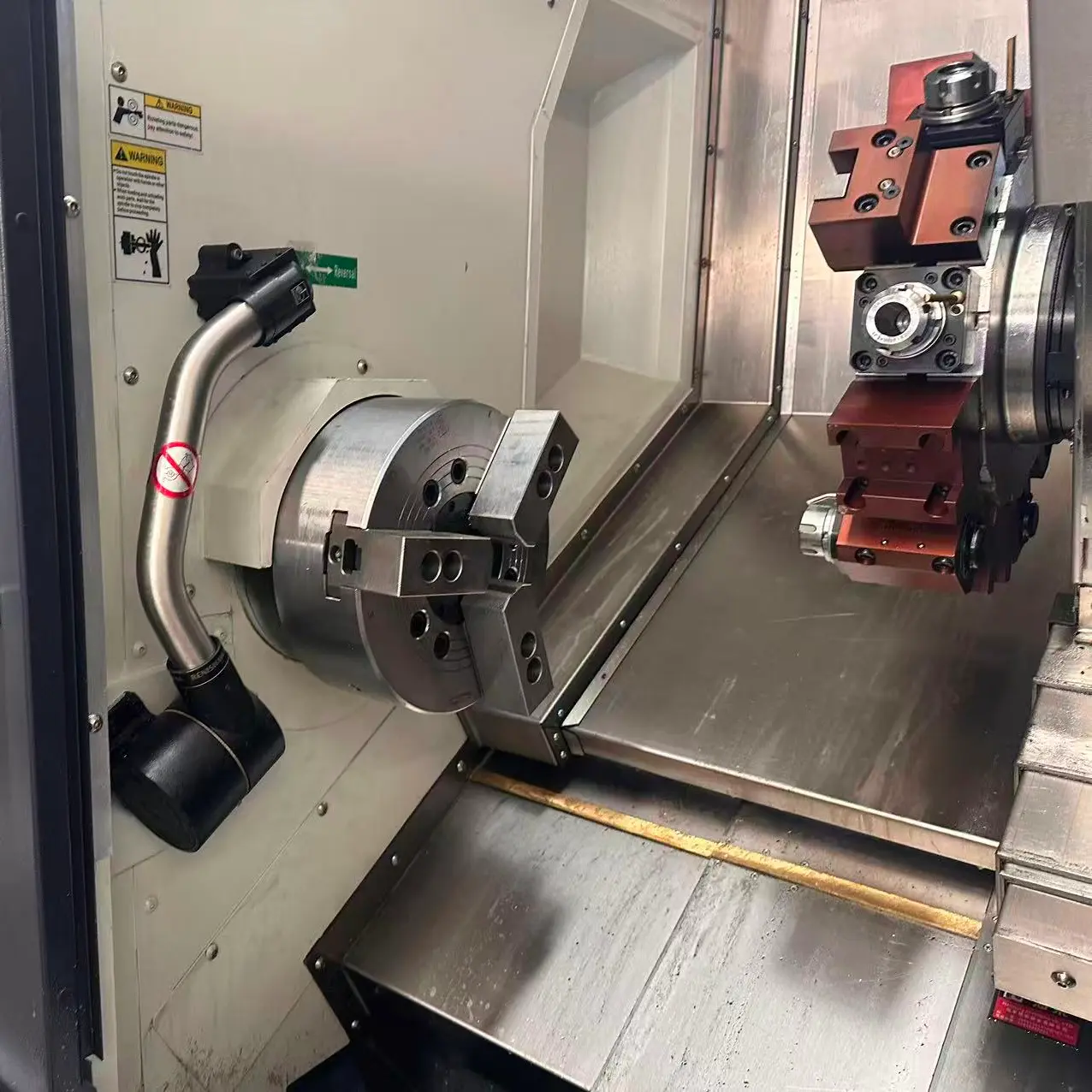
Precio de un torno CNC y qué factores lo determinan
| Clase | Rango de funcionamiento típico o potencia | Ejemplo de control o de origen | Precio indicativo FOB en USD |
|---|---|---|---|
| Torno CNC de bancada plana básico | 500 mm swing, 1000 mm between centers, 7.5 kW spindle | GSK 980TDb or KND K1Ti | 18,000–28,000 |
| Torno CNC de bancada plana de gama media | 660 mm swing, 1500–2000 mm between centers, 11 kW spindle | Siemens 828D or Mitsubishi M80 | 32,000–48,000 |
| Torno CNC de bancada inclinada con entrada frontal | 250 mm max turning diameter, 500 mm length, 5.5 kW spindle | GSK 980TC3 or Syntec 21TA | 22,000–35,000 |
| Torno CNC de gama media con bancada inclinada | 360 mm max turning diameter, 650 mm length, 11 kW spindle | FANUC 0i-TF Plus o Siemens 828D | 45,000–70,000 |
| Heavy slant bed / turning center | 500 mm max turning diameter, 1000 mm length, 15 kW spindle, 12-station turret | FANUC 0i-TF Plus o Mitsubishi M80 | 75,000–120,000 |
| Twin spindle / Y-axis mill-turn | 250 mm max turning diameter, 12 kW main + 8 kW sub, driven tooling | FANUC 31i-B o Siemens 840D sl | 140,000–220,000 |
What Drives the Ex-Works Price
A CNC lathe shipped from China at USD 35,000 FOB typically breaks down as follows. These ratios hold for mid-range slant bed machines; flat bed machines shift 3–5% toward the casting and away from the linear guide package.
| Elemento de coste | Porcentaje del FOB | Notas |
|---|---|---|
| Fundición / estructura | 12–18% | HT250 or HT300 resin sand casting; stress relieved. A 360 mm swing slant bed machine runs roughly 4,500–6,500 kg net weight. |
| Guías y husillos de bolas | 8–12% | HIWIN or PMI linear roller guides on slant beds; hardened box ways on heavy flat beds. C3 or C5 grade ground ball screws. |
| Conjunto del husillo | 10–15% | A2-5, A2-6 or A2-8 nose; ceramic bearings for 4,000+ rpm; 7.5–15 kW asynchronous or servo spindle motor. |
| Sistema de control y paquete de servomotores | 18–28% | FANUC, Siemens, Mitsubishi at the high end; GSK, KND, Syntec at mid and entry levels. |
| Tool turret / changer | 6–10% | 8-station electric turret entry; 12-station servo turret mid-range; BMT55 or VDI40 driven tooling adds 4–6%. |
| Assembly labour and testing | 5–8% | Scraping box ways, laser alignment, ball bar testing, 24–48 hour run-off. |
| Embalaje para exportación | 2–3% | Full crate, moisture barrier, silica gel, forklift pockets; adds 800–1,500 kg to shipping weight. |
| Transporte terrestre hasta el puerto | 1–2% | From Shandong or Jiangsu base to Shanghai/Qingdao port. |
The control system brand and the spindle servo package are normally the two single biggest line items. A FANUC 0i-TF Plus with αi series servos and spindle can add USD 12,000–18,000 over a GSK 980TC3 with comparable axis motors. The gap narrows on smaller machines but widens on multi-axis mill-turn centers where FANUC or Siemens integrated PLC and safety functions are harder to replicate.
Why the Cheapest Quote Costs Less
A quote 20–30% below the mid-range band almost always reflects one or more of these substitutions:
Lighter casting grade or section thickness. HT250 instead of HT300; ribbing reduced; machine weight drops 15–25%. Rigidity suffers on interrupted cuts and large-diameter face turning. Chatter marks appear at 0.3–0.5 mm depth of cut where a heavier frame would hold 0.8–1.0 mm.
Lower grade ball screws or unbranded linear guides. C7 rolled screws instead of C5 ground; unhardened rail surfaces. Positioning repeatability shifts from ±0.005 mm to ±0.015 mm. After 8,000 hours, backlash compensation exceeds the control’s available range.
Unbranded spindle motor or generic bearings. Thermal growth increases; bearing life drops from L10 20,000 hours to 6,000–8,000 hours. Replacement requires full spindle cartridge pull, 4–6 hours downtime.
Simplified turret. 6-station bolt-on instead of 8-station servo index; 1.2 second index time versus 0.4 second. On batch sizes above 50 pieces, cycle time penalty accumulates fast.
Five Year Running Cost Comparison
Assume two 360 mm swing slant bed machines, both cutting medium carbon steel hydraulic fittings in batches of 200–500 pieces. Annual running: 4,000 hours.
| Partida de gastos | Mid-Range Machine (FANUC, HT300, HIWIN, 11 kW) | Entry Machine (GSK, HT250, Generic, 7.5 kW) |
|---|---|---|
| Power consumption | 11 kW spindle + 6 kW auxiliaries = ~14 kW average; 56,000 kWh/year at USD 0.10/kWh = USD 22,400/year | 7.5 kW spindle + 5 kW auxiliaries = ~10 kW average; 40,000 kWh/year = USD 16,000/year |
| Insert and tooling | USD 3,800/year; stable tool life due to rigidity | USD 5,400/year; 40% higher insert breakage from chatter |
| Ball screw / guide replacement | None planned; periodic lubrication only | C7 screws at hour 12,000; USD 4,200 parts + 16 hours labour |
| Spindle bearing / motor | Inspection at hour 15,000; no replacement | Bearing replacement hour 8,000; USD 2,800 parts + 12 hours labour |
| Control-related downtime | Minimal; spare servo amplifier held in stock | Unplanned downtime: 40–60 hours/year on generic servo faults; USD 1,200/year service calls |
| Five year total (excl. labour rate) | USD 125,000 | USD 116,000–124,000 |
The entry machine saves USD 20,000–30,000 upfront but converges on total cost by year four or five. If labour rates exceed USD 25/hour or machine uptime carries penalty clauses, the mid-range machine wins earlier.
Destination Costs Beyond FOB
| Artículo | Rango típico | Notas |
|---|---|---|
| Sea freight (40′ HC, China to Hamburg/Jebel Ali/Santos) | USD 3,500–7,500 | One machine per container for slant beds under 6,500 kg; flat beds over 8,000 kg may need flat rack. |
| Marine insurance | 0.15–0.25% of CIF value | |
| Duty and VAT | 0–15% duty + VAT per destination | CE-compliant machines enter EU at 0% duty under HS 8458.11; most ASEAN at 0–5%. |
| Customs clearance, THC, inland delivery | USD 800–2,500 | |
| Transformer (220V 60Hz markets) | USD 1,200–3,500 | Step-up to 380V 50Hz or motor rewinding; specify before order. |
| Foundation and levelling | USD 500–2,000 | Vibration-damping pad or epoxy-grout base; 150 mm reinforced concrete minimum. |
| Unloading crane / forklift | 10-tonne capacity | Machine packed weight with crate: add 1,000–1,500 kg to net. |
| Installation and training | USD 1,500–4,500 | 3–5 days; includes geometric alignment, ball bar test, basic G-code and maintenance instruction. |
Selection Checklist by Part Requirement
Use this to convert your actual work into specifications before comparing quotes.
| Your Part Requirement | Specification to Demand | Why It Matters |
|---|---|---|
| Material: cast iron, stainless, Inconel | Spindle power and torque curve; A2-6 or A2-8 nose for larger chucks | Inconel needs 15 kW continuous at low rpm; cast iron runs fine at 7.5 kW. |
| Max diameter × length | Swing over bed and between centers; or max turning diameter on slant bed | Add 20% clearance for chuck jaws and tool overhang. |
| Tolerance IT7–IT8 or tighter | C3 ball screws, linear roller guides, thermal compensation, FANUC/Siemens control | Box ways with GSK can hold IT9 reliably; tighter needs linear guides and control compensation. |
| Batch size: 5 pieces or 5,000 | Turret station count, bar feeder interface, program memory | Small batches need quick setup; large batches need 12-station turret and parts catcher. |
| Shop power: 380V 50Hz or 220V 60Hz | Motor winding, transformer inclusion, control voltage compatibility | Specify at order; retrofit transformers add cost and floor space. |
Shortlist Verification
Before final purchase, confirm each machine on your shortlist against:
- Net weight and casting grade — within 10% of comparable models from known makers; HT300 for 360 mm+ swing.
- Control and servo brand — exactly as quoted, not “FANUC compatible” or “Siemens protocol.”
- Ball screw grade and guide brand — C5 ground, HIWIN/PMI or equivalent; C7 acceptable only for roughing operations.
- Spindle taper and nose — A2-6 for 250 mm chuck, A2-8 for 315 mm and above; BT40 or BT50 if mill-turn capability specified.
- Rapid traverse and positioning — X/Z rapids above 20 m/min on slant beds; positioning accuracy ≤ ±0.008 mm, repeatability ≤ ±0.003 mm.
- Documentación — CE machinery directive compliance, electrical schematic in English, spare parts manual with exploded views, lubrication chart.
Price is a range, not a quotation. Final FOB depends on currency, steel prices, and control system availability at order date.
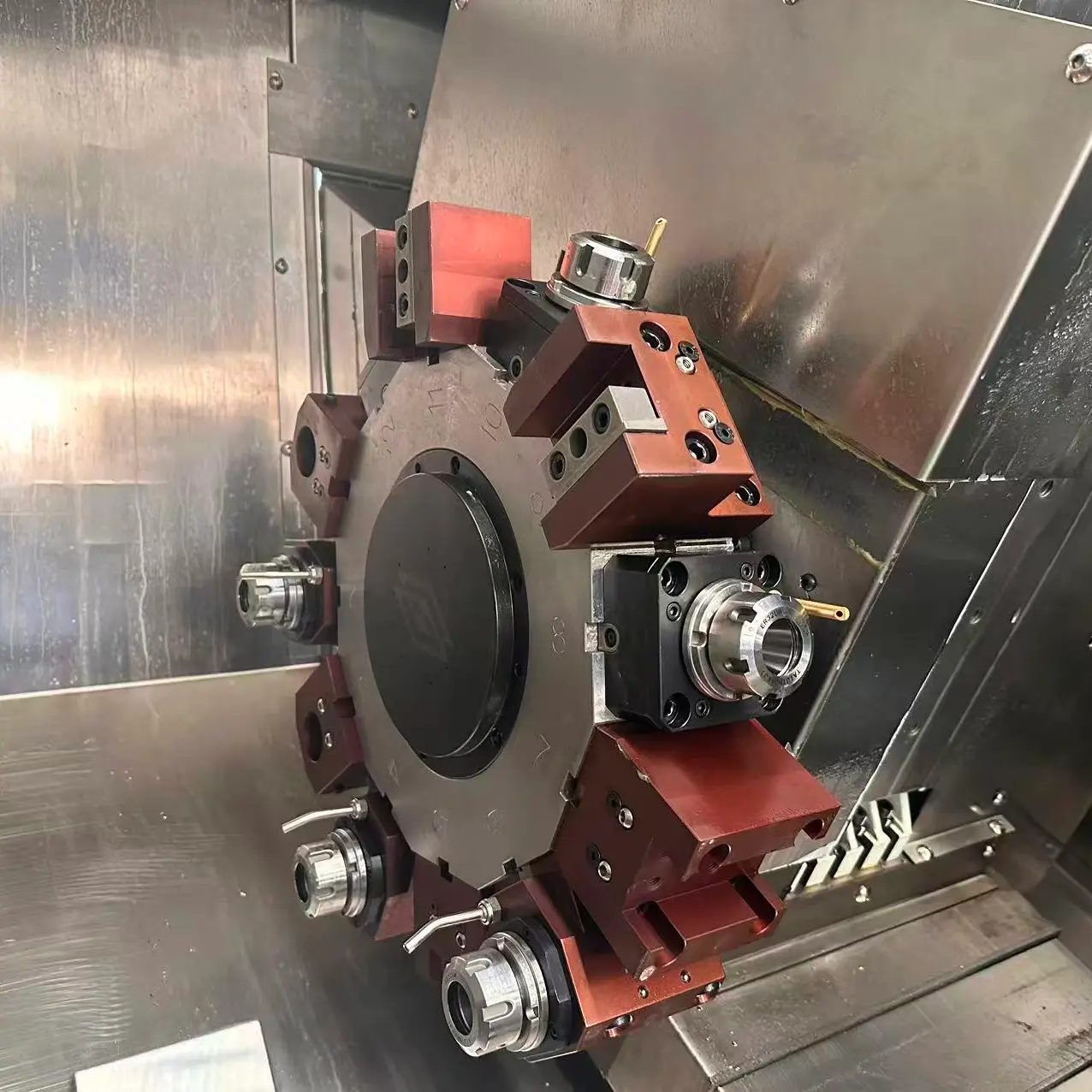
Aplicaciones industriales del torno CNC
| Sector | Piezas típicas fabricadas | Especificaciones recomendadas | Por qué esta máquina es la más adecuada |
|---|---|---|---|
| Recambios para automóviles y motocicletas | Brake discs, camshafts, wheel hubs, drive shafts, piston pins | Flat bed CNC lathe, 500 mm max turning diameter, 1500 mm max turning length, A2-8 spindle nose, 45 kW spindle motor, 2000 rpm, 0.008 mm positioning accuracy, FANUC 0i-TF or Siemens 828D | High torque at low rpm for cast iron and forged steel; A2-8 accommodates large chucks for brake discs; flat bed handles long shafts with steady rest support |
| Maquinaria agrícola | Gear blanks, axle housings, hydraulic cylinder rods, bearing seats, pulley hubs | Flat bed CNC lathe, 630 mm swing over bed, 3000 mm between centers, A2-11 spindle, 55 kW spindle, 800 rpm, hardened box ways, HT300 casting, GSK 980TDi or KND K1000Ti | HT300 casting and box ways absorb intermittent cuts on sand castings; long bed with 3000 mm capacity matches axle and cylinder rod lengths; lower rpm suits large-diameter roughing |
| Accesorios hidráulicos y neumáticos | Cylinder barrels, piston rods, valve bodies, hose couplings, thread adapters | Slant bed CNC lathe, 400 mm max turning diameter, 650 mm turning length, A2-6 spindle, 15 kW spindle, 4000 rpm, 0.005 mm repeatability, linear roller guides, FANUC 0i-TF | Slant bed geometry delivers chip evacuation straight into conveyor; 4000 rpm and linear guides enable finish threading to ISO 7/1 tolerance; compact footprint suits high-volume cell layouts |
| Acoplamientos para petróleo y gas | Drill pipe couplings, casing connectors, subsea valve bodies, flanged adapters | Flat bed CNC lathe, 800 mm swing, 2000 mm length, A2-15 spindle, 75 kW spindle, 600 rpm, 0.01 mm positioning, Siemens 828D, 12,000 kg machine weight | Massive casting and low-speed torque for API thread forms on thick-wall alloy steel; A2-15 handles 380 mm chucks; Siemens control supports custom macro threading cycles |
| Fabricación de moldes y matrices | EDM electrode blanks, core pins, ejector sleeves, mould inserts, thread cores | Slant bed CNC lathe with C-axis and driven tools, 250 mm max turning diameter, 500 mm length, A2-5 spindle, 11 kW spindle, 6000 rpm, 0.003 mm repeatability, Syntec 22MA or Mitsubishi M80 | C-axis and live tooling combine turning and light milling in one setup; 0.003 mm repeatability matches EDM electrode tolerances; 6000 rpm enables small-diameter finishing with carbide inserts |
| Centros de formación técnica | Student practice pieces, stepped shafts, threaded samples, taper exercises, test coupons | Flat bed CNC lathe, 360 mm swing, 750 mm length, A2-6 spindle, 7.5 kW spindle, 2500 rpm, GSK 980TDi or KND K1000Ti, 2800 kg weight, 220V/380V dual voltage | Simpler control systems reduce learning curve; forgiving cast-iron construction tolerates crashes; dual voltage avoids transformer costs in regions with mixed supply; price range $18,000–$28,000 FOB |
Recambios para automóviles y motocicletas
Automotive work demands volume and repeatability. A flat bed CNC lathe with 500 mm swing and 1500 mm bed handles brake discs up to 400 mm diameter and camshafts up to 900 mm long. The A2-8 spindle nose accepts 315 mm chucks with direct-mount adapters. Spindle power of 45 kW at 2000 rpm generates 860 Nm torque—sufficient for continuous roughing of nodular cast iron brake discs at 3 mm depth of cut. Positioning accuracy of 0.008 mm keeps disc run-out within 0.02 mm after finish turning. FANUC 0i-TF controls dominate this sector for their canned cycles and widespread technician familiarity. The trade-off: flat bed machines occupy 4.2 m × 1.8 m floor space and weigh 4,500 kg, requiring 5-tonne forklift or overhead crane for installation.
Maquinaria agrícola
Agricultural components arrive as sand castings or forgings with uneven stock allowance. A 630 mm swing flat bed with HT300 casting and hardened box ways withstands interrupted cuts without chatter. The 3000 mm between-centers option accepts hydraulic cylinder rods with center support; without steady rest, 80 mm diameter rod deflects 0.15 mm at 2500 mm length. Box ways, though slower at 6 m/min rapid traverse than linear guides, carry 12-tonne load between ways and resist abrasion from sand inclusions. GSK 980TDi or KND K1000Ti controls cut acquisition cost by 40% versus FANUC; the trade-off is slower parts program transfer via USB rather than Ethernet in older generations. Machine weight reaches 8,200 kg; container loading requires flat-rack or breakbulk for units over 6.5 m bed length.
Accesorios hidráulicos y neumáticos
Slant bed geometry defines this sector. The 45° bed angle drops chips directly into a screw conveyor, preventing bird-nesting on high-volume brass and steel threading operations. A 400 mm swing slant bed with linear roller guides (HIWIN or PMI) achieves 24 m/min rapid traverse and 0.005 mm repeatability—critical for NPT and BSP thread forms held to ±0.025 mm pitch diameter. The A2-6 spindle at 15 kW and 4000 rpm matches carbide insert speeds on 12L14 free-machining steel. Typical cycle time for a 3/4″ hose coupling drops from 4.5 minutes on manual lathe to 1.2 minutes with bar feeder integration. Floor space is compact: 2.6 m × 1.5 m for a 65° slant bed. The limitation: slant beds under 500 mm swing rarely accommodate large chuck jaws for irregular castings.
Acoplamientos para petróleo y gas
API 5CT and 5B specifications govern thread forms on couplings and premium connections. These parts require heavy stock removal on alloy steel (AISI 4140H, 110 ksi yield) with deep bores. An 800 mm swing flat bed with 75 kW spindle at 600 rpm delivers 2,400 Nm torque—enough for 6 mm depth of cut on 200 mm diameter pipe. The A2-15 spindle nose with 380 mm four-jaw chuck grips upset forgings with 50 mm wall thickness. Siemens 828D controls store custom macro cycles for proprietary thread profiles (VAM, NEW VAM, FOX). Machine weight of 12,000 kg and 5.8 m × 2.1 m footprint demand poured concrete foundation with 200 mm thickness and M24 anchor bolts at 500 mm centers. Supply voltage is 380V 50Hz; 460V 60Hz regions need step-down transformer or motor re-rating consultation.
Fabricación de moldes y matrices
Precision mould components often combine turned diameters with milled flats, hexagons, or cross-holes. A slant bed CNC lathe with C-axis indexing and driven tools (BMT55 or VDI40 turret) eliminates second-setup milling. Specifications: 250 mm swing, 500 mm length, A2-5 spindle with 11 kW and 6000 rpm, 0.003 mm repeatability. The C-axis resolution of 0.001° enables engraving and light helical milling; live tooling at 4 kW and 6000 rpm handles M3-M8 cross-tapping in ejector sleeves. Syntec 22MA or Mitsubishi M80 controls offer simultaneous turning-milling interpolation at lower cost than full mill-turn configurations. The constraint: driven tool turrets add $8,000–$15,000 to base machine price and increase maintenance on tool drive belts and couplings.
Centros de formación técnica
Training environments prioritize durability, simplicity, and voltage flexibility over metal removal rate. A 360 mm swing flat bed at 2800 kg machine weight ships in standard 20-foot container without disassembly. GSK 980TDi or KND K1000Ti controls use ISO G-code with Chinese/English interface; FANUC compatibility mode allows program portability to industrial machines later. Dual voltage motors (220V/380V, 50/60Hz) accommodate Southeast Asian and Latin American supply variations without external transformer. The 7.5 kW spindle at 2500 rpm handles all standard training materials: aluminum 6061, mild steel, brass, and cast iron. Positioning accuracy of 0.012 mm is acceptable for learning; the machine’s real value is crash tolerance from HT250 casting and simple mechanical spindle brake. Price range $18,000–$28,000 FOB Tianjin leaves budget for tooling packages and curriculum development.
Cómo realizar un pedido e importar, paso a paso
The three mistakes that leave a CNC lathe idle after delivery are easy to prevent. Voltage or frequency mismatch—fix by confirming your shop supply (380V 50Hz three-phase, 220V 60Hz, or other) and ordering the matching transformer with the machine. Working range too small for actual parts—fix by measuring your largest existing part’s swing over bed, length between centers, and chuck diameter, then adding 20% margin before selecting model. No hay esquema eléctrico, copia de seguridad de los parámetros ni fuente local de consumibles—fix by requiring printed schematics, a USB backup of all parameters, and a written list of local suppliers for inserts, coolant, and proximity switches before signing the acceptance certificate.
Define Workpiece Envelope and Tolerance First
Start with the part, not the machine. Measure your largest and smallest batch workpieces.
| Dimension to Measure | What to Record | Typical CNC Lathe Range |
|---|---|---|
| Maximum swing over bed | Diameter of largest round part | 360 mm to 800 mm |
| Maximum turning length | Longest shaft between chuck and tailstock | 500 mm to 3000 mm |
| Bar capacity through spindle | For bar-fed work | 42 mm to 105 mm |
| Chuck size required | Three-jaw hydraulic or manual | 6 inch to 12 inch (152 mm to 304 mm) |
| Typical tolerance held | IT grade or micron | ±0.01 mm (IT7) standard; ±0.005 mm (IT6) with linear guides and thermal compensation |
Batch size drives configuration. Under 50 pieces: manual chuck, quick-change tool post, basic 2-axis control. 200–2,000 pieces: 8-inch hydraulic chuck, turret with 12 stations, parts catcher, bar feeder interface. Over 5,000 pieces: consider adding Y-axis for off-center milling, sub-spindle for backworking, or moving to a twin-spindle twin-turret design.
Material matters for spindle power and speed. Aluminum and free-machining steel: 5.5 kW to 7.5 kW base, 4,000 rpm to 6,000 rpm. Stainless 316L, Inconel, or hardened alloy steels: 11 kW to 15 kW, torque-rated at low speed (500 rpm–1,500 rpm), with A2-6 or A2-8 spindle nose for rigidity.
Choose Control System and Service Path
The control system determines who can repair it, how fast parts arrive, and what your operators already know.
| Control | Common In | Service Reality | Best Fit |
|---|---|---|---|
| FANUC 0i-TF | Global distribution | Dealer network in most countries; 24-hour parts in major cities | Shops with existing FANUC machines, trained staff |
| Siemens 828D | Europe, India, Middle East | Strong in Germany/Eastern Europe; weaker in Southeast Asia | Shops running Siemens milling centers; academic programs |
| Mitsubishi M80 | Southeast Asia, Japan | Good in Thailand, Indonesia, Malaysia; limited elsewhere | Existing Mitsubishi user base |
| GSK 980 TDi | China domestic, Africa, South America | Factory-direct support; local agents in belt-and-road markets | Tight budget, willing to train operators in-house |
| KND K2000TF | China, emerging markets | Growing agent network; lower parts cost | Job shops with simple turning, no sub-spindle |
| Syntec 22TA | Taiwan-origin machines | Strong in Southeast Asia, moderate elsewhere | Mixed shops with Syntec mills already |
Ask before ordering: Who is the authorized service agent within 500 km of your shop? What is their typical response time? Do they stock servo motors, spindle drives, and the specific PLC battery for your control generation? A FANUC machine with no local support is riskier than a GSK machine with a technician in your city.
Verificar las necesidades de suministro eléctrico y de transformadores
Record your actual incoming supply, not what the building was designed for.
| Parámetro | Standard Chinese Export | North America | Latin America / Southeast Asia |
|---|---|---|---|
| Tensión | 380 V ±101 TP3T | 208V, 240V, or 480V | 220V or 380V, varies by country |
| Frequency | 50 Hz | 60 Hz | 50 Hz or 60 Hz |
| Phase | Three-phase | Three-phase | Often three-phase, rural areas single-phase |
Motor derating at wrong frequency: A 50 Hz spindle motor run on 60 Hz spins 20% faster but loses torque below base speed. A 60 Hz motor on 50 Hz overheats. Variable frequency drive (VFD) spindles tolerate this; direct-coupled induction motors do not.
Transformer sizing: Machine nameplate kW × 1.25 for transformer kVA rating. A 15 kW lathe needs minimum 18.75 kVA isolation transformer. Specify step-up or step-down, primary and secondary voltages, and whether you need delta-wye conversion for phase matching. Order the transformer from the machine supplier or a local electrical contractor—do not discover this when the container arrives.
Check Floor Loading Foundation and Space
| Tamaño de la máquina | Peso neto | Floor Loading | Minimum Floor Space (including chip conveyor and operator access) |
|---|---|---|---|
| Small CNC lathe, 360 mm swing | 2,500 kg | 5 t/m² | 3.5 m × 2.5 m |
| Mid-size, 500 mm swing, 1,000 mm bed | 4,500 kg | 8 t/m² | 4.5 m × 3.0 m |
| Heavy duty, 800 mm swing, 3,000 mm bed | 12 000 kg | 15 t/m² | 8.0 m × 4.0 m |
Foundation rules: Machines under 5,000 kg run on industrial concrete 150 mm thick with M20 grade. Machines over 8,000 kg need isolated foundation pad or vibration-damping pads, especially if near milling centers or presses. Check ceiling height for crane hook path—minimum 500 mm above machine height for sling clearance.
Confirmar el marcado de conformidad para la aduana
Determine what your customs authority requires before the machine ships.
- CE marking: Required for import into European Union, Turkey, and countries with EU alignment agreements. Supplier must provide Declaration of Conformity, technical file reference, and affix CE plate to electrical cabinet.
- EAC: Required for Russia, Kazakhstan, Belarus, Armenia, Kyrgyzstan. Separate certification process; cannot be added after shipment.
- SONCAP: Required for Nigeria; pre-shipment verification.
- No marking: Possible for some Southeast Asian and African markets, but verify with your customs broker.
Action: Send your supplier the exact marking requirement and country standard number. Do not assume “CE available” means “CE already done and documented.”
Comparación entre FOB y CIF
| Término | What You Pay Supplier | What You Arrange | Risk Transfer Point |
|---|---|---|---|
| FOB (Libre a bordo) | Machine price + inland transport to port + export clearance | Ocean freight, insurance, destination port fees, unloading, customs | When cargo crosses ship’s rail at origin port |
| CIF (coste, seguro y flete) | Machine price + freight + marine insurance to destination port | Destination unloading, customs clearance, inland delivery | Same as FOB—risk still transfers at origin port |
CIF does not cover port handling at destination. A 12,000 kg lathe in a 40-foot container generates terminal handling charges of $800–$2,500 depending on port. CIF quotes often use minimal insurance (110% of invoice value). Consider increasing to 130% for total loss coverage including freight and duties paid.
Practical choice: First-time importers often prefer CIF for price predictability. Experienced buyers with freight forwarder relationships usually take FOB for control and potential savings.
Tipo de contenedor y límites de peso de la máquina
| Peso de la máquina | Contenedor | Método de carga | Considerations |
|---|---|---|---|
| Under 3,500 kg | 20-foot GP | Forklift or crane into container | Secure with chains and timber blocks; watch axle weight distribution |
| 3,500 kg–8,000 kg | 40-foot GP or 40-foot HC | Crane with spreader bar | Machine often sits on steel shipping base; remove coolant tank if separate |
| Over 8,000 kg | Carga en contenedores planos o carga general | Port crane direct to vessel | Higher freight cost; weather protection with tarp and shrink wrap |
Weight limit awareness: 20-foot GP maximum payload is approximately 21,500 kg including tare, but road weight limits in origin and destination countries often restrict actual cargo to 18,000 kg. A 12,000 kg machine plus 2,000 kg base and packaging may need special trucking permits.
Payment Terms Factory Acceptance Test
Standard structure: 30% deposit to confirm production, 70% balance against documents or before shipment.
Better protection: 30% deposit, 60% after factory acceptance test (FAT) with your parts or representative sample, 10% after successful installation and first article inspection at your shop.
FAT minimum requirements:
– Run your actual part material and program, or equivalent test piece with turning, facing, threading, and grooving operations.
– Verify positioning accuracy with laser interferometer or ballbar: positioning ±0.02 mm/300 mm, repeatability ±0.008 mm for linear guide machines; ±0.03 mm/300 mm, repeatability ±0.012 mm for box way machines.
– Confirm all optional accessories function: hydraulic chuck, tailstock, parts catcher, chip conveyor.
– Receive USB backup of all parameters, PLC ladder diagram in editable format, and printed electrical schematic with wire numbers matching cabinet labels.
Equipos de descarga en el lugar de destino
| Peso de la máquina | Equipamiento mínimo | Alternativa |
|---|---|---|
| Under 2,500 kg | Forklift, 3-ton capacity | Manual hydraulic jack and machine skate |
| 2,500 kg–6,000 kg | Forklift, 5-ton capacity, extended forks | Gantry crane or overhead crane with 8-ton rating |
| Over 6,000 kg | Overhead crane or mobile crane, rated at 1.5× machine weight | Disassemble into sub-assemblies at container side (requires technician) |
Crane hook height: Measure from floor to underside of building beam or crane rail. Subtract sling length (typically 1.5 m–2.0 m for balanced lift) and machine height on base. Result must be positive.
Instalación y formación de los operadores
Installation sequence: Level machine with precision level (0.02 mm/m) on longitudinal and transverse bed ways. Anchor with vibration-damping pads or foundation bolts per supplier drawing. Connect power through transformer. Fill coolant tank with recommended concentration. Run spindle warm-up cycle (typically 30 minutes ramping through speed range).
Training split:
– Mechanical maintenance: 2 days—lubrication schedules, chuck pressure settings, tailstock alignment, chip conveyor cleaning.
– Control operation: 3 days—program entry, tool offset measurement, work coordinate setting, MDI operations, alarm diagnosis.
– Programming: 2 days if operators lack CAM or G-code experience.
Verify: Training is included in quoted price or specified as additional cost. Request training agenda in writing before shipment.
Paquete inicial de piezas de recambio y consumibles
Order with machine, not after breakdown.
| Categoría | Artículos | Typical Quantity |
|---|---|---|
| Eléctrico | Proximity switches, relay coils, control fuses, servo motor encoder battery | 2 each of each type installed |
| Hydraulic | Chuck pressure gauge, seal kit for chuck cylinder, hydraulic filter element | 1 seal kit, 2 filters |
| Mechanical | Chuck jaws for your part diameter range, tailstock center, tool holder bolts | 1 set soft jaws, 1 live center |
| Consumibles | Inserts (CNMG, DNMG, WNMG geometries for your materials), cutting oil concentrate | 50 inserts, 20 liters concentrate |
Documentation required: Complete bill of materials with manufacturer part numbers, not just supplier internal codes. Cross-reference to Fanuc, Siemens, or third-party component numbers where applicable.
Shortlist Checklist Before Signing Order
- Part swing over bed recorded with 20% margin: ______ mm
- Maximum turning length required: ______ mm
- Control system chosen and service agent confirmed within 500 km: ______
- Shop voltage/frequency/phase: __ V / _ Hz / phase; transformer required: yes/no, ___ kVA
- Floor loading capacity verified: __ t/m²; foundation type: ____
- Floor space available: __ m × _ m; ceiling height: ___ m
- Conformity marking required at customs: ______
- Shipping term chosen: FOB/CIF; container type: ______
- Payment terms: __ % deposit, _ % after FAT, ___ % after installation
- FAT criteria agreed in writing: yes/no
- Unloading equipment confirmed: __ ton capacity, type ____
- Training days included: ______; agenda received: yes/no
- Spare parts package quoted and approved: yes/no
Price guidance only: Small 2-axis CNC lathe with GSK control, 8-inch chuck, 500 mm swing: $25,000–$38,000 FOB China. Mid-size with FANUC 0i-TF, 10-inch chuck, linear guides, hydraulic turret: $45,000–$75,000. Heavy-duty 800 mm swing, A2-8 spindle, 15 kW, with sub-spindle and Y-axis: $90,000–$150,000+. Price variance reflects control brand, guide type, and local support infrastructure more than casting weight alone.
Máquinas RUNNEWTECH relacionadas

Preguntas frecuentes sobre los tornos CNC
Q: What is the minimum order quantity for a CNC lathe?
One unit is standard for lathes up to 1000 mm swing. For machines with swing over 1500 mm or custom spindle bore, MOQ is typically two units to optimize casting batch costs. Container loading efficiency matters: a 40 ft HC fits two slant-bed CNC lathes in the 500 mm swing class, or one large flat-bed machine with disassembled tailstock.
Q: Which control systems are available and what languages does the interface support?
FANUC 0i-TF Plus, Siemens 828D, Mitsubishi M80, GSK 980TDi, KND 2000Ti, and Syntec 21TA are stocked. FANUC and Siemens carry 15-25 % price premiums over GSK or KND. All HMI screens support English; Syntec and GSK add Spanish, Russian, and Turkish. FANUC and Siemens require separate language licenses for Korean or Arabic.
P: ¿Cuál es el plazo de entrega habitual desde que se realiza el pedido hasta que se envía?
Standard configurations ship in 25-35 days. FANUC or Siemens controls extend this to 45-55 days due to import lead time. Custom spindle bore, A2-8 chuck mount, or 600 mm swing machines need 60-75 days. Peak season (March-May, September-November) adds 10-15 days to all timelines.
P: ¿Cuáles son las condiciones de pago habituales para los pedidos de exportación?
30 % TT deposit, 70 % TT before shipment is standard for orders under $50,000. Letters of credit accepted above $80,000 with buyer bearing bank charges. Machinery dealers with two years’ trading history may negotiate 20 % deposit, 80 % against copy of BL. No OA terms on first orders.
Q: Can you adapt supply voltage and frequency to our local standard?
380V 50Hz is standard. 220V 60Hz (North America, parts of Southeast Asia) requires a step-up transformer or motor rewinding, adding $800-2,500 depending on spindle power. Machines over 15 kW spindle power need factory-rewound motors; transformer-only solutions overheat above 11 kW continuous duty. Specify voltage at order stage; field conversion voids warranty.
P: ¿Qué método de envío, tipo de contenedor y tiempo de tránsito se aplican?
40 ft HC containers for lathes under 6,000 kg net weight. Flat-bed CNC lathes over 8,000 kg or 4,000 mm bed length ship break-bulk or flat-rack. Sea freight to Jebel Ali: 18-22 days; Lagos: 35-42 days; Santos: 28-32 days; Mombasa: 21-25 days. CIF terms include marine insurance; FOB Qingdao saves 3-5 % for buyers with freight forwarders.
Q: What warranty coverage and spare parts support do you provide?
12 months warranty on mechanical and electrical components from BL date. Control system warranty follows FANUC (24 months), Siemens (18 months), or domestic brands (12 months). Spare parts kit included: belt, fuse set, proximity switches, coolant pump seal. Post-warranty, GSK and KND parts ship within 72 hours; FANUC/Siemens parts sourced through regional service centers with 5-10 day lead time.
Q: Is a factory acceptance test and accuracy report provided before shipment?
Yes. Every machine undergoes ball-bar test and laser interferometer verification. Standard report includes: positioning accuracy ±0.008 mm, repeatability ±0.003 mm, spindle runout test, and actual cutting test on carbon steel bar. FANUC or Siemens controlled machines include control-builder test certificate. Buyer may witness FAT via video or appoint third-party inspector at their cost.
P: ¿Qué servicios de instalación y formación para el personal se incluyen?
Installation and commissioning included for single-machine orders within major port cities; buyer provides crane or forklift rated at 1.5x machine weight. Two-day operator training covers program entry, tool offset, and basic maintenance. Advanced macro programming or live tooling setup requires separate quotation at $350-500/day plus technician travel. Training manuals in English or Russian provided.
Q: What tolerance can your CNC lathe hold on our specific material?
On 45# carbon steel or 304 stainless, standard machines achieve IT6-IT7 with surface finish Ra 1.6-3.2 μm. Harder materials above 45 HRC require ceramic or CBN inserts and reduce feed rates 30-40 %. Repeatability ±0.003 mm under controlled conditions; thermal drift after 4-hour continuous run may add 0.010-0.015 mm on 500 mm length parts. Cast iron (HT250) machines more stably than aluminum due to lower thermal expansion.
Q: What are the annual consumables costs for typical use?
Tool inserts: $1,200-2,800/year for mixed production. Coolant concentrate: $400-600/year at 5 % mix ratio. Chuck jaws: hardened sets last 2-3 years; soft jaws for prototyping need replacement every 6-8 months ($180-350/set). Spindle belt: 18-24 months at two-shift operation. Linear guide lubrication: automatic systems use 2-3 liters/year of ISO VG68 oil.
P: ¿Pueden facilitar la documentación CE necesaria para el despacho de aduana?
CE conformity declaration and technical file provided for all machines with enclosed guarding and interlocked chuck doors. Machinery Directive 2006/42/EC compliance covers electrical safety (EN 60204-1) and machine safety (EN ISO 12100). EMC testing certificates from notified body available for orders above $40,000. CE plate affixed to electrical cabinet door. Non-EU destinations using CE for import facilitation receive same documentation package.
Aviso importante
Las especificaciones, los datos de precisión y los rangos de precios que figuran en esta guía son orientativos y se facilitan con fines de planificación.
solo a efectos informativos. Rango de funcionamiento real, tolerancia alcanzable, disponibilidad del sistema de control, requisitos de tensión de alimentación y conformidad
El etiquetado varía según el modelo y el país de destino. Los compradores deben comprobar por sí mismos la tensión y la frecuencia de la red eléctrica, la carga admisible del suelo y
los cimientos, el equipo de descarga y los requisitos de importación antes de realizar un pedido. Todas las cifras están sujetas a confirmación por escrito en
la última factura proforma emitida por RUNNEWTECH.
Adquisición de un torno CNC de RUNNEWTECH
Why RUNNEWTECH Fits the Selection Framework
Runlongjia Machinery, operating internationally as RUNNEWTECH (runnewtech.com), has manufactured and exported metalworking machinery since 2010. The 15-year track record matters for buyers who need a supplier that understands voltage adaptation, container loading limits, and the documentation required in multiple regulatory environments.
The CNC lathe range covers both flat bed and slant bed architectures. Flat bed machines suit heavy, irregular workpieces and shaft work with swing diameters from 500 mm to 800 mm and center distances from 750 mm to 3000 mm. Slant bed machines with 30° or 45° castings favor automated production and chip evacuation, typically with max turning diameters of 360 mm to 520 mm and standard bar capacities of 42 mm to 65 mm through spindle. Control options include FANUC 0i-TF, Siemens 828D, Mitsubishi M80, GSK 980TDi, KND 2000Ti, and Syntec 22TA—selected to match operator familiarity and spare parts availability in the destination country.
Every machine is run-in for a minimum period and factory acceptance tested before packing. Voltage and frequency are adapted to specification—380V 50Hz, 220V 60Hz, or stepped through a transformer—then packed in plywood cases with VCI rust protection. Quotes are issued FOB or CIF. After delivery, RUNNEWTECH provides installation guidance, operator training material, remote commissioning support, and spare parts for the control, spindle, turret, and lubrication systems.
Send your workpiece material, maximum part size, required tolerance, and destination port to receive a quotation within 24 hours via email or the website contact form.
Solicita un presupuesto directo de fábrica para un torno CNC
RUNNEWTECH se dedica a la fabricación de maquinaria para el trabajo del metal desde 2010,
con más de 15 años de experiencia en exportación. Las máquinas se suministran con el sistema de control que usted elija, adaptado a su red eléctrica
tensión y frecuencia; se somete a pruebas de rodaje y de aceptación en fábrica antes de su embalaje. Envíenos el material de su pieza de trabajo, el tamaño máximo de la pieza,
Indíquenos la tolerancia requerida y el puerto de destino, y le enviaremos un presupuesto en un plazo de 24 horas.

 English
  Indonesian
  Vietnamese
  Arabic
  Russian
  Spanish