
Fiber CNC Laser Cutting Machine Buyer Guide
A real China fiber laser cutting machine factory builds the frame from cast iron or welded steel plate in-house or under direct foundry partnership, assembles the gantry on a granite surface table, and delivers geometric accuracy verified by laser interferometer and ball bar records—not a trading office that forwards your deposit to three subcontractors. The difference shows up in the machine’s ability to hold ±0.03 mm positioning accuracy and ±0.02 mm repeatability after 10,000 hours of cutting 6 mm mild steel at 6 kW.
Qué trata esta página
This section walks through the specific checks that separate a qualified builder from a broker: physical production assets, metrology documentation, factory acceptance test protocols, payment structures that align risk, and after-sales engineering capability that keeps your 4020 table cutting within tolerance. You will learn which factory records to request before placing a deposit, how to read a geometric accuracy report, and why a 30% TT advance with 70% against copy of B/L carries different risk than 100% LC at sight. The focus stays on supplier qualification—not laser source selection, not cutting parameter optimization, not freight logistics. Those topics are covered in adjacent sections of this buyer guide.
Price Drivers by Machine Class
FOB China pricing for fiber laser cutting machines from qualified factories clusters as follows: entry-level 1.5 kW Raycus-powered 3015 machines with GSK or Syntec control and HIWIN linear guides run $28,000–$38,000; mid-range 3 kW to 6 kW machines with MAX or IPG source, Raytools cutting head, and Siemens 840D or FANUC 0i-F control on a 4020 table land at $55,000–$95,000; heavy-duty 12 kW to 20 kW machines with Precitec ProCutter, Beckhoff or FANUC control, and 6020 or larger tables with pallet changers range $140,000–$280,000. The spread within each band comes from casting grade (HT250 versus QT500-7 for stress-relieved weldments), gantry weight (a 5000 kg frame versus 8000 kg), and whether the factory owns and operates a CNC floor-type boring mill for rail mounting surfaces versus outsourcing that machining.
Foundry and Casting Verification
Ask for the foundry name and location. A factory that pours its own beds or sources from a captive foundry within 50 km can show you molten iron or resin sand casting records; a trading office will deflect or provide a generic supplier name with no direct relationship. HT250 gray cast iron beds for 3015 machines weigh 4,500–6,500 kg; 4020 machines use HT300 or Meehanite-equivalent castings at 8,000–12,000 kg. Stress relief cycle time matters: 48 hours minimum in a tempering furnace, not ambient cooling. Request the heat treatment log with furnace number and date.
Assembly Floor and Scraping Evidence
Qualified factories maintain a temperature-controlled assembly area (20±2°C) with granite surface tables for scraping gantry ways to 0.02 mm/1000 mm straightness. Ask for dated photos or video of the scraping process, not stock images. The rail mounting surfaces for HIWIN or PMI linear guides must be hand-scraped or precision-ground after machining; skipping this step saves 3–4 days but costs 0.05–0.10 mm in accumulated geometric error over the first year of thermal cycling. A factory with nothing to hide will schedule a live video call showing the current build stage.
Metrology Records You Should Request
Demand three documents before deposit: (1) laser interferometer report for X/Y positioning accuracy and repeatability, run per ISO 230-2 or VDI/DGQ 3441, showing actual measured values not just “pass/fail”; (2) ball bar circular interpolation test at 150 mm radius, with roundness and reversal error in mm; (3) geometric accuracy report covering straightness of X and Y axis motion, squareness of axes, and parallelism of cutting head motion to table surface. These tests require equipment costing $80,000–$150,000; their absence indicates either a trading office or a builder cutting verification corners. Typical values from a qualified factory: positioning accuracy ±0.03 mm, repeatability ±0.02 mm, ball bar roundness 0.03 mm.
Estructura de las pruebas de aceptación en fábrica
A proper FAT runs 8–24 hours continuous cutting at rated power on material you specify—typically 6 mm mild steel and 3 mm stainless for a 6 kW machine, with part dimension sampling every 2 hours. The factory should measure cut perpendicularity (≤0.05 mm for 6 mm steel), kerf width consistency, and dross height on bottom edges. Request the raw measurement log, not a summary certificate. For machines above 6 kW, insist on overnight thermal stability testing: park the gantry, measure positioning drift after 4 hours idle, then resume cutting and verify accuracy recovery within 0.05 mm.
Payment Structure as Risk Signal
Trading offices often demand 30% deposit, 70% before shipment with no FAT participation option. Qualified factories accept 30% TT advance, 60% against FAT approval with your witness or third-party inspector, and 10% against copy of B/L. Letters of credit at sight are standard for first transactions above $100,000; anyone refusing LC in favor of 100% advance payment is either undercapitalized or not the actual builder. Escrow through Alibaba Trade Assurance provides limited protection but does not replace physical factory audit.
Capacidad de ingeniería de posventa
Verify the factory employs at least two full-time laser application engineers who speak English or your local language, with passport records showing actual overseas installation trips. Ask for the spare parts inventory value held in RMB: a serious builder maintains ¥800,000–¥2,000,000 in Raycus/IPG power module stock, cutting head consumables, and servo motor reserves. Request the nearest service partner name in your country; if the factory has none and offers only remote WeChat support, budget $8,000–$15,000 for a third-party laser technician to handle your first tube replacement or optical alignment.
Types and Configurations of Fiber CNC Laser Cutting Machine
| Tipo o clase | Rango de trabajo habitual | Opciones de control | Ideal para | Notas |
|---|---|---|---|---|
| Entry-Level Single-Table Open Bed | 1500 × 3000 mm | GSK, KND, Syntec | Small sheet metal shops, sign makers, first-time laser buyers | Raycus 1 kW–3 kW source; no shuttle table; manual loading only; positioning accuracy ±0.05 mm |
| Mid-Range Dual-Shuttle Pallet | 1500 × 3000 mm or 2000 × 4000 mm | Syntec, Mitsubishi, FANUC 0i-F | Job shops, automotive parts suppliers, agricultural equipment fabricators | Exchange pallet in 15–20 s; IPG or MAX 3 kW–6 kW; ±0.03 mm positioning; HT250 bed casting |
| High-Power Heavy-Gantry | 2000 × 4000 mm to 2000 × 6000 mm | FANUC 31i-B, Siemens 828D | Structural steel fabricators, shipyard subcontractors, heavy equipment OEMs | IPG 6 kW–12 kW; carbon steel to 25 mm; gantry weight 12 000 kg–18 000 kg; linear roller guides on HIWIN or PMI |
| Compact Precision Tube-and-Sheet | 1500 × 3000 mm plus rotary chuck Ø 20–220 mm | Syntec, Mitsubishi | Furniture makers, fitness equipment, exhaust system manufacturers | Cannot process I-beams or angles; tube intersection cuts only with optional 5-axis head; ±0.04 mm on rotary axis |
| Large-Format Multi-Pallet | 2500 × 6000 mm or 2000 × 8000 mm | FANUC 31i-B, Siemens 840D sl | Wind tower sections, construction machinery side frames, semi-trailer manufacturers | Requires 40 ft HC container or flat-rack; 15 kW–20 kW IPG; bed casting HT300; floor space 14 m × 4 m |
| 5-Axis 3D Cutting Cell | 3000 × 1500 × 800 mm (Z travel) | Siemens 840D sl, FANUC 31i-B5 | Aerospace subcontracting, die and mold shops, prototype EV battery tray producers | Precitec cutting head with capacitive height follow; ±0.05 mm on 3D contour; 3×–4× cost of 2D equivalent |
Entry-Level Single-Table Open Bed
This is the configuration most trading companies advertise at $9,800–$18,000 FOB Qingdao. The frame is typically welded steel plate rather than cast, with a 1.5 kW or 3 kW Raycus source and a Raytools BM110 head. Positioning accuracy runs ±0.05 mm and repeatability ±0.03 mm, which is adequate for signage, kitchenware and thin-gauge ducting. The buyer loses automatic pallet exchange, so production stops during load/unload. Control is usually GSK 983 or Syntec 60CA—functional but without the macro-B and high-speed look-ahead of FANUC. These machines suit shops with one or two operators and no night-shift unmanned running. What it cannot do: process reflective copper or brass reliably without a back-reflection isolator, and the open bed offers no fume containment for galvanized steel.
Mid-Range Dual-Shuttle Pallet
This class represents the bulk of RUNLONGJIA’s export volume. Working ranges are 3015 (1500 × 3000 mm) or 4020 (2000 × 4000 mm), with exchange pallets cycling in 15–20 s. Laser sources are IPG, MAX or nLIGHT from 3 kW to 6 kW; the 6 kW configuration cuts 6 mm stainless at 1.2–1.5 m/min and 12 mm carbon steel at 0.6–0.8 m/min. Controls are Syntec 22MA, Mitsubishi M80 or FANUC 0i-F. The bed is HT250 resin-sand casting, stress-relieved, weighing roughly 4 500 kg on a 3015 frame. HIWIN HG series linear guides and YYC rack-and-pinion drives with αi series FANUC servo motors are common. Positioning accuracy is ±0.03 mm, repeatability ±0.02 mm. Buyers are job shops serving automotive Tier-2 and agricultural implement manufacturers. What it cannot do: economically justify itself below 40 hours/week utilization, and the shuttle mechanism adds 800 kg–1 200 kg to machine weight, pushing a 4020 unit close to a 20 ft container limit of 21 500 kg.
High-Power Heavy-Gantry
Built for structural steel and thick-plate service centers, these machines use a fixed gantry with moving table or a moving gantry on double linear rails. Working ranges start at 4020 and extend to 6020 (2000 × 6000 mm). IPG sources from 6 kW to 12 kW are standard; at 12 kW, 20 mm mild steel cuts at 0.4–0.6 m/min with oxygen, 25 mm at 0.2–0.3 m/min. The gantry alone weighs 8 000 kg–12 000 kg, with total machine weight 12 000 kg–18 000 kg. Controls are FANUC 31i-B or Siemens 828D with Sinamics S120 drives. PMI or HIWIN roller linear guides are mandatory—box ways cannot achieve the 80 m/min–120 m/min rapid traverse these machines use to offset thick-plate piercing time. Foundation requirements are critical: a 200 mm reinforced concrete slab with anchor bolt pattern, level to 0.02 mm/m. Buyers are shipyard subcontractors and excavator bucket manufacturers. What it cannot do: compete on small-batch, thin-sheet work where the gantry inertia wastes acceleration; and 12 kW sources below 6 kW threshold power draw poorly on 380 V 50 Hz supplies with voltage sag.
Compact Precision Tube-and-Sheet
This hybrid addresses shops where tube accounts for 30–60% of revenue but full separate investment is impossible. The flat bed is 3015, with a rotary chuck mounted at the rear or side for round, square and rectangular tube to 220 mm diameter or 150 mm square. Syntec or Mitsubishi controls manage switched kinematics: flat-bed mode runs standard 2D cutting, tube mode enables rotary interpolation. Laser power is typically 1.5 kW–3 kW; tube wall thickness practical limit is 6 mm mild steel or 4 mm stainless at 3 kW. Positioning on the rotary axis is ±0.04 mm, but this degrades to ±0.08 mm on tube intersection cuts without a bevel head option. Buyers include fitness equipment manufacturers, commercial furniture makers and aftermarket exhaust producers. What it cannot do: process open structural sections—I-beam, H-beam, angle—because the chuck cannot grip them, and the rotary axis adds 1.5 m–2 m to machine depth, often blocking door access in cramped shops.
Large-Format Multi-Pallet
For wind energy, construction machinery and transport equipment, these machines start at 6020 and run to 8020 or 1250 × 4000 mm custom. Two or four pallets allow parallel loading while cutting proceeds; changeover under 30 s is specified. IPG 15 kW or 20 kW sources are paired with FANUC 31i-B or Siemens 840D sl controls. The bed casting is HT300, with machine weight 16 000 kg–24 000 kg. Rapid traverse reaches 140 m/min on X and Y, but practical cutting speeds on 30 mm plate are 0.3–0.5 m/min, so the high traverse matters more for non-productive positioning than for cycle time. Floor space is 14 m × 4 m minimum, plus 3 m service clearance on the source side. Shipping requires 40 ft HC containers or flat-rack open-top; at 24 000 kg, road transport needs low-loader trailers and crane capacity of 25 ton at unloading. Buyers are OEMs or dedicated subcontractors with 10+ years of laser operation. What it cannot do: operate profitably without nesting software investment—sheet utilization below 75% destroys economics at this scale—and the 20 kW source demands 63 A three-phase supply minimum, ruling out many Southeast Asian industrial parks without transformer upgrade.
5-Axis 3D Cutting Cell
Not a flat-bed replacement but a complementary cell for bevel edges, chamfers and 3D contoured workpieces. The working volume is typically 3000 × 1500 × 800 mm Z travel, with A and B axes on the cutting head (±45° or ±135° depending on kinematic variant). Controls are Siemens 840D sl or FANUC 31i-B5 with RTCP. Precitec ProCutter or LightCutter heads with capacitive height sensing and collision protection are standard; source is IPG 3 kW–6 kW because beam quality matters more than raw power. Positioning accuracy on 3D contours is ±0.05 mm, but this assumes CMM-verified fixture datums and temperature-stable environments. Machine weight is 7 000 kg–10 000 kg. Buyers are aerospace Tier-2 suppliers, die and mold shops cutting prototype stamping tools, and EV battery tray prototype houses. What it cannot do: match the throughput of 2D flat-bed machines on simple perpendicular cuts—the 5-axis head adds 20–30% cycle time overhead even when straight—and programming requires CAM (NX, HyperMill or Tebis) with post-processor validation, not native G-code.

Especificaciones y cómo interpretarlas
| Parámetro | Nivel básico | Gama media | Alta calidad |
|---|---|---|---|
| Working Range (X × Y × Z) | 3000 × 1500 × 150 mm | 4000 × 2000 × 200 mm | 6000 × 2000 × 250 mm |
| Laser Source Power | 1.5 kW Raycus | 3 kW MAX | 6 kW IPG |
| Laser Source Brand | Raycus | MAX Photonics | IPG Photonics |
| Cutting Head | Raytools BM110 | Raytools BM111 | Precitec ProCutter 2.0 |
| Max Cutting Speed (mild steel) | 25 m/min | 45 m/min | 80 m/min |
| Rapid Traverse (X/Y) | 80 m/min | 120 m/min | 170 m/min |
| Precisión de posicionamiento | ±0.05 mm | ±0.03 mm | ±0.02 mm |
| Repetibilidad | ±0.03 mm | ±0.02 mm | ±0.01 mm |
| Tipo de guía | HIWIN 25 mm linear | HIWIN 30 mm linear | PMI 35 mm linear + hardened |
| Sistema de control | FSCUT 2000C | FSCUT 3000 | Beckhoff / Siemens 840D |
| Tensión de alimentación | 380 V, 50 Hz, trifásico | 380 V, 50 Hz, trifásico | 380V 50Hz 3-phase (220V 60Hz opt) |
| Carga total conectada | 18 kW | 35 kW | 65 kW |
| Peso neto de la máquina | 3500 kg | 6500 kg | 12 000 kg |
| Superficie ocupada (L × W × H) | 4800 × 2600 × 2000 mm | 6000 × 3200 × 2200 mm | 8500 × 3500 × 2500 mm |
| Chiller Unit | Hanli 1.5P | Tongfei 3P | S&A CWFL-6000 |
| Dust Collector | 3.0 kW portable | 5.5 kW cartridge | 11 kW automatic pulse |
| Approximate EXW Price Range | $12,000 – $18,000 | $28,000 – $45,000 | $75,000 – $140,000 |
How to Read Each Line of the Specification Sheet
Rango de trabajo o recorrido
The X and Y dimensions define your maximum sheet size. A 3015 table (3000 × 1500 mm) handles standard 1.5 × 3 meter sheets common in Southeast Asian and Middle Eastern markets. A 4020 (4000 × 2000 mm) accepts larger automotive panels without repositioning. The Z travel—150 mm to 250 mm—determines maximum material thickness plus nozzle clearance. Entry-level 150 mm Z travel limits you to roughly 25 mm mild steel; 250 mm Z travel accommodates thicker plate and reduces collision risk during piercing.
Laser Source Power and Brand
Raycus (Wuhan, China) dominates entry-level fiber lasers at 1.0–3.0 kW. MAX Photonics offers better beam quality stability for mid-range applications. IPG Photonics (Germany/USA) holds the premium segment with higher electro-optical efficiency—typically 35–40% versus 28–32% for Chinese sources—and longer diode life. A 1.5 kW source cuts 6 mm mild steel at 1.2 m/min. A 6 kW IPG cuts 25 mm mild steel at 0.8 m/min and 6 mm at 12 m/min. The trade-off: IPG sources cost 2.5–3× more than Raycus and require stricter chiller specifications.
Cutting Head
Raytools BM110 handles up to 3 kW with manual focus. BM111 adds motorized focus adjustment for mid-range automation. Precitec ProCutter 2.0 integrates capacitive height sensing with 0.1 mm accuracy and supports 6 kW+ with active cooling. The cutting head is a consumable-bearing assembly; lens replacement every 300–800 hours of cutting time is standard. Verify your supplier stocks replacement lenses and nozzles locally or ships within 72 hours.
Rapid Traverse and Cutting Speed
Rapid traverse moves the gantry between cuts without firing the laser. Entry-level 80 m/min rapid traverse creates visible hesitation on complex nesting patterns with many start points. High-specification 170 m/min traverse reduces non-cutting time to under 5% of cycle time on thin sheet. Cutting speed and rapid traverse are separate specifications; a machine with 80 m/min rapid but only 25 m/min cutting speed bottlenecks on continuous straight-line cuts.
Precisión y repetibilidad del posicionamiento
Positioning accuracy (±0.05 mm to ±0.02 mm) measures how close the actual position matches commanded position across the full travel. Repeatability (±0.03 mm to ±0.01 mm) measures consistency returning to the same point. For sheet metal fabrication, repeatability matters more than absolute accuracy—your parts nest relative to each other, not to an external datum. Request laser interferometer records showing measurement at 5 points minimum per axis, with temperature compensation at 20°C ± 2°C.
Tipo de guía
HIWIN and PMI linear guides with 25–35 mm roller blocks dominate fiber laser gantries. Hardened box ways appear only on hybrid punch-laser or very heavy plate machines. Linear guides tolerate 0.01 mm/m leveling error; beyond 0.03 mm/m, preload loss accelerates wear. Ask for guideway manufacturer certificates; counterfeit HIWIN blocks circulate in lower-tier supply chains.
Sistema de control
FSCUT 2000C (Shanghai Friendess) controls most entry-level Chinese fiber lasers with embedded nesting and common-line cutting. FSCUT 3000 adds bus-based servo control and faster lookahead. Beckhoff or Siemens 840D appear on high-specification machines for integration with automated storage and retrieval. The control system determines nesting software compatibility; FSCUT runs CypCut nesting, while Siemens requires Lantek or SigmaNEST integration.
Tensión de alimentación y carga total conectada
380V 50Hz 3-phase is standard for Chinese-built machines. North American 220V 60Hz or 480V 60Hz requires a transformer—typically $2,500–$6,000 additional for mid-range machines, $8,000–$15,000 for high-specification with servo transformer isolation. Total connected load includes laser source, chiller, dust collector, and servo drives. A 6 kW machine drawing 65 kW connected needs 100 A three-phase service minimum.
Peso neto de la máquina y superficie ocupada
Weight correlates directly with frame rigidity and vibration damping. A 3500 kg entry-level machine uses 8–10 mm welded steel plate construction. A 12000 kg high-specification machine uses 12–16 mm plate with internal ribbing and sand-fill damping. Floor space includes operator walkways, sheet loading clearance, and chiller/dust collector placement. Add 1500 mm minimum to each side for maintenance access.
Supplier Qualification: Builder Versus Trading Office
Foundry or Documented Casting Source
Real machine builders source gantry side beams and base frames from controlled foundries—typically HT250 or HT300 gray iron, resin sand cast, stress relieved for 30+ days. Trading offices buy welded steel frames from job shops with no stress relief. Ask for foundry name, casting grade certificate, and stress relief furnace photos with temperature charts. A builder shows furnace logs; a trader shows catalog photos.
Assembly Floor and Hand Scraping
Visit or video-inspect the assembly floor. Gantry mounting surfaces require hand scraping to 0.02 mm/m flatness over 2000 mm length. This takes 2–3 days per machine by skilled fitters. Trading offices ship frames direct to paint with no scraping, relying on bolted shims for alignment. Request scraping tool photos and flatness inspection records with blue-dye contact patterns.
Laser Interferometer and Ball Bar Records
Geometric accuracy verification requires Renishaw XL-80 laser interferometer for linear positioning and QC20-W ball bar for circular interpolation. Ask for reports showing:
– X and Y positioning accuracy per ISO 230-2, 5-step bidirectional at 1000 mm/min
– Ball bar test at 1000 mm/min feed, 150 mm radius, showing roundness deviation
Records should carry machine serial number, technician signature, and calibration certificate expiry for the measuring equipment. Records missing serial numbers are recycled from other machines.
Factory Acceptance Test Protocol
Una FAT válida incluye:
– 8-hour continuous cutting test on standard test pieces (mild steel, stainless, aluminum at rated thickness)
– Power meter verification at 100% and 80% duty cycle
– Chiller temperature stability within ±1°C
– Dust collector airflow measurement at filter inlet
Request the FAT checklist before payment. Absence of a written protocol indicates no systematic testing.
Documented Geometric Accuracy Report
Per ISO 230-1, verify:
– Straightness of X and Y axis motion: 0.02 mm over 1000 mm
– Squareness of X to Y axis: 0.03 mm over diagonal of working range
– Parallelism of cutting head vertical motion to Z axis: 0.02 mm
Demand thermal imaging records showing no localized hot spots exceeding 35°C on bearings after 4 hours operation.
Payment Structure and Risk Allocation
Trading offices typically demand 30% T/T advance, 70% before shipping, with no retention for acceptance. Established builders accept:
– 30% T/T advance against proforma
– 60% against copy of bill of lading (FOB/CIF terms)
– 10% within 30 days of successful installation, or
– 100% irrevocable L/C at sight for orders above $80,000
L/C terms add $1,500–$3,000 bank charges but protect against non-shipment. Avoid 100% advance payment to any supplier without 5+ years of verifiable export references.
Capacidad de ingeniería de posventa
Verify:
– Permanent service engineer count (minimum 3–5 for credible export operation)
– Regional spare parts warehouse locations with inventory lists
– Response time commitment in written contract (48 hours remote, 7 days on-site for Southeast Asia/Middle East)
– Training duration: minimum 5 days operator, 3 days maintenance at buyer’s facility included in price
Trading offices subcontract service to third-party technicians with no laser-specific training. Ask for technician CVs showing fiber laser-specific certification from Raycus, MAX, or IPG.
Trade Terms and Export Practicalities
FOB (Libre a bordo)
Seller delivers machine to named Chinese port, cleared for export, loaded on vessel. Buyer pays ocean freight, insurance, and destination charges. FOB suits buyers with existing freight forwarders in China. Typical FOB port: Shanghai, Ningbo, or Shenzhen. Add $800–$2,500 for port handling and documentation.
CIF (coste, seguro y flete)
Seller arranges ocean freight and marine insurance to destination port. Insurance covers total invoice value at 110% against Institute Cargo Clauses (A). CIF adds 8–15% to EXW price for Southeast Asia/Middle East, 18–25% for South America/Eastern Europe, 25–35% for North America. Verify insurance currency matches payment currency to avoid exchange rate gaps in claims.
CFR (coste y flete)
Identical to CIF minus insurance. Buyer arranges marine insurance separately. Rare in machinery trade; most buyers lack marine insurance relationships.
EXW (En fábrica)
Buyer collects from factory, handles all export clearance, loading, and transport. EXW saves 3–5% formally but requires Chinese business entity or agent for export license. Not recommended for first-time buyers.
Payment Instruments
T/T (telegraphic transfer): Standard for machinery under $50,000. Irrevocable L/C: Required by many Middle Eastern and North African buyers; adds bank charges but guarantees payment against compliant documents. Avoid D/P (documents against payment) or open account for initial orders.
HS Code and Customs
Fiber laser cutting machines classify under HS 8456.11 (machine tools operated by laser). Correct classification determines import duty rate—typically 0–5% under various free trade agreements, 8–15% MFN rate. Incorrect classification as “laser engraving machine” (HS 8456.10) risks customs seizure and penalty.
CE Marking and Documentation
CE for machinery requires:
– Machinery Directive 2006/42/EC compliance
– EN ISO 11553-1 (safety of laser processing machines)
– EN 60204-1 (electrical safety)
– Risk assessment documentation in English
Request the EC Declaration of Conformity with notified body number if Category III; self-certification is acceptable for standard fiber lasers. CE marking without supporting technical file is common among trading offices; the mark is legally meaningless without documentation.
Lista de embalaje y certificado de origen
Packing list must detail:
– Machine net and gross weight
– Overall dimensions per crate
– Contents of each crate (main unit, chiller, dust collector, tool kit, documentation)
– Lashing points and center of gravity marking
Certificate of Origin (CO) from China Council for Promotion of International Trade (CCPIT) or local customs. Required for preferential tariff under China-ASEAN, China-Chile, RCEP, and other agreements. Allow 3–5 working days and $150–$300 fee.
Container Loading and Weight Limits
A 3015 entry-level machine at 3500 kg plus accessories fits one 20′ GP container with 21,500 kg payload limit. A 4020 mid-range machine at 6500 kg requires 40′ HQ with 26,500 kg payload limit or splits across two 20′ GP for weight distribution. A 6020 high-specification machine at 12000 kg requires flat-rack container or breakbulk vessel—add $4,000–$8,000 and 10–15 days transit time. Verify destination port handles flat-rack; many African and smaller South American ports do not.
Foundation and Levelling
Machine requires 150–200 mm reinforced concrete foundation with 5000 kg/m² minimum bearing capacity. Level to 0.02 mm/m using precision level on gantry rails. Entry-level machines ship with adjustable leveling pads; high-specification machines require epoxy grout after initial alignment. Foundation drawing should arrive 30 days before machine for civil preparation.
Crane or Forklift for Unloading
Calculate lifting capacity at maximum reach: a 12000 kg machine needs 25-tonne forklift with 4-meter mast or 16-tonne mobile crane with 6-meter boom radius. Container unloading requires side-loader or ramp; standard container cranes lift only the container, not internal contents. Verify unloading equipment availability before vessel arrival; demurrage charges accumulate at $200–$500 daily.
Installation and Training Timeline
Allow 7–10 days for entry-level, 14–21 days for high-specification:
– Days 1–2: Unload, position, rough level
– Days 3–4: Connect power, chiller, exhaust, verify laser alignment
– Days 5–6: Geometric verification, cutting test, parameter optimization
– Days 7–10: Operator training, maintenance training, documentation handover
Builder technician daily rate: $250–$400 plus accommodation and visa facilitation. Include in contract or accept $3,000–$8,000 additional billing.
Spare Parts and Consumables
First-year consumables package should include:
– 5 protective lenses (replace every 50–150 hours)
– 10 nozzles in mixed sizes (0.8–3.0 mm)
– 2 ceramic rings
– 1 focus lens assembly
– 1 collimator lens
– O-ring and seal kit for cutting head
Request parts price list with 3-year validity. A builder stocks these; a trader marks up 30–50% through third-party procurement.

Fiber CNC Laser Cutting Machine Price and What Drives It
| Clase | Rango de funcionamiento típico o potencia | Ejemplo de control o de origen | Precio indicativo FOB en USD |
|---|---|---|---|
| Entry-level open bed | 3015 table, 1–2 kW Raycus | Syntec or GSK servo; Raytools head | 28,000–38,000 |
| Mid-range enclosed exchange | 3015/4020, 3–6 kW Raycus/MAX | Syntec 21MA or Mitsubishi M80; Precitec or Raytools | 45,000–68,000 |
| Mid-plus high-speed | 4020/6020, 6–12 kW MAX/IPG | Siemens 828D or FANUC 0i-F; Precitec ProCutter | 75,000–120,000 |
| Heavy-format multi-pallet | 6020 or 8020, 12–20 kW IPG | Siemens 840D sl or FANUC 31i-B; Beckhoff or PA CNC | 140,000–220,000 |
These bands assume standard 380 V 50 Hz supply, single pallet or standard exchange-table configuration, and exclude options such as automatic nozzle changers, tube-cutting attachments, or fume-extraction upgrades. Prices move weekly with laser source availability and shipping-container rates.
What the Money Actually Buys
A fiber CNC laser cutting machine shipped from China contains roughly eight cost layers. The proportions below are typical for a mid-range 6 kW 4020 machine at roughly 85,000 USD FOB:
Mechanical structure and casting — 12–16 percent. A 4020-format gantry bed in HT250 or HT300 resin sand casting, stress relieved and finish machined, weighs 6,500–9,000 kg depending on whether the builder uses a tubular-steel weldment or a full casting. Casting costs more upfront but damps vibration at 25 m/min rapid traverse. Weldment frames save 8–12 percent on this line item and show up in the lowest quotes.
Guías y husillos de bolas — 6–9 percent. HIWIN or PMI 35 mm or 45 mm linear roller guides on X and Y, C3 or C5 grade ground ball screws with pre-tensioned nuts. Some entry builders substitute 30 mm guides or unbranded screws to cut 2,000–3,000 USD.
Fuente láser — 22–30 percent. This is the first of the two dominant line items. A 6 kW Raycus RFL-C6000 costs roughly 40–45 percent less than a 6 kW IPG YLS-6000 at current export pricing. MAX Photonics sits in between. Source brand directly affects beam quality (M²), wall-plug efficiency, and warranty terms—Raycus typically 24 months, IPG 36 months.
Cutting head and optics — 4–7 percent. Raytools BM110 or BM210 heads dominate the Chinese export market; Precitec LightCutter or ProCutter add 1,500–4,000 USD depending on autofocus and crash-protection features.
Sistema de control y paquete de servomotores — 15–22 percent. The second dominant line item. Syntec 21MA with Yaskawa Σ-7 servos is common at the lower end. Siemens 828D with SINAMICS S120 and 1FK7 motors adds 8,000–14,000 USD. FANUC 0i-F with αi series servos adds 10,000–18,000 USD depending on axis count and PLC options. GSK or KND packages exist for domestic Chinese machines but are rare in export configurations because of limited overseas service infrastructure.
Tool changer or automation — 0–8 percent. Pure plate-cutting machines need none. Automatic nozzle changers, shuttle tables, or tower loaders add cost here.
Assembly labour and scraping — 5–8 percent. A real builder scrapes mating surfaces, checks gantry squareness with a laser interferometer, and runs ball-bar tests before paint. Trading offices skip this and rely on subcontractor assembly without geometric verification.
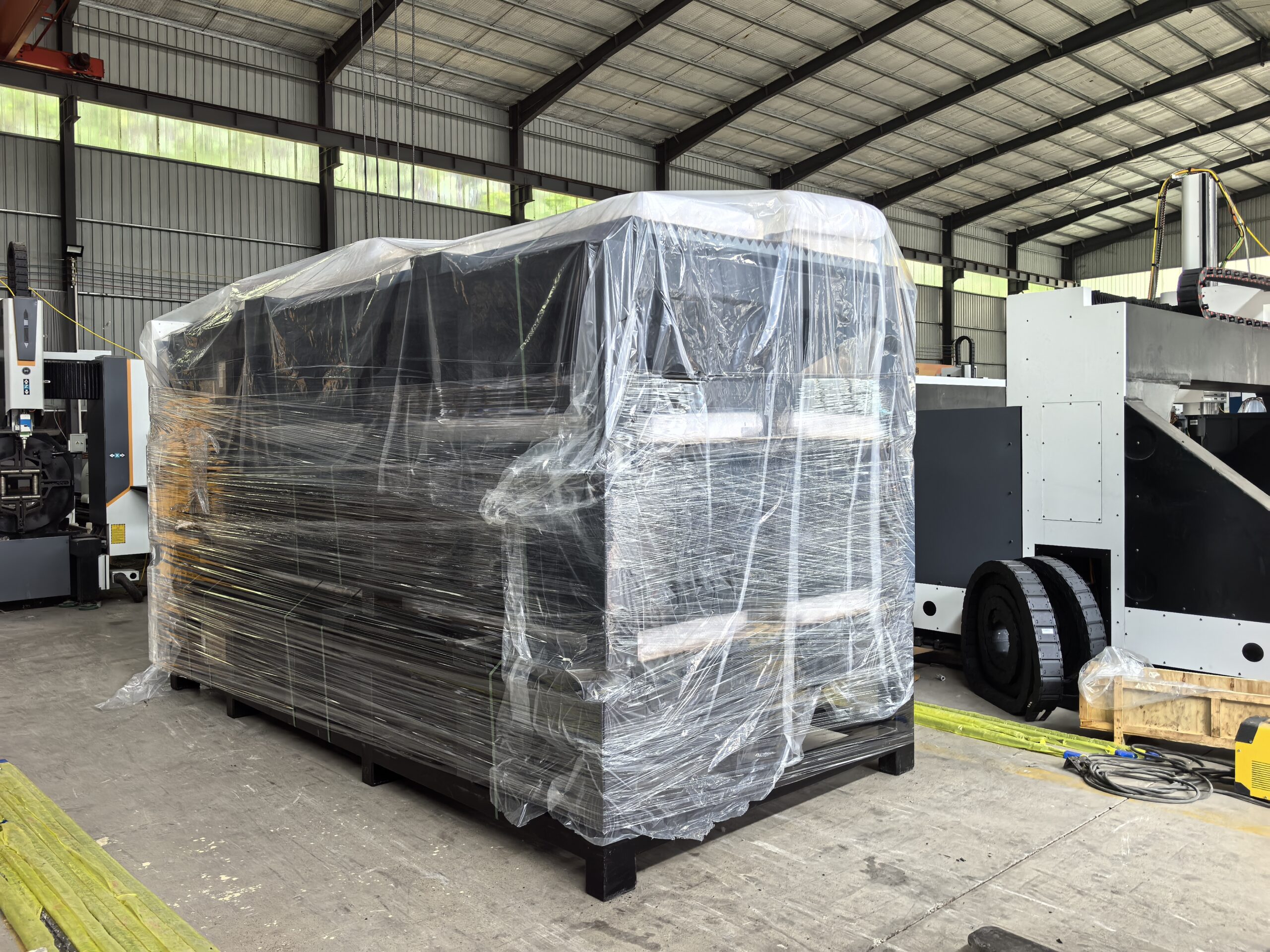
Export packing and logistics — 8–12 percent. Ocean crate in plywood and steel frame, desiccant, vacuum bag for optics, inland truck to Shanghai or Ningbo port, ocean freight to Southeast Asia or Middle East, marine insurance at 110 percent CIF value. A 4020 machine with pallet changer needs two 40 HQ containers; single-table 3015 machines fit one.
Destination charges — not included in FOB. Unloading crane or forklift at 8–12 tonne capacity, customs clearance, duty (typically 0–5 percent for HS 84561100 in many markets), VAT at local rate, and inland delivery to foundation.
Por qué el presupuesto más barato es más barato
Three substitutions explain most of the gap between a 32,000 USD quote and a 58,000 USD quote for nominally the same 3015 3 kW machine:
Lighter or lower-grade casting. A 3,800 kg machine versus a 5,200 kg machine for the same table size usually means a thinner-walled weldment or lower-grade HT200 instead of HT300. The lighter frame deflects under 2G acceleration and shows edge waviness on 6 mm mild steel at 1.2 m/min feed.
Unbranded or downgraded motion components. C7 rolled ball screws instead of C5 ground; 25 mm linear guides instead of 35 mm; open-loop stepper on auxiliary axes instead of full closed-loop servo. Positioning repeatability drifts from ±0.03 mm to ±0.08 mm, which matters for bolt-hole patterns on 10 mm plate.
Unbranded or lower-specification laser source. A “3 kW” source without brand documentation may be a refurbished module or a domestic source with 18-month instead of 24-month warranty and no global service depot. Beam parameter product (BPP) may exceed 3.5 mm·mrad versus 2.5 for a branded unit, producing wider kerf and slower cutting on reflective metals.
The control system and laser source together typically account for 40–50 percent of factory cost. A quote that cuts both by using generic alternatives is not necessarily dishonest; it is simply a different product with different uptime expectations.
Comparación de los costes de funcionamiento a lo largo de cinco años
Assumptions: two-shift operation, 3,500 cutting hours per year, electricity at 0.12 USD/kWh, mild steel and stainless mix, operator wage excluded.
| Partida de gastos | Branded 6 kW Build (Siemens + IPG) | Budget 6 kW Build (Syntec + Unbranded Source) |
|---|---|---|
| Annual power consumption (laser + chiller + motion) | 145,000 kWh at 42% wall-plug efficiency | 168,000 kWh at 36% wall-plug efficiency |
| Annual electricity cost | 17,400 USD | 20,160 USD |
| Nozzle and lens consumables (ceramic, focusing lens, protective windows) | 2,800–3,500 USD/year | 3,200–4,500 USD/year (faster degradation from beam quality) |
| Source service or module replacement | 0 USD under warranty years 1–3; 8,000 USD module at year 4–5 if needed | 4,000 USD at year 2–3 for unplanned module swap; 10,000 USD at year 4–5 |
| Control system spare parts (servo motor, drive, I/O) | 1,200 USD/year stocked inventory | 2,800 USD/year; longer lead times for generic equivalents |
| Estimated annual downtime (source + control faults) | 35–50 hours | 90–140 hours |
| Five-year total operating cost (excluding depreciation) | 103,000–115,000 USD | 128,000–152,000 USD |
The branded build recovers its 25,000–35,000 USD higher purchase price by year three in most scenarios. If your annual cutting hours are below 1,500, the payback extends and the budget build becomes mathematically defensible.
Supplier Qualification Checklist
Use these items to distinguish a machine builder from a trading office before releasing a deposit:
Foundry or casting documentation. Ask for the casting supplier name, material grade (HT250, HT300, or Meehanite equivalent), and stress-relief cycle duration. A builder with in-house or long-term foundry partnership keeps records; a trader forwards a generic mill certificate.
Assembly floor evidence. Request dated photographs or video of the scraping process, gantry alignment, and laser interferometer setup. Look for Renishaw XL-80 or equivalent equipment in the frame, not just a calibration sticker.
Geometric accuracy report. A real factory acceptance test (FAT) includes ISO 230-2 positioning accuracy and repeatability, typically ±0.05 mm/500 mm or better for a 4020 machine, and squareness of X to Y within 0.03 mm/1,000 mm. The report should carry the machine serial number, test date, and technician signature.
Ball-bar record. A 150 mm or 300 mm Renishaw QC20-W circularity test at 1,000 mm/min feed, showing contouring deviation. Ask for the raw data file, not a summary screenshot.
Estructura de pagos. Typical for Chinese machinery: 30 percent T/T advance, 60 percent against copy of bill of lading, 10 percent after installation and acceptance. A demand for 100 percent advance or payment to a personal account is a red flag regardless of price.
Capacidad de ingeniería posventa. Verify whether the supplier employs its own laser application engineers or relies on a third-party service network. Ask for the name and location of the engineer who would fly to your site for source alignment or cutting-parameter optimization. A trading office cannot answer this question with a specific name.
Spare parts inventory. Confirm 48-hour availability of protective windows, nozzles, and ceramic rings from the supplier’s export warehouse or regional partner. Control system spares (Siemens/FANUC drives) should be traceable to authorized distribution, not grey-market equivalents.
Lead time from contract to sailing date is currently 45–75 days for standard configurations and 85–110 days for high-power IPG or Beckhoff control builds. Add 25–35 days sea freight to Southeast Asia, 35–45 days to Middle East or Eastern Europe, and 40–55 days to East Africa or South America. Foundation preparation—reinforced concrete at 150 mm thickness, level to 0.1 mm/m—should be complete before the machine arrives to avoid demurrage.
Industry Applications for Fiber CNC Laser Cutting Machine
| Sector | Piezas típicas fabricadas | Especificaciones recomendadas | Por qué esta máquina es la más adecuada |
|---|---|---|---|
| Recambios para automóviles y motocicletas | Exhaust flanges, bracketry, sprockets, frame tubes, battery trays | 3000 mm × 1500 mm table, 1.5–3 kW Raycus or IPG source, ±0.03 mm positioning accuracy, 120 m/min rapid traverse | High-volume repeatability for JIT supply chains; piercing time under 0.5 s on 3 mm mild steel |
| Maquinaria agrícola | Harrow discs, PTO shields, grain chute liners, hydraulic tank mounts, cultivator tines | 4000 mm × 2000 mm table, 3–6 kW source, Yaskawa or FANUC servo pack, 0.05 mm repeatability | Handles 6–12 mm abrasion-resistant steel; large table reduces nesting waste on irregular profiles |
| Accesorios hidráulicos y neumáticos | Manifold plates, cylinder end caps, valve bodies, adapter flanges, accumulator mounts | 1500 mm × 3000 mm table, 2 kW IPG source, ±0.02 mm accuracy, Raytools BM110 cutting head with auto-focus | Clean edge quality on 8–16 mm stainless eliminates secondary machining; tight tolerances prevent seal leakage |
| Sheet Metal Fabrication and Cabinets | Server racks, electrical enclosures, HVAC ducting, tool cabinets, control panels | 3000 mm × 1500 mm or 6000 mm × 2000 mm table, 1.5–3 kW Raycus source, 0.08 mm repeatability, Syntec or GSK control | Nesting software integration cuts material yield above 85%; gantry speed matches batch sizes from 1 to 1000 |
| Kitchen Equipment | Worktops, sinks, range hoods, shelving, food-grade trolleys | 3000 mm × 1500 mm table, 1.5 kW MAX or Raycus source, stainless-dedicated cutting parameters, 0.05 mm repeatability | Nitrogen cutting preserves 2B finish on 304/316; minimal dross reduces downstream grinding |
| Fabricación de moldes y matrices | Stripper plates, ejector plates, die shoes, backing plates, gibs and wear plates | 1500 mm × 3000 mm table, 3–6 kW IPG source, ±0.015 mm positioning accuracy, 0.005 mm repeatability, granite-mounted interferometer verification | Direct-to-tolerance cutting on pre-hardened 1.2379 or 1.2344 at 48–54 HRC replaces wire EDM for through-features |
Recambios para automóviles y motocicletas
A Tier-2 supplier in Shandong running 400 exhaust flanges per shift switched from turret punch to a 3 kW fiber system on a 3015 table. Pierce-to-cut time on 4 mm hot-rolled steel dropped from 2.1 seconds to 0.4 seconds. The machine runs a FANUC 0i-F Plus control with 1.5 μm resolution linear scales on X and Y. Repeatability holds at ±0.03 mm over 8-hour cycles, which matters because the downstream robotic welder rejects flanges with hole-to-edge deviation above 0.1 mm. The supplier paid roughly USD 38,000 FOB Qingdao for the 3 kW configuration versus USD 22,000 for a 1.5 kW unit that could not pierce 6 mm stainless without blowback. Lead time was 35 days from deposit to loading; 20 GP container fit one machine with palletized sheet racks.
Maquinaria agrícola
A Harbin-based manufacturer of subsoiler frames sources 6 mm and 10 mm Q345B plate in 6-meter lengths. They selected a 4020 table with 6 kW IPG source and dual shuttle tables to keep one side loading while the other cuts. Positioning accuracy is ±0.05 mm, sufficient because welded joints tolerate 0.3 mm gap. The 6 kW source cuts 10 mm plate at 1.2 m/min versus 0.4 m/min on their older 3 kW CO₂ machine, but the real gain was elimination of edge rounding: the fiber cut edge on 10 mm material shows Ra 12–15 μm versus Ra 35 μm from plasma, so powder-coat adhesion improved and reject rates for field corrosion dropped. Machine weight is 9,800 kg; the factory poured a 200 mm concrete isolation pad because the gantry acceleration hits 1.2 G at 120 m/min rapid. Voltage is 380V 50Hz; they added a 45 kVA servo stabilizer for rural grid fluctuation.
Accesorios hidráulicos y neumáticos
A Ningbo valve producer machines manifold blocks from 20 mm and 30 mm 316L plate. They bought a 1530 table with 2 kW IPG and Raytools BM110 auto-focus head. The specification sheet shows ±0.02 mm positioning, 0.015 mm repeatability, and a 0.1 mm kerf width at 1.0 MPa nitrogen pressure. This lets them cut internal port passages to within 0.05 mm of finish-machined size, reducing subsequent CNC mill time by 40%. The trade-off: 2 kW on 30 mm stainless runs at 0.15 m/min, so the machine is not for volume work but for prototype and small-batch manifolds where EDM lead times stretch to three weeks. They paid USD 28,000; a 6 kW version would cut faster but cost USD 52,000 and deliver no accuracy benefit on these parts.
Sheet Metal Fabrication And Cabinets
A job shop in São Paulo serving telecom and medical OEMs runs two 3015 machines: one 1.5 kW Raycus for gauges 0.5–3 mm, one 3 kW for 3–6 mm and occasional 8 mm mild steel. The 1.5 kW machine with Syntec 60CA control and HIWIN 25 mm linear guides cost USD 19,500 FOB; the 3 kW with FANUC and 30 mm guides was USD 31,000. Both use Lantek nesting software. The 1.5 kW unit rapid traverses at 100 m/min, positioning accuracy ±0.08 mm. For a 2 mm aluminium server panel with 847 holes, total cut time is 4.2 minutes versus 11 minutes on their old CO₂ laser. The shop reports 92% material yield on 1500 × 3000 mm sheets because common-line cutting and micro-tabs reduce skeleton waste. They stock one spare ceramic ring and one nozzle set per machine; nozzle life is roughly 80 hours on clean steel, 35 hours on oily hot-rolled.
Kitchen Equipment
A Guangzhou fabricator producing 200 stainless sinks weekly runs a 3015 table with 1.5 kW MAX source, cutting 1.0 mm and 1.2 mm 304 sheet with nitrogen at 1.2 MPa. The cut speed is 8 m/min on 1 mm, producing a hairline edge that needs only Scotch-Brite finishing before welding. Positioning accuracy ±0.05 mm ensures sink bowl corners match press-brake formed profiles. The machine weighs 4,200 kg and shipped in a 40 HQ container with a de-coiler and straightener. They chose MAX over IPG because the USD 4,000 price difference covered a nitrogen generator; generator payback was 14 months versus cylinder rental. One caution: 1.5 kW struggles with 3 mm stainless at useful speed, so they outsource thicker gauge work rather than upgrade source power.
Fabricación de moldes y matrices
A toolroom in Dongguan cuts pre-hardened die plates up to 40 mm thick on a 1530 machine with 6 kW IPG and Heidenhain linear scales. The supplier provided a laser interferometer report showing ±0.008 mm positioning over 1000 mm travel and 0.005 mm bi-directional repeatability. They cut 30 mm 1.2379 at 0.25 m/min with oxygen assist, then switch to nitrogen for the final 2 mm to reduce oxide on fitting surfaces. The 6 kW source and granite-mounted gantry added USD 18,000 over a standard 3 kW build, but eliminated wire EDM for through-holes and pockets up to 200 mm depth. Ball bar testing at FAT showed 0.012 mm circularity; the toolroom now accepts plates directly to grinding without jig-boring. Lead time for this spec was 55 days due to scrape-fit assembly of the Y-axis box ways.
Cómo realizar un pedido e importar, paso a paso
The three mistakes that most often leave a delivered fiber laser sitting idle are easy to prevent. Tensión o frecuencia de alimentación incorrectas — confirm 380V 50Hz three-phase versus your local 220V 60Hz or 415V grid and specify a transformer before production starts. Working range too small for actual nested sheets — measure your largest part plus clamping margin, not just the raw sheet size. No electrical schematic, parameter backup or local consumable source — demand native format parameter files, a printed schematic set, and a written consumables list with regional part numbers before the machine ships.
Define Workpiece Envelope and Tolerance First
Cutting table size determines machine class. A 3015 table handles 3000 mm × 1500 mm sheet. A 4020 handles 4000 mm × 2000 mm. A 6020 handles 6000 mm × 2000 mm. The physical footprint grows substantially: a 3015 gantry machine typically needs 4800 mm × 2600 mm floor space, while a 6020 needs roughly 9000 mm × 3400 mm. Add 1500 mm minimum clearance on three sides for material handling and extraction ducting.
Positioning accuracy and repeatability drive price more than laser power. A machine rated ±0.03 mm positioning accuracy with ±0.02 mm repeatability uses HIWIN or PMI linear guides on all axes, servo motors with absolute encoders, and a steel-welded gantry stress-relieved before finish machining. A machine rated ±0.05 mm positioning accuracy may use rack-and-pinion on the long axis with lower-grade guides. The ±0.03 mm machine costs 15–25 percent more. For automotive fixture plate work or agricultural equipment brackets, ±0.05 mm often suffices. For electronics enclosures or precision agricultural hydraulic manifolds, demand ±0.03 mm.
Maximum cutting speed depends on material and power, not just machine mechanics. A 3 kW Raycus or MAX source cuts 1 mm mild steel at roughly 25–30 m/min. A 6 kW IPG source cuts 3 mm stainless at 8–12 m/min. Rapid traverse is separate: 80–120 m/min on entry-level machines, 140–170 m/min on machines with linear motor or high-pitch ballscrew long axes. Rapid traverse does not improve cut quality but reduces non-cut time on complex nests with many starts.
Choose Control System and Service Path
Common controls in Chinese-built fiber lasers: FANUC Series 0i-F Plus, Siemens 828D, Mitsubishi M800, GSK 980 TDi (less common on lasers), Syntec 60CA or 60CB, KND K2000MF. Syntec and KND dominate the domestic Chinese laser market for cost reasons. FANUC and Siemens command premiums of 3000–8000 USD depending on axis count and function packages.
The critical question is who services it in your country. Syntec has authorized distributors in Thailand, Vietnam, Turkey, Mexico and several Eastern European countries. KND has stronger presence in Southeast Asia and the Middle East. FANUC and Siemens have global networks but response time varies by region. Before finalizing the control, ask the builder for the name and phone number of the local authorized service agent for that specific control generation. Call them. Confirm they stock servo drives, encoders and the CNC motherboard. If they do not, every fault becomes a 2–4 week parts wait from China.
Cutting head matters for serviceability too. Raytools BM110 or BM114 heads are standard on Chinese machines. Precitec LightCutter or Procutter heads cost more but have wider global service networks. Raytools nozzles and ceramic rings are commodity items; Precitec consumables cost 40–60 percent more but are stocked in more countries.
Confirm Electrical Supply and Transformer Need
Standard Chinese export machines ship wired for 380V 50Hz three-phase. If your shop runs 220V 60Hz (common in Taiwan, Philippines, parts of South America) or 415V 50Hz (India, parts of Africa), specify before production. A step-up or step-down transformer adds 800–2500 USD depending on laser power: 3 kW needs roughly 15 kVA transformer capacity, 6 kW needs 30 kVA, 12 kW needs 50 kVA. The transformer must handle the laser source’s inrush current, not just steady-state draw.
Phase balance matters. Laser sources and servo drives tolerate ±10 percent voltage imbalance. Beyond that, servo alarms and source instability result. If your grid is known for imbalance, specify a transformer with tap changers or electronic voltage regulation.
Grounding requirement: machine frame and transformer neutral to local earth rod, resistance under 4 ohms. Chinese builders rarely include earth rods or local grounding design. Your electrician must handle this.
Check Floor Loading Foundation and Space
Machine net weight by table size and construction:
| Table | Net Weight (kg) | Floor Load (kg/m²) |
|---|---|---|
| 3015, steel welded bed | 3500–4500 | 800–1200 |
| 3015, cast base with welded gantry | 5000–6500 | 1200–1600 |
| 4020, steel welded | 5500–7000 | 1000–1400 |
| 4020, cast base | 7500–9500 | 1400–1800 |
| 6020, steel welded | 9000–12000 | 1200–1600 |
A 3015 machine fits in a 20-foot container if partially disassembled (gantry separated from bed). A 4020 or 6020 requires 40-foot high cube. Machine weight plus crate adds 800–1500 kg. Total container payload limit is roughly 28,000 kg in a 40-foot HC. Two 6020 machines cannot share one container.
Foundation: industrial concrete floor minimum 200 mm thick, compressive strength C25 or higher. For machines over 8000 kg, specify isolated foundation pad or verify existing floor slab was designed for concentrated loads. Level to 0.05 mm/m using precision level on the bed rails after grouting. Builders provide foundation drawings with anchor bolt locations. Do not pour concrete until you confirm bolt pattern matches your machine serial; late design changes happen.
Confirmar el marcado de conformidad para la aduana
CE marking is standard for machines sold into Europe and often accepted in Southeast Asia, Middle East and parts of Africa. The builder must provide: EC Declaration of Conformity, technical file reference, and CE plate affixed to electrical cabinet. For markets without CE recognition, ask what local conformity assessment applies. Russia needs EAC. Saudi Arabia needs SASO. Nigeria needs SONCAP. The builder may not hold these; you may need to engage a local certification body with machine documentation.
Laser safety classification documentation: the fiber source is Class 4. The builder must provide IEC 60825-1 test report or equivalent showing enclosure integrity and interlock function. Customs in some countries flags laser equipment for additional inspection without this paperwork.
Comparación entre FOB y CIF
| Término | What Builder Pays | Lo que pagas | Risk Transfer |
|---|---|---|---|
| FOB puerto chino | Inland transport, export customs, loading onto vessel | Ocean freight, insurance, destination customs, inland delivery | At ship’s rail in China |
| Puerto de destino CIF | All of above plus ocean freight and marine insurance | Destination customs, inland delivery, unloading from port | At destination port |
CIF adds 2000–6000 USD depending on destination and machine size. Marine insurance under CIF typically covers total loss only, not partial damage. For a 60,000 USD machine, buy all-risks cargo insurance separately for 300–600 USD. FOB gives you freight forwarder choice and often faster customs clearance at destination if you have established relationships.
Container Type and Weight Distribution
- 20-foot standard: internal length 5898 mm. Fits one 3015 machine with gantry detached. Gross weight limit 22,000 kg.
- 40-foot high cube: internal length 12032 mm. Fits one 4020 or 6020, or two 3015 machines stacked with care. Gross weight limit 26,480 kg to 28,000 kg depending on line.
- Flat rack or open top: needed if machine height with crate exceeds 2695 mm (rare for standard lasers, common if extraction unit ships mounted).
Weight distribution: the laser source and electrical cabinet ship separately in most cases. Confirm whether they travel in same container or LCL. LCL adds handling risk and 2–3 weeks transit time.
Deposit and Balance Payment Structure
Standard practice among Chinese machine builders: 30 percent deposit to confirm order and release material procurement. 70 percent balance due before shipment, payable after factory acceptance test (FAT) photos or video but before bill of lading release. Some builders accept 30/60/10 with 10 percent retained until installation, but this is not standard and requires strong credit references or letter of credit.
Letter of credit (LC) terms: builder typically adds 1.5–3 percent to cover bank charges and confirmation risk. At 80,000 USD machine price, this is 1200–2400 USD additional. LC at sight is builder-preferred. Usance LC (30, 60, 90 days) requires builder discounting and adds more cost.
Never pay 100 percent advance. If a builder demands it, this is a trading office with no cash flow for material procurement, not a manufacturer.
Prueba de aceptación en fábrica antes del pago del saldo restante
Insist on FAT with your presence or by video call with screen sharing. Minimum FAT scope:
- Geometric accuracy: laser interferometer or ball bar test on X, Y axes. Record straightness, positioning accuracy, repeatability. For a 3015 machine, demand ≤0.03 mm positioning accuracy and ≤0.02 mm repeatability over full travel.
- Prueba de corte: your material, your thickness, your specified assist gas. 3–5 sample cuts with dimensional report. Edge quality per ISO 9013 or your internal standard.
- Laser power verification: power meter reading at source output, comparing rated versus actual. A 3 kW Raycus source should deliver 3000W ±5 percent.
- Control function: full program simulation, emergency stop response time, door interlock test.
- Documentación: electrical schematic in PDF and native Eplan format if possible, parameter backup on USB, operation manual in your language, maintenance schedule.
Request the FAT report signed by builder’s quality engineer with machine serial number. Withhold balance payment if report is missing or test failed.
Equipos de descarga en el lugar de destino
A 3015 machine (4500 kg net, 6000 kg with crate) requires minimum 5-ton forklift with extended forks or 8-ton crane with spreader bar. A 6020 machine (12000 kg net, 14000 kg with crate) requires 16-ton crane or two 10-ton forklifts in tandem with proper lifting beam. Check your receiving dock: door width minimum 3.5 m for 4020, 4.5 m for 6020. Ceiling height minimum 4 m for overhead crane clearance.
If unloading by third party, send them machine weight and center-of-gravity drawing in advance. The crate has lifting points; do not sling around gantry or rails.
Instalación y formación de los operadores
Builder’s engineer typically stays 5–7 working days for installation, leveling, alignment and training. Scope should include: machine leveling and anchor grouting, laser source alignment to cutting head, assist gas plumbing pressure testing, extraction duct connection, control parameter optimization for your materials, and operator training on nesting software, program transfer, daily maintenance and fault diagnosis.
Training is often limited to 2–3 operators. Specify number of trainees in contract. Request training outline in writing before engineer arrival.
If your country requires work visas for Chinese nationals, confirm builder handles visa invitation letter and processing time (typically 2–4 weeks). Delays here idle your machine after delivery.
Paquete inicial de piezas de recambio y consumibles
Negotiate this into purchase order, not as after-sale goodwill. Minimum package for first year:
| Artículo | Cantidad | Purpose |
|---|---|---|
| Nozzles (various diameters) | 10–15 | Consumable, 2–4 week life depending on material |
| Ceramic rings / sensor bodies | 4–6 | Fragile, single-point failure |
| Protective lenses (collimating and focusing) | 6–10 each | Replace every 50–200 hours depending on environment |
| O-rings and seals kit | 1 juego | Annual preventive maintenance |
| Servo drive fuses | 2 each axis | Electrical fault protection |
| Limit switch assemblies | 2 each axis | Mechanical overtravel |
Also request: source fiber cable spare (5 m or 10 m) if your layout has cable wear risk; chiller coolant (deionized water or manufacturer-specified antifreeze) for climate-appropriate concentration; and one set of focus lenses for alternative thickness ranges if your work varies.
Confirm consumable part numbers match regional availability. A Raytools nozzle ordered by Chinese part number may not be stocked by your local supplier. Get cross-reference to regional catalog numbers.
Numbered Ordering and Import Checklist
- Measure largest nested sheet plus 200 mm clamping margin on all sides; select 3015, 4020 or 6020 table.
- Define positioning accuracy requirement: ±0.03 mm for precision work, ±0.05 mm for general fabrication.
- Select laser power: 1.5 kW for thin sheet under 3 mm, 3 kW for mixed 1–6 mm, 6 kW for 4–12 mm, 12 kW for 6–25 mm mild steel.
- Choose laser source brand: Raycus or MAX for cost, IPG for stability and global service.
- Choose control: Syntec 60CA or KND K2000MF for value; FANUC or Siemens for service network; verify local authorized agent exists.
- Confirm cutting head brand and regional nozzle/ lens availability.
- Verify shop voltage, frequency, phase; specify transformer if not 380V 50Hz.
- Check floor load capacity against machine weight; order foundation drawing.
- Measure door, ceiling and dock capacity for unloading; book crane or forklift.
- Specify conformity marking needed: CE, EAC, SASO, SONCAP or other.
- Negotiate FOB versus CIF; arrange marine insurance if FOB.
- Confirm container type: 20-ft, 40-ft HC, or flat rack.
- Agree payment: 30 percent deposit, 70 percent after FAT and before B/L.
- Schedule FAT with your material samples; demand signed geometric report.
- Request electrical schematic, parameter backup, operation manual in local language.
- Confirm installation engineer visa and travel timeline.
- Specify operator training scope and number of trainees.
- Negotiate first-year spare parts and consumables package with regional part numbers.
- Verify extraction unit specification and duct connection size.
- Establish chiller coolant and assist gas supply chain before machine arrival.
Related RUNLONGJIA Machines
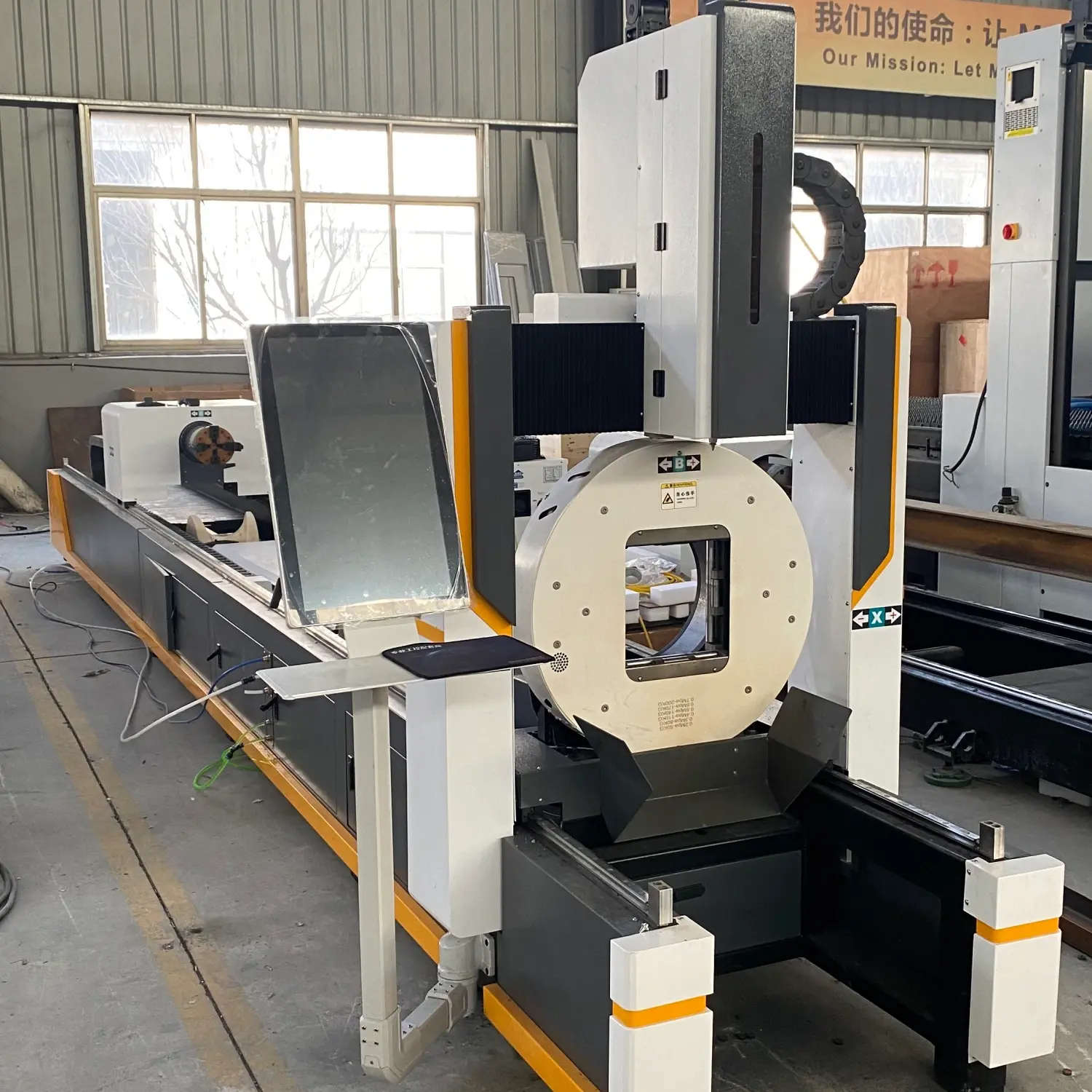
Máquina de corte por láser CNC
Directamente de fábrica máquina de corte por láser CNC con opciones de control de FANUC, Siemens, Mitsubishi, GSK o Syntec y alimentación de 380 V/50 Hz o 220 V/60 Hz para la exportación.
Frequently Asked Questions About Fiber CNC Laser Cutting Machine
Supplier Qualification And Factory Verification
Q: What is the minimum order quantity and can I order a single machine for evaluation?
Single-unit orders are standard for fiber laser cutting machines. RUNLONGJIA ships one machine per 40 HQ container for bed sizes up to 4020 mm (4000 × 2000 mm cutting area). A 6020 mm machine requires flat-rack or open-top container loading. No MOQ penalty applies. Dealers requesting three or more units receive consolidated freight pricing. Lead time for one machine remains identical to small batch orders at 25–35 days after deposit.
Q: Which control systems are available and does the interface support my local language?
Cypcut and FSCUT2000/4000 systems dominate the China fiber laser market and support English, Spanish, Russian, Arabic, Turkish, and Vietnamese. FANUC or Siemens 828D CNC are available at 15–25% premium for shops with existing technician familiarity. The Beckhoff-based bus control option suits high-speed piercing cycles above 200 Hz. All systems include nesting software with DXF/DWG import. Language files load at commissioning; no factory reflash required.
Q: What is the realistic lead time from deposit to readiness for export?
Standard lead time is 25–35 days for 1.5–6 kW Raycus or MAX configured machines. IPG source machines add 10–14 days due to import clearance. Machines above 12 kW or with 6020 tables run 40–50 days. These timelines assume confirmed sheet metal specification and nesting software parameters. December through February extends by one week due to Chinese New Year factory closure. Deposit confirmation date locks the production slot; verbal holds expire in 72 hours.
Q: What payment structure protects both parties when buying direct from a China factory?
Standard terms are 30% T/T deposit, 70% T/T before shipment against factory acceptance test (FAT) photos and video. L/C at sight acceptable for orders above USD 80,000 with 1.5% bank fee addition. Trading offices often demand 50% deposit and offer no FAT documentation. RUNLONGJIA provides FAT report, laser interferometer linear positioning data, and geometric accuracy sheet before final payment release. Escrow through Alibaba Trade Assurance is available at 0.5% surcharge.
Q: How do you verify actual manufacturing capability versus a trading office with no assembly floor?
Request dated video of the specific machine bed casting with serial number, scraping of mounting surfaces, and gantry alignment using electronic levels. A real builder holds HT250 or HT300 casting supplier contracts, not trading company invoices. Ask for laser interferometer records showing positioning accuracy ±0.05 mm/1000 mm and repeatability ±0.03 mm. Ball bar circularity test reports for the XY plane should be available within 24 hours. Trading offices delay or deflect these requests; factories produce them from the QC office.
Q: Is supply voltage and frequency adapted for my region and what electrical preparation is needed?
Standard configuration is 380V 50Hz three-phase. For 220V 60Hz regions (North America, parts of Southeast Asia), a step-up transformer 220V→380V with 20% headroom above laser source rated kW is required. A 6 kW machine draws approximately 28 kVA; specify 35 kVA minimum transformer. Voltage stabilizer recommended where grid fluctuation exceeds ±10%. Machine ships with CE-marked electrical cabinet; local electrician connects main breaker and earth per provided schematic. No factory technician needed for electrical hookup.
Q: What shipping method, container type, and transit time apply to my region?
Machines up to 4020 size load in 40 HQ container with dismantled gantry and separate control cabinet; reassembly requires four hours and crane or forklift with 5000 kg capacity. Transit time: 18–25 days to Southeast Asian ports, 25–35 days to Middle East (Jebel Ali, Port Said), 30–40 days to Mombasa or Lagos, 35–45 days to South American Atlantic ports, 14–21 days to Eastern European rail terminals via Chengdu/Europe block train. CIF terms include marine insurance; FOB Shanghai/Tianjin/Qingdao available for freight forwarder consolidation.
Q: Is factory acceptance testing with documented accuracy report provided before shipment?
Yes. FAT includes: (1) laser interferometer measurement of X/Y axis positioning accuracy and repeatability, (2) ball bar test for circular interpolation, (3) cutting sample on buyer’s actual material thickness with dimensional report, (4) 8-hour continuous run thermal stability check. Report contains serial number, technician signature, and timestamp. Witnessed FAT via video call is standard; physical presence requires two-week advance notice and buyer’s travel cost. Geometric accuracy report per ISO 9013 for thermal cutting is included; ISO 230-2 for positioning available at request.
Q: What warranty coverage and spare parts availability should I expect?
Two-year warranty on mechanical structure, one-year on laser source (Raycus/MAX) or two-year on IPG, one-year on servo motors and drives, six months on consumables. Critical spares kit ships with machine: protective lenses (10 pcs), nozzle assortment (0.8–3.0 mm, 8 pcs), ceramic rings (4 pcs), focus lens (2 pcs). Regional spare parts stock held in Dubai, São Paulo, and Jakarta for 48-hour dispatch. Technical support via remote VPN diagnostic; on-site engineer dispatch within 72 hours for warranty claims, chargeable after warranty at USD 350/day plus airfare.
Q: Does the factory provide CE documentation for customs clearance in my country?
CE Declaration of Conformity, machine risk assessment, and laser safety EN 11553 compliance report are issued per serial number. These documents accompany Bill of Lading and commercial invoice for customs entry. For markets requiring GOST-R (EAEU), SONCAP (Nigeria), or PVOC (East Africa), RUNLONGJIA coordinates with certified third-party inspectors at factory before shipment. CE marking on machine nameplate and electrical cabinet is permanent; adhesive CE labels indicate trading company sourcing, not original manufacture.
Q: What installation and operator training is included, and what is my site preparation responsibility?
Installation includes gantry reassembly, laser source alignment, geometric level check, and cutting parameter setup for two material thicknesses. Training covers: Cypcut nesting, nozzle change and centering, focus position adjustment, daily maintenance checklist, protective lens inspection. Duration: 3–5 days with two operators. Buyer provides: prepared concrete foundation (minimum 200 mm thickness, ±2 mm/m level), 5000 kg forklift or crane for unloading, compressed air 1.0 MPa dry and filtered, designated operator with basic CAD familiarity. Foundation drawing ships 14 days before machine arrival.
Q: What cutting tolerance is achievable on my specific material and thickness?
On mild steel to 6 mm: ±0.05 mm dimensional tolerance, ±0.03 mm repeatability, surface roughness Ra 12.5–25 μm. Stainless steel 3 mm: ±0.03 mm with nitrogen assist at 1.5 MPa. Aluminum 4 mm: ±0.08 mm due to thermal conductivity; edge quality improves with 6 kW versus 3 kW source. Thickness capacity versus quality: 1.5 kW to 6 mm MS, 3 kW to 12 mm MS, 6 kW to 20 mm MS, 12 kW to 30 mm MS. Higher power reduces heat-affected zone width but increases consumable cost per meter; 6 kW offers optimal duty-cycle economics for mixed-thickness job shops.
Q: What are the real consumable costs per operating hour?
Protective lens: USD 8–15 each, 2–8 hours life depending on cutting gas purity and anti-spatter dosing. Nozzle: USD 12–25, 20–40 hours. Ceramic ring: USD 45–80, 200–400 hours. Focus lens: USD 200–400, 800–1200 hours with proper handling. Total consumable cost runs USD 3–6 per hour for 3–6 kW machines in clean shop conditions. Dirty environments or unfiltered compressed air triple lens consumption. Nitrogen consumption at 99.999% purity: 15–25 L/min for 3 mm stainless; oxygen for mild steel costs 40–60% less per cubic meter. Annual consumable budget for 2000 hours operation: USD 6000–12,000.
Aviso importante
Las especificaciones, los datos de precisión y los rangos de precios que figuran en esta guía son orientativos y se facilitan con fines de planificación.
solo a efectos informativos. Rango de funcionamiento real, tolerancia alcanzable, disponibilidad del sistema de control, requisitos de tensión de alimentación y conformidad
El etiquetado varía según el modelo y el país de destino. Los compradores deben comprobar por sí mismos la tensión y la frecuencia de la red eléctrica, la carga admisible del suelo y
los cimientos, el equipo de descarga y los requisitos de importación antes de realizar un pedido. Todas las cifras están sujetas a confirmación por escrito en
the final proforma invoice issued by RUNLONGJIA.
Sourcing Fiber CNC Laser Cutting Machine from RUNLONGJIA
What RUNLONGJIA Brings to the Sourcing Decision
RUNLONGJIA was founded in 2010 and has more than 15 years of manufacturing and export experience. The product range covers conventional lathes, milling machines, flat bed and slant bed CNC lathes, CNC machining centers, CNC fiber laser cutting machines, plasma cutting machines and portable laser welding machines. This breadth matters for buyers who may later expand into adjacent equipment and prefer a supplier with proven cross-platform engineering.
Machines are supplied with a choice of control system — FANUC, Siemens, Mitsubishi, GSK, KND or Syntec — adapted to the buyer’s supply voltage and frequency. A 380V 50Hz machine bound for a 220V 60Hz site receives the correct transformer and motor winding specification at build stage, not as an afterthought. Each fiber laser cutting machine undergoes run-in and factory acceptance testing before packing. Geometric accuracy is verified with laser interferometer and ball bar records, and the documented report ships with the machine. Packing is in plywood cases with rust protection. Quotations are FOB or CIF.
Post-delivery support includes installation guidance, operator training material, remote commissioning and spare parts. The factory maintains assembly and scraping floors, sources castings through controlled channels, and can demonstrate actual machine build rather than brokered trade.
Next Step
Send your workpiece material, maximum part size, required tolerance and destination port to receive a quotation within 24 hours via email or the website contact form at runnewtech.com.
Get a Factory Direct Quote on Fiber Cnc Laser Cutting Machine
RUNLONGJIA has been building metalworking machinery since 2010,
con más de 15 años de experiencia en exportación. Las máquinas se suministran con el sistema de control que usted elija, adaptado a su red eléctrica
tensión y frecuencia; se somete a pruebas de rodaje y de aceptación en fábrica antes de su embalaje. Envíenos el material de su pieza de trabajo, el tamaño máximo de la pieza,
Indíquenos la tolerancia requerida y el puerto de destino, y le enviaremos un presupuesto en un plazo de 24 horas.

 English
 Indonesian
 Vietnamese
 Arabic
 Russian
 Spanish