
Guía para la compra de tornos CNC
Un auténtico Torno CNC factory in China controls its own casting supply, maintains an in-house scraping and assembly floor, and can produce documented geometric accuracy reports from laser interferometer and ball bar testing. Trading offices rent showroom space and ship machines they never assembled—buyers pay 8–15% more for identical specifications while losing direct access to spare parts and application engineering.
The rest of this page breaks down seven verification points: foundry or casting source documentation, assembly floor evidence, metrology records, factory acceptance test protocols, payment structure risk signals, after-sales engineering capability, and how each factor affects total cost of ownership across a 10-year machine life.
Casting Source and Bed Construction
Genuine builders either operate a captive foundry or hold long-term contracts with HT250 or HT300 resin sand casting suppliers. A 500 mm swing flat bed CNC lathe should carry roughly 3,200–4,500 kg net weight; slant bed machines in the 8-inch chuck class typically run 3,500–5,000 kg. Ask for the casting grade certificate—HT300 offers 30% better damping than HT250—and confirm stress relief duration. Two-stage aging, 6 months natural plus furnace normalization, prevents 0.05 mm/300 mm geometric drift in the first two years.
Assembly Floor and Hand Scraping
Trading offices display machines under plastic sheets in rented warehouses. Real factories show scraping marks on guideway mating surfaces, typically 10–16 contact points per 25 mm × 25 mm on box way machines. Linear roller guide machines (HIWIN or PMI) skip hand scraping but require precision-ground mounting surfaces to ±0.01 mm/1000 mm. Request time-stamped photos of your specific serial number during spindle run-in—minimum 4 hours at 3,500 rpm for a 7.5 kW A2-6 spindle.
Metrology Records That Matter
Laser interferometer positioning accuracy should read ≤0.020 mm/300 mm for standard class, ≤0.010 mm/300 mm for precision class. Ball bar circularity on a 150 mm radius test: ≤0.015 mm for job shop grade, ≤0.008 mm for tooling work. Ask for the actual report with machine serial number, date, and technician signature—not a generic template. Repeatability per ISO 230-2: ±0.006 mm for 8-inch chuck machines, ±0.003 mm for 12-inch and above.
Factory Acceptance Test Protocol
A proper FAT includes: 72-hour continuous run at 80% rated spindle load; thermal growth compensation check (spindle centerline drift ≤0.010 mm after 4 hours); and actual cutting test on 45# steel or 304 stainless. Reject any supplier who offers only “visual inspection” or refuses witness testing. For slant bed CNC lathes with 8-inch chuck, specify bar capacity—52 mm through-hole on A2-6 spindles, 65 mm on A2-8—and confirm C-axis indexing accuracy ±0.01° if live tooling is included.
Payment Structure and Risk Signals
Trading offices typically demand 100% TT before shipping. Established factories accept 30% deposit, 70% against copy of BL, or letter of credit for orders above $80,000. Red flags: refusal to accept third-party inspection, no VAT invoice from the actual manufacturer, or quotes 20% below market without specification variance. Current FOB Shanghai indicative ranges: flat bed CNC lathe 500 × 1,000 mm with GSK 980TDi, $18,000–$24,000; slant bed 8-inch chuck with FANUC 0i-TF, $35,000–$48,000; 12-inch chuck slant bed with Siemens 828D and 12-station turret, $55,000–$72,000.
Capacidad de ingeniería de posventa
Verify: staffed service office in your region or committed 48-hour response time; spare parts inventory held domestically (turret index fingers, spindle bearings, servo motors); and remote diagnostics capability through control system native function—FANUC FOCAS, Siemens Access MyMachine. Ask for three reference installations in your industry, same machine class, operating minimum 18 months. A factory that built the machine can dispatch a spindle engineer; a trader forwards your complaint to a WeChat group.
Tipos y configuraciones de los tornos CNC
| Tipo o clase | Rango de trabajo habitual | Opciones de control | Ideal para | Notas |
|---|---|---|---|---|
| Flat Bed CNC Lathe (Economy) | Max turning diameter 400–500 mm, length 750–1500 mm, spindle bore 52–80 mm | GSK 980TDi, KND K1000Ti, Siemens 808D | General job shops, agricultural parts makers, technical training centres | Lowest entry cost; linear guides on X/Z, hardened box ways on some heavier models; positioning accuracy ±0.01 mm, repeatability ±0.005 mm; 5.5–7.5 kW spindle at 2500 rpm; machine weight 2200–2800 kg |
| Torno CNC de bancada plana (alta resistencia) | Max turning diameter 630–1000 mm, length 1500–3000 mm, spindle bore 105–130 mm | FANUC 0i-TF, Siemens 828D, Mitsubishi M80 | Oil field equipment, large shaft work, mining machinery repair | HT300 casting, hardened box ways on all axes; 15–22 kW spindle at 1500–2000 rpm; rapid traverse 6–8 m/min; machine weight 5500–12000 kg; requires substantial foundation |
| Slant Bed CNC Lathe (2-Axis Turning Center) | Max turning diameter 200–360 mm, bar capacity 42–65 mm, length 500–650 mm | FANUC 0i-TF Plus, Siemens 828D, Syntec 22TB | Automotive suppliers, hydraulic fittings, mass production of rotationally symmetric parts | 45° or 60° bed angle; linear roller guides (HIWIN/PMI); 5.5–11 kW direct-drive spindle at 4000–6000 rpm; positioning accuracy ±0.005 mm, repeatability ±0.003 mm; turret index time 0.2–0.3 s; machine weight 3500–5000 kg |
| Slant Bed CNC Lathe (Turn-Mill with Y-Axis and Sub-Spindle) | Max turning diameter 200–320 mm, Y-axis travel ±25–40 mm, bar capacity 51–76 mm | FANUC 31i-B, Siemens 840D sl, Mitsubishi M80 | Medical implants, aerospace fittings, complex automotive components requiring complete machining in one setup | Live tooling up to 8000 rpm, C-axis interpolation, sub-spindle for backworking; 7.5–15 kW main spindle; machine weight 6500–9500 kg; significantly higher cost and longer lead time |
| Torno CNC vertical (VTL) | Max turning diameter 800–1600 mm, max height 600–1000 mm, table load 2000–8000 kg | FANUC 0i-TF, Siemens 828D | Heavy brake discs, pump housings, large bearing races, wind power flanges | HT300 or Meehanite cast base; table speed 100–320 rpm; 22–45 kW main motor; positioning accuracy ±0.008 mm; machine weight 14000–35000 kg; requires pit or elevated platform |
| Torno CNC de tipo suizo | Max bar diameter 20–38 mm, part length typically under 200 mm | FANUC 32i-B, Mitsubishi M80, Citizen/Miyano proprietary | Watch components, connectors, medical bone screws, high-volume precision electronics | Sliding headstock, guide bushing for long slender parts; 3.7–7.5 kW main spindle at 10000–16000 rpm; 5–7 axes standard; positioning accuracy ±0.003 mm; oil mist collection required; machine weight 2500–4000 kg |
Flat Bed CNC Lathe Economy Class
This is the machine most first-time CNC buyers from Africa, Southeast Asia and South America encounter. A 400 mm swing by 1000 mm between centres unit with GSK 980TDi control, 7.5 kW spindle and HIWIN linear guides ships in a 40-foot container at roughly 2600 kg net weight. The factory price at FOB Qingdao typically falls between $18,000 and $28,000 depending on chuck size (200 mm or 250 mm hydraulic), whether tailstock is included, and whether the builder uses HT250 or HT300 casting. Lead time runs 25–35 days for standard configurations. What this machine cannot do: maintain tight tolerances on interrupted cuts or heavy roughing passes. The linear guide version lacks the damping mass of box ways, and the 2500 rpm maximum spindle speed limits productivity on small-diameter aluminium work. Buyers are usually small job shops, municipal technical schools, or agricultural repair workshops that need to step up from manual lathes without operator retraining. The real supplier qualification task here is verifying the casting source—many trading offices source HT250 beds from small foundries with inconsistent cooling, leading to warping six months after installation.
Flat Bed CNC Lathe Heavy Duty Class
When a machine shop in the Middle East or Eastern Europe repairs oil drilling stems or wind turbine main shafts, this is the configuration specified. A 630 mm swing by 3000 mm length machine with 130 mm spindle bore, FANUC 0i-TF control and hardened box ways on all axes weighs approximately 8500 kg and requires a 12-tonne forklift or overhead crane for unloading. The 22 kW spindle at 1500 rpm delivers high torque at low speed for alloy steel roughing. Rapid traverse stays modest at 6–8 m/min because mass and accuracy take priority over speed. Positioning accuracy of ±0.01 mm and repeatability of ±0.005 mm are achievable only after proper foundation and levelling—builders who skip scraping the box way mating surfaces will not hit these numbers regardless of control brand. Lead time extends to 45–60 days due to casting stress relief cycles (minimum 30 days for HT300 beds). Price drivers: spindle bore size (105 mm vs 130 mm), whether the bed is one-piece or joined, and whether the builder performs laser interferometer verification on X and Z axes. What it cannot do: compete with slant bed machines on cycle time for small batch work. The heavy casting and slow rapids make it inefficient for parts under 100 mm diameter.
Slant Bed CNC Lathe Two-Axis Turning Center
This class dominates automotive supply chains and high-volume hydraulic fitting production. The 45° bed angle provides chip gravity discharge and ergonomic operator access, while linear roller guides permit 20–30 m/min rapid traverse. A typical 250 mm swing machine with 65 mm bar capacity, FANUC 0i-TF Plus, 8-station or 12-station turret, and 7.5 kW spindle at 4500 rpm weighs 4200 kg and occupies 2.8 m × 1.6 m floor space. Positioning accuracy ±0.005 mm and repeatability ±0.003 mm are standard when the builder ball-bar tests each machine before dispatch. Price at FOB China runs $32,000–$55,000 depending on turret type (electric vs hydraulic), whether C-axis preparation is included, and whether the spindle uses A2-5 or A2-6 nose configuration. Lead time is 30–40 days for standard builds. Buyers are tier-two automotive suppliers, valve manufacturers, and job shops serving the construction equipment aftermarket. What it cannot do: mill flats or drill cross-holes efficiently—that requires live tooling and Y-axis travel, which this base configuration lacks. The supplier qualification focus shifts to turret sourcing (imported vs domestic tool disc), whether the linear guides are genuine HIWIN/PMI or unbranded copies, and whether the builder maintains laser interferometer records for each serial number.
Slant Bed CNC Lathe Turn-Mill with Y-Axis and Sub-Spindle
This is the configuration that separates actual machine builders from assembly shops. A 260 mm swing turn-mill with ±35 mm Y-axis travel, C-axis interpolation, 12-station turret with live tooling, sub-spindle, and FANUC 31i-B control weighs 7800 kg and requires precise thermal management. The 11 kW main spindle at 6000 rpm and 5.5 kW sub-spindle at 5000 rpm enable complete machining of complex aerospace or medical parts in a single setup. Positioning accuracy of ±0.004 mm demands that the builder scrape the slant bed to the spindle within 0.01 mm over 500 mm, then verify with ball bar and laser interferometer. Machine price ranges $75,000–$140,000 depending on sub-spindle specification, live tooling rpm (4000 vs 8000), and whether the control includes full 5-axis simultaneous capability. Lead time stretches to 60–90 days. Buyers are medical device contract manufacturers, aerospace tier-one suppliers, and precision automotive component houses. What it cannot do: compete on price with simple two-axis lathes for straight turning work—the sub-spindle, Y-axis mechanism and thermal compensation add cost and complexity that recover only when part families justify the capital outlay. Supplier qualification here is critical: ask for the geometric accuracy report including spindle runout (target under 0.003 mm), turret repeatability, and documented thermal growth test after 4-hour warm-up.
Torno CNC vertical
VTLs occupy a niche that horizontal lathes cannot serve: heavy, short workpieces where gravity assists clamping and chip removal. A 1250 mm table diameter machine with 4000 kg table load capacity, 30 kW main motor, and FANUC 0i-TF control uses a single-column or double-column HT300 casting weighing 22000 kg. Table speed of 200 rpm with 3200 Nm torque handles cast iron brake discs and pump housings. Positioning accuracy ±0.008 mm is achievable with cross-roller bearings on the table and box way construction on the ram. Price drivers: single vs double column, table bearing diameter (determines radial load capacity), and whether the builder includes automatic tool measurement. FOB pricing runs $85,000–$180,000; lead time 60–75 days due to large casting procurement and lengthy stress relief. Buyers are wind turbine component manufacturers, railway wheel producers, and mining equipment rebuilders. What it cannot do: handle long shafts—the vertical configuration limits workpiece height, and the ram deflection on overhang becomes significant above 600 mm. Foundation requirements are substantial: a 250 mm reinforced concrete pad with anchor bolts, versus 150 mm for horizontal lathes of equivalent weight class.
Torno CNC de tipo suizo
Swiss-type machines represent a distinct architecture where the bar feeds through a guide bushing while the headstock slides on Z-axis ways, maintaining tool support within 2 mm of the cut at all times. A 20 mm maximum bar capacity machine with 5 axes, FANUC 32i-B control, 3.7 kW main spindle at 12000 rpm and 2.2 kW sub-spindle at 8000 rpm weighs 3200 kg and occupies 2.2 m × 1.4 m. Positioning accuracy ±0.003 mm and surface finishes under Ra 0.4 µm are achievable with quality guide bushings and thermal stability systems. Price ranges $65,000–$120,000 for configurations with backworking attachment, chip conveyor, and oil mist collector. Lead time 45–60 days; many builders source critical components (guide bushings, collet systems) from Japan or Switzerland, creating supply chain dependencies. Buyers are medical implant manufacturers (bone screws, dental abutments), electronics connector houses, and precision watch component suppliers. What it cannot do: accept cast or saw-cut bar with diameter variation over 0.05 mm—the guide bushing principle requires ground bar stock. It also cannot economically produce parts longer than 3–4 times the bar diameter. Supplier qualification must address: whether the builder manufactures its own spindles or sources from Setco or Weifu, guide bushing material (tungsten carbide vs ceramic for abrasive alloys), and whether thermal compensation is standard or optional.

Especificaciones y cómo interpretarlas
| Parámetro | Nivel básico | Gama media | Alta calidad |
|---|---|---|---|
| Diámetro máximo de torneado | 360 mm | 500 mm | 800 mm |
| Longitud máxima de torneado | 750 mm | 1000 mm | 3000 mm |
| Tamaño del mandril | 8 inch (200 mm) | 10 inch (250 mm) | 12 pulgadas (315 mm) |
| Punta del husillo | A2-5 | A2-6 | A2-8 |
| Velocidad del husillo | 3.500 rpm | 3000 rpm | 2000 rpm |
| Potencia del husillo | 7,5 kW | 11 kW | 22 kW |
| Orificio del husillo | 52 mm | 65 mm | 105 mm |
| Recorrido del eje X | 180 mm | 250 mm | 420 mm |
| Recorrido del eje Z | 750 mm | 1000 mm | 3000 mm |
| Desplazamiento rápido en los ejes X y Z | 20/24 m/min | 24/30 m/min | 16/20 m/min |
| Precisión de posicionamiento | ±0,015 mm | ±0,010 mm | ±0,008 mm |
| Repetibilidad | ±0,006 mm | ±0,004 mm | ±0,003 mm |
| Tipo de guía | Guía de caja endurecida | Guía lineal de rodillos (HIWIN/PMI) | Guía lineal de rodillos (HIWIN/PMI) |
| Sistema de control | GSK 980TDi or KND K2000Ti | FANUC 0i-TF o Siemens 828D | FANUC 0i-TF Plus or Siemens 840D sl |
| Puestos de torreta | 8-position | 12-position servo | 12-position servo + Y-axis |
| Peso neto de la máquina | 2 200 kg | 4 500 kg | 12 000 kg |
| Superficie útil (L × W) | 2400 × 1400 mm | 3200 × 1800 mm | 6500 × 2200 mm |
| Tensión de alimentación | 380 V, trifásico, 50 Hz | 380 V, trifásico, 50 Hz | 380 V, trifásico, 50 Hz |
| Carga total conectada | 15 kVA | 25 kVA | 45 kVA |
How to Read Each Line of the Specification Sheet
Working Range and Travels
The X-axis travel tells you how far the tool post moves perpendicular to the spindle centerline. On a 500 mm swing lathe, 250 mm X-travel means you can turn a part up to 500 mm diameter with the tool on center. The Z-axis travel is your maximum part length between chuck face and tailstock or tailstock center. Add 100–150 mm to the stated Z-travel for tooling clearance and part overhang. A machine rated at 1000 mm Z-travel handles roughly 850–900 mm of actual turned length.
Diámetro y longitud máximos de torneado
These are the hard limits set by bed width, carriage height, and tailstock travel. Check whether the max diameter is over-bed or over-carriage. Over-bed diameter is larger and rarely usable for actual cutting. Over-carriage or over-swing diameter is what matters for your parts. For long shafts, verify that the tailstock quill diameter and taper (typically MT3, MT4, or MT5) match your center hole sizes.
Velocidad y potencia del husillo
Higher rpm suits small diameters and aluminum. Lower rpm with higher torque handles large steel forgings. The 7.5 kW entry-level spindle peaks at 3500 rpm but torque drops above 2500 rpm. The 22 kW A2-8 spindle at 2000 rpm delivers constant torque from 200–1200 rpm, which is where heavy roughing happens. Check the torque curve, not just the kW rating. A 15 kW spindle with a 1:4 gear reduction often out-torques an 11 kW direct-drive spindle below 800 rpm.
Cono del husillo y tamaño del mandril
A2-5, A2-6, and A2-8 are short taper nose standards. Larger numbers mean larger flange diameters and higher torque capacity. An 8-inch chuck on A2-5 is the practical limit; 10-inch on A2-6 is standard; 12-inch on A2-8 handles 250 mm billets. The spindle bore diameter determines maximum bar capacity for automatic feeding. 52 mm bore passes 50 mm hex bar. 105 mm bore passes 102 mm round bar. If you buy hydraulic bar feeders later, the bore must match.
Tipo de guía
Hardened box ways ( scraped Turcite-B on cast iron ) damp vibration and carry heavy interrupted cuts. Linear roller guides (HIWIN HG series or PMI MSA series) enable 24–30 m/min rapids and tighter positioning but have lower shock resistance. For general job shop work with mixed batch sizes, linear guides reduce non-cutting time. For foundry-facing, roll-turning, or heavy alloy steel, box ways last longer and require less rail replacement.
Rapid Traverse and Feed Rates
Rapid traverse is the turret’s positioning speed between cuts. 30 m/min Z-axis rapid on a mid-range machine means the turret crosses 1000 mm in 2.5 seconds. Actual cutting feeds are 0.05–2 mm/rev, so rapid speed only affects cycle time on short parts with many tool changes. For long shafts, rapid speed matters less than steady feed rate and chip control.
Precisión y repetibilidad del posicionamiento
Positioning accuracy ( ±0.010 mm ) is where the machine thinks it is versus where it actually is. Repeatability ( ±0.004 mm ) is whether it returns to the same spot after a full traverse. Repeatability matters more for batch consistency. Positioning accuracy matters for first-off parts and when you transfer programs between machines. Ask for the laser interferometer report: X-axis straightness, Z-axis pitch error compensation, and backlash values at multiple points along the travel.
Tool Magazine and Change Time
Turret index time is 0.3–0.6 seconds per station on servo-driven turrets. Hydraulic turrets are slower at 0.8–1.2 seconds and require periodic seal maintenance. Live tooling on milling-capable turrets adds BMT55 or BMT65 tapers and 3–7.5 kW driven tools. Check whether live tooling is standard or requires a factory-built option—retrofitting later is often impossible.
Sistema de control
GSK 980TDi and KND K2000Ti are Chinese systems with FANUC-compatible G-code. They cost 40–50% less than FANUC but have smaller installed bases outside China. FANUC 0i-TF and Siemens 828D are the global standards. FANUC dominates Southeast Asian and North American job shops; Siemens dominates Eastern Europe and technical training centers. Syntec is common on Taiwanese-style slant-bed machines. Mitsubishi M80 is rare on lathes but appears on Japanese-built turning centers. Control choice affects spare parts availability, operator training cost, and resale value.
Tensión de alimentación y carga conectada
Chinese-built CNC lathes ship at 380V 3-phase 50Hz. For 220V 60Hz regions (North America, parts of South America, Philippines), you need a step-up transformer or a factory-ordered 220V/60Hz spindle motor and control voltage. The transformer adds 8–12% to landed cost and 150–300 kg to shipping weight. Verify whether the control cabinet includes an isolation transformer for voltage stabilization.
Machine Weight and Floor Space
Weight correlates with rigidity. A 500 mm swing lathe at 2200 kg uses lighter castings and may need bolt-down for heavy cuts. The same swing at 4500 kg has thicker walls, wider box ways, and better chatter resistance. Floor space must include operator access: 1000 mm front clearance for chuck loading, 600 mm rear clearance for chip conveyor and coolant tank service.
Price Drivers and Lead Time
Control System Premium
FANUC 0i-TF adds $4,000–$6,000 over GSK on a mid-range lathe. Siemens 828D adds $5,000–$7,000. FANUC 0i-TF Plus with 200-block lookahead and AI contour control adds $8,000–$10,000. This is the single largest optional cost after the base machine.
Spindle and Chuck Upgrades
Moving from 8-inch hydraulic to 10-inch hydraulic chuck adds $1,200–$1,800. A2-6 spindle over A2-5 adds $2,500–$3,500 in bearing and shaft costs. Through-spindle coolant (70 bar) adds $3,000–$4,500 and requires a high-pressure pump and rotary union.
Guideway and Scale Feedback
Linear guides over box ways add $2,000–$3,500. Linear scale feedback (closed-loop positioning, mandatory for some aerospace work) adds $4,000–$6,000 per axis and requires Heidenhain or Fagor glass scales with sealed read heads.
Lead Time Structure
Standard configurations from established builders: 25–35 days production. Custom spindle bore, special voltage, or third-party control integration: 45–60 days. Peak months (March–May pre-Canton Fair, September–October pre-IMTS) extend by 10–15 days. Sea freight to Southeast Asian ports: 12–18 days. To Middle East (Jebel Ali): 18–25 days. To East Africa (Mombasa): 25–35 days. To South America East Coast (Santos): 35–45 days.
How to Verify a Real Builder from a Trading Office
Foundry or Documented Casting Source
Ask for the casting grade certificate: HT250 for entry-level beds, HT300 for mid-range and above. HT300 has 300 MPa tensile strength versus 250 MPa and better damping. Some builders use Meehanite-processed castings with flake graphite structure for heavy cuts. A trading office cannot produce this document; they forward what the factory gives them, often without understanding it. Request photos of the casting storage yard with machined beds in raw finish, not painted.
Assembly Floor and Scraping Records
Precision lathe beds are hand-scraped to 8–12 contact points per 25 mm × 25 mm on the guideway mounting surfaces. Ask for photos of the scraping floor with scrapers, blue dye, and surface plates. A real builder keeps these records for 5–7 years. The scraping pattern should be visible even under Turcite or guideway covers.
Laser Interferometer and Ball Bar Records
Factory acceptance test (FAT) requires laser interferometer measurement per ISO 230-2 or GB/T 17421.2. Ask for the raw data file, not a summary. Renishaw XL-80 or API XD laser systems produce traceable reports. Ball bar testing (Renishaw QC20-W) checks circular interpolation and servo tuning mismatch. A 150 mm ball bar test at 1000 mm/min feed should show roundness under 0.015 mm for entry-level, under 0.010 mm for mid-range.
Geometric Accuracy Report
The report covers: spindle runout (test bar at 300 mm, 0.010 mm max); bed straightness (0.02 mm per 1000 mm); parallelism of spindle axis to Z-axis movement (0.02 mm per 300 mm); perpendicularity of turret face to spindle axis (0.015 mm). Each item should have measured values, tolerance limits, and inspector signature with date.
Payment Structure as Signal
Trading offices often demand 30% T/T advance, 70% against copy of B/L—standard but risky if they have no factory leverage. Established builders accept 30% advance, 65% after FAT photos or video confirmation, 5% after installation. Letters of credit (L/C at sight) are accepted by builders with 5+ years export history; trading offices often refuse L/C due to bank collateral requirements.
Capacidad de ingeniería de posventa
Ask for the service engineer’s passport copy and visa history. A builder with Southeast Asian or Middle Eastern installations can show entry stamps. Verify whether they stock servo motors, drives, and ball screws in regional warehouses or only ship from China. Response time commitment should be in the contract: 48-hour remote diagnosis, 7-day on-site arrival for critical failures.
Condiciones comerciales y documentación de exportación
FOB, CIF, CFR, EXW
EXW (Ex Works) means you arrange everything from the factory gate. FOB (Free On Board) includes factory loading and China port export clearance; you pay ocean freight and insurance. CFR (Cost and Freight) includes ocean freight to your port; risk transfers at ship’s rail in China. CIF (Cost, Insurance, Freight) adds marine insurance; still your responsibility to unload and clear customs. For CNC lathes over 3000 kg, CIF is common because the builder has freight forwarding relationships for heavy machinery. For single small lathes, FOB saves 5–8% if you have your own freight forwarder.
Condiciones de pago
T/T (telegraphic transfer) is standard: 30% deposit, balance before shipment or against documents. L/C at sight adds $400–$800 in bank charges but protects against non-shipment. For orders above $80,000, some builders accept 180-day usance L/C with bank guarantee. Avoid 100% advance payment for first orders.
HS Code and Customs
CNC lathes fall under HS 8458.11 (horizontal lathes, numerically controlled) or 8458.91 (other lathes, numerically controlled). Duty rates vary: 0% within ASEAN under China-ASEAN FTA with Form E certificate; 5–8% in Middle Eastern GCC countries; 0–3.5% in most African countries under GSP. The packing list must match the machine nameplate, motor ratings, and control serial numbers.
CE Marking and Documentation
CE marking on Chinese-built lathes covers the Machinery Directive 2006/42/EC and EMC Directive 2014/30/EU. Request the EC Declaration of Conformity with the notified body number if third-party assessment was used. Many Chinese builders self-declare CE; this is legal for most CNC lathes but requires technical file availability. The CE plate should be fixed to the machine column with builder name, address, year of manufacture, and serial number.
Certificate of Origin and Packing
The certificate of origin (CO) is issued by China Council for the Promotion of International Trade (CCPIT) or local customs. For FTA benefits, request Form E (ASEAN), Form A (GSP countries), or specific bilateral forms. Packing for ocean shipment: vacuum-sealed plastic, plywood case with IPPC-treated wood marking, desiccant packs, and rust-preventive oil on unpainted surfaces. Total packed weight is 15–25% above net machine weight due to crate and foundation bolts.
Unloading and Installation
A 4500 kg mid-range lathe requires a 5-tonne forklift or 3-tonne crane with spreader bar. The crate is 2200 mm × 1800 mm × 2100 mm—check door widths and ceiling heights. Foundation bolts (M16 or M20, 8–12 pieces) set in epoxy grout or lead wedges. Levelling to 0.05 mm/m using precision level on the bed ways. Full installation and training: 3–5 days for standard lathe, 7–10 days for Y-axis mill-turn with live tooling. Spare parts to stock initially: turret index pins, chuck jaws, coolant pump seals, and one set of axis servo motor brushes or encoder batteries.
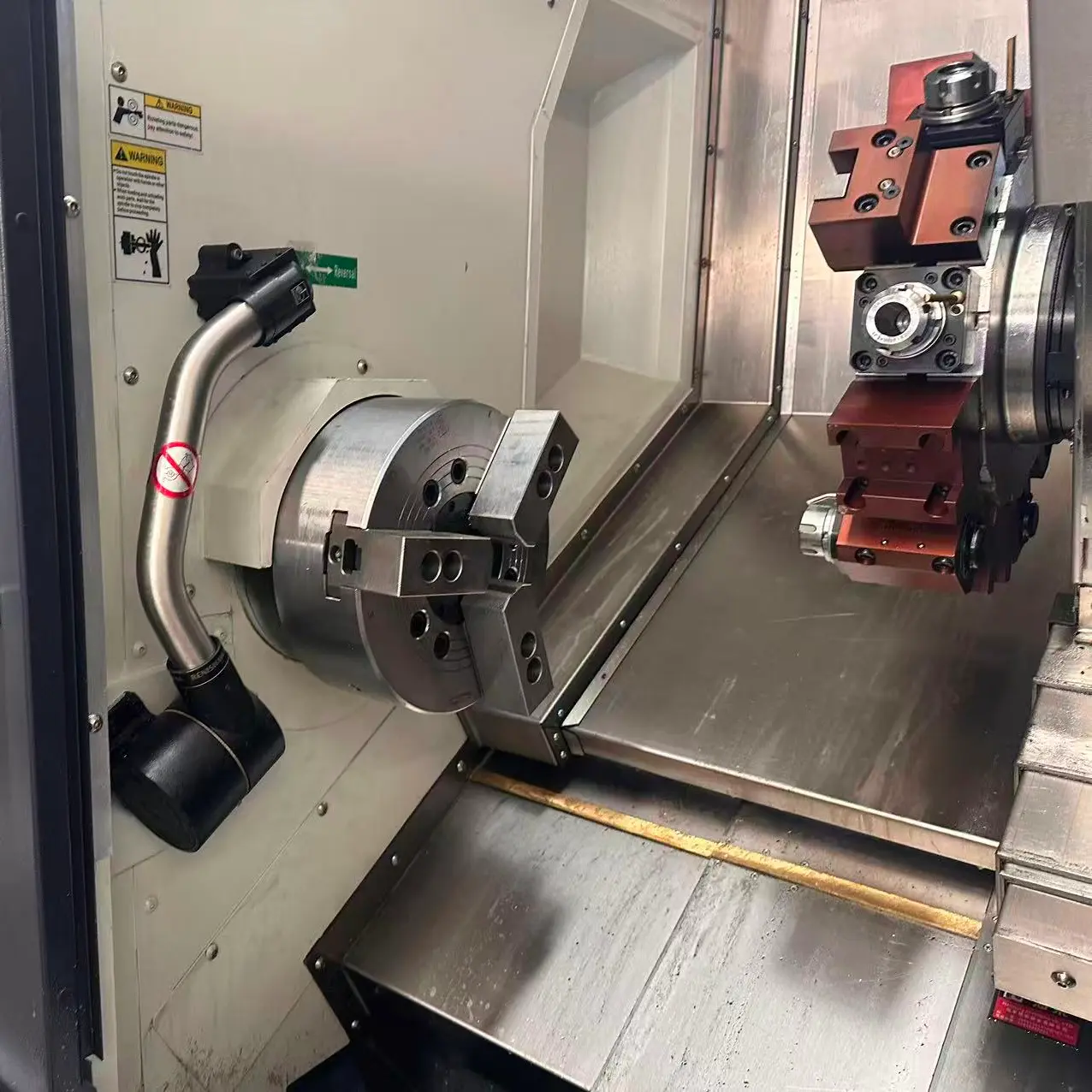
Precio de un torno CNC y qué factores lo determinan
| Clase | Rango de funcionamiento típico o potencia | Ejemplo de control o de origen | Precio indicativo FOB en USD |
|---|---|---|---|
| Entry-level flat bed CNC lathe | 500 mm max swing, 750 mm between centers, 5.5 kW spindle | GSK 980TDi or KND K1000Ti, 250 mm chuck | 18,000 – 28,000 |
| Torno CNC de bancada plana de gama media | 630 mm swing, 1500 mm between centers, 7.5–11 kW spindle | Siemens 828D Basic or Mitsubishi M80, 320 mm chuck | 32,000 – 48,000 |
| Torno CNC de gama media con bancada inclinada | 400 mm max turning diameter, 500 mm Z travel, 15 kW spindle | Fanuc 0i-TF Plus or Siemens 828D, 8-station turret | 38,000 – 58,000 |
| Heavy-duty slant bed with live tooling | 520 mm swing over bed, 1000 mm Z travel, 22 kW spindle, C axis | Fanuc 0i-TF Plus or Siemens 840D sl, 12-station servo turret | 65,000 – 95,000 |
| Twin-spindle twin-turret turning center | 2 × 15 kW spindle, 65 mm bar capacity, full Y axis | Fanuc 31i-B or Siemens 840D sl, integrated gantry loader | 140,000 – 220,000 |
These bands assume standard configuration without optional part catchers, bar feeders, or automatic tool presetters. A Fanuc or Siemens control typically adds 8,000–15,000 USD over a domestic Chinese control on the same iron. Prices move with currency, steel casting costs, and sea freight indices.
What the Factory Price Actually Covers
A Torno CNC supplier and factory in China structures cost differently than a trading office reselling someone else’s build. The factory’s internal cost stack, expressed as approximate shares of a mid-range slant bed machine with Siemens 828D control, looks like this:
- Casting or frame: 12–18%. HT300 resin sand casting, stress relieved, roughly 4,200 kg for a 400 mm swing slant bed machine. A factory with its own foundry or a dedicated casting partner controls this directly; a trading office does not.
- Guías y husillos de bolas: 8–12%. HIWIN or PMI linear roller guides on X and Z, C3 or C5 grade ground ball screws. Hardened box ways cost 15–20% less but reduce rapid traverse from 24 m/min to 12 m/min and need more frequent scraping.
- Conjunto del husillo: 10–15%. A2-6 or A2-8 nose, 15 kW at 3,500 rpm, with ceramic bearings for thermal stability. The spindle motor and drive amplifier are often bundled with the control brand.
- Sistema de control y paquete de servomotores: 22–30%. This is the first of the two largest line items. Fanuc 0i-TF Plus with αi series servos and spindle motor runs higher than Siemens 828D with SINAMICS drives. GSK 980TDi with domestic servos cuts this to 8–12% of total cost but sacrifices interpolation smoothing and diagnostic depth.
- Tool turret or tool post: 6–10%. 8-station electric turret with BMT55 tooling, or 12-station servo turret for live tooling. Imported turrets from brands like Duplomatic or Sauter add 4,000–7,000 USD.
- Assembly labour and scraping: 5–8%. Hand scraping of box ways or fitting of linear guides to casting datum surfaces. A real factory employs fitters who measure with dial indicators and blue dye; a trading office has no floor.
- Embalaje para exportación: 2–3%. Vacuum-sealed moisture barrier, plywood crate, steel banding, desiccant. A 40-foot HC container fits one large slant bed lathe or two compact flat beds.
- Transporte terrestre hasta el puerto: 1–2%. From Shandong or Jiangsu province to Shanghai or Qingdao port.
- Sea freight and insurance: 3–6% depending on destination. Southeast Asia 800–1,200 USD per 20-foot container; East Africa or South America 3,000–5,500 USD.
- Destination duty and VAT: 5–25% depending on HS code 8458.11 classification and local tariff schedule. Many buyers forget to model this in their landed cost.
- Customs clearance and handling: 1–2%.
El marca del sistema de control and, on laser-hybrid machines, the laser source brand (Raycus 1.5 kW versus MAX 3 kW versus IPG 6 kW) are the two single biggest line items because they are imported under foreign exchange, carry brand premiums, and determine the machine’s resale value and serviceability. On a pure CNC lathe without laser, the control-servo package dominates. On a hybrid turn-mill with integrated laser cladding, the laser source (Raycus 2 kW at 6,000 USD versus IPG 2 kW at 14,000 USD) becomes the second major variable.
Por qué el presupuesto más barato es más barato
A quote 20–30% below the midpoints in the table above normally reflects one or more of these substitutions:
- Lighter casting grade: HT250 instead of HT300, or wall thickness reduced 15–20%. Machine net weight drops from 4,200 kg to 3,400 kg. Rigidity under interrupted cuts suffers; chatter appears above 1.2 mm depth of cut on 1045 steel.
- Lower grade ball screw: C7 rolled instead of C3 ground. Positioning accuracy degrades from ±0.005 mm to ±0.020 mm; repeatability from ±0.003 mm to ±0.010 mm.
- Unbranded or cloned components: Servo motors without proper encoder feedback resolution, or control systems with modified firmware that locks the buyer out of parameter access. Spare availability becomes uncertain after three years.
- No laser interferometer or ball bar record: The factory skipped geometric verification. You receive a machine that meets no documented standard.
These trade-offs are honest choices for low-volume, soft-material work. They are catastrophic for automotive shaft production or bearing race finishing where Cpk 1.33 is contractually required.
Comparación de los costes de funcionamiento a lo largo de cinco años
Assuming 2,000 operating hours per year, 70% utilization, electricity at 0.10 USD/kWh:
| Partida de gastos | Mid-Range Properly Specified | Lowest-Quote Alternative |
|---|---|---|
| Consumo energético anual | 22 kW × 0.7 load × 2,000 h × 0.85 PF = 26,180 kWh, 2,618 USD | 18 kW lighter spindle, but 15% longer cycle times from rigidity loss: 24,500 kWh, 2,450 USD |
| Ball screw and guide replacement | C3 grade, first replacement year 7: 0 USD in years 1–5 | C7 grade, replacement year 3: 2,800 USD; year 5 second replacement risk |
| Turret tooling investment | Standard BMT55 holders, 4,500 USD initial | Same |
| Control system spare availability | Siemens or Fanuc parts stocked in regional hub, 48-hour delivery | Unbranded control: 3–4 week wait from China, air freight premium |
| Expected downtime (unplanned) | 40–60 hours/year from turret indexing or chip management | 120–180 hours/year from servo alarm, thermal drift, repeated geometry loss |
| Downtime cost at 80 USD/hour lost production | 3,200–4,800 USD/year | 9,600–14,400 USD/year |
| Five-year total excluding purchase price | 38,000–48,000 USD | 58,000–78,000 USD |
The heavier upfront machine recovers its premium in year three if downtime is valued. If downtime is not valued—if the machine stands idle half the week—the lighter option may suffice.
How to Verify a Real Factory Before Payment
Payment structure is your first signal. Trading offices often demand 50% advance, 50% before shipping, with no factory acceptance test (FAT) visit permitted. Real builders accept 30% T/T advance, 70% against copy of bill of lading, or 30/60/10 with FAT deduction. Some offer 5% retention for 12 months.
Request these documents before placing the order:
- Casting certificate or foundry partnership agreement. HT300 grade with chemical composition report.
- Laser interferometer record for positioning accuracy and repeatability, measured per ISO 230-2 or JIS B6330. Look for ±0.005 mm/500 mm positioning, ±0.003 mm repeatability on a 400 mm travel axis.
- Ball bar test report for circular interpolation, 150 mm radius at 1,000 mm/min feed, showing roundness deviation under 0.015 mm.
- Documented geometric accuracy report: spindle runout at nose and 300 mm from nose; parallelism of Z axis to spindle centerline; perpendicularity of X to Z.
- Photographs or video of the assembly floor, specifically the scraping bench and the guide fitting station. A trading office cannot produce these.
- After-sales engineering capability: names and locations of resident service engineers in your region, not just “we have agents.” Ask for a specific contact who has performed spindle alignment on your continent.
CE documentation, where claimed, should be verifiable with a notified body number on the declaration of conformity. Do not accept a generic CE sticker photograph.
Lead Time and Container Logistics
Standard lead time from deposit to ready for shipment: 45–60 days for a configured slant bed CNC lathe with Siemens 828D. Fanuc-controlled machines often stretch to 60–75 days due to Japanese import lead time for servo amplifiers. Entry-level flat beds with GSK control ship in 25–35 days.
A 400 mm swing slant bed CNC lathe in crate measures roughly 3,200 × 1,800 × 2,100 mm and weighs 4,200 kg net, 4,800 kg gross with packing. One machine per 20-foot container; two compact flat beds fit a 40-foot HC. Unloading requires a forklift rated at 6,000 kg minimum or a 10-tonne overhead crane. Foundation bolts and leveling wedges are not included; specify M24 or M30 anchor bolt pattern and 150 mm reinforced concrete slab.
Voltage: Chinese factories build for 380V 50Hz three-phase. For 220V 60Hz destinations (parts of North America, Philippines), a step-up transformer 50 kVA minimum is required, adding 1,200–2,000 USD. Specify this before build; retrofitting motor windings is not practical.
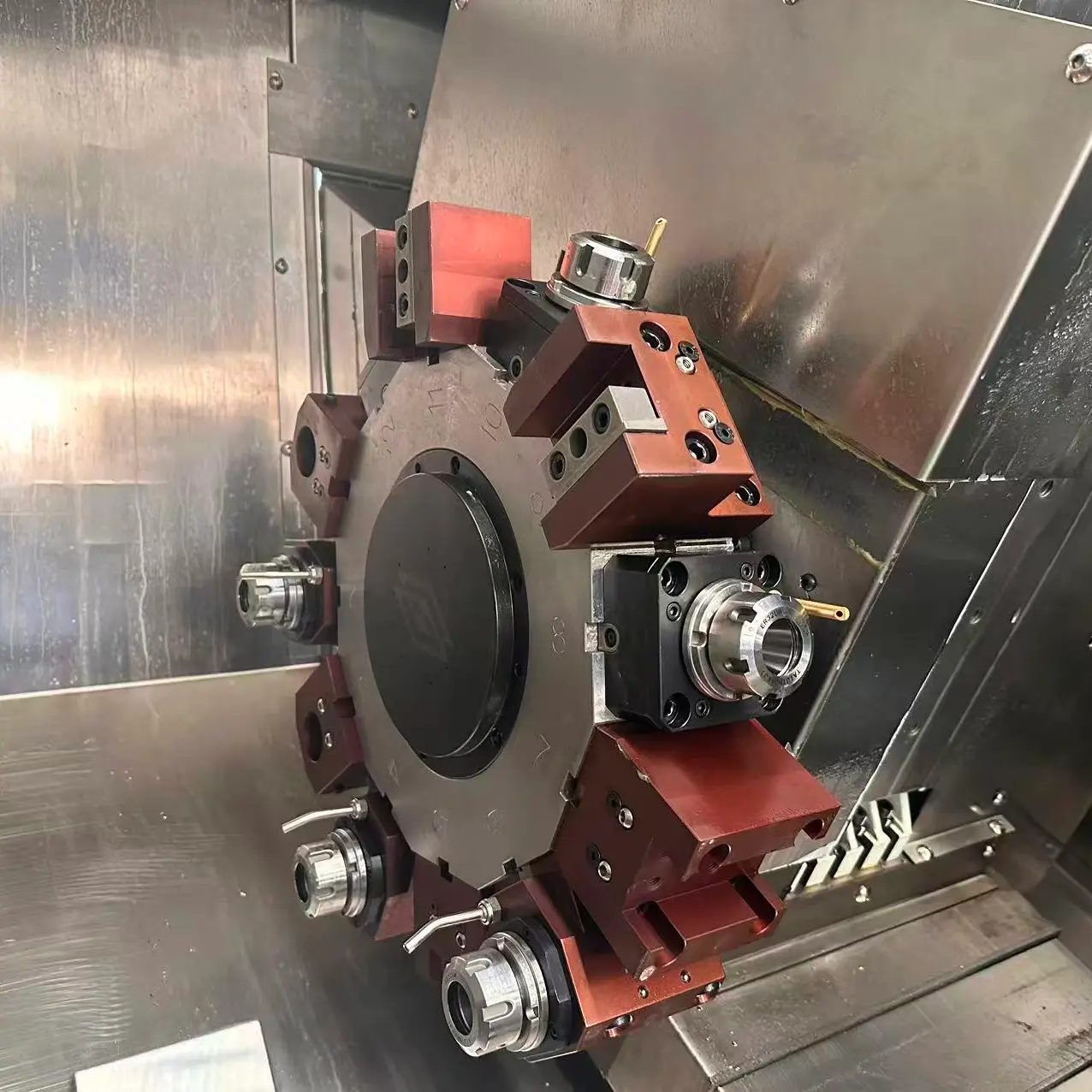
Aplicaciones industriales del torno CNC
| Sector | Piezas típicas fabricadas | Especificaciones recomendadas | Por qué esta máquina es la más adecuada |
|---|---|---|---|
| Recambios para automóviles y motocicletas | Discos de freno, árboles de levas, cubos de rueda, pasadores de pistón, ejes de transmisión | Flat bed CNC lathe, 500 mm max turning diameter, 1500 mm max turning length, A2-8 spindle nose, 11–15 kW spindle power, 2000 rpm, FANUC 0i-TF control, ±0.008 mm positioning accuracy, HT300 casting, 4500 kg machine weight | High torque at low rpm for cast iron and steel; rigid box ways absorb interrupted cuts on forgings and castings; large chuck capacity handles brake drum diameters |
| Maquinaria agrícola | Tractor axle housings, hydraulic cylinder rods, gear blanks, PTO shafts | Flat bed CNC lathe, 630 mm swing over bed, 3000 mm between centers, A2-11 spindle, 22 kW spindle, 800 rpm, GSK 980TDb or Siemens 828D, ±0.01 mm repeatability, 6800 kg | Extended bed models accommodate long shafts; high spindle bore (105 mm) allows bar feeding for hydraulic rods; Meehanite casting resists vibration from heavy roughing |
| Accesorios hidráulicos y neumáticos | Cylinder bodies, valve stems, union nuts, hose connectors, piston rods | Slant bed CNC lathe, 360 mm max turning diameter, 500 mm turning length, A2-6 spindle, 7.5 kW, 4500 rpm, linear roller guides (HIWIN/PMI), FANUC or Mitsubishi M80, ±0.005 mm, rapid traverse 24 m/min | Slant bed design aids chip evacuation for continuous brass and aluminum production; high rpm and rapid traverse match fitting volume demands; compact footprint suits cell layouts |
| Acoplamientos para petróleo y gas | Drill pipe couplings, wellhead connectors, valve bonnets, flanged adapters | Flat bed CNC lathe, 800 mm swing, 2000 mm length, A2-15 spindle, 30 kW, 600 rpm, hardened box ways, Siemens 828D, ±0.01 mm, 12,000 kg machine weight | Extreme rigidity for API thread cutting on thick-walled steel; low-speed high-torque spindle delivers stable threading cycles; heavy casting dampens forces on interrupted bores |
| Fabricación de moldes y matrices | Core pins, ejector sleeves, mould cavities, die buttons, punch blanks | Slant bed CNC lathe with C-axis and driven tools, 250 mm max turning diameter, 400 mm length, A2-5 spindle, 5.5 kW, 6000 rpm, FANUC 0i-TF Plus, ±0.003 mm repeatability, linear guides, 3500 kg | C-axis and live tooling combine turning and light milling in one setup; tight repeatability holds taper fits for mould assemblies; reduces hand-off to machining centers |
| Centros de formación técnica | Curriculum parts: shafts, pulleys, threads, grooves, simple gears | Flat bed CNC lathe, 360 mm swing, 750 mm length, A2-6 spindle, 5.5 kW, 2000 rpm, GSK 980TDb or KND K2000Ti, ±0.01 mm, 2200 kg, 380V 50Hz | Lower acquisition cost with full G-code exposure; robust mechanical design tolerates student errors; widespread control availability matches regional service infrastructure |
Recambios para automóviles y motocicletas
Brake disc machining demands a machine that maintains roundness under interrupted cutting forces. A 500 mm swing flat bed lathe with A2-8 spindle nose and 380 mm chuck handles cast iron discs up to 350 mm diameter. Spindle power of 11 kW at 2000 rpm delivers sufficient torque for roughing at 2–3 mm depth of cut, while the HT300 casting and hardened box ways limit chatter. For camshaft production, the same machine with C-axis interpolation and a driven tool station allows angular drilling and keyway milling without secondary setups. Positioning accuracy of ±0.008 mm holds journal-to-lobe phase tolerances within 0.02 mm, which is acceptable for most passenger vehicle applications. Machine weight of 4500 kg requires a 6-tonne forklift or overhead crane for unloading; foundation bolts at 800 mm centers with 150 mm concrete depth prevent vibration transmission.
Maquinaria agrícola
Tractor axle housings in QT450 nodular cast iron require heavy roughing passes and large swing capacity. A 630 mm swing flat bed lathe with 3000 mm between centers accepts workpieces up to 250 mm diameter by 2800 mm length. The 22 kW spindle at 800 rpm with 3150 Nm peak torque removes material efficiently at low speed. A 105 mm spindle bore permits 3-meter hydraulic cylinder rods to be fed through the headstock, eliminating tailstock support for straightness-critical parts. Meehanite-grade casting at 6800 kg machine weight provides the damping necessary for interrupted cuts on gear blanks with cast-in gussets. Siemens 828D control with ShopTurn conversational programming reduces operator training time in regions where skilled CNC programmers are scarce.
Accesorios hidráulicos y neumáticos
Brass union nuts and stainless steel valve stems in ISO 7-1 taper threads require volume production with rapid changeover. A slant bed CNC lathe with 360 mm swing and 500 mm turning length positions the turret at 30 degrees for gravity chip fall into a conveyor. Linear roller guides (HIWIN HG series or PMI MSA series) enable 24 m/min rapid traverse and 0.003 mm repeatability for thread crest consistency. The 7.5 kW spindle at 4500 rpm with A2-6 nose and 200 mm hydraulic chuck matches the power-to-weight ratio for bar work up to 65 mm diameter. FANUC 0i-TF or Mitsubishi M80 controls offer identical G-code structures to Japanese and Korean competitor machines, simplifying operator migration. Floor space of 2800 × 1600 mm fits two machines back-to-back in a 6-meter cell width.
Acoplamientos para petróleo y gas
API 5CT specification couplings for 2-3/8 to 7-inch drill pipe require heavy-duty threading with partial profile inserts on thick-walled steel. An 800 mm swing flat bed lathe with A2-15 spindle nose and 500 mm three-jaw chuck accepts pre-machined forgings up to 600 mm diameter. The 30 kW spindle at 600 rpm with 7600 Nm torque sustains 5 mm depth of cut at 0.3 mm/rev feed in 4140H alloy steel. Hardened box ways with Turcite-B coating and hand-scraped contact patterns (8–10 points per 25 × 25 mm) maintain geometric accuracy under continuous cutting loads. Siemens 828D with synchronized spindle orientation ensures thread runout within 0.05 mm on 150 mm length. Machine weight of 12,000 kg ships in a 40-foot flat rack container; unloading requires a 16-tonne crane with 8-meter boom reach.
Fabricación de moldes y matrices
Core pins for injection moulds demand diameter tolerances of ±0.005 mm and surface finishes below Ra 0.8 µm after hard turning. A slant bed lathe with C-axis, 12-station turret, and 4000 rpm live tooling performs turning, drilling, and light milling in one clamping. The A2-5 spindle with 5.5 kW at 6000 rpm and 160 mm collet chuck accepts pre-ground bar to 40 mm diameter. Linear roller guides and 0.003 mm repeatability hold taper angles within 0.5 minutes of arc for mould assembly fits. FANUC 0i-TF Plus with nano interpolation smooths tool paths on complex radii. Driven tool power of 2.2 kW at 4000 rpm handles HRC 52 pre-hardened steel with coated carbide inserts. Machine weight of 3500 kg suits second-floor installations in toolroom buildings with 500 kg/m² floor loading.
Centros de formación técnica
Curriculum-driven lathes must balance mechanical durability with control authenticity. A 360 mm swing flat bed lathe with GSK 980TDb or KND K2000Ti control exposes students to standard G-code without the premium of FANUC or Siemens hardware. The 5.5 kW spindle at 2000 rpm with A2-6 nose and 200 mm manual chuck handles shafts, pulleys, and thread exercises from 20 to 150 mm diameter. Positioning accuracy of ±0.01 mm is sufficient for teaching tolerance concepts; the mechanical simplicity of box ways and geared headstock tolerates improper feeds and speeds during learning. At 2200 kg, the machine ships in a 20-foot container with three other training units. 380V 50Hz three-phase supply matches Southeast Asian and African infrastructure; optional transformer to 220V 60Hz for Caribbean or South American installations adds 4-week lead time and USD 800–1200 cost. Foundation requires four M16 anchor bolts at 600 mm centers and 100 mm minimum concrete thickness. Installation and operator training included in EXW pricing; on-site commissioning by regional agent available at USD 250–400 per day plus travel.
Supplier Qualification Checklist
Distinguishing a machine builder from a trading office requires verification of specific capabilities. Request dated photographs of the foundry or casting supplier’s melt analysis reports for HT250/HT300; traders cannot produce these. Inspect the assembly floor for hand-scraped way surfaces—laser-guided machines show uniform scrape patterns, manual scraping shows variation that indicates actual craft. Demand a laser interferometer report (Renishaw XL-80 or equivalent) showing positioning accuracy and repeatability across full X and Z travel, plus a ball bar test for circular interpolation. A factory acceptance test (FAT) should include a test cut on a certified workpiece with documented geometric accuracy (roundness, cylindricity, surface roughness). Payment structure reveals builder confidence: 30% advance, 60% after FAT photo/video confirmation, 10% after installation is standard for builders; 100% advance or refusal of FAT attendance suggests trading risk. After-sales engineering capability requires regional spare parts stock, not courier-from-China promises; verify the nearest service engineer’s location and response commitment in writing. Lead time for standard specification from RUNNEWTECH is 25–35 days after deposit; customized spindle bore or control requires 45–55 days. FOB Qingdao or Shanghai pricing excludes ocean freight; CIF to major ports adds USD 800–2500 per 20-foot container depending on destination. CE documentation includes machinery directive compliance, electrical safety EN 60204-1, and noise emission test; request the certificate number for verification against the notified body database.
Cómo realizar un pedido e importar, paso a paso
Three mistakes that leave a delivered CNC lathe sitting idle:
- Desajuste de tensión o frecuencia. The machine arrives with a 380V 50Hz main motor and your shop runs 220V 60Hz or 415V 50Hz with different phase configuration. Fix: Request the factory wiring diagram and motor nameplate data before signing the purchase order; confirm whether a step-up/step-down transformer with phase conversion is needed and who supplies it.
- El rango de trabajo es demasiado pequeño para la pieza en cuestión. The chuck swallows the raw forging but the maximum turning length leaves no room for tailstock drilling, or the swing over bed clears the flange but the carriage hits the steady rest. Fix: Model your longest and widest actual part in CAD, add 150 mm to each end for tooling clearance and chip evacuation, then compare against the machine’s maximum turning diameter and maximum turning length.
- No electrical schematic, parameter backup or local consumable source. A blown encoder cable or failed turret proximity switch grounds production for weeks while you chase PDFs across time zones. Fix: Require hardcopy and digital electrical schematics, a full parameter backup on USB, and a written consumable cross-reference list with local part numbers for fuses, relays, and tool holders.
Defining the Workpiece Envelope and Tolerance
Start with the part, not the brochure. A slant bed CNC lathe with 500 mm swing over bed and 750 mm maximum turning length handles automotive brake discs and hydraulic cylinder pistons comfortably. Stretch to 1,000 mm or 1,500 mm turning length for propeller shafts or agricultural tie rods. Maximum turning diameter over carriage on a 500 mm swing machine typically drops to 280–320 mm; verify this against your flanged or irregular castings.
Positioning accuracy and repeatability drive price more than travel does. A machine rated at 0.020 mm positioning accuracy and 0.008 mm repeatability with a 0.001 mm minimum input increment suits general job shop work. Demand 0.010 mm positioning and 0.004 mm repeatability with laser-calibrated ball screw compensation for hydraulic valve bodies or bearing seats. Ask for the laser interferometer report and the ball bar circularity test; a builder with an in-house Renishaw XL-80 or equivalent keeps these on file. A trading office forwards PDFs they do not understand.
Spindle bore matters for bar work. A 65 mm bore accepts 2.5 inch bar stock. An 80 mm or 105 mm bore with hydraulic chuck runs 3 inch or 4 inch bar through the spindle, reducing material waste and handling. Match spindle power to the cut: 7.5 kW continuous at 3,500 rpm for finish turning; 11 kW or 15 kW at 2,500 rpm with A2-6 or A2-8 spindle nose for heavy roughing in cast iron or stainless. Chuck size follows spindle nose: 8 inch hydraulic for A2-6, 10 inch or 12 inch for A2-8.
Choosing the Control System and Service Path
FANUC 0i-TF Plus dominates global resale and technician availability. Budget $4,000–$7,000 more than a GSK 980TDi or KND K2000Ti for the control alone. Siemens 828D Basic T offers excellent interpolation and cycle support but fewer local technicians in Southeast Asia or South America. Mitsubishi M80 is strong in Indonesia and Thailand where their distributor network runs deep. Syntec 22TA competes on price for simple turning and grooving cycles but lacks advanced macros and user customisation depth.
Who services it within 500 km of your shop? A FANUC or Siemens badge on the panel means nothing if the nearest authorised engineer flies in from another country. Ask the builder for three local service contacts, then call one. For GSK, KND, or Syntec, confirm the builder keeps spare CPU boards, I/O modules, and servo motors in regional stock. A real builder stocks these; a trader promises to “source them quickly.”
Confirming Electrical Supply and Transformer Requirements
Request the electrical cabinet schematic and motor data sheet before deposit payment. Standard Chinese export machines ship at 3-phase 380V 50Hz. North American shops often need 460V 60Hz or 208V 60Hz. Middle Eastern and African sites run 415V 50Hz. A 380V 50Hz motor on 460V 60Hz spins 20% faster with magnetic saturation issues; a 380V motor on 415V 50Hz tolerates the overvoltage but verify the heater elements and contactor coils.
When voltage or frequency differs, specify a transformer and possibly a VFD retrofit at the factory. A 30 kVA three-phase transformer for a mid-size CNC lathe weighs 180–250 kg and costs $800–$1,500; shipping it separately doubles the freight cost. Having the builder integrate and test it before shipment eliminates finger-pointing. Confirm phase sequence; reversing two lines swaps spindle direction and alarms the turret.
Floor Loading Foundation and Floor Space
A flat bed CNC lathe with 750 mm turning length and 8 inch chuck weighs 2,800–3,500 kg. A slant bed with 1,000 mm turning length, 12 inch chuck, and full enclosure reaches 4,500–5,500 kg. Floor loading at 0.5 kg/cm² requires a 200 mm reinforced concrete slab; older industrial floors at 0.3 kg/cm² need a 1,200 mm × 800 mm × 250 mm isolated foundation pad with rebar mesh. Request the machine footprint and centre-of-gravity drawing to plan levelling pads or vibration-damping mounts.
Floor space exceeds the machine footprint. Add 1,500 mm operator access on the front, 1,000 mm chip conveyor and coolant tank service at the rear, and 800 mm electrical cabinet clearance on the right. A 3,200 mm × 1,800 mm footprint machine needs roughly 5,500 mm × 3,500 mm clear floor area.
Conformity Marking and Customs Documentation
CE marking is standard for European-bound machines and increasingly requested by Middle Eastern and Southeast Asian customs for industrial equipment. A real builder provides the Declaration of Conformity, EN 60204-1 electrical safety report, and CE plate affixed to the machine. Ask to see a scanned copy of a previous machine’s CE documentation before order; traders show certificates for products they never built. For North America, UL or CSA compliance is rarely standard on Chinese lathes; budget $3,000–$6,000 for third-party field evaluation if your insurer or inspector requires it. Confirm what marking your customs authority demands; “CE equivalent” or “CE-ready” is not CE marked.
Comparing FOB versus CIF
FOB (Free On Board) puts freight risk on you once the machine crosses the ship’s rail at the Chinese port. You control the forwarder, insurance, and destination handling. CIF (Cost Insurance Freight) includes ocean freight and basic insurance to your port; the builder chooses the forwarder. CIF adds 8–15% to the machine price for a single CNC lathe in a 20-foot container. For first-time importers, CIF reduces paperwork complexity but limits forwarder choice. FOB suits buyers with established customs brokers who can clear machinery and arrange bonded trucking. Either way, marine insurance at 110% of invoice value covers total loss; partial damage claims for precision machinery are contentious without independent survey.
Container Type and Weight Limits
A small CNC lathe under 2,500 kg and 2,200 mm length ships in a 20-foot GP container (internal length 5,900 mm, payload limit 21,700 kg). Most slant bed lathes with chip conveyor and enclosure need a 40-foot HC container (internal length 12,000 mm, payload 26,500 kg) or share a 40-foot with accessories. Machine weight concentrated on four feet risks container floor damage; request a loading plan with timber blocking and load spreaders. Maximum axle weight limits at your destination port affect unloading; a 5,500 kg machine plus 800 kg crate exceeds many standard forklift ratings.
Condiciones de pago del depósito y del saldo
Standard practice for established builders: 30% deposit against proforma invoice, 70% balance before shipment after factory acceptance test photos and video. For first orders or customised specifications, some buyers negotiate 20% deposit, 70% before shipment, 10% after installation and runoff. Letters of credit (LC) at sight add $400–$800 in bank fees and delay shipment 5–10 days for document verification. TT (telegraphic transfer) is faster but offers less recourse. Never pay 100% before shipment. A real builder with cash flow discipline accepts 30/70; a trader desperate for full prepayment is a red flag.
Prueba de aceptación en fábrica antes del pago del saldo restante
Insist on a witnessed or live-video FAT. The builder runs a test piece: typical spec is a 100 mm diameter × 300 mm length carbon steel bar, rough and finish turned, with diameter tolerance ±0.020 mm, roundness 0.010 mm, and surface finish Ra 1.6 μm. Request the actual measurement report with CMM or micrometer readings, not “passed” checkmarks. For your specific application, ship two raw blanks to the factory (you pay freight both ways, roughly $300–$600) and witness the cut on your material. Verify turret indexing time (typically 0.3–0.6 seconds per station), spindle acceleration to 3,000 rpm, and all alarm functions tested. Withhold the 70% balance until FAT documentation is accepted in writing.
Equipos de descarga en el lugar de destino
A 4,000 kg crated machine needs a 5-tonne forklift with extended forks or a 5-tonne overhead crane with spreader bar. Container unloading with a dock-level forklift requires fork pockets in the crate base; confirm the builder includes them. Ground-level unloading needs a mobile crane or heavy-duty forklift with 3,000 mm fork length. A 2.5-tonne forklift rated at 2,500 kg with 500 mm load centre drops to 1,800 kg capacity at 1,000 mm extension—insufficient and dangerous. Check your warehouse door height: a crated slant bed lathe often stands 2,400–2,700 mm tall.
Instalación y formación de los operadores
The builder should offer 7–10 days on-site installation and training for one engineer, or 14 days for two machines installed together. Daily rate including airfare, visa, and local accommodation runs $250–$400 depending on destination. The scope must include: machine levelling and alignment, geometric accuracy verification (level, straightness, spindle runout), control parameter loading, tool offset and work coordinate setup, and hands-on operator training for your actual parts. Training without your material and fixtures is theatre. Record the training on video for staff turnover. Confirm the engineer speaks a language your operators understand; technical English is not universal.
Paquete inicial de piezas de recambio y consumibles
Negotiate this into the purchase order, not as a post-delivery afterthought. Minimum package for a CNC lathe:
| Artículo | Cantidad | Purpose |
|---|---|---|
| Turret index motor/brake assembly | 1 | Turret failure stops all production |
| Spindle encoder | 1 | No encoder signal = no spindle |
| Proximity switches for turret position | 4 | Common failure point |
| Control fuse and relay assortment | 1 juego | Electrical faults |
| Hydraulic pump seal kit | 1 | Chuck pressure loss |
| Way oil and hydraulic oil | 20 litres each | Initial fill and first change |
| Chuck jaws (soft, for machining to part) | 1 juego | Grip variation per job |
For FANUC or Siemens controls, request the parameter backup on CF card or USB with checksum verification. For GSK/KND, request the PLC ladder in editable format. A real builder archives this; a trader asks the factory after delivery.
Qualifying the Actual Builder
Cross-check these points before deposit:
- Fuente del reparto. Own foundry or long-term contract with a foundry using HT250 or HT300 resin sand casting, stress relieved. Ask for the foundry name and visit if possible; a trader deflects.
- Assembly floor. Photos or video showing castings being scraped for way alignment, not just final paint. Scraping marks on hardened box ways or linear guide mounting surfaces indicate hand-finished geometry.
- Metrology records. Laser interferometer linear accuracy reports and ball bar circularity tests for the specific machine serial number, not generic marketing samples.
- Estructura de pagos. 30/70 with FAT trigger; refusal indicates cash flow distress or trader margin pressure.
- After-sales engineering. Named service engineer, regional parts stock list, and response time commitment in the contract.
A trading office sources machines from whichever workshop quotes lowest this month. A builder with fifteen years of export experience keeps consistent casting grades, documented accuracy records, and engineering staff who answer technical questions directly. The extra 5–10% in first cost returns in runnable machines, available parts, and technicians who answer the phone.
Máquinas RUNNEWTECH relacionadas

Torno CNC
Torno CNC de fábrica con opciones de control FANUC, Siemens, Mitsubishi, GSK o Syntec y alimentación de 380 V/50 Hz o 220 V/60 Hz para exportación.
Preguntas frecuentes sobre los tornos CNC
How To Verify A Real CNC Lathe Builder In China
Q: What is your minimum order quantity and do you keep standard models in stock?
Una unidad es la cantidad mínima de pedido (MOQ) habitual para los tornos CNC estándar de bancada plana y de bancada inclinada. RUNNEWTECH no dispone de stock de máquinas terminadas; cada máquina se monta bajo pedido con el sistema de control, el diámetro interior del husillo y el tamaño del mandril especificados. En el caso de un modelo CK6140 con bancada de 750 mm, radio de giro sobre bancada de 200 mm, punta de husillo A2-6 y mandril hidráulico de 8 pulgadas, la producción comienza tras la confirmación del depósito.
Q: Which control systems are available and can the interface run in our local language?
FANUC 0i-TF Plus, Siemens 828D, Mitsubishi M80, GSK 980TDi, KND K2000Ti y Syntec 22TA son opciones estándar. Todas admiten el inglés; FANUC y Siemens ofrecen español, ruso, árabe y portugués. Se incluyen la copia de seguridad de los parámetros y la transferencia por USB/RS-232. GSK y KND incluyen programación conversacional para operadores sin experiencia en código G.
Q: What is the typical lead time from deposit to ready for shipment?
Modelos estándar: 25-35 días. Si se solicitan un diámetro interior del husillo, una configuración de torreta o un sistema de control importado a medida, el plazo se amplía a 45-55 días. Una CK6150 con bancada de 1.000 mm, radio de giro de 500 mm, FANUC 0i-TF Plus y torreta servo de 12 posiciones se envía en 30 días. Las pruebas con interferómetro láser y barra de bolas añaden entre 3 y 4 días antes del embalaje.
Q: What are your payment terms and do you accept letters of credit?
30% de depósito mediante transferencia bancaria (T/T) para iniciar la producción; 70% antes del envío, previo envío de fotografías y vídeo de las pruebas de aceptación en fábrica. Se acepta carta de crédito irrevocable a la vista para pedidos superiores a $50 000 USD. No se admiten condiciones D/P ni D/A para los compradores que compran por primera vez. La estructura de pago refleja la distribución de los costes de la máquina: fundición y mecanizado en bruto 40%, mecanizado de acabado y montaje 35%, sistema de control y pruebas 25%.
Q: Can you adapt supply voltage and frequency for our local power grid?
Standard is 380V 50Hz three-phase. For 220V 60Hz regions (North America, parts of South America), we install a step-up transformer 220V-to-380V, 25–50 kVA depending on machine size. A CK6180 with 11 kW spindle motor requires 35 kVA transformer. Transformer is FOB-priced separately at $800–$1,500. Customer supplies cable from transformer to machine main breaker.
Q: What shipping method, container type, and transit time apply?
Flat bed lathes up to CK6140/750 mm ship in 20GP containers (net weight 2,800–3,500 kg, 28 CBM). Larger CK6150, CK6180, and slant bed models require 40HQ containers (net weight 4,500–7,200 kg, 68 CBM). Disassembly of tailstock or chip conveyor may be needed for door clearance. FOB Qingdao or Shanghai. Transit: Southeast Asia 7–14 days, Middle East 18–25 days, Africa 25–35 days, South America 30–40 days, Eastern Europe 25–35 days by rail or sea.
Q: What warranty coverage do you provide and how are spare parts supplied?
Twelve months from B/L date covering manufacturing defects; control system warranty follows FANUC/Siemens terms (typically 24 months). Critical spares—spindle bearings, ball screws, servo motors, turret index mechanism—shipped by air within 72 hours. Standard wear items (belts, wipers, coolant nozzles) included in packing list at 1-year consumption rate. Spare parts pricing locked for 5 years from shipment date.
Q: Is factory acceptance testing performed and what accuracy documentation is provided?
Every machine undergoes full FAT before shipment. Laser interferometer records for X/Z positioning accuracy (±0.005 mm/300 mm) and repeatability (±0.003 mm/300 mm). Ball bar test for circular interpolation. Geometric accuracy per ISO 13041 or GB/T 16462: spindle runout 0.005 mm, tailstock center alignment 0.02 mm/300 mm, bed straightness 0.02 mm/m. Hard copy report and USB drive with original data files included in shipping documents. Customer or third-party inspector welcome at factory during FAT.
Q: Do you provide installation and operator training at our facility?
One engineer for 7–10 days included for machines above $25,000 FOB. Scope: foundation check, leveling with precision level 0.02 mm/m, geometric accuracy re-verification after transit, power and air connection, control system parameter loading, test cuts on buyer’s material. Training: 2 operators, 3 days, covering program upload/edit, tool offset, work coordinate setting, alarm recovery, daily maintenance. Interpreter provided if engineer is not fluent in local language. Customer covers visa, flights, local accommodation, and meals.
Q: What tolerance can your CNC lathe hold on our actual material?
On mild steel 1045, cast iron HT250, or aluminum 6061, continuous turning achieves IT6–IT7 (±0.01 mm diameter at 50 mm), surface finish Ra 1.6–3.2 µm with coated carbide inserts. Finish cut parameters: 0.1–0.15 mm/rev feed, 0.5–1.0 mm depth, 800–1,500 SFM depending on material. Hard turning above HRC 45 requires CBN inserts and reduces feed 30%. Actual results depend on insert grade, coolant concentration 5–8%, and workpiece rigidity.
Q: What are the annual consumables costs for typical production?
For a CK6150 running 2,000 hours/year: carbide inserts $1,200–$2,000 (depending on ISO grade and supplier), cutting fluid concentrate $400–$600 (semi-synthetic, 5% mix), hydraulic oil 46# $200 every 2 years, way lubricant 68# $150/year, turret index mechanism seals $100/year. Ball screw and linear guide (HIWIN/PMI) are lubricated for life; replacement interval 8,000–12,000 hours under normal conditions.
Q: Can you supply CE documentation for customs clearance in our country?
CE Declaration of Conformity, machine risk assessment per EN ISO 12100, electrical safety EN 60204-1, and noise emission test report provided for all machines sold to EU, EEA, and countries recognizing CE for import. For non-CE destinations, we prepare COC (Certificate of Conformity) to destination country standards. Original documents sent by courier; scanned copies by email for pre-clearance. No CE marking claimed for machines shipped to markets where it is not legally required.
Aviso importante
Las especificaciones, los datos de precisión y los rangos de precios que figuran en esta guía son orientativos y se facilitan con fines de planificación.
solo a efectos informativos. Rango de funcionamiento real, tolerancia alcanzable, disponibilidad del sistema de control, requisitos de tensión de alimentación y conformidad
El etiquetado varía según el modelo y el país de destino. Los compradores deben comprobar por sí mismos la tensión y la frecuencia de la red eléctrica, la carga admisible del suelo y
los cimientos, el equipo de descarga y los requisitos de importación antes de realizar un pedido. Todas las cifras están sujetas a confirmación por escrito en
la última factura proforma emitida por RUNNEWTECH.
Adquisición de un torno CNC de RUNNEWTECH
What RUNNEWTECH Verifies Before Shipping
Every CNC lathe leaves the Runlongjia factory only after documented verification. A factory acceptance test runs the spindle through its full speed range—typically 2,500 rpm to 3,500 rpm on flat bed models, 4,000 rpm to 6,000 rpm on slant bed models—checking thermal stability and vibration. Geometric accuracy is recorded with a laser interferometer and ball bar, producing reports you receive with the machine. Positioning accuracy is verified to 0.020 mm/300 mm or tighter depending on guideway grade; repeatability to 0.010 mm. The machine undergoes a 24-hour run-in cycle before packing.
Export Configuration and Documentation
Voltage adaptation is standard, not optional. Machines ship configured for 380V 50Hz or 220V 60Hz with the appropriate transformer and motor winding. Control systems—FANUC 0i-TF, Siemens 828D, Mitsubishi M80, GSK 980TDi, KND K2000Ti, or Syntec 21TB—are installed and parameterized before crating. Plywood cases with VCI rust protection and silica gel desiccant protect castings during ocean transit. Quotes are FOB Qingdao or CIF to your destination port.
After-Sales Engineering Reach
Installation guidance, operator training manuals, and remote commissioning support are included. Spare parts—turret inserts, spindle bearings, ball screws, encoder batteries—are stocked for 15 years of model support.
Send your workpiece material, maximum part diameter and length, required tolerance, and destination port to receive a quotation within 24 hours at runnewtech.com or via email.
Solicita un presupuesto directo de fábrica para un torno CNC
RUNNEWTECH se dedica a la fabricación de maquinaria para el trabajo del metal desde 2010,
con más de 15 años de experiencia en exportación. Las máquinas se suministran con el sistema de control que usted elija, adaptado a su red eléctrica
tensión y frecuencia; se somete a pruebas de rodaje y de aceptación en fábrica antes de su embalaje. Envíenos el material de su pieza de trabajo, el tamaño máximo de la pieza,
Indíquenos la tolerancia requerida y el puerto de destino, y le enviaremos un presupuesto en un plazo de 24 horas.

 English
  Indonesian
  Vietnamese
  Arabic
  Russian
  Spanish