
Guía para la compra de tornos CNC
The right CNC lathe is determined by five part-driven variables: maximum swing over bed, turning length between centers, material hardness, tolerance band, and annual batch volume. A 360 mm swing machine with 750 mm bed length, 5.5 kW spindle, and ±0.015 mm positioning accuracy handles 90% of shaft and flange work in carbon steel. Hardened alloy or Inconel parts demand 11 kW or higher, A2-6 or A2-8 spindle nose, and linear roller guideways over box ways for sustained cutting.
The rest of this page translates your part requirements into machine specifications. We cover flat-bed versus slant-bed geometry, control system selection by operator skill level, power supply constraints including 380V 50Hz to 220V 60Hz conversion, and the weight and foundation requirements that determine your loading and installation costs. Each section ends with a pass-or-fail specification threshold you can apply to supplier quotations.
From Part Geometry to Machine Size
Maximum swing over bed sets the hard limit. Measure your largest diameter plus fixture clearance. Add 50 mm minimum for tool interference. Standard classes: 360 mm, 460 mm, 560 mm, 660 mm, and 800 mm. Turning length between centers must exceed your longest shaft by at least 100 mm to allow center drill and tailstock engagement. Typical pairings: 750 mm bed for shafts under 600 mm, 1000 mm or 1500 mm for drive shafts and hydraulic cylinders. Chuck size scales with swing: 200 mm (8 inch) on 360 mm machines, 250 mm (10 inch) on 460 mm, 320 mm (12 inch) on 560 mm, 380 mm (15 inch) on 660 mm. Heavier chucks require larger spindle bearings and more powerful motors.
Material Hardness and Spindle Power
Carbon steel and cast iron up to 45 HRC cut reliably with 5.5 kW to 7.5 kW spindle power at 2500 rpm to 3500 rpm maximum. 4140 pre-hard, stainless 316, and tool steels need 11 kW to 15 kW with torque-optimized lower speed ranges of 1500 rpm to 2000 rpm. Inconel and titanium demand 18.5 kW or higher, through-spindle coolant at 20 bar minimum, and ceramic or CBN insert capability. Spindle nose specification: A2-5 for light to medium duty, A2-6 for 11 kW to 15 kW class, A2-8 for heavy turning and large chuck applications.
Tolerance Requirements and Machine Construction
Positioning accuracy of ±0.010 mm and repeatability of ±0.005 mm achieves IT6 to IT7 tolerance bands with stable process control. For IT5 or tighter, specify machines with ±0.005 mm positioning and ±0.003 mm repeatability, typically requiring linear roller guideways (HIWIN or PMI) on X and Z axes rather than hardened box ways. Box ways absorb more vibration and tolerate interrupted cuts but sacrifice 20% to 30% in rapid traverse speed. Casting grade matters: HT250 suits general work, HT300 or Meehanite castings reduce thermal drift in precision applications. Machine net weight correlates with rigidity: expect 2800 kg for a 360 mm swing flat bed, 4500 kg for a 560 mm slant bed.
Batch Size and Control System Selection
Annual volume below 500 pieces favors manual programming on GSK 980TDb or KND K1000Ti systems. Operators learn in days, not weeks. Volumes above 2000 pieces justify FANUC 0i-TF Plus or Siemens 828D with macro programming, tool life management, and Ethernet for DNC. Syntec and Mitsubishi occupy the middle ground with solid turning cycles at lower cost. Dealer support availability in your region matters more than feature lists for controls you cannot service.
Power Supply and Export Practicalities
Standard Chinese build is 380V three-phase 50Hz. North American buyers need 220V 60Hz or 460V 60Hz with transformer and sometimes motor rewind. Budget $800 to $2500 for transformer and installation by a licensed electrician. Foundation: slant bed machines 560 mm and above need 150 mm reinforced concrete with anchor bolts; flat beds under 500 kg may run on precision leveling pads. Unloading requires forklift capacity matching 120% of machine net weight, or overhead crane with 2-ton minimum for medium lathes. CIF pricing by class: 360 mm flat bed $18,000 to $25,000; 460 mm slant bed $28,000 to $38,000; 560 mm slant bed with turret and tailstock $42,000 to $58,000; 660 mm heavy duty $65,000 to $90,000. Container loading: one 20-foot container fits machines up to 3600 kg; larger units need 40-foot flat rack or disassembly of tailstock and chip conveyor.
Lista de comprobación para la preselección
Verify each item against your part requirements and supplier quotation:
- [ ] Swing over bed exceeds largest part diameter by 50 mm minimum
- [ ] Turning length between centers exceeds longest shaft by 100 mm
- [ ] Spindle power and nose size match material hardness and chuck diameter
- [ ] Positioning accuracy and repeatability support target tolerance band
- [ ] Guideway type matches your priority: rigidity (box way) or speed and precision (linear roller)
- [ ] Control system aligns with operator skill and annual batch volume
- [ ] Power supply voltage and frequency match, or transformer cost included
- [ ] Machine weight and floor space fit existing foundation and unloading equipment
- [ ] CE documentation, operation manual, and spare parts list confirmed in Incoterms
- [ ] Installation, leveling, and operator training scope defined in contract
Tipos y configuraciones de los tornos CNC
| Tipo o clase | Rango de trabajo habitual | Opciones de control | Ideal para | Notas |
|---|---|---|---|---|
| Torno CNC de bancada plana | Max turning diameter 400–800 mm, length 750–3000 mm, chuck 200–380 mm | GSK 980TDi, KND K2000Ti, Siemens 828D, FANUC 0i-TF | Shafts, flanges, oilfield couplings, agricultural equipment; first CNC for conventional shops transitioning from engine lathes | Box ways on X/Z, lower rpm ceiling than slant beds, excellent for interrupted cuts on cast iron; weight 3500–8500 kg |
| Slant Bed CNC Lathe (2-Axis) | Max turning diameter 360–520 mm, length 500–1000 mm, chuck 160–250 mm | FANUC 0i-TF, Mitsubishi M80, Syntec 22TA, Siemens 828D | Automotive fasteners, hydraulic fittings, medical implants, precision batch work | 30°–45° slant bed chip evacuation, linear roller guides (HIWIN/PMI), rapid traverse 20–36 m/min, positioning ±0.008 mm, repeatability ±0.003 mm |
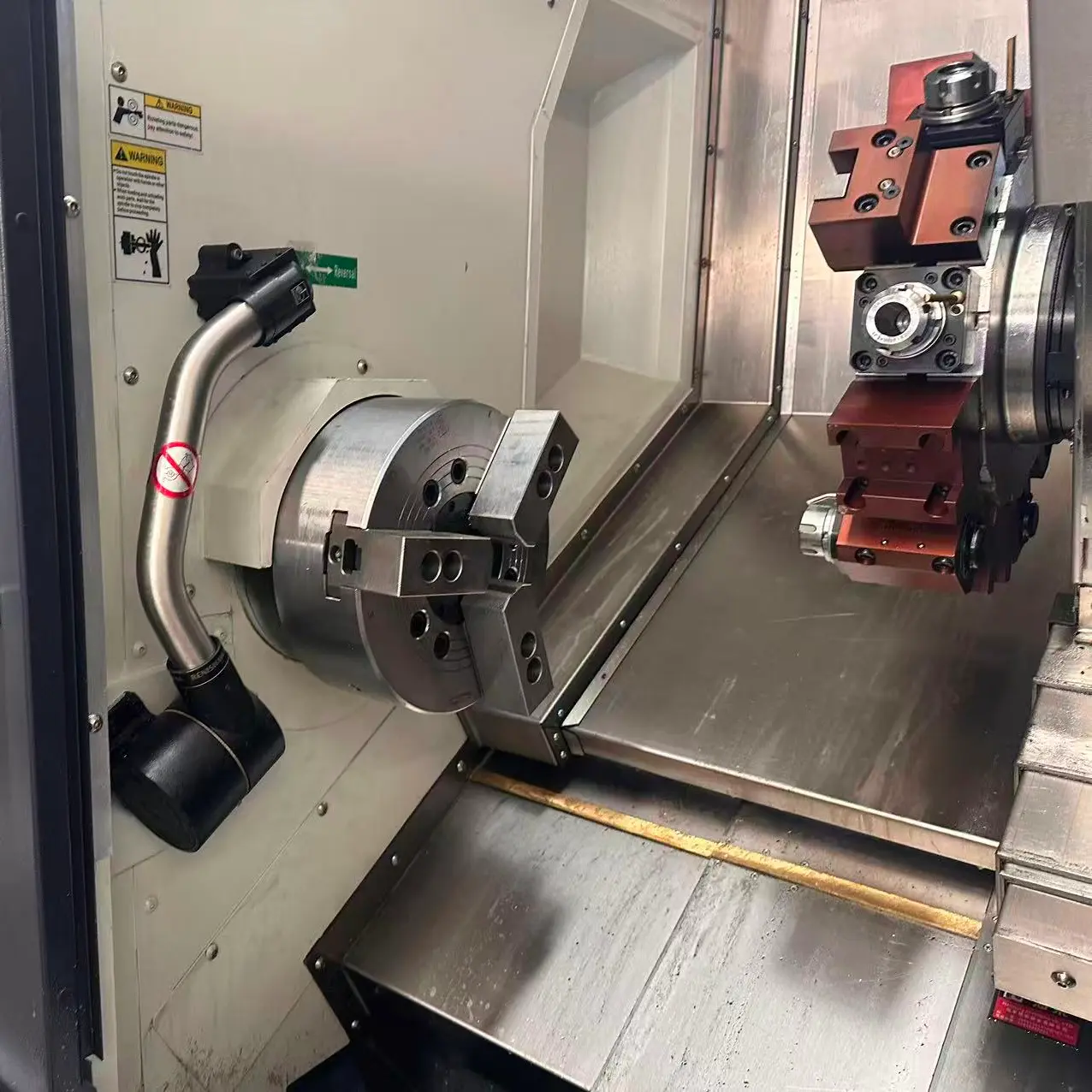
| Slant Bed Turning Center (C/Y Axis or Live Tool) | Same base as 2-axis plus Y±50 mm, C-axis spindle indexing 0.001° | FANUC 0i-TF Plus, Siemens 828D SL, Mitsubishi M80 | Milled flats, drilled cross-holes, polygonal profiles, pump bodies with off-center features | Live tool turret (ER32/ER40 collets), sub-spindle optional, price premium 40–60% over 2-axis; spindle power 11–18.5 kW, 4000–6000 rpm |
| Torno CNC de bancada plana para trabajos pesados | Swing over bed 800–1600 mm, length 1500–8000 mm, chuck 400–800 mm | Siemens 828D, FANUC 0i-TF, GSK 980TDi | Wind turbine shafts, marine propellers, large rollers for steel mills, oil country tubular goods | HT300 or Meehanite casting 12,000–45,000 kg, hardened box ways, spindle bore 130–320 mm, spindle power 22–75 kW, 800–1500 rpm |
| Swiss-Type Sliding Headstock Lathe | Bar capacity 3–38 mm diameter, up to 12 axes with back-working attachments | FANUC 32i-B, Mitsubishi M80, Citizen/LNS proprietary | Watch components, connector pins, surgical screws, long slender shafts L/D > 6 | Guide bushing requires ground bar stock, oil-cooled cutting, sub-spindle and part catcher standard; not for chucked work or large diameters |
| Torno CNC vertical (VTL) | Max turning diameter 1000–4000 mm, max height 800–2000 mm, table 800–2500 mm | Siemens 840D sl, FANUC 31i-B, Mitsubishi M80 | Brake drums, flywheels, large gears, aerospace rings, short heavy parts | Table load 2–40 tonnes, double column or single column, hydrostatic or roller guideways; floor space 4 m × 4 m to 12 m × 12 m |
Torno CNC de bancada plana
Flat bed CNC lathes preserve the horizontal bed layout of conventional engine lathes but add ballscrew-driven axes and programmable control. Typical specifications include X-axis travel 200–400 mm, Z-axis travel 750–3000 mm, spindle nose A2-5 to A2-8, and spindle power 7.5–15 kW at 1500–2500 rpm. Buyers are typically job shops in India, Vietnam, or Egypt upgrading from manual turning, or technical training centres needing a familiar geometry for student instruction. The flat bed’s broad chip pan and open access simplify setup of awkward shafts, but the horizontal bed traps chips against the ways, requiring more frequent scraping and way-cover maintenance than slant designs. These machines rarely exceed 4000 rpm in standard form, so they are poorly suited to small-diameter aluminium work requiring high surface speed. A 380V 50Hz supply is standard; 220V 60Hz markets such as Colombia or Saudi Arabia need a step-up transformer or inverter-duty motor reconfiguration.
Slant Bed CNC Lathe (2-Axis)
The slant bed CNC lathe dominates new machine sales because the angled casting (30° to 45°) uses gravity to clear chips into a conveyor, keeping thermal distortion away from the cutting zone. RUNNEWTECH builds these with linear roller guides (HIWIN or PMI) achieving rapid traverse to 30 m/min and positioning accuracy within ±0.008 mm on a 500 mm swing class. Control options cluster around FANUC 0i-TF for Middle Eastern automotive suppliers, Siemens 828D for Eastern European firms with existing Siemens milling machines, and GSK 980TDi for African job shops prioritising spare part availability from local distributors. Typical buyers run 500–5000 piece batches of hydraulic fittings, bearing races, or motorcycle components. The limitation is geometric: without Y-axis or live tooling, every cross-hole, flat, or hex must be a secondary milling or grinding operation, adding handling cost and concentricity risk.
Slant Bed Turning Center (C/Y Axis or Live Tool)
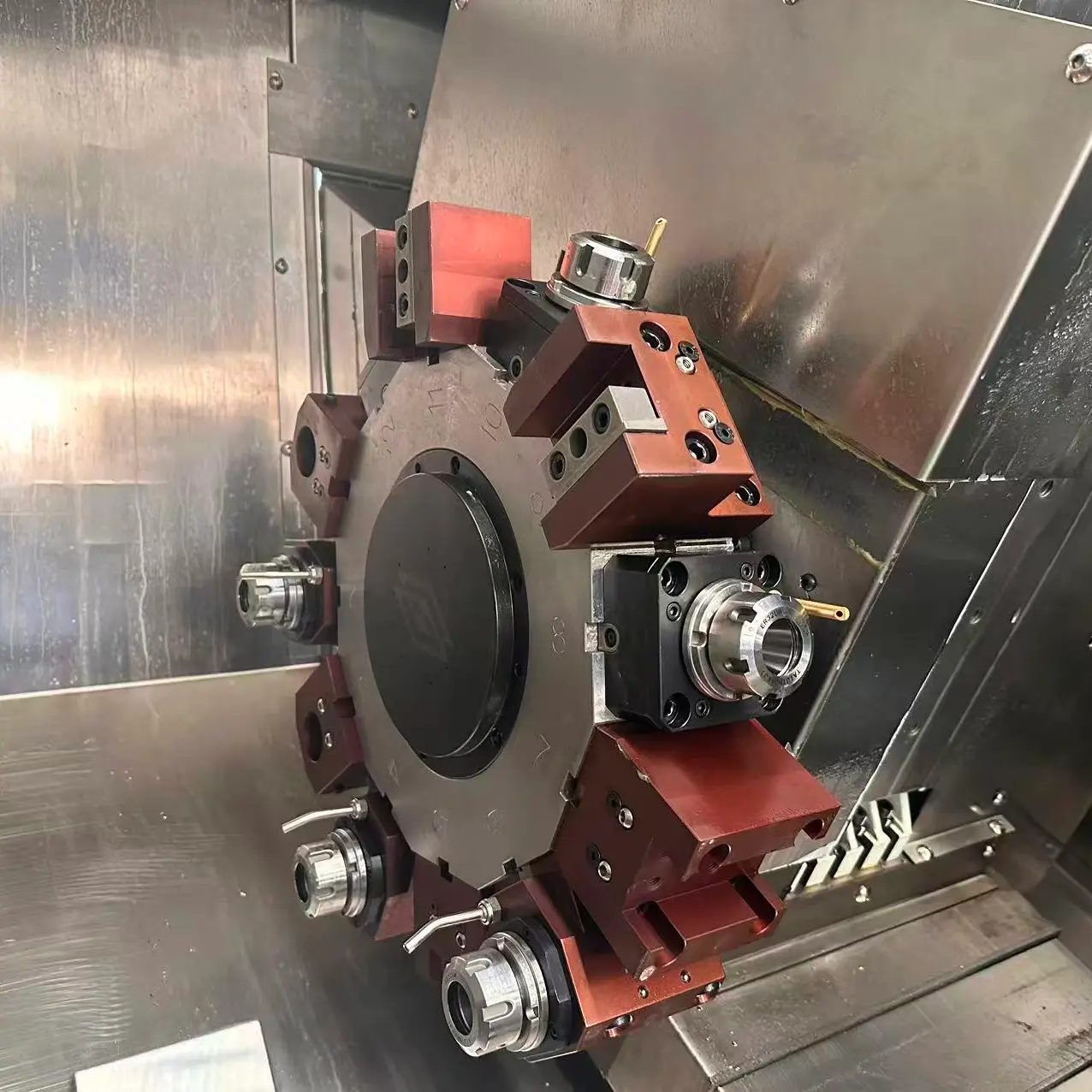
Adding a C-axis spindle encoder and driven tools converts a slant bed lathe into a turning centre capable of off-axis drilling, tapping, and light milling. Y-axis travel of ±25 mm to ±50 mm lets the live tool reach features not on the centreline. Spindle power rises to 11–22 kW, with torque-optimised ranges of 2000–4000 rpm for steel and 6000 rpm for aluminium. The turret holds 12 stations, typically VDI 40 or BMT 55 tooling interfaces. Buyers are Tier 2 automotive suppliers in Mexico and Thailand, medical device contract manufacturers in Malaysia, and valve makers in Turkey who need complete machining in one clamping. What it cannot do: the live tool is not a machining centre; radial milling lacks the rigidity of a BT40 vertical mill, and deep cavity work or heavy side-milling will chatter and shorten tool life. The price premium over a 2-axis slant bed is substantial—expect $45,000–$75,000 FOB depending on control and sub-spindle options—so shops with genuine multi-face work should evaluate whether a twin-spindle turn-mill or a separate machining centre is more productive.
Torno CNC de bancada plana para trabajos pesados
These machines scale the flat bed concept to workpiece masses measured in tonnes rather than kilograms. A 1000 mm swing model with 3000 mm between centres weighs 18,000–25,000 kg, ships in a 40-foot open-top container, and requires a 50-tonne crane for unloading. Spindle bores of 200–400 mm pass oil pipe or large forged blanks. Controls are typically Siemens 828D or FANUC 0i-TF with manual handwheel retraction for safety during heavy interrupted cuts. Buyers include steel mill roll shops in Brazil, wind energy component suppliers in Poland, and railway axle manufacturers in South Africa. The trade-off is speed: maximum spindle speeds of 800–1200 rpm and rapid traverse below 10 m/min reflect the inertia of large chucks and workpieces, not the limitation of the drive. These machines are unsuitable for small precision batches; the thermal mass of the casting takes hours to stabilise, and tooling cost per edge is high when applied to 50 mm shafts.
Swiss-Type Sliding Headstock Lathe
Swiss-type lathes move the bar stock through a guide bushing while tools cut immediately adjacent to the support point, eliminating deflection on length-to-diameter ratios exceeding 10:1. Bar capacity ranges from 3 mm for watch components to 38 mm for automotive sensor housings. Axis counts of 7 to 13 include overlapping slides and a back-working spindle that machines the parted-off rear face. Controls are almost exclusively FANUC or Mitsubishi with customised PLC cycles for bar loader integration. Buyers are medical device specialists in Costa Rica, connector manufacturers in Vietnam, and precision subcontractors in Romania serving German automotive. The machine cannot chuck cast or forged blanks; it demands ground or precision-drawn bar stock, and the guide bushing clearance must match material diameter within 0.02 mm. Setup time is long—tooling a 12-station drum for a new family of parts may take four hours—so batch sizes below 200 pieces rarely justify the changeover.
Torno CNC vertical (VTL)
Vertical CNC lathes clamp short, heavy, or disc-shaped parts to a horizontal table rotating on a hydrostatic or roller bearing turntable. The ram or gantry-mounted tool system machines the outer diameter, face, and bore in vertical planes. Table diameters of 1000–4000 mm accommodate brake drums, gear blanks, and pump impellers weighing up to 40 tonnes. Controls are Siemens 840D sl or FANUC 31i-B with gear cutting packages optional. Buyers are mining equipment rebuilders in Chile, shipyards in Turkey, and wind tower flange producers in India. The VTL cannot machine long shafts; workpiece height is constrained by ram travel and gantry clearance, and the footprint per unit of working volume is large—a 2500 mm table machine needs 8 m × 8 m of floor space plus crane aisle. Foundation requirements are critical: a 30-tonne table load at 100 rpm generates substantial overturning moment, and inadequate concrete or missing anchor bolts will destroy accuracy within months.
Decision Shortlist Checklist
Use this five-point filter before requesting quotations:
- Sobre para envíos parciales: Measure your largest diameter and length. Add 20% for chuck clearance and tool overhang. If your largest part is 600 mm diameter × 1500 mm long, a flat bed 660 mm swing × 2000 mm length is the minimum; a slant bed 520 mm swing is too small.
- Material and cut severity: Cast iron interrupted cuts need box ways and low rpm (flat bed or heavy duty). Aluminium or free-cutting steel at high surface speed favours linear guides and higher rpm (slant bed).
- Tolerance and surface finish: Positioning repeatability of ±0.003 mm is achievable on linear guide slant beds; ±0.010 mm is realistic on entry flat beds with GSK control. Specify Cpk requirements to your supplier.
- Power supply audit: Confirm your shop has 380V 50Hz three-phase with neutral, or budget $800–$2,500 for a step-up/step-down transformer and motor reconnection. A 22 kW spindle plus 7.5 kW coolant pump draws 60A at full load.
- Batch size versus setup flexibility: Under 50 pieces, prioritise quick-change tooling and macro programming; above 1000 pieces, justify bar feeders, gantry loaders, or sub-spindle automation.
Price guidance at 2024 FOB China levels: entry flat bed CNC lathes with GSK control and 400 mm swing start near $18,000; mid-range slant bed 2-axis machines with FANUC or Siemens range $28,000–$45,000; turning centres with C/Y axis and live tooling run $50,000–$85,000; heavy duty flat beds above 1000 mm swing begin at $75,000 and scale to $250,000 depending on length and bore; Swiss-type machines range $120,000–$300,000; small VTLs under 1600 mm table start around $90,000, with large double-column machines exceeding $400,000.

Especificaciones y cómo interpretarlas
| Parámetro | Nivel básico | Gama media | Alta calidad |
|---|---|---|---|
| Bed type | Plataforma plana | Slant bed 45° | Slant bed 60° |
| Diámetro máximo de torneado | 400 mm | 500 mm | 650 mm |
| Longitud máxima de torneado | 750 mm | 1000 mm | 1500 mm |
| Tamaño del mandril | 200 mm (8″) hydraulic | 250 mm (10″) hydraulic | 315 mm (12″) hydraulic |
| Punta del husillo | A2-6 | A2-8 | A2-11 |
| Velocidad del husillo | 3.500 rpm | 3000 rpm | 2.500 rpm |
| Potencia del husillo | 7,5 kW | 11 kW | 18.5 kW |
| Spindle torque | 140 Nm | 280 Nm | 450 Nm |
| Recorrido del eje X | 220 mm | 280 mm | 350 mm |
| Recorrido del eje Z | 800 mm | 1050 mm | 1550 mm |
| Desplazamiento rápido en los ejes X y Z | 20/24 m/min | 24/30 m/min | 30/36 m/min |
| Tipo de guía | Guía de caja endurecida, 400 mm de ancho | Linear roller guide (HIWIN/PMI), 35 mm rail | Linear roller guide (HIWIN/PMI), 45 mm rail |
| Precisión de posicionamiento | ±0,015 mm | ±0,010 mm | ±0,008 mm |
| Repetibilidad | ±0,008 mm | ±0,005 mm | ±0,003 mm |
| Estaciones de la torreta portaherramientas | 8-position electric | 12-position servo | 12-position servo + live tooling |
| Tiempo de cambio de herramienta | 1.2 s | 0.6 s | 0.4 s |
| Live tooling speed | — | 4.000 rpm | 6000 rpm |
| Live tooling power | — | 3.7 kW | 5,5 kW |
| Sistema de control | GSK 980TDi / KND K2000Ti | FANUC 0i-TF / Siemens 828D | FANUC 31i-B / Mitsubishi M80 |
| Tensión de alimentación | 380 V, 50 Hz, trifásico | 380 V, 50 Hz, trifásico | 380 V, 50 Hz, trifásico |
| Carga total conectada | 15 kVA | 25 kVA | 40 kVA |
| Peso neto de la máquina | 2 800 kg | 4 500 kg | 7500 kg |
| Floor space (L×W×H) | 2800×1600×1800 mm | 3500×1900×2000 mm | 4800×2200×2200 mm |
| Casting grade | HT250 | HT300 | HT300, stress relieved |
| Approximate FOB range | $18,000–$28,000 | $35,000–$55,000 | $75,000–$120,000 |
How to Read Each Line of the Specification Sheet
Working range or travels — X-axis is the cross-slide movement (diameter control); Z-axis is the carriage movement along the bed (length control). Match these to your largest part plus 20% clearance for tool approach. A shaft of 850 mm needs at least 1050 mm Z-travel.
Max turning diameter and length — These are the hard limits at the spindle centerline. Check the “swing over bed” versus “swing over carriage”; the latter is smaller because the tool post occupies space. For disc-type parts, diameter dominates. For shaft-type parts, length dominates.
Spindle speed and power — Higher rpm suits aluminum and small-diameter finishing. Higher torque at lower rpm suits stainless steel, cast iron, and heavy roughing. The 7.5 kW entry-level spindle stalls on 316 stainless above 3 mm depth of cut; 18.5 kW holds the cut.
Spindle taper or chuck size — A2-6, A2-8, A2-11 are standard spindle nose forms for direct chuck mounting. Larger numbers mean larger bolt circles and higher clamping force. Hydraulic chucks grip consistently at 25–70 bar; manual chucks are cheaper but slower and less repeatable.
Tipo de guía — Hardened box ways ( scraped or ground cast iron) damp vibration and carry heavy interrupted cuts. They wear-in over years and tolerate dirty coolant. Linear roller guides (HIWIN, PMI, THK) give higher rapid traverse and lower friction but demand cleaner coolant and show wear as lost accuracy, not as smooth operation. For batch production of steel parts, box ways often win. For aluminum and fast cycle times, linear guides win.
Rapid traverse and feed rate — Rapids are non-cutting positioning moves. On a job shop with frequent setups, 30 m/min versus 20 m/min saves measurable idle time per shift. Feed rates during cutting are typically 1/10 to 1/5 of rapid values, constrained by chip load and surface finish.
Positioning accuracy and repeatability — Positioning accuracy is the maximum deviation from commanded position anywhere in travel. Repeatability is the variation when returning to the same point. Repeatability matters more for batch consistency; accuracy matters for first-article correctness. Both are measured with laser interferometer per ISO 230-2, often at 20°C. Your shop’s thermal variation degrades these numbers.
Tool magazine capacity and change time — Turret lathes use indexable tool discs, not chain magazines. More stations reduce setup frequency. Live tooling (driven tools) enables milling, drilling, and tapping on the lathe face or periphery, eliminating second operations. Each live tool station adds $2,000–$4,000 to base price.
Sistema de control — FANUC dominates global resale value and technician familiarity. Siemens 828D offers better conversational programming for shops without CAM. GSK and KND cut $4,000–$8,000 from machine cost but limit resale and require dedicated training. Mitsubishi M80 matches FANUC performance with stronger rigid tapping cycles.
Supply voltage and total connected load — 380V 50Hz is Chinese/European standard. North American 460V 60Hz or 220V 60Hz in some regions requires motor rewinding or a transformer. Connected load determines your electrical service upgrade cost. A 40 kVA machine needs 63A breaker and 25 mm² cable run.
Machine net weight and floor space — Weight correlates with rigidity and vibration damping. A 2800 kg machine chatters on interrupted cuts that a 7500 kg machine absorbs. Floor space includes maintenance access; allow 1 m clearance on all sides for chip removal and service.
Decision Framework: From Your Part to the Specification
Material determines spindle torque and thermal management:
– Aluminum and brass: High rpm, moderate torque, standard coolant
– Mild steel: Moderate rpm, moderate torque, standard coolant
– Stainless steel, Inconel, titanium: Low rpm, high torque, high-pressure coolant (70 bar), rigid machine base
– Cast iron: Moderate rpm, high torque, positive chip evacuation, enclosed guarding for dust
Tamaño máximo de la pieza sets the non-negotiable travels:
– Record your largest existing part and your forecast largest part for the next five years
– Add 20% to diameter for chuck jaw clearance and tool clearance
– Add 150 mm to length for tailstock or part catcher clearance if needed
Requisito de tolerancia drives the control and mechanical grade:
– ±0.05 mm general machining: Entry level with GSK/KND, box ways acceptable
– ±0.02 mm precision: Mid range with FANUC/Siemens, linear guides, thermal compensation
– ±0.005 mm or IT6 fits: High specification with linear scales, spindle thermal monitoring, 0.003 mm repeatability
Tamaño del lote affects automation and changeover:
– 1–10 pieces, high variety: Quick tool preset, conversational control, manual chuck for flexibility
– 50–500 pieces: Hydraulic chuck, bar feeder interface, parts catcher, consistent cycle time
– 1000+ pieces: Full automation with gantry loader, probe for in-process measurement, automatic tool life monitoring
Fuente de alimentación para taller filters the electrical practicalities:
– 380V 50Hz available: Standard Chinese machine, no modification
– 220V 60Hz or 460V 60Hz: Specify motor winding, add $800–$1,500; or add step-up transformer ($2,000–$4,000) with 5–8% energy loss
– Limited service capacity: Entry level at 15 kVA avoids electrical upgrade; high specification at 40 kVA may need utility company involvement
Trade Terms and Export Practicalities
FOB (Libre a bordo) — Seller delivers machine to port of departure, cleared for export. Buyer pays ocean freight, insurance, and destination charges. RUNNEWTECH quotes FOB Qingdao or Shanghai as baseline. You control the shipping line and insurance terms.
CIF (coste, seguro y flete) — Seller adds ocean freight and marine insurance to FOB price. Insurance typically covers 110% of CIF value against total loss or damage. Hidden risk: Destination port handling, customs clearance, and inland delivery remain buyer’s cost and coordination.
CFR (coste y flete) — Seller pays freight to destination port; buyer arranges insurance. Rare in machinery because buyers prefer CIF or FOB.
EXW (En fábrica) — Buyer collects from factory, handles all export clearance and transport. Lowest quoted price, highest buyer burden. Requires Chinese import/export license or agent. Not recommended for first-time buyers.
Payment terms — T/T (telegraphic transfer) is standard: 30% deposit with order, 70% before shipment. L/C (letter of credit) adds $400–$800 bank fees but gives documentary security; useful for first transactions or high-value orders. RUNNEWTECH accepts both; L/C requires 60-day lead time for documentation.
HS code — CNC lathes fall under 8458.11 (numerically controlled lathes). Correct classification determines import duty rate, which varies 0–15% by destination country and trade agreements. Verify with your customs broker before quoting.
CE marking — Indicates conformity with EU machinery directive 2006/42/EC. RUNNEWTECH provides CE technical file, declaration of conformity, and EC-type examination where applicable. CE is not a quality mark; it is a legal requirement for EU import. Non-EU destinations (Southeast Asia, Middle East, Africa) may accept CE as evidence of safety compliance or require additional local certification.
Packing list and certificate of origin — Packing list details each crate’s contents, net/gross weight, and dimensions for customs and unloading planning. Certificate of origin (FORM A or CO) may reduce duty under trade agreements; request at order placement, not after shipment.
Lista de comprobación para la preselección
Before requesting final quotes, confirm:
– [ ] Largest part diameter and length match machine travels with 20% margin
– [ ] Material and operation type (roughing/finishing/live tooling) match spindle torque and power curve
– [ ] Tolerance requirement matches positioning accuracy and repeatability, with thermal stability plan
– [ ] Batch size justifies automation level (hydraulic chuck, bar feeder, gantry loader)
– [ ] Power supply voltage, frequency, and available kVA match machine requirement or transformer budget is allocated
– [ ] Control system matches existing shop knowledge or training budget is allocated
– [ ] Guideway type matches coolant cleanliness maintenance capability and cutting load pattern
– [ ] Foundation load capacity exceeds machine weight plus workpiece weight at maximum extension
– [ ] Crane or forklift capacity at destination exceeds heaviest crate (typically 1.2× machine net weight)
– [ ] CE or required certification documentation is specified in purchase order
– [ ] Spare parts list (turret insert holders, chuck jaws, proximity sensors, ball screw bearings) priced and included or excluded
– [ ] Installation, leveling, and operator training days included in quote or priced separately
Precio de un torno CNC y qué factores lo determinan
| Clase | Rango de funcionamiento típico o potencia | Ejemplo de control o de origen | Precio indicativo FOB en USD |
|---|---|---|---|
| Entry-level flat bed CNC lathe | 500 mm max turning diameter, 1000 mm length, 7.5 kW spindle | GSK 980TDi, KND K1000Ti | 18,000 – 28,000 |
| Torno CNC de bancada plana de gama media | 660 mm swing, 1500–3000 mm length, 11 kW spindle, A2-6 | Siemens 808D, Mitsubishi M80 | 32,000 – 48,000 |
| Slant bed turning center | 400 mm max turning diameter, 650 mm length, 15 kW, 8-station turret | FANUC 0i-TF, Syntec 22TA | 45,000 – 75,000 |
| Torno CNC de bancada plana para trabajos pesados | 1000 mm swing, 5000 mm length, 22 kW, A2-8, 4-jaw chuck 400 mm | FANUC 0i-TF Plus, Siemens 828D | 85,000 – 140,000 |
| Twin-spindle live-tool turning center | Main/sub spindle 15 kW each, Y-axis, 12-station driven turret | FANUC 31i-B, Siemens 840D sl | 120,000 – 200,000 |
Real Cost Structure From Factory Floor to Your Workshop
A CNC lathe shipped from China to a Southeast Asian or Middle Eastern port carries roughly 55–65% of its FOB value in physical machine content, with the remainder consumed by logistics, finance, and destination charges. Here is how the ex-works cost breaks down for a mid-range slant bed turning center with a FANUC 0i-TF package and an indicative FOB of 60,000 USD.
Casting and frame: 12–16% of ex-works. HT250 resin sand casting is standard for entry and mid-range machines; HT300 or Meehanite-grade castings add 8–15% to this line. Stress relief cycle—typically 72 hours for HT250 versus 120+ hours for HT300—determines dimensional stability over five years. A 500 mm swing slant bed machine in HT250 weighs roughly 3,200 kg; the same geometry in HT300 with ribbed reinforcement reaches 4,100 kg.
Guideways and ball screws: 8–12%. Hardened box ways with Turcite-B coating cost less and damp vibration better for interrupted cuts on cast iron or forged steel, but rapid traverse drops to 8–10 m/min. Linear roller guides from HIWIN or PMI raise rapid traverse to 20–30 m/min and reduce stick-slip for tight tolerance work, but add 20–25% to this category. C3 grade ground ball screws are standard; C5 grade (lower cost, looser lead error) appears in the cheapest configurations and shows up as 0.02–0.03 mm repeatability degradation after two years.
Spindle and drive package: 15–20%. A2-5 or A2-6 spindle cartridge with NSK or FAG bearings, 15 kW, 4,000 rpm, with hydraulic chuck and rotary cylinder. A2-8 spindles for heavy pipe or flange work jump to 22 kW, 2,000 rpm, and add roughly 40% here. Belt-driven spindles cost less than direct-drive or built-in motor spindles but impose torque drop-off at low rpm.
Control system and servo package: 18–28%. This is the first of the two largest single line items. FANUC 0i-TF with αi series servos and spindle drive typically runs 14,000–18,000 USD at OEM volume pricing. Siemens 828D with S120 drives is comparable; GSK 980TDi with servo package drops this to 4,000–6,000 USD. The delta in control cost explains why two machines with identical castings and travels can sit 10,000–15,000 USD apart on the quotation sheet.
Tool turret or tool post: 6–10%. 8-station electric turret with Haldex or Sauter internals, 1.2 s indexing. 12-station driven turret for live tooling adds 50–70%. Quick-change tool posts on flat bed lathes drop this to 2–3% but eliminate automated multi-tool sequencing.
Assembly labour and factory overhead: 5–8%. Includes scraping of box ways, ball screw alignment, spindle runout test to 0.005 mm TIR, and 24-hour burn-in. Factories with ISO-level process control spend more here; price-focused workshops compress this cycle.
Export packing: 2–3%. Full sea-worthy crate with moisture barrier, silica gel, and steel banding for container loading. Machines over 6,000 kg may require flat-rack or break-bulk, tripling this figure.
Inland freight to port: 1–2%. From Yangzhou, Tengzhou, or Ningbo to Shanghai or Qingdao port.
Sea freight: 3–6% depending on destination. A 4,000 kg machine in a 40 HQ container to Jebel Ali or Lagos runs 2,500–4,500 USD; to Santos or Guayaquil, 3,500–6,000 USD. Flat-rack for oversized machines adds 30–50%.
Insurance: 0.3–0.5% of CIF value.
Destination duty and VAT: Highly variable. 5–15% duty plus VAT in most Southeast Asian and Middle Eastern markets; up to 25% duty in some African and South American jurisdictions. CE documentation is standard from RUNNEWTECH; CO, Form E, or other preferential origin certificates must be requested at order stage to reduce duty exposure.
Customs clearance and terminal handling: 1,000–3,000 USD depending on port complexity.
Por qué el presupuesto más barato es más barato
The lowest FOB quotation in any competitive tender normally reflects one or more of the following substitutions, which are rarely itemised transparently:
- Lighter casting grade: HT200 instead of HT250, or reduced wall thickness and rib count. Machine weight drops 15–20%, rigidity suffers, and chatter becomes visible on finish passes above 1.5 mm depth of cut.
- Lower-grade ball screw: Unbranded or C7 grade instead of C3 or C5. Lead error accumulates; a 500 mm Z-axis move can drift 0.04–0.06 mm over 12 months of thermal cycling.
- Unbranded linear guide: Domestic Chinese guide with 55CrMoV steel instead of German or Japanese equivalent. Surface hardness and roller consistency vary; premature pitting appears after 8,000–10,000 hours.
- Integrated control-servo package from a single budget vendor: GSK or KND with matched motors is functional and well-supported in China, but servo bandwidth and acceleration tuning for rigid tapping or C-axis interpolation lag FANUC or Siemens by a measurable margin. Cycle time on complex profiles extends 8–15%.
- Omitted features: No hydraulic tailstock, no chip conveyor, no coolant through tool, manual chuck instead of power chuck. Each omission is recoverable at 1,500–4,000 USD post-delivery.
Comparación de los costes de funcionamiento a lo largo de cinco años
Assume 2,000 operating hours per year, electricity at 0.10 USD/kWh, and aluminium/steel mixed production.
| Cost Category | Entry-Level Flat Bed GSK Control | Mid-Range Slant Bed FANUC 0i-TF | Heavy-Duty Flat Bed Siemens 828D |
|---|---|---|---|
| Consumo energético anual | 22,000 kWh (7.5 kW spindle, no regenerative drive) | 28,000 kWh (15 kW, regenerative servos) | 38,000 kWh (22 kW, sustained load) |
| Annual electricity cost | 2,200 USD | 2,800 USD | 3,800 USD |
| Insert and tooling (indexable, coated carbide) | 3,500 USD/year | 4,200 USD/year | 5,500 USD/year |
| Líquidos refrigerantes y de mantenimiento | 800 USD/year | 1,000 USD/year | 1,400 USD/year |
| Ball screw and guide replacement (year 4–5) | 2,500–3,500 USD | 1,200–1,800 USD (C3 grade, preventive) | 2,000–3,000 USD (box way rescrape + screw) |
| Control/servo repair or board replacement | 800–1,500 USD (domestic support, shorter lead time) | 2,500–4,000 USD (FANUC parts, 2–3 week air freight) | 2,200–3,500 USD (Siemens regional stock) |
| Expected unplanned downtime (hours/year) | 45–70 | 20–35 | 30–50 (heavier wear items) |
| Estimated revenue loss at 50 USD/hour shop rate | 2,250–3,500 USD/year | 1,000–1,750 USD/year | 1,500–2,500 USD/year |
The entry-level machine saves 15,000–25,000 USD upfront but accumulates 8,000–14,000 USD in additional running and risk-adjusted cost over five years. The crossover point where FANUC or Siemens control reliability offsets premium pricing is typically 18–24 months in a multi-shift job shop environment.
Decision Framework: Map Your Part to Specification
Use this sequence to convert part requirements into a machine specification before requesting quotations.
Material and cut severity
– Aluminium, brass, free-machining steel: standard 7.5–11 kW spindle, coated carbide tooling, no special requirement.
– 4140, 4340, stainless 316, Inconel: minimum 15 kW, A2-6 or A2-8 spindle with high-torque low-rpm characteristic, ceramic or CBN insert capability. Box way or roller guide with high preload.
Tamaño máximo de la pieza
– Swing over bed defines capacity. Add 100 mm clearance for chuck and tool holder. A 400 mm swing machine cannot safely turn a 380 mm flange with a 200 mm chuck installed.
– Length between centers or maximum turning length determines bed requirement. For shaft work, measure your longest part plus 150 mm for tailstock engagement and tool approach.
Tolerance and surface finish
– General turning ±0.05 mm: entry-level positioning accuracy 0.02 mm, repeatability 0.01 mm sufficient.
– Bearing seats, hydraulic cylinders, ±0.01 mm: require C3 ball screws, 0.005 mm repeatability, thermal compensation or coolant temperature control. Slant bed with 30° inclination aids chip evacuation and reduces thermal distortion.
Tamaño del lote y frecuencia de cambio de producción
– Batch size 1–10, frequent setups: driven tooling, Y-axis, and sub-spindle reduce second-operation handling. Justified above 50,000 USD machine investment only if annual part family volume exceeds 500 pieces.
– Batch size 100+: simple turret, bar feeder interface, and rapid traverse priority. Cycle time reduction of 10% pays back quickly.
Fuente de alimentación para taller
– 380V 50Hz three-phase is standard ex-factory. 220V 60Hz regions (parts of Southeast Asia, South America, North America residential) require a 30–50 kVA step-up transformer, roughly 2,500–4,500 USD installed. Specify at order; retrofitting transformer and reconfiguring servo parameters post-delivery costs 1,500–2,000 USD in technician time.
Shortlist Checklist Before Requesting Quotations
- [ ] Maximum swing and turning length confirmed with 15% margin for future work
- [ ] Spindle power and rpm matched to material removal rate, not just catalogue peak
- [ ] Control brand and servo generation specified (e.g., FANUC 0i-TF, not “FANUC system”)
- [ ] Ball screw grade stated (C3, C5, or C7) and guideway brand named
- [ ] Machine weight noted; cross-check against casting grade and expected rigidity
- [ ] Power supply voltage, frequency, and phase confirmed; transformer requirement clarified
- [ ] Tool turret station count and indexing time stated; live tooling and C-axis if needed
- [ ] Foundation drawing, levelling specification, and crane/forklift capacity for unloading provided by supplier
- [ ] Installation, operator training, and first-year spare parts package included or priced separately
- [ ] CE marking and conformity documentation confirmed for destination customs clearance
All figures are indicative based on RUNNEWTECH’s 2024–2025 export pricing structure and are not binding quotations. Final pricing depends on real-time component costs, currency, and shipping rates at order confirmation.
Aplicaciones industriales del torno CNC
| Sector | Piezas típicas fabricadas | Especificaciones recomendadas | Por qué esta máquina es la más adecuada |
|---|---|---|---|
| Recambios para automóviles y motocicletas | Brake discs, camshafts, wheel hubs, piston rods, drive shafts | Flat bed CNC lathe, 750 mm max turning diameter, 1500 mm max turning length, A2-8 spindle nose, 11 kW spindle motor, 2000 rpm, 0.008 mm positioning accuracy, FANUC 0i-TF control, HT300 casting, 4500 kg machine weight | High torque at low rpm handles interrupted cuts on cast iron; flat bed design accepts heavy fixtures for shaft work; A2-8 nose accommodates 380 mm chucks for disc-type parts |
| Maquinaria agrícola | Gear blanks, axle housings, hydraulic cylinder rods, pulley hubs, bearing seats | Slant bed CNC lathe, 520 mm max turning diameter, 1000 mm max turning length, A2-6 spindle nose, 7.5 kW spindle, 3500 rpm, linear roller guideways (HIWIN/PMI), 0.006 mm repeatability, GSK 980TDi or KND control | Slant bed configuration improves chip evacuation in dusty environments; linear guides maintain accuracy despite temperature swings in unheated shops; 30° bed angle aids gravity chip removal |
| Accesorios hidráulicos y neumáticos | Cylinder barrels, piston rods, valve bodies, connector threads, port adapters | Slant bed CNC lathe with C-axis and live tooling, 360 mm max turning diameter, 650 mm max turning length, A2-5 nose, 5.5 kW main spindle, 4000 rpm, 0.005 mm repeatability, Syntec or Mitsubishi control | Live tooling eliminates second-operation milling on hex faces and cross-holes; C-axis positioning to 0.001° enables precise port drilling; compact footprint suits high-mix low-volume fitting production |
| Acoplamientos para petróleo y gas | API thread couplings, drill pipe tool joints, valve bonnets, flange adapters | Flat bed CNC lathe, 1000 mm swing over bed, 3000 mm between centers, A2-11 spindle nose, 22 kW spindle, 800 rpm, hardened box ways, 0.01 mm positioning accuracy, Siemens 828D or FANUC 0i-TF | Box ways absorb heavy cutting loads on alloy steel; extended bed supports long pipe threading; low rpm high torque matches API thread cutting requirements; 6000 kg machine weight dampens vibration |
| Fabricación de moldes y matrices | Core pins, ejector sleeves, gate inserts, mould cavities, punch blanks | Slant bed CNC lathe with sub-spindle and Y-axis, 400 mm max turning diameter, 550 mm max turning length, A2-6 nose, 11 kW main / 5.5 kW sub-spindle, 6000 rpm, 0.004 mm repeatability, linear guides, FANUC 0i-TF | Sub-spindle completes back-end operations without reclamping; Y-axis off-center milling machines flat faces and keyways; high rpm finish-turns hardened H13 and P20 steels to mirror surface requirements |
| Centros de formación técnica | Student practice shafts, thread exercises, taper turning projects, CNC programming samples | Flat bed CNC lathe, 500 mm max turning diameter, 1000 mm max turning length, A2-6 nose, 5.5 kW spindle, 2500 rpm, GSK 980TDi control, 0.01 mm positioning accuracy, 3200 kg weight, 380V 50Hz standard | GSK control reduces software licensing costs for multiple machines; flat bed visibility aids instructor demonstration; HT250 casting withstands student crashes; simple manual handwheel operation teaches fundamentals before full CNC |
Recambios para automóviles y motocicletas
Automotive production demands machines that handle both ferrous and non-ferrous materials across batch sizes from 50 to 10,000 pieces. A flat bed CNC lathe with 750 mm swing and A2-8 spindle nose accommodates 380 mm three-jaw chucks for brake disc finishing. The 11 kW spindle delivers 2000 rpm maximum with constant torque through 800 rpm, matching the low-speed heavy cuts required for cast iron camshaft roughing. Positioning accuracy of 0.008 mm suffices for most automotive tolerances; tighter requirements move to cylindrical grinding in a second operation. FANUC 0i-TF controls dominate this sector for their widespread technician familiarity and parts program portability between suppliers. Machine weight of 4500 kg on HT300 castings provides the damping needed for interrupted cuts on sand-cast blanks. For motorcycle parts—smaller diameters, higher rpm—specify a 360 mm swing slant bed at 4000 rpm with A2-5 nose and 5.5 kW spindle.
Maquinaria agrícola
Farm equipment manufacturers operate in environments with wide temperature swings and often unheated shops. The slant bed configuration at 30° or 45° bed angle uses gravity to clear chips, reducing manual intervention and coolant contamination in dusty conditions. Linear roller guideways from HIWIN or PMI maintain preload better than box ways through thermal expansion cycles, though they carry less shock load capacity. A 520 mm swing machine with 7.5 kW spindle and 3500 rpm covers gear blanks to 400 mm diameter and hydraulic cylinder rods to 1000 mm length. GSK 980TDi or KND controls reduce acquisition cost by 30-40% versus FANUC while providing adequate threading and macro programming for agricultural part families. Repeatability of 0.006 mm matches the ISO IT8-IT9 tolerances common in this sector. Specify IP54 electrical cabinet sealing minimum.
Accesorios hidráulicos y neumáticos
Fitting production mixes turning, drilling, and milling in single setups to avoid concentricity errors between machined features. A slant bed lathe with C-axis indexing and live tooling eliminates secondary operations on hexagonal wrench flats, cross-drilled lubrication ports, and BSP/NPT thread relief grooves. The C-axis resolution to 0.001° positions drill spindles for port machining at compound angles. Typical specification: 360 mm swing, 650 mm length, A2-5 nose for 200 mm collet chucks, 5.5 kW main spindle at 4000 rpm. Syntec controls integrate live tooling logic cleanly; Mitsubishi offers robust servo hardware for high-frequency tool indexing. Cycle time reduction of 40-60% versus two-machine operation justifies the 25-35% machine price premium. Live tooling turrets accept ER32 or ER40 collets; specify torque rating at 12 Nm minimum for stainless steel fitting bodies.
Oil and Gas Coupling
API specification threads on drill pipe couplings require rigid setups, slow threading speeds, and precise lead control. The flat bed design with hardened box ways supports the 22 kW spindle and 800 rpm maximum through heavy interrupted cuts on alloy steel forgings. Box way machines at 6000 kg weight absorb vibration that would chatter thread forms on linear-guide lathes. Extended beds to 3000 mm between centers hold pipe lengths for single-setup threading; steady rests at mid-span prevent whip on 114 mm diameter pipe. Siemens 828D includes canned cycles for API round and buttress threads; FANUC 0i-TF requires custom macro development. Positioning accuracy of 0.01 mm is acceptable because final thread inspection uses ring gauges, not machine feedback. Specify flood coolant at 20 bar pressure minimum for chip breaking in deep holes.
Fabricación de moldes y matrices
Mould components require geometric tolerances to 0.01 mm and surface finishes to Ra 0.4 µm on hardened steels to 52 HRC. The slant bed lathe with sub-spindle and Y-axis completes core pins and ejector sleeves without reclamping, maintaining concentricity between OD turning and internal boring. Sub-spindle power of 5.5 kW at 6000 rpm handles small-diameter finish work while the 11 kW main spindle roughs. Y-axis travel of ±25 mm enables flat milling and keyway cutting with driven tools. Linear guides support the rapid traverse to 30 m/min needed for non-cutting positioning between detailed features. FANUC 0i-TF with nanometer-scale interpolation aids surface finish. Repeatability of 0.004 mm ensures cavity dimensions repeat across 20-piece mould sets. Machine weight 3800 kg minimum for stability during finish passes.
Centros de formación técnica
Training machines must demonstrate fundamental operations—facing, turning, tapering, threading—while introducing CNC programming without excessive software cost. The flat bed configuration provides visual access for instructors and students; the open bed shows tool engagement clearly. GSK 980TDi controls at roughly one-third FANUC licensing cost allow facilities to purchase six machines versus four, increasing student throughput. Specification: 500 mm swing, 1000 mm length, A2-6 nose, 5.5 kW spindle at 2500 rpm, 0.01 mm positioning accuracy. Manual handwheel mode teaches coordinate concepts before full program execution. HT250 casting at 3200 kg weight survives tooling crashes and improper feeds common in learning environments. Standard 380V 50Hz supply avoids transformer complexity. Specify safety interlocks on chuck and tailstock operation.
Shortlist Checklist by Decision Factor
Part material: Cast iron and heavy steel → flat bed, box ways, A2-8 or larger nose; Aluminum and stainless → slant bed, linear guides, higher rpm; Hardened mould steels → sub-spindle, Y-axis, 6000 rpm capability.
Maximum part size: Under 300 mm diameter × 500 mm length → compact slant bed, A2-5, 5.5 kW; 300-600 mm × 1000-1500 mm → mid-size flat or slant bed, A2-6/A2-8, 7.5-11 kW; Over 600 mm or over 2000 mm length → heavy flat bed, A2-11, 15 kW minimum, box ways.
Tolerance requirement: IT10 or looser → standard 0.01 mm positioning; IT8-IT9 → 0.006 mm repeatability, linear guides; IT7 or finer → 0.004 mm, thermal compensation, consider grinding add-on.
Batch size: 1-50 pieces → quick-change tooling, program storage capacity, live tooling to reduce setups; 500-5000 pieces → dedicated fixtures, bar feeder compatibility, A2-6 for 250 mm chucks; 10,000+ → consider gantry-loaded twin spindle or transfer line integration.
Shop power supply: 380V 50Hz three-phase → standard Chinese specification, no transformer; 220V 60Hz or 415V 50Hz → specify transformer, verify motor derating; single-phase unavailable above 3 kW spindle—upgrade supply or select different machine class.
Cómo realizar un pedido e importar, paso a paso
The three mistakes that most often leave a delivered CNC lathe sitting idle are easy to prevent with one-line fixes:
- Tensión o frecuencia de alimentación incorrectas: Confirm your shop delivers 380V 50Hz three-phase or 220V 60Hz three-phase before signing the purchase order; order a transformer with the machine if they do not match.
- Working range too small for the actual part: Measure your largest existing part’s swing over bed and maximum length, then add 20% to both dimensions for chuck and tool clearance.
- No documentation, backup or consumable source: Require electrical schematics, parameter backups on USB, and a named local supplier for inserts, pull studs, and drive belts before the deposit leaves your account.
Definir el contorno de la pieza y la tolerancia
Start with the part, not the machine. Record the maximum swing diameter you actually cut, the maximum length between centers or chuck face, and the tightest tolerance you must hold repeatedly.
| Part Characteristic | Specification Driver | Typical CNC Lathe Range |
|---|---|---|
| Max swing over bed | Bed width and carriage height | 400 mm to 800 mm |
| Longitud máxima de torneado | Recorrido del eje Z | 500 mm to 3000 mm |
| Bar work diameter | Orificio del husillo | 52 mm to 105 mm |
| Tolerance ±0.01 mm | Positioning accuracy ≤0.015 mm, repeatability ≤0.005 mm | Linear roller guideways preferred |
| Tolerance ±0.05 mm | Positioning accuracy ≤0.02 mm acceptable | Hardened box ways sufficient |
Batch size drives the fixture and automation decision. Under 50 pieces: manual chuck, quick-change tool post. 200–2000 pieces: hydraulic chuck with foot pedal, parts catcher. Above 2000 pieces: consider bar feeder interface, even if not purchased immediately.
Material matters for spindle power and speed. Aluminum and brass need 3500–4500 rpm and lower torque. Stainless steel and Inconel need 2000–3000 rpm with 7.5–11 kW continuous spindle power. Cast iron and medium carbon steel sit in the middle: 2500–3500 rpm, 5.5–7.5 kW.
Selecciona el sistema de control y la ruta de servicio
The control system determines who can repair your machine when it stops at 2 AM.
| Control | Typical Availability | Consideraciones sobre el servicio | Price Position |
|---|---|---|---|
| FANUC 0i-TF | Global | Dealer network in most countries; parts within 48 hours in major cities | Higher |
| Siemens 828D | Europe, Middle East, Southeast Asia | Strong in Eastern Europe; requires Siemens-certified technician | Higher |
| Mitsubishi M80 | Southeast Asia, Japan | Good in ASEAN; weaker in Africa and South America | Mid |
| GSK 980 TDi | China, Africa, Southeast Asia | Factory-direct support from RUNNEWTECH; local technician training provided | Lower |
| KND K2000Ti | China, emerging markets | Similar to GSK; verify spare PLC and I/O module stock locally | Lower |
| Syntec 22TA | Taiwan, Southeast Asia | Strong in ASEAN job shops; English manuals standard | Mid |
If your shop has no FANUC or Siemens technician within 200 km, budget $3,000–$5,000 for factory training or choose GSK/KND with RUNNEWTECH-provided installation training. Request the PLC ladder diagram in editable format, not PDF, if you plan to modify interlocks later.
Confirm Electrical Supply and Transformer Need
Record these four parameters from your shop’s main panel before ordering:
- Tensión: 380V 50Hz three-phase (IEC standard) or 220V 60Hz three-phase (North America, parts of Japan, some Caribbean)
- Phase: Three-phase, never single-phase for CNC lathes above 3 kW spindle
- Frequency: 50 Hz or 60 Hz; affects spindle motor cooling fan speed and control system clock
- Available amperage: Machine plus coolant pump, chip conveyor, hydraulic unit; typically 25–40 A at 380V
If your shop is 220V 60Hz and the machine is built for 380V 50Hz, a step-up transformer is mandatory. Size it at 1.25× the machine’s total connected load. A 15 kW lathe with 5 kW coolant and hydraulics needs 25 kVA minimum, 30–35 kVA recommended. Transformer weight: 80–150 kg; include in unloading plan.
Some controls accept 50/60 Hz automatically. FANUC and Siemens generally do. GSK and KND may need parameter changes or a control-specific transformer—confirm in writing on the quotation.
Comprobar la carga del suelo, los cimientos y la superficie útil
CNC lathe mass concentrates on four leveling pads. Calculate floor loading:
| Tamaño de la máquina | Peso neto | Footprint (L × W) | Point Load per Pad |
|---|---|---|---|
| 6″ chuck, 500 mm swing | 2,500 kg | 2,500 mm × 1,500 mm | ~6,250 N on 150 mm² pad |
| 8″ chuck, 650 mm swing | 4,000 kg | 3,200 mm × 1,700 mm | ~10,000 N on 200 mm² pad |
| 10″ chuck, 800 mm swing | 6.500 kg | 4,500 mm × 2,000 mm | ~16,250 N on 250 mm² pad |
Upper-floor installations in older industrial buildings: verify slab rating, typically 5–10 kN/m². A 6,500 kg machine on a 9 m² footprint exceeds 7 kN/m²; consult a structural engineer or relocate to ground floor.
Foundation requirement: 100–150 mm reinforced concrete pad, level to 0.02 mm/m, with anchor bolt sleeves or epoxy-grouted studs. Allow 1,000 mm clearance on operator side, 800 mm on rear for service. Ceiling height: 3,000 mm minimum for overhead crane clearance.
Confirmar el marcado de conformidad para la aduana
Determine what marking your customs authority accepts as proof of safety compliance:
- CE marking: Required for import into EU member states, EFTA countries, Turkey, and increasingly Middle Eastern customs (UAE, Saudi Arabia as baseline for SASO). Request Declaration of Conformity and technical file summary.
- EAC marking: Required for Russia, Kazakhstan, Belarus, Armenia, Kyrgyzstan.
- No marking: Acceptable in some Southeast Asian and African markets, but verify with your customs broker—requirements change without public notice.
Ask the supplier: “Will you provide the conformity certificate number and the notified body or self-certification route before shipment?” Do not accept “CE ready” or “CE compliant” without documentation. Customs holds without valid paperwork run $200–$500 per day demurrage.
Comparación entre FOB y CIF
| Término | What Supplier Pays | Lo que pagas | Risk Transfer | Best For |
|---|---|---|---|---|
| FOB (Libre a bordo) | Delivery to port, export clearance, loading onto vessel | Ocean freight, marine insurance, destination port charges, customs clearance, inland delivery | When goods cross ship’s rail at origin port | Experienced importers with freight forwarder relationships |
| CIF (coste, seguro y flete) | Delivery to port, export clearance, ocean freight, minimum marine insurance | Destination port charges, customs clearance, inland delivery, any insurance shortfall | Same as FOB—insurance claim is your problem if damage occurs | First-time importers or markets with limited forwarder options |
CIF adds 5–15% to machine price for freight. For a $35,000 lathe, expect $2,500–$5,500 CIF premium to major ports. Always purchase additional all-risk marine insurance; CIF minimum cover is 110% of invoice value but excludes mechanical damage from improper lashing.
Tipo de contenedor y límites de peso de la máquina
| Peso de la máquina | Container Type | Internal Dimensions | Weight Limit | Notas |
|---|---|---|---|---|
| Under 2,200 kg | 20′ GP | 5,900 × 2,350 × 2,390 mm | 21,700 kg payload | Lathe on skid, possibly with chip conveyor removed |
| 2,200–4,500 kg | 20′ OT (Open Top) or 40′ GP | 12,030 × 2,350 × 2,390 mm | 26,680 kg payload (40′) | Tailstock and coolant tank often shipped separately; crane loading required |
| 4,500–8,000 kg | 40′ FR (Flat Rack) | 12,080 × 2,430 × 2,100 mm (collapsible) | 45,000 kg total | Secured with chains and twist-locks; most secure for heavy machines |
| Above 8,000 kg | Breakbulk or RO-RO | Vessel deck space | N/A | Separate ocean freight quotation; longer transit |
Machinery over 3,500 kg in a 40′ container approaches axle weight limits for road transport in many countries. Check your inland route: European Union allows 11,500 kg per axle for standard trucks; some African and Southeast Asian markets limit to 8,000 kg. Overweight permits add cost and delay.
Condiciones de pago del depósito y del saldo
Standard structure for machinery from Chinese manufacturers:
- 30% deposit with order confirmation and signed technical specification
- 70% balance against copy of Bill of Lading, or after factory acceptance test (FAT), or after arrival at destination port
Preferred: balance after FAT with video verification, before shipment. This requires you or your agent to attend FAT or delegate to a third-party inspector (SGS, Bureau Veritas, ~$800–$1,500 per visit).
Letter of Credit (L/C) at sight: adds $400–$800 bank fees, protects both parties for first-time transactions. Avoid 100% advance payment unless supplier is a verified long-term partner with performance bond.
Prueba de aceptación en fábrica antes del pago del saldo restante
Request these verifications during FAT, with video recording:
- Circular test bar: 300 mm length, 50 mm diameter, run at 80% max spindle speed. Measure runout at three positions: ≤0.010 mm for general purpose, ≤0.005 mm for precision grade.
- Positioning accuracy: Laser interferometer or ballbar test per ISO 230-2. X and Z positioning accuracy ≤0.015 mm, repeatability ≤0.005 mm.
- Spindle warmup: 30 minutes at 3,000 rpm, thermal drift on test bar ≤0.020 mm.
- All axis rapid traverse: X-axis 20–30 m/min, Z-axis 24–36 m/min, sustained without alarm.
- Tool changer or turret index: 12-station turret, 0.3–0.6 s per station, all stations repeat to ±0.003 mm.
- Control system backup: Parameter file exported to USB, electrical schematic printed and digital, PLC ladder provided in editable format.
Refuse shipment if FAT fails two consecutive attempts on critical items. Define “critical” in the purchase order: positioning accuracy, repeatability, spindle runout, control system functionality.
Equipos de descarga en el lugar de destino
| Peso de la máquina | Equipamiento mínimo | Capacity Margin |
|---|---|---|
| Under 2,500 kg | Forklift with forks | 1.5× machine weight, 4,000 kg forklift |
| 2,500–6,000 kg | Forklift with forks or telehandler | 1.5× machine weight, 10,000 kg forklift |
| 6,000–12,000 kg | Crane (overhead or mobile) with lifting beam | 1.25× machine weight, certified slings |
| Above 12,000 kg | Mobile crane with spreader beam | Engineer’s lift plan required |
Check container unloading: if machine ships in a 40′ GP, you need a ramp or dock leveler and forklift with 4,000 mm fork length, or a crane to lift from open-top container. Flat rack unloading requires mobile crane with 15 m boom minimum.
Inspect for shipping damage before signing the delivery receipt. Photograph any rust, impact marks, or oil leaks. Concealed damage claims require notification to carrier within 72 hours in most jurisdictions.
Instalación y formación de los operadores
Installation sequence, typically 3–5 days:
- Day 1: Unload, position, level with precision level (0.02 mm/m), grout anchor bolts if required.
- Day 2: Connect power, air, coolant; verify phase rotation with meter; install transformer if applicable.
- Day 3: Load parameters from backup, reference return all axes, spindle orientation test, tool presetting.
- Day 4–5: Cut test piece (typically a stepped shaft with threading), measure, adjust tool offsets, train operators on program upload, editing, and alarm recovery.
Training scope to specify in order: minimum 40 hours on-machine for two operators, covering part programming (G-code or conversational), tool setup, preventive maintenance (grease points, coolant concentration, chip conveyor), and first-level troubleshooting (alarm codes, limit switch checks, fuse replacement).
Request training materials in English or local language: operator manual, maintenance manual, electrical schematic, parts list with exploded views.
Paquete inicial de piezas de recambio y consumibles
Budget 3–5% of machine purchase price for initial spares. Minimum package:
| Categoría | Artículos | Cantidad | Purpose |
|---|---|---|---|
| Herramientas | External turning inserts, threading inserts, grooving inserts | 10 each | First month production without waiting for import |
| Husillo | Pull studs (if BT or similar taper), spindle bearings | 2 studs, 1 bearing set | Critical failure item, 4–6 week lead time |
| Eléctrico | Fuses, contactors, servo motor encoder cables | 2 each | First-level repair capability |
| Hydraulics | Chuck seal kit, hydraulic filter | 1 kit, 3 filters | Annual maintenance |
| Coolant | Coolant pump seal, chip conveyor belt links | 1 seal, 10 links | Common wear items |
| Documentación | Parameter backup USB, PLC program backup, electrical schematic | 2 sets | Disaster recovery |
Confirm consumable availability locally: inserts (Sandvik, Kennametal, Mitsubishi Carbide distributors), hydraulic oil (ISO VG 46, locally sourced), way oil (ISO VG 68). If no local insert supplier exists for your tool holder system (DIN 69880, VDI, or bolt-on), order 50 inserts with the machine.
Lista de comprobación para la preselección
Before final supplier selection, verify:
- Maximum part swing and length fit within machine specifications with 20% margin
- Tolerance requirement matches positioning accuracy and repeatability on quotation
- Control system has service technician within acceptable travel distance
- Shop voltage, frequency, phase match machine nameplate; transformer quoted if needed
- Floor loading and space verified; foundation plan provided by supplier
- Conformity marking confirmed for destination customs
- Incoterms defined: FOB or CIF with port named
- Container type and weight limits checked against inland transport route
- Payment terms include FAT before balance or acceptable L/C structure
- FAT criteria defined in purchase order with pass/fail thresholds
- Unloading equipment capacity confirmed and reserved
- Installation and training hours specified in contract
- Spare parts package quoted and consumable local source identified
- Electrical schematic, parameter backup, and PLC program delivery guaranteed in editable format
Price range for RUNNEWTECH CNC lathes by category: flat bed CNC lathe with GSK control, 6″ chuck, 500 mm swing, 750 mm length, approximately $18,000–$28,000 FOB; slant bed CNC lathe with FANUC 0i-TF, 8″ chuck, 650 mm swing, 1,000 mm length, linear guides, approximately $35,000–$55,000 FOB; heavy duty flat bed with 1,000 mm swing, 3,000 mm length, Siemens 828D, hardened box ways, approximately $65,000–$95,000 FOB. Final price depends on chuck size, spindle bore, tailstock configuration, and automation options.
Máquinas RUNNEWTECH relacionadas

Preguntas frecuentes sobre los tornos CNC
Q: What is the minimum order quantity for a CNC lathe?
Single-unit orders are accepted for all standard models. Flat bed CNC lathes from 500 mm to 1000 mm swing and slant bed models from 36 to 52 mm bar capacity ship as individual machines. Container consolidation discounts apply at three units for 20 GP or six units for 40 HQ. Custom specifications do not trigger MOQ penalties.
P: ¿Qué sistemas de control hay disponibles y qué idiomas de interfaz son compatibles?
FANUC 0i-TF Plus, Siemens 828D, Mitsubishi M80, GSK 980TDi, KND K2000TF, and Syntec 21TB are stocked. English, Spanish, Russian, Arabic, and Turkish interfaces are pre-installed. Parameter manuals and ladder diagrams ship in the selected language. Control selection adds 8–15% to base machine cost for FANUC or Siemens versus GSK or KND.
P: ¿Cuál es el plazo de entrega habitual desde que se realiza el pedido hasta que se envía?
Standard flat bed CNC lathes with GSK control ship in 15–20 days. Slant bed models with FANUC or Siemens require 25–35 days. Custom spindle bore, turret configurations, or automated bar feeders extend to 45–55 days. Peak demand months (March–May, September–November) add 7–10 days. Factory slot confirmation requires 30% deposit.
Q: What are the payment terms?
30% TT deposit to confirm production, 70% TT balance before shipment. Sight letter of credit accepted for orders above $50,000 USD. Machinery dealers with established annual volume may negotiate 20/80 terms after two completed orders. No consignment or deferred payment arrangements for first-time buyers.
Q: Can the machine run on our local power supply?
Standard configuration is 380V 50Hz three-phase. 220V 60Hz (North America, parts of Southeast Asia) requires a step-up transformer, typically 30–50 kVA for flat bed models and 15–25 kVA for slant bed machines. Transformer cost ranges $800–$2,500 depending on local regulation quality. Specify voltage tolerance ±10% and frequency at order stage; factory pre-configures motor windings and contactor coils.
P: ¿Cómo se envía la máquina y cuál es el plazo de entrega?
Flat bed CNC lathes 500 mm swing (net weight 2,800–3,500 kg) load one per 20 GP container. Larger 750–1,000 mm swing machines or multiple units require 40 HQ. Slant bed models under 2,000 kg allow two units per 20 GP with removed tailstocks. Transit time: 18–25 days to Southeast Asian ports, 30–40 days to Middle East, 35–45 days to Africa and South America, 25–30 days to Eastern Europe. CIF terms standard; FOB Qingdao available.
Q: What warranty and spare parts support is provided?
12-month warranty on mechanical and electrical components from bill of lading date. Control system warranty follows manufacturer terms: FANUC and Siemens provide 24-month parts coverage through their global service network. Critical spare parts package—turret tool holders, spindle bearings, encoder, proximity switches, fuses—ships with machine at $800–$1,500 depending on turret station count. Post-warranty parts ship within 72 hours from Qingdao or Dubai stocking point.
Q: Is factory acceptance testing and accuracy documentation provided?
Yes. Each machine undergoes ball bar test and laser interferometer verification. Positioning accuracy 0.015 mm/300 mm and repeatability 0.008 mm are recorded on flat bed models with hardened box ways; 0.010 mm/300 mm positioning and 0.005 mm repeatability on slant bed models with HIWIN linear roller guides. Test report, CE declaration, and original certificate of conformity ship with documents. Optional witness inspection at factory accepted; buyer bears travel and accommodation.
Q: Does installation and operator training come with the machine?
Installation and commissioning included under CIF terms: one technician for 5–7 days, covering leveling, geometric alignment, spindle runout verification, and parametric programming for buyer’s first article. Training covers G-code, tool offset, work coordinate setup, and maintenance scheduling. Interpreter provided for English, Spanish, or Russian. Additional technician days at $180/day plus lodging. Remote diagnostic support via Ethernet port standard on FANUC, Siemens, Syntec controls.
Q: What tolerance can your CNC lathe hold on my material?
On mild steel and cast iron: ±0.01 mm diameter tolerance achievable in stable environment with proper insert grade. Stainless steel 304/316: ±0.015 mm due to work-hardening; reduce depth of cut to 0.5–1.0 mm and spindle speed to 60% of rated maximum. Aluminum: ±0.008 mm with sharp polished inserts and high-pressure coolant. Repeatability figures assume ISO 230-2 test conditions; actual shop tolerance degrades 30–50% with poor foundation or temperature swings beyond 5°C.
Q: What are the annual consumables costs?
Insert cost dominates: $2,500–$4,000/year for moderate production (2,000 hours) using coated carbide. Hydraulic oil 46#: 80 liters initial fill, $180; annual replacement $120. Way lubrication oil: $90/year. Coolant concentrate: $600/year at 6% mix ratio. Turret index mechanism maintenance: $400 every 8,000 hours. Spindle belt replacement: $220 at 10,000 hours. Budget $4,500–$7,000 annually for a single-shift operation.
P: ¿Pueden facilitar la documentación CE necesaria para el despacho de aduana?
CE machinery directive 2006/42/EC compliance declaration, EC-type examination certificate for electrical components, and EN 60204-1 safety of machinery electrical equipment report provided. Harmonized code 8458.11.00 for horizontal lathes. Technical construction file available for customs inspection upon request. Note: CE marking is affixed at factory; importer responsibility applies for in-country electrical inspection in some jurisdictions. No additional certification cost for standard export documentation.
Aviso importante
Las especificaciones, los datos de precisión y los rangos de precios que figuran en esta guía son orientativos y se facilitan con fines de planificación.
solo a efectos informativos. Rango de funcionamiento real, tolerancia alcanzable, disponibilidad del sistema de control, requisitos de tensión de alimentación y conformidad
El etiquetado varía según el modelo y el país de destino. Los compradores deben comprobar por sí mismos la tensión y la frecuencia de la red eléctrica, la carga admisible del suelo y
los cimientos, el equipo de descarga y los requisitos de importación antes de realizar un pedido. Todas las cifras están sujetas a confirmación por escrito en
la última factura proforma emitida por RUNNEWTECH.
Adquisición de un torno CNC de RUNNEWTECH
Once you have mapped your part requirements to the specification framework above, the remaining step is to verify that your supplier can deliver a machine configured for your exact conditions rather than forcing you to adapt to a stock configuration.
Why Source CNC Lathes from RUNNEWTECH
Runlongjia Machinery, founded in 2010, has manufactured and exported metalworking machinery for more than 15 years. The RUNNEWTECH product range covers flat bed CNC lathes, slant bed CNC lathes, CNC machining centers, and complementary equipment including CNC fiber laser cutting machines and conventional lathes. This breadth matters when you are equipping a complete shop and prefer consolidated sourcing with compatible control architectures.
Configuration and Export Readiness
RUNNEWTECH builds CNC lathes with control options spanning FANUC, Siemens, Mitsubishi, GSK, KND, and Syntec. Voltage and frequency are adapted to your local supply—380V 50Hz, 220V 60Hz, or other—without forcing an external transformer purchase unless your facility specifically requires isolation. Machines are run-in and factory acceptance tested before packing. Each unit ships in plywood cases with rust protection, quoted FOB or CIF to your destination port.
Post-Delivery Support
The standard package includes installation guidance, operator training material, remote commissioning support, and spare parts availability. For a 500 mm swing flat bed CNC lathe with HT300 casting, linear roller guideways, and A2-6 spindle nose, expect a net weight near 3,200 kg and plan your unloading crane or forklift accordingly. Slant bed machines with 12-station turrets and 36 mm bar capacity typically run 2,800–4,500 kg depending on bed length and tailstock configuration.
Solicita tu producto a medida
Send your workpiece material, maximum part diameter and length, required tolerance, target batch size, and destination port to RUNNEWTECH via email or the runnewtech.com contact form. You will receive a configured quotation within 24 hours.
Solicita un presupuesto directo de fábrica para un torno CNC
RUNNEWTECH se dedica a la fabricación de maquinaria para el trabajo del metal desde 2010,
con más de 15 años de experiencia en exportación. Las máquinas se suministran con el sistema de control que usted elija, adaptado a su red eléctrica
tensión y frecuencia; se somete a pruebas de rodaje y de aceptación en fábrica antes de su embalaje. Envíenos el material de su pieza de trabajo, el tamaño máximo de la pieza,
Indíquenos la tolerancia requerida y el puerto de destino, y le enviaremos un presupuesto en un plazo de 24 horas.

 English
  Indonesian
  Vietnamese
  Arabic
  Russian
  Spanish