
Guía para la compra de centros de mecanizado CNC
Un auténtico Centro de mecanizado CNC manufacturer in China operates an assembly floor with scraped guideways, a foundry or documented casting source, and keeps laser interferometer and ball bar records for every machine shipped. Trading offices rent showroom space and outsource everything; they cannot adjust spindle bearing preload, scrape a box way to 0.015 mm/1000 mm straightness, or dispatch an engineer when your BT40 taper runs 0.008 mm TIR.
This page walks through six verification points: physical production assets, geometric accuracy documentation, factory acceptance test protocols, payment structure risk, after-sales engineering capability, and how each item affects your quoted lead time and final landed cost.
Own Foundry or Verified Casting Source
Ask for the foundry name and casting grade. HT250 suffices for light-duty VMCs under 800 kg table load; HT300 or Meehanite is standard for 1000 mm Y-travel machines handling BT50 spindles at 15 kW. A manufacturer without foundry control should produce mill test certificates from a long-term supplier and show you rough casting inventory on video. Trading companies show polished assembly halls with no metal chips on the floor.
Assembly Floor and Hand Scraping
Box way machines require manual scraping to achieve 0.015 mm/1000 mm straightness and 0.01 mm contact points per 25 mm × 25 mm. Linear roller guide machines (HIWIN or PMI) need less scraping but still require scraped mating surfaces for preload. Request photos of the scraping floor with granite straightedges and blue-dye check patterns. A 1000 kg to 3000 kg machine needs 10 to 20 days of scraping and fitting before spindle installation.
Laser Interferometer and Ball Bar Records
Demand documented geometric accuracy: positioning accuracy ±0.005 mm, repeatability ±0.003 mm, measured with a laser interferometer over full X/Y/Z travel. Ball bar tests at 100 mm radius verify servo mismatch and reversal spikes. Manufacturers keep these records per serial number; resellers produce generic templates. Ask for a sample report with actual serial number, date, and technician signature.
Factory Acceptance Test and Runoff
A real builder offers FAT with your fixture blank or test piece: 50 to 100 holes on a grid, surface finish Ra 1.6 on mild steel, contour milling at 80% rated spindle speed. The test runs 4 to 8 hours with thermal compensation active. Without FAT, you discover ball screw pitch error or spindle thermal drift after the machine clears customs.
Payment Structure and Risk
Manufacturers typically structure payment as 30% T/T deposit, 70% against copy of B/L, or 30/60/10 with 10% retention after installation. Trading companies often demand 50% upfront and push for 100% before shipping. Escrow through Alibaba or documentary credit adds 2% to 4% cost but protects against non-shipment. A builder with cash flow from domestic sales can afford standard export terms; a trader cannot.
Capacidad de ingeniería de posventa
Verify: resident service engineers in your region, stocked spare parts warehouse (spindle bearings, ball screws, servo motors), and remote PLC/CNC diagnostic access. FANUC and Siemens controllers allow remote monitoring; GSK and KND require more local presence. Ask for response time commitment: 48 hours for Southeast Asia, 72 hours for Africa or South America. A manufacturer keeps service records; a trader forwards your WhatsApp to a third party.
Lead Time and Price Drivers
Standard VMC lead time runs 35 to 55 days for castings in stock, 75 to 90 days if casting molds are made fresh. BT40, 8000 rpm, 7.5 kW machines with GSK 980MDc or Syntec 22MA start near $28,000 FOB Qingdao; BT50, 6000 rpm, 15 kW with FANUC 0i-MF Plus and linear scales push past $55,000. Fourth axis, chip conveyor, and CTS through-spindle coolant add $3,000 to $8,000 each. Transformer for 380V 50Hz to 220V 60Hz: $800 to $1,500. Foundation bolts and leveling pads: $200. Crane or forklift for unloading 4500 kg machines: minimum 6-ton capacity.
Tipos y configuraciones de los centros de mecanizado CNC
| Tipo o clase | Rango de trabajo habitual | Opciones de control | Ideal para | Notas |
|---|---|---|---|---|
| Compact 3-Axis Vertical (VMC 650–850) | X/Y/Z: 600/500/500 mm to 800/500/550 mm | GSK 25i, KND 2100Ti, FANUC 0i-MF, Mitsubishi M80 | Job shops, training centres, first-time CNC buyers, small automotive and agricultural parts | 7,000–10,000 rpm direct-drive spindle, BT40 taper, 3.7–7.5 kW spindle power, 0.008 mm positioning accuracy, 24–30 m/min rapid traverse, 3,500–5,500 kg machine weight |
| Mid-Size 3-Axis Vertical (VMC 1060–1370) | X/Y/Z: de 1.000/600/600 mm a 1.300/700/700 mm | FANUC 0i-MF Plus, Siemens 828D, Syntec 22MA | General machine shops, mould and die shops, medium batch production | 8,000–12,000 rpm, BT40 or BT50, 7.5–15 kW, 0.006–0.008 mm positioning accuracy, linear roller guideways (HIWIN/PMI) or hardened box ways, 6,000–9,000 kg |
| Heavy-Duty Box Way Vertical (VMC 1580–1890) | X/Y/Z: 1,500/800/700 mm to 1,800/900/800 mm | FANUC 0i-MF Plus, Siemens 828D, Mitsubishi M80 | Heavy cutting, cast iron, steel forgings, roughing operations | 6,000–8,000 rpm, BT50 only, 15–22 kW, hardened box ways (HT300 casting), 0.010 mm positioning accuracy, slower rapids at 16–24 m/min, 10,000–14,000 kg |
| Horizontal Machining Center (HMC 500–630) | X/Y/Z: 700/700/800 mm to 1,000/900/900 mm pallet | FANUC 31i-B, Siemens 840D sl, Mitsubishi M800 | Automotive transmission cases, hydraulic valve bodies, high-volume palletised production | Twin-pallet APC, 1° or 0.001° indexing, BT40 or BT50, 12,000–15,000 rpm, 11–18.5 kW, 0.005–0.008 mm accuracy, 14,000–22,000 kg |
| 5-Axis Vertical Machining Center (5AX 320–650) | X/Y/Z: 320/320/300 mm to 650/650/500 mm + A/C or B/C trunnion | FANUC 31i-B5, Siemens 840D sl, Syntec 60WA | Aerospace impellers, medical implants, complex mould cores, prototype-to-medium batch | 12,000–20,000 rpm, HSK-A63 or BT40, 7.5–15 kW, 0.005 mm positioning/0.003 mm repeatability, full simultaneous contouring, 6,000–12,000 kg |
| Centro de mecanizado de pórtico/de doble columna | X/Y/Z: 1,600/1,000/600 mm to 3,000/2,000/1,000 mm | FANUC 31i-B, Siemens 828D/840D sl | Large aerospace panels, machine base fabrication, energy sector components | BT50 or HSK-A100, 6,000–10,000 rpm, 18.5–30 kW, HT300 or Meehanite casting, 18,000–45,000 kg, requires foundation bolts and levelling |
Vertical compacto de 3 ejes
This is the entry point for most machine shops crossing from manual to CNC operations. Typical models like the VMC650 or VMC850 offer enough X/Y/Z travel for brake caliper brackets, pump housings, and agricultural linkage parts without demanding excessive floor space or electrical supply. Buyers are typically job shops with 2,000–5,000 kg overhead crane capacity, technical training centres buying 3–5 units at once, or automotive Tier-3 suppliers who need dedicated machines for single-part families. The trade-off is rigidity: at 3,500–5,500 kg total weight these machines lack the damping mass for heavy interrupted cuts in steel, and the BT40 taper at 7.5 kW will stall before completing a 20 mm depth-of-cut slot in 4140. Controls in this class are price-sensitive; GSK or KND keeps capital cost down but sacrifices macro programming flexibility and network integration compared to FANUC. Expect 25–35 day factory lead time and FOB Shanghai pricing starting around USD 28,000–42,000 depending on control and linear guide brand.
Vertical de 3 ejes de tamaño medio
The workhorse class. VMC1060 and VMC1370 machines dominate general machine shops across Southeast Asia and Eastern Europe because they swallow 80 percent of typical mould bases, manifold blocks, and motor end bells without the premium of larger machines. Spindle power at 11–15 kW with BT50 option allows face milling alloy steel at proper speeds, while linear roller guideways on the X and Y axes push rapid traverse to 36–48 m/min for faster positioning between drilled hole patterns. The typical buyer runs 10–30 machines and needs proven reliability with overnight parts availability. Siemens 828D with ShopMill conversational programming is popular here for shops that bridge German automotive contracts and local operator skill levels. These machines normally ship 40–55 days after order confirmation; a 40-foot high-cube container fits one VMC1370 at roughly 8,500 kg with disassembled chip conveyor. What this class cannot do: true 4th-axis contouring (requires rotary table add-on), or sustained heavy roughing without chatter if fitted with linear guides on all axes—specify box ways on Z if roughing dominates the cycle.
Guía de caja vertical de alta resistencia
When the part starts at 50 kg and the first operation removes 60 percent of the raw forging mass, this is the specified class. The VMC1580 and up run hardened box ways on all axes, not linear rollers, because the sliding contact distributes load across cast iron scraped surfaces better than rolling elements under heavy chip loads. Spindle speeds stay modest at 6,000–8,000 rpm because the BT50 holders grip shell mill arbors and large face mills that would imbalance at higher revolutions. Typical buyers are agricultural machinery manufacturers machining gearbox housings from HT250 castings, or steel foundry suppliers roughing weldment prep. Machine weight hits 10,000–14,000 kg, so floor loading and foundation requirements matter: a 200 mm reinforced concrete slab with M16 anchor bolts is minimum, and unloading needs a 10-tonne forklift or gantry crane. The penalty is speed—rapid traverse at 16–24 m/min and acceleration under 0.3G means non-cutting time stretches on small features. These machines are not for aluminium aerospace work; the spindle cannot rev high enough and the box ways add unnecessary friction.
Centro de mecanizado horizontal
The HMC separates production shops from general job shops. With a twin-pallet automatic pallet changer (APC), the operator loads fixture A while machine cuts fixture B, reducing non-cutting time to under 10 seconds per pallet swap. The horizontal spindle orientation lets chips fall away from the cutting zone naturally, critical for cast iron transmission cases and ductile iron hydraulic manifolds where chip recutting destroys surface finish and tool life. Indexing tables at 1° increments (or 0.001° on high-end models) allow 4-sided machining in one clamping, holding true position within 0.005 mm for bore-to-bore alignment across pallet rotations. Buyers are automotive transmission plants, hydraulic valve OEMs, and high-volume agricultural equipment makers running 500+ identical parts monthly. The barrier is capital and space: HMC500 machines start around USD 85,000 FOB and climb past USD 180,000 for HMC630 with FANUC 31i-B and full 4th-axis contouring. A 40-foot container ships one unit; machine weight at 14,000–22,000 kg requires 16-tonne minimum crane at destination. What it cannot do: economically justify itself at batch sizes under 50 pieces, or handle very large single-face plates—the horizontal envelope favours cubic parts over flat sheet work.
5-Axis Vertical Machining Center
Simultaneous 5-axis machining centres in the 320–650 mm travel range solve tool access problems that would otherwise require multiple setups, custom fixtures, or EDM finishing. The A/C trunnion table tilts the part while the spindle stays vertical, or B/C configurations tilt the head for larger part envelopes. Aerospace impeller blades, titanium medical femoral knees, and complex injection mould cores with deep rib features are the target applications. Accuracy demands are tighter here: 0.005 mm positioning and 0.003 mm repeatability are baseline, verified with laser interferometer and ball bar records before factory acceptance test. Controls must handle TCP (tool centre point) compensation and look-ahead for 5-axis simultaneous paths; FANUC 31i-B5 and Siemens 840D sl dominate, with Syntec 60WA gaining ground in cost-sensitive Asian markets. The buyer profile is aerospace sub-contractors with AS9100 requirements, medical device startups, and precision mould shops serving automotive lighting. Lead times stretch to 60–90 days due to trunnion casting procurement and geometric accuracy alignment. The limitation is not size—parts over 400 mm in any dimension strain trunnion bearing capacity and demand the much larger, pricier gantry 5-axis platforms. Additionally, 5-axis programming requires CAM software and operator skill that many job shops lack; buying the machine without post-processor investment wastes the capability.
Gantry and Double-Column Machining Center
For parts measured in metres, not millimetres, the gantry or double-column design removes the table from the centre of the machine and suspends the spindle from a cross-rail between two vertical columns. This eliminates workpiece weight deflection—critical when machining 2,000 kg wind turbine bearing rings or 6-metre aluminium aerospace bulkheads. X-axis travel commonly spans 1,600 mm to 3,000 mm, with some platforms reaching 6,000 mm or more with floor-mounted linear guideway extensions. The casting is HT300 or Meehanite grade, stress-relieved, and often filled with polymer concrete for vibration damping. Spindle power runs 18.5–30 kW at BT50 or HSK-A100 taper, with gear-driven low-speed torque for steel and direct-drive high-speed options for aluminium. Buyers are energy sector fabricators, large aerospace tier-1 suppliers, and machine tool builders machining their own cast beds. The practical realities are substantial: foundation design with isolation pads, 45,000 kg machine weight requiring pit-mounted installation in some cases, and 380V 50Hz three-phase supply with 100 kVA minimum. A 40-foot container ships only the cross-rail and columns; final assembly occurs at the customer’s factory with factory technician supervision over 10–14 days. These machines cannot economically machine small batches of diverse parts—the setup time and floor space penalty makes them unsuitable for job shops under 1,000 square metres.

Especificaciones y cómo interpretarlas
| Parámetro | Nivel básico | Gama media | Alta calidad |
|---|---|---|---|
| X/Y/Z Travels (mm) | 600/400/450 | 1000/600/600 | 1500/800/700 |
| Conicidad del husillo | BT40 | BT40 | BT50 |
| Max Spindle Speed (rpm) | 8,000 | 12,000 | 10,000 |
| Potencia del husillo (kW) | 7.5 | 11 | 18.5 |
| Desplazamiento rápido en los ejes X/Y/Z (m/min) | 30/30/24 | 48/48/36 | 36/36/24 |
| Precisión de posicionamiento (mm) | ±0,010 | ±0,008 | ±0,005 |
| Repetibilidad (mm) | ±0,006 | ±0,005 | ±0,003 |
| Capacidad de la revista «Tool» | 16 (armless) | 24 (tipo de brazo) | 30 (arm type) |
| Tool Change Time (chip-to-chip) | 6 segundos | 2.5 sec | 2.2 sec |
| Sistema de control | GSK 25i / KND 2000M | Mitsubishi M80 / Syntec 22MA | FANUC 0i-MF Plus / Siemens 828D |
| Tipo de guía | Guía de caja endurecida (X/Y), guía de caja (Z) | Guía lineal de rodillos (HIWIN/PMI) | Linear roller guide (HIWIN/PMI), hardened and ground |
| Peso neto de la máquina (kg) | 3,200 | 5,800 | 12,500 |
| Superficie ocupada: L × W × H (mm) | 2,200×1,800×2,400 | 3,200×2,600×2,700 | 4,500×3,200×3,100 |
| Tensión de alimentación | 380 V, 50 Hz, trifásico | 380 V, 50 Hz, trifásico | 380 V, 50 Hz, trifásico |
| Carga total conectada (kVA) | 15 | 25 | 45 |
How to Read Each Line of the Specification Sheet
Ámbito de trabajo o recorrido (X/Y/Z) — These numbers define the maximum cube you can machine in one setup. A 600/400/450 mm machine handles small brackets and molds up to roughly 400 mm in the longest dimension. A 1500/800/700 mm machine takes automotive subframes or large injection mold halves. The Y-axis travel often limits whether you can use a tombstone fixture with parts on both faces.
Velocidad y potencia del husillo — 8,000 rpm with 7.5 kW suits mild steel and cast iron with carbide inserts. 12,000 rpm at 11 kW handles aluminum aerospace pockets and finish passes in hardened steel. The 18.5 kW BT50 spindle at 10,000 rpm delivers the torque for heavy roughing in 4140 steel or titanium; lower speed here trades ultimate rpm for mechanical advantage. Check the duty cycle: continuous rating versus 30-minute peak.
Spindle Taper (BT40 vs BT50) — BT40 uses a 40-taper interface, max tool weight around 8 kg, common for tools up to 25 mm diameter in steel. BT50 uses a 50-taper with larger flange, handles tools to 15 kg and 50 mm diameter, and resists pull-out during aggressive interrupted cuts. BT50 machines cost 15–25% more for the spindle assembly alone. A shop doing mostly aluminum and light steel loses money specifying BT50.
Desplazamiento rápido y velocidad de avance — Rapids move the table between cuts; feed rates move it during cutting. 48 m/min rapid on a mid-range linear guide machine reduces non-cutting time to under 10% of cycle time on small parts. Box way machines top out at 24–30 m/min rapids because sliding friction generates heat and stick-slip. Feed rates during cutting are typically 5–15 m/min in steel and 20–40 m/min in aluminum, well below rapid limits.
Precisión y repetibilidad del posicionamiento — Positioning accuracy (±0.010 mm entry level) measures how close the commanded position matches actual position across the full travel. Repeatability (±0.006 mm) measures how closely the machine returns to the same point after a full traverse. Repeatability matters more for batch consistency; accuracy matters for first-article conformance to print. Laser interferometer verification per ISO 230-2 should accompany any machine claiming these numbers.
Capacidad y tiempo de cambio de la revista «Tool Magazine» — 16 tools in an armless carousel means manual intervention for complex jobs. 24 tools with a swing-arm changer supports unattended overnight running on families of parts. Chip-to-chip time includes spindle orient, Z retract, arm swap, and re-engage; 6 seconds versus 2.2 seconds adds 3–8 minutes per hour of spindle-on time depending on tool changes per part.
Sistema de control — GSK 25i and KND 2000M cost 40–60% less than FANUC or Siemens and handle 3-axis milling competently. Mitsubishi M80 and Syntec 22MA offer macros, look-ahead, and Ethernet for mid-complexity work. FANUC 0i-MF Plus and Siemens 828D provide 5-axis transformation, high-speed machining packages, and global parts availability. Control choice drives 10–20% of total machine price and 90% of your operator training burden.
Tipo de guía — Hardened box ways (HT250 or HT300 cast, scraped to 8–12 contact points per 25×25 mm) damp vibration and tolerate intermittent heavy cuts. Linear roller guides (HIWIN HG series or PMI MSA series) reduce friction, enable higher rapids, and show less thermal drift but carry 20–30% less load capacity and require sealed environments. Mixed configurations (linear X/Y, box Z) attempt compromise; results vary by builder scraping skill.
Peso neto de la máquina y superficie ocupada — Weight correlates with rigidity for cast-iron-base machines. A 3,200 kg machine with 600 mm travels sits on standard industrial flooring without reinforcement. A 12,500 kg machine needs 200 mm reinforced concrete with anchor bolts and leveling pads. Floor space includes coolant tank, chip conveyor, and operator access; add 1,000 mm minimum on all sides for maintenance.
Tensión de alimentación y carga conectada — Chinese builders standardize on 380V 50Hz 3-phase. North American 220V 60Hz or 460V 60Hz requires a step-up/step-down transformer sized at 1.5× connected load to handle starting inrush. A 25 kVA machine needs a 40 kVA transformer minimum. Voltage stability must stay within ±10%; rural Southeast Asian or African plants often need additional line conditioning.
Price Drivers and Lead Time
Base machine cost structure — Entry level 600 mm travels with GSK control and box ways: USD 28,000–35,000 FOB Shanghai. Mid-range 1000 mm travels with Mitsubishi M80 and linear guides: USD 55,000–72,000. High specification 1500 mm travels with FANUC 0i-MF Plus, BT50, and full enclosure: USD 120,000–180,000. These ranges reflect 2024–2025 export pricing from Yangzhou, Ningbo, and Shenzhen production bases.
What moves price within each tier — Adding a 4th axis rotary table (Ø250 mm faceplate, 5,000 rpm, harmonic drive) adds USD 8,000–15,000. Through-spindle coolant at 20 bar adds USD 3,500–6,000. Renishaw tool probe and work probe package adds USD 6,000–9,000. Chip conveyor with lift-up auger: USD 2,500–4,000. Oil mist collector: USD 1,800–3,200. Each option extends lead time 5–10 days for integration and testing.
Lead time breakdown — Standard configuration from confirmed payment: 25–35 days production for entry level, 35–50 days for mid-range, 55–75 days for high specification with imported control. Add 7–10 days factory acceptance test and documentation. Ocean freight to Southeast Asian ports: 7–14 days; Middle East: 18–25 days; East Africa: 25–35 days; East Coast North America: 30–40 days. Total order-to-dock: 60 days minimum for simple machines, 120 days for complex configurations during Q4 peak season.
Payment structure as qualification signal — Trading offices typically demand 100% T/T advance or aggressive L/C terms with hidden confirmation charges. Established machine builders accept 30% T/T deposit, 70% against copy of bill of lading, or negotiate 20/30/50 splits with factory acceptance test as second trigger. Any supplier refusing factory visit before final payment warrants scrutiny.
Supplier Qualification: Builder versus Trading Office
Foundry and casting source — Ask for the foundry name and location. Real builders source from captive or long-term partner foundries using HT250 (entry level) or HT300 (mid-range and above) resin sand castings with stress relief cycles. Request the casting certificate with melt analysis; trading offices produce generic mill certificates or none. Meehanite-grade castings (specific flake graphite structure, guaranteed tensile strength 250 MPa minimum) cost 8–12% more but reduce seasonal thermal distortion.
Assembly floor and hand scraping — Insist on video or visit showing the assembly bay. Guideway mounting surfaces must be hand-scraped to 6–10 points per 25×25 mm for box way machines; linear guide machines need precision-milled and ground surfaces to 0.02 mm flatness. Assembly jigs with master squares and levels, not portable tools, indicate process control. Trading offices show finished machines only or stock photos from multiple unrelated factories.
Laser interferometer and ball bar records — Demand the specific serial-matched report. A proper builder tests each machine with Renishaw XL-80 or equivalent laser interferometer for positioning accuracy and repeatability per ISO 230-2, and QC20-W ball bar for circular interpolation. Reports should show test date, technician signature, ambient temperature, and compensation values entered into the control. Blank template reports or batch-averaged data indicate corner-cutting.
Factory Acceptance Test (FAT) — Standard FAT runs 8 hours minimum: 2 hours warm-up, geometric accuracy verification (21 items per ISO 10791), cutting test in cast iron or aluminum with supplied tools, spindle thermal monitoring, and full tool magazine cycle. The buyer or agent witnesses; video FAT became acceptable post-2020 but requires live feed with timestamp. Unwitnessed FAT with only a photo of a machined cube is insufficient.
Documented geometric accuracy report — Separate from interferometer data, this covers squareness of axes, spindle runout, spindle-to-table perpendicularity, and table flatness. Values must be recorded before and after compensation parameter entry. A trading office supplies a one-page “inspection certificate” with pass/fail checkmarks; a builder provides 8–15 pages of tabulated data with instrument serial numbers.
After-sales engineering capability — Verify the supplier maintains spare parts inventory at regional hubs or can air-freight spindle bearings, servo motors, and ball screws within 72 hours. Ask for technician CVs: FANUC or Siemens certified service engineers on payroll, not subcontracted per incident. Remote diagnostic capability via Ethernet requires control-level support, not just a camera pointed at the screen.
Trade Terms and Export Practicalities
FOB (Libre a bordo) — Seller delivers machine to port of departure, clears export customs, and loads on vessel. Buyer assumes freight, insurance, and destination costs. FOB Shanghai or Shenzhen is standard for Chinese machine tool exports. Container loading for a mid-range machining center (5,800 kg) typically uses one 40-foot high-cube container; machines over 8,000 kg may require flat-rack or break-bulk at 25–40% freight premium.
CIF (coste, seguro y flete) — Seller adds ocean freight and marine insurance to FOB price. Insurance covers total loss or damage during transit; verify Institute Cargo Clauses (A) coverage, not (C). CIF to Port of Lagos, Port of Mombasa, or Jebel Ali adds USD 3,500–8,000 depending on machine weight and routing. CIF does not include destination unloading, customs clearance, or inland transport.
CFR (coste y flete) — Identical to CIF minus insurance. Buyer arranges marine insurance separately. Rare in machine tool trade; most buyers lack marine insurance relationships.
EXW (En fábrica) — Buyer collects from factory door, handles all export clearance and loading. Only viable for experienced importers with Chinese logistics agents. Saves 2–3% but exposes buyer to loading damage disputes.
L/C (Carta de crédito) — Bank-guaranteed payment on presentation of conforming documents. Adds USD 800–2,500 in bank charges depending on issuing bank and confirmation requirements. Chinese builders prefer at-sight L/C over usance (deferred payment) L/C. Discrepancy fees of USD 100–300 per document error accumulate quickly; trading offices exploit this with deliberate documentation errors to extract release fees.
T/T (transferencia telegráfica) — Direct bank wire. 30% deposit/70% balance most common. Risk: deposit exposure if builder defaults. Mitigate by verifying factory registration capital (RMB 10 million minimum for credible machining center builders), visiting before deposit, or using escrow through Alibaba Trade Assurance for smaller transactions.
Código SA — 8457.10 for machining centers (numerically controlled, metal-cutting). Correct classification determines import duty rate; some countries apply 0% for CE-marked industrial machinery, others 5–15%. Incorrect HS code at destination triggers customs hold and penalty.
Marcado CE — Required for European Economic Area entry; accepted as quality baseline in Middle East and parts of Africa. Valid CE for machining centers requires conformity to Machinery Directive 2006/42/EC, EMC Directive 2014/30/EU, and Low Voltage Directive 2014/35/EU. Demand the EC Declaration of Conformity with notified body number for Annex IV machinery; self-certification without third-party assessment is common but legally insufficient for full machining center category.
Lista de embalaje y certificado de origen — Packing list must detail each crate, gross/net weight, dimensions, and contents with HS code per line. Certificate of Origin (Form A for GSP countries, or ordinary CO from China Council for Promotion of International Trade) affects duty rates in ASEAN, African, and South American markets. Trading offices often delay these documents or issue incorrect versions, causing port storage charges of USD 50–200 per day.
Voltage and Foundation Preparation — Before machine arrival, confirm transformer sizing: 380V 50Hz input to 460V 60Hz or 220V 60Hz output requires 1.5× connected load minimum. Foundation drawings from the builder specify anchor bolt pattern, concrete depth, and leveling pad specifications. A 12,500 kg machine needs 200 mm reinforced concrete with 25 MPa compressive strength; 100 mm industrial slab cracks under concentrated load. Crane or forklift capacity for unloading: 1.5× machine gross weight (includes crate and lifting gear), so 10-ton crane minimum for mid-range machines, 20-ton for large vertical machining centers.
Installation and Training — Budget USD 2,500–4,500 per technician per trip including visa, flights, and local accommodation. Standard installation: 3–5 days for 3-axis machine with builder technician; operator training 3–5 additional days. Request training curriculum in advance: should cover control navigation, tool and work offset setting, program transfer, basic alarm recovery, and daily maintenance (grease points, coolant concentration, chip conveyor clearing). Training on actual production parts, not demo programs, validates readiness.
Spare Parts and Consumables — Initial spare parts package typically includes: spindle bearings (matched set), ball screw support bearings, servo motor encoder batteries, limit switches, and seal kits. Cost: USD 2,000–5,000 depending on machine tier. Consumables: way oil (ISO VG 68, 200 liters annually), hydraulic oil (ISO VG 46 for tool changer, 60 liters every 2 years), coolant concentrate (synthetic or semi-synthetic, 5% mix ratio). Confirm local availability of control-specific batteries (FANUC A98L-0031-0028, Siemens 6FC5247-0AA06-0AA0) or stock 2-year supply; control memory loss from dead battery requires full parameter re-entry.

Precio de los centros de mecanizado CNC y qué factores lo determinan
| Clase | Rango de funcionamiento típico o potencia | Ejemplo de control o de origen | Precio indicativo FOB en USD |
|---|---|---|---|
| Entry-level VMC 850 | 800 × 500 × 500 mm XYZ, BT40, 7.5 kW | GSK 25i or KND K2000MF | 28,000–38,000 |
| Mid-range VMC 850 | 800 × 500 × 500 mm XYZ, BT40, 11 kW | Syntec 22MA or Mitsubishi M80 | 42,000–58,000 |
| Mid-range VMC 1060 | 1000 × 600 × 600 mm XYZ, BT40, 15 kW | FANUC 0i-MF Plus o Siemens 828D | 55,000–78,000 |
| Heavy-duty VMC 1370 | 1300 × 700 × 700 mm XYZ, BT50, 18.5 kW | FANUC 0i-MF Plus o Siemens 828D | 75,000–105,000 |
| 5-axis trunnion table | 500 mm dia table, A/C axis, BT40, 12 kW | FANUC 31i-B5 o Siemens 840D sl | 140,000–220,000 |
| Gantry double column | 2000 × 1600 × 800 mm, BT50, 22 kW | FANUC 31i-B or Mitsubishi M800 | 180,000–320,000 |
These bands assume standard 380V 50Hz supply, CE-marked electrical panel, and container loading from Qingdao or Shanghai. Prices move 8–15% upward for 220V 60Hz transformer-built machines and 5–10% downward for stripped configurations without tool setter or chip conveyor.
Real Cost Structure From Casting to Customer Floor
A Centro de mecanizado CNC FOB price is not arbitrary markup. The bill of materials and process steps break down roughly as follows for a mid-range VMC 850 at approximately USD 52,000 FOB:
| Componente de coste | Porcentaje del FOB | Notas |
|---|---|---|
| Casting or frame | 12–16% | HT300 resin sand casting, stress relieved; roughly 4,200 kg for 850 class |
| Guías y husillos de bolas | 8–12% | HIWIN or PMI linear roller guides, C3 or C5 grade ground screws |
| Conjunto del husillo | 14–18% | BT40, 8,000–12,000 rpm, 11–15 kW, ceramic hybrid bearings |
| Sistema de control y paquete de servomotores | 22–28% | FANUC 0i-MF Plus Alpha i series; Siemens 828D with S120 drives comparable |
| Cambiador de herramientas y almacén | 6–9% | 24-arm ATC, cam-driven, 1.5 second tool-to-tool |
| Assembly labor and scraping | 7–10% | Hand-scraped box way contact patterns, laser alignment |
| Embalaje para exportación | 2–3% | Vacuum-sealed within steel frame crate, desiccant, shock indicators |
| Transporte terrestre hasta el puerto | 1–2% | Flatbed truck from Shandong or Jiangsu to Qingdao |
| Sea freight | 3–5% | 20′ FCL to Southeast Asia; 40′ HC to Europe or Americas |
| Insurance (CIF add) | 0.5–1% | 110% of CIF value, Institute Cargo Clauses (A) |
| Destination duty and VAT | Variable | 0–15% duty depending on HS code 8457.10 and bilateral agreement; VAT 5–20% |
| Customs clearance and brokerage | 0.5–1.5% | Destination port fees, documentary charges |
The control system brand and the spindle source are normally the two single biggest line items. A FANUC 0i-MF Plus with Alpha i servo motors and drives can account for 25% of machine cost. A Siemens 828D with S120 servos runs 2–4% lower in most configurations. GSK or KND packages drop this line to 10–12% of total machine cost but sacrifice 30–40% in servo loop gain, directly affecting contouring accuracy and surface finish in high-speed mold work.
Por qué el presupuesto más barato es más barato
A quote 20–30% below the mid-range band almost always reflects one or more of these substitutions:
Fundición más ligera: HT250 instead of HT300; wall thickness reduced 2–3 mm; machine net weight 3,200 kg versus 4,200 kg for same nominal travels. Rigidity under 70% spindle load drops measurably. Damping of chatter in heavy cuts degrades.
Lower grade ball screws: C5 ground replaced with C7 rolled screws. Positioning accuracy loosens from ±0.005 mm to ±0.015 mm; repeatability from 0.003 mm to 0.008 mm. Backlash compensation in the control cannot fully recover this in bidirectional contouring.
Unbranded or rebuilt spindle: Unknown bearing grade, no ceramic hybrid option, thermal growth 30–50% higher. Spindle life 6,000–8,000 hours versus 15,000–20,000 hours with documented preload and lubrication.
Striped servo package: Smaller motor frame, lower continuous torque, slower acceleration to 48 m/min rapid versus 60 m/min on full-spec Alpha i or S120.
No laser interferometer or ball bar records: Geometric accuracy claimed but not traceable to ISO 230-2 or ASME B5.54 test procedures.
Comparación de los costes de funcionamiento a lo largo de cinco años
| Elemento de coste | Full-Spec Mid-Range VMC 850 | Discounted Entry-Level VMC 850 |
|---|---|---|
| Consumo energético anual | 28,000–32,000 kWh at 60% utilization | 26,000–30,000 kWh (lighter, but longer cycle times) |
| Power cost at USD 0.12/kWh | USD 3,360–3,840/year | USD 3,120–3,600/year |
| Spindle rebuild or replacement | Year 4–5, USD 6,500–9,000 | Year 2–3, USD 4,500–7,000 (unbranded, shorter life) |
| Ball screw replacement | Year 5+, USD 3,500–5,500 | Year 3–4, USD 2,800–4,500 |
| ATC cam and tool pot wear | USD 800–1,200/year | USD 1,200–2,000/year (softer materials, looser tolerances) |
| Unplanned downtime (estimated) | 40–60 hours/year | 100–160 hours/year |
| Downtime cost at USD 85/hour loaded rate | USD 3,400–5,100/year | USD 8,500–13,600/year |
| Five-year total excluding labor and tooling | USD 58,000–72,000 | USD 72,000–98,000 |
The discounted machine saves USD 14,000–24,000 at purchase but typically costs USD 14,000–26,000 more over five years in downtime, earlier component replacement, and slower throughput. For a job shop running two shifts, the crossover point where the full-spec machine pays back is 18–30 months.
Supplier Qualification: Builder Versus Trading Office
Machine shop owners evaluating a “CNC machining center manufacturer in China” should verify the following before deposit. Trading offices rent credibility; real builders have traceable production inputs.
Foundry or casting source: Ask for the foundry name, location, and casting grade certificate. A builder without foundry access buys castings on spot market; grade consistency varies batch to batch. Request HT300 spectral analysis report for sulfur and phosphorus content. RunLONGJIA sources from long-term foundry partners with Meehanite-process capability; records available on request.
Assembly and scraping floor: Demand dated photographs with machine serial numbers visible, not stock renders. Hand scraping of box way contact patterns (8–12 points per 25 mm × 25 mm on hardened ways) requires skilled labor and 2–3 days per machine. Trading offices cannot produce these photographs from their own floor.
Laser interferometer and ball bar records: Every builder running ISO 9001 or equivalent should have Renishaw XL-80 or comparable interferometer data for positioning accuracy, and QC20-W ball bar records for circular interpolation. Ask for the actual report for your serial number, not a generic template. Typical values: positioning accuracy ±0.005 mm, repeatability ±0.003 mm, ball bar circular test 0.010 mm on 150 mm radius at feed 1,000 mm/min.
Factory acceptance test (FAT): Insist on witnessed FAT or video-recorded FAT with your part program. FAT should include: 4-hour spindle run-in at 80% rated speed, thermal growth check, full ATC cycle test, and actual part cut with dimensional report.
Documented geometric accuracy report: Per ISO 230-1 or equivalent. Straightness of X-axis motion in horizontal plane, squareness of Z to X, spindle runout at nose and 300 mm projection. Values without measurement temperature (typically 20°C ± 2°C) are invalid.
Payment structure: Standard practice for established builders is 30% deposit, 60% against copy of bill of lading, 10% after installation and acceptance. Demands for 100% T/T in advance, or 50% deposit with 50% before shipment without FAT option, correlate with trading office or cash-flow distressed operations.
After-sales engineering capability: Ask for resident service engineer names, locations, and visa status for your region. A builder with genuine export experience has engineers who have traveled to your target market before. Spare parts inventory location and typical air freight time for servo drive or spindle bearing set should be stated in days, not vague assurances.
Lead Time and Container Reality
Standard lead time from deposit to FOB shipment for a configured VMC 850 is 45–60 days. Five-axis machines or gantry configurations run 75–105 days. These assume no Chinese New Year interruption (January–February).
Container loading limits: a VMC 850 in export crate typically weighs 5,200–5,800 kg and occupies 18–22 CBM. Two machines fit in a 40′ HC container (max payload 26,000 kg gross). A single heavy gantry may require flat rack or breakbulk. Crane or forklift at destination must handle 6,000 kg minimum; 8,000 kg recommended for safe margin with slings.
Voltage and foundation: 380V 50Hz three-phase is standard. For 220V 60Hz regions, a transformer-isolated rebuild adds 7–10 days and USD 2,500–4,500. Foundation mass should be 1.5× machine weight minimum, with M16 or M20 anchor bolts on 500 mm centers. Vibration isolation pads are recommended for second-floor installations.
All figures presented are indicative for budget planning. Final specification, pricing, and terms require written quotation against confirmed technical requirement sheet.
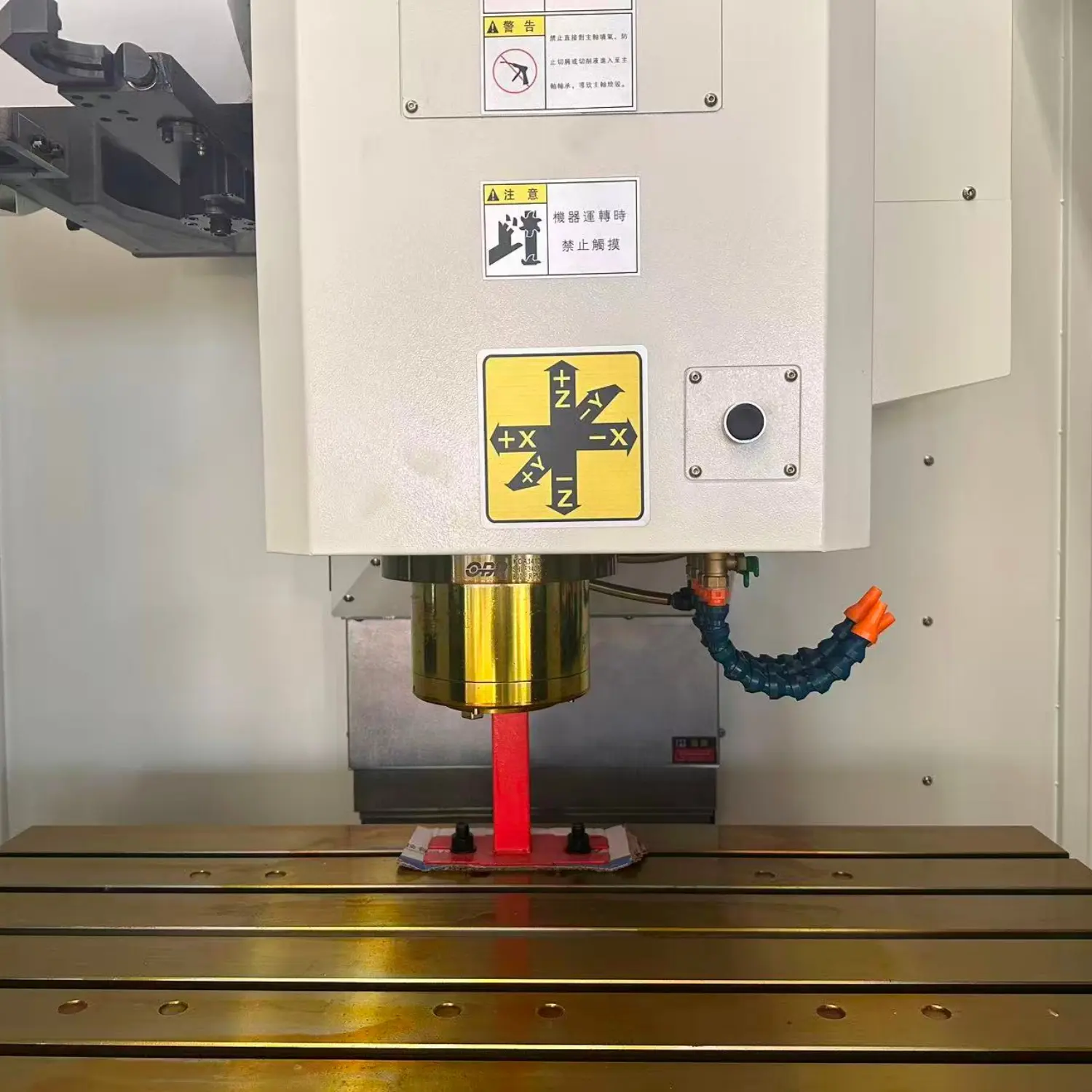
Aplicaciones industriales de los centros de mecanizado CNC
| Sector | Piezas típicas fabricadas | Especificaciones recomendadas | Por qué esta máquina es la más adecuada |
|---|---|---|---|
| Recambios para automóviles y motocicletas | Cylinder heads, brake calipers, transmission housings, wheel hubs, connecting rods | 1060/1370 mm X travel, 600/700 mm Y, 600/700 mm Z, BT50 taper, 15–22 kW spindle, 8000 rpm, FANUC 0i-MF Plus, ±0.005 mm positioning, 4500 kg net weight | High-torque BT50 spindle handles cast iron and aluminum alloy roughing; rigid box ways on Z-axis absorb interrupted cuts from sand-cast blanks |
| Maquinaria agrícola | Gearbox housings, hydraulic valve bodies, PTO shafts, combine header components, tillage tool holders | 1370/1500 mm X travel, 700 mm Y, 700 mm Z, BT50 taper, 18.5 kW spindle, 6000 rpm, GSK or KND control, linear roller guideways on X/Y, ±0.008 mm repeatability, 5500 kg | Extended X travel accommodates long PTO housings; cost-effective GSK/KND controls match lower batch volumes and seasonal demand patterns |
| Accesorios hidráulicos y neumáticos | Manifold blocks, directional valve bodies, cylinder end caps, quick-connect couplings, port adapters | 800/1000 mm X travel, 500 mm Y, 500 mm Z, BT40 taper, 11 kW spindle, 12000 rpm, Siemens 828D, ±0.005 mm positioning, 3200 kg | Compact footprint suits high-mix low-volume cell layouts; 12000 rpm BT40 spindle delivers fine surface finish on SAE port threads and seal grooves |
| Fabricación de moldes y matrices | Injection mould cavities, blow mould inserts, progressive die plates, forging die impressions, EDM electrodes | 1000 mm X travel, 600 mm Y, 600 mm Z, BT40 taper, 15 kW direct-drive spindle, 15000 rpm, FANUC 31i-B5, ±0.003 mm positioning, ±0.0015 mm repeatability, 4800 kg, linear roller guides on all axes | High-speed spindle and rigid linear guideway combination enables semi-finishing and finishing in single setups; FANUC look-ahead controls complex 3D surfacing |
| Centros de formación técnica | Curriculum parts, student projects, maintenance training blocks, CNC competition workpieces, retrofit demonstration units | 600/800 mm X travel, 400/500 mm Y, 450/500 mm Z, BT40 taper, 7.5 kW spindle, 8000 rpm, Syntec 21MA or GSK 983Ma, ±0.01 mm positioning, 2200 kg, 220V 60Hz or 380V 50Hz transformer | Lower capital outlay and dual-voltage compatibility suit institutional budgets; Syntec/GSK controls align with regional industrial employment markets |
| Sheet Metal Fabrication and Cabinets | Mounting brackets, hinge reinforcements, enclosure frames, busbar supports, conveyor roller housings | 1000 mm X travel, 600 mm Y, 600 mm Z, BT40 taper, 11 kW spindle, 10000 rpm, Mitsubishi M80, ±0.006 mm positioning, 3500 kg, rapid traverse 36 m/min | Fast rapid traverse and Mitsubishi M80 pallet-changing compatibility integrate with fabrication cell automation; handles mixed aluminum and mild steel brackets from laser-cut blanks |
Recambios para automóviles y motocicletas
Automotive work demands machines that survive thermal cycling from heavy roughing and maintain geometric stability through finish passes on bearing bores. A 1370 mm X by 700 mm Y by 700 mm Z centre with BT50 taper and 18.5 kW spindle at 6000 rpm handles cast iron cylinder head decks at 4 mm depth of cut without chatter. The 4500 kg HT300 casting mass damps vibration better than lighter machines, though buyers pay roughly 15–20 percent premium over linear-guide-only designs. FANUC 0i-MF Plus with 512 KB look-ahead handles the complex tool paths of ported intake runners. Lead time from confirmed casting to factory acceptance test runs 45–55 days for this specification. Payment structures in this segment typically run 30 percent T/T advance, 70 percent against copy of bill of lading; avoid suppliers demanding 100 percent upfront on machines above USD 35 000.
Maquinaria agrícola
Seasonal demand and price-sensitive end markets push agricultural suppliers toward machines with GSK or KND controls rather than FANUC, saving USD 4000–6000 on control cost. A 1500 mm X travel machine with 700 mm Y and Z, BT50 taper, and 18.5 kW at 6000 rpm machines gearbox housings from GGG50 nodular cast iron. The trade-off: GSK 983Ma has 128 MB program memory versus FANUC’s 2 GB, limiting simultaneous five-axis work if the buyer later upgrades. Linear roller guideways on X and Y permit 30 m/min rapid traverse for positioning between bolt hole patterns; Z-axis often retains hardened box ways for rigidity in axial drilling. Factory acceptance test should include circular interpolation test with ball bar, recording roundness deviation below 0.015 mm. Casting source verification matters here—some trading offices source HT250 instead of specified HT300, visible only in sectioned test pieces.
Accesorios hidráulicos y neumáticos
Manifold blocks require precise intersection drilling of SAE and BSP ports at compound angles, then finish reaming to 25 μm surface roughness. An 800 mm X by 500 mm Y by 500 mm Z compact centre with BT40 taper, 11 kW, 12000 rpm, and Siemens 828D suits this work. The Siemens control’s ShopMill conversational programming reduces setup time for operators crossing from manual machines. Positioning accuracy of ±0.005 mm and repeatability of ±0.003 mm ensure port-to-port centre distances hold across 50-piece batches without mid-process offset adjustment. Machine weight of 3200 kg allows single forklift unloading; no foundation bolt pattern required beyond standard 150 mm concrete and M16 chemical anchors. Spare parts criticality: keep one spindle encoder, one set of Y-axis ball screw support bearings, and two BT40 tool clamp springs in local stock.
Fabricación de moldes y matrices
Mould machining separates capable builders from assemblers. The 1000 mm X by 600 mm Y by 600 mm Z specification with 15 kW direct-drive spindle at 15000 rpm, FANUC 31i-B5, and ±0.003 mm positioning demands laser interferometer verification on all axes before shipment. Ask for the actual record: X-axis positioning accuracy plot, cumulative pitch error compensation table, and reversal spike values at each axis turnaround. A real builder has this documentation; a trading office forwards supplier WeChat screenshots. The 4800 kg machine weight with Meehanite-grade casting resists deformation during overnight roughing of H13 tool steel at 48 HRC. Linear roller guides on all axes—HIWIN HG45 or PMI MSA45 equivalent—enable 0.001 mm programmable increment for electrode orbiting paths. Ball bar test should show circular deviation below 0.008 mm at 150 mm radius, feed 1000 mm/min. Lead time stretches to 60–75 days for this grade due to hand-scraping of guideway mounting surfaces and spindle run-in.
Centros de formación técnica
Training centres need machines that fail predictably and are repaired in front of students. A 600 mm X by 400 mm Y by 450 mm Z bench-type centre at 2200 kg, BT40, 7.5 kW, 8000 rpm, with Syntec 21MA control, fits this pedagogy. Dual-voltage capability—380V 50Hz with internal transformer to 220V 60Hz—matters for institutions in Philippines, Vietnam, or Central America where infrastructure varies by campus. Positioning tolerance relaxes to ±0.01 mm, acceptable for curriculum workpieces and regional CNC competition standards. Cost runs 40–50 percent below industrial-grade machines, but the trade-off is limited rigidity: 3 mm depth of cut in steel is realistic maximum, not 8 mm. After-sales engineering capability here means the supplier provides fault simulation training for instructors—broken limit switch, drifted tool offset, thermal alarm—not just operator button-pushing. Payment terms for educational institutions often extend to 30 percent advance, 40 percent at readiness confirmation, 30 percent after installation and teacher training.
Sheet Metal Fabrication And Cabinets
Fabrication shops laser-cut flat blanks then need machining for perpendicular faces, tapped holes, and precision bores. A 1000 mm X by 600 mm Y by 600 mm Z centre with 36 m/min rapid traverse and Mitsubishi M80 control interfaces cleanly with robotic loading from pallet-based laser cells. BT40 taper, 11 kW, 10000 rpm handles aluminum brackets at 8000 rpm and mild steel at 4500 rpm without spindle changeover. Positioning accuracy of ±0.006 mm is sufficient for mounting hardware patterns; chasing ±0.003 mm adds cost without functional benefit. Machine weight 3500 kg permits 20-foot container loading with two machines per box, reducing ocean freight per unit by 35–40 percent versus single-machine 40-foot containers. Foundation requirement: 120 mm reinforced concrete, vibration-isolated from adjacent press brake or shear. Crane or forklift capacity for unloading: minimum 5 ton with 3 metre fork extensions to reach machine centre of gravity.
Cómo realizar un pedido e importar, paso a paso
Three mistakes that most often leave a delivered CNC machining center sitting idle, and their one-line fixes:
- Desajuste de tensión o frecuencia. Confirm 380V 50Hz versus 220V 60Hz at your service entry and order the matching motor winding or specify a transformer rating in kVA before production starts.
- Working envelope too small for the actual part. Measure your largest existing job plus fixture height and add 150 mm clearance in Z; compare to the machine’s X/Y/Z travels in mm before signing specification.
- No electrical schematic, parameter backup or local consumable source. Require the supplier to deliver a printed schematic, USB parameter backup, and a 12-month consumable parts list with local vendor contacts.
Define Workpiece Envelope and Tolerance First
State the maximum part length, width, height and weight you will machine in the next five years. A BT40 vertical machining center with 850 mm X travel, 500 mm Y travel and 500 mm Z travel handles 80 percent of general mold and job shop work. A BT50 machine with 1300 mm X, 700 mm Y and 700 mm Z travel is needed for automotive transmission cases or large agricultural castings. Add 200 mm minimum in Z for rotary table clearance if fourth-axis work is planned.
Positioning accuracy and repeatability requirements drive guideway selection. Hardened box ways on HT300 casting deliver 0.016 mm positioning and 0.008 mm repeatability under heavy interrupted cuts. Linear roller guideways (HIWIN or PMI) on the same casting grade reach 0.010 mm positioning and 0.006 mm repeatability with 48 m/min rapid traverse versus 24 m/min on box ways. The trade-off: box ways tolerate poorer coolant filtration and heavier roughing; linear guides need cleaner conditions but cut cycle time on high-volume aluminum work.
Spindle power and speed follow material removal rate. A 7.5 kW, 8000 rpm BT40 spindle machines steel and cast iron economically. A 15 kW, 12000 rpm BT40 spindle doubles aluminum throughput. BT50 spindles start at 11 kW and 6000 rpm for heavy cast iron facing. Specify maximum torque in N·m at rated speed, not just peak power.
Choose Control System and Service Path
FANUC 0i-MF Plus and Siemens 828D are the most common export configurations. FANUC dominates Southeast Asia and the Middle East; local service engineers and spare keyboards, servo drives and memory boards are easier to source. Siemens 828D dominates Eastern Europe and parts of South America; its conversational programming reduces operator training time for shops with high turnover. Mitsubishi M80 suits shops already running Mitsubishi wire EDM for shared parts and service relationships.
Chinese controls—GSK 25i, KND 2000M, Syntec 22MA—cut 15 to 25 percent from machine price. The trade-off: service documentation is primarily in Chinese, overseas spare parts stock is thinner, and macro B-style custom cycles may need rewriting. Only choose these if you have an in-house electrician familiar with the brand or a contracted local integrator.
Ask the supplier: “Who in my country has replaced a spindle encoder or servo amplifier on your machine?” A real builder names three service contacts with phone numbers. A trading office deflects to “we will arrange.”
Confirm Electrical Supply and Transformer Need
Standard Chinese-built machining centers ship with 380V ±10 percent, 50Hz, three-phase main power and 220V control circuit derived via transformer. If your shop runs 220V 60Hz (common in North America, parts of South America and Saudi Arabia), you need either a motor winding change at the factory or a step-up transformer rated at 1.5 times the machine’s total electrical load in kVA. A 15 kW spindle plus six servo motors and coolant pump draws roughly 35 kVA; specify a 50 kVA transformer minimum with 480V primary and 380V secondary if your incoming service is 480V.
Request the electrical schematic in your language and the parameter backup on USB before the machine leaves the factory. Verify the control cabinet label matches your supply.
Comprobar la carga del suelo, los cimientos y la superficie útil
Machine net weight and floor loading:
| Machine class | Peso neto (kg) | Floor space (mm) | Foundation requirement |
|---|---|---|---|
| BT40 VMC, 850 mm X | 4500–5500 | 2600 × 2400 | 150 mm reinforced concrete, 8 bolts |
| BT40 VMC, 1100 mm X | 6500–8000 | 3200 × 2800 | 200 mm reinforced concrete, 12 bolts |
| BT50 VMC or 1300 mm X | 9000–12000 | 4200 × 3200 | 300 mm isolated foundation pad |
Floor loading exceeds 5000 kg/m² on smaller machines and 8000 kg/m² on BT50 models. Most industrial mezzanine floors fail this; verify with your building engineer. The supplier should provide foundation drawing with bolt pattern and leveling pad locations.
Confirmar el marcado de conformidad para la aduana
CE marking is standard for European-bound machines and widely accepted in Southeast Asia and the Middle East. For North America, UL or CSA recognition on the electrical panel is rare on Chinese-built machines; most importers rely on a third-field evaluation by a licensed electrical inspector. Request the CE declaration of conformity, electrical safety test report (EN 60204-1), and noise emission report before shipment. Missing customs paperwork delays delivery by two to six weeks.
Comparación entre FOB y CIF
FOB (Free On Board) means you control ocean freight and insurance; use this if you have a freight forwarder relationship. CIF (Cost Insurance Freight) means the supplier arranges to your port; simpler for first-time importers but 8 to 12 percent more expensive due to markup. Neither includes destination unloading, customs clearance or inland trucking.
A standard 850 mm X travel VMC fits in a 20-foot container with disassembled chip conveyor and tool magazine. Larger BT50 machines or 1300 mm X travels need a 40-foot high-cube container. Machine weight limits: 20-foot container maximum payload 21,000 kg; 40-foot high-cube 26,000 kg. A 9000 kg machine plus crate and sea fastening stays within 20-foot limits. A 12,000 kg machine needs 40-foot and careful weight distribution to avoid axle overload fines at destination port.
Payment Structure and Factory Acceptance Test
Standard terms for first-time buyers: 30 percent deposit to start production, 70 percent balance after factory acceptance test (FAT) and before bill of lading. Do not agree to 100 percent advance. Do not release the final 70 percent until you or your agent witnesses the FAT.
Factory acceptance test minimum requirements:
- Laser interferometer measurement of X, Y, Z positioning accuracy and repeatability per ISO 230-2, with printed report
- Ball bar test for circular interpolation accuracy, with printed polar plot
- Geometric accuracy test per ISO 10791: straightness, perpendicularity, spindle runout, spindle taper contact
- Four-hour continuous run at 80 percent rated spindle speed, recording bearing temperature
- Test cut on supplied material (A36 steel or 6061 aluminum), achieving stated surface finish and dimensional tolerance
- Full tool change cycle count at rated capacity (e.g., 24 tools, BT40, 2.5 second chip-to-chip)
Request the FAT report with your company name and machine serial number. A trading office cannot produce this; a real builder keeps laser interferometer and ball bar records by serial number for years.
Equipos de descarga en el lugar de destino
A 5500 kg BT40 VMC needs a forklift with 7000 kg capacity minimum, or a 10-ton crane with lifting slings rated for the machine’s center of gravity. A 12,000 kg BT50 machine needs a 16-ton crane or two 10-ton forklifts in tandem with spreader bar. Check your receiving dock: standard dock height is 1200 mm; container floor is 1400 mm. A ramp or rollback truck may be needed. The supplier should mark lifting points and center of gravity on the crate.
Instalación y formación de los operadores
Real builders send or contract an engineer for three to five days: two days for leveling, alignment and geometric check; one day for control, spindle and ATC function verification; two days for operator training on programming, tool setting and maintenance routines. Trading offices offer “video installation support” or a local freelancer with no machine-specific experience.
Require: signed installation completion certificate with geometric accuracy re-verification values, operator training attendance list with topics covered, and 90-day warranty start date from installation sign-off, not from bill of lading.
Paquete inicial de piezas de recambio y consumibles
Order with the machine, not after:
- Spindle bearings or cartridge (one set, matched to your spindle model)
- ATC cam motor and limit switches (two each)
- Coolant pump seals and impeller (one set)
- Way wipers and bellows covers for all axes (one full set)
- Control battery, encoder battery, parameter backup battery (two-year supply)
- Tool holders and pull studs for your taper (BT40 or BT50), 10 pieces minimum
- Cutting tools and inserts for your first three months of production, sourced locally or shipped with machine
Request the electrical schematic, PLC ladder diagram, parameter list, and maintenance manual in your language. These are not optional; they are the difference between a four-hour local repair and a three-week wait for factory email support.
Numbered Ordering and Import Checklist
- Define largest part dimensions plus fixture clearance; match to X/Y/Z travels in specification
- Specify positioning accuracy and repeatability required; choose box way or linear guide accordingly
- Select BT40 or BT50 taper based on tool size, spindle power in kW, and torque at rated rpm
- Choose FANUC, Siemens, Mitsubishi, GSK, KND or Syntec control; confirm local service capability
- Record shop supply voltage, frequency, phase and available kVA; order matching motor or transformer
- Verify floor loading capacity and pour foundation per supplier drawing; confirm bolt pattern
- State conformity marking needed for destination customs; request documentation before shipment
- Negotiate FOB or CIF; confirm 20-foot or 40-foot container type against machine weight and dimensions
- Pay 30 percent deposit; withhold 70 percent balance until witnessed FAT with laser and ball bar records
- Arrange unloading: forklift capacity or crane tonnage, dock height, ramp if needed
- Require supplier engineer installation and five-day operator training; sign completion certificate
- Order spindle bearings, ATC parts, way wipers, batteries, tool holders and cutting tools with machine
- Receive electrical schematic, parameter backup USB, PLC ladder and maintenance manual in your language
Máquinas RUNNEWTECH relacionadas

Centro de mecanizado CNC
Centro de mecanizado CNC directo de fábrica con opciones de control FANUC, Siemens, Mitsubishi, GSK o Syntec y alimentación de 380 V/50 Hz o 220 V/60 Hz para exportación.
Preguntas frecuentes sobre los centros de mecanizado CNC
Minimum Order Quantity And Control System Options
Q: What is your minimum order quantity and which CNC controls can you fit?
One unit is the practical MOQ for machining centers. We install FANUC 0i-MF Plus, Siemens 828D, Mitsubishi M80, GSK 25i, KND K2000MF or Syntec 22MA per buyer preference. All systems support English interface; FANUC and Siemens also offer Spanish, Russian and Arabic. Control cabinets are built in-house, not outsourced to third-party integrators.
Q: How long is lead time from deposit to ready for shipment?
Standard lead time is 35–45 days for BT40 vertical centers with 850 mm X travel. BT50 or 1300 mm X travel machines run 50–60 days. Add 10 days if factory acceptance test with laser interferometer and ball bar is required. Peak months (March–May, September–November) extend lead time by 7–10 days.
Payment Structure And Voltage Adaptation
Q: What are your payment terms and can you handle 220V 60Hz?
Payment is 30% T/T deposit, 70% T/T before shipment. For orders above USD 80,000, we accept 30/60/10 via confirmed L/C. All machines are built 380V 50Hz standard; 220V 60Hz for North American or Southeast Asian supply requires a step-up transformer (quoted separately, roughly USD 1,200–2,800 depending on spindle power). Transformers ship in same container.
Shipping Logistics And Transit Time
Q: What shipping method, container type and transit time should I plan for?
Machines ship FOB Qingdao or CIF to buyer’s port. A VMC850 (BT40, 24-tool arm magazine, roughly 5,200 kg net) fits one 20-foot GP with rigging and crate. Larger VMC1060 or BT50 machines need 40-foot HC. Transit time: 18–25 days to Southeast Asia, 30–40 days to Middle East, 35–45 days to East Africa, 25–35 days to South America East Coast.
Factory Acceptance Test And Accuracy Documentation
Q: Do you provide factory acceptance test, geometric accuracy report and CE documentation?
Yes. Every machine runs a 72-hour FAT including laser interferometer positioning accuracy test (typically ±0.008 mm/500 mm) and ball bar circularity test. We issue documented geometric accuracy report (ISO 10791-4 or VDI/DGQ 3441 format) and CE declaration of conformity for customs clearance. Third-party SGS or BV inspection at buyer’s cost is accepted.
Installation Training And Achievable Tolerance
Q: What installation and operator training do you include, and what tolerance can I hold on my parts?
One engineer travels for 5–7 working days: foundation levelling (requires 150 mm reinforced concrete, anti-vibration pads), geometric re-check, and operator training on G-code, tool presetting and maintenance. Positioning accuracy is ±0.008 mm, repeatability ±0.005 mm. On aluminum with balanced tooling, buyers typically achieve ±0.015 mm dimensional tolerance; cast iron or steel with interrupted cuts runs ±0.025 mm.
Warranty Spare Parts And Consumables
Q: What is the warranty, and what do spare parts and consumables cost annually?
12-month warranty on machine and control, 36 months on casting and spindle cartridge. We recommend stocking USD 800–1,500 in consumables: spindle bearings (BT40 set roughly USD 220), way oil, coolant nozzles, and drawbar springs. Annual consumables budget for a single-shift shop: USD 1,200–2,500 depending on cutting intensity. Critical spares ship within 72 hours from Qingdao warehouse.
Trading Office Versus Real Builder Qualification
Q: How do I know you are the actual manufacturer and not a trading office?
Visit or video-verify: our foundry casts HT300 beds and columns (stress-relieved, roughly 6,800 kg on a 1060 frame), assembly floor with 12 scraping stations, and a climate-controlled metrology room with Renishaw XL-80 laser and QC20 ball bar. We hold assembly permits, not reseller licenses. Payment is to Runlongjia Machinery account directly; no third-party invoicing.
Aviso importante
Las especificaciones, los datos de precisión y los rangos de precios que figuran en esta guía son orientativos y se facilitan con fines de planificación.
solo a efectos informativos. Rango de funcionamiento real, tolerancia alcanzable, disponibilidad del sistema de control, requisitos de tensión de alimentación y conformidad
El etiquetado varía según el modelo y el país de destino. Los compradores deben comprobar por sí mismos la tensión y la frecuencia de la red eléctrica, la carga admisible del suelo y
los cimientos, el equipo de descarga y los requisitos de importación antes de realizar un pedido. Todas las cifras están sujetas a confirmación por escrito en
la última factura proforma emitida por RUNNEWTECH.
Adquisición de un centro de mecanizado CNC de RUNNEWTECH
What RUNNEWTECH Delivers at Factory Gate
Runlongjia Machinery, operating under the export brand RUNNEWTECH (runnewtech.com), was founded in 2010 and carries more than 15 years of manufacturing and export experience. The product range covers conventional lathes, milling machines, flat bed and slant bed CNC lathes, CNC machining centers, CNC fiber laser cutting machines, plasma cutting machines and portable laser welding machines.
For CNC machining centers, machines are supplied with a choice of control system including FANUC, Siemens, Mitsubishi, GSK, KND and Syntec, adapted to the buyer’s supply voltage and frequency—whether 380V 50Hz or 220V 60Hz with transformer where required. Machines are run-in and factory acceptance tested before packing, with documented geometric accuracy reports and laser interferometer records available on request. Standard configurations include BT40 or BT50 spindle taper, spindle speeds to 8000 rpm or 12000 rpm, spindle power from 7.5 kW to 18.5 kW, rapid traverse rates to 36 m/min, positioning accuracy of 0.008 mm and repeatability of 0.005 mm. Machines are packed in plywood cases with rust protection, quoted FOB or CIF, and supported with installation guidance, operator training material, remote commissioning and spare parts.
How to Move Forward
Send your workpiece material, maximum part size, required tolerance and destination port to receive a quotation within 24 hours via email or the website contact form at runnewtech.com.
Solicita un presupuesto directo de fábrica para un centro de mecanizado CNC
RUNNEWTECH se dedica a la fabricación de maquinaria para el trabajo del metal desde 2010,
con más de 15 años de experiencia en exportación. Las máquinas se suministran con el sistema de control que usted elija, adaptado a su red eléctrica
tensión y frecuencia; se somete a pruebas de rodaje y de aceptación en fábrica antes de su embalaje. Envíenos el material de su pieza de trabajo, el tamaño máximo de la pieza,
Indíquenos la tolerancia requerida y el puerto de destino, y le enviaremos un presupuesto en un plazo de 24 horas.

 English
  Indonesian
  Vietnamese
  Arabic
  Russian
  Spanish