
Guía para la compra de tornos CNC
Un auténtico fabricante chino de tornos CNC cuenta con una planta de montaje con guías rectificadas y mantiene archivados los registros del interferómetro láser; no es una oficina comercial que reenvía tu consulta a tres talleres sin relación entre sí. La diferencia se nota en la precisión geométrica, la trazabilidad de las piezas de recambio y en si un técnico de servicio puede tomar un vuelo hasta tus instalaciones con la contraseña correcta del PLC y la copia de seguridad de los parámetros.
Qué trata esta página
En esta sección se describen los controles específicos que distinguen a los fabricantes de maquinaria de los intermediarios: verificación del suministro de fundición, montaje propio frente a montaje subcontratado, documentación de las pruebas de aceptación en fábrica, estructuras de pago que distribuyen el riesgo de forma equitativa y capacidad de ingeniería posventa que va más allá de las notas de voz de WeChat. Cada punto incluye lo que hay que solicitar por escrito antes de abonar un anticipo.
Verificación de la procedencia de las fundiciones y las piezas fundidas
Solicita el certificado de calidad de la fundición y el nombre del proveedor. Las piezas fundidas en arena con resina HT300 sometidas a un tratamiento de alivio de tensiones en nuestras propias instalaciones cuestan aproximadamente entre un 15 y un 20% más que las piezas en bruto HT250 subcontratadas, pero mantienen su estabilidad durante más de 5.000 horas de corte intermitente. Un fabricante que controle su propia fundición puede mostrarle el número de lote estampado en la pieza de base y el informe metalúrgico correspondiente. Las oficinas comerciales eludirán la cuestión o proporcionarán un certificado genérico de la fábrica sin referencia al lote. Solicite fotografías de las piezas fundidas en bruto en el patio de la fábrica con sellos de fecha; su ausencia sugiere, como mínimo, un mecanizado en bruto subcontratado.
Planta de montaje y capacidad de raspado
Las bancadas de los tornos CNC de precisión requieren un raspado manual o un rectificado de precisión para alcanzar una rectitud de 0,02 mm/m en el montaje de guías lineales de rodillos, o de 0,015 mm/m en los patrones de contacto de las guías en caja. Un fabricante de confianza cuenta con raspadores con más de 5 años de experiencia y mantiene reglas de rectitud de referencia con etiquetas de calibración. Pide:
- Registros de pruebas con barra de bolas de los últimos seis meses de producción (precisión de interpolación circular, normalmente de 0,015 a 0,025 mm para una prueba con un radio de 300 mm)
- Informes sobre interferómetros láser en cuanto a precisión de posicionamiento (±0,005 mm/300 mm o mejor en máquinas con ejes lineales) y repetibilidad (±0,003 mm)
- Informe de precisión geométrica según la norma ISO 13041 o su equivalente nacional, incluyendo la excentricidad del husillo en la punta (0,005 mm como máximo para A2-5, 0,008 mm para A2-8) y la alineación del contrapunto
Las oficinas comerciales no pueden elaborarlos porque no ven la máquina hasta el momento previo al envío.
Trazabilidad del sistema de control y de los componentes
Los constructores deben documentar los controles de origen a través de canales autorizados, con protocolos de respaldo de parámetros. Verificar:
| Control | Aplicación típica | Método de copia de seguridad | Riesgos del mercado gris |
|---|---|---|---|
| FANUC 0i-TF | Torneado de producción, husillo de 7,5-15 kW | Tarjeta CF y PCMCIA | Pérdida de parámetros, sin acceso a la escalera |
| Siemens 828D | Flexibilidad de taller de producción, multieje | USB y red | Problemas con la verificación de la licencia |
| GSK 980 TDi | Mercados sensibles al precio, 3-7,5 kW | Solo USB | Documentación en inglés limitada |
| KND K2000Ti | Sustitución del CNC de la entrada | USB | Red de servicios en el extranjero poco extensa |
Solicita el número de serie del controlador y compruébalo con la oficina regional de la marca. Pregunta por los números de modelo de los servomotores (serie FANUC αi, Siemens 1FK7) y las fechas de fabricación de los variadores; si los años no coinciden, es posible que se haya producido una «canibalización» de componentes.
Estructura de las pruebas de aceptación en fábrica
Una FAT válida incluye:
- Funcionamiento en vacío: 2 horas a la velocidad máxima del husillo (3.500 rpm para el A2-5, 2.500 rpm para el A2-8), con control de la temperatura de los cojinetes
- Prueba de corte: Torneado continuo de acero 1045 a la potencia nominal del 80%, con un acabado superficial de Ra 1,6 o superior
- Verificación de la precisión: Interferómetro láser y barra de bolas, no solo comprobaciones puntuales con comparador de cuadrante
- Documentación: Informe firmado con el nombre del inspector, la fecha y el número de serie de la máquina
Insiste en la presencia por videoconferencia o en un testigo externo. Las condiciones de pago deben incluir un anticipo del 30%, el 60% al dar el visto bueno a la FAT con un informe verificado y el 10% tras la aceptación de la instalación. Cualquier solicitud de pago del 100% antes del envío por parte de un constructor desconocido es una señal de alarma.
Servicio técnico posventa y recambios
Los auténticos fabricantes afirman:
- Copias de seguridad de parámetros y del PLC por número de serie, disponible en un plazo de 24 horas
- Inventario de piezas de recambio más de 10 años para las piezas de fundición y 5 años para los componentes electrónicos, con referencias cruzadas de los números de pieza a los fabricantes originales (OEM) de los componentes
- Despliegue de ingenieros de servicio con pasaporte válido para obtener un visado, sin subcontratar a técnicos locales de reparaciones generales
Pregunta cuáles son los tres últimos países en los que sus ingenieros han realizado instalaciones. Verifícalo por tu cuenta si es posible. Una constructora con más de 15 años de experiencia en exportaciones al sudeste asiático, Oriente Medio, África, y América Latina se ha enfrentado a la conversión de tensión (de 380 V a 50 Hz a 220 V a 60 Hz), a los requisitos de cimentación para máquinas de entre 4.000 y 12.000 kg, y a la descarga de contenedores con carretillas elevadoras de 5 toneladas o grúas puente. Especificarán la potencia del transformador en kVA, los planos de la disposición de los pernos de cimentación y la ubicación de los puntos de elevación sin que se les pida. Las oficinas comerciales proporcionan manuales genéricos copiados de las páginas web de la competencia.
Tipos y configuraciones de los tornos CNC
| Tipo o clase | Rango de trabajo habitual | Opciones de control | Ideal para | Notas |
|---|---|---|---|---|
| Torno CNC de bancada plana | Sobrsaliente sobre la cama: 400–660 mm; longitud máxima de torneado: 750–3000 mm | GSK 980TDi, KND K1000Ti, FANUC 0i-TF, Siemens 828D | Talleres de servicios generales, fabricación de ejes para la agricultura y la automoción, centros de formación | Diámetro interior del husillo: 52-105 mm; punta de husillo A2-6 o A2-8; motor principal de 7,5-15 kW; precisión de posicionamiento: 0,020 mm; repetibilidad: 0,008 mm. Guías de caja endurecidas o guías lineales. Peso: 2.800–5.500 kg. |
| Torno CNC de bancada inclinada | Salida sobre la cama: 360–520 mm; longitud máxima de giro: 350–650 mm | FANUC 0i-TF Plus, Mitsubishi M80, Syntec 22TA, Siemens 828D | Fabricación en serie de componentes de precisión, racores hidráulicos y anillos de rodamientos | Máquina de fundición con bancada inclinada de 30–45° (HT300), evacuación de virutas asistida por gravedad. Husillo A2-5 o A2-6, 5,5-11 kW, avance rápido de 20-30 m/min. Precisión de posicionamiento de 0,015 mm, repetibilidad de 0,006 mm. Peso de 2200-4000 kg. |
| Torno CNC de doble husillo y doble torreta | Recorrido: 400-500 mm; longitud de torneado: 500-800 mm | FANUC 0i-TF, Siemens 840D sl, Mitsubishi M80 | Piezas de eje y disco para el sector de la automoción, fabricadas en serie y en grandes volúmenes | Dos husillos + dos torretas (12 estaciones cada una), transferencia síncrona. 11-18,5 kW por husillo, reducción del tiempo de ciclo de 40 a 60% en comparación con un solo husillo. Superficie ocupada: 4500 × 2200 mm. Peso: 8.000–12.000 kg. |
| Torno CNC vertical (VTL) | Diámetro máximo de torneado: 1000–2500 mm; altura máxima: 800–1600 mm | FANUC 0i-TF, Siemens 828D, GSK 980MDi | Tambores de freno de gran tamaño, volantes de inercia, carcasas de bombas, bridas para energía eólica | De una o dos columnas, con guía hidrostática o de rodillos. Diámetro de la mesa: 800–2000 mm; carga máxima: 3000–15 000 kg. Potencia del husillo: 22–55 kW; precisión de posicionamiento: 0,025 mm. La disposición de los pernos de fijación es fundamental. |
| Torno CNC de tipo suizo | Capacidad para barras de 12 a 38 mm de diámetro; longitud de la pieza de hasta 300 mm | FANUC 0i-TF, Mitsubishi M80, sistema propio de Citizen, sistema propio de Star | Implantes médicos, elementos de fijación aeroespaciales, conectores electrónicos, piezas de relojería | Cabezal deslizante, casquillo guía, 5-9 ejes. Velocidad del husillo de hasta 12 000 rpm, 3,7-7,5 kW. Subhusillo y herramientas motorizadas de serie. Precisión de posicionamiento de 0,005 mm. Es imprescindible la integración de un alimentador de barras. |
| Torno CNC de alta resistencia (para el sector petrolero / de gran diámetro interior) | Ancho de paso sobre el bancado: 800–1600 mm; diámetro interior del husillo: 130–340 mm; longitud: 1500–6000 mm | FANUC 0i-TF, Siemens 828D, PLC a medida | Roscado de tuberías para yacimientos petrolíferos, cilindros de gran tamaño, ejes de hélice para embarcaciones | Punta de husillo A2-11 o A2-15, 22-75 kW, caja de cambios de dos velocidades o totalmente variable. Guías de caja endurecidas (fundición Meehanite), soportes fijos y soportes móviles. Peso: 12 000–45 000 kg. Solo CIF; carga a granel o contenedor flat-rack. |
Torno CNC de bancada plana
El torno CNC de bancada plana sigue siendo la configuración más exportada por los fabricantes chinos, ya que el proceso de fundición y mecanizado es sencillo y su arquitectura abierta se adapta a piezas de gran diámetro y longitud corta a media. Los propietarios de talleres mecánicos del sudeste asiático y África suelen adquirir este tipo de máquinas para trabajos generales de reparación, el torneado de ejes para maquinaria agrícola y las flotas de centros de formación, donde los alumnos necesitan una visibilidad clara del contacto de la herramienta con la pieza. El ángulo de la bancada es de cero grados, por lo que la acumulación de virutas en la guía en V supone un verdadero problema en los trabajos con hierro fundido; la mayoría de los fabricantes incluyen ahora transportadores de virutas en espiral de serie. Lo que no puede hacer es mantener la estabilidad térmica durante largos periodos de funcionamiento continuo a altas revoluciones por minuto: la bancada plana tiene una superficie más expuesta que una bancada inclinada, y la masa del carro provoca una distribución desigual del calor. Una máquina con un radio de giro de 660 mm y una distancia entre centros de 3000 mm pesará aproximadamente 5500 kg y ocupará una superficie de 4,8 m × 1,6 m. Los compradores deben comprobar si el fabricante somete la pieza fundida de la bancada a un tratamiento de distensión; el HT300 sin normalización se deformará 0,05 mm a lo largo de un turno en climas tropicales.
Torno CNC de bancada inclinada
Las máquinas de bancada inclinada predominan en los pedidos de los proveedores de segundo nivel del sector de la automoción y de los fabricantes de accesorios hidráulicos, que producen lotes de entre 500 y 2000 piezas con cambios de configuración mínimos. El ángulo de la bancada de 30° o 45° sitúa al operario más cerca de la línea central del husillo y permite que la gravedad arrastre las virutas hacia una cinta transportadora situada en la parte trasera. Una máquina típica con radio de giro de 400 mm y recorrido en el eje Z de 500 mm utiliza un husillo A2-6 de 7,5 kW que alcanza las 3.500 rpm, con un avance rápido de 24 m/min sobre guías lineales de rodillos HIWIN o PMI. Se puede alcanzar una precisión de posicionamiento de 0,015 mm y una repetibilidad de 0,006 mm si el fabricante ha ajustado correctamente la relación entre la bancada y los cojinetes; solicite el informe del interferómetro láser en los ejes X y Z, no solo la prueba de redondez con barra de bolas. Lo que esta clase no puede hacer es absorber cortes pesados e interrumpidos como lo haría una bancada plana con guías de caja endurecidas; la versión con guías lineales tiene una menor amortiguación y el carro es más compacto, lo que limita la integración de un soporte fijo para ejes largos. Los importadores de Europa del Este suelen especificar el modelo Siemens 828D con el paquete conversacional ShopTurn para reducir el tiempo de formación del operario.
Torno CNC de doble husillo y doble torreta
Esta configuración distingue a los fabricantes de maquinaria propiamente dichos de las oficinas comerciales, ya que la alineación de dos husillos y dos torretas exige una planta de montaje con suelo nivelado, dispositivos de calibración de la excentricidad de los husillos calibrados con láser y protocolos de ciclos térmicos documentados. El comprador suele ser un fabricante de piezas de automoción o un gran taller de subcontratación con contratos de suministro de entre 3 y 5 años que requieren más de 20.000 unidades anuales de ejes de transmisión o cubos de freno. El tiempo de ciclo se reduce entre un 40 % y un 60 % porque la pieza pasa del husillo principal al secundario para las operaciones finales sin necesidad de volver a sujetarla. Una máquina de doble husillo con un diámetro de giro de 500 mm, dos torretas de 12 estaciones y herramientas motorizadas (eje B en la torreta superior) pesa 10 000 kg y requiere una alimentación de 380 V a 50 Hz con un transformador de 100 kVA de capacidad. El plazo de entrega de un fabricante real es de 90 a 120 días; una oficina comercial que cite 45 días simplemente está reenviando el folleto de otro fabricante. Lo que no resulta rentable es procesar lotes de menos de 200 piezas: el tiempo de cambio de las dos torretas y los dos husillos reduce la tasa de utilización, y la inversión de capital (normalmente tres veces el coste de una máquina de bancada inclinada de un solo husillo) requiere una alta tasa de ocupación para justificar la amortización.
Torno CNC vertical
El VTL resuelve el problema de sujeción que supone un obstáculo para los tornos horizontales: las piezas grandes, delgadas y con forma de disco, como los tambores de freno o las bridas de las bombas, se deforman bajo la presión del mandril si se colocan en posición horizontal. Una máquina con mesa de 1600 mm y un diámetro máximo de torneado de 2500 mm utiliza un husillo de 37 kW a través de un cojinete hidrostático de la mesa, con una capacidad de carga de la mesa de 8000 kg. Los sistemas de control son FANUC o Siemens con un PLC personalizado para los enclavamientos de sujeción y liberación de la mesa; Rara vez se especifica GSK para diámetros de giro superiores a 1250 mm debido a las limitaciones del bucle de servo en ejes rotativos pesados. Lo que un torno vertical (VTL) no puede hacer es manejar eficazmente el mecanizado de ejes: la restricción de altura y la necesidad de alcanzar un gran diámetro hacen que el voladizo de la herramienta sea excesivo para piezas esbeltas. Los requisitos de cimentación son fundamentales: una máquina con mesa de 2000 mm necesita 800 mm de hormigón armado con anclajes químicos, y el fabricante debe proporcionar un plano de cimentación sellado por su ingeniero estructural, no un boceto genérico. El precio CIF de esta clase de máquinas conlleva unos gastos de transporte elevados; una máquina de 15 000 kg supera los límites estándar de un contenedor de 20 pies y puede requerir un envío en flat-rack o a granel desde Tianjin o Shanghái.
Torno CNC de tipo suizo
Las máquinas de tipo suizo están tan especializadas que solo tres o cuatro fabricantes chinos cuentan con experiencia real en su producción; la mayoría de los “fabricantes” de este sector se dedican a montar kits o a comercializar productos con su propia marca. La característica que las define es el cabezal móvil que hace avanzar la barra a través de un casquillo guía, manteniendo la pieza de trabajo apoyada a menos de 2 mm del corte en todo momento. Una máquina con capacidad para barras de 20 mm y 5 ejes (X, Y, Z, herramienta motorizada B, husillo C) funciona a 10 000-12 000 rpm con un husillo principal y un subhusillo de 3,7 kW, alcanzando una precisión de posicionamiento de 0,005 mm y acabados superficiales de Ra 0,4 µm en titanio médico y acero inoxidable 316L. Los sistemas de control son casi exclusivamente FANUC 0i-TF o Mitsubishi M80; la complejidad cinemática supera a la mayoría de los controladores nacionales. Lo que esta clase de máquinas no puede hacer es procesar piezas fundidas, forjadas o piezas en bruto aserradas: solo barras, y la longitud residual (normalmente de 150 a 200 mm por barra) supone un coste de desperdicio que los talleres deben tener en cuenta. Los compradores deben comprobar que el fabricante haya suministrado máquinas con alimentadores de barras (Iemca, LNS o Samsys) integrados y puestos en marcha, y no solo “compatibles con”.”
Torno de alta resistencia para la industria petrolera
Esta clase se sitúa en el límite en el que los tornos CNC pasan a considerarse infraestructura de capital. El diámetro interior del husillo es la dimensión crítica: 130 mm para accesorios de tuberías, 240 mm para revestimientos de pozos petrolíferos y 340 mm para ejes marinos. Una máquina con un diámetro de giro de 1000 mm, un diámetro interior del husillo de 240 mm y una longitud de bancada de 3000 mm pesa 18 000 kg, cuenta con un motor principal de 45 kW con una caja de cambios mecánica de dos velocidades (rango bajo de 20 a 350 rpm para roscado, gama alta de 350 a 1200 rpm para el acabado), y ofrece una precisión de posicionamiento de 0,020 mm sobre guías de caja endurecidas con recubrimiento de Turcite-B. Los compradores son empresas de servicios para yacimientos petrolíferos, astilleros y empresas de reacondicionamiento de maquinaria pesada en Oriente Medio, Rusia y Sudamérica. Lo que esta máquina no puede hacer es moverse rápidamente: el avance rápido es de 6–8 m/min, los cambios de herramienta son manuales o semiautomáticos, y el espacio que ocupa (6 m × 2,5 m más el espacio libre para el mandril) la hace inadecuada para talleres con una gran variedad de piezas pequeñas. Las condiciones de pago de los auténticos fabricantes suelen ser: depósito por transferencia bancaria (T/T) a los 30%, 60% tras la prueba de aceptación en fábrica (FAT) con el informe de precisión geométrica firmado, y 10% tras la instalación y la formación; cualquier proveedor que exija un anticipo del 100% no es un fabricante.
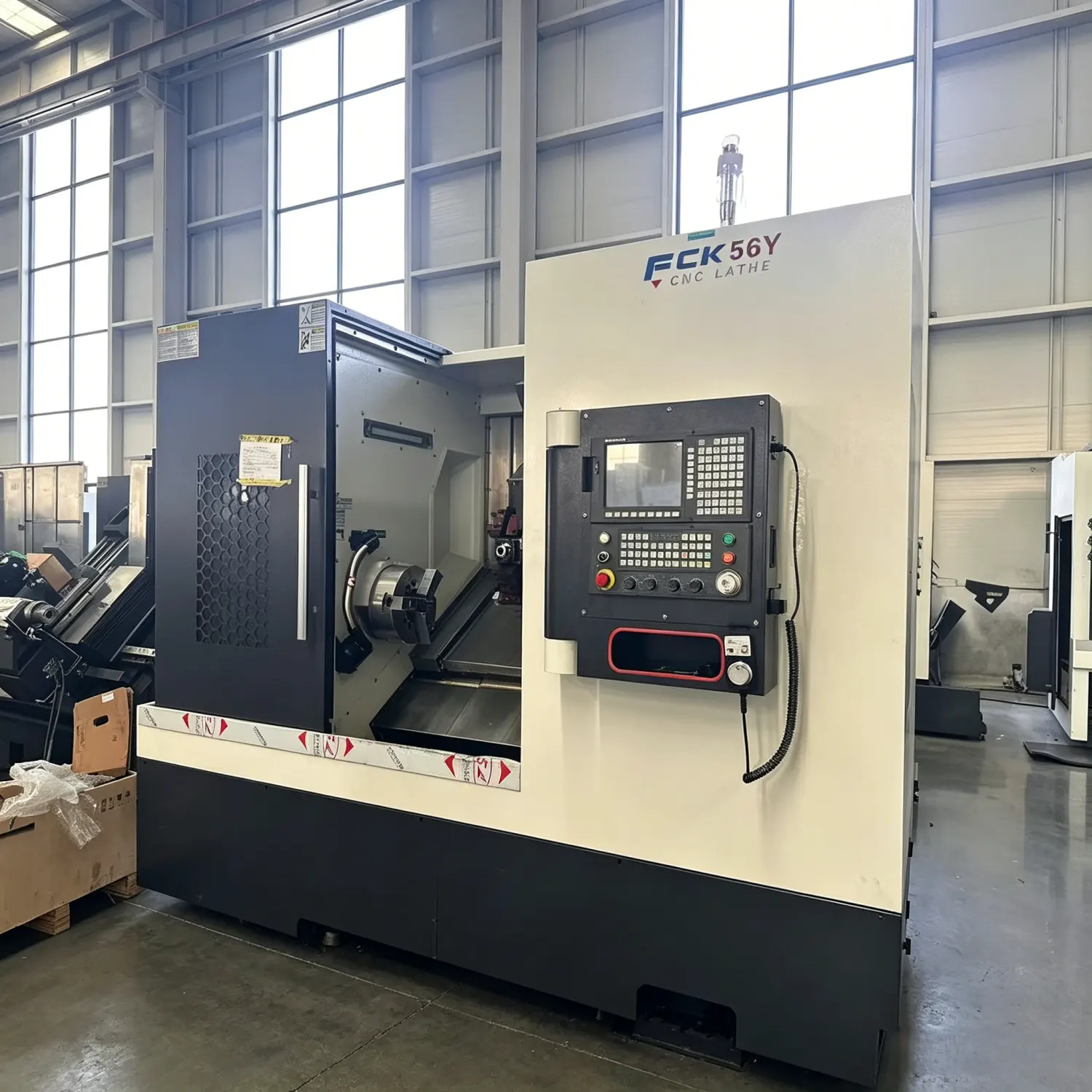
Especificaciones y cómo interpretarlas
| Parámetro | Nivel básico | Gama media | Alta calidad |
|---|---|---|---|
| Diámetro máximo de torneado sobre el bancada (mm) | 360 | 500 | 800 |
| Longitud máxima de torneado (mm) | 500 | 1000 | 3000 |
| Tamaño del mandril (hidráulico) | 6 pulgadas (160 mm) | 8 pulgadas (210 mm) | 12 pulgadas (315 mm) |
| Punta del husillo | A2-5 | A2-6 | A2-8 |
| Velocidad máxima del husillo (rpm) | 3500 | 3000 | 2000 |
| Potencia del motor del husillo (kW) | 5.5 / 7.5 | 11 / 15 | 22 / 30 |
| Diámetro interior del husillo (mm) | 52 | 66 | 105 |
| Recorrido del eje X (mm) | 200 | 260 | 420 |
| Recorrido del eje Z (mm) | 550 | 1050 | 3050 |
| Desplazamiento rápido en los ejes X/Z (m/min) | 12 / 16 | 20 / 24 | 24 / 30 |
| Tipo de guía | Guía de cajón endurecida, 55 mm de ancho | Linear roller guide (HIWIN/PMI), 35 mm | Linear roller guide (HIWIN/PMI), 45 mm |
| Precisión de posicionamiento (mm) | ±0.020 | ±0,010 | ±0,008 |
| Repetibilidad (mm) | ±0,010 | ±0,005 | ±0,003 |
| Estaciones de la torreta portaherramientas | 4-station electric | 8-station hydraulic | 12-station servo + Y-axis |
| Tamaño del vástago de la herramienta | 20 × 20 mm | 25 × 25 mm | 32 × 32 mm |
| Sistema de control | GSK 980TDi or KND K2000Ti | FANUC 0i-TF Plus o Siemens 828D | FANUC 31i-B o Siemens 840D sl |
| Peso neto de la máquina (kg) | 2200 | 4500 | 12000 |
| Floor space L × W × H (mm) | 2300 × 1500 × 1700 | 3200 × 1800 × 1900 | 6500 × 2400 × 2200 |
| Total connected load (kVA) | 15 | 25 | 45 |
| Tensión de alimentación | 380 V, trifásico, 50 Hz | 380 V, trifásico, 50 Hz | 380 V, trifásico, 50 Hz |
How to Read Each Line on the Specification Sheet
Working range defines what you can physically fit and machine. Max turning diameter over bed is the largest workpiece the machine can swing without collision. Max turning length is the longest shaft between chuck and tailstock centers. These two numbers determine if your parts fit; a 500 mm diameter machine cannot handle a 600 mm brake drum even once.
Spindle speed and power set your material removal rate and surface finish capability. Higher rpm suits aluminum and small-diameter finishing. Higher torque at lower rpm cuts stainless steel and large castings. The entry-level 5.5 kW/3500 rpm spindle will bog down in heavy interrupted cuts on 4140 steel; the 30 kW/2000 rpm spindle will not.
Spindle nose and chuck size specify tooling interface and gripping force. A2-6 is the standard for mid-range CNC lathes; A2-8 is required for large-diameter work and requires matching chuck adapters. Hydraulic chucks grip harder and more consistently than manual or electric chutes; the specification should state “hydraulic” explicitly.
Orificio del husillo matters for bar feeding. A 52 mm bore limits you to 2-inch bar stock. A 105 mm bore handles 4-inch bar. If you never run bar work, this number is irrelevant. If you plan unattended production with a bar feeder, it is critical.
Desplazamiento rápido is how fast the turret moves between cuts, not how fast it cuts. Entry-level 12 m/min in X means 5 seconds to cross the slide. Mid-range 20 m/min cuts that to 3 seconds. On short-cycle parts, rapid traverse dominates cycle time more than cutting feed rate.
Tipo de guía is a fundamental trade-off. Hardened box ways ( scraped cast iron, Turcite-B or Rulon lining) damp vibration and carry heavy interrupted loads. They wear slowly but have higher friction and lower rapid speeds. Linear roller guides (HIWIN, PMI, THK) move faster with lower friction but transmit more vibration and have lower impact resistance. For rough turning forged crankshafts, box ways survive. For finish-turning hydraulic fittings, linear guides win on speed and positioning.
Positioning accuracy and repeatability are different. Positioning accuracy is where the control thinks it is versus where it actually is; repeatability is whether it returns to the same point after a full day of thermal drift and load changes. Repeatability matters more for production consistency. A machine with ±0.010 mm positioning but ±0.003 mm repeatability will make identical parts all day, even if the absolute dimension drifts slightly with temperature.
Torreta portaherramientas station count and change time determine setup flexibility. Four stations means you finish one operation, stop, and re-tool for the next. Twelve stations with servo indexing and Y-axis off-center milling capability lets you complete a part in one chucking. Hydraulic turret clamping holds position under cutting load; electric turrets can slip on heavy cuts.
Sistema de control is where hidden cost lives. FANUC and Siemens dominate export markets for a reason: spare parts availability, operator familiarity, and resale value. GSK and KND cost 30-40 percent less upfront and perform adequately for 2-axis turning. The risk is local service engineer availability in your market and controller obsolescence in 8-10 years. Syntec and Mitsubishi sit in the middle, stronger in Southeast Asian markets than in Eastern Europe or North America.
Machine weight and floor space indicate casting mass and rigidity. A 2200 kg machine on a 360 mm swing is light; it will move under heavy cuts. A 4500 kg machine on 500 mm swing is proportionally stiffer. The 12000 kg machine on 800 mm swing is necessary for that envelope, not generous. Weight also determines your foundation requirements and crane capacity for installation.
How to Verify a Real Builder from a Trading Office
Own foundry or documented casting source. Ask for the foundry name and location. A builder with in-house casting control will specify HT250 versus HT300 by machine model and explain why. HT250 is standard for entry-level beds; HT300 or Meehanite equivalent is specified for mid-range and above for better damping and less thermal distortion. A trading office will describe “high quality casting” without grade or source. Request a mill certificate for the casting batch.
Assembly floor and hand-scraping records. Real builders maintain scraping teams who fit box ways to the bed by hand, checking contact points with blue dye. Ask for photos of the scraping floor, not just finished machines. The contact pattern should show 8-12 points per 25 mm × 25 mm area on critical surfaces. A trading office has no floor to photograph and will send catalog images instead.
Registros del interferómetro láser y de la barra de bolas. These are the objective tests. A laser interferometer (Renishaw XL-80 or equivalent) measures positioning accuracy and repeatability along each axis against ISO 230-2 standards. A ball bar (Renishaw QC20-W) checks circular interpolation and squareness in 15 minutes of rapid testing. Request the actual report for your serial-numbered machine, not a generic template. The report should show test date, technician signature, ambient temperature, and compensation values entered into the control. A builder who cannot produce this tests nothing or tests selectively.
Factory acceptance test (FAT) protocol. A real FAT includes: geometric accuracy (level, straightness, squareness), positioning accuracy with laser, spindle runout at multiple speeds, hydraulic system pressure and flow, and a test cut on a certified test bar. The protocol should specify allowable deviations. Ask to witness the FAT via video link if you cannot travel. A trading office will offer “inspection by third party” as an extra-cost option and has no protocol of their own.
Documented geometric accuracy report. This covers: bed flatness (0.02 mm/m), spindle axis parallelism to Z-axis motion (0.02 mm/300 mm), tailstock sleeve center height alignment, and turret indexing repeatability. These are measured before control compensation is applied. If the builder only offers positioning accuracy after ballscrew compensation, the underlying machine geometry may be poor.
Payment structure as signal. Real builders with production capacity typically structure: 30 percent T/T deposit, 70 percent L/C at sight against shipping documents, or 30/40/30 with the final 30 percent after FAT acceptance. A demand for 100 percent advance payment or payment to a personal account indicates no factory investment and high risk. Escrow through a machinery trading platform is acceptable for first orders under 50000 USD.
Capacidad de ingeniería posventa. Ask: how many service engineers in your country or region? What is their visa status and typical response time? Do they carry ballscrews, spindle bearings, and encoder cables in stock locally? A builder with real export experience has answered these questions before and has names and numbers. A trading office will promise “24-hour online support” and “local agent arrangement” without specifics.
Trade Terms and Export Practicalities
EXW (En fábrica) means you collect the machine from the factory door. You arrange export packing, inland transport to port, export customs, ocean freight, insurance, and import clearance. Only use EXW if you have a freight forwarder in China and experience with machinery export packing. CNC lathes require steel-frame skids, moisture-barrier wrapping, and shock indicators; factory packing varies enormously.
FOB (Libre a bordo) is the standard for machinery. The builder delivers to port, loads on vessel, and clears export customs. You pay ocean freight, insurance, and all destination charges. FOB Qingdao or FOB Shanghai are common for Chinese machine tools. Confirm whether FOB includes terminal handling charges; disputes arise when the buyer faces unexpected THCs at departure.
CFR (coste y flete) means the builder pays freight to your port. Risk transfers at departure; you insure the voyage. CFR suits buyers who want price certainty on freight but can arrange their own cargo insurance. For a 4500 kg CNC lathe in a 40-foot container, CFR adds roughly 800-1500 USD to Southeast Asian ports, 2500-4000 USD to Middle Eastern ports, and 4000-7000 USD to East African or South American ports depending on carrier and fuel surcharge.
CIF (coste, seguro y flete) includes builder-arranged voyage insurance. The insurance is typically Institute Cargo Clauses (C), covering total loss but not partial damage from seawater or rough handling. For machinery, arrange ICC (A) all-risks coverage separately if the builder’s CIF insurance is minimal.
L/C (Carta de crédito) versus T/T (transferencia telegráfica). T/T is faster and cheaper (20-50 USD bank charge) but requires trust. L/C adds 300-800 USD in bank fees and requires strict document compliance; a mismatch between packing list and bill of lading can delay payment and release of goods. For first orders above 30000 USD, many buyers use 30 percent T/T deposit, 70 percent L/C at sight. For repeat orders with established builders, 100 percent T/T against copy of bill of lading is common.
HS code for CNC lathes is typically 8458.11 (horizontal lathes, numerically controlled) or 8458.91 depending on exact configuration and local customs classification. The builder’s commercial invoice and packing list must match the HS code on your import license or registration. Discrepancies cause port delays.
CE marking for European destination requires the builder to hold a technical file, risk assessment, and Declaration of Conformity. The CE mark on the machine nameplate should be traceable to a notified body or self-certified under the Machinery Directive 2006/42/EC. Ask for the DoC document number and date. For non-European markets, CE is irrelevant but may indicate the builder has done systematic safety design; absence of CE on an export machine suggests no third-party review at all.
Packing list and certificate of origin are standard shipping documents. The packing list must itemize: machine net weight, gross weight with packing, dimensions of each package, contents of each crate (machine body, control cabinet, coolant tank, chip conveyor, tooling, manuals). The certificate of origin (Form A or CO per your country’s trade agreement with China) affects import duty rates. Request the builder confirm CO availability before order confirmation; some smaller builders have never issued one.
Voltage and frequency mismatch is a common arrival problem. Chinese machines ship at 380V 50Hz three-phase. If your supply is 220V 60Hz (North America, parts of Philippines, Korea) or 415V 50Hz (India), you need a step-up or step-down transformer and possibly frequency conversion for the control system. FANUC and Siemens controls tolerate 50/60 Hz; spindle motor cooling fans and coolant pumps may not. Specify your actual supply voltage and frequency in the purchase order and require the builder to confirm compatibility or include the transformer. A 15 kVA transformer for an entry-level lathe weighs 80 kg and costs 400-700 USD; a 45 kVA unit for a large machine weighs 250 kg and costs 1500-2500 USD. This is not an afterthought.
Container loading and weight limits. A 20-foot container holds roughly 28000 kg total including cargo; a 40-foot standard holds 26000-28000 kg, and a 40-foot high cube holds similar weight with more volume. A 4500 kg CNC lathe with packing reaches 5500-6000 kg and fits one per 20-foot container, or two per 40-foot if the machines are narrow and the builder designs split skids. A 12000 kg large lathe requires a 40-foot flat rack or open-top container. Confirm the builder has loaded your configuration before; first-time container packing for unusual dimensions risks corner damage and insurance disputes.
Foundation and leveling. Entry-level machines (under 3000 kg) often ship with adjustable leveling pads and require only a flat concrete floor rated 5 ton/m². Mid-range and above need isolated foundations or at least epoxy-grouted anchor bolts and precision leveling to 0.02 mm/m. The builder should supply a foundation drawing with bolt locations, conduit trenches for power and coolant, and recommended concrete thickness. Request this drawing at order stage, not after arrival when production is waiting.
Crane or forklift for unloading. A 2200 kg machine unloads with a 3-ton forklift. A 4500 kg machine needs a 5-ton forklift with extended forks or a 5-ton crane with spreader bar. A 12000 kg machine needs a 16-ton crane minimum, often with dual lifting points. The builder’s packing list states center of gravity location; provide this to your rigging contractor before the truck arrives. Container unloading without proper equipment has caused tipped machines and voided warranties.
Installation and operator training. Distinguish between mechanical installation (leveling, anchoring, utility connection) and control training (programming, tool setting, work offset). A real builder sends one mechanical technician for 3-5 days and offers separate FANUC or Siemens-certified training for operators, either at factory or on-site. Training bundled “free” for 2-3 days is typically only button-pushing familiarization, not CAM post-processor optimization or troubleshooting. Negotiate training scope explicitly: how many operators, what curriculum, what language, written materials provided.
Spare parts and consumables. At minimum, stock: spindle encoder, X and Z axis servo motor or encoder, ballscrew nut assembly, turret proximity switches, hydraulic pump and pressure switch, control battery, and one complete set of way wipers and coolant nozzles. Ask the builder for a recommended spare parts list with part numbers and prices, valid for 10 years. If the builder cannot provide part numbers for their own machine, they are assembling from purchased subassemblies with no parts continuity. For FANUC or Siemens controls, parts availability is global. For GSK or KND, confirm whether the builder holds stock in your region or ships from China with 4-6 week lead times.
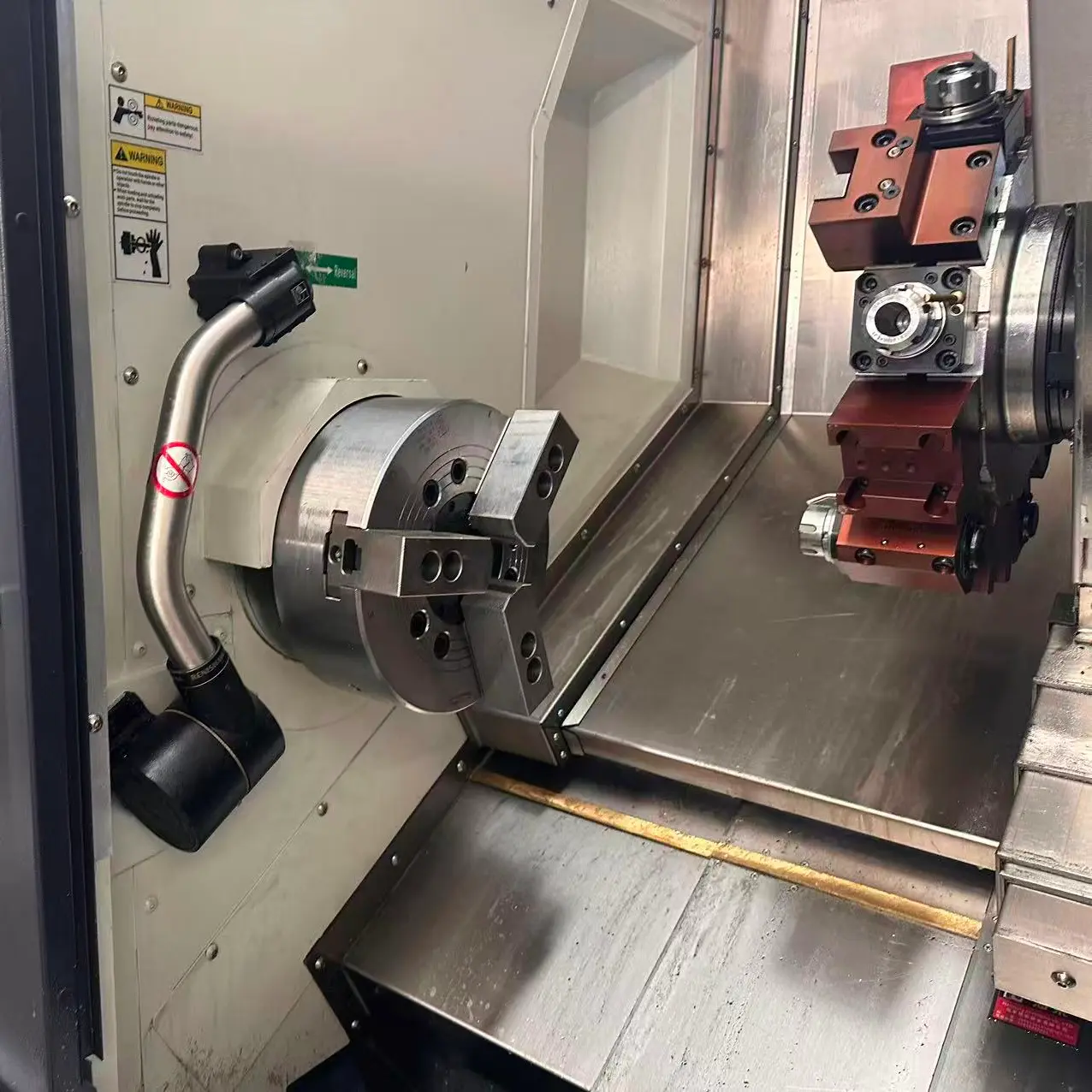
Precio de un torno CNC y qué factores lo determinan
| Clase | Rango de funcionamiento típico o potencia | Ejemplo de control o de origen | Precio indicativo FOB en USD |
|---|---|---|---|
| Entry-level flat bed CNC lathe | 500 mm swing × 1000 mm length, 7.5 kW spindle | GSK 980TDi or KND K2000Ti | 18,000 – 28,000 |
| Torno CNC de bancada plana de gama media | 660 mm swing × 1500 mm length, 11 kW spindle | Siemens 828D o FANUC 0i-TF | 35,000 – 55,000 |
| Torno CNC de bancada plana para trabajos pesados | 800 mm swing × 3000 mm length, 15–22 kW spindle | FANUC 0i-TF Plus or Mitsubishi M800 | 65,000 – 95,000 |
| Torno CNC de bancada inclinada con entrada frontal | 8″ chuck, A2-6 spindle, 400 mm turning diameter | GSK 980TDi o Syntec 22TA | 22,000 – 32,000 |
| Torno CNC de gama media con bancada inclinada | 10″ chuck, A2-8 spindle, 500 mm turning diameter, 12-station turret | FANUC 0i-TF o Siemens 828D | 45,000 – 70,000 |
| High-performance slant bed CNC lathe | 12″ chuck, A2-11 spindle, 630 mm turning diameter, servo turret + C-axis | FANUC 0i-TF Plus or Siemens 840D sl | 85,000 – 140,000 |
| Twin-spindle twin-turret turning centre | Main/sub spindle, Y-axis, BMT55 live tooling | FANUC 31i-B or Mitsubishi M800 | 150,000 – 280,000 |
What Actually Makes Up the Machine Price
A CNC lathe invoice from a real builder breaks into roughly these shares of FOB value. The proportions shift with machine class and destination electrical requirements, but the pattern holds across Runlongjia’s export range.
Casting or frame: 12–18 percent. A 500 mm swing flat bed lathe in HT250 resin sand casting runs about 2,800–3,500 kg. Step up to HT300 or Meehanite for a 660 mm machine and the casting share rises to 16–20 percent. The cheapest quotes often use HT200 or poorly seasoned castings that distort within two seasons of workshop temperature cycling. Ask for the foundry name and stress-relief documentation.
Guideways and ball screws: 8–12 percent. Hardened and precision-ground box ways on a 1000 mm bed cost more than linear roller guides but tolerate interrupted cuts better. HIWIN or PMI linear guides on a slant bed machine add 2,000–4,000 USD over unbranded equivalents. C3 grade ball screws from THK or NSK versus C5 from a domestic source: expect 1,500–3,000 USD difference per axis.
Spindle assembly: 10–15 percent. A2-6 or A2-8 spindle cartridge with SKF or FAG bearings, 4000 rpm, 11 kW: roughly 6,000–9,000 USD at factory cost. Built-in motor spindles for higher speeds multiply this. The cheapest alternative is a rebuilt or unbalanced cartridge with angular contact bearings of uncertain preload.
Control system and servo package: 18–28 percent. This is the first of the two dominant line items. FANUC 0i-TF with αi series servos and motors typically adds 14,000–22,000 USD to the machine cost over a domestic GSK or KND package. Siemens 828D with S120 drives sits in the same band. Mitsubishi M800 for heavy-duty applications runs slightly higher. A full GSK 980TDi servo package might add only 4,000–6,000 USD. The performance gap shows in rigid tapping synchronization, servo gain tuning range, and diagnostic depth.
Tool turret: 6–10 percent. A 12-station servo-indexed turret with HYD or Sauter internals runs 4,000–7,000 USD. Hydraulic clamping and disc-type tooling systems for BMT live holders add 50 percent. Entry machines sometimes ship with open VDI turrets or manual quick-change systems to hit a price point.
Assembly labour and scraping: 5–8 percent. Hand scraping of box way contact patterns to 8–12 points per 25 mm × 25 mm takes 40–80 hours on a flat bed lathe. Factories without in-house scraping capability grind to approximate geometry and ship. The difference appears in positioning accuracy maintenance after 5,000 cutting hours.
Electrical panel and ancillaries: 4–6 percent. Schneider or ABB contactors, separate transformer for 220V 60Hz regions, chip conveyor, coolant system.
Export packing and inland freight: 3–5 percent. Vacuum-sealed moisture barrier with VCI film, plywood crate, steel frame. A 660 mm swing lathe in crate runs 4,200–5,500 kg; inland truck to Qingdao or Shanghai port adds 800–1,500 USD depending on distance.
Sea freight, insurance, duty and VAT: Not included in FOB. A 40-foot high-cube container holds one mid-size lathe or two entry machines. Shanghai to Jebel Ali or Santos: 3,500–6,000 USD ocean freight depending on season. Insurance at 110 percent of CIF value: 0.15–0.3 percent. Destination duty varies 0–15 percent; VAT 5–20 percent. Customs clearance and port handling: 800–2,000 USD.
The control system brand and the spindle or laser source brand are normally the two single biggest line items because they are purchased complete from tier-one suppliers at global list prices with limited factory negotiation room. Everything else—casting, sheet metal, assembly labour—scales with local manufacturing economics and offers more flexibility.
Why the Cheapest Quote Costs Less
A 15,000 USD CNC lathe quote against a 28,000 USD competitor for nominally the same specification almost always differs in one or more of these:
- Lighter casting. HT200 instead of HT250, wall thickness reduced 10–15 percent, machine weight 2,100 kg versus 3,200 kg. Chatter on heavy roughing cuts increases; geometric accuracy drifts faster.
- Lower grade ball screws. C7 rolled screws with standard nut preload instead of C5 ground screws. Positioning repeatability degrades from ±0.005 mm to ±0.015 mm within 8,000 hours.
- Unbranded spindle source. No documented bearing preload, no balance grade, no thermal growth test. Bearing replacement at 18 months instead of 5–7 years.
- Missing servo package. Stepper-driven turret or open-loop spindle orientation. Rigid tapping impossible; tool life inconsistent.
- No laser interferometer or ball bar record. The factory has never measured volumetric accuracy or circular interpolation. You receive no geometric report with the machine.
- Trading office markup structure. The seller owns no foundry, no assembly floor, no service engineer. They subcontract to the lowest bidder and disappear after payment.
Comparación de los costes de funcionamiento a lo largo de cinco años
Assume a mid-range slant bed CNC lathe running 2,000 hours per year, machining alloy steel and cast iron automotive parts.
| Partida de gastos | Budget Configuration (GSK, domestic spindle, linear guides) | Mid-Range Configuration (Siemens 828D, branded spindle, box ways) |
|---|---|---|
| Consumo energético anual | 28,000 kWh at 55 kW installed, 0.85 load factor | 26,000 kWh at 55 kW installed, 0.80 load factor due to better servo efficiency |
| Power cost at 0.12 USD/kWh | 3,360 USD/year | 3,120 USD/year |
| Insert and tooling consumables | 4,800 USD/year (higher scrap rate from inconsistency) | 4,200 USD/year |
| Líquidos refrigerantes y de mantenimiento | 1,200 USD/year | 1,200 USD/year |
| Unplanned downtime (estimated) | 180 hours/year, mostly electrical and spindle | 60 hours/year |
| Downtime cost at 45 USD/hour lost margin | 8,100 USD/year | 2,700 USD/year |
| Scheduled spindle bearing replacement | Year 3, 3,500 USD | Year 6, 4,200 USD |
| Ball screw replacement | Year 4, 2,800 USD | Year 7–8, 3,500 USD |
| Control system spare parts reserve | 800 USD/year (limited availability, longer air freight) | 600 USD/year (standard regional stock) |
| Five-year total excluding purchase price | 76,300 USD | 54,100 USD |
The budget machine saves 20,000–35,000 USD upfront. Over five years it typically costs 20,000–30,000 USD more to run. The crossover point depends on your local power rate, labour cost, and whether downtime triggers penalty clauses with your customers.
Lead Time and Factory Verification
Realistic production lead times from a builder with in-house casting and assembly:
- Entry flat bed lathe with GSK control: 35–45 days after deposit
- Mid-range slant bed with Siemens or FANUC: 55–75 days (control system import and spindle build time)
- Heavy-duty or twin-spindle configuration: 90–120 days
Add 7–14 days for factory acceptance test (FAT) including laser interferometer measurement of positioning accuracy and repeatability, and ball bar test for circular interpolation. Request the raw data files, not a summary certificate.
To verify you are dealing with a builder rather than a trading office:
- Ask for foundry name and location; request photos of casting stock with date stamps
- Demand video of the specific assembly bay with your machine serial number visible
- Require laser interferometer report (Renishaw XL-80 or equivalent) showing positioning accuracy to ISO 230-2 and repeatability; ball bar test to ISO 230-4
- Confirm payment structure: 30 percent deposit, 70 percent after FAT and before bill of lading is standard for first orders; demands for 100 percent advance or payment to a personal account are red flags
- Verify after-sales engineering: named service engineer, passport number for visa application to your country, spare parts warehouse location and stock list
A builder who refuses FAT attendance or provides only a template test report without machine-specific serial numbers is signalling limited process control or outsourced assembly.
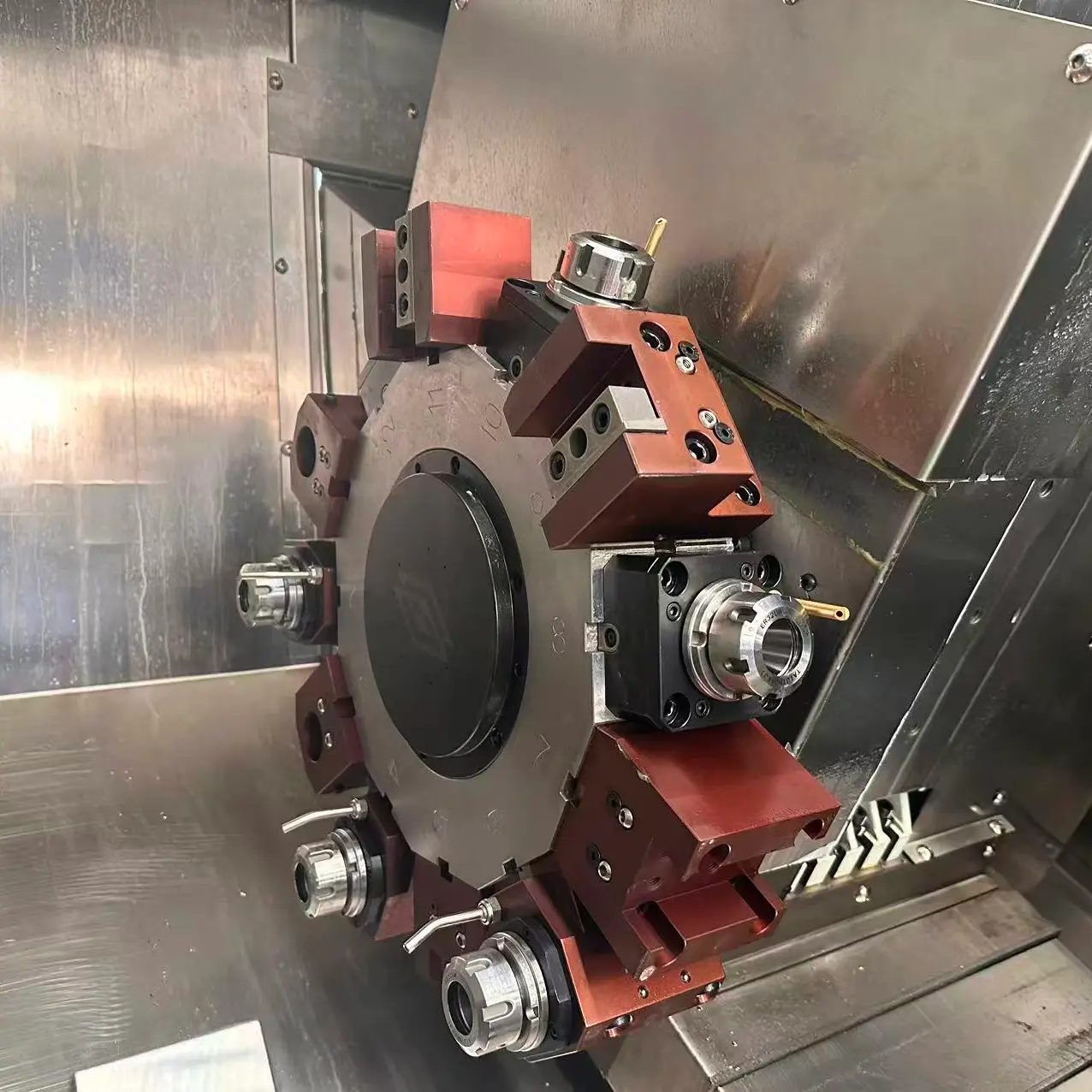
Aplicaciones industriales del torno CNC
| Sector | Piezas típicas fabricadas | Especificaciones recomendadas | Por qué esta máquina es la más adecuada |
|---|---|---|---|
| Recambios para automóviles y motocicletas | Brake discs, camshafts, wheel hubs, drive shafts, piston rods | Flat bed CNC lathe, 500 mm max turning diameter, 750 mm bed length, A2-8 spindle nose, 11 kW spindle motor, 2500 rpm, FANUC 0i-TF or Siemens 828D, ±0.008 mm positioning accuracy, 3200 kg machine weight | High-volume OD turning with rigid box-way construction absorbs interrupted cuts on cast iron brake discs; A2-8 nose accepts 12-inch hydraulic chuck for hub work |
| Maquinaria agrícola | Gear blanks, axle shafts, hydraulic cylinder rods, pulley hubs, bearing housings | Slant bed CNC lathe, 360 mm max turning diameter over bed, 650 mm turning length, A2-6 spindle nose, 7.5 kW spindle, 3500 rpm, GSK 980TDi or KND K2000Ti, linear roller guideways, 2800 kg | Slant bed chip evacuation prevents packed chips in cast iron gear blank production; 45-degree bed angle suits shaft work common in tractor drivetrains |
| Accesorios hidráulicos y neumáticos | Cylinder bodies, piston rods, valve stems, connector bodies, thread adapters | Flat bed CNC lathe with threading cycle, 280 mm swing over bed, 1000 mm between centers, A2-5 nose, 5.5 kW spindle, 3000 rpm, Syntec 21TA or Mitsubishi M80, ±0.005 mm repeatability, 2200 kg | Long bed version handles 800 mm piston rods; rigid tapping and constant surface speed ensure metric and UNF thread quality on stainless cylinder bodies |
| Acoplamientos para petróleo y gas | Drill collar subs, tubing couplings, valve bonnets, flanged connectors, pump shafts | Flat bed CNC lathe, 800 mm swing over bed, 1500 mm bed length, A2-11 spindle nose, 22 kW spindle, 1600 rpm, FANUC 0i-TF Plus, hardened box ways on all axes, 8500 kg machine weight | Massive casting and low-speed torque delivery for heavy interrupted cuts on alloy steel couplings; wide swing accepts 20-inch four-jaw chuck for oilfield flanges |
| Fabricación de moldes y matrices | Core pins, ejector sleeves, gate inserts, mould cavities, die buttons | Slant bed CNC lathe with C-axis and driven tool, 200 mm max turning diameter, 400 mm turning length, A2-5 nose, 5.5 kW main spindle, 6000 rpm, 3 kW driven tool motor, FANUC 0i-TF or Siemens 828D, 0.001° C-axis indexing | Mill-turn capability eliminates second setup for cross-drilled ejector holes; sub-spindle configuration allows complete “one-and-done” processing of 250 mm core pins |
| Centros de formación técnica | Practice shafts, stepped pulleys, threaded test pieces, taper exercises, CNC programming samples | Flat bed CNC lathe, 360 mm swing, 750 mm bed, A2-6 nose, 5.5 kW spindle, 2500 rpm, GSK 980TDi or KND K1000Ti, hardened box ways, 2400 kg, 380V 50Hz with 220V step-down transformer option | Simpler control architecture matches vocational curricula; GSK and KND systems dominate Chinese technical exams; lower spindle speed reduces risk in student operation |
Recambios para automóviles y motocicletas
Automotive production demands cycle time consistency across 8-hour shifts. A flat bed CNC lathe with A2-8 spindle nose and 11 kW motor at 2500 rpm handles 280 mm brake disc castings with 6 mm depth-of-cut roughing passes. The 3200 kg HT300 casting mass damps vibration that would chatter carbide inserts on lighter machines. FANUC 0i-TF control with rigid tapping cycles produces M14x1.5 wheel stud threads at 1200 rpm without floating tap holders. Shops running camshaft production should verify the supplier’s geometric accuracy report shows ≤0.015 mm total indicator runout on 500 mm test bars; this determines whether finish grinding can be eliminated. Payment structures typically run 30% T/T advance, 70% against bill of lading; lead time from confirmed drawing to FOB Qingdao is 35–45 days for standard models, 55 days for hydraulic chuck and bar feeder integration.
Maquinaria agrícola
Tractor axle shafts and gear blanks from cast iron or 45# steel tolerate lower surface finish requirements than automotive work but punish machines with interrupted cuts. A 45-degree slant bed CNC lathe at 2800 kg with linear roller guideways achieves 20 m/min rapid traverse for fast positioning between coarse cuts. The A2-6 nose with 8-inch hydraulic chuck grips 180 mm gear blanks securely; chip gravity discharge prevents the packed-chip failures that stall production in flat-bed designs. GSK 980TDi control keeps per-unit cost down for price-sensitive farm equipment suppliers, though shops requiring ISO program compatibility should specify Siemens 828D at roughly 18% higher controller cost. Foundation requirements are modest: 150 mm reinforced concrete with M16 anchor bolts at 800 mm spacing; machine levelling to 0.02 mm/m using precision levels, not carpenter’s levels.
Accesorios hidráulicos y neumáticos
Stainless steel 304 cylinder bodies and chrome-plated piston rods require surface finishes below Ra 1.6 µm to maintain seal integrity. A flat bed CNC lathe with 1000 mm between centers and constant surface speed control (G96) machines 800 mm rods without speed adjustment as diameter reduces. Threading accuracy depends on repeatability; specify ≤0.005 mm repeatability per laser interferometer record, not marketing claims. Syntec 21TA control offers macro programming for variable-pitch threads on hydraulic adjusters at lower cost than FANUC. Transformer requirements matter here: Chinese-built machines ship 380V 50Hz; buyers in 220V 60Hz regions (Philippines, parts of South America) need 15–20 kVA step-up transformers, roughly $800–1200 FOB, adding 3 days to lead time. Ball bar test records should show 0.010 mm circularity on 150 mm radius at 1000 mm/min feed.
Acoplamientos para el sector del petróleo y el gas
API-specified tubing couplings in 4130 or 4140 alloy steel demand torque reserves no light lathe provides. The 800 mm swing, 8500 kg flat bed with 22 kW spindle at 1600 rpm delivers 420 Nm continuous torque for 8 mm roughing depths on 300 mm OD coupling blanks. A2-11 spindle nose accepts 20-inch chucks; verify the supplier’s casting source—HT300 from own foundry or long-term Meehanite supplier, not gray market scrap castings that crack under weld prep loads. Factory acceptance test should include actual cutting: 50 mm diameter test piece, 200 mm length, verifying ≤0.02 mm cylindricity. CE documentation for EU-bound machines must include noise emission test per EN 12418; trading offices often lack this. Crane capacity for unloading: 10-tonne minimum at 6-meter reach; 8500 kg machines do not tolerate forklift tipping.
Fabricación de moldes y matrices
Precision mould components require geometric relationships—concentricity between OD and cross-holes on ejector sleeves—that demand mill-turn capability. A slant bed CNC lathe with C-axis indexing to 0.001° and 3 kW driven tool motor drills 4 mm cross-holes at 90° to axis without transfer to machining center. Sub-spindle configuration with 400 mm between spindles completes 250 mm core pins from bar: turn, drill, cross-mill, part-off, back-face in one cycle. Siemens 828D with ShopTurn conversational interface reduces programming time for die shops without full-time CAM operators; FANUC 0i-TF suits shops with existing ISO program libraries. Driven tool machines add 25–30% to base lathe cost and 15 days lead time for turret integration. Verify ball bar bi-directional circularity at 0.008 mm before acceptance.
Centros de formación técnica
Vocational programs in Southeast Asia and Africa need durable machines that survive student errors while matching local industrial control platforms. GSK 980TDi and KND K1000Ti dominate Chinese technical competition environments; graduates transfer directly to job shop floors running identical systems. Specify 5.5 kW spindle at 2500 rpm maximum—sufficient for curriculum exercises without the injury risk of 6000 rpm machines in novice hands. Hardened box ways tolerate crashes better than linear guides; scraping marks on ways should be visible, evidence of hand-finished contact patterns not ground-only production. Transformer to 220V 60Hz is essential for Philippine, Indonesian, and Central American installations; include this in initial quotation, not as after-sale surprise. Training package should include 5-day on-site instruction: 2 days operation, 2 days programming, 1 day maintenance. Spare parts kit—drive belts, proximity switches, fuse sets—should ship in same container, roughly $400–600.
Cómo realizar un pedido e importar, paso a paso
The three mistakes that most often leave a delivered CNC lathe idle in a new shop are straightforward to prevent with one-line fixes. Voltage or frequency mismatch: confirm your incoming supply—380V 50Hz three-phase versus 220V 60Hz split-phase—and order the matching transformer with the machine rather than improvising after customs clearance. Working range too small for actual parts: measure your largest existing and planned workpiece including chuck jaw projection and tailstock center extension, then add 20 percent margin to both swing over bed and maximum turning length before selecting a model. No documentation, backup or consumable source: require electrical schematics, parameter backup on USB, and a named local supplier for inserts, coolant and hydraulic oil before final payment release.
Defining Workpiece Envelope And Tolerance
Start with the part, not the brochure. List your maximum diameter, maximum length, and whether you need through-bore capacity for bar work.
| Parámetro | Typical Range for Small-Medium CNC Lathes | Typical Range for Heavy-Duty CNC Lathes |
|---|---|---|
| Diámetro máximo de torneado sobre bancada | 360 mm to 660 mm | 800 mm to 1,500 mm |
| Longitud máxima de torneado | 500 mm to 2,000 mm | 2,000 mm to 6,000 mm |
| Spindle through-bore | 52 mm to 105 mm (A2-6, A2-8) | 130 mm to 310 mm (A2-11, A2-15) |
| Tamaño del mandril | 6″ to 12″ hydraulic | 15″ to 32″ hydraulic |
| Potencia del husillo | 7.5 kW to 15 kW | 18.5 kW to 45 kW |
| Velocidad del husillo | 3,500 rpm to 6,000 rpm | 1,500 rpm to 3,000 rpm |
| Precisión de posicionamiento | ±0.005 mm to ±0.01 mm | ±0.01 mm to ±0.02 mm |
| Repetibilidad | ±0.003 mm to ±0.005 mm | ±0.005 mm to ±0.008 mm |
Match tolerance requirements to machine class. A positioning accuracy of ±0.005 mm and repeatability of ±0.003 mm demands linear roller guideways (HIWIN or PMI), C3 or C5 grade ballscrews, and thermal compensation in the control—not hardened box ways. Box ways carry heavier interrupted cuts and have better damping but typically achieve ±0.01 mm positioning accuracy at best. If your parts need consistent 0.01 mm total tolerance, specify the tighter machine. If you machine cast iron forgings with heavy roughing passes, the damping of box ways may justify the accuracy trade-off.
Choosing Control System And Service Capability
The control determines who can repair it, how long you wait for parts, and whether your operators already know the menus.
| Control | Common In | Service Reality | Best Fit |
|---|---|---|---|
| FANUC 0i-TF Plus | Global export machines | Dealer network in most countries; parts 48-72 hours from regional hub | Shops with existing FANUC experience, production environments |
| Siemens 828D / 840D sl | European-influenced markets | Strong in Eastern Europe, Middle East, Southeast Asia; requires Siemens-certified technician | Complex milling-turning, high-end job shops |
| Mitsubishi M80 | Southeast Asia, some Middle East | Good in Thailand, Malaysia, Indonesia; weaker in Africa and South America | Existing Mitsubishi installed base |
| GSK 980TDi / 2180 | Budget Chinese exports | Limited direct support outside China; relies on builder’s engineer | Very price-sensitive shops with in-house electrical capability |
| KND K2000TF / K1000TF | Mid-market Chinese exports | Growing in Pakistan, Bangladesh, some African markets | Shops with Chinese-speaking technician or builder support contract |
| Syntec 21TA / 22TB | Taiwanese-influenced designs | Moderate in Southeast Asia; weaker in Africa and Latin America | Turn-mill centers, live tooling applications |
Ask the builder: “Who in my country has serviced your machines with this control in the last 24 months?” A real builder names a technician or distributor. A trading office deflects. For FANUC and Siemens, verify the control is genuine—not a stripped “partner” version with limited PLC access. For GSK or KND, confirm the builder has exported at least 50 units with that control to your region; otherwise you are the test case.
Confirming Electrical Supply And Transformer Requirements
| Supply Type | Region | Transformer Needed | Notas |
|---|---|---|---|
| 380 V, 50 Hz, trifásico | China, most of Europe, Middle East, Southeast Asia, Africa | None if machine matches | Standard for most Chinese-built CNC lathes |
| 415V 50Hz three-phase | India, parts of Africa | Usually none; verify motor tap settings | Check nameplate voltage range ±10 percent |
| 220V 60Hz three-phase | Taiwan, South Korea, parts of Latin America | Step-down transformer or 60Hz-rated motors | Motor derating typically 15-20 percent at 60Hz without redesign |
| 208V-240V 60Hz single or split-phase | North America residential/light commercial | Phase converter plus transformer | Not recommended for CNC lathes over 10 kW spindle |
| 480V 60Hz three-phase | North America industrial | Step-down transformer to 380V or custom motor winding | Specify at order; retrofit is expensive |
Request the builder’s electrical schematic in your language before deposit. Confirm whether the spindle drive, servo drives, and coolant pump are all rated for your frequency or whether a transformer-isolated supply is planned. A 60Hz motor on 50Hz runs hotter and slower; a 50Hz motor on 60Hz overspeeds and loses torque. The fix is ordering the correct windings or a variable-frequency drive rated for both.
Floor Loading Foundation And Floor Space
A 360 mm swing CNC lathe with 750 mm bed length typically weighs 2,800 kg to 3,500 kg. A 660 mm swing machine with 3,000 mm bed weighs 8,000 kg to 12,000 kg. Check your floor load capacity: standard industrial concrete 150 mm thick with mesh handles 3,500 kg/m². Machines over 6,000 kg need a dedicated foundation pad or thickened slab with rebar.
Floor space must include operator access, chip conveyor extension, and tool cart circulation. Add 1,000 mm minimum to each side of the machine footprint for maintenance access. A typical 500 mm swing × 1,500 mm bed CNC lathe needs 4.5 m × 2.5 m installed footprint, plus 2 m rear clearance for electrical cabinet ventilation.
Specify casting grade: HT250 is standard for beds and saddles on machines under 5,000 kg. HT300 or Meehanite castings are specified for heavy cuts and thermal stability. The builder should state the grade on the quotation; absence suggests HT200 or ungraded recycled material.
Conformity Marking For Customs Clearance
Determine what marking your customs authority requires before the machine ships. CE marking is mandatory for entry into European Union countries, EFTA members, and several Eastern European and Middle Eastern customs unions that reference EU directives. CE requires a technical file, declaration of conformity, and often a third-party assessment for the electrical and machinery safety directives.
For Southeast Asia: Indonesia requires SNI for some electrical components but not the machine itself. Malaysia accepts CE or local DOSH inspection. Thailand has TISI requirements for electrical systems. For Middle East: Saudi Arabia requires SASO conformity for electrical equipment; UAE accepts CE. For Africa: Nigeria SONCAP, Kenya PVOC, and Egypt GOEIC each have specific inspection and documentation rules.
A real builder has shipped to your country before and knows the customs entry requirements. A trading office copies a generic CE certificate from another product. Request the specific directive references (2006/42/EC for machinery, 2014/35/EU for low voltage) and the notified body number if applicable.
Comparing FOB Versus CIF
| Término | Builder Responsibility | Buyer Responsibility | When to Choose |
|---|---|---|---|
| FOB (Libre a bordo) | Deliver to named port, load on vessel, export clearance | Ocean freight, insurance, unloading, import clearance, inland transport | You have freight forwarder relationships, want cost transparency, or ship multiple machines |
| CIF (coste, seguro y flete) | Deliver to named destination port, insurance included | Import clearance, unloading, inland transport, any port demurrage | Single machine purchase, unfamiliar with freight booking, or builder has favorable shipping contracts |
For CNC lathes, CIF often adds 8-15 percent to the machine price for freight and insurance. FOB gives you control and potential savings if you consolidate shipments. Either way, specify Incoterms 2020 in writing. For machines over 6,000 kg, breakbulk or flat-rack container shipment may be required; standard 20GP or 40HQ containers have payload limits of 21,000 kg and 26,000 kg respectively including packaging.
Container Type And Weight Limits
| Peso de la máquina | Container Type | Payload Limit | Considerations |
|---|---|---|---|
| Under 2,500 kg | 20GP standard | 21,000 kg total | Single machine with accessories fits easily |
| 2,500-6,500 kg | 40HQ standard | 26,000 kg total | May need machine positioned over center for axle loading |
| 6,500-15,000 kg | 40HQ with removal of chip conveyor or tailstock | 26,000 kg total | Requires factory disassembly and reassembly documentation |
| Over 15,000 kg | Flat-rack or breakbulk | N/A | Separate ocean freight quotation; lifting points and lashing plan required |
Confirm the builder provides container loading photos, lashing diagram, and packing list with gross/net weights. For flat-rack shipments, the buyer arranges port crane unloading; verify crane capacity matches machine weight plus packaging.
Deposit And Balance Payment Terms
Standard practice for first-time buyers with Chinese builders: 30 percent deposit against proforma invoice, 70 percent balance against copy of bill of lading (BL) under FOB or CIF terms. For repeat buyers with established relationship, terms may shift to 20/80 or letter of credit at 90 days.
Avoid 100 percent advance payment. A real builder with factory and export track record accepts 30/70. A trading office often demands 50/50 or full payment upfront because they lack credit with their upstream supplier.
Specify payment release tied to documentation: deposit upon signed contract and proforma acceptance; balance upon fax or PDF of BL, packing list, commercial invoice, and certificate of origin. For letter of credit transactions, specify “clean on board” BL and exact document presentation period.
Prueba de aceptación en fábrica antes del pago del saldo restante
The FAT is your only chance to verify the machine before it is sealed in a container. Attend in person or appoint a third-party inspector.
Minimum FAT requirements:
- Geometric accuracy: Laser interferometer or ball bar test for positioning accuracy and repeatability. Request the printed report with environmental conditions (temperature, humidity). Compare to quoted specifications: ±0.005 mm positioning, ±0.003 mm repeatability for linear guide machines.
- Spindle performance: Run at maximum rated speed (e.g., 4,000 rpm) for 30 minutes. Record bearing temperature rise (typically ≤25°C above ambient). Check vibration velocity per ISO 10816.
- Cutting test: Machine a test bar in specified material (e.g., 45# steel or ASTM 1045). Measure roundness, cylindricity, and surface finish. Typical results: roundness 0.003 mm, Ra 1.6 μm with carbide insert at standard speeds and feeds.
- Control functionality: Verify all axes, spindle orientation, tool changer (if equipped), tailstock, and chip conveyor operate per program.
- Documentation: Electrical schematics in your language, parameter backup on USB, operation manual, maintenance manual, spare parts list with part numbers.
Do not release balance payment until FAT is passed and documented. A builder refusing FAT or offering only a video is not a builder with confidence in their process.
Unloading Equipment At Destination
| Peso de la máquina | Minimum Unloading Equipment | Notas |
|---|---|---|
| Under 3,500 kg | Forklift 5,000 kg capacity | Check fork length versus machine center of gravity |
| 3,500-8,000 kg | Forklift 10,000 kg capacity or crane 10,000 kg | Crane preferred for machines over 5,000 kg due to bed length |
| 8,000-15,000 kg | Crane 16,000 kg capacity with spreader bar | Lifting points must be marked; use builder’s lashing points only |
| Over 15,000 kg | Contract rigging company with engineered lift plan | Foundation must be cured before placement |
Verify unloading equipment is booked before vessel arrival. Port storage charges accumulate daily. For container delivery, the builder should mark lifting points and center of gravity on the packaging.
Installation And Operator Training
A real builder sends an engineer or certifies a local partner for installation. Minimum scope:
- Leveling: Precision level 0.02 mm/m on bed ways in longitudinal and transverse directions. Shimming and grouting for machines over 6,000 kg.
- Alignment: Spindle centerline to tailstock centerline within 0.01 mm per 300 mm for machines under 1,000 mm bed; 0.02 mm for longer beds.
- Power-on and parameter load: Verify all parameter backups load correctly. Test emergency stops and door interlocks.
- Training: 3-5 days typical for operators with conventional lathe experience; 7-10 days for new operators. Cover programming (G-code or conversational), tool setup, workpiece zero setting, and daily maintenance.
Training should include your actual parts, not just a demonstration bar. Specify number of trainees, language, and whether interpreter is needed. Chinese-speaking engineer with your English-speaking supervisor is common; confirm this works or request English-speaking engineer (adds cost, often $200-300/day).
Initial Spare Parts And Consumables Package
Order with the machine, not after breakdown. Minimum package:
| Artículo | Cantidad | Purpose |
|---|---|---|
| Spindle drive belt or coupling | 1 juego | 2-3 year life on heavy cycle machines |
| Servo motor encoder battery | 2 units | FANUC and Siemens absolute encoders lose position on battery failure |
| Hydraulic filter element | 2 sets | 500-hour change interval typical |
| Sello mecánico de la bomba de refrigerante | 1 juego | Common failure point |
| Chuck soft jaws (blank) | 1 juego | Machined to your first part geometry |
| Tooling adapter sleeves | Per turret station | MT3, MT4, or ER collet chucks as needed |
| Cutting inserts and holders | Starter set | Specify your material: steel, stainless, cast iron, aluminum |
Request part numbers that cross-reference to standard component brands (NSK bearings, SKF seals, Festo pneumatics). A builder using proprietary part numbers with no cross-reference is hiding something or planning captive aftermarket revenue.
Confirm consumable availability in your country: hydraulic oil ISO VG 46, way oil ISO VG 68, and water-miscible coolant concentrate. If local supply is uncertain, ship a six-month supply with the machine.
Supplier Qualification Checklist
Use this to distinguish a builder from a trading office before placing deposit.
- Own foundry or verified casting source: Request foundry name and location; HT300 certificate if specified. Trading offices cannot produce this.
- Assembly floor with scraping records: Ask for photos of guideway scraping with blue-check patterns and contact points per 25 mm × 25 mm (typically 8-12 points for CNC, 6-8 for conventional). Request specific scraping technician names.
- Laser interferometer and ball bar equipment: Ask for model (Renishaw XL-80, QC20-W) and last calibration certificate. Request sample report from recent machine of your model.
- Factory acceptance test protocol in writing: FAT document should list test items, acceptance criteria, and instruments used. Vague “we will test” language indicates no formal process.
- Documented geometric accuracy report: Per ISO 13041 or national equivalent. Report should show actual measured values, not just “pass/fail.”
- Payment structure: 30/70 standard. Demands for 50/50 or 100 percent advance suggest cash flow problems or trading office structure.
- After-sales engineering: Name and contact of technician who serviced machines in your country in last 24 months. Not “we have agents”—specific names and recent service dates.
- Electrical schematic in your language: Available before deposit or only after full payment? Before indicates professional export practice.
- Control parameter backup on USB: Included with documentation or extra charge? Should be standard.
- Spare parts local stock or 72-hour delivery commitment: Written confirmation, not verbal assurance.
A builder who answers all ten with specifics within two business days is likely genuine. A trading office will delay, deflect, or provide generic marketing materials.
Máquinas RUNNEWTECH relacionadas

Preguntas frecuentes sobre los tornos CNC
Minimum Order And Control System Options
Q: What is your minimum order quantity and which CNC controls do you offer?
El pedido mínimo es de una máquina. Instalamos FANUC 0i-TF Plus, Siemens 828D, Mitsubishi M80, GSK 980TDb, KND K2000TFi o Syntec 22TA. Los modelos de FANUC y Siemens tienen un sobreprecio de entre 15 y 251 TP3T respecto a los de GSK o KND. Todas las pantallas HMI admiten inglés, español, ruso y árabe; FANUC y Siemens ofrecen además alemán y francés. Los manuales de parámetros y los diagramas de escalera se incluyen con los pedidos de Siemens y FANUC; GSK y KND solo proporcionan manuales de funcionamiento en inglés.
Q: Can you customize supply voltage and frequency for our local power grid?
Standard build is 380V 50Hz three-phase. We reconfigure spindle motor, coolant pump, and control transformer for 220V 60Hz (common in North America and parts of Southeast Asia) or 415V 50Hz at no extra cost if specified at order. A 380V-to-220V step-down transformer rated at 25-40 kVA runs roughly USD 800-1,200 if your shop needs one later. We label the machine nameplate to match your declared voltage.
Lead Time And Payment Structure
Q: What is typical lead time and what payment terms do you require?
Standard slant bed CNC lathe with A2-6 spindle, 8-inch hydraulic chuck, and GSK control: 25-30 days after deposit. Fanuc or Siemens configurations add 10-15 days for controller import and PLC alignment. Payment is 30% T/T deposit, 70% T/T before shipment against copy of B/L; L/C at sight accepted for orders above USD 50,000 but adds roughly 3% bank charges. No OA terms for first-time buyers.
Factory Verification And Acceptance Testing
Q: How do we verify you are the actual manufacturer, not a trading office?
Our HT250 and HT300 castings come from a partnered foundry 12 km from our assembly plant in Tengzhou, Shandong; we hold the tooling and perform roughing in-house. The scraping floor employs eight technicians hand-scraping box way contact points to 12-16 points per 25×25 mm. We own a Renishaw XL-80 laser interferometer and QC20-W ball bar; geometric accuracy reports and positioning data (typically ±0.005 mm positioning, ±0.003 mm repeatability on 500 mm X-axis travel) are available for review before shipment. We welcome video factory tours or third-party inspection by SGS/BV at buyer cost.
Q: Is factory acceptance test included, and what accuracy documentation do we receive?
Every machine undergoes FAT before crating. We provide a documented geometric accuracy report covering: spindle runout (internal taper test bar, 0.005 mm at 300 mm from spindle nose), X/Z axis positioning and repeatability (laser interferometer, ISO 230-2), and actual cutting test on 45# steel (roundness 0.01 mm, surface roughness Ra 1.6). Ball bar circularity test results (typically 0.015 mm on 150 mm radius at 1000 mm/min) are included for linear guide machines. Reports are in English; third-party notarization available for USD 400.
Shipping Logistics And Installation
Q: What shipping method, container type, and transit time apply?
A CK6140 slant bed lathe (net weight 3,200 kg, floor space 2,800 x 1,650 mm) ships in a 40-foot high-cube container; two units fit if chucks and tailstocks are detached and crated separately. Larger machines (CK6185, 6,500 kg) require flat-rack or open-top container. FOB Qingdao to Jebel Ali: 18-22 days; to Mombasa: 25-30 days; to Santos: 35-40 days; to Hamburg: 28-32 days. CIF quotes include basic marine insurance; crane or forklift with 5-ton capacity minimum required at your dock for unloading.
Q: Do you send engineers for installation and operator training?
One technician travels for 5-7 working days at buyer expense (round-trip airfare, local hotel, USD 120 daily allowance). Scope includes: machine levelling on foundation bolts (epoxy grout recommended for 6,000 kg+ machines), spindle alignment check, hydraulic and pneumatic connection, control parameter verification, and operator training on programming, tool offset, and maintenance. Training covers G-code and conversational cycles for the specific control ordered. Remote diagnosis via TeamViewer or WeChat video is free for the warranty period.
Warranty Spare Parts And Operating Costs
Q: What warranty, spare parts availability, and consumables cost should we budget?
Warranty is 12 months from B/L date on all components except consumables. Critical spares—spindle bearings (NSK or SKF depending on spec), ball screw support bearings, servo motor encoder cables, and hydraulic seals—ship by air within 72 hours of confirmed payment. Annual consumables budget: hydraulic oil (46# anti-wear, 60 liters) at USD 90; chuck grease and way oil at USD 150; coolant concentrate at USD 200 for average usage. We maintain FANUC, Siemens, GSK, and KND servo drive stock in our warehouse; proprietary parts like turret index cams are machined in-house with 10-day turnaround.
Q: Can you supply CE documentation for customs clearance in our country?
CE machinery directive 2006/42/EC compliance documentation—including risk assessment, technical file, EC declaration of conformity, and EN ISO 12100 safety analysis—is prepared and notarized for EU-bound machines. For non-EU destinations requiring CE for import formality (Egypt, Algeria, some Gulf states), we provide the same documentation package. The CE certificate is machine-serial-specific, not a generic factory certificate. Allow 5 working days after FAT completion for documentation finalization; originals travel with the shipping documents.
Aviso importante
Las especificaciones, los datos de precisión y los rangos de precios que figuran en esta guía son orientativos y se facilitan con fines de planificación.
solo a efectos informativos. Rango de funcionamiento real, tolerancia alcanzable, disponibilidad del sistema de control, requisitos de tensión de alimentación y conformidad
El etiquetado varía según el modelo y el país de destino. Los compradores deben comprobar por sí mismos la tensión y la frecuencia de la red eléctrica, la carga admisible del suelo y
los cimientos, el equipo de descarga y los requisitos de importación antes de realizar un pedido. Todas las cifras están sujetas a confirmación por escrito en
la última factura proforma emitida por RUNNEWTECH.
Adquisición de un torno CNC de RUNNEWTECH
If you are evaluating a China CNC lathe manufacturer for a direct machine purchase, the gap between a trading office and a real builder determines whether your machine arrives with documented accuracy or with excuses. Trading companies quote aggressively because they carry no scraping floor, no foundry relationship, and no engineer to fly out when the turret indexes 0.05 mm off. A qualified builder should show you laser interferometer records for positioning accuracy (typically ±0.005 mm full travel) and ball bar circularity tests, not generic CE stickers.
What RUNNEWTECH Builds and Tests
Runlongjia Machinery, founded in 2010, operates with more than 15 years of manufacturing and export experience. The factory sources castings in HT250 or HT300 grades, stress relieves them, machines beds and heads in-house, and finishes critical surfaces by hand scraping. Every flat bed and slant bed CNC lathe undergoes run-in before packing: spindle at rated rpm for thermal stabilization, turret index repeatability checked, and geometric alignment verified against factory acceptance test criteria. You receive the laser interferometer report and ball bar record with the machine, not on request weeks later.
Specification Flexibility and Export Readiness
RUNNEWTECH machines ship with control systems selected for your market and operator base: FANUC 0i-TF Plus, Siemens 828D, Mitsubishi M80, GSK 980TC3, KND K2000TF, or Syntec 22TA. Spindle configurations include A2-5, A2-6, and A2-8 tapers with 5.5 kW to 15 kW spindle power and speeds to 3500 rpm. Chuck sizes from 160 mm to 315 mm, maximum turning diameters from 360 mm to 800 mm, and turning lengths from 500 mm to 3000 mm cover job shop through production volumes. Rapid traverse reaches 20 m/min to 30 m/min on linear roller guideway models; hardened box way versions trade speed for heavier interrupted cuts.
Voltage adaptation is standard: 380V 50Hz, 220V 60Hz, or step-down transformer supplied where grid conditions differ. Machines pack in plywood cases with VCI rust protection, quoted FOB Qingdao or CIF to your destination port. Container loading respects 20′ FCL and 40′ FCL weight distribution limits; a typical 500 mm swing slant bed lathe with chip conveyor runs 4500 kg net, 5200 kg gross.
After-Sales Engineering Capacity
Installation guidance, operator training material, remote commissioning support, and spare parts stocking distinguish RUNNEWTECH from brokers who disappear post-shipment. The engineering team has handled slant bed lathe commissioning in Southeast Asia, the Middle East, Africa, South America, and Eastern Europe. Spare turret stations, spindle bearings, and control system components ship from factory stock, not third-party dropship.
Send your workpiece material, maximum part diameter and length, required tolerance band, target control system, and destination port to receive a quotation within 24 hours via email or the runnewtech.com contact form.
Solicita un presupuesto directo de fábrica para un torno CNC
RUNNEWTECH se dedica a la fabricación de maquinaria para el trabajo del metal desde 2010,
con más de 15 años de experiencia en exportación. Las máquinas se suministran con el sistema de control que usted elija, adaptado a su red eléctrica
tensión y frecuencia; se somete a pruebas de rodaje y de aceptación en fábrica antes de su embalaje. Envíenos el material de su pieza de trabajo, el tamaño máximo de la pieza,
Indíquenos la tolerancia requerida y el puerto de destino, y le enviaremos un presupuesto en un plazo de 24 horas.

 English
  Indonesian
  Vietnamese
  Arabic
  Russian
  Spanish