
Flat Bed CNC Lathe Machine Buyer Guide
A reliable flat bed CNC lathe manufacturer in China owns its casting source, maintains an in-house scraping floor, and can produce laser interferometer records and geometric accuracy reports on demand. The difference between a real builder and a trading office shows up in spindle bore runout under load, positioning repeatability under 0.010/300 mm, and whether their FANUC 0i-TF or GSK 980TDi machines ship with factory acceptance test sheets or only a commercial invoice.
Price drivers break into three bands. Entry-level flat bed CNC lathes with GSK 980TDi control, A2-6 spindle nose, 380 mm swing over bed, and 750 mm between centers run roughly $18,000–$25,000 FOB Qingdao. Mid-range machines with FANUC 0i-TF, A2-8 nose, 500 mm swing, 1,500 mm bed, and linear roller guideways from HIWIN fall between $32,000–$48,000. Heavy-duty machines with 660 mm swing, 3,000 mm bed, 22 kW spindle, and hardened box ways on all axes start near $55,000 and reach $78,000 with Siemens 828D and full C-axis live tooling.
Lead times range from 25 days for stocked configurations to 55 days for custom bed lengths or voltage changes from 380V 50Hz to 220V 60Hz. Real builders will quote exact casting grades—HT250 for beds under 500 mm swing, HT300 or Meehanite above—and specify whether the headstock casting was stress relieved for 72 hours or left green.
Qué trata esta página
The sections below walk through supplier qualification checkpoints: foundry and casting traceability, assembly floor evidence, metrology documentation, factory acceptance testing, payment structures that protect buyers, and after-sales engineering capability. Each checkpoint includes what to request, what the response reveals, and red flags that signal a trading office posing as a manufacturer.
Types and Configurations of Flat Bed CNC Lathe Machine
| Tipo o clase | Rango de trabajo habitual | Opciones de control | Ideal para | Notas |
|---|---|---|---|---|
| Compact Flat Bed CNC Lathe | Swing over bed 360–400 mm, processing length 500–750 mm, X/Z travel 200/600 mm | GSK 980TDi, KND K2000Ti, Siemens 808D | Small job shops, automotive repair, technical training centers, first-time CNC buyers | Rapid traverse 6–8 m/min, spindle power 5.5–7.5 kW at 2500 rpm, positioning accuracy ±0.015 mm, machine weight 1800–2200 kg. Often shipped in 20 ft containers. |
| Medium-Duty Flat Bed CNC Lathe | Swing over bed 500–660 mm, processing length 1000–3000 mm, X/Z travel 300/1000–3000 mm | FANUC 0i-TF, Siemens 828D, Mitsubishi M80, GSK 980TDi | General machine shops, shaft and sleeve work, agricultural and construction equipment parts | Rapid traverse 8–12 m/min, spindle power 11–15 kW at 2000–2500 rpm, A2-6 or A2-8 spindle nose, positioning accuracy ±0.010 mm, repeatability ±0.005 mm, machine weight 3200–5500 kg. |
| Heavy-Duty Flat Bed CNC Lathe | Swing over bed 800–1100 mm, processing length 1500–6000 mm, X/Z travel 500/1500–6000 mm | FANUC 0i-TF Plus, Siemens 828D SL, Syntec 22TA | Oil and gas, shipbuilding, mining equipment, large shaft turning | Rapid traverse 6–10 m/min, spindle power 22–37 kW at 1600 rpm, A2-11 or larger spindle nose, positioning accuracy ±0.020 mm, machine weight 8000–25000 kg. Foundation and crane capacity become critical. |
| Flat Bed CNC Lathe with C-Axis and Live Tooling | Swing over bed 400–660 mm, processing length 1000–2000 mm, X/Z travel 250–300/1000–2000 mm plus C-axis 0.001° indexing | FANUC 0i-TF, Siemens 828D with ShopTurn | Aerospace fittings, hydraulic manifolds, medical implants, parts needing milling and drilling on turned surfaces | Adds Y-axis travel ±25–50 mm on some models. Spindle power 11–15 kW, live tooling power 3.7–5.5 kW at 4000–6000 rpm. Positioning accuracy ±0.008 mm. Price premium 40–60% over standard two-axis lathe. |
| Flat Bed CNC Lathe with Dual Chuck / Follow Rest | Swing over bed 500–800 mm, processing length 3000–8000 mm, X/Z travel 400/3000–8000 mm | FANUC 0i-TF Plus, Siemens 828D SL | Long slender shafts, printing rollers, turbine rotors, hydraulic piston rods | Dual chuck configuration reduces deflection on L/D ratios exceeding 8:1. Steady rest or follow rest integrated. Rapid traverse 5–8 m/min, spindle power 15–22 kW. Machine length exceeds standard 40 ft container; may require flat-rack or breakbulk shipment. |
| Economical Flat Bed CNC Lathe with Simplified Control | Swing over bed 360–500 mm, processing length 750–1500 mm, X/Z travel 200–250/750–1500 mm | GSK 980TB3, KND K1000Ti, custom PLC-based panel | Budget-conscious buyers, simple repetitive parts, emerging markets with limited service infrastructure | Rapid traverse 4–6 m/min, spindle power 5.5–7.5 kW at 2000 rpm, positioning accuracy ±0.020 mm, machine weight 1500–2500 kg. Often lacks full closed-loop servo on X-axis; stepper or hybrid drives common. |
Compact Flat Bed CNC Lathe
This class addresses shops moving from manual engine lathes to their first CNC or training institutions that need machines students can crash without catastrophic cost. Typical specifications include 360–400 mm swing over bed, 200 mm X-axis travel, and 600–750 mm Z-axis travel. Controls are predominantly GSK 980TDi, KND K2000Ti, or Siemens 808D—systems with lower licensing costs that still provide full G-code compatibility. The spindle runs 5.5–7.5 kW at up to 2500 rpm, often with A2-5 or A2-6 nose and manual three-jaw chuck. Rapid traverse of 6–8 m/min reflects the lighter castings and smaller servo motors. Machine weight stays below 2200 kg, allowing forklift unloading without facility cranes. Buyers are small job shops, automotive repair facilities, and technical training centers. What this class cannot do: heavy interrupted cuts, large-diameter threading, or sustained high-material-removal-rate work. The bed width and casting mass limit rigidity; chatter appears quickly on tough materials above 30 HRC. Tool capacity is typically four-station electric turret or manual quick-change, not the 8–12 station turrets of larger machines.
Medium-Duty Flat Bed CNC Lathe
The workhorse segment representing 60–70% of export volume from Chinese manufacturers. Swing over bed ranges 500–660 mm, with 1000–3000 mm between centers and X/Z travels of 300 mm and 1000–3000 mm respectively. FANUC 0i-TF, Siemens 828D, and Mitsubishi M80 dominate control selection; GSK 980TDi serves price-sensitive markets. Spindle power of 11–15 kW at 2000–2500 rpm with A2-6 or A2-8 nose drives 250–320 mm hydraulic chucks. Rapid traverse reaches 8–12 m/min on linear roller guideway versions, or 6–8 m/min on hardened box-way machines that trade speed for damping in interrupted cuts. Positioning accuracy of ±0.010 mm and repeatability of ±0.005 mm are achievable with proper laser calibration. Machine weight runs 3200–5500 kg for 1000–1500 mm models, requiring 3-ton forklift or overhead crane for unloading. Typical buyers: general machine shops producing shaft and sleeve components, agricultural equipment manufacturers, and machinery dealers serving job-shop networks. Limitations: not suited for large-diameter faceplate work over 800 mm, nor for ultra-precision finishing below ±0.005 mm without thermal compensation and controlled environment. The 3000 mm and longer beds exhibit proportionally more sag; leveling and foundation become consequential.
Heavy-Duty Flat Bed CNC Lathe
Built for workpieces where diameter and mass dominate. Swing over bed of 800–1100 mm, processing lengths from 1500 mm to 6000 mm, with X-axis travel of 500 mm and Z-axis matching the bed length. FANUC 0i-TF Plus or Siemens 828D SL manage the larger servo systems and spindle drives of 22–37 kW at 1600 rpm, with A2-11 or custom spindle noses accepting 500–800 mm four-jaw chucks. Rapid traverse of 6–10 m/min reflects the inertia of moving heavy slides. Positioning accuracy relaxes to ±0.020 mm given the scale and thermal gradients. Machine weight ranges 8000 kg for 1500 mm beds to 25000 kg for 6000 mm beds, mandating poured foundations and crane capacity exceeding machine weight by 25% for safe handling. Buyers are oil-field service companies, shipyards, mining equipment rebuilders, and heavy-vehicle axle manufacturers. What it cannot do: economical small-batch work. Setup time and power consumption make short runs of small parts financially irrational. The minimum practical batch size is typically 10–20 pieces, and the machine occupies floor space that could house three medium-duty lathes.
Flat Bed CNC Lathe with C-Axis and Live Tooling
This configuration merges turning center capability with flat-bed accessibility for large or irregular workpieces unsuited to slant-bed enclosures. C-axis indexing to 0.001° enables milling flats, drilling cross-holes, and cutting polygonal profiles without secondary operations. Y-axis travel of ±25–50 mm on some models allows off-center milling. Controls are FANUC 0i-TF or Siemens 828D with milling-capable software packages; the control cost premium alone runs 15–20% over turning-only. Spindle power remains 11–15 kW, with live tooling power of 3.7–5.5 kW at 4000–6000 rpm through a motorized turret or driven tool station. Positioning accuracy tightens to ±0.008 mm with full closed-loop scales. Typical buyers: aerospace fitting manufacturers, hydraulic component shops, and medical device producers needing turned-milled parts in the 400–660 mm swing range. The limitation: chip containment. Without the enclosed slant-bed geometry, live tooling throws chips across the shop; coolant collection and guarding require additional investment. The turret interference with large faceplate work also restricts the maximum turning diameter compared to standard two-axis flat beds of the same swing.
Flat Bed CNC Lathe with Dual Chuck and Follow Rest
Designed specifically for long slender shafts where deflection under cutting load destroys accuracy and surface finish. Dual independent chucks grip both ends, with a programmable follow rest or steady rest traversing with the tool. Specifications include 500–800 mm swing, 3000–8000 mm between centers, and X/Z travels of 400 mm and 3000–8000 mm. Controls are FANUC 0i-TF Plus or Siemens 828D SL with synchronized spindle and tailstock management. Spindle power of 15–22 kW at 1600 rpm with A2-8 or A2-11 nose. Rapid traverse drops to 5–8 m/min due to bed length and moving mass. Machine length exceeds 40 ft container internal dimensions for 6000 mm and longer beds; flat-rack or breakbulk shipping adds 15–25% to freight cost. Buyers: printing roller manufacturers, turbine rotor repair shops, hydraulic cylinder producers, and steel service centers finishing long bars. What it cannot do: short rigid workpieces efficiently. The dual chuck setup adds 30–45 minutes to changeover; for parts under 1000 mm, a standard medium-duty lathe outproduces it. The follow rest also limits maximum cutting diameter near the center support, creating a stepped-diameter constraint on some profiles.
Economical Flat Bed CNC Lathe with Simplified Control
The lowest entry point to CNC turning, priced to compete with quality manual lathes. Swing over bed of 360–500 mm, 750–1500 mm processing length, with X/Z travels of 200–250 mm and 750–1500 mm. Controls are GSK 980TB3, KND K1000Ti, or proprietary PLC-based panels that may not support full Fanuc-compatible macro B programming. Spindle power of 5.5–7.5 kW at 2000 rpm with manual chuck. Rapid traverse of 4–6 m/min; some X-axis implementations use hybrid stepper-servo drives rather than true AC servo motors. Positioning accuracy of ±0.020 mm and repeatability of ±0.010 mm are achievable under light cuts. Machine weight of 1500–2500 kg allows standard forklift unloading. Buyers: first-time CNC adopters in emerging markets, shops with extremely price-sensitive bidding environments, and manufacturers in regions where local service infrastructure cannot support complex control diagnostics. The honest limitation: this class struggles with anything beyond mild steel, aluminum, and cast iron under 200 MPa tensile strength. Threading accuracy, surface finish, and tool life suffer in comparison to servo-closed-loop machines. Resale value is minimal; buyers often run them to failure rather than rebuild.

Especificaciones y cómo interpretarlas
| Parámetro | Nivel básico | Gama media | Alta calidad |
|---|---|---|---|
| Max swing over bed | Φ400 mm | Φ500 mm | Φ630 mm |
| Longitud máxima de torneado | 750 mm | 1000 mm | 1500 mm |
| Recorrido de los ejes X/Z | 220/750 mm | 300/1050 mm | 350/1550 mm |
| Orificio del husillo | Φ52 mm | Φ82 mm | Φ105 mm |
| Tamaño del mandril | Hidráulico de 8″ | Hidráulico de 10″ | Hidráulico de 12″ |
| Velocidad del husillo | 50–2500 rpm | 35–2000 rpm | 35–1600 rpm |
| Potencia del husillo | 7,5 kW | 11 kW | 15 kW |
| Punta del husillo | A2-6 | A2-8 | A2-8 |
| Tipo de guía | Hardened box way, 550 mm width | Hardened box way, 600 mm width | Hardened box way, 650 mm width |
| Desplazamiento rápido en los ejes X y Z | 6/8 m/min | 6/10 m/min | 8/12 m/min |
| Precisión de posicionamiento | ±0.02 mm | ±0,015 mm | ±0.01 mm |
| Repetibilidad | ±0.01 mm | ±0,008 mm | ±0,005 mm |
| Tool post | 4-station electric | 6-station hydraulic | 8-station hydraulic + live tooling |
| Sistema de control | GSK 980 TDi | KND 2000Ti / Syntec 22TA | FANUC 0i-TF Plus / Siemens 828D |
| Peso neto de la máquina | 2 800 kg | 3800 kg | 5200 kg |
| Floor space (L×W×H) | 2650×1450×1750 mm | 3200×1600×2050 mm | 4200×1850×2200 mm |
| Tensión de alimentación | 380 V, 50 Hz, trifásico | 380 V, 50 Hz, trifásico | 380 V, 50 Hz, trifásico |
| Carga total conectada | 15 kVA | 22 kVA | 30 kVA |
How to Read Each Line of the Specification Sheet
Working range or travels — The X-axis travel is the cross-slide movement from center toward the operator; Z-axis travel is carriage movement along the bed. Add 50–80 mm to your longest part for chuck clearance and tool overhang. A 1000 mm Z-travel machine handles roughly 900 mm of actual shaft between centers after accounting for the chuck jaws and tailstock quill.
Max turning diameter and length — “Swing over bed” is the largest diameter that clears the flat bed ways; “swing over carriage” or “over slide” is smaller because the cross-slide sits above the bed. On a Φ500 mm swing machine with Φ290 mm over-slide, you can turn a 500 mm flange only if you remove the cross-slide-mounted tool post and use a faceplate. Normal OD turning is limited to 290 mm.
Spindle speed and power — Lower maximum speeds on larger machines reflect heavier chuck and workpiece inertia. The 11 kW mid-range spindle delivers continuous duty; peak ratings for 30 minutes may reach 15 kW. Ask for the S1 (continuous) rating, not S6 (intermittent). Fanuc αi and Siemens 1PH8 spindles publish both figures.
Spindle nose and chuck size — A2-6, A2-8, and A2-11 are short-taper camlock standards. Larger numbers mean larger flange diameters and higher torque capacity. Hydraulic chucks above 10″ require a through-bore spindle for bar feed compatibility; specify bore diameter if you plan to run bar stock.
Tipo de guía — Flat bed CNC lathes from Chinese builders almost universally use hardened and ground box ways, not linear guides. The scraping pattern (8–12 points per 25 mm × 25 mm) creates oil retention pockets. Wider ways (600 mm vs 550 mm) reduce unit pressure and improve damping during interrupted cuts. Linear roller guides (HIWIN, PMI) appear on slant-bed designs; on flat beds they sacrifice rigidity for speed.
Rapid traverse and feed rate — Rapids are positioning moves only, not cutting. Box-way machines top out at 8–12 m/min; linear guide slant beds reach 20–30 m/min. Feed rates during threading or finishing are typically 0.01–2 mm/rev. The rapid figure matters for cycle time on batch work with frequent retracts.
Positioning accuracy and repeatability — Positioning accuracy (±0.015 mm) is the maximum deviation from commanded position across full travel. Repeatability (±0.008 mm) is the scatter when returning to the same point. Repeatability matters more for production consistency; accuracy can be compensated through ball-screw pitch error correction in the control. Demand laser interferometer records per axis, not just a factory claim.
Tool post capacity and change time — Electric 4-station posts index in 2.5–3 seconds; hydraulic 6-station posts in 1.8–2.2 seconds. Live tooling (driven tools on the turret) adds milling and drilling capability but requires C-axis spindle orientation and a Y-axis on the turret—verify both are present if quoted.
Sistema de control — GSK 980TDi and KND 2000Ti dominate the entry and mid-range Chinese market; spare parts availability is local and response times are shorter. FANUC 0i-TF Plus and Siemens 828D add macro B, high-speed rigid tapping, and better servo tuning for tight tolerances. Syntec 22TA offers a middle path with FANUC-compatible G-code and lower hardware cost.
Supply voltage and connected load — 380V 50Hz is standard ex-factory. For 220V 60Hz regions (North America, parts of Japan), specify a transformer or request a 220V 60Hz motor winding at order. The connected load (kVA) determines your breaker and cable sizing; actual running consumption is 40–60% of this figure.
Machine net weight and floor space — Weight correlates with casting mass and rigidity. A 3800 kg CK6150-class machine with HT300 bed casting vibrates less than a 2500 kg unit in HT250. Floor space includes operator access panels; add 1000 mm clearance on the chuck side for loading long shafts.
Supplier Qualification: Builder versus Trading Office
Foundry and casting source — Ask for the foundry name and location. Runlongjia Machinery sources HT300 bed castings from a dedicated foundry in Shandong province with resin sand lines and monthly stress-relief batch ovens. Trading companies cannot produce foundry certificates; they photocopy generic mill sheets. Request a casting chemistry report (C: 3.0–3.3%, Si: 1.8–2.2%, Mn: 0.8–1.0%) and ultrasonic test records for the headstock and bed castings.
Assembly floor and hand scraping — A builder maintains a temperature-controlled assembly area (20±2°C) for final fitting. The box ways are hand-scraped to match the carriage and tailstock after rough machining and stress relief. Demand photos of the scraping floor with blue-dye check patterns, or better, video of the lead scraper working a production machine bed. Trading offices have no such floor; they rely on subcontract assembly shops with variable standards.
Laser interferometer and ball bar records — Geometric accuracy requires measured evidence, not promises. A qualified builder runs Renishaw XL-80 laser interferometer tests on X and Z axes, and QC20-W ball bar tests for circular interpolation. Ask for the actual report from your serial-numbered machine, not a sample from 2019. Values to verify: positioning accuracy ≤0.02 mm, repeatability ≤0.008 mm, reversal error (backlash) ≤0.005 mm, ball bar roundness ≤0.015 mm.
Factory acceptance test (FAT) — The FAT should include: (1) 4-hour continuous run at 80% rated speed with thermal drift check on spindle; (2) test bar turning with consecutive diameter variation ≤0.01 mm; (3) thread cutting test (ISO metric, 6H tolerance); (4) surface finish check Ra ≤1.6 µm on mild steel. Attendance via video link is acceptable if travel is impractical; insist on live unedited footage, not a produced video.
Payment structure as risk indicator — Trading offices often demand 100% T/T before shipment or offer unrealistically low deposits (10%). Established builders use staged payments: 30% deposit with order, 60% against FAT photos and bill of lading copy, 10% after installation and sign-off. Letters of credit (L/C at sight) are accepted for orders above $50,000 but add $800–1200 in bank charges and 2–3 weeks to lead time. Avoid suppliers refusing L/C or demanding cash before FAT.
After-sales engineering capability — Verify the builder has employed service engineers in your region, not just agents. Ask for names, contact methods, and response time commitments. RUNNEWTECH maintains direct service partnerships in Thailand, Vietnam, UAE, Turkey, Mexico, and Poland with 48-hour response commitments and local spare parts depots. Trading companies cannot offer this; they forward your complaint to the actual builder with added delay.
Condiciones comerciales y documentación de exportación
FOB (Libre a bordo) — Seller delivers machine to the port of departure (Qingdao, Shanghai, Tianjin) cleared for export. Buyer pays ocean freight, insurance, and destination charges. FOB suits buyers with existing freight forwarders and import experience. Container loading for a CK6150-class machine: one unit per 40’HQ container, gross weight 4200 kg including export crate. Machines above 6000 kg net require flat-rack or break-bulk shipment.
CIF (coste, seguro y flete) — Seller arranges ocean freight and marine insurance to destination port. Insurance coverage is typically 110% of invoice value against Institute Cargo Clauses (A). CIF adds $800–2500 to FOB depending on destination (Southeast Asia lowest, East Africa and South America highest). The buyer still handles customs clearance, duties, and inland delivery.
CFR (coste y flete) — Same as CIF but without marine insurance. Buyer arranges insurance separately. Rarely used for machinery; most buyers lack marine insurance relationships.
EXW (En fábrica) — Buyer collects from factory. Only viable if you maintain a China-based logistics agent. Export clearance, trucking to port, and loading are your responsibility. Saves 3–5% but exposes inexperienced buyers to customs delays and VAT complications.
L/C versus T/T — Irrevocable L/C at sight protects the buyer if documents (bill of lading, commercial invoice, packing list, certificate of origin) do not match the credit terms. T/T is faster and cheaper but offers no documentary protection. For first orders above $30,000, L/C is worth the cost.
HS code and CE marking — Flat bed CNC lathes fall under HS 8458.11.00 (lathes, numerically controlled, horizontal). CE marking requires compliance with Machinery Directive 2006/42/EC, EMC Directive 2014/30/EU, and Low Voltage Directive 2014/35/EU. Request the EU-type examination certificate (not a self-declaration) and the original technical construction file summary. Chinese trading offices often supply CE certificates for unrelated products or expired notified body references.
Packing list and certificate of origin — The packing list must match actual contents: machine, coolant tank, chip conveyor, tool kit, manual, control cabinet keys, and spare fuses. Certificate of origin (Form A or CO) determines preferential tariff treatment under bilateral agreements. ASEAN-China FTA reduces duties to 0–5% with correct Form E; generic CO does not qualify.
Lead Time and Price Drivers
Standard configuration lead time — 25–35 days for GSK/KND controls, 40–55 days for FANUC/Siemens (imported control components held in bonded warehouse). Peak season (March–May, September–November) adds 10–15 days.
Price drivers by specification tier — Entry level at $14,000–18,000 FOB Qingdao uses domestic ball screws, GSK control, and manual tailstock. Mid range at $22,000–28,000 adds NSK or THK bearings, hydraulic chuck and tailstock, and KND/Syntec control. High specification at $35,000–48,000 includes FANUC 0i-TF Plus, 12″ hydraulic chuck, automatic bar feeder interface, and linear scale feedback on X/Z.
Control system premium — FANUC 0i-TF Plus adds $6,500–8,000 over GSK; Siemens 828D adds $7,500–9,000. The premium buys better servo algorithms, wider third-party software compatibility, and global parts availability. For job shops running proven G-code with minimal CAM, the payback period exceeds three years.
Foundation and installation costs — Budget $2,000–4,000 for foundation bolts, leveling pads, and anti-vibration grout. A 3800 kg machine requires minimum 200 mm reinforced concrete floor (3000 kg/m² capacity). Unloading demands a 5-ton forklift or 3-ton crane with 4-meter reach. These are buyer responsibilities under all Incoterms except DDP, which RUNNEWTECH does not offer.
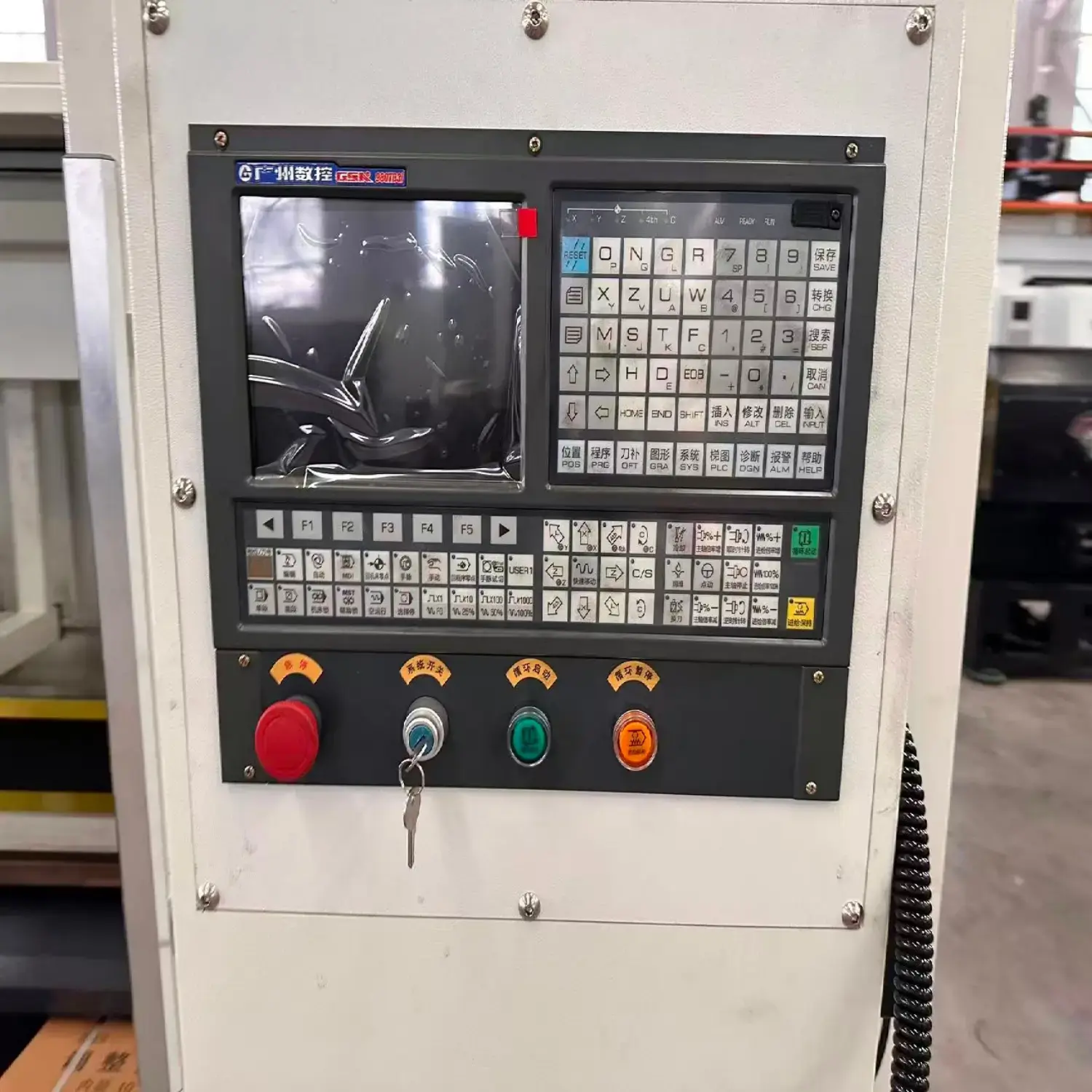
Flat Bed CNC Lathe Machine Price and What Drives It
| Clase | Rango de funcionamiento típico o potencia | Ejemplo de control o de origen | Precio indicativo FOB en USD |
|---|---|---|---|
| Entry light-duty | 360 mm swing × 750 mm, 5.5 kW spindle | GSK 980TDb, domestic servo | 18,000–26,000 |
| Standard duty | 500 mm swing × 1000–1500 mm, 7.5–11 kW | KND 2000Ti, Syntec 22TA, domestic linear guides | 28,000–42,000 |
| Heavy duty | 630 mm swing × 1500–3000 mm, 15–22 kW | Siemens 828D, FANUC 0i-TF, HIWIN/PMI linear guides or box ways | 55,000–85,000 |
| Large bore oil-country | 800 mm swing × 3000–6000 mm, 30–45 kW | FANUC 0i-TF Plus, Siemens 840D sl, imported ball screws | 95,000–160,000 |
These bands reflect RUNNEWTECH’s 2024–2025 export shipments from Qingdao. Actual factory acceptance test (FAT) configurations move quotes up or down by 8–15 percent.
What Moves the Price Inside Each Band
The control system and the spindle/servo package are normally the two largest line items on a flat bed CNC lathe bill of materials. A FANUC 0i-TF kit with αi series servos and spindle motor adds roughly 9,000–14,000 USD to a 500 mm swing machine against a GSK 980TDb with domestic motors. Siemens 828D with SINAMICS drives sits in between at roughly 6,000–10,000 USD premium over GSK. The spindle itself—bearing grade, whether P4 angular contact paired or standard P5, and whether A2-6 or A2-8 nose with 11 kW versus 7.5 kW—accounts for 3,000–7,000 USD swing.
Casting or frame share runs 18–24 percent of ex-works cost on a standard CK6150-class machine. HT250 resin sand casting with natural aging is the baseline. HT300 or Meehanite-grade iron with forced stress relief adds roughly 600–1,200 USD but reduces thermal drift during interrupted cuts. A machine quoted at the bottom of the entry band almost certainly uses a lighter bed, narrower box way width, or both. Ask for net weight: a properly built 500 mm × 1000 mm flat bed CNC lathe should land at 3,200–3,800 kg. Quotes below 2,600 kg for the same envelope suggest thinner wall sections or reduced ribbing.
Guideways and ball screws consume 12–16 percent. Hardened and scraped box ways with Turcite-B or Rulon lining suit heavy interrupted turning and cost roughly the same as HIWIN or PMI HG-series 35 mm linear roller guides on the Z axis, but the box way machine tolerates higher chip loads with less chatter. The trade-off is rapid traverse: box way machines typically top out at 6–8 m/min rapid, while linear guide machines reach 12–24 m/min. Ball screw grade matters directly for positioning accuracy: C3 ground screws with pre-tensioned nuts hold 0.012 mm positioning and 0.006 mm repeatability; C5 rolled screws with standard nuts open that to 0.020 mm and 0.010 mm. The C3 upgrade adds roughly 800–1,400 USD on X and Z.
Real Cost Structure from Foundry to Your Floor
For a standard 500 mm × 1500 mm flat bed CNC lathe at roughly 35,000 USD FOB Qingdao, the approximate breakdown runs:
- Casting, rough machining, stress relief: 6,500–7,500 USD
- Guideways, ball screws, bearings: 4,500–6,000 USD
- Spindle assembly, motor, drive: 5,500–8,000 USD
- Control system, servo package, electrical cabinet: 7,000–11,000 USD
- Tool turret (8-station electric, VDI or bolt-on): 2,000–3,500 USD
- Assembly, scraping, alignment labour: 3,000–4,500 USD
- Export packing (plywood crate, moisture barrier, silica gel, bracing): 800–1,200 USD
- Inland freight to Qingdao port: 400–700 USD
- Sea freight to Southeast Asia / Middle East / Africa / South America: 1,200–2,800 USD depending on destination and container type
- Marine insurance (110 percent CIF value, ICC-A): 200–400 USD
- Destination duty and VAT (varies 5–25 percent): 2,500–9,000 USD
- Customs clearance, THC, agency fees: 600–1,500 USD
Total landed cost typically runs 1.35–1.55 × FOB for most destinations outside free-trade zones.
Why the Cheapest Quote Is Usually Cheaper
The lowest bid in a competitive tender normally achieves savings through three areas visible only on inspection, not on paper:
Lighter casting. A 500 mm swing machine weighing 2,400 kg instead of 3,400 kg saves roughly 1,200–1,800 USD in iron and rough machining but shows up as chatter on 1045 steel at 2 mm depth of cut and 0.3 mm/rev feed.
Lower grade ball screw or unbranded linear guide. Generic 32 mm rolled screws without pre-load, or non-HIWIN/PMI linear guides with lower roller conformity, save 600–1,000 USD. Positioning accuracy drifts after 6–12 months of chip load cycling. Rapid traverse noise increases.
Unbranded or refurbished control components. A used FANUC 0i-MD screen in a 0i-TF housing, or servo motors with rewound windings, cuts 3,000–5,000 USD. Thermal overload trips and encoder drift follow within the first year.
Supplier Qualification: Machine Builder versus Trading Office
Request these items before placing deposit. A real builder produces them without delay; a trading office deflects or disappears.
Foundry or casting source documentation. Ask for the foundry name, casting grade certificate (HT250 or HT300), and whether stress relief is natural (outdoor stacked 6+ months) or forced (resin sand with furnace normalization). RUNNEWTECH sources from a dedicated Shandong foundry with HT300 capability and maintains batch traceability. A trading office has no foundry relationship to show.
Suelo de la sala de sesiones y registros de raspado. Demand dated photos or video of the specific machine bed being scraped—flatness checked with a 1,000 mm straightedge and 0.02 mm feeler gauge, contact points per 25×25 mm square. Hand scraping remains standard for box way machines; linear guide machines still need datum surface prep. No scraping floor means subcontracted assembly with no geometric control.
Registros del interferómetro láser y de la barra de bolas. A builder running ISO or factory standards keeps Renishaw XL-80 or equivalent laser interferometer reports for positioning accuracy and repeatability, and QC20-W ball bar reports for circular interpolation. Ask for the actual plot for your machine serial number, not a generic template. Values to see: positioning accuracy ≤ 0.016 mm/300 mm, repeatability ≤ 0.008 mm, ball bar roundness ≤ 0.020 mm at 150 mm radius and 1,000 mm/min feed.
Factory acceptance test (FAT) with documented geometric accuracy. The FAT should reference GB/T 16462 or ISO 13041 geometric tests: bed straightness in horizontal and vertical planes, spindle runout, tailstock alignment, turret index repeatability. Insist on witness or live video, not just a signed paper.
Payment structure that aligns risk. Standard builder terms: 30 percent T/T deposit, 60 percent against FAT photos/video and shipping documents, 10 percent after installation and run-off. A demand for 100 percent advance, or 50/50 with no FAT milestone, signals cash-flow stress or trading-office fragility.
Capacidad de ingeniería posventa. Ask for the name and location of the next available service engineer, and whether they carry spare servo drives, encoder cables, and turret proximity switches in regional stock. A builder maintains parts inventory by machine serial number; a trading office forwards WhatsApp messages to a WeChat group.
Comparación de los costes de funcionamiento a lo largo de cinco años
Assuming 2,000 operating hours per year, 70 percent spindle load factor, electricity at 0.10 USD/kWh:
| Partida de gastos | Standard Duty (GSK/Syntec, domestic servo) | Heavy Duty (Siemens/FANUC, imported components) |
|---|---|---|
| Consumo energético anual | 28,000–32,000 kWh | 26,000–29,000 kWh (higher efficiency servos) |
| Annual electricity cost | 2,800–3,200 USD | 2,600–2,900 USD |
| Ball screw/way lubricant, annual | 400–600 USD | 350–500 USD (centralized system, less waste) |
| Turret tool holders, inserts, annual | 1,800–2,400 USD (same for both classes) | 1,800–2,400 USD |
| Control/spindle failure downtime, expected | 80–140 hours over 5 years | 30–60 hours over 5 years |
| Estimated spare parts over 5 years | 4,500–7,000 USD (servo motor, encoder, turret solenoid) | 2,500–4,000 USD (higher initial quality, better availability) |
| Total 5-year operating cost | 38,000–48,000 USD | 32,000–40,000 USD |
The heavier-built machine with branded controls costs more upfront but typically recovers 6,000–12,000 USD in operating and downtime costs over five years. For a job shop running single-shift with 600 hours annual spindle time, the entry machine may suffice. For automotive or hydraulic shaft work with tight tolerances and penalty clauses for late delivery, the heavier specification pays back faster.
Lead Time and What Extends It
Standard configuration from confirmed deposit: 35–45 days for entry and standard classes, 55–75 days for heavy duty with imported control systems. Factors that extend lead time include:
- FANUC or Siemens control backorder (currently 4–8 weeks for 0i-TF Plus in some regions)
- Custom spindle bore or A2-8 nose not in subassembly stock
- Third-party inspection witness (adds 5–7 days for scheduling)
- Peak season container shortage (September–November)
RUNNEWTECH maintains buffer stock of GSK and KND configured machines for 25-day expedited shipment when the application permits. Confirm voltage requirement at order stage: 380V 50Hz three-phase is standard; 220V 60Hz or 415V 50Hz for specific regions requires transformer or reactor specification that adds 3–5 days and 400–800 USD.
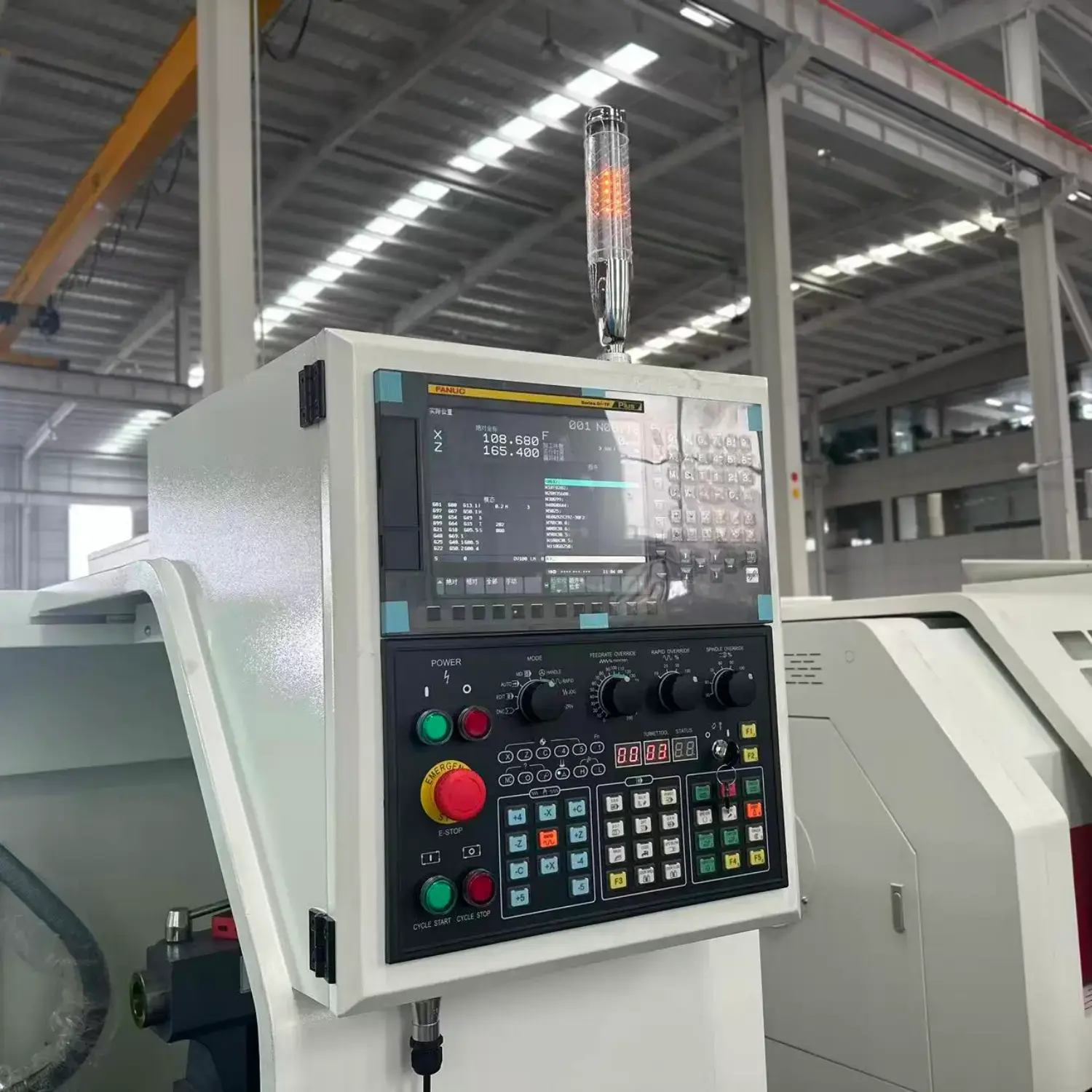
Industry Applications for Flat Bed CNC Lathe Machine
| Sector | Piezas típicas fabricadas | Especificaciones recomendadas | Por qué esta máquina es la más adecuada |
|---|---|---|---|
| Recambios para automóviles y motocicletas | Brake discs, camshafts, wheel hubs, drive shafts, piston rods | 500 mm swing, 1000–1500 mm Z travel, A2-6 or A2-8 spindle nose, 11–15 kW spindle, 2500 rpm, GSK 980TDi or FANUC 0i-TF, positioning accuracy 0.015 mm, repeatability 0.008 mm | Flat bed rigidity absorbs interrupted cuts on cast iron brake discs; wide swing handles truck hubs without tailstock interference |
| Maquinaria agrícola | Tractor axle shafts, gearbox housings, hydraulic cylinder rods, combine harvester spindles | 630 mm swing, 1500–3000 mm Z travel, A2-8 spindle, 15–18.5 kW, 2000 rpm, hardened box ways on Z, HT300 casting, machine weight 4500–6000 kg | Long bed variants support 2–3 metre shafts common in drivelines; box ways outperform linear guides under heavy chip loads from sand-cast workpieces |
| Accesorios hidráulicos y neumáticos | Cylinder barrels, piston rods, valve bodies, tie rods, port connectors | 360–400 mm swing, 750 mm Z travel, A2-5 spindle, 7.5–11 kW, 3000 rpm, C axis optional for cross-drilling, GSK or KND control | High concentricity requirements (0.02 mm TIR) for barrel-to-rod sealing; flat bed thermal stability maintains bore consistency across shift changes |
| Acoplamientos para petróleo y gas | Drill pipe tool joints, casing connectors, wellhead flanges, valve bonnets | 500–630 mm swing, 1500 mm Z travel, A2-8 spindle, 18.5–22 kW, 1500 rpm (low-speed torque priority), FANUC or Siemens with rigid tapping | API thread forms require sustained cutting forces at low rpm; flat bed mass dampens vibration during threading cycles on alloy steel |
| Fabricación de moldes y matrices | Core pins, ejector sleeves, guide pillars, mould cavities, die buttons | 400 mm swing, 750 mm Z travel, A2-6 spindle, 11 kW, 3500 rpm, linear roller guides on X/Z for rapid traverse 20 m/min, positioning accuracy 0.01 mm | Frequent tool changes and fine finishing passes benefit from rapid traverse; linear guides reduce stick-slip during micro-feeds for cavity profiling |
| Centros de formación técnica | Student projects across shaft, disc and thread exercises | 360 mm swing, 750 mm Z travel, A2-5 spindle, 5.5–7.5 kW, 2500 rpm, GSK 980TDi or Syntec 22TA, machine weight 2200–2800 kg, 380V 50Hz single-phase option | GSK and Syntec controls dominate vocational curricula in Southeast Asia and Africa; flat bed visibility aids instruction; lower spindle power reduces consumable costs |
Recambios para automóviles y motocicletas
Brake disc machining illustrates the flat bed advantage clearly. A 500 mm swing CK6150 with A2-6 spindle nose and 11 kW motor running at 2500 rpm faces cast iron discs at 2–3 mm depth of cut. The interrupted cutting pattern from ventilation slots generates impact loads; HT300 bed castings with 3200–3800 kg machine mass absorb this better than slant bed designs of equivalent swing. Positioning accuracy of 0.015 mm and repeatability of 0.008 mm meets the 0.05 mm runout tolerance typical for ventilated automotive discs. For motorcycle camshafts, the same machine with C axis and driven tooling performs milling and cross-drilling in single setup, though buyers should note that full C axis adds 15–20% to base machine cost and extends lead time by 3–4 weeks.
Maquinaria agrícola
Tractor axle shafts at 1.5–2.5 metres length require Z travel matching the workpiece plus 200 mm clearance for chuck and tailstock. A CK6163 variant with 630 mm swing, 3000 mm Z travel and 15 kW spindle at 2000 rpm handles 4140 steel shafts at 4 mm depth of cut. The critical specification here is bed construction: hardened box ways on Z axis, scraped to 0.02 mm straightness over full length, outperform linear roller guides under the abrasive chip loads from sand castings common in agricultural supply chains. Machine weight reaches 5500 kg for this configuration, requiring 5-tonne forklift or overhead crane for container unloading. Foundation bolts and levelling pads are mandatory; without proper anchoring, long shaft turning induces bed flexure that shows as taper error.
Accesorios hidráulicos y neumáticos
Hydraulic cylinder barrels demand concentricity between OD and bore within 0.03 mm for proper seal function. A CK6136 or CK6140 with 360–400 mm swing, 750 mm Z travel and A2-5 spindle nose achieves this through thermal stability rather than raw precision. The flat bed’s uniform mass distribution minimises differential expansion during warm-up; positioning accuracy of 0.015 mm is sufficient because the critical feature is relative concentricity, not absolute position. GSK 980TDi controls with 0.001 mm programming resolution handle the fine finish passes at 0.1–0.2 mm depth. For shops producing stainless steel fittings, specify a 7.5 kW minimum spindle to maintain surface speed at lower rpm where galling occurs.
Acoplamientos para petróleo y gas
API 5CT and 5B thread specifications on drill pipe tool joints require sustained torque at 50–150 rpm cutting speed on 4130 or 4145H steel. A 500 mm swing machine with 18.5 kW spindle and A2-8 nose delivers 800 Nm continuous torque at 800 rpm, dropping to 1200 Nm at 150 rpm for roughing. FANUC 0i-TF or Siemens 828D controls include canned cycles for API round and buttress threads, though custom macro programming is still common in Chinese-built machines. The trade-off: this specification pushes machine weight to 4800 kg and requires 380V 50Hz three-phase supply; buyers in 220V 60Hz regions need a 25–30 kVA transformer, adding $800–1200 to landed cost. Factory acceptance test with laser interferometer on Z axis and ball bar circularity test should be specified in purchase contract for this sector.
Fabricación de moldes y matrices
Core pins and ejector sleeves at 150–300 mm length require frequent tool changes and rapid positioning between roughing and finishing operations. Linear roller guides (HIWIN or PMI) on X and Z axes enable 20 m/min rapid traverse versus 8–10 m/min for box way machines, reducing non-cutting time to 15–20% of cycle time on small parts. Positioning accuracy of 0.01 mm supports the 0.02 mm tolerances typical for pin diameters in injection moulds. However, the trade-off is rigidity: linear guides deflect more under heavy roughing cuts, so specify 11 kW spindle minimum and limit depth of cut to 2–3 mm on tool steel. For cavity blocks requiring 3D profiling, a flat bed lathe with C axis and Y axis (live tooling) approaches machining centre capability at 60–70% of the capital cost, though true 5-axis contouring remains the domain of dedicated mill-turn centres.
Centros de formación técnica
Vocational programmes in Indonesia, Vietnam, Nigeria and Peru standardise on GSK 980TDi or Syntec 22TA controls because training materials, spare keyboards and parameter documentation circulate in local languages. A CK6136 with 360 mm swing, 750 mm Z travel and 5.5 kW spindle covers 80% of turning exercises: shaft turning, grooving, threading, taper turning and simple facing. Machine weight of 2400 kg allows unloading with 3-tonne forklift, critical for schools without overhead crane infrastructure. The 380V 50Hz requirement conflicts with Philippine or Brazilian 220V 60Hz supply; specify 220V motor winding or external transformer at order stage, as retrofitting is impractical. Lead time runs 25–30 days for single units, with 15% deposit and balance against copy of bill of lading standard payment structure. Installation and operator training, typically 5 working days, should be specified as included or itemised separately to avoid scope disputes.
Cómo realizar un pedido e importar, paso a paso
Three mistakes leave more imported flat bed CNC lathes idle in the first month than mechanical failure ever does. Each has a one-line fix.
Mistake 1: Supply voltage or frequency mismatch. A 380V 50Hz machine landed in a 220V 60Hz shop with no transformer and no parameter rewrite for the spindle drive. The fix: confirm actual shop voltage, frequency, and phase at the main breaker before final specification, and require the builder to state whether a step-up/step-down transformer and drive parameter adjustment are included.
Mistake 2: Working range too small for the actual part family. A 500 mm swing lathe specified for 480 mm flange blanks with no margin for fixture height or tool clearance. The fix: model the largest part, plus chuck, plus tallest tool holder, plus 50 mm clearance in every axis, before selecting bed length and swing.
Mistake 3: No electrical schematic, parameter backup, or local consumable source. One blown fuse or broken insert stalls production for weeks. The fix: contractually require paper and digital schematics, a complete parameter backup on USB, and a named list of local or regional sources for inserts, coolant, and drive modules.
Defining Workpiece Envelope and Tolerance
Start with the part, not the catalog. Maximum swing over bed must exceed the largest diameter by at least the chuck jaw height plus tool clearance. For a 400 mm diameter flange in a 250 mm three-jaw hydraulic chuck with 60 mm jaws, you need roughly 520 mm swing over bed; a 610 mm swing machine (CK6163 class) is the practical minimum. Maximum turning length must include part length, tailstock center engagement, and facing clearance. A 1500 mm bed often delivers only 1350 mm between centers once a chuck and tailstock are mounted.
| Especificaciones | Typical Range for Flat Bed CNC Lathe | What to Verify |
|---|---|---|
| Columpio sobre la cama | 400 mm to 800 mm | Diameter + chuck + clearance |
| Longitud máxima de torneado | 750 mm to 3000 mm | Between centers with fixtures installed |
| Orificio del husillo | 52 mm to 105 mm | Bar capacity if running stock through spindle |
| Punta del husillo | A2-5, A2-6, A2-8 | Chuck mounting compatibility |
| Potencia del husillo | 7.5 kW to 22 kW | Continuous rating, not peak |
| Velocidad del husillo | 1500 rpm to 2500 rpm | Lower on large swing machines |
| Recorrido del eje X | 220 mm to 400 mm | Diameter direction, tool clearance |
| Recorrido del eje Z | 650 mm to 3100 mm | Matches bed length |
| Desplazamiento rápido en los ejes X y Z | 6 m/min to 12 m/min | Affects cycle time on short moves |
| Precisión de posicionamiento | ±0.015 mm to ±0.025 mm | Per ISO 230-2, 300 mm length |
| Repetibilidad | ±0.008 mm to ±0.012 mm | Ball bar or laser test, not catalog claim |
Tolerance drives control system selection and cost. ±0.05 mm on diameter for rough turning of cast iron hydraulic fittings allows GSK 980TDi or KND K2000Ti with no linear scales. ±0.01 mm on shaft journals for bearing fits demands FANUC 0i-TF Plus or Siemens 828D with linear scale feedback, thermal compensation, and C-axis capability for milling. The price gap between these two configurations on a 500 mm swing machine is typically USD 8,000 to 15,000.
Control System and Service Capability
The control system is the machine’s nervous system and its service dependency. Each has regional coverage implications.
| Control | Aplicación típica | Consideraciones sobre el servicio |
|---|---|---|
| FANUC 0i-TF / 0i-TF Plus | High-volume automotive, tight tolerances | Global parts network; confirm local distributor stocks drive modules |
| Siemens 828D / 840D sl | European job shops, milling-turning centers | Requires Siemens-certified technician for parameter recovery |
| Mitsubishi M80 | Southeast Asian automotive suppliers | Strong in Thailand, Indonesia; weaker in Africa and South America |
| GSK 980TDi / 988T | Budget production, training centers | GSK has service offices in Vietnam, Egypt, Brazil, Russia; elsewhere depends on builder |
| KND K2000Ti / K1000Ti | Entry-level CNC replacement of manual lathes | KND supports through machine builder; verify builder’s English documentation quality |
| Syntec 21TA / 22TA | Taiwanese-influenced markets, milling-turning | Good in Southeast Asia; parts from Taiwan or mainland China |
Ask the builder directly: who services this control within 500 km of your shop? A real builder has a named technician or distributor, not a vague “we have agents worldwide.” Request a service call log from the last 12 months for your country or region. Trading offices cannot produce this.
Supply Voltage Frequency and Phase Confirmation
Flat bed CNC lathes from Chinese builders are wound for 380V three-phase 50Hz as standard. North American shops at 208V or 240V three-phase 60Hz require explicit confirmation.
| Suministros para tiendas | Requisitos de la máquina | Solución | Cost Impact |
|---|---|---|---|
| 380 V, 50 Hz | 380 V, 50 Hz | Conexión directa | Ninguno |
| 400V 50Hz (Europe) | 380 V, 50 Hz | Usually within ±10% tolerance; confirm with builder | Ninguno |
| 220V 60Hz (Taiwan, parts of Southeast Asia) | 380 V, 50 Hz | Step-up transformer + verify spindle drive accepts 60Hz | USD 800–2,500 for transformer |
| 208V 60Hz (North America) | 380 V, 50 Hz | Step-up transformer + drive parameter change or replacement | USD 1,500–4,000 |
| 460V 60Hz (North America industrial) | 380 V, 50 Hz | Step-down transformer; motor current increases | USD 1,000–3,000 |
The spindle drive (typically Mitsubishi FR-A800 or Siemens SINAMICS series) must accept the actual frequency or be reprogrammed. A 60Hz supply on a 50Hz-parameterized vector drive causes motor overheating and premature bearing failure. The fix is in the mistake list: require written confirmation of drive parameter compatibility with your supply, not just “we can add a transformer.”
Floor Loading Foundation and Floor Space
Flat bed CNC lathes concentrate weight on four feet. A CK6150 (500 mm swing, 1500 mm bed) weighs 3200 kg to 3800 kg depending on casting grade and tailstock. A CK6180 (800 mm swing, 3000 mm bed) reaches 8500 kg to 12,000 kg.
| Machine Class | Approximate Weight | Floor Loading at Feet | Foundation Requirement |
|---|---|---|---|
| CK6136 (360 mm swing, 750 mm bed) | 1600–2000 kg | 4–5 t/m² | 150 mm reinforced concrete, no isolated pad |
| CK6140/6150 (400–500 mm swing, 1000–2000 mm bed) | 2800–4200 kg | 6–8 t/m² | 200 mm reinforced concrete; isolated pad if floor is suspended or mezzanine |
| CK6163 (630 mm swing, 1500–3000 mm bed) | 5 500–7 500 kg | 10–14 t/m² | 250 mm isolated foundation pad, 500 mm wider than machine base on all sides |
| CK6180/61100 (800–1000 mm swing, 3000 mm bed) | 9000–15000 kg | 15–20 t/m² | Engineered foundation with rebar mesh, vibration isolation from adjacent machines |
Floor space must include operator access, chip conveyor clearance, and maintenance panel swing. A CK6150/1500 typically requires 3600 mm × 2000 mm machine footprint plus 1000 mm minimum on the operator side, 800 mm on the tailstock end for bar feed or part removal, and 600 mm on the rear for electrical cabinet ventilation. Total recommended bay: 5500 mm × 3500 mm.
Conformity Marking for Customs
CE marking is the most common requirement for customs clearance in European Union countries, Turkey, and several Middle Eastern and North African markets. A real builder provides:
- EC Declaration of Conformity referencing Machinery Directive 2006/42/EC
- Technical file with risk assessment (EN ISO 12100)
- Electrical safety per EN 60204-1
- Noise emission test report if claimed
For non-EU destinations, requirements vary. Saudi Arabia requires SASO conformity; UAE requires ECAS for some product categories; Nigeria requires SONCAP. A trading office often cannot produce valid CE documentation because they did not control the design. Request the CE certificate number and the notified body; verify it on the EU NANDO database. RUNNEWTECH provides CE documentation for all flat bed CNC lathe models shipped to markets requiring it; state your destination in the inquiry.
FOB versus CIF and Container Logistics
| Término | What Builder Pays | What Buyer Pays | Risk Transfer Point | Best For |
|---|---|---|---|---|
| FOB (Chinese port) | Inland transport, export customs, loading on vessel | Ocean freight, insurance, destination customs, inland delivery | Ship’s rail at origin port | Experienced importers with freight forwarder |
| CIF (destination port) | All of above plus ocean freight and marine insurance | Unloading, destination customs, inland delivery, insurance claim administration if damage occurs | Ship’s rail at origin port (risk does not shift with CIF) | Buyers without freight relationships; verify insurance coverage amount |
Flat bed CNC lathes ship in 20-foot or 40-foot containers. A CK6136 or CK6140/1000 fits in a 20-foot container (internal length 5900 mm). A CK6150/1500 or larger requires a 40-foot container (internal length 12000 mm). Machines over 800 mm swing or 3000 mm bed length may require flat-rack or breakbulk shipment.
| Machine Class | Approximate Shipping Weight | Container Type | Weight Limit Consideration |
|---|---|---|---|
| CK6136 | 2200–2600 kg with crate | 20′ GP | Well within 21,500 kg payload |
| CK6150/1500 | 4200–4800 kg with crate | 40′ GP | Within limits; single machine |
| CK6163/2000 | 6800–7800 kg with crate | 40′ GP | Near limit; verify axle weights for inland trucking |
| CK6180/3000 | 10,000–13,000 kg with crate | 40′ HQ or flat-rack | Flat-rack for overweight; requires special unloading |
Request container loading photos: machine bolted to skid, desiccant bags, moisture barrier wrapping, and corner bracing. Trading offices rarely have these; they rely on the actual builder’s shipping department.
Deposit Balance Payment and Factory Acceptance Test
Standard structure for machinery from Chinese builders:
| Milestone | Payment | What Triggers It |
|---|---|---|
| Purchase order with signed specification | 30% deposit | Contract effective; builder orders castings and control system |
| Factory Acceptance Test (FAT) passed | 60% balance before shipment | Buyer or agent witnesses test; or video FAT with live measurement data |
| Installation and commissioning completed | 10% retention | Machine meets geometric accuracy on buyer’s floor; or negotiate 5% at 90 days |
The FAT is the critical gate. A real builder conducts it on their floor and welcomes witness or video participation. Minimum FAT content for a flat bed CNC lathe:
- Laser interferometer test of X and Z positioning accuracy and repeatability per ISO 230-2, with printed graph
- Ball bar test for circular interpolation, 150 mm radius at 1000 mm/min feed rate
- Spindle runout: axial and radial, <0.005 mm at nose
- Tailstock alignment and quill travel straightness
- Full 8-hour run-in at rated spindle speed, monitoring bearing temperature
- Test cut on certified test bar: diameter consistency over 300 mm length
Request the FAT report template before deposit. Trading offices often have no template; they forward whatever the builder sends, sometimes months after payment.
Equipos de descarga en el lugar de destino
| Machine Class | Unloading Method | Equipamiento mínimo |
|---|---|---|
| Up to 2500 kg | Forklift from container | 3-tonne capacity forklift, 4-meter mast |
| 2500–5000 kg | Forklift or crane | 5-tonne forklift with fork extensions, or 5-tonne mobile crane |
| 5.000–10.000 kg | Crane required | 10-tonne mobile crane or overhead crane; machine skidded to lifting points |
| Over 10,000 kg | Rigging crew | 16-tonne crane, spreader bar, certified rigging; foundation ready before arrival |
The machine ships on a timber skid with designated lifting points. Do not lift by the bed ways or the electrical cabinet. A real builder marks lifting points in the shipping manual with diagrams. Request this manual before shipment to confirm your unloading plan.
Instalación y formación de los operadores
Installation by the builder’s technician typically takes 3–5 days for a CK6150-class machine, 7–10 days for CK6180 with hydraulic chuck and tailstock. Scope should include:
- Leveling: precision level on bed ways, longitudinal and transverse, adjusted to 0.02 mm/m; shim placement documented
- Geometric accuracy verification: same tests as FAT, now on buyer’s foundation
- Control system parameter confirmation: voltage, frequency, axis travel limits, spindle orientation
- Tool offset and work coordinate setup with buyer’s actual fixtures
- Test cut on buyer’s material
Operator training: 3–5 days, minimum two operators. Content should cover program transfer (USB or Ethernet), tool setup and offset entry, work coordinate setting, basic G-code editing, alarm diagnosis, and daily maintenance (way lubrication levels, chip conveyor, coolant concentration). Request training outline in writing before machine arrival.
Paquete inicial de piezas de recambio y consumibles
Contract for these items with the machine order, not after arrival when air freight costs multiply.
| Artículo | Cantidad | Rationale |
|---|---|---|
| Control system battery | 2 units | FANUC or Siemens lithium battery; 2-year life |
| Axis servo motor encoder | 1 per axis, or 1 complete set | Long lead item; verify part numbers match actual motors shipped |
| Spindle encoder | 1 | If equipped with C-axis or rigid tapping |
| Fuse and contactor set | 1 juego completo | Per electrical schematic; label by circuit |
| Way lubrication pump filter | 2 | Monthly replacement on heavy use |
| Sello mecánico de la bomba de refrigerante | 1 | Common failure; stops production |
| Hydraulic chuck seals | 1 juego | O-rings for 10-inch or 12-inch chuck |
| Tool holder bolts and pull studs | 4 each | Matching actual taper (not applicable to flat bed lathe direct mount; confirm if using VDI or BMT turret) |
For flat bed CNC lathes with turret tooling (VDI40 or VDI50, or bolt-on tool post), confirm turret type before ordering holders. A real builder specifies turret model (Sauter, Duplomatic, or domestic equivalent) and provides holder drawing.
Consumables for first six months: carbide inserts for your material (ISO P, M, or K grade), cutting oil or semi-synthetic coolant concentrate, way oil ISO VG 68, hydraulic oil ISO VG 46 for chuck and tailstock if applicable.
Numbered Ordering and Import Checklist
- Workpiece envelope confirmed: largest diameter + chuck + clearance = required swing; part length + fixtures + tailstock = required bed length; spindle bore matches bar stock if applicable.
- Tolerance and surface requirement drive control system: FANUC 0i-TF Plus or Siemens 828D for ±0.01 mm; GSK 980TDi or KND for ±0.05 mm production; C-axis and live tooling specified if needed.
- Control service verified: named technician or distributor within 500 km; service call log requested; language capability confirmed.
- Voltage frequency phase confirmed: actual measurement at shop main breaker; transformer requirement stated with kVA rating; drive parameter compatibility documented.
- Foundation and floor space verified: floor loading calculated; isolated pad specified if needed; machine footprint plus operator and maintenance clearance confirmed against bay dimensions.
- Conformity marking identified: CE, SASO, SONCAP, or other; certificate number and notified body provided; verified on official database if CE.
- Shipping term selected: FOB or CIF; container type (20′ GP, 40′ GP, flat-rack) matched to machine and bed length; overweight permits checked for inland trucking.
- Payment structure negotiated: 30/60/10 or 30/65/5; FAT as balance payment gate; retention for 90-day performance period if possible.
- Factory Acceptance Test defined: laser interferometer, ball bar, spindle runout, tailstock alignment, 8-hour run-in, test cut; report template received before deposit.
- Unloading equipment reserved: forklift or crane capacity confirmed against shipping weight; lifting points reviewed in shipping manual; rigging crew booked for over 10,000 kg.
- Installation and training scheduled: builder technician arrival within 14 days of machine delivery; leveling and geometric accuracy scope confirmed; training outline for two operators received.
- Spare parts and consumables packaged: battery, encoder, fuse, filter, seal set ordered with machine; six-month insert and coolant supply identified with local or regional source.
Máquinas RUNNEWTECH relacionadas

Torno CNC de bancada plana
Factory direct flat bed cnc lathe with FANUC, Siemens, Mitsubishi, GSK or Syntec control options and 380V/50Hz or 220V/60Hz supply for export.

Frequently Asked Questions About Flat Bed CNC Lathe Machine
Minimum Order Quantity And Control System Options
Q: What is your minimum order quantity and which CNC controls do you offer?
MOQ is one machine for standard models. Control options are FANUC 0i-TF Plus, Siemens 828D, Mitsubishi M80, GSK 980TDi, KND K2000TFi, and Syntec 22TB. All systems ship with English interface as standard; Spanish, Russian, Arabic, and Portuguese are available on request. GSK and KND reduce unit cost by 15–20% versus FANUC or Siemens, though macro programming and servo response differ.
Lead Time And Payment Terms
Q: What is the lead time and what payment structure do you require?
Standard lead time is 25–35 days for GSK or KND configurations, 45–55 days for FANUC or Siemens due to longer import cycle for drives and motors. Payment is 30% T/T deposit, 70% balance before shipment by irrevocable L/C at sight for orders above $50,000. No OA terms for first-time buyers. Custom spindle bore or swing modifications add 10–15 days.
Power Supply And Voltage Adaptation
Q: Can you adapt the machine to our local voltage and frequency?
Standard supply is 380V 50Hz three-phase. For 220V 60Hz regions (North America, parts of Southeast Asia), we fit a step-up transformer 220V-to-380V inside the electrical cabinet, rated at 1.5× machine total load. Transformer adds $400–$600 and 25 kg net weight. Motor deration is not required for 60Hz operation on our Fanuc or Siemens servo packages.
Shipping Method And Transit Time
Q: How is the machine shipped and what is the transit time?
Flat bed CNC lathes ship in 40HQ containers; machines with swing over 660 mm require flat-rack or open-top containers due to 2,850 mm height. Net weight ranges from 2,800 kg (CK6140, 400 mm swing) to 7,500 kg (CK6180, 800 mm swing). FOB Qingdao to Jebel Ali is 18–22 days, to Mombasa 25–30 days, to Santos 35–40 days, to Los Angeles 14–18 days. CIF quotes include marine insurance.
Factory Acceptance Test And Accuracy Documentation
Q: Do you provide a factory acceptance test and geometric accuracy report?
Yes. Every machine undergoes FAT per ISO 13041 or GB/T 16462 before shipment. We record laser interferometer linear positioning accuracy (typically ±0.015 mm/300 mm) and repeatability (±0.008 mm), plus ball bar circularity test for servo tuning match. The geometric accuracy report includes spindle runout (≤0.005 mm at nose), tailstock alignment, and bed level to 0.02 mm/m. Documents ship with the machine; originals by courier.
Warranty Spare Parts And Consumables
Q: What warranty and spare parts support do you offer?
Warranty is 12 months from B/L date, covering control system, servo motors, spindle bearings, and ball screws. We ship a standard spare parts kit: one set of fuses, proximity switches, solenoid valves, and encoder batteries. Consumables—turning inserts, coolant, way oil—are buyer’s scope; we recommend ISO VG68 way oil at 8–12 liters initial fill. Critical spares (spindle bearings, turret index mechanism) ship within 72 hours from our warehouse.
Installation Training And Achievable Tolerance
Q: Do you send engineers for installation and what tolerance can we hold on our material?
One engineer for 5–7 days is included; buyer covers visa, flights, and local accommodation ($120–$150/day). Training covers programming, tool offset, and daily maintenance. On cast iron or mild steel, expect IT7–IT8 tolerance (±0.01–0.02 mm on 50 mm diameter) with carbide inserts. Stainless steel and titanium reduce tool life 30–40%; adjust feeds accordingly. For hardened material above HRC45, specify CBN or ceramic insert capability at order stage.
CE Documentation For Customs Clearance
Q: Can you supply CE documentation for customs clearance in our country?
Yes. We provide CE conformity declaration, machinery directive 2006/42/EC technical file summary, and EN ISO 12100 risk assessment. These are issued by the notified body that audited our assembly floor, not self-certified. For markets requiring additional certification (EAC for Russia, SONCAP for Nigeria), we coordinate with third-party agencies; buyer bears testing costs of $800–$1,500 per certificate. CE documents ship with original B/L set.
Aviso importante
Las especificaciones, los datos de precisión y los rangos de precios que figuran en esta guía son orientativos y se facilitan con fines de planificación.
solo a efectos informativos. Rango de funcionamiento real, tolerancia alcanzable, disponibilidad del sistema de control, requisitos de tensión de alimentación y conformidad
El etiquetado varía según el modelo y el país de destino. Los compradores deben comprobar por sí mismos la tensión y la frecuencia de la red eléctrica, la carga admisible del suelo y
los cimientos, el equipo de descarga y los requisitos de importación antes de realizar un pedido. Todas las cifras están sujetas a confirmación por escrito en
la última factura proforma emitida por RUNNEWTECH.
Sourcing Flat Bed CNC Lathe Machine from RUNNEWTECH
Why Machine Shops Source Flat Bed CNC Lathes from RUNNEWTECH
Runlongjia Machinery has operated its own assembly and scraping floor since 2010. Over 15 years of manufacturing and export experience means the difference between a machine that ships and a machine that ships ready to cut to specification. Every flat bed CNC lathe leaves the factory after a documented run-in cycle and geometric accuracy check. Ball bar and laser interferometer records are available on request for buyers who need traceable positioning accuracy and repeatability data, typically ±0.005 mm positioning and ±0.003 mm repeatability on 500 mm swing machines.
The foundry relationship is direct, not brokered. Castings use HT250 or HT300 resin sand process with stress relief. Assembly teams scrape box way surfaces to matching marks rather than relying solely on machining. This matters for machines with 750 mm or 1000 mm Z-axis travel where carriage load is distributed across long slideways. Control options include FANUC 0i-TF, Siemens 828D, GSK 980TDi and KND systems. Spindle configurations cover A2-5, A2-6 and A2-8 tapers with 5.5 kW to 15 kW motor power, 2500 rpm to 3500 rpm standard. Chuck sizes from 160 mm to 380 mm are stocked.
Voltage adaptation is handled before packing, not left to the buyer’s electrician. Machines are built for 380V 50Hz and retrofitted with transformers for 220V 60Hz regions. Factory acceptance test includes thermal spindle run, backlash measurement and actual turning test on a sample shaft. Plywood case packing with VCI rust protection follows. Terms are quoted FOB Qingdao or CIF to destination port.
After-sales engineering is remote commissioning plus video-guided installation, backed by spare parts inventory for mechanical, electrical and control components. Operator training material is included in the documentation package.
Send your workpiece material, maximum part diameter and length, required tolerance and destination port to receive a specification and quotation within 24 hours via email or the contact form at runnewtech.com.
Get a Factory Direct Quote on Flat Bed Cnc Lathe Machine
RUNNEWTECH se dedica a la fabricación de maquinaria para el trabajo del metal desde 2010,
con más de 15 años de experiencia en exportación. Las máquinas se suministran con el sistema de control que usted elija, adaptado a su red eléctrica
tensión y frecuencia; se somete a pruebas de rodaje y de aceptación en fábrica antes de su embalaje. Envíenos el material de su pieza de trabajo, el tamaño máximo de la pieza,
Indíquenos la tolerancia requerida y el puerto de destino, y le enviaremos un presupuesto en un plazo de 24 horas.

 English
  Indonesian
  Vietnamese
  Arabic
  Russian
  Spanish