
CNC Laser Cutting Machine Buyer Guide
A CNC laser cutting machine for metal is a gantry or cantilever-mounted system that directs a focused fiber laser beam through a cutting head to melt and eject material from carbon steel, stainless steel, aluminum, brass, or copper sheet and plate. The right configuration depends on matching your workpiece envelope to bed size, your material thickness to laser source power, and your edge quality requirements to control system and cutting head specification.
What actually determines machine selection is not brand prestige but verifiable component matching. A 3015 mm × 1525 mm bed handles standard sheet stock; 4020 mm or 6020 mm beds reduce indexing for long automotive or agricultural parts. Fiber laser sources from Raycus (1 kW to 6 kW, lower cost per watt), MAX (1.5 kW to 12 kW, stable mid-range), or IPG (2 kW to 20 kW, premium efficiency at high reflectivity cutting) define your practical cutting limit: 6 mm carbon steel at 1.5 kW, 16 mm at 6 kW, 25 mm at 12 kW with oxygen assist. Positioning accuracy of ±0.05 mm and repeatability of ±0.03 mm are achievable with HIWIN or PMI linear guides and rack-and-pinion drives on the gantry; heavier plate applications benefit from welded steel frame construction over aluminum extrusion. Control systems from Beckhoff, PA, or Syntec manage the servo loop and piercing parameters; Raytools or Precitec cutting heads with automatic capacitive height sensing maintain standoff across warped plate.
Qué trata esta página
The remainder of this guide walks through bed size selection against your typical blank size, laser source and cutting head pairing for your material mix, control system capability for nested batch versus single-part programming, and the supplier qualification checks that separate build-to-order manufacturers from trading companies. Price enters only as an indicative FOB range by power class; detailed pricing mechanics are addressed separately.
Types and Configurations of CNC Laser Cutting Machine
| Tipo o clase | Rango de trabajo habitual | Opciones de control | Ideal para | Notas |
|---|---|---|---|---|
| Compact Single-Table 3015 | 3000 × 1500 mm | GSK, KND, Syntec | Prototype shops, small HVAC ductwork, electrical enclosures | 1.5–3 kW Raycus or MAX source; ~3500 kg; rapid traverse 80 m/min; positioning accuracy ±0.05 mm |
| Standard Single-Table 4020 | 4000 × 2000 mm | Syntec, Mitsubishi, FANUC 0i-F | General sheet metal job shops, automotive panels | 3–6 kW; table loads to ~800 kg sheet; ±0.03 mm repeatability; gantry dual-drive Y axis |
| Large Format Single-Table 6020 | 6000 × 2000 mm | FANUC 0i-F, Siemens 828D | Shipbuilding, agricultural equipment, heavy truck bodies | 6–12 kW IPG or nLIGHT; machine weight 12000–16000 kg; foundation slab required |
| Exchange-Table Tandem 3015/4020 | 3000 × 1500 or 4000 × 2000 mm | FANUC, Siemens 828D, Mitsubishi M80 | High-volume contract manufacturers running two-shift operations | Sub-15 second pallet change; 3–12 kW; cuts unattended throughput 30–40% higher than single-table |
| Tube and Sheet Hybrid | Sheet: 3000 × 1500 mm; Tube: Ø20–220 mm × 6000 mm | Syntec, FANUC | Furniture, fitness equipment, structural steel fabricators | Rotary chuck A-axis; B-axis tilt for bevel cuts; slower on sheet than dedicated flat-bed |
| Coil-Fed Laser Blanking Line | Strip width 800–1600 mm, continuous feed | Siemens 840D sl, proprietary coil line controller | Automotive stampers, appliance makers replacing press blanking | Decoiler + straightener + laser cell; 4–6 kW; not for one-off prototype work |
Compact Single Table 3015
This is the entry point for shops buying their first fiber laser. At roughly 3500 kg and 2.5 m × 5 m floor space, it fits where a turret punch or plasma table once sat. Buyers are typically job shops cutting mild steel to 6 mm and stainless to 3 mm, or electrical panel builders working in 1.5–2.5 mm cold-rolled sheet. The 1.5–3 kW Raycus or MAX source keeps capital outlay low—expect roughly $35,000–$55,000 FOB depending on source brand and chiller spec. What it cannot do: thick plate over 8 mm reliably, or sustained production without operator attendance for loading. The single table means downtime during sheet changeover, and the lighter gantry (often 6–8 mm steel plate construction) shows vibration at 4 kW and above. GSK or KND controls are common; they handle standard G-code but lack the macro and servo-tuning depth of FANUC or Siemens. If your work is mostly 2–4 mm mild steel with occasional 6 mm, this class is adequate. If you plan to move into 10 mm+ structural work, the gantry mass and thermal stability will limit you.
Standard Single Table 4020
The 4000 × 2000 mm bed is the volume sweet spot for general fabrication. Machine weight steps up to 7000–9000 kg, with a welded steel gantry and HIWIN or PMI linear guides on X and Y. Rapid traverse rates of 100–120 m/min are standard, and positioning repeatability tightens to ±0.03 mm with proper calibration. This class normally runs 3–6 kW; at 6 kW with nitrogen assist, you can cut stainless to 8 mm and mild steel to 16 mm, though edge quality on the thick end requires parameter tuning. Controls split by market: Syntec and Mitsubishi M80 for Southeast Asia and Middle East, FANUC 0i-F for Eastern Europe and North America. The 4020 handles half-sheet and full-sheet nesting efficiently—common buyers are automotive Tier 2 suppliers cutting door blanks, hood inner panels, and seat frames. What it cannot do: match the unattended throughput of an exchange-table machine. A skilled operator loading sheets every 8–12 minutes becomes the bottleneck at volumes above 40–50 plates per shift. Also, the 2 m Y travel limits nested parts to roughly 1900 mm clear; oversized agricultural panels or truck sideboards force you to the 6020 class.
Large Format Single Table 6020
At 6000 × 2000 mm, this machine serves industries where one part equals one sheet: ship bulkhead panels, combine harvester side sheets, truck trailer walls. Weight runs 12000–16000 kg, requiring a 200 mm reinforced concrete foundation with anchor bolts and levelling to 0.1 mm/m. The gantry spans 2 m across Y with dual servo drives and linear encoders to prevent racking. Laser power is 6–12 kW, normally IPG or nLIGHT for beam quality at the upper end; Raycus at 6 kW is acceptable for mild steel but struggles on highly reflective 10 mm+ aluminum. Rapid traverse stays similar to the 4020—100–120 m/min—because gantry mass limits acceleration despite larger motors. Buyers are heavy equipment OEMs and large contract manufacturers in Turkey, Brazil, and Southeast Asian shipyards. What it cannot do: small-part economics. The 6020’s fixed costs—floor space, foundation, 80–100 kVA power supply—make it inefficient for shops running 500 × 500 mm brackets. It also ships as 40-foot HC open-top or flat-rack container load, adding $3000–$6000 to freight versus standard 20-foot container for a 3015.
Exchange Table Tandem 3015 or 4020
The exchange-table design uses a split pallet system: one table cuts while the operator loads/unloads the second. Pallet change times of 10–15 seconds mean the laser head is idle only during tab separation and repositioning. Throughput gains of 30–40% over single-table are realistic for nests with many small parts, where loading time otherwise dominates cycle time. Controls are almost exclusively FANUC, Siemens 828D, or Mitsubishi M80—brands that support synchronized pallet clamping and safe torque-off during table transfer. Laser power ranges 3–12 kW; the 6–8 kW configuration with Raytools or Precitec cutting head is the most common order from RUNNEWTECH’s export records. Buyers are high-volume contract manufacturers in Mexico, Poland, and Vietnam running two-shift or three-shift operations for electronics enclosures, server racks, and appliance housings. What it cannot do: justify itself at low volume. The second table adds roughly 25–30% to machine cost, plus the shuttle mechanism increases maintenance points—linear rails under the table collect slag and require weekly cleaning. If your monthly sheet count is below 400–500 plates, the capital premium does not amortize.
Tube and Sheet Hybrid
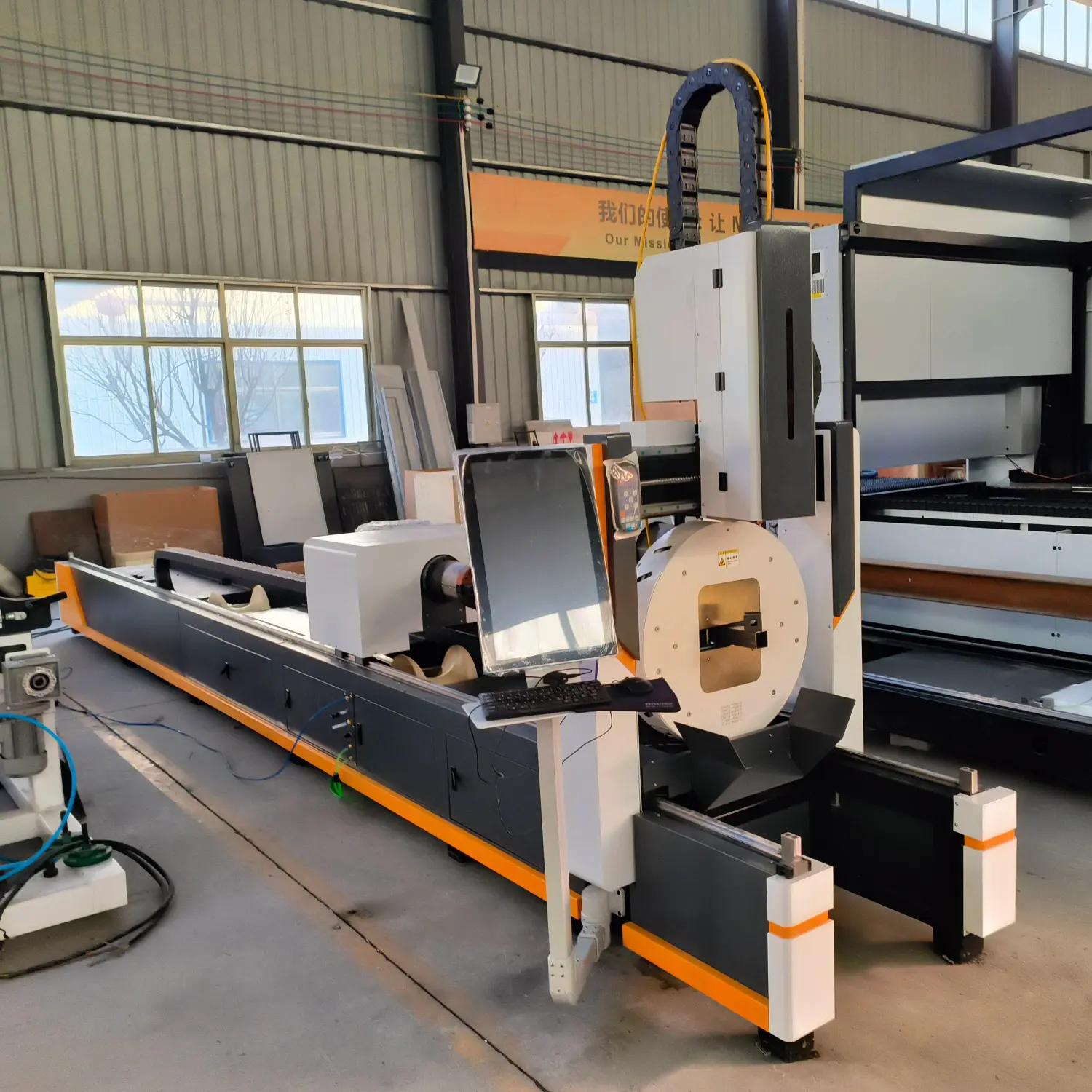
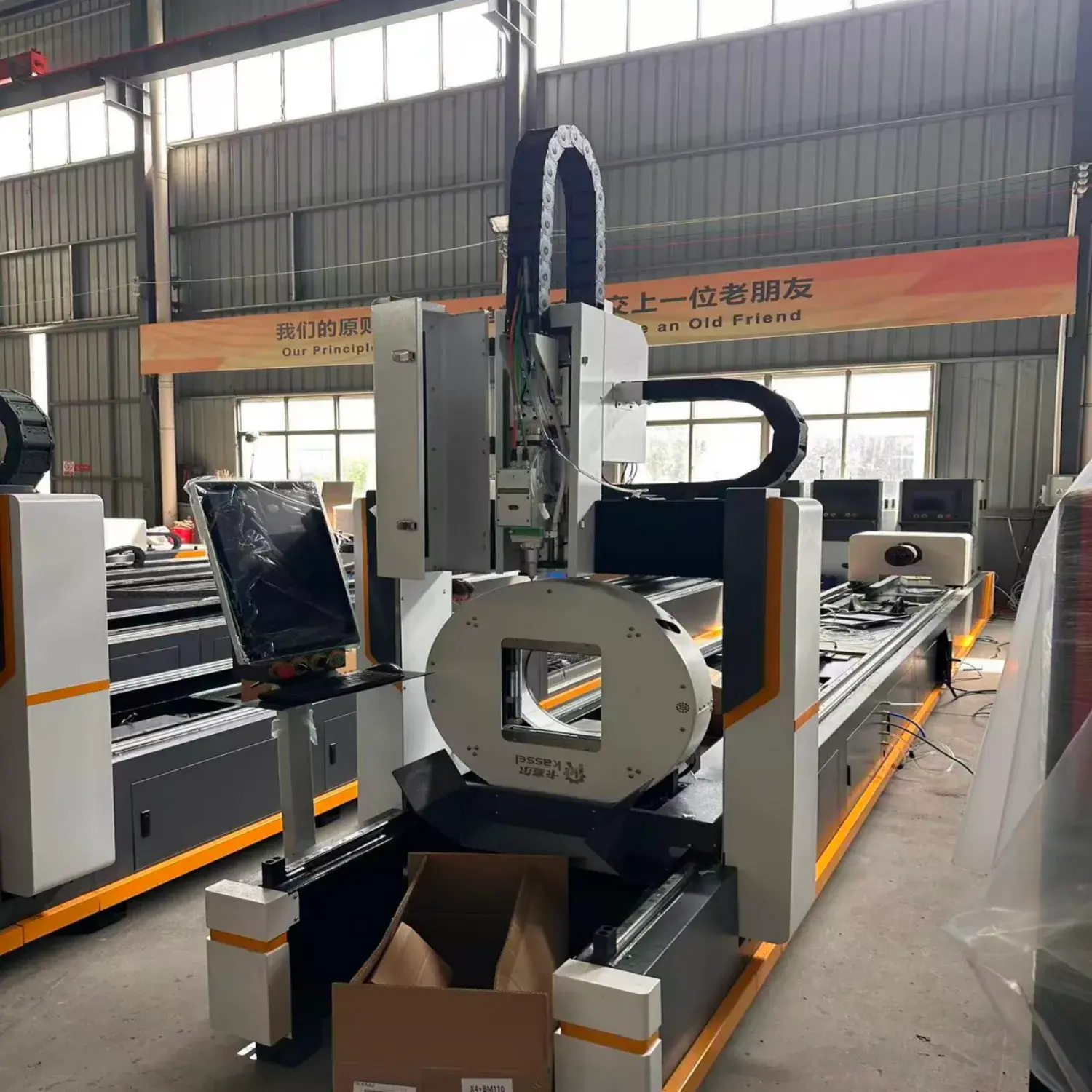
This configuration adds a rotary chuck and tube support bed to a standard flat-bed laser, enabling A-axis rotation and often B-axis tilt for bevel cutting. Tube capacity is typically Ø20–220 mm round, with optional square/rectangle clamping jaws, and lengths to 6000 mm. The sheet area is usually 3000 × 1500 mm, sacrificed slightly for the tube bed integration. Controls from Syntec or FANUC handle the fourth-axis interpolation; B-axis bevel adds significant cost and is rare below 6 kW. Buyers are furniture makers (tube frames for chairs and tables), fitness equipment manufacturers, and architectural metalwork shops doing both flat panels and tubular frames. What it cannot do: match a dedicated flat-bed’s sheet productivity. The tube chuck and support fixtures obstruct nesting near the table edges, and the rotary axis acceleration limits rapid traverse to 60–80 m/min in tube mode. Thick-wall tube over 6 mm also challenges the smaller chuck motors; dedicated tube lasers with flying headstock design handle Ø300 mm+ and 10 mm wall thickness better.
Coil Fed Laser Blanking Line
This is not a standard sheet-fed laser but a continuous processing line: decoiler, straightener/leveler, feeder, laser cutting cell, and stacker. Strip widths run 800–1600 mm, with coil thickness 0.5–3.0 mm. The laser cell itself is compact—often 1500–2000 mm X travel—because it cuts from a moving web with precision encoder tracking. Siemens 840D sl or proprietary coil-line controllers manage the synchronization. Buyers are automotive stampers and appliance manufacturers replacing hard tooling for low-to-medium volume blanking. A 4–6 kW source suffices because material is thin; speed is feed-rate limited, not laser power limited. What it cannot do: prototype or mixed-thickness work. Coil lines require 10–15 ton coil changes, dedicated floor pits for decoilers, and significant scrap optimization software. Changeover between coil widths takes 30–60 minutes. This is a production system, not a job shop machine.
Supplier Qualification Checklist
Beyond machine type, supplier selection determines whether the configuration performs as specified. Request these specifics in writing:
- Laser source serial number range and factory calibration certificate. IPG, nLIGHT, Raycus, and MAX all produce tiered products; a 3 kW MAX source from 2021 performs differently than a 2024 unit with upgraded resonator.
- Cutting head brand and focal length options. Raytools BM110 handles 0–6 kW; BM114 or Precitec LightCutter required for 8–12 kW. Ask whether collimating and focusing lenses are included as spares.
- Chiller specification. S&A or Hanli chillers are standard; confirm flow rate matches source wattage and ambient temperature rating for your region.
- Linear guide and rack brand. HIWIN or PMI on X/Y; some suppliers substitute unstamped generics after quotation. Specify in purchase order.
- Voltage and transformer. Chinese machines ship 380V 50Hz three-phase. For 220V 60Hz regions (North America, parts of South America), a step-up transformer adds 5–8% to landed cost and 300–500 kg to shipping weight. Confirm transformer is included or excluded in quote.
- CE documentation availability. For European or CE-accepting markets, ask for MD 2006/42/EC declaration, not just a sticker. RUNNEWTECH provides CE-compliant builds; verify this is specified if your market requires it.
- Installation and training scope. Unloading a 12000 kg 6020 requires a 10-ton forklift or overhead crane. Foundation drawings should arrive 30 days before machine. Operator training is typically 3–5 days at your site; confirm this is included, not optional at $400–$600/day.
- Spare parts inventory location. Ask whether the supplier stocks nozzles, lenses, ceramic rings, and bellows in your region, or if every order ships from China with 4–6 week lead time. RUNNEWTECH maintains regional spare kits for Southeast Asia and the Middle East; confirm availability for your location.
Price guidance across these types: compact 3015 at 1.5–3 kW runs $35,000–$55,000 FOB; standard 4020 at 3–6 kW runs $55,000–$90,000; exchange-table 4020 at 6 kW adds 25–30%; 6020 at 6–12 kW runs $110,000–$180,000; tube/sheet hybrid at 3–6 kW runs $65,000–$95,000; coil-fed lines start near $200,000 and scale with decoiler and stacker complexity. Final pricing depends on source brand, control, and destination freight terms.

Especificaciones y cómo interpretarlas
| Parámetro | Nivel básico | Gama media | Alta calidad |
|---|---|---|---|
| Cutting Table Size (mm) | 3015 (3000 × 1500) | 4020 (4000 × 2000) | 6020 (6000 × 2000) |
| Laser Source Power | 1.5 kW Raycus | 3 kW MAX / IPG | 6 kW IPG |
| X/Y Axis Travel (mm) | 3000 / 1500 | 4000 / 2000 | 6000 / 2000 |
| Z Axis Travel (mm) | 120 | 150 | 200 |
| Rapid Traverse X/Y (m/min) | 80 / 80 | 100 / 100 | 140 / 140 |
| Precisión de posicionamiento (mm) | ±0.05 | ±0.03 | ±0.02 |
| Repetibilidad (mm) | ±0.03 | ±0.02 | ±0.01 |
| Maximum Cutting Speed (m/min) | 35 | 60 | 80 |
| Cutting Head | Raytools BM110 | Raytools BM111 | Precitec ProCutter 2.0 |
| Sistema de control | GSK / Syntec | Syntec / Mitsubishi | Siemens 840D / FANUC |
| Linear Guides | HIWIN 25 mm | HIWIN 30 mm | HIWIN 35 mm / THK equivalent |
| Servo Motors | Chinese Brand | Yaskawa / Panasonic | Yaskawa / Mitsubishi |
| Peso neto de la máquina (kg) | 4500 | 8500 | 14000 |
| Superficie ocupada: L × W × H (mm) | 4800×2600×1800 | 6500×3200×2200 | 9000×3500×2500 |
| Tensión de alimentación | 380 V, 50 Hz, trifásico | 380 V, 50 Hz, trifásico | 380 V, 50 Hz, trifásico |
| Total Connected Load (kW) | 18 | 35 | 55 |
| Cooling System | Water chiller 1P | Water chiller 2P | Water chiller 3P dual circuit |
| Auxiliary Gas | Single (O₂ or N₂) | Dual (O₂/N₂ switch) | Triple (O₂/N₂/Ar) with high-pressure |
How to Read the Specification Sheet
Working Range and Cutting Table Size
The table size determines the maximum sheet you can load without repositioning. A 3015 table handles standard 1500 × 3000 mm sheet stock common in Asia and Europe. A 4020 suits North American 4 × 8 ft and 5 × 10 ft panels. The 6020 handles full 6-meter structural profiles and large agricultural equipment blanks. Add 200–400 mm to each axis travel versus the table envelope; the extra is overrun space for acceleration and deceleration. If your typical blank is 2500 × 1250 mm, a 3015 machine runs efficiently. Buying a 6020 for that work wastes floor space, increases idle traverse time, and raises your chiller and extraction costs proportionally.
Laser Source Power and Brand
Power dictates material thickness and cutting speed, not merely maximum capability. A 1.5 kW source cuts 6 mm carbon steel at roughly 0.8–1.0 m/min with oxygen assist. A 3 kW source doubles that feed rate and pushes nitrogen cutting of 6 mm stainless to 2.5 m/min. At 6 kW, you cut 20 mm mild steel with nitrogen at speeds that eliminate oxide edge formation, saving downstream grinding.
Raycus and MAX are Chinese sources with proven reliability in the 1.5–3 kW range and lower cost per watt. IPG holds the reference standard for beam quality (M² < 1.1) and long-term power stability, critical above 4 kW and for reflective metals like brass and copper. The trade-off: IPG costs 40–60% more upfront and replacement modules carry that premium through the machine life.
Z Axis Travel and Cutting Head
Z travel of 120–200 mm accommodates focal length changes, nozzle-to-plate distance adjustments for warped plate, and capacitive height sensor range. The Raytools BM110 is a proven manual-focus head for flat sheet up to 25 mm. The BM111 adds motorized collimation for automatic focal position shifts during pierce-to-cut transitions. Precitec ProCutter integrates zoom optics, enabling continuous focal length adjustment during the cut—useful for bevel preparation and variable-thickness work. For pure flat-sheet production, the premium Precitec adds cost without throughput benefit.
Rapid Traverse and Positioning
Rapid traverse moves the head between cuts, not during cutting. An 80 m/min entry machine completes a 2000 mm reposition in 1.6 seconds plus acceleration/deceleration. At 140 m/min, that drops to roughly 1.0 second. On a nested sheet with 400 holes, the difference accumulates. However, rapid traverse above 120 m/min demands linear roller guides and rigid portal construction; box-way machines cannot safely achieve it.
Precisión y repetibilidad del posicionamiento
Positioning accuracy (±0.03 mm on mid-range) is the absolute error from commanded to actual position. Repeatability (±0.02 mm) is the variation when returning to the same point. For laser cutting, repeatability matters more than absolute accuracy; your part tolerances depend on the beam following the same path consistently. ±0.03 mm repeatability achieves ISO 9013 thermal cutting range 3. ±0.01 mm reaches range 2, acceptable for precision press-brake blanks without secondary machining.
Sistema de control
GSK and Syntec on entry machines offer G-code compatibility and adequate lookahead for simple contours. Syntec adds better Ethernet integration and macro B capability. Mitsubishi M80 provides 600 block lookahead and excellent servo tuning for acceleration-limited small-radius cutting. Siemens 840D sl and FANUC 31i-B5 are the industrial standards for high-speed, high-precision applications with full digital twin and remote diagnostic capability. The control choice also determines your spare parts strategy: GSK boards are inexpensive but obsolescence risk is higher; FANUC and Siemens maintain 20-year part availability commitments.
Tipo de guía
All three builds above use HIWIN linear roller guides. Hardened box ways appear on some gantry plasma machines but are rare on fiber laser cutters because the rapid traverse and acceleration requirements favor rolling contact. HIWIN 25 mm rails on the entry build carry the 4500 kg machine adequately. The 35 mm rails on the high-spec build handle 140 m/min traverse with 1.5G acceleration on a 14000 kg frame. PMI is an acceptable alternative to HIWIN with similar load ratings; specify C-grade or better preload for laser applications.
Machine Weight and Floor Space
Net weight correlates with structural damping and thermal stability. A 4500 kg entry machine on a 3015 table is sufficient for 1.5–3 kW operation. At 6 kW, thermal load from the source and cutting process demands mass: 14000 kg absorbs heat without distorting the gantry. Foundation requirements scale accordingly—entry machines run on 150 mm reinforced industrial floor; high-spec builds need isolated pads or 200 mm slabs with anchor bolts.
Trade Terms and Export Practicalities
FOB, CIF, CFR, EXW
EXW (Ex Works) places maximum obligation on the buyer. You arrange collection from the factory, export clearance, ocean freight, insurance, and destination unloading. FOB (Free On Board) shifts export clearance and port loading to the supplier; you pay from departure port onward. CFR (Cost and Freight) adds ocean freight to the supplier’s scope but leaves insurance to you. CIF (Cost, Insurance, Freight) includes marine insurance to the destination port. For a 6000 kg machine in a 40-foot HC container, CFR typically adds $800–2500 to FOB depending on route; CIF adds another 0.3–0.5% of machine value for Institute Cargo Clauses (A) coverage.
Condiciones de pago
T/T (Telegraphic Transfer) in two stages is standard: 30% advance, 70% against copy of bill of lading. Some suppliers accept 100% L/C (Letter of Credit) at sight for buyers with established banking relationships; L/C fees run 0.15–0.3% per month and require strict document compliance. For orders above $150,000, consider 30% T/T advance, 60% against shipping documents, 10% after installation acceptance.
HS Code and Documentation
Fiber laser cutting machines export under HS code 8456.11 (machine tools for working any material by removal of material, operated by laser). The packing list must itemize: machine body, control cabinet, laser source, chiller, extraction unit, cable sets, and loose accessories. CE marking requires a Declaration of Conformity to Machinery Directive 2006/42/EC, EN ISO 11553-1 (safety of laser processing machines), and EN 60204-1 (electrical safety). Request the NB (Notified Body) number if third-party certification was used; self-certification is permitted for most configurations but the technical file must exist.
Voltage and Transformer Requirements
Chinese-built machines ship at 380V 50Hz 3-phase. For 220V 60Hz regions (North America, parts of Japan, Taiwan), a step-up transformer is mandatory: 45 kVA for entry, 75 kVA for mid-range, 120 kVA for high-spec. Frequency difference affects chiller compressor and extraction fan motors; specify 50/60Hz-rated motors or plan replacement. Transformer cost: $800–2500 depending on kVA and local certification requirements.
Unloading and Installation
A 4500 kg entry machine loads on a standard flatbed and unloads with a 5-ton forklift at 3-meter fork length. The 14000 kg high-spec machine requires a 10-ton forklift or 16-ton mobile crane with spreader bars. Foundation and leveling to 0.1 mm/m takes one day for entry, two to three days for large gantry machines. Laser alignment (beam path squareness, nozzle centration, focal spot position) requires the supplier’s technician or a trained local engineer with power meter and beam profiler.
Spare Parts and Consumables
Stock for first-year operation: nozzles (brass, 1.0–2.5 mm orifice, 20 pieces), ceramic rings and sensor heads (4 sets), protective windows (10 pieces), focus lenses (2 pieces, ZnSe or fused silica depending on wavelength). Raytools nozzles cost $8–15 each; Precitec nozzles $25–40. Ceramic rings fail from crash or thermal shock; keep four on hand. Protective windows are consumables changed every 8–40 hours depending on cutting pressure and contamination. Laser source modules carry 2–3 year warranty; negotiate extended coverage to 5 years for IPG sources at 8–12% of source cost.
CNC Laser Cutting Machine Price and What Drives It
| Clase | Rango de funcionamiento típico o potencia | Ejemplo de control o de origen | Precio indicativo FOB en USD |
|---|---|---|---|
| Entry-level open bed | 3000×1500 mm, 1.5–3 kW | Raycus + Cypcut, Gantry welded frame | 18,000–28,000 |
| Standard enclosed shuttle table | 3000×1500 mm, 3–6 kW | Raycus/MAX + Cypcut, cast iron bed | 32,000–48,000 |
| Mid-range high-speed | 4000×2000 mm, 6–12 kW | IPG + Beckhoff/Siemens, cast iron bed | 55,000–85,000 |
| Heavy-format thick plate | 6000×2000 mm, 12–20 kW | IPG + Precitec, HT300 casting, dual drive | 95,000–140,000 |
| Ultra-high power tube/sheet combo | 6000×2000 mm + tube chuck, 20 kW+ | IPG + Siemens 840D, full enclosure | 160,000–220,000 |
Cost Structure Breakdown
A CNC fiber laser cutting machine shipped from China to a buyer’s floor in Southeast Asia, the Middle East, Africa, or South America accumulates cost across roughly twelve stages. The factory FOB price typically represents 55–70% of the landed, installed machine. Below is how a standard 6 kW, 3015 enclosed machine with shuttle table breaks down.
Factory production cost (approximate shares of FOB):
- Cast iron bed / frame: 8–12%. HT250 or HT300 resin sand casting, stress relieved. A 3015 machine bed runs 3,500–5,500 kg. Cheaper quotes substitute welded steel tube frames with surface grinding only; rigidity drops and thermal drift increases over multi-hour cutting cycles.
- Guideways and ball screws: 6–10%. HIWIN or PMI linear roller guides on Y and Z axes, ground ball screws with C5 or C7 grade. A lighter quote may use unbranded Taiwanese guides or lower preload screws; positioning repeatability suffers from 0.03 mm to 0.06 mm over two years.
- Laser source: 18–28%. This is the first of the two largest line items. Raycus 6 kW runs roughly USD 8,500–11,000 at factory cost. MAX Photonics 6 kW adds 15–25%. IPG Photonics 6 kW adds 80–120%. Source brand determines beam quality (M²), wall-plug efficiency, and warranty terms.
- Control system and servo package: 12–20%. The second largest line item. Cypcut with Shanghai Fulong servo motors is standard on Chinese-built machines. Upgrade to Beckhoff TwinCAT with Bosch Rexroth servos adds 25–35%. Full Siemens 828D or Mitsubishi M80 adds 40–60%. FANUC 0i-F is rarely specced on Chinese laser builds due to integration cost and laser source compatibility protocols.
- Cutting head and auto-focus: 3–6%. Raytools BM110 or BM111 for flat sheet. Precitec LightCutter or Procutter for 12 kW+ or tube cutting. Capacitive height sensing and collision protection add USD 2,000–4,000.
- Chiller and dust extraction: 2–4%. S&A or Tongfei chiller matched to source thermal load. Cyclone or cartridge filter for fume extraction on enclosed machines.
- Assembly labour and overhead: 8–12%. Includes gantry alignment, laser alignment, test cutting on mild steel and stainless, and 24–48 hour burn-in.
- Export packing: 1–2%. Full plywood case with moisture barrier, VCI film, and shock indicators. A 3015 machine in running weight of 8,000–10,000 kg requires a 40 HQ container; 4020 or 6020 machines may need flat-rack or breakbulk.
Logistics and landing cost:
- Inland freight to port (China): USD 800–2,500 depending on factory location relative to Shanghai, Shenzhen, or Qingdao.
- Sea freight: USD 2,500–6,500 for 40 HQ to Southeast Asia; USD 4,500–9,000 to Mombasa or Lagos; USD 6,000–12,000 to Santos or Buenos Aires.
- Insurance: 0.3–0.5% of CIF value.
- Destination duty and VAT: Highly variable. ASEAN-China FTA often reduces duty to 0–5% for HS 8456.11. Middle East generally 5%. Africa 10–25%. Brazil 14–18% plus ICMS. VAT or GST adds 5–20% on top of duty-inclusive value.
- Customs clearance, THC, and inland delivery: USD 1,500–4,000 depending on port complexity and crane requirements.
Por qué el presupuesto más barato es más barato
The lowest FOB quote in any tender normally achieves savings through three substitutions that are rarely itemised:
- Lighter casting or welded frame. A 3015 machine at 5,500 kg versus 8,500 kg saves foundry cost but transmits vibration into the gantry at rapid traverse above 80 m/min. Acceleration must be derated, cutting speed on thin sheet drops 10–15%, and long-term geometry holding degrades.
- Lower grade ball screw or single-nut design. C7 grade versus C5 adds 0.02 mm positioning uncertainty. On nested sheet parts with 0.1 mm kerf width, this consumes tolerance stack rapidly.
- Unbranded or refurbished laser source. Some suppliers install “OEM” sources with removed brand plates, or sources with 5,000+ hours prior runtime. Beam quality instability and failed warranty claims result.
Comparación de los costes de funcionamiento a lo largo de cinco años
Assumptions: 6 kW machine, two-shift operation, 3,500 cutting hours per year, mixed mild steel and stainless steel under 12 mm.
| Cost Category | Entry Config (Raycus, Cypcut, welded frame) | Mid Config (MAX, Beckhoff, HT250 bed) | Premium Config (IPG, Siemens 828D, HT300) |
|---|---|---|---|
| Annual power consumption (laser + motion + chiller) | 145,000 kWh at 0.08 USD/kWh = 11,600 USD | 128,000 kWh at 0.08 USD/kWh = 10,240 USD | 118,000 kWh at 0.08 USD/kWh = 9,440 USD |
| Laser source degradation / planned replacement | Raycus 50,000 hr rated; 5% power drop at 3 years; partial rebuild at year 4: 4,500 USD | MAX 80,000 hr rated; 3% drop at 4 years; no rebuild: 0 USD | IPG 100,000 hr rated; 2% drop at 5 years; no rebuild: 0 USD |
| Consumables (nozzles, lenses, ceramics, gas) | 3,800 USD/year | 3,500 USD/year | 3,200 USD/year |
| Expected annual downtime (unplanned) | 85 hours (source instability, chiller fault, alignment drift) | 35 hours (preventive maintenance window) | 22 hours (scheduled maintenance only) |
| Downtime cost at 80 USD/hour lost margin | 6,800 USD | 2,800 USD | 1,760 USD |
| Five-year total | 107,000 USD | 81,700 USD | 68,000 USD |
The premium configuration’s 39,000 USD five-year operating advantage against the entry build exceeds the typical 25,000–35,000 USD initial FOB gap. This calculation excludes scrap rate differences; unplanned downtime and positioning drift on entry machines typically raise first-off rejection rates by 2–4 percentage points on tight-tolerance work.
Supplier Qualification Checklist
Before shortlisting, verify the following during factory video audit or third-party inspection:
- Casting certificate. Request HT250 or HT300 mill certificate and stress-relief documentation. Weigh the machine or review packing list gross weight.
- Laser source serial number verification. Raycus, MAX, and IPG all provide online verification. Photograph the source nameplate before container loading.
- Control system license. Cypcut should be正版 (licensed) with USB dongle. Beckhoff or Siemens requires hardware licence key present.
- Test cut protocol. Demand 30-minute continuous cut on your actual material thickness, with kerf width measurement at start and end. Request CMM or laser interferometer report for positioning accuracy and repeatability; typical values are ±0.03 mm positioning, ±0.02 mm repeatability on a properly built 3015 machine.
- Spare parts stocking location. Confirm whether the supplier stocks nozzles, lenses, and ceramic rings in a warehouse accessible to your region, or whether every consumable ships from China with 3–6 week lead time.
- Transformer and voltage. Chinese-built machines are wired for 380V 3-phase 50Hz. Buyers in 220V 60Hz territories (Philippines, parts of Latin America) must specify step-up transformer or request factory reconfiguration; add USD 1,500–3,500 and 2–3 weeks lead time.
Final Selection Framework
Match workpiece to machine size first, then power, then control. A job shop cutting 1–6 mm mild steel and aluminium for architectural panels needs 3–6 kW on 3015 with shuttle table; 12 kW adds capital cost with no speed gain on thin material due to acceleration limits. A heavy fabrication shop cutting 20–25 mm mild steel plate requires 12 kW minimum, 4020 or 6020 table, and Precitec cutting head with high-pressure oxygen assist. Tube cutting adds rotary chuck and interferometric gap control; do not assume a flat-sheet machine retrofits economically.
Control the two largest cost drivers—laser source brand and control system brand—explicitly in purchase specification. Do not accept “or equivalent” without written approval of the specific equivalent. The price bands in the opening table are indicative for 2024 factory FOB China; actual quotations vary with exchange rate, steel price, and source availability.
Industry Applications for CNC Laser Cutting Machine
| Sector | Piezas típicas fabricadas | Especificaciones recomendadas | Por qué esta máquina es la más adecuada |
|---|---|---|---|
| Recambios para automóviles y motocicletas | Exhaust flanges, brackets, frame tabs, sprocket carriers, battery trays | 3015 table, 1.5–3 kW Raycus or IPG source, ±0.03 mm positioning accuracy, 120 m/min rapid traverse | Clean edge quality on 3–6 mm mild steel and 2–4 mm stainless; fast nesting for medium batch production |
| Maquinaria agrícola | Harrow discs, PTO shields, mounting plates, grain chute segments | 4020 table, 3–6 kW IPG source, ±0.05 mm repeatability, 10–12 mm carbon steel capacity | Large parts need extended table; thick plate capability matches frame and implement demands |
| Sheet Metal Fabrication and Cabinets | Enclosure panels, doors, mounting rails, ventilation grilles | 3015 table, 1.5–2 kW MAX or Raycus source, ±0.03 mm accuracy, 80 m/min rapid | High sheet utilization with common 1500×3000 mm stock; tight tolerances for interlocking seams |
| Kitchen Equipment | Sinks, range hoods, worktops, shelving brackets | 3015 table, 1.5–3 kW source, ±0.03 mm, stainless steel optimized cutting parameters | Mirror finish on 304/316 stainless; minimal secondary deburring for food-grade surfaces |
| Accesorios hidráulicos y neumáticos | Manifold plates, adapter flanges, valve bodies, cylinder mounts | 3015 table, 2–4 kW source, ±0.02 mm positioning, 0.01 mm repeatability | Precise port alignment requires tight tolerance; clean kerf reduces post-machining bore work |
| Shipbuilding and Structural Steel | Stiffeners, bulkhead panels, pipe saddles, deck plates | 6020 table, 6–12 kW IPG source, ±0.08 mm on thick plate, 15–25 mm mild steel capacity | Extra-wide table handles 6 m plates; high power pierces heavy plate without blowback |
Recambios para automóviles y motocicletas
A Tier-2 supplier in Thailand running 8,000 exhaust flanges monthly switched from plasma to a 3 kW fiber laser on a 3015 table. Positioning accuracy of ±0.03 mm eliminated the 0.5 mm edge allowance previously needed for grinding. Rapid traverse at 120 m/min reduced part-to-part dead time by 40% compared to their older CO2 system. The 1.5–3 kW range covers 90% of motorcycle frame production; moving to 6 kW only pays out above 8 mm wall thickness, which is rare in this sector. Control systems from FANUC or Syntec dominate here for their familiarity among Southeast Asian operators.
Maquinaria agrícola
Harvester and tractor OEMs in Brazil and Ukraine source 4020-format machines with 6 kW IPG sources to cut 10 mm frame plates and 6 mm wear liners from Hardox. The 4020 table accepts standard 2000×4000 mm sheet, reducing remnant strips versus 3015 formats. Repeatability of ±0.05 mm is sufficient since welded assemblies absorb minor deviation. A 6 kW source cuts 12 mm mild steel at 0.8–1.2 m/min; below 3 kW, speed drops below viable throughput for seasonal production peaks. These machines typically weigh 10,000–14,000 kg and require 380V 50Hz three-phase supply; buyers in 220V 60Hz regions need a step-up transformer rated at 1.5× the source draw.
Sheet Metal Fabrication and Cabinets
Job shops in Poland and Mexico serving enclosure OEMs run 1.5–2 kW machines on 3015 tables with Raytools cutting heads. The 1.5 kW source cuts 1 mm galvanized steel at 15–18 m/min and 3 mm at 3.5–4 m/min, matching typical cabinet gauges. Nesting software integration matters more than raw power here; most controllers from GSK or Syntec handle standard DXF import, but shops running automated ERP-to-nest workflows prefer Siemens 828D or FANUC 0i-F for their macro and API flexibility. Machine weight of 3,500–4,500 kg suits standard factory slabs without reinforced foundations.
Kitchen Equipment
Stainless steel fabricators in Turkey and India producing 200–400 sinks weekly use 2–3 kW machines with nitrogen assist for 1.5–2 mm 304 sheet. The nitrogen process leaves an oxide-free edge eliminating pickling or passivation. IPG sources show 8–10% better beam quality (M² < 1.1) than entry-level Raycus units, visible on internal corner radii below 3 mm. This segment tolerates higher capital cost for the source because secondary finishing labor drops 60%. Table format stays 3015; 4020 only makes sense if the shop also processes range hood chimneys over 3 m tall.
Accesorios hidráulicos y neumáticos
Manifold plate producers in Germany and South Korea demand ±0.02 mm positioning with 0.01 mm repeatability for port patterns that mate with CNC-machined valve bodies. A 2–4 kW source on a 3015 table with HIWIN linear guides and a Precitec cutting head with capacitive height sensing maintains 0.1 mm standoff across 12 mm carbon steel plate. The kerf width of 0.15–0.2 mm is narrow enough that final reaming of bolt holes removes minimal stock. These users often pair the laser with a vertical machining center sharing the same CAD/CAM database; Siemens 828D or Mitsubishi M80 controls ease this integration.
Shipbuilding and Structural Steel
Yard subcontractors in Vietnam and Egypt cutting 15–20 mm DH36 ship plate run 6–12 kW machines on 6020 tables. A 6 kW source pierces 20 mm at 0.3–0.5 m/min; 12 kW doubles this but increases electrical demand to 80–100 kVA and chiller capacity to 12–15 kW. The 6020 format reduces plate handling versus multiple 3015 setups, but floor space exceeds 15 m × 4 m and machine weight reaches 18,000–22,000 kg. Foundation specifications call for 200 mm reinforced concrete with M20 anchor bolts at 500 mm spacing. CE documentation and third-party SGS or BV inspection reports are standard procurement requirements in this sector due to class society oversight.
Cómo realizar un pedido e importar, paso a paso
The three mistakes that most often leave a delivered CNC laser cutting machine sitting idle are easy to prevent with one-line fixes:
- Wrong supply voltage or frequency: Confirm your shop runs 380V 50Hz three-phase or 220V 60Hz three-phase before signing the contract; if mismatched, specify a step-up/step-down transformer with the order, not after arrival.
- Working range too small for actual parts: Measure your largest part diagonal plus 200 mm clamping clearance, then select the next standard table size up—3015 (3000 × 1500 mm), 4020 (4000 × 2000 mm), or 6020 (6000 × 2000 mm).
- No electrical schematic, parameter backup, or local consumable source: Require the supplier to deliver printed schematics, a USB backup of all PLC and drive parameters, and a written list of local distributors for nozzles, protective lenses, and ceramic rings.
Workpiece Envelope and Tolerance Definition
Start with the material, not the machine. Maximum sheet size determines table length and width. Maximum material thickness determines laser source power: 1.5–3 mm carbon steel and 1–2 mm stainless steel cut cleanly at 1.5 kW; 6–8 mm carbon steel and 3–4 mm stainless steel need 3 kW; 12–16 mm carbon steel and 6–8 mm stainless steel require 6 kW; above 20 mm carbon steel or 12 mm stainless steel moves to 12 kW or higher with oxygen assist.
Part tolerance drives positioning specification. A machine rated at ±0.05 mm positioning accuracy and ±0.03 mm repeatability handles general fabrication. Precision appliance or automotive fixture work demands ±0.03 mm accuracy and ±0.02 mm repeatability, which requires servo motor resolution of 0.001 mm/pulse, ball screw C3 or C5 grade, and HIWIN or PMI linear guides with preloaded blocks—not economy-grade round rails.
Consider part height and weight too. A 3015 machine with Z-axis travel of 120–150 mm accommodates standard formed parts. Deep-drawn automotive components may need 200 mm Z clearance. Sheet weight on a 4020 table can exceed 800 kg for 10 mm mild steel; confirm the pallet changer or load/unload system rating matches this.
Control System Selection and Service Access
The CNC control governs motion interpolation, pierce routines, and adaptive cutting parameters. Common options on Chinese-built fiber laser machines include:
| Control | Aplicación típica | Consideraciones sobre el servicio |
|---|---|---|
| FANUC Series 0i-F | High-volume production, automotive | Global service network, higher hardware cost |
| Siemens 828D | Flexible job shops, integration with CAD/CAM | Strong in Europe and Americas; local Siemens partner needed |
| Mitsubishi M800 | Precision cutting, Japanese supply chains | Good in Southeast Asia; parts availability varies by country |
| GSK 980TDi / 25i | Cost-sensitive markets, standard fabrication | Widely supported in China and Africa; verify local technician training |
| Syntec 60WA / 21MA | Mid-range job shops | Growing dealer network; confirm firmware update access |
| KND K2000Ti | Entry-level, training centres | Lowest cost; limited outside China |
Match the control to who will service it. If your country has no FANUC or Siemens-certified technician within 500 km, a GSK or Syntec system with local distributor support may reduce downtime more than a premium control with 14-day part lead time. Ask the supplier: Who is your authorized service agent in my country? Request contact details, not vague assurances.
Cutting head brand matters for serviceability too. Raytools BM110 or BM114 heads dominate the 1.5–6 kW range; Precitec ProCutter or LightCutter appear on 6–12 kW machines. Raytools nozzles and ceramics are stocked globally; Precitec parts ship from Germany or authorized regional hubs. Confirm the head model and lens diameter (typically 28 mm or 37.7 mm) before ordering.
Power Supply Verification and Transformer Sizing
Laser source, servo drives, and chiller draw simultaneously during startup. A 3 kW fiber laser with chiller and extraction needs approximately 35–45 kVA installed capacity; 6 kW needs 55–70 kVA; 12 kW needs 90–110 kVA.
Check three parameters against your shop supply: voltage (V), frequency (Hz), and phase (3-phase). Chinese-built machines ship wired for 380V 50Hz three-phase as standard. If your facility provides 220V 60Hz (common in Taiwan, Philippines, parts of South America) or 208V 60Hz (North America), you need a transformer. Size it at 1.25× the machine’s maximum draw, not nominal draw. A 6 kW laser machine drawing 60 kVA needs a 75 kVA transformer minimum.
Frequency difference affects chiller compressor and extraction fan motors. 50Hz motors on 60Hz supply run 20% faster, increasing noise and reducing bearing life. Specify 60Hz-rated motors or a motor-drive chiller if your supply is 60Hz. Never assume the supplier will catch this—confirm in writing.
Floor Loading Foundation and Machine Footprint
Machine weight concentrates on four or six foot pads. A 3015 gantry machine with exchange table weighs 4500–6000 kg; a 4020 with full enclosure and pallet changer reaches 8000–12000 kg; a 6020 heavy-duty machine with cast iron base exceeds 15000 kg.
Floor loading in industrial buildings typically allows 5000–8000 kg/m². Calculate pad pressure: machine weight divided by total pad contact area. If this exceeds your floor rating, pour a 300 mm thick reinforced concrete pad, 500 mm wider than the machine footprint on all sides, with M20 or M25 grade concrete and rebar mesh. Allow 28-day cure before machine placement.
Floor space must include: machine footprint plus 1000 mm maintenance clearance on all sides, 1500 mm front clearance for sheet loading, and space for transformer and chiller (often 1500 × 1000 mm beside or behind the machine). A 4020 machine with enclosure typically needs 9000 × 6000 mm minimum floor area; with full material handling and sorting, plan 12000 × 8000 mm.
Level to 0.5 mm/m across the full bed using precision levels on the gantry rails, not the floor. Shimming under foot pads is normal; grouting is required only for machines over 10000 kg or high-precision applications.
Conformity Marking for Customs Clearance
CE marking is standard for European-bound machines and widely accepted in Middle Eastern and North African customs. For Southeast Asia, Africa, and South America, requirements vary: Indonesia requires SNI for electrical components; Nigeria requires SONCAP with pre-shipment inspection; Saudi Arabia requires SASO; Brazil requires INMETRO for some electrical equipment.
Do not accept a generic CE certificate for a laser machine. Verify: the certificate references EN ISO 11553-1 (safety of machinery—laser processing machines), EN 60204-1 (electrical safety), and EN ISO 12100 (risk assessment). The notified body number must be valid and current. For non-EU destinations, ask specifically: Which conformity marking does customs in [country] require for laser processing equipment? The supplier should provide a customs clearance document checklist, not just a CE certificate.
FOB Versus CIF and Container Logistics
FOB (Free On Board) means you control ocean freight and destination insurance. Use FOB if you have a freight forwarder with laser machine experience—container securing and moisture protection matter. CIF (Cost, Insurance, Freight) simplifies first-time importing but limits your choice of destination port agent.
A 3015 machine without exchange table fits in one 20-foot standard container (weight limit 21500 kg including packaging). A 4020 with exchange table needs a 40-foot high-cube container (weight limit 26500 kg). A 6020 or machine with full material tower requires flat-rack or open-top container, significantly increasing shipping cost. Confirm container type in the quotation; “container included” without specification often means 20-foot standard, which may not fit.
Machine net weight and gross shipping weight differ by 300–800 kg for crate, desiccant, and bracing. Verify both numbers. If your destination port has weight restrictions (common in African ports with older cranes), plan for 25-tonne capacity mobile crane or heavy forklift for unloading.
Payment Terms and Factory Acceptance Test
Standard terms for custom-configured machines: 30% deposit with order, 70% balance against copy of bill of lading or before shipment. For first-time relationships, negotiate: 30% deposit, 60% against satisfactory factory acceptance test (FAT), 10% after installation and trial cut at your facility.
The FAT should witness: cutting your material sample (send 300 × 300 mm sheets of your actual thickness and grade), measurement of cut edge perpendicularity with a square, dross height inspection, and verification of positioning accuracy with laser interferometer or ball bar test. Request the FAT report with photos and signed test data. Do not release the 60% payment without this documentation.
Equipos de descarga en el lugar de destino
A 6000 kg machine in crate requires minimum 8-tonne capacity forklift with 1800 mm fork length, or a 10-tonne mobile crane with spreader bar. Forklift unloading is faster but needs 3500 mm overhead clearance; crane unloading needs 5000 mm clearance and skilled rigging. Confirm your unloading equipment before the ship sails—port storage charges accumulate daily.
Inspect crate for moisture damage, impact indicators, and seal integrity before signing the delivery receipt. Note any damage photographically and in writing. Insurance claims require this documentation.
Installation Operator Training and Acceptance
Supplier technicians typically stay 5–7 working days for installation, alignment, and training. Scope should include: machine leveling and geometric alignment, laser source and chiller connection, cutting parameter library setup for your materials, CAD/CAM nesting software training (if included), daily maintenance procedures (lens inspection, nozzle centering, capacitive sensor calibration), and safety interlock verification.
Train two operators, not one. Operator turnover in job shops is high; redundancy prevents idle machine time. Request training materials in your language or English, not only Chinese.
Final acceptance: cut a production part from your actual nesting program, measure critical dimensions, and sign acceptance only when results meet your tolerance specification. Withhold the final 10% retention until acceptance if negotiated.
Paquete inicial de piezas de recambio y consumibles
Order with the machine, not after. A 3 kW or 6 kW fiber laser needs:
- Protective windows: 10 pieces, 27.9 × 4.1 mm for Raytools or 37.7 × 7 mm for Precitec, matched to your head model
- Nozzles: 20 pieces mixed sizes (1.0 mm, 1.5 mm, 2.0 mm, 2.5 mm, 3.0 mm) in brass or copper
- Ceramic rings: 2 pieces
- Focus lenses: 2 pieces, focal length matched to your typical material (125 mm for thin sheet, 200 mm for thicker plate)
- O-rings and lubrication: one set for annual maintenance
- One complete set of drive belts or rack pinion lubricant if specified by manufacturer
Laser source warranty often requires using specified consumable grades or voids coverage. Confirm this in writing. For Raycus, MAX, or IPG sources, ask for the source serial number and warranty card before shipment; register with the source manufacturer if required.
Ordered Checklist for Procurement
- Define workpiece envelope: Record maximum sheet length, width, thickness, and part height; select table size (3015, 4020, or 6020) with 200 mm minimum clearance on all axes.
- Specify tolerance requirement: General fabrication (±0.05 mm) or precision (±0.03 mm); confirm ball screw grade and linear guide brand accordingly.
- Select laser source power: Match to maximum material thickness and cutting speed requirement; specify Raycus, MAX, or IPG brand and wattage.
- Choose cutting head: Raytools for 1.5–6 kW standard; Precitec for 6–12 kW or specialized applications; record lens diameter and focal length.
- Specify CNC control: FANUC, Siemens, Mitsubishi, GSK, Syntec, or KND; verify authorized service agent exists in your country.
- Confirm electrical supply: Voltage, frequency, phase; calculate transformer size at 1.25× maximum draw if needed.
- Verify floor loading: Calculate pad pressure; specify concrete pad requirements if floor rating insufficient.
- Plan floor space: Machine footprint plus 1000 mm maintenance clearance, 1500 mm loading frontage, transformer and chiller space.
- Identify conformity marking: CE, SNI, SONCAP, SASO, INMETRO, or other; verify customs requirement for destination country.
- Select shipping terms: FOB or CIF; confirm container type (20-foot, 40-foot HC, flat-rack) and weight limit.
- Negotiate payment terms: 30/70 or 30/60/10 with retention; tie balance to FAT documentation.
- Schedule factory acceptance test: Witness cutting of your material; require interferometer or ball bar accuracy report; photograph and document.
- Arrange unloading equipment: 8-tonne forklift with 1800 mm forks or 10-tonne crane; confirm overhead clearance.
- Inspect delivery crate: Photograph damage; note in writing before signing receipt.
- Plan installation and training: 5–7 days; two operators; materials in English or local language.
- Order initial consumables package: Protective windows, nozzles, ceramic rings, focus lenses, O-rings, lubricants matched to head and source model.
- Verify warranty registration: Laser source serial number and warranty card; confirm consumable specifications required for warranty validity.
Máquinas RUNNEWTECH relacionadas
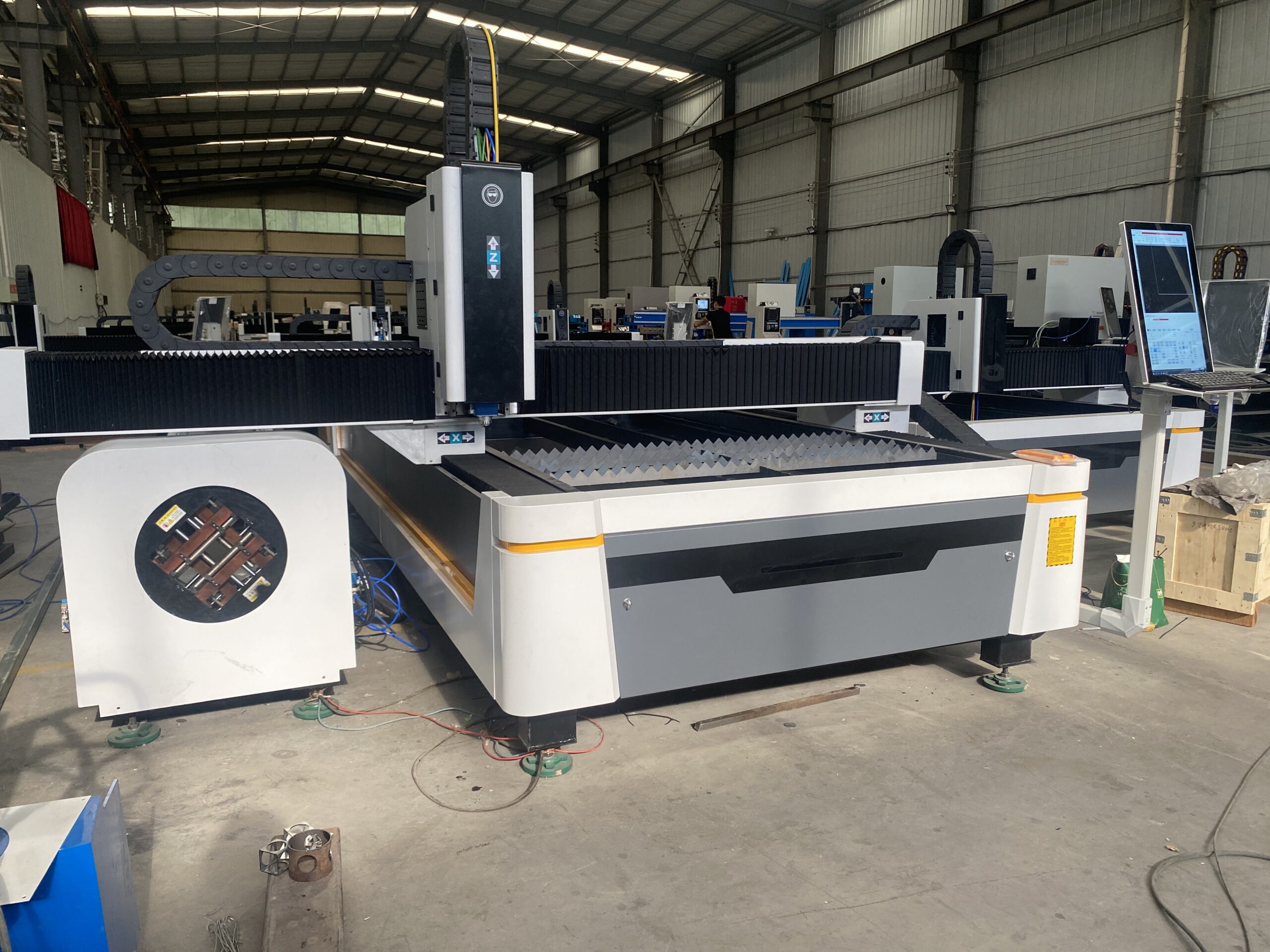
Máquina de corte por láser CNC
Factory direct cnc laser cutting machine with FANUC, Siemens, Mitsubishi, GSK or Syntec control options and 380V/50Hz or 220V/60Hz supply for export.
Frequently Asked Questions About CNC Laser Cutting Machine
Configuration and Supplier Selection
Q: What is the minimum order quantity and can I order a single machine?
Single-unit orders are standard for CNC laser cutting machines. RUNNEWTECH accepts one machine for all configurations from 1 kW to 12 kW. Volume discounts apply at 3+ units. Custom table sizes such as 4020 or 6020 mm require factory scheduling and may carry a minimum of 2 units for non-standard widths.
Q: What control systems are available and does the interface support my local language?
Cypcut and FSCUT are standard for flatbed fiber lasers. Cypcut supports English, Spanish, Russian, Turkish, Vietnamese and Arabic. FSCUT offers English and Chinese with optional language packs. Both systems run on industrial PCs with 15-inch touchscreens. EtherCAT bus control is standard on 6 kW and above for faster response.
Q: What is the lead time from order confirmation to ready for shipment?
Standard 3015 table with Raycus 3 kW ships in 15–20 working days. IPG or MAX laser sources add 5–7 days due to import scheduling. Custom 4020 or 6020 tables require 25–30 days. Peak months March–May and September–November extend lead times by 10–15 days. Factory confirmation is issued with every proforma invoice.
Q: What payment terms do you offer for international orders?
30% T/T deposit to confirm production, 70% balance before shipment against copy of B/L. L/C at sight is accepted for orders above USD 100,000 with additional bank charges on buyer’s account. For trusted distributors with 3+ prior shipments, open account terms of 60 days are negotiable with Sinosure coverage.
Q: Can the machine run on our local voltage and frequency?
Standard supply is 380V 50Hz three-phase. For 220V 60Hz regions including North America and parts of South America, a step-up transformer to 380V is required. RUNNEWTECH supplies transformers rated for the machine’s total electrical load: 25 kVA for 3 kW systems, 50 kVA for 6 kW, 80 kVA for 12 kW. Transformer weight adds 180–400 kg to shipping.
Q: How is the machine shipped and what is the transit time?
Machines ship in 40-foot high-cube containers. A 3015 table fits with protective frame; 4020 and 6020 tables ship disassembled with gantry separated from bed. Net weight ranges from 4,500 kg (3 kW 3015) to 12,000 kg (12 kW 6020). FOB Qingdao or Shanghai. Transit time: 18–25 days to Southeast Asia, 30–40 days to Middle East, 35–45 days to Africa and South America, 25–35 days to Eastern Europe.
Q: What warranty coverage and spare parts support do you provide?
Two-year warranty on laser source, one year on motion components and control system. Spare parts kit included: protective lenses (10 pcs), nozzles (20 pcs), ceramic rings (2 pcs), focus lens (1 pc), limit switches (2 pcs). Critical spares ship within 72 hours from Shanghai warehouse. Extended warranty to three years available at 4% of machine value.
Q: Is factory acceptance testing and accuracy documentation provided?
Yes. Every machine undergoes FAT before shipment. Standard report includes: positioning accuracy ±0.05 mm/m, repeatability ±0.03 mm, cutting test on 2 mm and 6 mm mild steel with actual speed and kerf width recorded. NIST-traceable laser interferometer test is optional at USD 800. Report and test coupons ship with machine documentation in waterproof tube.
Q: Does installation and operator training come with the machine?
Installation and training are included for orders above USD 50,000. Technician stays 5–7 days: 2 days mechanical leveling and alignment, 3 days operator training on nesting software, parameter adjustment, and daily maintenance. Buyer provides local transport, accommodation, and interpreter if needed. Remote technical support via TeamViewer is lifetime at no charge.
Q: What tolerance can I expect on my actual material?
On mild steel up to 6 mm: ±0.05 mm positional, ±0.03 mm repeatability. Stainless and aluminum achieve ±0.06–0.08 mm due to thermal conductivity differences. Thickness above 12 mm: ±0.10–0.15 mm depending on assist gas purity and pressure. Your material sample can be tested at factory and video recorded before shipment.
Q: What are the running consumables costs per hour?
Protective lens: USD 3–5 per piece, life 8–20 hours depending on cutting environment. Nozzle: USD 2–4, life 15–30 hours. Ceramic ring: USD 25–40, life 200–400 hours. Focus lens: USD 80–150, life 500+ hours with proper care. Total consumables cost runs USD 6–12 per hour at 3–6 kW power, USD 10–18 per hour at 12 kW with nitrogen cutting.
Q: Do you supply CE documentation for customs clearance?
CE declaration of conformity, machinery directive 2006/42/EC compliance certificate, and laser safety EN 60825-1 report are provided. For countries requiring CO or Form E, these are issued with chamber of commerce stamp. Original documents ship by DHL separate from machine to avoid port delays. Photocopies travel with the cargo for immediate customs reference.
Aviso importante
Las especificaciones, los datos de precisión y los rangos de precios que figuran en esta guía son orientativos y se facilitan con fines de planificación.
solo a efectos informativos. Rango de funcionamiento real, tolerancia alcanzable, disponibilidad del sistema de control, requisitos de tensión de alimentación y conformidad
El etiquetado varía según el modelo y el país de destino. Los compradores deben comprobar por sí mismos la tensión y la frecuencia de la red eléctrica, la carga admisible del suelo y
los cimientos, el equipo de descarga y los requisitos de importación antes de realizar un pedido. Todas las cifras están sujetas a confirmación por escrito en
la última factura proforma emitida por RUNNEWTECH.
Sourcing CNC Laser Cutting Machine from RUNNEWTECH
Why Configuration Matching Matters More Than Brand Alone
A 3015 table with a 3 kW Raycus source handles 6 mm mild steel at 1.2 m/min feed rate. Step to 6 kW MAX and the same table cuts 12 mm at 0.8 m/min. The wrong pairing wastes capital; the right pairing returns the investment in 14–18 months for a typical Southeast Asian job shop running two shifts. Positioning accuracy of ±0.03 mm and repeatability of ±0.02 mm are achievable with HIWIN linear guides and Syntec or FAGOR controls on machines in the 8000–12000 kg range. IPG sources push cutting speed 15–20% higher but carry premium pricing and longer lead times. Raycus and MAX sources dominate the export market for good reason: local service networks exist in Bangkok, Dubai, Istanbul, São Paulo and Cairo.
Qualifying the Supplier Beyond the Specification Sheet
Factory acceptance testing is where claims become numbers. Request a cut sample in your actual material, measured on a CMM report, before the machine is packed in plywood with VCI film. Verify the transformer rating for your site voltage: 380V 50Hz versus 220V 60Hz requires different winding configurations, not just a plug adapter. A 12 kW machine with 6020 table exceeds 15 000 kg; confirm your unloading crane or forklift capacity before CIF delivery.
RUNNEWTECH as Your Sourcing Partner
Runlongjia Machinery, founded in 2010, has supplied CNC fiber laser cutting machines, plasma cutting machines and portable laser welding machines across Southeast Asia, the Middle East, Africa, South America, Eastern Europe and North America for over 15 years. The export range spans conventional lathes, milling machines, flat bed and slant bed CNC lathes, and CNC machining centers, with control options including FANUC, Siemens, Mitsubishi, GSK, KND and Syntec adapted to local electrical standards. Machines are run-in and factory acceptance tested before packing, shipped FOB or CIF in plywood cases with rust protection, and supported with installation guidance, operator training material, remote commissioning and spare parts.
Send your workpiece material, maximum part size, required tolerance and destination port to receive a quotation within 24 hours via email or the contact form at runnewtech.com.
Get a Factory Direct Quote on Cnc Laser Cutting Machine
RUNNEWTECH se dedica a la fabricación de maquinaria para el trabajo del metal desde 2010,
con más de 15 años de experiencia en exportación. Las máquinas se suministran con el sistema de control que usted elija, adaptado a su red eléctrica
tensión y frecuencia; se somete a pruebas de rodaje y de aceptación en fábrica antes de su embalaje. Envíenos el material de su pieza de trabajo, el tamaño máximo de la pieza,
Indíquenos la tolerancia requerida y el puerto de destino, y le enviaremos un presupuesto en un plazo de 24 horas.

 English
  Indonesian
  Vietnamese
  Arabic
  Russian
  Spanish