
CNC Lathe Machine Buyer Guide
A real CNC lathe manufacturer in China owns the metal from melt to shipment, not just a sales desk and a photo gallery. The distinction matters because the same model designation—CK6136, CK6140, or a slant-bed TCK50—can hide a 2,500 kg properly scraped machine or a 1,800 kg bolt-together unit with hand-ground ways and no stress relief.
What Separates a Builder From a Broker
Casting and Foundry Control. Ask directly: do you pour your own beds or buy from a foundry pool? HT300 resin-sand castings with natural aging plus vibration stress relief cost more than HT250 green-sand castings rushed to the line, but the difference shows up as 0.015 mm vs. 0.030 mm positioning drift after six months of interrupted cuts. A builder with foundry relationships or in-house pouring can show you the casting date stamped in the tailstock end.
Assembly Floor Evidence. Request timestamped photos of the specific machine’s bed being hand-scraped to 16–20 contact points per 25 mm × 25 mm. Ask for the laser interferometer and ball bar records: positioning accuracy ±0.010 mm/300 mm and repeatability ±0.005 mm are achievable on mid-range machines; ±0.020 mm with no ball bar data suggests corner cutting. The factory acceptance test (FAT) should include a geometric accuracy report per ISO 230-2 or equivalent, not a generic template.
Payment Structure as Signal. Trading offices often demand 30% T/T then 70% before loading, with no FAT visit option. Established builders accept 30% deposit, 60% after FAT video or live feed, 10% on BL copy. Escrow through Alibaba Trade Assurance is common for orders under $50,000; above that, a factory visit or third-party inspection (SGS, Bureau Veritas) is standard.
After-Sales Engineering Depth. A broker ships a control manual. A builder keeps FANUC, Siemens, GSK, KND, and Syntec parameter backups on file, can remote-diagnose via Ethernet within 24 hours, and stocks turret index cams, spindle bearings, and servo motors at regional warehouses. Ask for the nearest service engineer’s location and typical response time to your port city.
Price Drivers by Machine Class
| الفصل | Typical Spec | FOB China (USD) | Lead Time |
|---|---|---|---|
| Entry flat-bed | 360 mm swing, 750 mm between centers, GSK 980TDi, 5.5 kW spindle, A2-5 nose | $12,000–$18,000 | 25–35 days |
| Mid flat-bed | 400 mm swing, 1,500 mm BC, KND or Syntec, 7.5 kW, A2-6, linear guides on X/Z | $22,000–$32,000 | 35–45 days |
| Slant-bed CNC | 500 mm swing over bed, 620 mm max turning diameter, 12-station turret, FANUC 0i-TF, 11 kW, A2-8 | $38,000–$55,000 | 45–60 days |
| Heavy slant-bed | 660 mm swing, 1,000 mm BC, 15 kW, Y-axis live tooling, Siemens 828D | $65,000–$90,000 | 60–75 days |
Price swings within each class come from three variables: control system (FANUC adds $4,000–$8,000 over GSK), guideway type (hardened box ways cost 10–15% less than HIWIN/PMI linear roller guides but limit rapid traverse to 15 m/min vs. 24 m/min), and whether the turret is servo-indexed or hydraulic with tool pre-setter included.
Documentation and Export Practicalities
CE marking is mandatory for EU-bound machines; verify the builder holds the original EC Declaration of Conformity and test reports, not a photocopied blanket certificate. For 220V/60Hz markets (North America, parts of Southeast Asia), confirm the transformer is built-in or quoted separately—a 15 kW machine needs roughly 25 kVA capacity, adding $800–$1,500. Foundation drawings with anchor bolt patterns and levelling pad specifications should arrive before the machine; a 5,000 kg slant-bed requires 150 mm reinforced concrete, not a standard industrial floor. Unloading demands a forklift rated at 1.5× machine weight or a 3-ton crane with spreader bar. Installation and operator training typically run 3–5 days on-site; budget $150–$250 per day plus airfare for the technician. Spare parts kits—turret coupling, spindle belt, limit switches, fuses—should ship in the same container or be available with 48-hour dispatch from a regional hub.
Types and Configurations of CNC Lathe Machine
| النوع أو الفئة | نطاق العمل النموذجي | خيارات التحكم | الأكثر ملاءمة لـ | ملاحظات |
|---|---|---|---|---|
| مخرطة CNC ذات قاعدة مسطحة | Swing over bed: 400–660 mm; max turning length: 750–3000 mm; spindle bore: 52–105 mm; chuck: 200–380 mm (8–15 in) | GSK 980TDi, KND K1000Ti, FANUC 0i-TF, Siemens 828D | General job shops, automotive shafts, agricultural fittings, training centers | Lowest cost entry point; rigid but slower rapids; typically 2-axis (X/Z) with optional C-axis |
| مخرطة CNC ذات قاعدة مائلة | Swing over bed: 360–520 mm; max turning diameter: 280–450 mm; turning length: 400–650 mm; chuck: 6–12 in | FANUC 0i-TF Plus, Siemens 828D, Mitsubishi M80, Syntec 22TA | Batch production, precision components, hydraulic fittings, medical parts | Chip evacuation and operator access superior to flat bed; linear guides on X/Z; rapids 20–36 m/min |
| Gang Tool CNC Lathe | Max bar diameter: 25–65 mm; spindle speed: 6000–8000 rpm; power: 3.7–7.5 kW | FANUC 0i-TF, Mitsubishi M80, Syntec | Small precision parts, connectors, electronics hardware, Swiss-style work | No turret; fixed gang plate with ER collets; extremely fast cycle times; limited to bar work |
| Turning Center with Live Tooling | Same as slant bed base; plus Y-axis travel ±25–50 mm; C-axis indexing 0.001°; turret stations: 12 | FANUC 0i-TF Plus، Siemens 828D، Mitsubishi M80 | Complex parts requiring milling, drilling, tapping in single setup; aerospace brackets, valve bodies | Live tooling adds 30–50% to base machine cost; BMT55 or VDI40 turret interfaces common; programming complexity higher |
| Heavy Duty Flat Bed CNC Lathe | Swing: 800–1600 mm; turning length: 1500–8000 mm; chuck: 24–63 in; spindle power: 22–75 kW | Siemens 828D, FANUC 31i-B | Oil field pipe, large flanges, ship propeller hubs, power generation shafts | HT300 or Meehanite casting 8000–45000 kg; hardened box ways; floor-mounted foundation mandatory; rarely exported in containers |
| Twin Spindle / Twin Turret CNC Lathe | Main/sub spindle: 6–10 in chuck each; turret stations: 12×2; max turning diameter: 280–400 mm | FANUC 0i-TF Plus، Siemens 828D، Mitsubishi M80 | High-volume automotive, bearing races, gear blanks, uninterrupted production | Complete part transfer between spindles; 40–60% machine cost premium; requires synchronized programming; uptime critical |
مخرطة CNC ذات قاعدة مسطحة
Flat bed CNC lathes remain the dominant configuration for first-time importers from Southeast Asia and Africa due to purchase prices roughly 30–40% below equivalent slant bed machines. A typical 500 mm swing machine with 1500 mm between centers weighs 3200–3800 kg, runs on HT250 resin sand castings with stress relief, and achieves positioning accuracy of ±0.015 mm with repeatability of ±0.008 mm. Spindle power ranges from 7.5 kW (380V 50Hz) with A2-6 nose and 250 mm chuck up to 11 kW on larger models. Rapids are modest at 6–10 m/min on hardened box ways. Buyers in technical training centers favor these for their open geometry and clear relationship to manual lathe operation. The trade-off is poor chip control in flood coolant applications and operator fatigue from reaching over the bed. These machines cannot efficiently handle high-volume swarf-generating work or achieve the surface finishes expected in hydraulic component production.
مخرطة CNC ذات قاعدة مائلة
Slant bed CNC lathes position the bed at 30° or 45° to the horizontal, directing chips into a conveyor while bringing the spindle nose closer to the operator. A 400 mm swing class machine with 500 mm turning length typically employs HIWIN or PMI linear roller guides on X and Z axes, achieving rapids of 24–30 m/min with positioning accuracy of ±0.008 mm and repeatability of ±0.005 mm. Spindle configurations run A2-5 or A2-6 nose with 8–10 in hydraulic chuck, 11–15 kW motor, and maximum speed 3500–4500 rpm. Control systems break into two price tiers: GSK 980TDi or KND K1000Ti at the entry level versus FANUC 0i-TF Plus or Siemens 828D for shops requiring macro programming and servo quality part-off. The slant bed design enables easier integration of tailstock, steady rest, and bar feeder interfaces. What these machines sacrifice is absolute rigidity against interrupted cuts on large forgings; the linear guide system prioritizes speed over damping compared to box ways.
Gang Tool CNC Lathe
Gang tool lathes eliminate the turret entirely in favor of a fixed tool plate with multiple ER16 or ER20 stations arranged radially around the spindle centerline. Bar capacity defines the machine: 32 mm maximum diameter for small electronics hardware, 42 mm for automotive fittings, 65 mm for general mechanical components. Spindle speeds reach 6000–8000 rpm with 3.7–7.5 kW direct-drive motors, enabling cycle times under 20 seconds for simple turned parts. The control is typically FANUC 0i-TF or Mitsubishi M80 with rigid tapping and polygon turning options. Machine weight stays low at 1200–2000 kg, permitting single-crate container loading. Buyers are precision component subcontractors in connector and fastener industries. The limitation is severe: no turret indexing means each tool must be preset and locked; changeover between part families requires physical repositioning of all gang blocks. These machines cannot handle chuck work or any operation requiring tool angle adjustment during the cycle.
Turning Center with Live Tooling
Turning centers add rotary tool capability to the slant bed platform, typically through a 12-station servo turret with BMT55 or VDI40 tool holders. Y-axis travel of ±25–50 mm permits off-center drilling and milling, while C-axis spindle indexing to 0.001° enables polar coordinate milling and helical groove cutting. A typical 400 mm swing machine with live tooling weighs 4500–6500 kg, carries 15–22 kW main spindle power, and achieves 0.005 mm repeatability. Control systems must support multi-axis interpolation: FANUC 0i-TF Plus with MANUAL GUIDE i, Siemens 828D with ShopTurn, or Mitsubishi M80 with EZMotion. Price premiums of 30–50% over base 2-axis lathes reflect the turret motor, C-axis hardware, and control software licensing. Procurement officers in aerospace supply chains and hydraulic manifold production demand these machines to reduce secondary operations. The constraint is programming complexity and maintenance: live tool spindles require dedicated air-oil mist units and fail predictably if coolant filtration is neglected. These machines cannot justify their cost in pure turning applications.
Heavy Duty Flat Bed CNC Lathe
Heavy duty flat bed lathes serve applications where workpiece weight exceeds 500 kg or diameter exceeds 800 mm. Casting material shifts to HT300 or Meehanite with ribbed construction; a 1000 mm swing machine with 3000 mm bed weighs 12000–18000 kg and requires a dedicated foundation with anchor bolts and leveling pads. Spindle noses run A2-8 or A2-11 with 24–32 in chucks, powered by 30–55 kW motors at 1000–1500 rpm maximum. Guideways are hardened and precision scraped box ways, not linear guides, to absorb cutting forces from interrupted cuts on cast iron forgings. Controls are typically Siemens 828D or FANUC 31i-B with absolute encoders. These machines ship breakbulk or flat-rack container, not standard 20GP/40GP, with FOB Shanghai pricing reflecting crane capacity and port handling. Buyers are oil field service companies, wind turbine tower flange manufacturers, and shipyards. The machine cannot achieve the rapid traverse rates or positioning precision of smaller slant bed machines; 0.02 mm positioning accuracy is typical, acceptable for roughing and semi-finishing but not for precision thread grinding or bearing seat finishing.
Twin Spindle Twin Turret CNC Lathe
Twin spindle configurations integrate main and sub-spindle with synchronized transfer, enabling complete machining of both ends of a shaft or disc without operator intervention. A typical 8 in / 10 in chuck combination with dual 12-station turrets achieves throughput equivalent to two single-spindle machines in 60–70% of the floor space. Spindle power is matched at 11–15 kW each with A2-5 or A2-6 noses; turrets accept BMT55 tooling with live tool options on both sides. Controls require dual-channel capability: FANUC 0i-TF Plus or Siemens 828D with synchronized spindle orientation and part transfer logic. Machine weight reaches 8000–12000 kg; foundation requirements and coolant tank capacity (800–1200 liters) exceed standard slant bed specifications. Automotive tier-one suppliers and high-volume bearing manufacturers are the primary buyers, often integrating these into automated cells with gantry loading. The limitation is capital intensity and risk concentration: a single turret or spindle failure idles the entire machine, whereas independent single-spindle machines offer redundancy. These machines cannot be justified at volumes below 5000 pieces per month per part number.

المواصفات وكيفية قراءتها
| المعلمة | المستوى المبتدئ | الفئة المتوسطة | مواصفات عالية |
|---|---|---|---|
| Max turning diameter (mm) | 360 | 500 | 800 |
| Max turning length (mm) | 500 | 1000 | 3000 |
| Chuck size (inch) | 6 | 8 | 12 |
| Spindle nose (taper) | A2-5 | A2-6 | A2-8 |
| سرعة المغزل (دورة في الدقيقة) | 3500 | 3000 | 2500 |
| Spindle power (kW) | 5.5 | 11 | 22 |
| نطاق الحركة على المحور X (مم) | 180 | 250 | 420 |
| نطاق حركة المحور Z (مم) | 500 | 1050 | 3050 |
| Rapid traverse X/Z (m/min) | 20/24 | 24/30 | 20/24 |
| Positioning accuracy (mm) | ±0.015 | ±0.010 | ±0.008 |
| التكرار (مم) | ±0.006 | ±0.004 | ±0.003 |
| نوع مسار التوجيه | مسار صندوقي مقوى | دليل أسطواني خطي (HIWIN/PMI) | Hardened box way or linear roller guide |
| نظام التحكم | GSK 980TDi | FANUC 0i-TF Plus / Siemens 828D | FANUC 0i-TF Plus / Mitsubishi M80 |
| Turret stations | 4 | 8 (hydraulic) | 12 (servo) |
| Machine net weight (kg) | 2200 | 4500 | 12000 |
| Floor space L×W (mm) | 2200×1400 | 3200×1800 | 6500×2200 |
| Supply voltage | 380 فولت، ثلاثي الأطوار، 50 هرتز | 380 فولت، ثلاثي الأطوار، 50 هرتز | 380 فولت، ثلاثي الأطوار، 50 هرتز |
| Total connected load (kVA) | 15 | 25 | 45 |
How to Read Each Line of the Specification Sheet
Working Range or Travels
The max turning diameter is the largest workpiece the machine can swing over the bed. On a flat bed CNC lathe this is typically 360 mm to 800 mm; slant bed designs sacrifice some swing for rigidity and chip evacuation. Max turning length is the distance between chuck face and tailstock center, or the Z-axis stroke on chuck-only parts. Match this to your longest shaft or pipe job plus 100 mm clearance for tooling.
سرعة المغزل وقوته
Higher rpm suits aluminum and small-diameter steel; lower rpm with higher torque handles stainless, cast iron, and large diameters. The 5.5 kW entry-level spindle peaks at 3500 rpm but drops torque above 2500 rpm. The 22 kW A2-8 spindle delivers constant torque from 30–1500 rpm for heavy roughing. Check the duty cycle: continuous rating vs 30-minute rating. Some builders quote the higher 30-minute figure.
Spindle Taper or Chuck Size
A2-5, A2-6, A2-8 are short taper nose standards for lathe chucks. A2-5 carries 6-inch chuck, A2-6 carries 8-inch, A2-8 carries 10–12-inch. Larger chucks grip heavier parts but add overhang and reduce clearance. Verify the chuck brand: self-made, Kitagawa, or Samchully. Hydraulic chuck clamping pressure is adjustable; 25–35 bar is standard for steel, 15–20 bar for thin-wall aluminum.
نوع مسار التوجيه
Hardened box ways (HT250 or HT300 casting, hand-scraped or ground, Turcite-B on mating surfaces) absorb vibration in interrupted cuts and heavy turning. Linear roller guides (HIWIN HG or PMI MSA series) allow faster rapids—24–30 m/min vs 16–20 m/min on box ways—but have lower damping. For general job shop work with mixed material, linear guides reduce non-cutting time. For brake drum, flywheel, or forging work, box ways outlast and out-stiffen.
سرعة التحرك السريع ومعدل التغذية
Rapid traverse moves the tool to position without cutting. Feed rate during cutting is typically 0.01–2 mm/rev on CNC lathes. The ratio of rapid to cutting speed matters less on lathes than machining centers, but fast rapids reduce cycle time on batch work with many tool changes.
دقة تحديد الموقع وقابلية التكرار
Positioning accuracy (±0.010 mm) is the absolute error from commanded to actual position. Repeatability (±0.004 mm) is the spread when returning to the same point. Repeatability matters more for batch consistency. Ask for laser interferometer records per axis: ISO 230-2 or VDI/DGQ 3441 standard, measured with Renishaw XL-80 or equivalent. Ball bar testing (Renishaw QC20-W, 150 mm or 300 mm radius) checks circular interpolation and servo match.
Tool Magazine and Turret
Lathes use turrets, not magazines. Entry 4-station turrets need manual indexing or electric tool posts. Mid-range 8-station hydraulic turrets index in 0.3–0.4 seconds. High-spec 12-station servo turrets with BMT tool holders allow driven tools for milling and drilling. Check if the turret is VDI or BMT: VDI is faster to set, BMT is more rigid for live tooling.
نظام التحكم
GSK 980TDi (entry) costs roughly 30% of FANUC 0i-TF Plus. GSK runs well for straight turning but has limited macro B and fewer canned cycles. FANUC dominates global resale and technician familiarity. Siemens 828D offers better conversational programming for job shops with mixed operator skill. Mitsubishi M80 suits slant bed lathes with complex C-axis and Y-axis interpolation. Syntec and KND are domestic alternatives with improving reliability but thinner overseas service networks.
جهد الإمداد والحمل المتصل
Chinese builders standardize on 380V 50Hz 3-phase. For 220V 60Hz regions (North America, parts of Southeast Asia), a step-up transformer 220V→380V is mandatory; add 15–20% capacity margin. Total connected load includes spindle motor, coolant pump, hydraulic pump, chip conveyor, and control cabinet. A 25 kVA machine needs 32 kVA supply to avoid voltage sag during spindle acceleration.
الوزن الصافي للآلة والمساحة التي تشغلها على الأرض
Net weight correlates with casting mass and rigidity. A 500 mm swing machine at 4500 kg uses roughly 2200 kg of castings (bed, headstock, tailstock, saddle). Machines under 1800 kg for 360 mm swing often use welded steel beds—adequate for light work, prone to twist over years. Floor space must include operator access: add 800 mm front, 500 mm sides, and 1500 mm rear for chip conveyor and electrical cabinet.
Price Drivers and Lead Time
Control System Premium
FANUC 0i-TF Plus adds $4,000–$6,000 over GSK 980TDi on a mid-range lathe. Siemens 828D sits between them. The premium buys global parts availability, operator familiarity, and resale value. For a training center or first-time buyer in a region with scarce FANUC technicians, GSK with local language support may reduce downtime more than the brand premium.
Casting and Guideway Choice
HT300 resin sand casting with full annealing stress relief adds 8–10% to HT250 green sand casting. Hand scraping contact points (12–16 points per 25 mm × 25 mm) adds 2–3 days labor but improves oil film retention and wear life. Linear roller guide assemblies (HIWIN HG series, grade H or P) cost $800–$1,500 per axis more than box ways but eliminate scraping labor.
Spindle and Chuck Package
Built-in spindle motor (direct drive, no belt) adds $2,000–$3,500, eliminates belt maintenance, and allows higher acceleration. Hydraulic chuck and tailstock add $1,200–$2,000. Oil country chuck (15-inch, for pipe threading) is a separate SKU, not a lathe upgrade.
Lead Time Structure
Standard machine with GSK control: 25–35 days production, 5–7 days factory test and packing. FANUC or Siemens control: add 10–15 days for control import and integration. Custom spindle bore (e.g., 105 mm instead of 65 mm for bar work): add 15–20 days for casting and machining. Peak season (March–May, September–November) extends by 10–15 days.
Supplier Qualification: Builder vs Trading Office
Foundry or Casting Source
Ask for the casting supplier name and relationship length. A builder with own foundry or 10+ year partnership with a local HT300 foundry controls cooling rate and annealing schedule. Trading offices quote “cast iron bed” without grade or source. Request material certificate with tensile test: HT250 ≥ 250 MPa, HT300 ≥ 300 MPa. Meehanite-grade castings (if claimed) require specific inoculation process—verify with Meehanite process certificate, not generic claim.
Assembly and Scraping Floor
Request dated photos or video of the specific machine’s assembly. Look for: granite surface plate for bed leveling, scraping tools (flaking or half-moon pattern), blue dye check of guideway contact. A trading office cannot produce this. Ask for the name of the assembly foreman and his years with the company—turnover above 30% annually degrades consistency.
Laser Interferometer and Ball Bar Records
Demand the actual test report for your serial number, not a generic template. Renishaw XL-80 laser interferometer data should show: measurement date, temperature/humidity, compensation on/off, forward and reverse runs, reversal error (backlash). Ball bar report should show: roundness deviation, servo gain mismatch, squareness error. Records older than 6 months or from a different machine model indicate batch testing or template reuse.
Factory Acceptance Test (FAT)
A real builder offers FAT with your material, your tooling, or a standard test piece (e.g., ISO 10791 circularity test piece). FAT should run 4–8 hours with thermal stabilization. Trading offices redirect to “third party inspection” (SGS at port) which checks packing, not machine performance. FAT agenda should include: geometric accuracy (laser or dial indicator), spindle runout (0.005 mm max at nose), noise level (≤ 78 dB at operator position), and test cut surface finish (Ra 1.6 µm or better).
Documented Geometric Accuracy Report
ISO 230-1 or GB/T 17421.1 geometric tests: straightness of bedways (0.02 mm/1000 mm), parallelism of spindle axis to Z-axis motion (0.02 mm/300 mm), perpendicularity of turret face to spindle axis (0.015 mm/100 mm). Each test needs instrument model, serial number, and calibration date. A 2-page “inspection certificate” with checkmarks and no instrument data is insufficient.
Payment Structure Risk
Trading offices often demand 30% T/T deposit, 70% before shipment—no leverage if machine fails FAT. Qualified builders accept: 30% deposit, 60% after FAT pass with photos/video, 10% after installation and run-off. Letter of credit (L/C at sight) adds $300–$800 bank fee but protects both parties. Avoid 100% advance payment regardless of quoted discount.
القدرات الهندسية في مجال خدمة ما بعد البيع
Ask: how many service engineers in your region, their visa status for your country, and average response time. A builder with resident engineers in Thailand, Turkey, or Mexico has invested in market presence. Trading offices promise “local agent” without naming them—verify independently. Spare parts inventory location: builder’s warehouse, regional hub, or only factory stock? Critical spares (spindle bearings, servo motor, control board) should reach you within 7–10 days air freight.
Trade Terms and Export Practicalities
FOB (تسليم على متن السفينة)
Seller delivers machine to Chinese port, clears export customs, loads container. Buyer pays ocean freight, insurance, and import clearance. FOB suits buyers with freight forwarders and import experience. Typical Chinese port: Shanghai, Qingdao, Tianjin, Shenzhen.
CIF (التكلفة والتأمين والشحن)
Seller arranges ocean freight to buyer’s port and marine insurance (usually 110% of invoice value, Institute Cargo Clauses C). Buyer handles unloading, inland transport, import duty, and VAT. CIF adds $800–$2,500 to FOB for a 40-foot container to Southeast Asia; $3,000–$6,000 to Eastern Europe or South America. Insurance covers total loss, not partial damage from poor lashing—inspect container seal and photos upon arrival.
CFR (التكلفة والشحن)
Same as CIF but without insurance. Buyer arranges marine insurance separately. Rare in machinery trade; most buyers prefer CIF for single-point accountability.
EXW (من المصنع)
Buyer collects from factory, handles all export clearance and transport. Only viable if you have China-based logistics agent. Saves 2–3% but exposes you to Chinese export license requirements and VAT rebate complications.
Payment Instruments
T/T (telegraphic transfer): fast, 1–2 days, but irreversible. L/C (letter of credit): bank guarantee, documents against payment, adds 5–7 days and bank charges. For first orders above $30,000, L/C at sight is standard risk mitigation. Some builders accept 30% T/T, 70% L/C at sight to balance cash flow and security.
HS Code and Customs
CNC lathes typically fall under 8458.11 (horizontal lathes, numerically controlled) or 8458.91 (other lathes, numerically controlled). Verify with builder’s customs broker—wrong classification delays clearance. Import duty varies: 0% within ASEAN-China FTA with FORM E certificate; 5–15% in Middle East and Africa depending on bilateral agreements; 2.5% base in USA plus Section 301 tariffs if applicable (check current USTR list).
علامة CE
CE for machinery requires compliance with 2006/42/EC (Machinery Directive), EN ISO 12100 (risk assessment), EN 60204-1 (electrical safety), and EN ISO 23125 (machine tools safety). Request EC declaration of conformity and technical file summary—not just a CE sticker photo. For lathes with laser measuring or automatic doors, additional standards apply. Non-CE machines can enter many markets but block resale to Europe and some Middle Eastern buyers.
Packing List and Certificate of Origin
Packing list must match actual contents: machine, coolant tank, tool box, manual, spare fuses, leveling pads. Weight per package for crane planning. Certificate of origin (FORM E for ASEAN, COO-China for general) determines duty rate. Apply before shipment; retroactive certificates are difficult and delay customs by 2–4 weeks.
Container Loading and Weight Limits
A mid-range CNC lathe at 4500 kg plus crate (500 kg) fits one 20-foot container (max payload 21,600 kg). Two machines or one large machine (8000 kg+) needs 40-foot container (max payload 26,500 kg). Some countries (South Africa, Chile) have road weight limits of 18,000 kg per axle—plan inland transport accordingly. Machines over 12,000 kg may require flat rack container with tarpaulin, costing 40% more than standard.
Foundation and Levelling
Cast iron bed lathes need 150–200 mm reinforced concrete foundation with anchor bolts (M16 or M20, 8–12 points). Slant bed machines with linear guides need finer levelling: 0.02 mm/m over full length. Provide builder with floor load data (typically 5–8 ton/m²) and request foundation drawing before machine arrival. Anti-vibration pads (Level-Fix or similar) reduce foundation cost but add 3–5% to machine vibration in heavy cuts.
Unloading Equipment
Forklift capacity: 1.5× machine net weight minimum (e.g., 7 ton forklift for 4500 kg machine) due to load center at fork tips. Crane: 10-ton capacity for mid-range, 25-ton for large slant bed with sub-spindle. Machine arrives on wooden crate with lifting eye bolts at headstock and tailstock ends—never lift from turret or saddle.
Installation and Operator Training
Builder’s engineer should supervise: mechanical levelling, electrical connection, spindle runout check, and test cut. Allow 3–5 days for entry-level, 5–7 days for mid-range with hydraulic systems. Training: 2–3 days basic operation and programming, 1 day maintenance (lubrication points, filter change, alarm list). Request training completion certificate with attendee names for warranty validation.
Spare Parts and Consumables
First-year spare parts kit should include: spindle bearings (front and rear), turret proximity switches, coolant pump mechanical seal, control fuse set, and way oil (ISO VG 68, 20 liters). Consumables: chuck jaws (hard and soft sets), insert screws and keys, and coolant concentrate. Ask for 10-year parts availability commitment in supply agreement. Critical parts pricing locked for 3 years prevents post-warranty gouging.
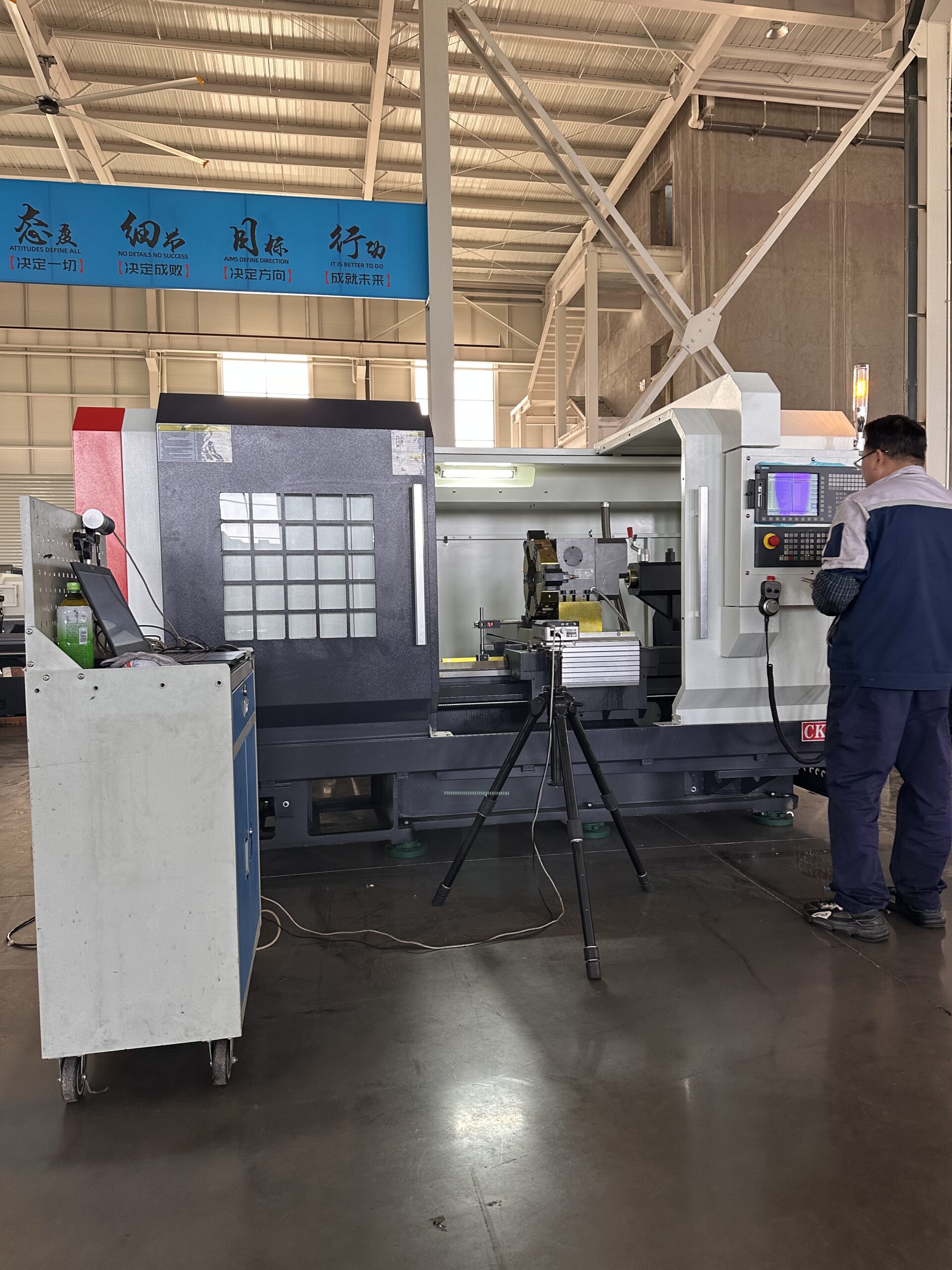
CNC Lathe Machine Price and What Drives It
| الفصل | نطاق العمل النموذجي أو القدرة | مثال على عنصر التحكم أو المصدر | السعر الإرشادي فوب بالدولار الأمريكي |
|---|---|---|---|
| Entry-level flat bed CNC lathe | 500 mm max turning diameter, 750 mm length, 5.5 kW spindle | GSK 980TDi or KND K2000Ti | 18,000 – 28,000 |
| Mid-range flat bed CNC lathe | 615 mm swing, 1500 mm length, 7.5 kW spindle, A2-8 nose | Siemens 828D or FANUC 0i-TF | 35,000 – 52,000 |
| Slant bed CNC lathe | 360 mm swing over bed, 500 mm length, 4000 rpm, 5.5 kW | Mitsubishi M80 or Syntec 22TA | 32,000 – 48,000 |
| Heavy slant bed with turret | 520 mm swing, 1000 mm length, 12-station turret, 11 kW | FANUC 0i-TF Plus | 55,000 – 85,000 |
| Twin-spindle turning centre | 250 mm chuck each, 600 mm length, Y-axis, live tooling | Siemens 840D sl or FANUC 31i-B | 120,000 – 180,000 |
| CNC fiber laser cutting machine | 1.5 kW Raycus source, 3015 table (3000 × 1500 mm) | Cypcut + Raycus | 28,000 – 38,000 |
| CNC fiber laser cutting machine | 3 kW MAX or IPG source, 4020 table, 6000 × 2000 mm | Cypcut + IPG | 55,000 – 78,000 |
| CNC fiber laser cutting machine | 6 kW IPG source, 6020 table, pallet changer | Beckhoff or PA | 95,000 – 140,000 |
These bands exclude destination duties, VAT and inland transport. They assume standard 380V 50Hz supply, standard export packing in sea-worthy crates, and FOB Qingdao or Shanghai.
Real Cost Structure from Factory Floor to Your Door
A CNC lathe machine price from China breaks into roughly these shares of the ex-works factory price:
| عنصر التكلفة | Share of Ex-Works Price | What Separates Quotes |
|---|---|---|
| Casting / bed and frame | 12 – 18% | HT250 vs HT300 vs Meehanite; resin sand vs green sand; stress relief cycle duration |
| Guideways and ball screws | 8 – 14% | HIWIN/PMI linear guides vs scraped box ways; C3 vs C5 grade ball screws; ground vs rolled |
| مجموعة المغزل | 10 – 16% | A2-5, A2-6, A2-8 nose; built-in motor spindle vs belt drive; ceramic vs steel bearings |
| نظام التحكم ومجموعة المحركات المؤازرة | 22 – 35% | FANUC, Siemens, Mitsubishi vs GSK, KND, Syntec; absolute vs incremental encoders |
| Tool turret or tool changer | 6 – 12% | 8-station vs 12-station; servo turret vs hydraulic; BMT55 vs BMT65 tool shank |
| Electrical and panel | 4 – 7% | Schneider/ABB vs domestic breakers; shielded vs unshielded cabling |
| أعمال التجميع والكشط | 5 – 8% | Hand scraping of box ways vs machined-only; assembly time per machine |
| Paint and finish | 2 – 3% | Two-component epoxy vs single coat |
| الاختبار في المصنع وضمان الجودة | 2 – 4% | Laser interferometer check, ball bar test, geometric accuracy report |
| Export packing (crate + vapor barrier) | 1.5 – 2.5% | Fumigated plywood crate vs OSB; desiccant and vacuum sealing |
| Inland freight to port | 1 – 2% | Distance from factory to Qingdao/Shanghai/Shenzhen |
The control system brand and the spindle or laser source brand are normally the two single biggest line items. A FANUC 0i-TF package with αi series servos and absolute encoders can cost 2.5× a GSK 980TDi equivalent. An IPG 3 kW fiber laser source runs roughly 40% above a domestic Raycus 3 kW unit. These are not cosmetic differences. FANUC and IPG command premiums because of global parts availability, deeper alarm diagnostics, and resale value on secondary markets.
Below the factory price, the landed cost accumulates:
| Landed Cost Layer | Typical Range | ملاحظات |
|---|---|---|
| Sea freight (20′ or 40′ HQ container) | 1,800 – 4,500 USD | A 500 mm swing flat bed lathe at 3,200 kg fits one per 20′ container; two slant bed machines at 2,800 kg each fit a 40′ HQ |
| Marine insurance (CIF + 10%) | 0.15 – 0.25% of CIF value | |
| Destination duty | 0 – 15% depending on HS code and trade agreement | CNC lathes typically HS 8458.11; laser cutters HS 8456.11 |
| VAT / GST at destination | 5 – 20% | Recoverable for VAT-registered buyers in most jurisdictions |
| Customs clearance and broker fees | 400 – 1,200 USD | |
| Inland delivery from port to shop | 800 – 3,000 USD | Depends on crane truck access and distance |
Why the Cheapest Quote Is Cheaper
The lowest bid in any CNC lathe machine price comparison normally achieves its number through one or more of these substitutions:
- Lighter casting: A 500 mm swing machine weighing 2,400 kg instead of 3,200 kg suggests thinner wall sections, less ribbing, or no stress relief. Vibration damping drops; chatter appears at lower depths of cut; geometric accuracy drifts as the bed warms
- Lower grade ball screw: C7 rolled screws instead of C5 ground screws. Positioning repeatability shifts from ±0.003 mm to ±0.010 mm; backlash compensation becomes a daily task
- Unbranded spindle bearings: Domestic deep-groove bearings rated to 3,000 hours instead of NSK or SKF angular contact pairs rated to 12,000+ hours. Thermal growth increases; spindle rebuilds occur in year two or three instead of year six
- Generic servo motor: 1.5 kW domestic servo with 17-bit encoder instead of 2.0 kW Mitsubishi with 22-bit absolute encoder. Rapid traverse drops from 20 m/min to 12 m/min; positioning time per part increases; encoder battery failures lose machine reference
- No laser interferometer or ball bar record: The machine ships with a one-page “certificate” printed in Word, not a Renishaw XL-80 report with compensated positioning accuracy plotted at 23 °C ± 1 °C
These substitutions are not fraud. They are choices. The buyer who needs ±0.005 mm repeatability for hydraulic valve bodies loses production to scrap. The buyer turning agricultural bushings at ±0.05 mm may never notice the difference.
مقارنة تكاليف التشغيل على مدى خمس سنوات
| فئة التكلفة | Mid-Range Specimen (Siemens 828D, HT300, HIWIN, 7.5 kW) | Entry Specimen (GSK, HT250, domestic guides, 5.5 kW) |
|---|---|---|
| Annual power consumption (2-shift operation, 4,000 hrs/yr) | 28,000 kWh at 0.10 USD/kWh = 2,800 USD/yr | 24,000 kWh at 0.10 USD/kWh = 2,400 USD/yr |
| Spindle bearing replacement (once in 5 years) | 2,800 USD parts + 1,200 USD labour | 1,400 USD parts + 1,000 USD labour (earlier, at year 2.5) |
| Ball screw replacement (once in 5 years) | 1,800 USD (C5 ground HIWIN) | 900 USD (C7 rolled, replaced twice = 1,800 USD) |
| Control battery, encoder, cable maintenance | 400 USD/yr | 600 USD/yr (more frequent encoder issues) |
| Tool turret maintenance (seals, indexing mechanism) | 1,500 USD over 5 years | 2,200 USD over 5 years |
| Unplanned downtime (estimated) | 80 hours total over 5 years | 220 hours total over 5 years |
| Downtime cost at 50 USD/hour lost margin | 4,000 USD | 11,000 USD |
| Five-year total operating cost | ~24,000 USD | ~28,000 USD |
The gap narrows if labour rates are very low and spare parts are sourced domestically at sharp prices. It widens if the machine runs three shifts, if spindle failure stops a production line, or if the buyer lacks in-house electrical repair capability.
Supplier Qualification: Machine Builder or Trading Office
For a buyer searching “cnc lathe manufacturer in china,” the critical task is verifying who actually builds the machine. These checkpoints separate factories from intermediaries:
Foundry or documented casting source
A real builder either pours castings in-house or maintains long-term contracts with a named foundry using HT250, HT300, or Meehanite specifications. Ask for the casting grade certificate and the supplier name. A trading office will hesitate or provide a generic “cast iron” description.
Assembly floor and scraping benches
Request dated photos or video of the specific machine in assembly, not stock images. Look for granite surface plates, hand-scraping tools, and blue-dye contact pattern checks on box ways. A 500 mm swing lathe bed should show 8–12 contact points per 25 mm × 25 mm after scraping.
Laser interferometer and ball bar records
Ask for the Renishaw XL-80 or QC20-W report for your specific machine serial number. The report should state positioning accuracy (e.g., ±0.008 mm/300 mm) and repeatability (e.g., ±0.003 mm) measured at controlled temperature. A builder with this equipment will email the PDF directly. A trader will delay or deflect.
Factory acceptance test (FAT) protocol
A qualified builder offers FAT with your material or a standard test bar. The protocol should include: runout at chuck and tailstock, spindle thermal drift after 2 hours at 80% max rpm, positioning accuracy per ISO 230-2, and surface finish on a test cut (Ra 1.6 μm or better). FAT attendance is normal; remote video FAT is acceptable for repeat orders.
Payment structure and risk allocation
Standard practice for a first order: 30% T/T deposit, 70% against copy of bill of lading after FAT and buyer release. A builder confident in its FAT will accept this. Demands for 100% advance payment, or “no FAT before shipment,” signal weak engineering confidence or a trader extending credit to the actual factory.
After-sales engineering capability
Verify whether the supplier employs its own service engineers or relies on third-party agents. Ask for: spindle replacement procedure documentation, PLC ladder access (critical for Siemens or FANUC systems), and availability of parameter backup tools. A builder stocks control system spare boards, servo drives, and encoder cables. A trader stocks brochures.
Lead Time Reality
| Machine Class | Standard Lead Time | FAT and Export Packing | ملاحظات |
|---|---|---|---|
| Entry flat bed with GSK/KND | 25 – 35 days | +3 – 5 days | Often built to forecast; faster if grey iron castings are in stock |
| Mid flat bed with Siemens/FANUC | 45 – 60 days | +5 – 7 days | Control system import and customs clearance adds 10 – 14 days |
| Slant bed with turret | 50 – 70 days | +5 – 7 days | Turret subassembly often on longer lead than base machine |
| Heavy slant bed or twin spindle | 75 – 100 days | +7 – 10 days | Casting aging requirements extend timeline |
| Laser cutting machine (Raycus) | 20 – 30 days | +3 – 5 days | Source and chiller often in local stock |
| Laser cutting machine (IPG) | 40 – 55 days | +3 – 5 days | IPG source shipped from Germany or US |
Lead times stretch 15 – 25% during Q4 (October–December) due to foundry capacity constraints and pre-Spring Festival shipping rushes. Book Q1 delivery by September for priority scheduling.
Voltage Transformer and Foundation Notes
Most Chinese-built CNC lathes ship wired for 380V 3-phase 50Hz. Buyers in 220V 60Hz regions (Philippines, parts of Latin America, some US industrial sites) require a step-up transformer rated at 1.5× the machine’s apparent power draw. A 7.5 kW spindle lathe with 15 kW total connected load needs a minimum 25 kVA transformer, costing 800 – 1,500 USD depending on local certification requirements.
Foundation specifications: a 500 mm swing flat bed lathe at 3,200 kg requires 150 mm reinforced concrete with 8 MPa compressive strength, isolated from surrounding floor to prevent vibration transmission. Slant bed machines at 2,500–3,000 kg need 120 mm minimum. Anchor bolt spacing should match the builder’s foundation drawing exactly; do not improvise. Unloading requires a forklift rated at 1.5× machine weight (5 tonne for a 3,200 kg lathe) or an overhead crane with equivalent capacity and a rated lifting sling or bar.
Installation and operator training typically requires 3 – 5 days for a flat bed lathe, 5 – 7 days for a slant bed with turret and live tooling. A qualified builder includes this in the price or offers it as a fixed-fee add-on of 1,500 – 3,000 USD per technician per day plus travel. Spare parts kits—seals, fuses, encoder batteries, turret index pins—should be quoted at order stage, not discovered after arrival.
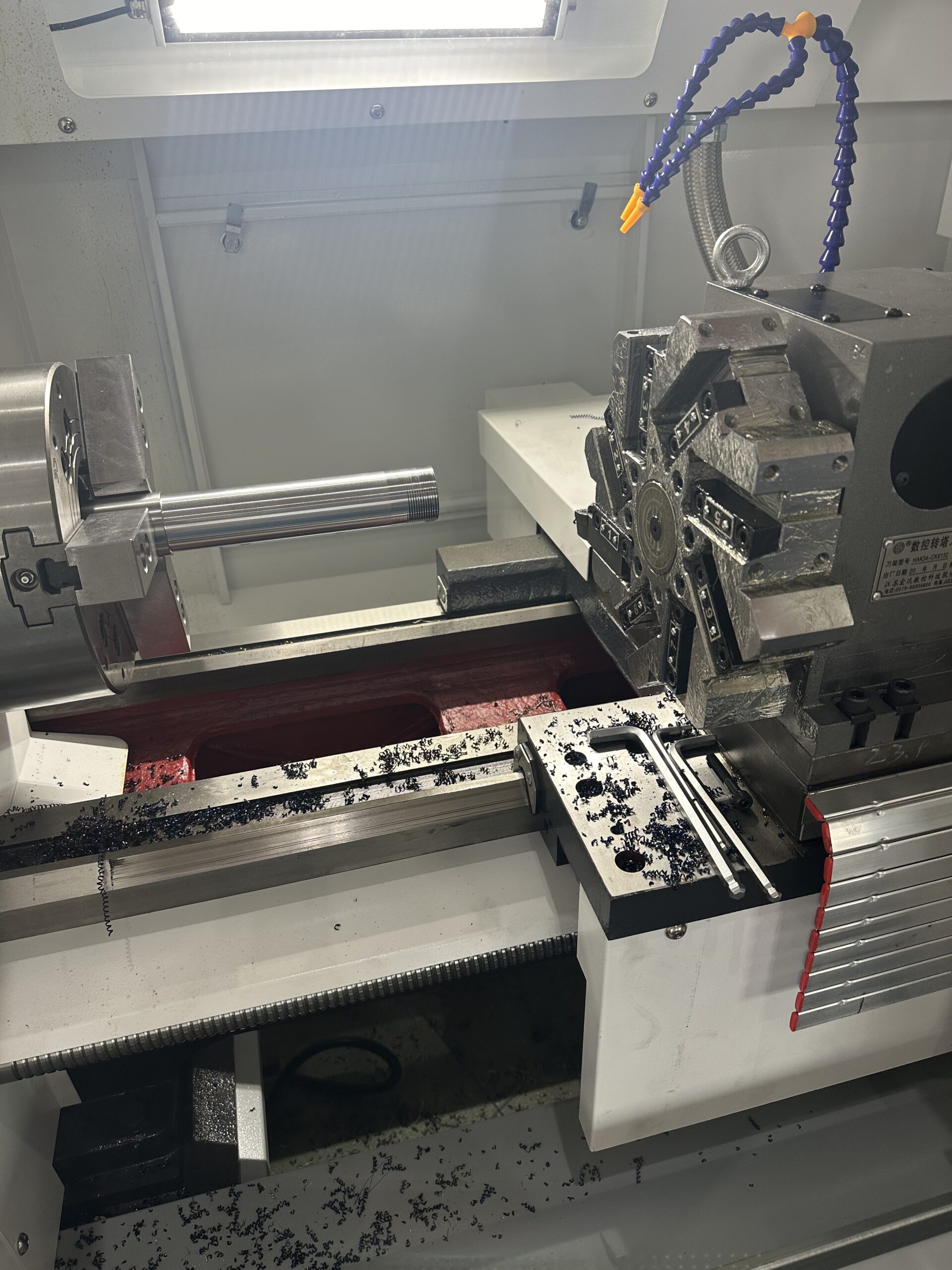
Industry Applications for CNC Lathe Machine
| القطاع | الأجزاء النموذجية التي يتم إنتاجها | المواصفات الموصى بها | لماذا تُعد هذه الآلة الخيار الأمثل؟ |
|---|---|---|---|
| قطع غيار السيارات والدراجات النارية | Brake discs, wheel hubs, camshafts, crankshaft journals, transmission shafts, valve bodies | Flat bed CNC lathe: 500 mm max swing, 1000–1500 mm max turning length, A2-6 or A2-8 spindle nose, 11–15 kW spindle motor, 2500 rpm, X/Z rapid traverse 8/12 m/min, positioning accuracy 0.015 mm, repeatability 0.008 mm. FANUC 0i-TF or Siemens 828D. Hardened box ways on Z, linear guides on X. Machine weight 4200–5500 kg. | High torque at low rpm for cast iron and forged steel; A2-8 handles 250 mm three-jaw hydraulic chuck for heavy disc brakes; box-way Z-axis absorbs interrupted cuts on cast hubs |
| الآلات الزراعية | Tractor axle shafts, gearbox housings, hydraulic cylinder rods, PTO shafts, combine harvester drums | Slant bed CNC lathe: 360–400 mm max turning diameter, 750 mm max length, A2-6 spindle, 7.5–11 kW, 3500 rpm, 45° slant bed casting HT300, chip evacuation angle >30°. GSK 980TDi or KND K2000Ti. Linear roller guideways (HIWIN/PMI), rapid traverse 20/24 m/min, positioning 0.010 mm, repeatability 0.006 mm. Weight 2800–3500 kg. | Slant bed geometry clears stringy chips from ductile iron; higher rapid traverse suits batch production of medium-length shafts; lower turret height reduces tool overhang on housing bores |
| الوصلات الهيدروليكية والهوائية | Cylinder barrels, piston rods, valve spools, hose couplings, BSP/NPT threaded adapters, manifolds | Flat bed CNC lathe with live tooling C-axis: 220 mm swing over bed, 500 mm max length, A2-5 nose, 5.5 kW spindle, 4000 rpm. C-axis positioning ±0.01°, driven tools at 4000 rpm, Y-axis travel ±30 mm (for off-centre drilling and milling). Syntec 22TA or Mitsubishi M80. Linear guides both axes, rapid 16/20 m/min. Weight 1800 kg. | Single-setup completion of hex bodies, cross-holes and threads eliminates second-operation milling; A2-5 collet-ready nose grips 42 mm bar for high-volume coupling production |
| وصلات النفط والغاز | Drill pipe tool joints, casing couplings, wellhead flanges, Christmas tree connectors, high-pressure unions | Heavy-duty flat bed CNC lathe: 800 mm swing, 3000–4000 mm between centres, A2-11 spindle nose, 22–30 kW main motor, 1000 rpm (constant torque to 800 rpm), 4-speed gearbox. Hardened and ground box ways on both axes, width 160 mm on Z. FANUC 0i-TD or Siemens 828D. Positioning 0.020 mm, repeatability 0.010 mm. Machine weight 12 000–16 000 kg, floor space 6.5 m × 1.8 m. | Massive castings and wide box ways handle 200 kg API couplings; low-speed torque for Inconel and 4130HT; long bed with steady rests controls whip on 3 m drill pipe |
| أعمال القوالب والقوالب المعدنية | Ejector pins, core inserts, sprue bushings, gate inserts, cylindrical cavities, thread cores | Precision slant bed CNC lathe: 250 mm swing, 300 mm max length, A2-4 spindle, 3.7 kW, 6000 rpm. C-axis 0.001° resolution, linear motor or direct-drive turret, rapid traverse 30 m/min. Positioning 0.008 mm, repeatability 0.003 mm. Thermal compensation package. Syntec or Mitsubishi M80. Weight 1500 kg. | Micron-level repeatability and C-axis interpolation produce polished ejector pins to h6 tolerance; high spindle speed enables fine finishing on hardened H13 inserts to Ra 0.4 µm |
| مراكز التدريب الفني | Student projects spanning shafts, pulleys, threads, tapers, simple gears, fit-and-assembly exercises | Flat bed CNC lathe: 360 mm swing, 750 mm length, A2-6 spindle, 5.5 kW, 2000 rpm. GSK 980TDi or KND K1000Ti control—identical G-code structure to FANUC for transferable skills. Hardened box ways, manual tailstock, 200 mm three-jaw chuck. Rapid traverse 6/8 m/min. Positioning 0.020 mm. Weight 2200 kg. 380V 50Hz three-phase. | Simpler control architecture reduces programming errors for trainees; box-way durability tolerates crashes; widespread domestic control availability keeps spare parts cost under $150 for boards and drives |
قطع غيار السيارات والدراجات النارية
A brake rotor line in Pune running two shifts needs 180 discs per day from cast iron G3000. The machine must hold 0.05 mm face runout after facing both sides. An A2-8 spindle nose with 11 kW continuous rating delivers 850 Nm at 350 rpm for the initial roughing pass. Hardened box ways on Z resist the hammering of sand inclusions in as-cast surfaces. Hydraulic chuck pressure set to 12 bar prevents disc distortion during finish turning. FANUC 0i-TF with servo learning control keeps cycle time within 8.5 minutes per piece including load/unload. The 15-year service history of HT300 bed castings in this class of machine is documented; trading offices rarely hold stress-relief furnace records or spindle run-off test data from their supplier.
الآلات الزراعية
A gearbox housing job shop in Mogi das Cruzes produces 40 axle shafts daily from 1045 hot-rolled bar. The 45° slant bed with 400 mm swing clears chips that would nest in a flat bed’s concave corners. A2-6 nose, 200 mm hydraulic chuck, 7.5 kW spindle at 1200 rpm roughs the bearing journals at 2.5 mm depth of cut. Linear roller guideways (HIWIN HG series, 25 mm rail) permit 20 m/min rapids between cuts, cutting non-cutting time to 18% of cycle. The GSK 980TDi control with Chinese-language support reduces operator training from three weeks to five days for local hires. Machine weight 3200 kg ships in a 40 HQ container with one other lathe; single-unit FOB Shanghai runs $28 000–$34 000 depending on hydraulic tailstock and chip conveyor inclusion.
الوصلات الهيدروليكية والهوائية
A coupling manufacturer in Izmir produces 5000 BSP 3/4″ bodies monthly from 316L stainless bar. The flat bed lathe with C-axis and live tooling machines the hex body, cross-drills the side port, and threads the bore in one chucking. A2-5 nose with 5C collet adapter grips 42 mm bar; Y-axis travel ±30 mm positions the driven tool for the 8 mm cross-hole at 15° from radial. Driven tool spindle 4000 rpm, 0.75 kW. Syntec 22TA control interpolates C-axis with X and Z for helical thread milling of NPT taper threads, eliminating thread whirling attachment cost. Positioning accuracy 0.010 mm ensures port-to-port centre distance within ±0.05 mm for O-ring seal reliability. Machine ships at 1800 kg; two units fit a 20 GP container.
وصلات النفط والغاز
A threading shop in Dammam machines API 5CT P-110 casing couplings: 244 mm OD, 190 mm ID, 225 mm length, 85 kg finished weight. The heavy flat bed lathe with 800 mm swing and 3000 mm bed runs at 45 rpm with 22 kW spindle through a 4-speed mechanical gearbox. Constant torque 2100 Nm from 20–800 rpm handles the interrupted cut across hardbanding welds. Z-axis box way 160 mm wide, Turcite-B coated, hand-scraped to 8 contact points per 25 mm × 25 mm. Siemens 828D with ShopTurn graphical programming reduces G-code dependency for Saudi operators. Factory acceptance test includes laser interferometer report: positioning 0.018 mm, repeatability 0.009 mm, straightness 0.02 mm over full Z travel. Machine weight 14 500 kg requires 25-tonne crane for container unloading; foundation bolts at 600 mm centres, 200 mm reinforced concrete minimum.
أعمال القوالب والقالب
A Shenzhen die shop machines H13 ejector pins to 12 mm diameter, 150 mm length, h6 tolerance (–0.011 mm). The precision slant bed lathe with 250 mm swing and 6000 rpm spindle runs at 4500 rpm, 0.15 mm/rev, with PVD-coated insert for finish pass to Ra 0.4 µm. C-axis resolution 0.001° enables helical grinding-wheel dressing for pin taper; thermal compensation package with bed temperature sensors corrects 0.003 mm drift during 4-hour continuous runs. Mitsubishi M80 control with nano-interpolation (0.001 mm command unit) and 600-block look-ahead prevents form error at toolpath direction changes. Machine weight 1500 kg, floor space 2.1 m × 1.4 m, fits small die shops with 3 m ceiling height. Positioning accuracy 0.008 mm verified by ball bar test; annual re-calibration cost $400.
مراكز التدريب الفني
A polytechnic in Nairobi requires six lathes for a CNC programming diploma. The 360 mm swing flat bed with GSK 980TDi control teaches identical G-code (G0/G1/G2/G3/G70–G76 cycles) to FANUC systems used in local industry. Manual tailstock, 200 mm three-jaw chuck, and hand-scraped box ways tolerate operator errors without catastrophic damage. Spindle 5.5 kW, 2000 rpm, adequate for mild steel shafts and aluminium pulleys. Rapid traverse 6 m/min keeps motion predictable for beginners. Each machine ships in CKD (complete knock-down) for $18 500 FOB; local assembly by RUNLONGJIA engineer over 10 days includes geometric alignment, laser compensation, and 40-hour instructor training. Spare parts inventory held in Nairobi warehouse: spindle motor $380, servo drive $220, ball screw $95. 380V 50Hz supply; no transformer needed for Kenyan grid.
الطلب والاستيراد خطوة بخطوة
Three mistakes regularly leave a delivered CNC lathe idle in a new shop. First, supply voltage or frequency mismatch: a 380V 50Hz machine wired into a 220V 60Hz North American service without an isolation transformer will fault on spindle acceleration or burn the coolant pump. Fix: confirm shop supply in writing before the proforma invoice, and budget 3–5% of machine value for a step-up/step-down transformer if needed. Second, working envelope too small: a buyer specifies a 500 mm swing lathe for a 480 mm part, then discovers the chuck jaws, steady rest, or tailstock quetravel reduce usable diameter to 420 mm. Fix: model every setup in CAD, adding 50 mm clearance to every interference point. Third, no documentation or consumable source: the parameter backup is lost, the electrical schematic is in Chinese only, and the only source for the A2-6 spindle bearings is six weeks away. Fix: require English schematics, a USB parameter backup, and a local supplier list for bearings, turret inserts, and way wipers in the purchase contract.
Define Workpiece Envelope and Tolerance Before Contacting Suppliers
Start with the largest part you will cut in the next five years, not just today’s batch. For a flat bed CNC lathe, record: maximum swing over bed (mm), swing over carriage (mm), maximum turning diameter with turret clearance (mm), and maximum turning length between centers or in chuck-only mode (mm). A 500 mm swing machine with 1500 mm bed length typically handles 480 mm diameter × 1400 mm length in practice, because the turret body and tool holder consume 30–40 mm of radial space. For a slant bed CNC lathe, the turret interference is smaller but the chip flow geometry favors shorter parts; a 320 mm swing slant bed with 500 mm Z-axis travel is rigid for automotive brake discs but cannot handle a 600 mm driveshaft.
Tolerance drives machine class, not just price. Positioning accuracy of ±0.015 mm and repeatability of ±0.008 mm is standard for HT250-cast machines with hardened box ways and GSK 980 or KND K2000 controls. If you need ±0.005 mm positioning and ±0.003 mm repeatability for hydraulic valve bodies or bearing seats, you need linear roller guideways (HIWIN or PMI), an HT300 or Meehanite casting, and thermal compensation in the control—typically FANUC 0i-TF or Siemens 828D. That specification jump adds 25–35% to base price and extends lead time from 35 days to 55–70 days.
Choose Control System Based on Who Services It
The control determines who can repair, parameterize, and train on your machine. FANUC 0i-TF and Siemens 828D have service networks in most countries; a local integrator can replace the motherboard or reload ladder logic without flying in a factory engineer. GSK 980TDi and KND K2000TCi cost 40–60% less for the control package, but outside China and Southeast Asia you may wait 7–10 days for parts and rely on remote video support. Mitsubishi M80 is common in Southeast Asian automotive plants; Syntec is strong in Taiwanese-influenced markets.
Ask the supplier: who performed the last control swap or spindle drive replacement in your country? If they cannot name a technician and a phone number, you are the test case. For a first CNC lathe in a job shop, FANUC or Siemens is the lower-risk choice even at higher initial cost. For a training centre buying three identical machines, GSK or KND with a factory training package and spare control unit may make sense.
Confirm Electrical Supply and Transformer Requirement
Request the machine’s nameplate data: voltage (V), frequency (Hz), phase, and full-load current (A). A 15 kW spindle CNC lathe typically draws 35–45 A at 380V 3-phase 50Hz. In a 220V 60Hz shop (Philippines, parts of North America), you need a transformer rated at minimum 1.5× the spindle kVA—so 25 kVA for a 15 kW spindle—to handle inrush current during spindle acceleration. The transformer must be isolated, not autotransformer, to avoid neutral-ground issues with the CNC’s sensitive 24V logic. Budget $800–$2,500 depending on kVA rating and local certification. Confirm the machine’s internal transformers can accept 60Hz; some older designs saturate at 60Hz and overheat.
Check Floor Loading Foundation and Floor Space
Machine weight is not the only load. A 3500 kg flat bed CNC lathe with 500 mm swing concentrates 2800 kg on four leveling pads over 0.04 m²—equivalent to 700 kPa. Standard industrial concrete (20 MPa, 150 mm thick) handles this, but mezzanine floors or older warehouses with 100 mm slabs may crack. Request the supplier’s foundation drawing: pad locations, bolt pattern, and recommended concrete grade. Floor space includes chip conveyor extension (add 800–1200 mm to rear), operator platform on one side, and tool cart access. A typical 500 mm swing × 1500 mm machine needs 4.5 m × 2.2 m of floor space; with full perimeter access for maintenance, plan 6 m × 3.5 m.
Confirm Conformity Marking for Customs
CE marking is required for customs clearance in EU countries, Turkey, and increasingly in Middle Eastern free zones. A real manufacturer provides the Declaration of Conformity, the EN 60204-1 electrical safety test report, and the noise emission test report. A trading office forwards documents they did not witness; customs may reject them. For Southeast Asia and Africa, check if the destination requires CCC (China Compulsory Certification) recognition, GOST-R for Russia/Kazakhstan, or SONCAP for Nigeria. Ask for the certificate number and verify it on the issuing body’s database. Never accept a photocopied CE mark pasted onto a machine built to domestic Chinese standards only.
Compare FOB versus CIF
FOB (Free On Board) means you control ocean freight and insurance; CIF (Cost Insurance Freight) means the supplier arranges both. For a single CNC lathe in a 20-foot container, FOB saves 5–8% if you have a freight forwarder with China volume. CIF is simpler for first-time importers but obscures the freight markup; request the breakdown. A 4000 kg machine with crate adds 600–800 kg; total container weight stays under 8 tonnes, well within a 20′ GP limit of 21,500 kg. Two machines or one large slant bed with chip conveyor may need a 40′ HC. Flat-rack containers for oversized machines cost 40–60% more and require special port handling—confirm the destination port accepts them.
Payment Structure and Factory Acceptance Test
Standard terms for Chinese machinery: 30% deposit to start production, 70% balance before shipment. Never pay 100% before seeing the machine run. Negotiate: 30% deposit, 60% after factory acceptance test (FAT) and before bill of lading, 10% retained 30 days after successful installation. The FAT must include: geometric accuracy test (ISO 13041 or equivalent), positioning accuracy and repeatability measured with laser interferometer or ball bar, spindle runout at 1000 rpm and maximum rpm, and a 4-hour continuous cutting test on cast iron or steel at 80% rated load. Request the actual FAT report with serial number, not a generic template. If the supplier refuses a witnessed or video-recorded FAT, that is a disqualifier.
Unloading Equipment at Destination
A 3500–4500 kg CNC lathe in a wooden crate requires a forklift with 5-tonne capacity minimum, or a gantry crane with 6-tonne safe working load. Container unloading with a standard 3-tonne forklift risks tipping; rent a 7-tonne forklift for the day or use a container ramp and winch. The crate centre of gravity is marked; if it is not, demand the supplier mark it before shipment. Remove the crate top and sides in the container if height clearance is tight, but leave the machine on its shipping skid until positioned over the foundation bolts.
Installation and Operator Training
Factory installation typically takes 3–5 days for a flat bed CNC lathe, 2–3 days for a slant bed. The supplier’s engineer levels the machine (0.02 mm/m precision level), scrapes or adjusts guideway contact if box way, connects power and verifies phase rotation, loads parameters, and performs a local geometric check. Operator training covers: program upload/download, tool offset and work coordinate setting, turret or tool post indexing, spindle speed override and feed hold use, alarm diagnosis for common faults, and daily maintenance (way lubrication levels, chip conveyor, coolant concentration). Demand a training checklist signed by your operators and the engineer. One day of training is insufficient for operators new to CNC; negotiate two days or a follow-up video call after first production week.
Initial Spare Parts and Consumables Package
The purchase contract should specify: one set of turret tool holders (if not included in base price), spare fuses and relays for the electrical cabinet, one set of way wipers, spare coolant pump seal, and the parameter backup USB plus printed electrical schematic in English. For the spindle: one set of bearings or at minimum the bearing specification and supplier part number. For the control: spare servo motor encoder cable, spare I/O module if modular design. Consumables for first three months: cutting inserts matched to your material (the supplier’s recommendation is a starting point, not gospel), way oil ISO VG 68, hydraulic oil if tailstock or chuck is hydraulically actuated, and coolant concentrate. If the supplier cannot list these items with part numbers, they are not the manufacturer.
Ordering and Import Checklist
- Workpiece envelope defined: maximum diameter with turret clearance (mm), maximum length (mm), chuck size (mm), and bar capacity if spindle bore is used.
- Tolerance class selected: positioning accuracy (mm), repeatability (mm), surface finish requirement (Ra), and whether C-axis or live tooling is needed for milling operations.
- Control system specified: FANUC, Siemens, Mitsubishi, GSK, KND, or Syntec model number, with confirmed local service contact.
- Electrical supply verified: shop voltage (V), frequency (Hz), phase, and transformer specification with kVA rating if conversion needed.
- Foundation checked: concrete grade and thickness, pad loading (kPa), bolt pattern received, and floor space including maintenance access (m × m).
- Conformity marking confirmed: CE, GOST, SONCAP, or other, with certificate number verified against issuing database.
- Shipping terms set: FOB or CIF specified, container type (20′ GP, 40′ HC, or flat-rack), and total shipped weight including crate (kg).
- Payment structure negotiated: deposit percentage, balance trigger (FAT completion / BOL / installation), and retention percentage with release conditions.
- Factory acceptance test documented: geometric accuracy, positioning/repeatability, spindle runout, and cutting test with actual report tied to machine serial number.
- Unloading equipment arranged: forklift or crane capacity (tonnes), container access, and crate handling plan.
- Installation and training scheduled: days on site, engineer scope, training topics checklist, and operator sign-off required.
- Spare parts and consumables listed: tool holders, electrical spares, way wipers, bearings with part numbers, oils, and initial cutting insert stock.
Related RUNLONGJIA Machines

ماكينة الخراطة ذات التحكم الرقمي (CNC)
Factory direct cnc lathe machine with FANUC, Siemens, Mitsubishi, GSK or Syntec control options and 380V/50Hz or 220V/60Hz supply for export.
Frequently Asked Questions About CNC Lathe Machine
Q: What is your minimum order quantity and do you require a deposit?
One unit is the practical MOQ for flat bed or slant bed CNC lathe orders. Serial buyers of five or more units receive consolidated packaging and shared container loading. Standard payment is 30 percent T/T deposit with order confirmation, 70 percent balance before shipment. L/C at sight is accepted for orders above USD 50,000 with additional bank charges on the buyer’s side.
Q: Which control systems do you offer and is the interface available in Spanish or Arabic?
FANUC 0i-TF Plus, Siemens 828D, Mitsubishi M80, GSK 980TDi, KND K2000TFi, and Syntec 22TA are all available. Each supports English and Chinese as standard. Spanish, Russian, Arabic, Portuguese, and Turkish are optional at no charge for orders above two units; single-unit orders incur a USD 180 language pack fee. Macro programming and USB-DNC transfer are standard across all variants.
Q: What is the lead time from deposit to ready for shipment?
Standard flat bed CNC lathe with GSK or KND control ships 25 to 30 days after deposit. FANUC or Siemens systems add 10 to 15 days due to import lead time for drives and motors. Slant bed CNC lathe with hydraulic chuck and turret runs 35 to 45 days. Peak season months of March to May and September to November extend this by one week.
Q: Can you adapt supply voltage and frequency to our local standard?
Primary build is 380V three-phase 50Hz. For 220V 60Hz regions including North America and parts of South America, we install a step-up transformer inside the electrical cabinet or supply an external isolation transformer rated at 1.5 times the machine’s total power draw. A 7.5 kW spindle lathe receives a 15 kVA transformer. This adds USD 400 to 800 and two days to assembly.
Q: How is the machine shipped and what is the transit time to our port?
Flat bed CNC lathe CK6140 at 2,800 kg ships in a 20-foot FCL. Larger slant bed machines with 500 mm swing and above, or multiple units, require 40-foot HQ. CIF terms to Jebel Ali, Lagos, or Cartagena run 18 to 25 days. Southeast Asian ports are 12 to 18 days. FOB Qingdao is standard; CIF includes marine insurance to port of discharge. Foundation bolts and lifting instructions travel inside the electrical cabinet.
Q: What warranty coverage and spare parts availability do you provide?
Twelve months from bill of lading date covers all components except consumables. Control system warranty is backed by FANUC, Siemens, or GSK directly for 24 months. We maintain spare parts inventory in Qingdao including spindle bearings, ball screws, turret index mechanisms, and servo motors. Critical spares ship within 72 hours by DHL or FedEx. A recommended spare parts list priced at USD 800 to 1,200 covers one year of typical operation.
Q: Is factory acceptance testing performed and what accuracy documentation is provided?
Every machine undergoes factory acceptance test before shipment. This includes laser interferometer measurement of positioning accuracy to 0.020 mm and repeatability to 0.008 mm on X and Z axes. Ball bar test records circular interpolation deviation. A geometric accuracy report in English documents spindle runout, tailstock alignment, bed levelness, and chuck face perpendicularity. Buyers may delegate third-party inspection or witness via video link at no charge.
Q: Do you provide installation, operator training, and CE documentation for customs clearance?
Installation and commissioning by our engineer is included for orders above USD 30,000; buyer covers round-trip airfare, visa, local lodging, and meals. Training spans three to five days covering programming, tool offset, maintenance schedules, and alarm diagnosis. CE declaration of conformity, machinery directive compliance, and electrical safety EN 60204-1 reports are standard for all EU-bound shipments. Non-EU buyers receive the same CE packet for customs pre-clearance where required.
قائمة مراجعة تأهيل الموردين
Own Manufacturing vs Trading Office
Ask for foundry or casting partner documentation. RUNLONGJIA sources HT300 resin sand castings from a dedicated foundry partnership with stress-relief records. Trading offices cannot produce bed casting certificates or scraping floor photographs.
Assembly Floor Evidence
Request timestamped photographs of the guideway scraping process. A builder maintains scraped contact points of 8 to 12 points per 25 mm by 25 mm on box way machines. Linear guide machines show torque records for rail mounting bolts.
Metrology Records
Laser interferometer and ball bar reports must reference the specific machine serial number, not generic templates. Renishaw XL-80 or equivalent equipment should appear in the report header with calibration due dates.
Payment Structure Red Flags
Trading offices often demand 50 percent or 100 percent advance with no milestone verification. A builder accepts 30 percent deposit and releases final payment against copy of bill of lading and factory acceptance sign-off.
After-Sales Engineering
Confirm that the exporting entity employs or contracts spindle technicians, servo motor specialists, and control system programmers. Ask for a sample service report from a previous export destination in your region. Generic “24/7 support” claims without regional case references indicate broker-level capability.
إشعار هام
المواصفات وأرقام الدقة ونطاقات الأسعار الواردة في هذا الدليل هي إرشادية، وقد أُدرجت لأغراض التخطيط
لأغراض إرشادية فقط. نطاق التشغيل الفعلي، والتفاوت المسموح به، وتوافر نظام التحكم، ومتطلبات جهد الإمداد، والمطابقة
تختلف المواصفات حسب الطراز وبلد الوجهة. يجب على المشترين التأكد من جهد التيار الكهربائي والتردد في بلدهم، والحمولة المسموح بها للأرضية، و
الأساسات، ومعدات التفريغ، ومتطلبات الاستيراد قبل تقديم الطلب. وتخضع جميع الأرقام للتأكيد الكتابي في
the final proforma invoice issued by Runlongjia (Hainan) Industrial Technology Co., Ltd.
Sourcing CNC Lathe Machine from RUNLONGJIA
Why Machine Shop Buyers Choose RUNLONGJIA as Their CNC Lathe Manufacturer in China
Runlongjia Machinery was founded in 2010 and has more than 15 years of manufacturing and export experience. The company operates its own casting supply chain with HT250 and HT300 resin sand castings, stress-relieved before machining, and maintains assembly and scraping floors where flat bed and slant bed CNC lathes are built from castings through final run-in.
Every machine ships only after factory acceptance testing. For CNC lathe models, this includes documented geometric accuracy reports with laser interferometer and ball bar records where applicable, typically verifying positioning accuracy within 0.020 mm/300 mm and repeatability within 0.008 mm on linear axis machines. Control systems are configured to buyer specification: FANUC 0i-TF Plus, Siemens 828D, Mitsubishi M80, GSK 980TDi, KND, or Syntec. Spindle configurations range from A2-5 to A2-8 with 6-inch to 12-inch hydraulic chucks, spindle power from 7.5 kW to 22 kW, and speeds to 3500 rpm on standard flat bed models or 4500 rpm on slant bed models with linear roller guideways. Rapid traverse reaches 20 m/min to 30 m/min on X and Z axes depending on ball screw pitch and servo motor selection.
Voltage and frequency adaptation is standard. Machines are built for 380V 50Hz but delivered with transformer packages for 220V 60Hz regions including North America and parts of Southeast Asia. Foundation drawings, levelling specifications, and unloading crane capacity requirements are included in pre-shipment documentation.
Payment structure follows progressive milestones: deposit on order, balance against copy of bill of lading or letter of credit terms for established distributor relationships. This aligns risk with production milestones rather than demanding full payment before packing.
After-sales engineering capability includes remote commissioning support, operator training material in English and other languages on request, and spare parts inventory for mechanical components, electrical elements, and control system-specific boards. Flat bed CNC lathes in the 500 mm swing class ship at roughly 3200 kg net weight, requiring 20-foot or 40-foot container loading depending on model and accessories. Slant bed CNC lathes with turrets and chip conveyors typically exceed 4000 kg and require 40-foot high-cube containers.
Send Your Requirements for a 24-Hour Quotation
RUNLONGJIA supplies machines quoted FOB major Chinese ports or CIF to your destination, packed in plywood cases with VCI rust protection and desiccant. To receive a specification and quotation within 24 hours, send your workpiece material, maximum part diameter and length, required tolerance band, annual production volume, preferred control system, and destination port to the email address or website contact form at runnewtech.com.
Get a Factory Direct Quote on Cnc Lathe Machine
RUNLONGJIA has been building metalworking machinery since 2010,
مع خبرة تزيد عن 15 عامًا في مجال التصدير. يتم تزويد الآلات بنظام التحكم الذي تختاره، بما يتناسب مع احتياجاتك
الجهد والتردد، وخضعت لاختبارات التشغيل الأولي واختبارات القبول في المصنع قبل التعبئة. أرسل إلينا معلومات عن مادة قطعة العمل الخاصة بك، والحجم الأقصى للقطعة،,
يرجى تحديد التفاوت المسموح به وميناء الوجهة، وسنرسل إليكم عرض الأسعار في غضون 24 ساعة.

 English
 Indonesian
 Vietnamese
 Arabic
 Russian
 Spanish