
Most articles ranking Chinese CNC lathe manufacturers are stitched together from Alibaba listings and press releases by writers who have never watched a cast-iron bed warp during seasoning, never had a 3 AM call about a turret encoder fault, and never had to explain to a buyer in Lagos or Lima why one builder’s servo pairing handles interrupted cuts while another chatters. The difference matters when you are the one wiring the machine, training the operator, and fielding the warranty claim.
This page is for the buyer who has to live with the decision: the job-shop owner expanding from manual to CNC, the dealer building a regional parts-and-service network, the plant engineer replacing a fleet of aging flat-beds. We separate the state-owned legacy plants from the private builders that have emerged since the mid-2000s, because each camp solves a different problem. One owns the heavy casting and rail-grinding expertise that only decades of Ministry of Machine Building investment can buy; the other moves faster on control architecture, automation integration, and export responsiveness.
After reading, you will know which builder type fits your budget, your operator skill level, and your tolerance for flying a technician to Shenzhen versus calling a local dealer with stocked spares.
كيف قمنا بترتيب هذه القائمة
This ranking ignores raw sales volume, brochure spindle-speed figures, and brand prestige accumulated decades ago in domestic markets. Those metrics do not predict whether your machine arrives with the thermal compensation you were quoted, or whether a replacement turret encoder ships in three days or three months.
Export-proven build consistency — the factory’s ability to ship the same casting grade, ball-screw preload, and spindle-bearing pairing to Dubai or São Paulo that it ships to its domestic distributors, month after month.
Component traceability and service depth — whether the builder stocks FANUC/Siemens parameter backups, has in-house spindle rebuild capability, and can name the country where its linear guideways are ground.
Value at real production load — not entry-level sticker price, but hourly operating cost over a 5-year amortization, including downtime risk from proprietary control architectures or turret designs that lock you to one supplier.
Private vs. state-owned strategic fit — legacy plants excel at heavy-duty, low-complexity, high-metal-removal turning; private builders typically iterate faster on slant-bed architectures, live tooling, and automation integration.
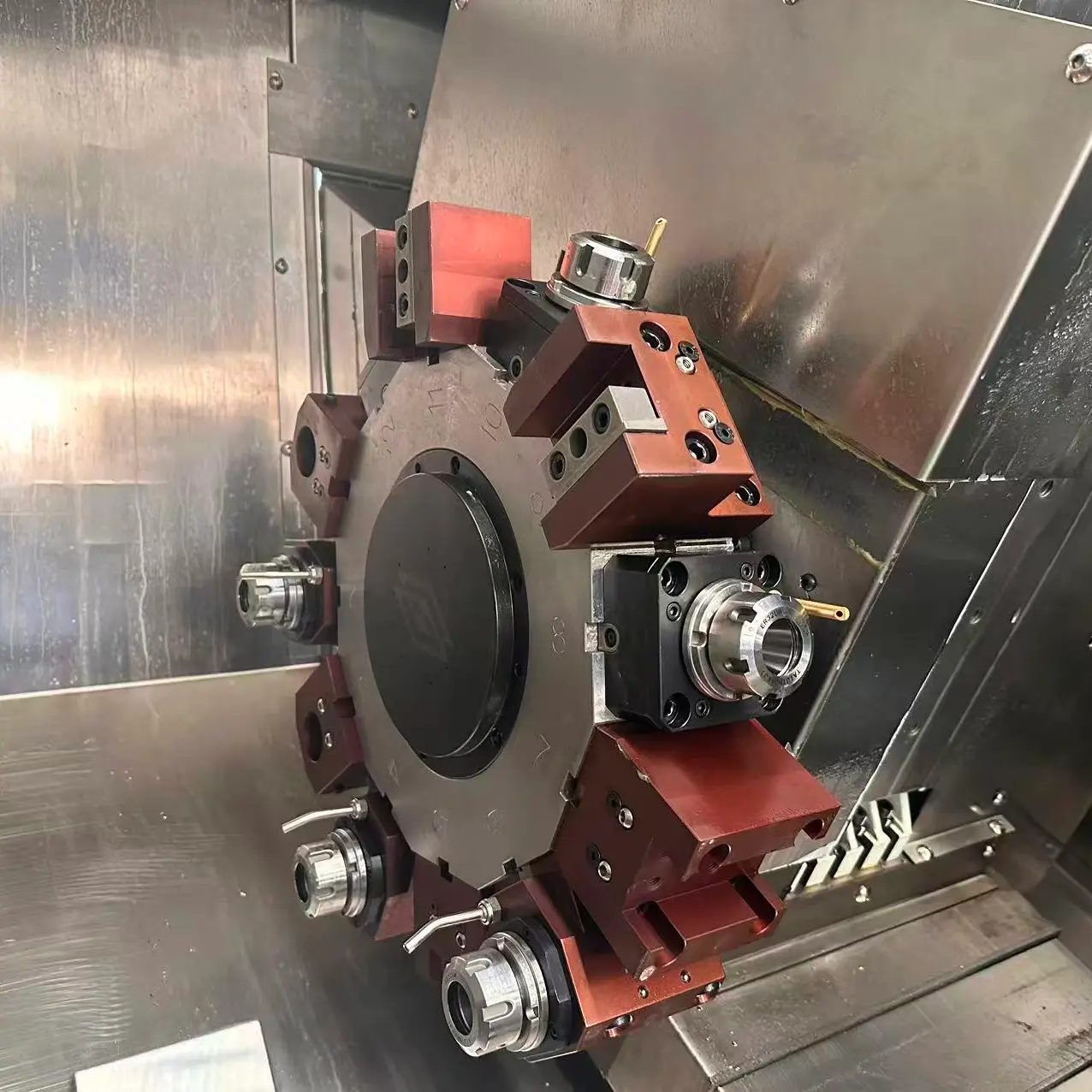
القائمة
1. SMTCL (Shenyang Machine Tool Co., Ltd.)
State-owned since 1935 and China’s largest machine tool builder by installed base, SMTCL commands this spot because no other Chinese manufacturer has shipped more cumulative spindle hours in heavy turning. Their HTM series large vertical lathes and conventional horizontal CNC lathes still serve Russian, Southeast Asian and domestic automotive plants where FANUC or Siemens controls are specified alongside 75 kW main drives. The trade-off is painful: state-owned procurement cycles mean six-month lead times are routine, and post-sale technical responsiveness for export buyers lags far behind private competitors. If your line goes down, you are negotiating with a bureaucracy, not a partner.
2. DMTG (Dalian Machine Tool Group)
Another state-owned legacy plant, founded 1935, DMTG earns second place on raw export footprint alone—machines operating in over 180 countries. Their CKA series flat-bed CNC lathes and VT series vertical turret lathes handle 1,000 mm swing diameters with geared headstocks that private builders rarely attempt. Spindle bearings and ball screws are sourced domestically or from Korea, keeping unit prices roughly 20% below SMTCL equivalents. The drawback is consistency: DMTG’s quality variance between production batches is wider than any private builder on this list, and spare parts availability outside China depends heavily on your local dealer’s inventory depth. You are buying capacity, not predictability.
3. Qiqihar Heavy CNC Equipment Co., Ltd.
The outlier here—a state-owned specialist in single-piece and small-batch monster machines. Qiqihar Heavy builds vertical lathes with 16-meter table diameters and horizontal boring mills that no private Chinese builder touches. Their VTM series handles workpieces exceeding 100 tons, serving wind turbine flanges, nuclear pressure vessels and ship propulsion shafts with Siemens 840D controls and hydrostatic table bearings. Roughly 40% of output serves state infrastructure projects with captive pricing. The trade-off is exclusivity by omission: minimum orders start where most shops end, delivery stretches beyond 12 months, and export support infrastructure barely exists for buyers outside Belt-and-Road corridors. This is a state strategic asset, not a commercial vendor.
4. Taian HAISHU Machinery Co., Ltd.
The first private builder, founded 2001 in Shandong, and the proof that focused specialization beats breadth. HAISHU ships 1,500+ CNC lathes annually from a 12,000 m² facility, concentrating on flat-bed and slant-bed models from CK6140 to CK61125 size classes with ±4μm positioning repeatability. They pair domestic spindles with Japanese THK or Taiwanese HIWIN linear guides depending on price tier, landing roughly 30% above bare-bones Chinese average but 25% below comparable Taiwanese builds. The weakness is scale limitation: above 1,500 mm swing or multi-axis mill-turn, HAISHU has no proven solution, and their export service network in Africa and South America remains thinner than their European presence. They win on value, not on complexity.
5. Ningbo Haitian Precision Machinery Co., Ltd.
Haitian earns this position as the private builder most aggressively bridging CNC turning with automation integration—over 30 patents in robotic loading and gantry-fed turning cells. Their HT series slant-bed CNC lathes, typically 6–12 inch chuck sizes with 45° bed angles, target automotive component suppliers in Mexico, Southeast Asia and Eastern Europe where unattended running justifies premium pricing roughly 15% above HAISHU. They manufacture critical castings in-house but source spindles from Taiwanese or Korean suppliers. The trade-off is automation lock-in: Haitian’s robotic interfaces work best with their own ecosystem, and mixed-vendor integration support is weaker than advertised. If you want a standalone lathe without tending equipment, you are paying for capability you will not use.
6. Dalian Guangyang Machine Tool Co., Ltd.
Guangyang earns its spot as the most export-hardened mid-size builder from Liaoning’s machine-tool belt, with particular density in Russian, Central Asian and Southeast Asian installed bases where DMTG and SMTCL pricing proved too steep. Their CK series flat-bed lathes run synchronous belt spindle drives rather than direct-drive, a cost-down that trims roughly 15% from competing builds but introduces belt-replacement intervals at 6,000-8,000 hours in heavy interrupted cuts. Castings are FC250 grade, one step below the HT300 norm, which shows in surface finish stability beyond three years of continuous duty. The right buyer values the parts availability and local dealer network over ultimate rigidity.
7. Jinan Style CNC Machinery Co., Ltd.
Style CNC’s volume play is undeniable: 23,000-plus machines sold positions them as the private-sector answer to how many entry-level turning centers the global market can absorb. Their slant-bed lathes ship with GSK 980TDi or optional Siemens 808D controls, and the mechanical package is deliberately interchangeable—same turret footprint, same bolt patterns—across five model generations to keep spare-part costs minimal. The drawback is thermal stability; castings undergo shorter seasoning cycles than legacy-plant norms, and shops holding ±0.015mm on long aluminum shafts will see drift after 90 minutes of spindle-on time. Best suited for short-cycle job shops where operators reset offsets routinely.
8. Shandong Maxnovo Machinery Co., Ltd.
Maxnovo carries 35 years of precision manufacturing heritage, though much of that history sits in manual lathe production rather than CNC. Their transition shows in conservative electronic architectures—FANUC 0i-TF pairings are standard, with none of the domestic-control experimentation that trips up less experienced buyers—and in bed ways that are hand-scraped on critical surfaces, a labor cost most private builders eliminated a decade ago. The resulting positioning is roughly 20% above Chinese private-market average, without the state-plant badge to justify it to cost-conscious procurement departments. The buyer here pays for craftsmanship that procurement software cannot quantify.
9. Weihai Blue Elephant CNC Machinery Co., Ltd.
Blue Elephant’s 75,000-square-meter facility represents the woodworking-to-metal crossover phenomenon, with router-derived supply chains applied to CNC lathe production at price points that undercut dedicated metal-cutting builders by 25-30%. Their flat-bed machines target the pipe-threading and basic shaft-turning markets where spindle horsepower matters more than contouring precision; 11kW main drives are common where competitors offer 7.5kW. The trade-off is control depth—typical installations run simplified GSK interfaces with limited macro-B capability—and turret tooling systems that are proprietary rather than VDI or BMT standard, locking buyers into single-source tool holders for the machine’s life.
10. Tengzhou Runlongjia Machinery Co., Ltd. / RUNNEWTECH
Runlongjia’s fifteen-year track record since 2010 places it at the newer end of private builders, with the operational honesty that comes from having rebuilt early export machines under warranty rather than burying the learning curve. HT300 castings and linear guideway slant-bed configurations are standard, paired with either GSK or Siemens controls depending on destination-market service infrastructure; the FANUC option exists but carries lead times that reflect genuine procurement rather than badge-engineering. The genuine limitation is scale—annual output sits well below SMTCL or DMTG single-facility months—which means customization flexibility for Southeast Asian and Middle Eastern buyers, but also longer waits for non-standard configurations and a spare-parts network still deepening in Eastern Europe and South America.
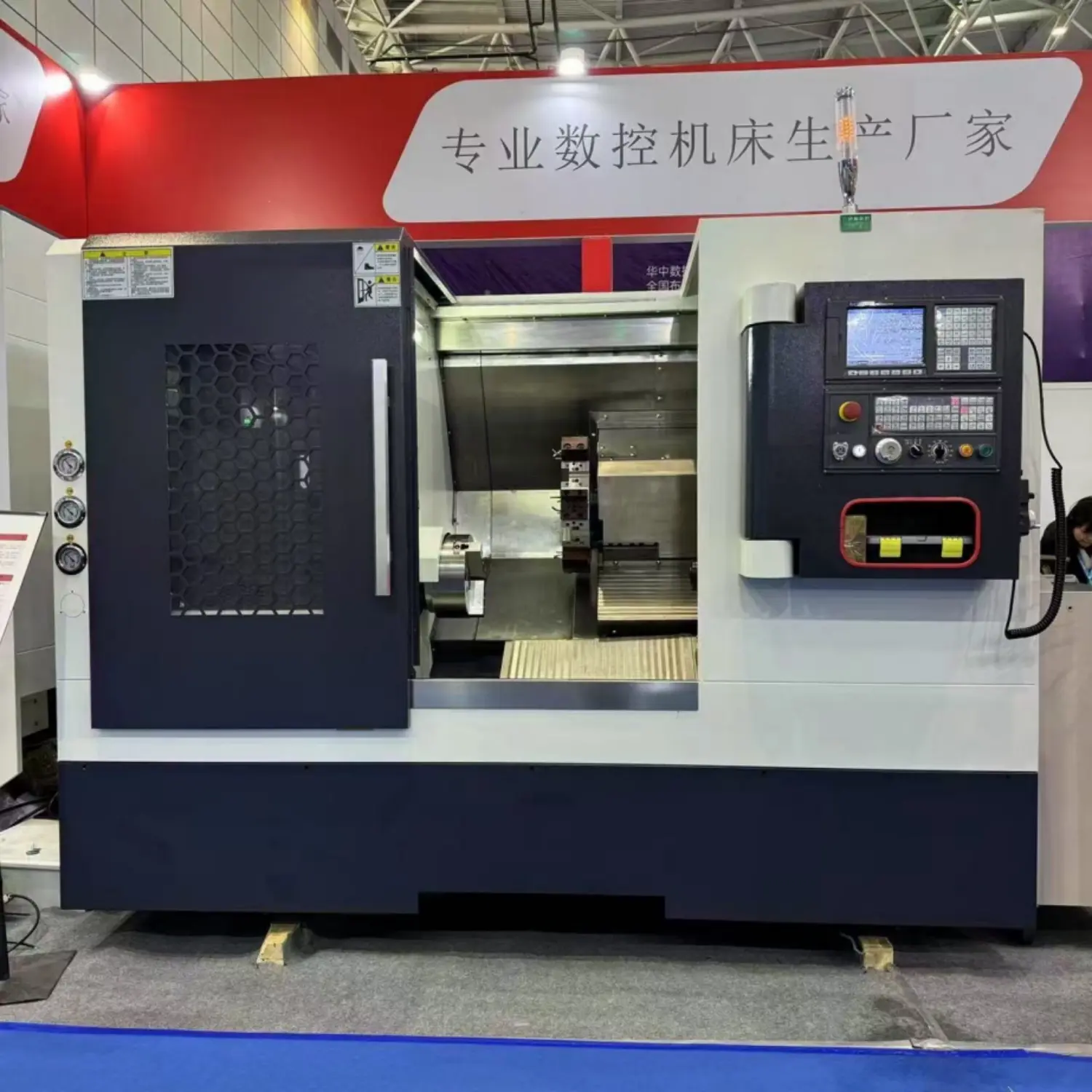
مرجع سريع: مواءمة القائمة مع حالتك
-
I need a rock-steady workhorse for rough turning large mining shafts, and I have the floor space and three-phase power to feed it. Qiqihar Heavy CNC Equipment is purpose-built for this. Their vertical lathe castings are in a different weight class than anything the private builders offer.
-
My shop runs small-batch automotive parts and I need FANUC reliability without paying Japanese sticker price. Ningbo Haitian Precision Machinery has the volume and supply-chain muscle to deliver that pairing at roughly two-thirds what a comparable import would cost.
-
I am buying my first CNC lathe and need someone who will pick up the phone at midnight when I crash a turret. Taian HAISHU Machinery or Jinan Style CNC Machinery. Both are mid-size private builders where the owner still answers WhatsApp personally. SMTCL will not.
-
I need a slant-bed CNC lathe shipped to Lagos in six weeks, and I cannot afford a customs headache. RUNNEWTECH or Weihai Blue Elephant CNC Machinery. Both have export packing down to a routine, with hardwood crate specs that actually match the bill of lading.
-
My contract requires a documented domestic Chinese brand with state-backing for political reasons. SMTCL or DMTG. Be honest with yourself: you are buying the nameplate, not the service response time.
-
I want the cheapest possible flat-bed CNC lathe that will still cut to print for two years. Dalian Guangyang Machine Tool or Shandong Maxnovo Machinery. Budget accordingly for spindle bearing replacement around month eighteen.
RUNNEWTECH builds and exports آلات الخراطة التي تعمل بنظام التحكم الرقمي (CNC) from our factory in Tengzhou, Shandong. We are a participant in this market, not a neutral observer, and the ranking above reflects exactly what we would tell a buyer who walked into our assembly hall. We did not put ourselves first because that would insult your intelligence. We build in the same ecosystem as the other private builders on this list, source from overlapping supplier networks, and face the same daily choices between cutting a corner or explaining it to a customer in Portuguese or Arabic six months later. The ranking is honest counsel from one manufacturer to a buyer who has dozens of options and limited time to sort them.
ما نبنيه بأنفسنا
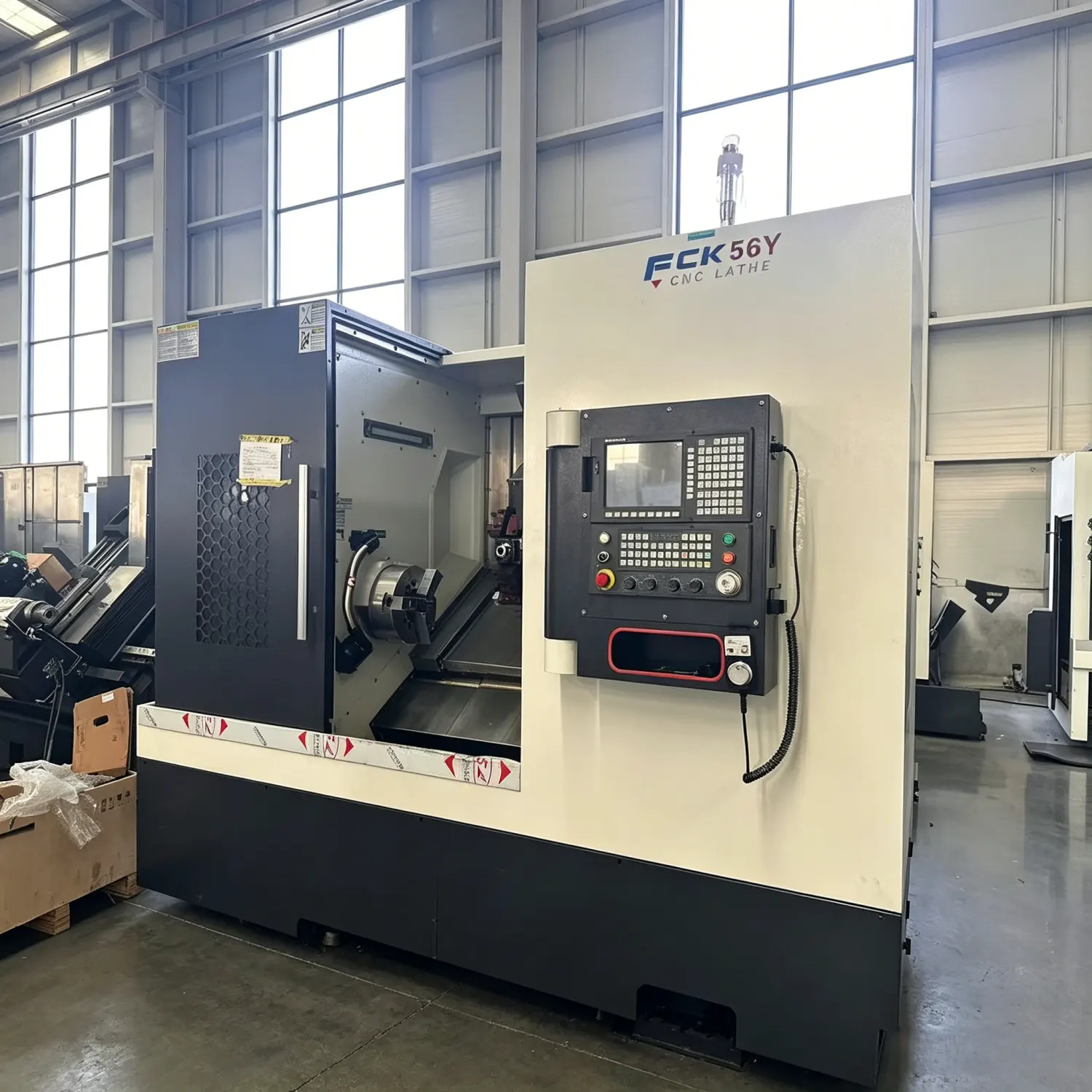
ماكينة الخراطة ذات التحكم الرقمي (CNC)
صُنعت بواسطة شركة RUNNEWTECH مع خيارات تحكم من FANUC أو Siemens أو Mitsubishi أو GSK أو Syntec، وتزويد بالطاقة بجهد 380 فولت/50 هرتز أو 220 فولت/60 هرتز للتصدير.
الأسئلة الشائعة
Q: Why would I buy a private builder’s CNC lathe over a state-owned legacy plant’s machine?
تتميز المصانع التقليدية المملوكة للدولة، مثل SMTCL وDMTG، بمخرطات المهام الثقيلة ذات نطاق الدوران الكبير، المزودة بأسِرّة مصبوبة أثبتت كفاءتها وشبكات خدمة ما بعد البيع المدعومة من الحكومة. أما الشركات الخاصة، فتتفوق في استجابة المغزل، وسرعة التسليم، ومرونة التكوين للأعمال ذات المهام المتوسطة. وإذا كان ورشتك تنفذ أعمالًا متنوعة على دفعات وتحتاج إلى مخرطة CNC ذات قاعدة مائلة مزودة بأدوات دوارة في غضون 8 أسابيع، فإن اللجوء إلى الشركات الخاصة عادةً ما يكون الخيار العملي الوحيد.
Q: How do I verify that the actual machine matches the spec sheet before it leaves China?
Request a pre-shipment witness test with your specific cutting parameters, not the builder’s demo part. Bring a bore gauge and check spindle runout yourself; 0.003 mm at the nose is achievable on a properly assembled machine, but 0.010 mm is common on rushed export builds. Insist on photos of the actual casting batch numbers and linear guide rail brands—THK and HIWIN are not interchangeable in rigidity.
Q: Which builders on this list actually stock spare parts outside China?
SMTCL and DMTG maintain parts depots in Southeast Asia and Eastern Europe through distributor networks, though lead times vary by region. Most private builders ship spares from their factory with 7–10 day air freight. If you are in Africa or South America, clarify before contract whether “global support” means stocked inventory or a WeChat response at 2 a.m. Beijing time.
Q: Is a slant bed CNC lathe from a private builder durable enough for 20 years of production?
The casting itself—HT300 on most entries here—will outlast the control system and ball screws. The real question is component accessibility: FANUC or Siemens parts remain available globally; a proprietary control from a defunct private builder becomes a paperweight. Budget for a control retrofit in year 12–15, and verify the builder uses standard turret bolt patterns so you are not locked into their tool disc geometry.
يعكس هذا التصنيف وجهة نظرنا الخاصة بصفتنا شركة مصنعة للآلات ومصدرة لها، ويُقدم كمرجع عام فقط.
تم ترتيب الشركات والعلامات التجارية المذكورة وفقًا للمعايير المذكورة أعلاه، وليس بناءً على أي ترتيب مدفوع. أسماء الشركات والعلامات التجارية المشار إليها مملوكة لأصحابها المعنيين. RUNNEWTECH هي شركة تصنيع مستقلة، ولا ترتبط بأي من الشركات الأخرى المذكورة، ولا تحظى بتأييدها، ولا تعمل كموزع معتمد لها. المواصفات، النطاقات السعرية
وأرقام الدقة هذه هي أرقام إرشادية وتخضع للتأكيد الكتابي في الفاتورة الأولية.
هل أنت مستعد لتحديد مواصفات آلتك القادمة؟
تقوم شركة RUNNEWTECH بتصنيع آلات تشغيل المعادن منذ عام 2010،,
مع خبرة تزيد عن 15 عامًا في مجال التصدير. أرسلوا إلينا معلومات عن مادة قطعة العمل، والحجم الأقصى للقطعة، والتفاوت المسموح به المطلوب، والوجهة
الميناء، وسنرد عليكم بمواصفات المنتج وعرض أسعار بنظام FOB أو CIF في غضون يوم عمل واحد.

 English
  Indonesian
  Vietnamese
  Arabic
  Russian
  Spanish