
CNC Lathe Machine Buyer Guide
A CNC lathe machine is a motorized lathe whose cutting movements are directed by computer numerical control code rather than by a human operator turning handwheels. The machine rotates a workpiece on a spindle while a turret-mounted cutting tool removes material to produce cylindrical, conical, threaded or contoured parts.
ما هي المشكلة التي يحلها؟
Manual lathes require an operator to control every feed rate, depth of cut and tool position by hand. This limits repeatability, consumes skilled labor and introduces variation between shifts. A CNC lathe stores the entire machining sequence as a G-code program, executes it automatically once proven, and repeats it with the same tool paths for hundreds or thousands of cycles. First-time buyers should understand that the capital cost is higher and the operator skill set shifts from hand dexterity to program verification, fixture logic and process troubleshooting.
How CNC Differs From Manual
| Element | Manual Lathe | CNC Lathe |
|---|---|---|
| Axis control | Handwheel, 2 axes (X, Z) | Servo motor, 2 to 5 axes with live tooling and Y-axis options |
| سرعة المغزل | Operator-selected, typically 50–2,000 rpm | Programmed, often 3,500–6,000 rpm on flat bed, 4,000–8,000 rpm on slant bed |
| حجم المفتاح | 160–320 mm common | 200–400 mm standard, hydraulic actuation |
| دقة تحديد الموقع | Dependent on operator | ±0.005 mm to ±0.015 mm declared repeatability depending on control and ballscrew grade |
| نظام التحكم | None | FANUC 0i-TF, Siemens 828D, GSK 980TDi, KND or Syntec |
| Net weight | 800–1,500 kg | 2,500–8,000 kg for flat bed; 3,500–12,000 kg for slant bed with linear roller guideways or hardened box ways |
What First-Time Buyers Must Grasp Before Shortlisting
Casting grade and mass. HT250 or HT300 resin sand castings with stress relief determine how the machine holds tolerance under interrupted cuts. A 500 mm swing flat bed CNC lathe typically weighs 3,200–4,500 kg. Lighter machines vibrate.
Guideway choice. Hardened box ways (Turcite-B coated, hand-scraped) tolerate heavy interrupted cuts and cast iron chips but limit rapid traverse to 6–10 m/min. Linear roller guideways (HIWIN or PMI) allow 20–30 m/min rapids and finer positioning but demand cleaner coolant filtration.
Spindle configuration. A2-5, A2-6 or A2-8 nose taper dictates chuck size and workpiece capacity. Spindle power of 7.5–15 kW covers most job shop turning; 22–30 kW suits large-diameter forging or alloy steel.
Control ecosystem. FANUC dominates global resale and technician availability. GSK or KND reduce controller cost by 30–40 percent but narrow the pool of local service talent outside China.
Power supply reality. Machines are built for 380V 50Hz three-phase. A 220V 60Hz shop needs a step-up transformer rated at 1.5× the machine kVA to handle starting current. Factor this into landed cost.
This page covers how to match lathe configuration to your actual part mix, control selection for your labor market, and the mechanical trade-offs that determine whether a machine earns its keep or becomes underutilized floor space.
How a CNC Lathe Machine Works
A CNC lathe is a machine tool that rotates a cylindrical workpiece while a single-point cutting tool removes material to create round parts—shafts, pulleys, threads, bores, and tapers. The “CNC” designation means servo motors, ball screws, and a programmable controller replace the hand wheels and levers of a conventional lathe, executing movements measured in micrometers rather than by operator feel.
The Workpiece Setup and Holding
The process begins with securing the raw stock. A chuck—typically hydraulic on production machines, manual on entry-level models—grips the workpiece. Common chuck sizes are 160 mm, 200 mm, 250 mm, or 315 mm for flat-bed lathes; slant-bed machines often use 6-inch, 8-inch, or 10-inch hydraulic chucks. The spindle nose conforms to standards like A2-5, A2-6, A2-8, or A2-11, dictating chuck interchangeability.
For first operations, material protrudes from the chuck face; for second operations, the part may transfer to a sub-spindle or be reversed in soft jaws. Collets (ER32, ER40, or proprietary power collet systems) grip smaller diameters with 0.01 mm runout or better. A tailstock with a live center supports long, slender work against deflection—critical when length-to-diameter ratio exceeds 4:1.
The Cutting Action Generation
The cutting tool, clamped in a turret or tool post, generates all material removal. Turrets on slant-bed CNC lathes typically carry 8, 12, or 16 stations; live tooling (driven tools) at those stations enable milling, drilling, and tapping off-center while the spindle indexes. Tool holders use VDI or BMT interfaces; VDI is quicker to change, BMT offers more rigidity for heavy interrupted cuts.
Spindle power ranges from 5.5 kW on small teaching lathes to 15 kW, 22 kW, or 37 kW on heavy-duty flat-bed machines. Maximum spindle speeds vary inversely with chuck size: a 160 mm chuck may run 4,000 rpm, a 315 mm chuck typically 1,500–2,000 rpm. The cutting speed (surface meters per minute), feed rate (mm per revolution), and depth of cut (mm) are calculated parameters embedded in the CNC program.
The Process Sequence
- Program loading and machine preparation. The operator loads a G-code program—generated manually, via conversational programming on the control, or exported from CAD/CAM software—into the CNC unit. Common controls include FANUC 0i-TF, Siemens 828D, Mitsubishi M80, GSK 980TDi, KND K2000TF, or Syntec 22TA. The operator calls tool offsets, sets work coordinate zero at the chuck face or finished shoulder, and verifies spindle and coolant readiness.
- Spindle start and workpiece rotation. The spindle drive accelerates the chuck and workpiece to commanded speed. Vector-controlled AC spindle motors maintain constant surface speed by adjusting rpm as diameter changes during facing operations.
- Turret indexing and tool positioning. The turret rotates to the active tool station. Servo motors on the X-axis (cross-slide, controlling diameter) and Z-axis (carriage, controlling length) drive ball screws to position the tool tip at the programmed start point. Rapid traverse rates of 20–30 m/min on linear guideway machines, or 8–15 m/min on box-way designs, minimize non-cutting time.
- Feed engagement and material removal. The tool advances at cutting feed rate—typically 0.05–0.5 mm/revolution for roughing, finer for finishing. The control interpolates X and Z axes simultaneously to generate tapers, radii, and threads. For threading, the spindle encoder provides one pulse per revolution to synchronize Z-axis feed exactly with spindle rotation, maintaining thread pitch within ±0.01 mm over 100 mm length.
- In-process verification and adjustment. Linear scales on X and Z axes (closed-loop systems) or motor-mounted rotary encoders (semi-closed loop) feed actual position to the control. Positioning accuracy is typically ±0.005 mm to ±0.015 mm; repeatability ±0.003 mm to ±0.008 mm. The control compares command to feedback at 1 ms or faster intervals, applying gains to eliminate following error.
- Tool change and cycle continuation. At operation completion, the tool retracts, the turret indexes to the next tool, and the sequence repeats. On machines with Y-axis and live tooling, the spindle becomes a C-axis (positioning in 0.001 degree increments), enabling milling flats, drilling bolt circles, or engraving.
- Part completion and unloading. The final tool retracts to a safe index position. The spindle stops. The operator removes the finished part manually, a bar feeder pushes new stock through for the next cycle, or a gantry loader transfers the part to a secondary operation or parts catcher.
Where Cheap Machines Lose Performance
Three points in this sequence expose cost-driven compromises:
Ball screw and guideway quality. Budget machines use C5 or C7 grade ball screws with 0.02–0.05 mm backlash, versus C3 grade (0.008 mm) on precision builds. HIWIN or PMI linear guides on quality machines provide 2–3 times the rigidity of generic alternatives. The result: during contouring cuts at feed rates above 5 m/min, a cheap machine overshoots corners and produces chatter marks that C3/closed-loop systems avoid.
Thermal stability and feedback type. Semi-closed loop machines (motor encoders only) cannot detect ball screw thermal expansion of 0.02–0.04 mm per 100 mm after 30 minutes of operation. Linear scale-equipped machines cost 15–25% more but maintain bore-to-bore spacing tolerance across a production shift. HT250 castings with stress relief age better than unstressed lower-grade iron, reducing long-term geometric drift.
Spindle drive response and turret indexing. Entry-level machines use variable frequency drives with 1–2 second acceleration to full speed; true servo spindle systems reach commanded speed in 0.5 seconds. Hydraulic turrets index in 0.3–0.4 seconds; economical electric turrets take 0.8–1.2 seconds. On a 12-tool cycle with frequent changes, this accumulates to 6–10 seconds per part—negligible for one-off work, significant at 500 parts per shift.
Control System and Programming Reality
The CNC control translates G-code into axis motion through look-ahead buffers—typically 40 blocks on basic systems, 200–1,000 blocks on FANUC or Siemens platforms. For a finishing pass with 0.2 mm chordal tolerance across a complex cam profile, insufficient look-ahead forces the control to decelerate at each geometry change, extending cycle time 20–40%. Conversational programming (ShopTurn on Siemens, Manual Guide i on FANUC) lets operators generate profiles at the machine without CAM software; this suits job shops with high mix, low volume.
Workpiece Unloading and Integration
Manual unloading suffices for batch sizes under 50. For unattended operation, options include: bar feeders (feeding 3 m or 6 m round bar up to 80 mm diameter); gantry loaders with gripper change systems; or robotic arm integration via Ethernet/IP or PROFINET to the machine PLC. The sub-spindle on turning centers enables “done-in-one” processing—machining the first end, transferring to the sub-spindle for second-end work, and dropping a complete part into a conveyor. This eliminates concentricity errors from rechucking but adds 30–50% to machine cost and requires synchronized main/sub-spindle control.
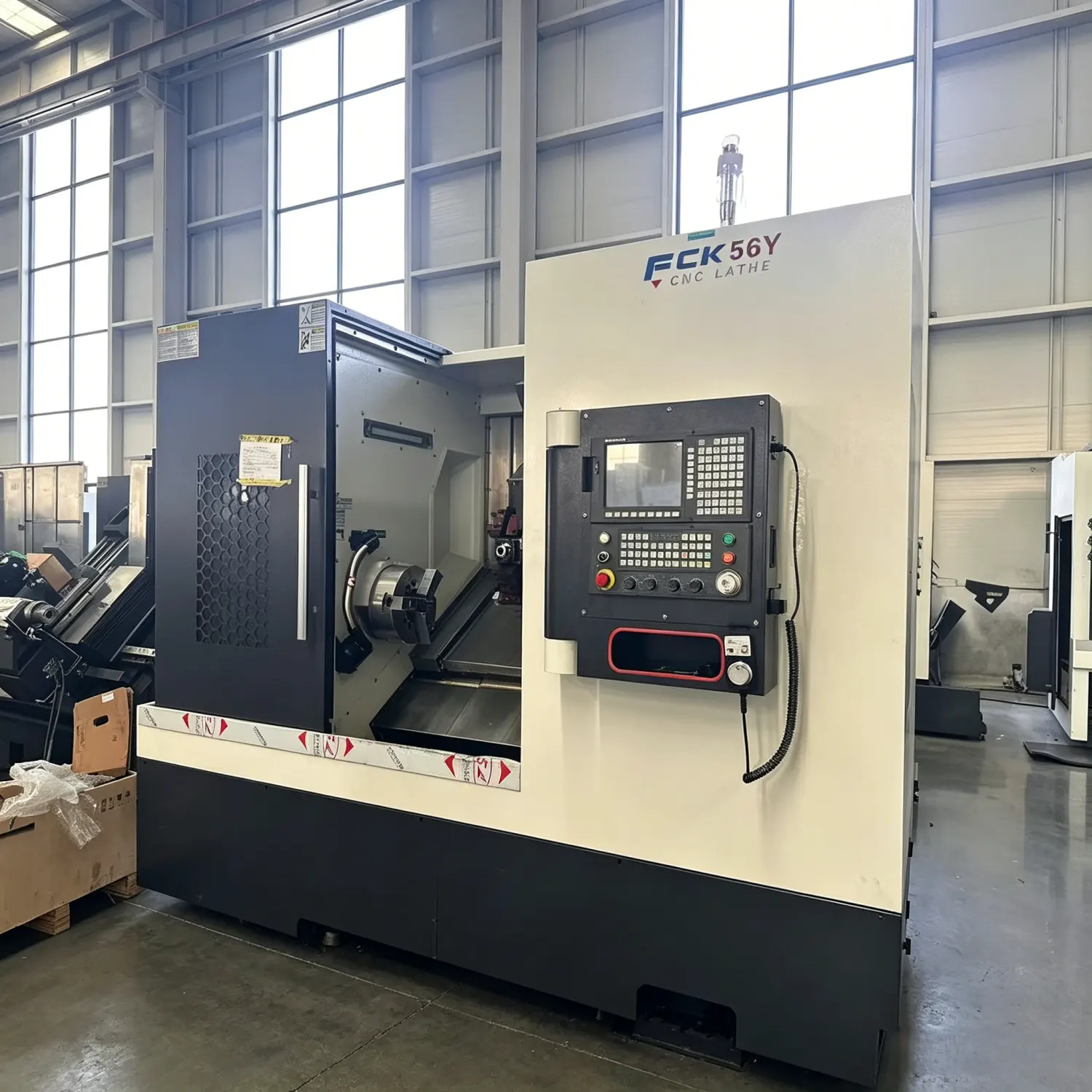
Types and Configurations of CNC Lathe Machine
A CNC lathe machine is a motorized lathe whose cutting movements—spindle speed, tool position, and feed rate—are directed by a computer numerical control program rather than by hand wheels and levers. It solves the problem of producing cylindrical parts with consistent accuracy across hundreds or thousands of pieces, eliminating the variation that comes from operator fatigue and manual measurement on a conventional engine lathe.
The manual equivalent requires a machinist to set speeds, engage feeds, and advance the cross slide by feel and eye; a CNC lathe stores these motions as G-code and executes them automatically once the workpiece is clamped. For a first-time buyer, the critical distinction is not merely automation but repeatability: a CNC lathe will hold positioning accuracy of ±0.005 mm and repeatability of ±0.003 mm under normal conditions, whereas a skilled operator on a manual lathe struggles to maintain ±0.05 mm across a production run. What you must understand before shortlisting is the relationship between bed design, axis count, and the parts you actually make—because the wrong configuration turns even the most capable control system into an expensive mismatch for your work.
Six Real Types and Size Classes
| النوع أو الفئة | نطاق العمل النموذجي | خيارات التحكم | الأكثر ملاءمة لـ | ملاحظات |
|---|---|---|---|---|
| Benchtop/Compact CNC Lathe | Max turning diameter 200–250 mm, max length 300–400 mm, chuck 6″ | GSK 980TDi, KND K1Ti, Siemens 808D | Technical training centers, prototype shops, jewelry and small medical parts | Spindle power 2.2–3.7 kW at 4000–6000 rpm; linear guides on X/Z; machine weight 400–700 kg; rapid traverse 12–16 m/min; limited to light cuts and soft materials |
| Flat Bed CNC Lathe (Light Duty) | Max turning diameter 360–500 mm, max length 750–1500 mm, chuck 8″–10″ | GSK 980TDB, KND K1000Ti, FANUC 0i-TF | General repair shops, agricultural parts, short-run job shops | Spindle power 5.5–7.5 kW at 2000–3000 rpm; hardened box ways or combination box/linear; positioning accuracy ±0.01 mm; machine weight 1800–2800 kg; lower cost but slower rapids (6–10 m/min) than slant bed designs |
| Flat Bed CNC Lathe (Heavy Duty) | Max turning diameter 630–1000 mm, max length 2000–6000 mm, chuck 12″–24″ | FANUC 0i-TF Plus، Siemens 828D، Mitsubishi M80 | Oil field components, large shafts, shipbuilding, heavy equipment repair | Spindle power 15–45 kW at 800–1500 rpm; HT300 or Meehanite casting, hardened box ways; positioning accuracy ±0.015 mm; machine weight 6000–18000 kg; requires substantial foundation and 10-ton crane for installation |
| Slant Bed CNC Lathe (Standard Turret) | Max turning diameter 400–520 mm, max length 500–1000 mm, chuck 8″–10″ | FANUC 0i-TF, Siemens 828D, Syntec 22TA | Automotive parts, hydraulic fittings, medium-volume production | Spindle power 7.5–15 kW at 3500–4500 rpm; A2-6 or A2-8 spindle nose; linear roller guides (HIWIN/PMI); rapid traverse 20–30 m/min; positioning accuracy ±0.005 mm; machine weight 3500–5500 kg; chip evacuation improved by slant geometry |
| Slant Bed CNC Lathe (Turn-Mill Center) | Max turning diameter 400–650 mm, max length 500–1500 mm, chuck 8″–12″, plus Y-axis ±50 mm and driven tooling | FANUC 0i-TF Plus, Siemens 840D sl, Mitsubishi M80 | Complex aerospace, medical, and automotive parts requiring milling, drilling, off-center tapping | Spindle power 11–22 kW; live tooling speed 4000–6000 rpm; BMT55 or VDI40 turret interfaces; sub-spindle and parts catcher common; machine weight 5000–9000 kg; positioning accuracy ±0.005 mm; 30–40% higher cost than standard turret |
| Swiss-Type CNC Lathe (Sliding Headstock) | Bar capacity 12–38 mm diameter, part length typically under 200 mm | FANUC 0i-TF, Citizen proprietary, Star proprietary | Watch parts, medical implants, electronic connectors, high-volume precision components | Spindle power 3.7–7.5 kW at 8000–12000 rpm; guide bushing requires ground bar stock; positioning accuracy ±0.003 mm; machine weight 2500–4000 kg; rapid traverse 30–50 m/min; not suited for chucked work or cast/forged blanks |
Benchtop/Compact CNC Lathe. Technical training centers and prototype shops buy these for teaching G-code fundamentals and machining small batches of aluminum, brass, and plastics. The GSK 980TDi or KND K1Ti controls are adequate for lathe operations but lack the macro programming and high-speed interfaces of industrial systems. What it cannot do: handle steel heavier than mild grades, hold tight tolerances on interrupted cuts, or run production shifts without thermal drift becoming visible. The 6″ chuck and 2.2 kW spindle limit you to parts under roughly 2 kg.
Flat Bed CNC Lathe (Light Duty). Job shops serving agricultural equipment and general mechanical repair gravitate here because the flat bed accommodates large faceplates and steady rests for awkward shafts, and the price sits below slant-bed equivalents. GSK and KND controls dominate this segment; FANUC 0i-TF appears when the buyer needs compatibility with existing shop programming standards. What it cannot do: achieve the surface finish and geometric accuracy of a slant bed with linear guides, or shed chips efficiently in high-volume cutting. The box-way construction adds rigidity but caps rapid traverse at roughly 8 m/min, so cycle times stretch on simple parts.
Flat Bed CNC Lathe (Heavy Duty). Oil field service companies and shipyards buy these for turning large flanges, drive shafts, and boring cylinders. The FANUC 0i-TF Plus or Siemens 828D manage the complexity of constant surface speed across large diameters and the math of taper turning over long beds. HT300 castings stress-relieved over weeks prevent seasonal distortion. What it cannot do: switch quickly between setups; these machines demand hours of alignment for each new workpiece. The 380V 50Hz supply is standard; a 220V 60Hz region requires a step-up transformer rated at 1.5× the spindle motor kVA to handle starting current.
Slant Bed CNC Lathe (Standard Turret). This is the default choice for automotive suppliers and hydraulic fitting producers running 500–5000 pieces per month. The 30° or 45° slant bed lets gravity pull chips into a conveyor, reducing manual cleaning and thermal distortion. A2-6 spindle noses with 8″ chucks handle most shaft and disc work; linear roller guides from HIWIN or PMI permit 24 m/min rapids that shorten non-cutting time. What it cannot do: mill flat surfaces or drill cross-holes without secondary operations, because the standard configuration lacks Y-axis travel and live tooling.
Slant Bed CNC Lathe (Turn-Mill Center). Aerospace subcontractors and medical device manufacturers buy these to complete parts in one clamping—reducing concentricity errors from rechucking. The Y-axis ±50 mm and driven tooling at 4000–6000 rpm allow cross-drilling, keyway milling, and polygon turning. Sub-spindles permit backworking. What it cannot do: compete on price with simpler machines for pure turning; the 30–40% premium only pays back when you eliminate a separate milling operation. Programming complexity rises sharply—your operator needs lathe and mill experience.
Swiss-Type CNC Lathe (Sliding Headstock). Medical implant makers and electronics contract manufacturers buy these for unattended production of long, slender parts from bar stock. The guide bushing supports the bar close to the cut, holding tolerances of ±0.003 mm on 20 mm diameter parts over 100 mm length. What it cannot do: accept castings, forgings, or pre-machined chucked blanks; the sliding headstock design assumes continuous bar feed. Ground bar stock adds material cost. The high spindle speeds and rapids demand stable 380V power; voltage sag causes alarm-level spindle load variation.
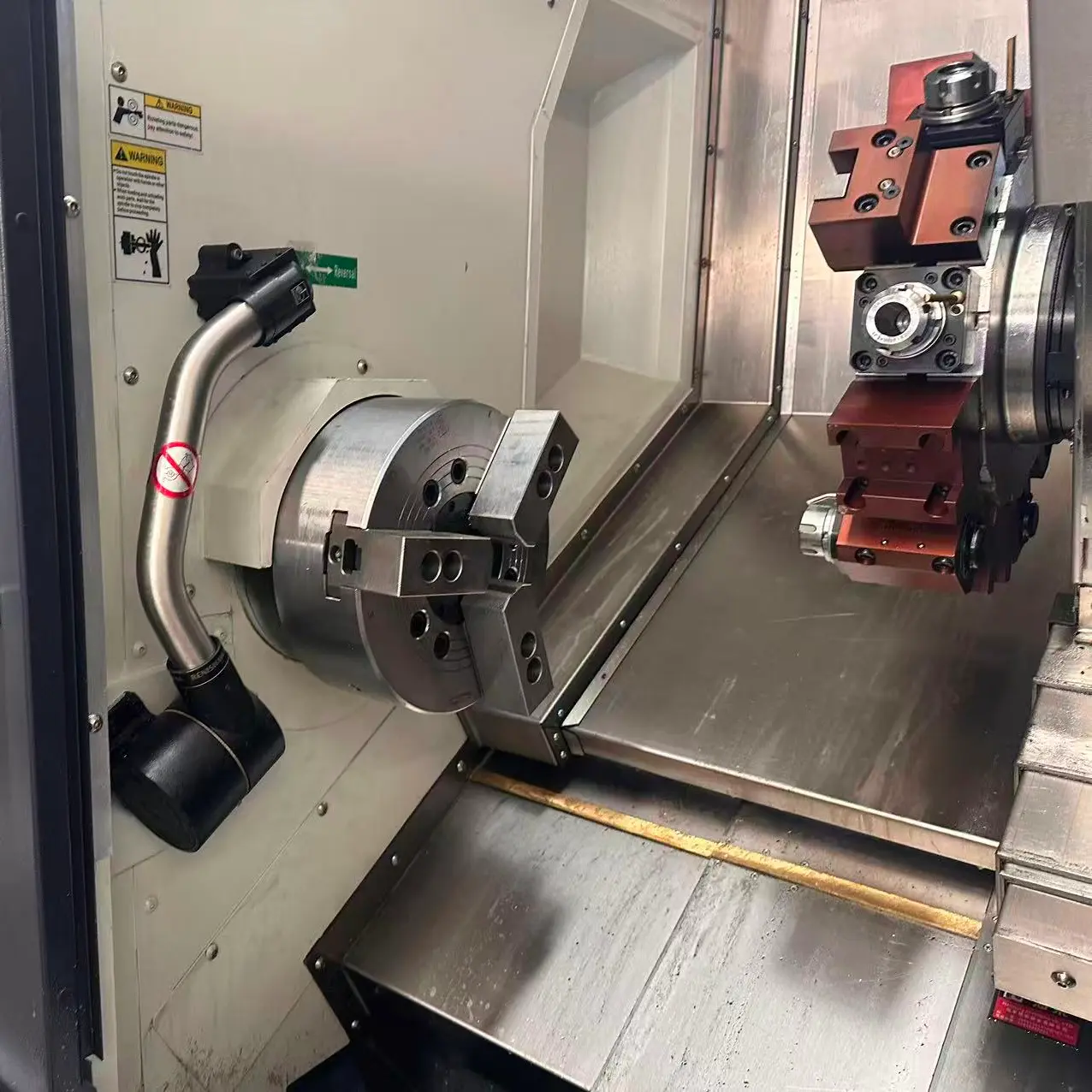
Main Components of a CNC Lathe Machine
A CNC lathe machine is a computer-controlled machine tool that rotates a metal workpiece while a stationary cutting tool removes material to create cylindrical parts. Unlike a conventional manual lathe where the operator turns handwheels to move the tool, a CNC lathe executes programmed commands to drive servo motors that position the tool precisely and repeatedly.
The machine solves the problem of producing complex turned geometries—tapers, threads, radii, contoured profiles—at production rates with tolerances held across hundreds or thousands of parts. Where a manual lathe depends on operator skill and consistency, a CNC lathe decouples part quality from operator fatigue. First-time buyers need to understand that the machine’s category (flat bed versus slant bed), control system, and spindle specification matter more than brand name when matching the machine to actual part mix.
الهيئات الرئيسية ووظائفها
| التجميع | الوظيفة | الإصدار النموذجي للمبتدئين | نسخة مطورة نموذجية | ما الذي يفشل أولاً؟ |
|---|---|---|---|---|
| صب السرير أو الإطار | Provides the structural foundation that determines rigidity and damping | HT250 resin sand casting, stress relieved, roughly 2200–2800 kg for 360 mm swing | HT300 or Meehanite casting, rib-reinforced, 3500–4500 kg for 500 mm swing | Thermal distortion from uneven chip accumulation; foundation settling if improperly leveled |
| مسارات التوجيه | Define axes of motion and load capacity for carriage and cross-slide | Hardened box way (HRC 52–58), scraped and flaked, 0.015 mm friction coefficient | Linear roller guide (HIWIN or PMI, 25 or 30 mm rail), 0.003 mm friction, rapid traverse to 24 m/min | Box ways: stick-slip and scoring from contaminated lubrication; linear guides: ball track fatigue and cage migration |
| البرغي الكروي وأنظمة الدفع | Convert rotary servo motion to linear axis positioning with minimal backlash | C7 grade ball screw, 0.050 mm backlash, direct-coupled servo motor | C5 or C3 grade ball screw with pre-tension, 0.008 mm backlash, absolute encoder on servo | Ball nut wear and axial lash; thrust bearing fatigue on high-rapidity machines |
| المغزل | Rotates workpiece; determines power transmission, speed range, and chuck mounting | A2-5 nose, 250 mm chuck, 5.5 kW, 3500 rpm, three-phase induction motor | A2-6 or A2-8 nose, 380 mm chuck, 11–15 kW, 4000–6000 rpm with vector drive | Front bearing set from contamination or lubrication breakdown; drawbar/spring fatigue on auto-chuck machines |
| نظام التحكم وحزمة الماكينة المؤازرة | Interprets G-code and closes position/speed/torque loops | GSK 980 or KND K1000Ti, analog servo drive, 0.010 mm positioning, 0.005 mm repeatability | FANUC 0i-TF or Siemens 828D, digital servo with 0.005 mm positioning, 0.003 mm repeatability, 0.001 mm with linear scale | Power supply module; encoder cable flex fatigue; battery-backed parameter memory |
| Tool Turret | Indexes and clamps cutting tools for automatic tool change | 6-station electric turret, 40 Nm clamping, 2.5 s index time | 12-station servo turret with live tooling (VDI 30 or BMT55), 80 Nm, 0.3 s index, 4000 rpm driven tools | Indexing mechanism wear; tool seat deformation from crashes; proximity switch drift |
| Chuck and Tailstock | Grips workpiece; tailstock supports long shafts with center or quill feed | Three-jaw hydraulic chuck, 200 mm diameter, 35 kN clamp force; manual tailstock, MT4 taper | Four-jaw independent or six-jaw compensating chuck, 55 kN; hydraulic programmable tailstock, 100 mm quill travel, MT5 | Chuck jaws from over-torquing irregular stock; tailstock barrel scoring from inadequate lubrication |
| نظام الرقاقة وسائل التبريد | Removes chips and delivers flood or through-spindle coolant to cutting zone | External flood coolant, 25 L/min pump, hinged chip pan, manual cleanout | Through-spindle coolant (20 bar, 70 L/min), auger or scraper conveyor, coolant chiller with paper filter | Pump seal and impeller from abrasive swarf; filter media blinding; conveyor chain stretch |
| الأغلفة وأجهزة القفل الآمنة | Contains coolant mist and chips; prevents access during hazardous motion | Partial splash guard, single door, basic door switch | Full steel enclosure with telescopic way covers, interlocked dual doors, CE Category 3 safety circuit with monitored relays | Way cover bellows tearing; door switch contact arcing from coolant ingress |
Assemblies That Most Affect Long-Term Accuracy
Bed Casting and Foundation Interface
The bed casting is the machine’s kinematic reference. Over months and years, accuracy loss originates not from the casting itself but from how it interacts with the shop floor. A 4000 kg slant-bed lathe on an inadequately thick concrete slab (minimum 150 mm, 200 kg/m³ reinforced) will experience localized flexure that manifests as taper in turned diameters. Thermal gradients from morning startup to afternoon operation cause the bed to bow if chip piles accumulate unevenly. RUNNEWTECH ships machines with foundation bolts and leveling pads; installers must verify level to 0.02 mm/m across the full length before the machine is anchored. Without this, no control system compensation can fully correct geometric drift.
Guideways and Their Lubrication Regime
Guideways translate servo positioning into physical tool location. On box-way machines, the oil film thickness (typically 0.01–0.03 mm) separates the sliding surfaces; contamination breaks this film and initiates adhesive wear. Linear roller guides trade some damping for speed and are more tolerant of momentary lubrication interruption, but their preload setting determines both stiffness and life. A 30 mm HIWIN rail with Z0 preload (slight clearance) will show 0.010 mm deflection under 500 N cutting load; with ZA preload (light interference), deflection drops to 0.004 mm but fatigue life reduces by 30–40 percent. Buyers should match preload to actual cutting forces, not specify maximum preload by default.
Spindle Bearing Assembly and Thermal Management
The spindle accounts for the majority of heat input during operation. A 7.5 kW spindle running at 3000 rpm for continuous roughing can warm the front bearing housing 15–20°C above ambient in 45 minutes, expanding the nose and altering part diameter by 0.020–0.040 mm on a 200 mm length if not compensated. Higher-end machines include spindle chiller circuits or firmware thermal growth models; entry-level machines rely on the operator to program wear offsets. Bearing preload is factory-set and not field-adjustable; when preload is lost through brinelling or lubricant degradation, the spindle exhibits chatter in finish cuts and accelerated tool wear. Rebuilding a standard A2-6 spindle costs roughly 15–20 percent of a new entry-level machine, making preventive lubrication and contamination control the dominant economic factor.
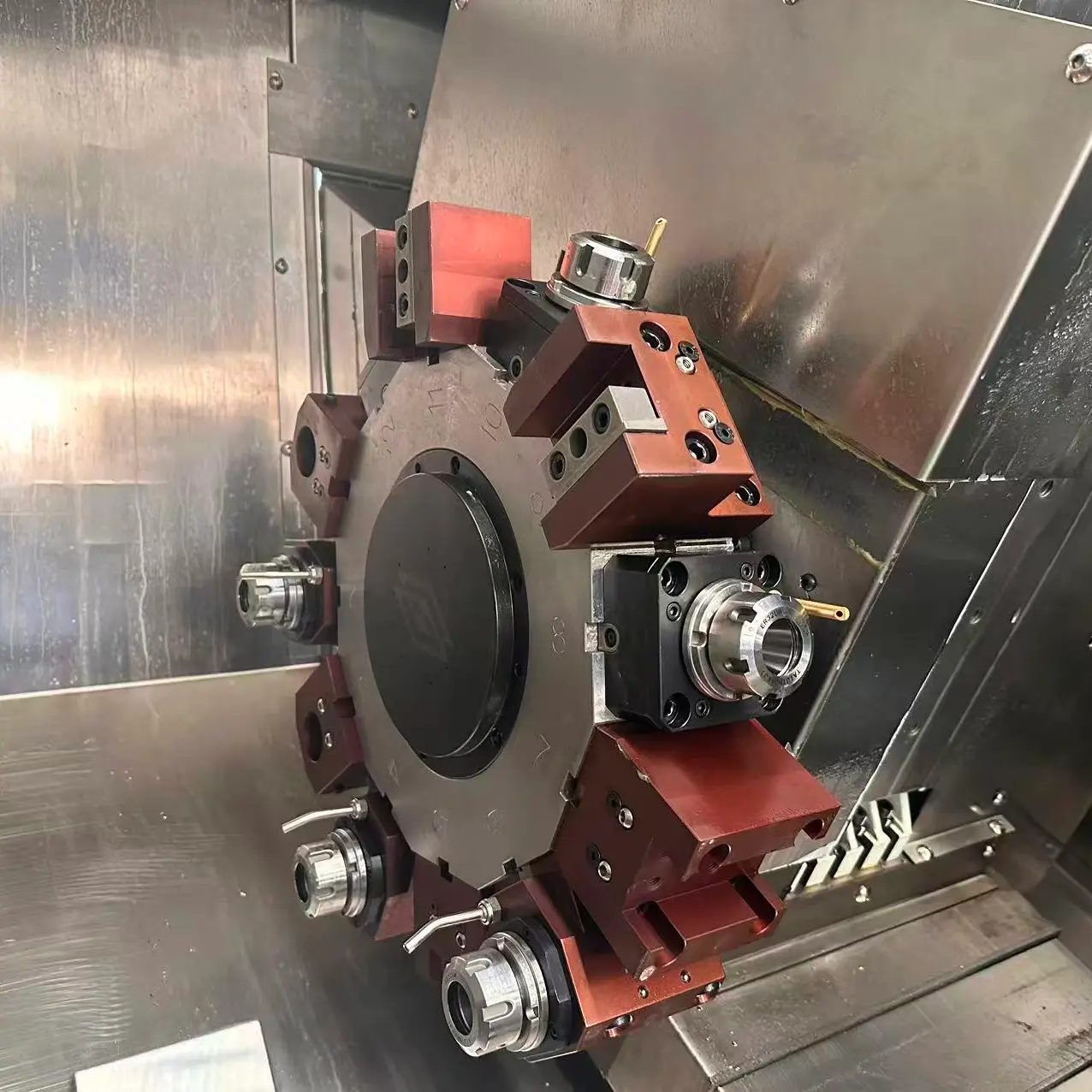
المواصفات وكيفية قراءتها
| المعلمة | المستوى المبتدئ | الفئة المتوسطة | مواصفات عالية |
|---|---|---|---|
| Max Turning Diameter | 360 mm | 500 ملم | 800 mm |
| Max Turning Length | 500 ملم | 1000 mm | 3000 mm |
| Chuck Size | 6″ (160 mm) | 8″ (210 mm) | 12″ (305 mm) |
| Spindle Speed | 3500 دورة في الدقيقة | 4000 rpm | 2000 rpm |
| Spindle Power | 7.5 كيلوواط | 11 kW | 22 kW |
| أنف المغزل | A2-5 | A2-6 | A2-8 |
| نوع مسار التوجيه | مسار صندوقي مقوى | دليل أسطواني خطي (HIWIN/PMI) | دليل أسطواني خطي (HIWIN/PMI) |
| X-Axis Travel | 180 mm | 250 mm | 420 mm |
| Z-Axis Travel | 520 ملم | 1050 mm | 3100 mm |
| Rapid Traverse (X/Z) | 12/16 m/min | 20/24 م/دقيقة | 24/30 مترًا في الدقيقة |
| دقة تحديد الموقع | ±0.015 مم | ±0.010 مم | ±0.008 مم |
| التكرار | ±0.008 مم | ±0.005 مم | ±0.003 مم |
| Tool Turret Stations | 4-6 | 8-12 | 12 with live tooling |
| نظام التحكم | GSK 980TC3 | FANUC 0i-TF / Siemens 828D | FANUC 0i-TF Plus / Siemens 840D sl |
| جهد الإمداد | 380 فولت، ثلاثي الأطوار، 50 هرتز | 380 فولت، ثلاثي الأطوار، 50 هرتز | 380 فولت، ثلاثي الأطوار، 50 هرتز |
| إجمالي الحمل المتصل | 15 كيلو فولت أمبير | 25 كيلو فولت أمبير | 45 kVA |
| الوزن الصافي للآلة | 2200 kg | 4500 kg | 12500 kg |
| المساحة الأرضية (الطول × العرض × الارتفاع) | 2200×1500×1700 mm | 3200×1800×1900 mm | 6500×2200×2200 mm |
A CNC lathe machine is a computer-controlled machine tool that rotates a metal workpiece while cutting tools remove material to create cylindrical parts. The “CNC” stands for Computer Numerical Control, meaning servo motors and ball screws execute programmed movements instead of a human hand turning cranks and levers.
ما هي المشكلة التي يحلها؟
Manual lathes require an operator to set feeds, speeds, and tool positions for every cut. This limits consistency, repeatability, and throughput. A CNC lathe stores cutting sequences as G-code programs. Once proven, the program produces identical parts across shifts, operators, and production runs. First-time buyers should understand that the machine’s value lies in programmability and repeatability, not merely in faster spindle speeds.
How CNC Differs From Manual Lathes
The core mechanical elements—bed, headstock, tailstock, carriage—remain recognizable. The critical difference is the control loop. A manual lathe has hand wheels connected to lead screws through change gears. A CNC lathe replaces these with servo motors, ball screws with C5 or C3 precision ground accuracy, and a feedback system using rotary encoders or linear scales. The control system interpolates X and Z axis movements to generate tapers, radii, and threads without physical template guides. Tool changes occur automatically via a turret or tool magazine, indexed by the program rather than by operator intervention.
قراءة ورقة المواصفات سطراً سطراً
Working Range or Travels
X-axis travel defines the maximum radial distance from spindle centerline the tool can reach, determining the maximum part diameter. Z-axis travel defines the maximum length between chuck face and tailstock center, or the maximum length for unsupported turning. On a slant bed CNC lathe, the X-axis travel is often specified as “swing over bed” and “swing over carriage” separately—subtract carriage height from bed swing to get true working diameter.
Max Turning Diameter and Length
These are the practical limits, not the theoretical travels. A 500 mm max turning diameter machine may have 250 mm X-axis travel above centerline. Max turning length assumes chuck-only workholding; add tailstock or steady rest setups and usable length reduces by 100-200 mm.
سرعة المغزل وقوته
Higher rpm suits smaller diameters and aluminum. Lower rpm with higher torque suits large diameters, stainless steel, and interrupted cuts. The entry-level 7.5 kW/3500 rpm spindle handles bar stock up to 65 mm diameter in mild steel. The 22 kW/2000 rpm high-specification spindle turns 800 mm diameter flanges in cast iron. Constant surface speed (CSS) programming automatically adjusts rpm as diameter changes during facing operations.
Spindle Taper or Chuck Size
A2-5, A2-6, A2-8 are short taper spindle nose standards (DIN 55026). Larger numbers mean larger tapers, larger through-hole diameters, and higher gripping force from matched hydraulic chucks. A2-5 accepts 6-8 inch chucks; A2-8 accepts 10-15 inch chucks. Through-hole diameter matters for bar feeder applications: 65 mm on A2-6 versus 105 mm on A2-8.
نوع مسار التوجيه
Hardened box ways ( scraped or ground, Turcite-B lined) damp vibration and handle heavy interrupted cuts. They wear gradually and can be rescraped. Linear roller guides (HIWIN, PMI, THK) enable faster rapid traverse and lower friction but have lower vibration damping and cannot be repaired once worn—replacement is the only option. For general job shop work with varied materials, box ways offer forgiveness. For high-volume aluminum or finish-critical medical parts, linear guides win on speed and positioning.
سرعة التحرك السريع ومعدل التغذية
Rapid traverse (G00) moves the tool to position without cutting. Entry-level 12/16 m/min X/Z rapids add non-cut time on complex profiles. Mid-range 20/24 m/min rapids reduce cycle time proportionally. Cutting feed rates (G01, G02, G03) are specified in mm/rev and are limited by servo response, not merely by rapid traverse capability.
دقة تحديد الموقع وقابلية التكرار
Positioning accuracy (±0.010 mm) measures how close the commanded position matches actual position after compensation. Repeatability (±0.005 mm) measures the spread of actual positions when returning to the same commanded point multiple times. Repeatability matters more than absolute accuracy for production—parts will be consistent even if the coordinate system is shifted by work offset. Laser calibration and ballbar testing verify these numbers; ask for recent inspection reports.
Tool Turret Capacity and Change Time
A 6-station turret suffices for families of similar parts. A 12-station turret with live tooling (driven tools) enables milling, drilling, and tapping on the lathe without secondary operations—effectively a turning center. Turret index time of 0.3-0.6 seconds per station matters less than total tool-to-tool time including clamp and unclamp. Live tooling adds cost, complexity, and maintenance burden; specify only if your part mix justifies it.
نظام التحكم
GSK 980TC3 and KND systems reduce machine cost by 15-25% versus FANUC or Siemens. They execute standard G-code and handle most turning cycles. FANUC 0i-TF and Siemens 828D offer broader macro programming, better canned cycles, more extensive manufacturer support networks, and higher resale value. FANUC dominates Southeast Asian and North American markets; Siemens has stronger presence in Eastern Europe and parts of South America. Control choice affects spare parts availability, operator training requirements, and integration with existing shop floor networks.
Supply Voltage and Total Connected Load
Chinese-built machines ship at 380V 3-phase 50Hz as standard. North American 220V/460V 60Hz requires a step-up or step-down transformer sized at 1.25× connected load to handle starting inrush. A 25 kVA machine needs a 31.25 kVA minimum transformer. Voltage fluctuation tolerance is typically ±10%; outside this range, add a stabilized power supply.
الوزن الصافي للآلة والمساحة التي تشغلها على الأرض
Weight correlates with rigidity and vibration damping. A 2200 kg entry-level machine suits second-floor installations or weaker factory floors (load capacity 500 kg/m²). A 12500 kg machine requires reinforced foundation (800-1000 kg/m²), often with isolated pads or epoxy grout. Floor space in specifications excludes operator access zones; add 1 meter minimum on all sides for maintenance and chip removal.
شروط التجارة التصديرية والوثائق المطلوبة
FOB (تسليم على متن السفينة)
Seller delivers machine to the port of departure and loads it onto the vessel. Buyer assumes freight, insurance, and risk from that point. RUNNEWTECH quotes FOB Shanghai, Tianjin, or Shenzhen depending on destination and vessel availability.
CIF (التكلفة والتأمين والشحن)
Seller arranges ocean freight to destination port and marine insurance. Risk transfers to buyer when cargo crosses the ship’s rail at origin. Insurance typically covers 110% of invoice value against Institute Cargo Clauses (A). CIF adds 8-15% to FOB price for standard container routes; specialized heavy-lift vessels for oversized machines cost more.
CFR (التكلفة والشحن)
Same as CIF but without seller-arranged insurance. Buyer must secure their own marine coverage. CFR suits buyers with existing annual freight policies.
EXW (من المصنع)
Buyer collects from factory with their own truck and export customs agent. Lowest quoted price but highest buyer responsibility. Rare for first-time importers; useful for experienced dealers consolidating multiple machines.
L/C (Letter of Credit)
Bank guarantees payment against presentation of compliant documents. Irrevocable, confirmed L/C protects both parties but adds 1-3% bank charges and requires precise document preparation. Typical terms: 30% T/T advance, 70% L/C at sight. Full L/C terms are available for established buyers with banking history.
T/T (Telegraphic Transfer)
Direct wire payment. Common structure: 30% deposit to confirm production, 70% before shipment after factory acceptance test. Some buyers negotiate 10% retention released after installation and commissioning.
رمز HS
CNC lathes fall under HS 8458.11 (horizontal lathes, numerically controlled) or 8458.91 (other lathes, numerically controlled). Correct classification determines import duty rates, which vary 0-15% depending on destination country trade agreements. Incorrect classification causes customs delays and penalty assessments.
علامة CE
Machinery Directive 2006/42/EC compliance documentation includes EC Declaration of Conformity, technical file, and risk assessment. CE marking is mandatory for European Economic Area import. The marking itself is affixed to the machine nameplate; supporting documentation travels with the shipment. CE does not imply fitness for a particular purpose—it confirms conformity with essential health and safety requirements.
قائمة التعبئة
Itemized contents: machine main body, control cabinet, coolant tank, chip conveyor, tool kit, spare fuses, manuals. Gross weight and dimensions per crate. Container loading plans for 20’GP, 40’GP, or 40’HQ depending on machine size. A 500 mm swing slant bed CNC lathe typically ships in one 40’HQ; a 1000 mm flat bed CNC lathe may require flat-rack or breakbulk for the bed section.
شهادة المنشأ
Chamber of Commerce or authorized body confirms goods originate in China. Required for preferential tariff treatment under ASEAN-China FTA, RCEP, or bilateral agreements. The certificate references the HS code and invoice number; discrepancies invalidate the preferential rate.
First-time buyers should request the complete documentation checklist before placing deposit. Factory acceptance test (FAT) video, packing photos, and shipping schedule should be contractually committed with penalty clauses for delay. Foundation drawings arrive 30 days before machine to allow concrete curing; standard foundation requires 200 mm reinforced concrete with M20 grade minimum, leveled to 0.05 mm/m across the full bed length.
Industry Applications for CNC Lathe Machine
A CNC lathe machine is a computer-controlled machine tool that rotates a workpiece while a stationary cutting tool removes material to create cylindrical parts. The “CNC” stands for Computer Numerical Control, meaning a programmed set of coordinates drives every tool movement instead of a human operator turning handwheels.
The core problem it solves is repeatable precision at production volume. A manual lathe can produce one good part if the operator is skilled, but repeating that part to ±0.05 mm across fifty pieces depends on operator fatigue, shift changes, and consistency. A CNC lathe holds positioning accuracy to ±0.003 mm and repeatability to ±0.002 mm (ISO 230-2, ballbar test) regardless of shift length. The computer stores the program; the servo motors execute it identically each cycle.
Key differences from manual lathes extend beyond automation. CNC lathes use ballscrews with C3 or C5 precision grades rather than Acme lead screws, eliminating backlash. Spindles are typically A2-5, A2-6, or A2-8 flange mount with integrated rotary encoders for rigid tapping and constant surface speed control. Turret index times of 0.3–0.5 seconds allow multiple tools in one setup. Live tooling and Y-axis capability on slant-bed models enable milling, drilling, and off-center operations without transferring parts to a machining center.
For first-time buyers, the critical distinction is between flat-bed and slant-bed architecture. Flat-bed CNC lathes retain the traditional horizontal bed design with hardened box ways (HT250 or HT300 casting), offering heavy cutting capacity and easier chuck access for large, awkward castings. Slant-bed designs (30° or 45° bed angle) use linear roller guides (HIWIN or PMI) with faster rapid traverse (20–30 m/min versus 8–15 m/min on box ways) and superior chip evacuation due to gravity. The slant-bed configuration also accommodates more compact footprints and tends toward higher spindle speeds (3500–6000 rpm) with lower machine weight.
| القطاع | الأجزاء النموذجية التي يتم إنتاجها | المواصفات الموصى بها | لماذا تُعد هذه الآلة الخيار الأمثل؟ |
|---|---|---|---|
| قطع غيار السيارات والدراجات النارية | Brake discs, camshafts, wheel hubs, piston pins, drive shafts | Flat-bed or slant-bed CNC lathe; A2-8 spindle, 380 mm max turning diameter, 1500 mm max length, 22 kW spindle, FANUC 0i-TF control, ±0.003 mm positioning | High-volume repeatability, rigid tapping for threaded features, automated bar feeder compatibility |
| الآلات الزراعية | Tractor axle housings, hydraulic cylinder rods, gear blanks, pulley hubs | Flat-bed CNC lathe; A2-6 or A2-8 spindle, 500 mm swing over bed, 2000 mm between centers, 15 kW spindle, GSK 980TDb or Siemens 808D, hardened box ways | HT300 casting and box-way construction absorb interrupted cuts on sand-cast workpieces; large swing accommodates irregular castings |
| الوصلات الهيدروليكية والهوائية | Cylinder barrels, valve bodies, connector threads, rod ends | Slant-bed CNC lathe with live tooling; A2-5 spindle, 250 mm max turning diameter, 8-station turret or 12-station servo turret, 11 kW spindle, 4000 rpm, Y-axis optional | Single-setup completion of turned and cross-drilled features; tight thread tolerances require ±0.002 mm repeatability |
| وصلات النفط والغاز | Drill collar connections, pipeline fittings, wellhead components, valve seats | Flat-bed CNC lathe; A2-8 spindle, 630 mm swing, 3000 mm length, 30 kW spindle, 1500 rpm, FANUC or Mitsubishi M80 control, 6000 kg machine weight | Heavy-wall threading on alloy steel demands high torque at low speed; large bore through-spindle options for long bar work |
| أعمال القوالب والقوالب المعدنية | Core pins, ejector sleeves, sprue bushings, gate inserts, cylindrical cavity components | Slant-bed CNC lathe with C-axis and live tooling; A2-5 spindle, 220 mm max turning diameter, 7.5 kW spindle, 6000 rpm, 0.001° C-axis indexing, Syntec or KND control | Hard turning capability (45–65 HRC) reduces grinding operations; C-axis interpolation for helical grooves and contour milling |
| مراكز التدريب الفني | Student practice pieces, stepped shafts, threaded specimens, taper test bars | Flat-bed CNC lathe; A2-5 spindle, 360 mm swing, 750 mm length, 5.5 kW spindle, 2500 rpm, GSK 980TDb control, 2200 kg machine weight, 380V/50Hz or 220V/60Hz with transformer | Transparent guarding and manual data input (MDI) capability teach fundamental G-code; lower spindle speed reduces risk; widely used control system matches regional industrial base |
قطع غيار السيارات والدراجات النارية
Automotive production demands lot sizes from 500 to 50,000 pieces with Cpk values above 1.33. A slant-bed CNC lathe with A2-8 spindle, 380 mm max turning diameter, and 22 kW spindle power handles brake disc finishing at 1200 rpm with ceramic inserts. The FANUC 0i-TF control integrates with gantry bar feeders for unattended overnight running. Positioning accuracy of ±0.003 mm ensures bearing seat concentricity within 0.01 mm total runout, eliminating 100% inspection on critical dimensions. For motorcycle fork tubes and wheel hubs, the faster rapid traverse (24 m/min) of linear guide machines reduces non-cutting time to under 15% of cycle time on parts under 200 mm diameter.
الآلات الزراعية
Tractor and combine harvester manufacturers use sand-cast or investment-cast workpieces with irregular surfaces and hard spots. A flat-bed CNC lathe with HT300 casting and hardened box ways (X-axis travel 300 mm, Z-axis 2000 mm) withstands the impact loading of interrupted cuts. The 15 kW spindle delivers 1200 Nm torque at 200 rpm for roughing cast iron axle housings. GSK 980TDb controls are common in Southeast Asian and African markets where local technicians have maintenance familiarity. Machine weight of 4500 kg and foundation bolt patterns of 2000 mm × 900 mm require 80 mm reinforced concrete floors; crane capacity of 5 tonnes covers loaded delivery.
الوصلات الهيدروليكية والهوائية
Hydraulic cylinder production combines precision tube boring with external threading and cross-hole drilling. A slant-bed CNC lathe with 8-station servo turret and optional Y-axis (±25 mm travel) completes cylinder barrels in one clamping: rough and finish turning, chamfering, and two perpendicular drilled ports. The 11 kW spindle at 4000 rpm generates adequate surface speed for stainless steel 316L fittings. ±0.002 mm repeatability maintains BSP or UNF thread pitch diameter tolerances across 200-piece batches. Live tooling with ER20 collet capacity handles drills to 16 mm diameter; rigid tapping cycles synchronize spindle rotation with Z-axis feed at 3000 rpm.
وصلات النفط والغاز
Downhole tools and pipeline connectors use AISI 4140, 4340, and Inconel 718 with wall thicknesses exceeding 25 mm. A flat-bed CNC lathe with 630 mm swing and 30 kW spindle provides 2400 Nm torque at 80 rpm for heavy roughing. The A2-8 spindle nose accepts 380 mm chucks with 127 mm bore through-spindle for pipe threading applications. FANUC or Mitsubishi M80 controls include custom macro B for API thread profiles (round, buttress, extreme-line). Machine weight of 6000 kg and 3200 mm × 1600 mm floor space require 10-tonne crane capacity and 120 mm foundation slabs with leveling pads to 0.02 mm/m.
أعمال القوالب والقالب
Injection mould core pins and ejector sleeves require diametral tolerances of ±0.005 mm with 0.4 Ra surface finish, often in hardened H13 or D2 tool steel. A slant-bed CNC lathe with C-axis indexing to 0.001° and 6000 rpm spindle enables hard turning at 45–65 HRC, replacing cylindrical grinding on parts under 50 mm diameter. Live tooling with BT30 or BT40 taper (on mill-turn configurations) machines helical coolant channels and gate details. Syntec or KND controls with 5-axis interpolation support complex form turning. The 7.5 kW spindle power is sufficient for ceramic insert finishing; higher speeds compensate for lower torque in this regime.
مراكز التدريب الفني
Vocational programs in Southeast Asia, the Middle East, and Africa require machines that teach G-code fundamentals without industrial overcapacity. A flat-bed CNC lathe with 360 mm swing, 5.5 kW spindle, and GSK 980TDb control matches the installed base in regional manufacturing. Manual pulse generator (MPG) handwheels allow step-through program verification; 2500 rpm maximum speed reduces risk during student operation. Dual voltage capability (380V 50Hz standard, 220V 60Hz with step-up transformer) accommodates varying infrastructure. Machine weight of 2200 kg permits forklift unloading without crane rental; installation requires two days with levelling, spindle runout check, and 40-hour operator training curriculum. Spare turret stations, tool holders, and ballscrew assemblies should be stocked for maintenance instruction.
آلات RUNNEWTECH ذات الصلة

ماكينة الخراطة ذات التحكم الرقمي (CNC)
Factory direct cnc lathe machine with FANUC, Siemens, Mitsubishi, GSK or Syntec control options and 380V/50Hz or 220V/60Hz supply for export.
Frequently Asked Questions About CNC Lathe Machine
A CNC lathe machine is a motorized lathe whose spindle rotation, tool movements, and cutting cycles are directed by computer numerical control code rather than by a human operator turning handwheels. It solves the problem of producing cylindrical parts—shafts, bushings, threads, tapered diameters—with repeatable accuracy across hundreds or thousands of pieces, while freeing the operator from continuous manual engagement.
What It Does Differently From a Manual Lathe
On a conventional engine lathe, the operator sets speeds with levers, feeds the tool via handwheels, and judges dimensions by dial indicator or caliper. A CNC lathe replaces this with servo-driven axes: typically X (cross-slide, controlling diameter) and Z (carriage, controlling length), with optional C-axis spindle orientation and Y-axis milling capability on turning centers. The control system—commonly FANUC 0i-TF, Siemens 828D, Mitsubishi M80, or GSK 980TDi—reads G-code and drives ballscrews through servo motors. Positioning accuracy is generally ±0.005 mm with repeatability of ±0.003 mm on machines built with linear roller guideways (HIWIN or PMI) or properly scraped and hardened box ways.
The casting bed matters for damping. Entry-level machines may use HT250 gray iron; heavier-duty models use HT300 or Meehanite-cast beds, stress-relieved before machining. A 360 mm swing machine over bed typically weighs 2,500–3,500 kg; a 500 mm swing flat-bed CNC lathe runs 4,000–6,000 kg. This mass absorbs vibration during interrupted cuts on cast iron or stainless steel.
What a First-Time Buyer Must Understand Before Shortlisting
Spindle configuration determines workpiece capacity. A2-5 spindles suit bar work and smaller chucks to 200 mm; A2-6 handles 250 mm chucks and medium shafts; A2-8 is needed for 315 mm chucks and large-diameter flanges. Max turning length between centers on a typical 500 mm swing flat-bed machine is 1,000–1,500 mm. Spindle power ranges 7.5 kW to 15 kW continuous, with speeds to 2,500 rpm on geared-head designs or 4,000+ rpm on direct-drive units. Match this to your material—aluminum needs speed; alloy steel needs torque at lower rpm.
Guideway selection is a trade-off. Linear roller guides permit rapid traverse to 20–30 m/min and are preferred for production turning of finished bar stock. Hardened box ways (induction hardened to HRC 52–58) handle heavier interrupted cuts and are more forgiving of abrasive dust in job-shop environments, but rapid traverse drops to 8–12 m/min.
Control ecosystem affects operating cost. FANUC and Siemens dominate global resale and technician availability; GSK and KND reduce initial outlay but may limit local service access in some regions. Verify whether the control supports your preferred CAD/CAM post-processor before committing.
Common Buyer Questions
Q: What is your minimum order quantity?
One machine is acceptable for most standard configurations. For customized spindle bore, bed length, or specialized turret configurations, minimums typically rise to 2–3 units depending on engineering change scope.
س: ما هي أنظمة التحكم المتاحة، وما هي لغات الواجهة المتوفرة؟
Standard offerings include FANUC 0i-TF, Siemens 828D, Mitsubishi M80, GSK 980TDi, KND 1000Ti, and Syntec 22 series. English is standard; Russian, Spanish, Turkish, Arabic, and Vietnamese interfaces are available by factory pre-configuration at no additional charge on FANUC and Siemens systems.
Q: What is the typical lead time from order to shipment?
Standard-configuration flat-bed CNC lathes ship 25–35 days after deposit. Slant-bed models and turning centers with live tooling require 40–55 days. Custom spindle bore or bed extensions add 15–20 days.
Q: What are your payment terms?
30% advance by T/T, 70% balance against copy of bill of lading. Irrevocable letter of credit at sight is accepted for orders exceeding $50,000 USD. Terms are negotiable for established distributors with annual volume commitments.
Q: Can you adapt supply voltage and frequency?
Standard build is 380V three-phase, 50Hz. 220V 60Hz, 415V 50Hz, and 440V 60Hz are available with motor rewinding and control transformer substitution. Specify at order; field conversion is impractical due to motor winding and thermal overload recalibration requirements.
Q: How is the machine shipped and what is transit time?
Machines under 4,000 kg ship in 20-foot containers; heavier units or multiple machines require 40-foot high-cube or flat-rack containers. Typical ocean transit: 18–25 days to Southeast Asian ports, 25–35 days to Middle East, 30–45 days to African Atlantic or East African ports, 35–50 days to Eastern Europe, 25–30 days to West Coast South America. Allow 3–5 days inland to CIF destination.
Q: What warranty and spare parts support do you provide?
Twelve months from bill of lading date covering manufacturing defects. Spare parts kits—seals, proximity switches, fuses, encoder batteries, turret index pins—ship with the machine. Post-warranty parts are stocked at regional warehouses; critical components ship within 72 hours of order confirmation.
Q: Is a factory acceptance test and accuracy report provided?
Yes. Each machine undergoes ballbar testing and laser interferometer verification per ISO 230-2. Positioning accuracy and repeatability are recorded on the test certificate, supplied with shipping documents. Buyers may witness FAT by video link or in person; third-party inspection by SGS or BV is accepted at buyer’s cost.
Q: What installation and operator training is included?
RUNNEWTECH provides one technician for 5–7 working days at buyer’s facility. Scope includes foundation verification, leveling, geometric alignment check, utility connection, and operator training on programming, tool offset setting, and maintenance routines. Buyer supplies interpreter if needed, crane or forklift rated minimum 1.5× machine weight, and technician accommodation.
Q: What tolerance can your machine hold on my material?
On mild steel and aluminum, consistent ±0.01 mm diameter tolerance is achievable in production conditions with proper tooling. ±0.005 mm is possible for short lengths under 50 mm with finishing inserts and stable environment. Cast iron and stainless steel typically run ±0.015 mm due to tool wear and thermal expansion; plan for in-process measurement or tool compensation offsets.
Q: What are the ongoing consumables costs?
Inserts, drill bushings, and coolant concentrate dominate. A typical job shop running 2,000 hours annually spends $800–1,500 USD on indexable inserts for medium-carbon steel work. Coolant maintenance and filter replacement add $400–600 yearly. Turret index mechanism lubricant is specified by control manufacturer; budget $200 annually.
Q: Can you supply CE documentation for customs clearance?
CE conformity declaration, technical construction file summary, and machinery directive 2006/42/EC compliance certificate are prepared for European-destined machines. For other markets, SASO (Saudi), EAC (Russia/Belarus/Kazakhstan), and SONCAP (Nigeria) documentation is available by prior arrangement with confirmed destination and import registration details.
إشعار هام
المواصفات وأرقام الدقة ونطاقات الأسعار الواردة في هذا الدليل هي إرشادية، وقد أُدرجت لأغراض التخطيط
لأغراض إرشادية فقط. نطاق التشغيل الفعلي، والتفاوت المسموح به، وتوافر نظام التحكم، ومتطلبات جهد الإمداد، والمطابقة
تختلف المواصفات حسب الطراز وبلد الوجهة. يجب على المشترين التأكد من جهد التيار الكهربائي والتردد في بلدهم، والحمولة المسموح بها للأرضية، و
الأساسات، ومعدات التفريغ، ومتطلبات الاستيراد قبل تقديم الطلب. وتخضع جميع الأرقام للتأكيد الكتابي في
الفاتورة الأولية النهائية الصادرة عن شركة RUNNEWTECH.
Sourcing CNC Lathe Machine from RUNNEWTECH
A CNC lathe machine is a computer-controlled machine tool that rotates cylindrical workpieces while cutting tools remove material to create precision-turned parts. The “CNC” stands for Computer Numerical Control, meaning servo motors and ball screws execute programmed movements instead of a human operator turning handwheels.
ما هي المشكلة التي يحلها؟
Manual lathes require skilled operators to control every feed and speed by hand. This limits repeatability, invites fatigue-related errors, and caps production rates. A CNC lathe solves this by storing part programs that execute identical cycles indefinitely. First-piece approval becomes batch approval. Taper turning, threading, grooving, and contouring that demand simultaneous two-axis coordination become routine operations rather than advanced skills.
Key Differences From Manual Lathes
| مقال مميز | Manual Lathe | CNC Lathe |
|---|---|---|
| Spindle control | Belt/gear selection by lever | Programmed 0–3,500 rpm (common), up to 6,000 rpm on precision models |
| Axis movement | Handwheel, 0.05 mm typical graduation | Ball screw with 0.001 mm programmable resolution |
| التكرار | Dependent on operator | ±0.005 mm positioning accuracy, ±0.003 mm repeatability typical |
| Tool changes | Manual, minutes per tool | Turret index in 0.3–0.6 seconds, 8–12 station standard |
| Complex profiles | Rarely attempted | C-axis and live tooling enable milling and drilling operations |
ما يجب أن يدركه المشترون لأول مرة
Control system selection shapes everything. FANUC 0i-TF, Siemens 828D, Mitsubishi M80, GSK 980TDb, KND K2000Ti, and Syntec 21TB each offer different programming syntax, servo performance, and local service availability. GSK and KND reduce initial cost; FANUC and Siemens simplify operator recruitment in markets where those systems dominate.
Bed design determines application fit. Flat bed CNC lathes with hardened box ways (HT250 or HT300 casting) absorb heavy interrupted cuts on cast iron and forged steel. Slant bed designs with linear roller guides (HIWIN or PMI) accelerate to 20–30 m/min rapid traverse and favor batch production of lighter, precision components.
Spindle specification must match the work. A2-5, A2-6, or A2-8 nose taper; 6″, 8″, or 10″ hydraulic chuck; and 5.5 kW to 15 kW spindle power define what the machine can grip and cut. Maximum turning diameter ranges from 360 mm on compact models to 800 mm on heavy-duty flat beds. Turning length between centers typically spans 500 mm to 1,500 mm.
Sourcing CNC Lathe Machine from RUNNEWTECH
Runlongjia Machinery was founded in 2010 and has more than 15 years of manufacturing and export experience. The product range covers conventional lathes, milling machines, flat bed and slant bed CNC lathes, CNC machining centers, CNC fiber laser cutting machines, plasma cutting machines and portable laser welding machines.
Machines are supplied with a choice of control system including FANUC, Siemens, Mitsubishi, GSK, KND, and Syntec. Each unit is adapted to the buyer’s supply voltage and frequency—380V 50Hz standard, 220V 60Hz with transformer where required. Machines are run-in and factory acceptance tested before packing. Packing uses plywood cases with rust protection. Quotations are available FOB or CIF. Support includes installation guidance, operator training material, remote commissioning, and spare parts.
Send your workpiece material, maximum part size, required tolerance, and destination port to receive a quotation within 24 hours via email or the website contact form at runnewtech.com.
Get a Factory Direct Quote on Cnc Lathe Machine
تقوم شركة RUNNEWTECH بتصنيع آلات تشغيل المعادن منذ عام 2010،,
مع خبرة تزيد عن 15 عامًا في مجال التصدير. يتم تزويد الآلات بنظام التحكم الذي تختاره، بما يتناسب مع احتياجاتك
الجهد والتردد، وخضعت لاختبارات التشغيل الأولي واختبارات القبول في المصنع قبل التعبئة. أرسل إلينا معلومات عن مادة قطعة العمل الخاصة بك، والحجم الأقصى للقطعة،,
يرجى تحديد التفاوت المسموح به وميناء الوجهة، وسنرسل إليكم عرض الأسعار في غضون 24 ساعة.

 English
  Indonesian
  Vietnamese
  Arabic
  Russian
  Spanish