
Slant Bed CNC Lathe Machine Buyer Guide
A real Máy tiện CNC bàn nghiêng supplier owns the metal before it becomes a machine. Look for in-house casting or direct foundry partnerships using HT250 or HT300 resin sand castings with full stress relief, plus an assembly floor where technicians hand-scrape box way mating surfaces to 0.02 mm contact points per 25 mm × 25 mm grid—trading offices skip this step and buy finished castings from job shops.
The rest of this page walks through six qualification checks that separate builders from resellers: foundry and casting traceability, scraping and assembly infrastructure, metrology records, factory acceptance testing, payment structure, and after-sales engineering reach.
Foundry Control And Casting Grade
Ask for the casting source in writing. RUNNEWTECH sources HT300 castings from long-term foundry partners with spectrographic batch records; machines in the 500 mm max swing class carry roughly 3,200–4,500 kg net weight depending on bed length. HT250 costs 8–12% less but shows 15–20% lower damping capacity under interrupted cuts. A supplier who cannot name their foundry or provide heat numbers is assembling, not building.
Scraping And Assembly Floor Evidence
Demand photos or video of the guide way scraping process. Proper Máy tiện CNC bàn nghiêng require 45° or 60° bed angles scraped to align tailstock and turret ways in a single plane; linear roller guide machines (HIWIN or PMI) need less scraping but still require precision ground mounting surfaces. Ask for spindle runout test data at 3,000–4,000 rpm with A2-6 or A2-8 nose tapers—0.003 mm TIR or better.
Metrology And Ball Bar Documentation
A builder with a laser interferometer and ball bar system keeps records. Request recent geometric accuracy reports: positioning accuracy ±0.005 mm, repeatability ±0.003 mm, and rapid traverse rates of 20–30 m/min on X and Z axes. Trading offices rarely possess this equipment; they rely on sub-supplier claims.
Factory Acceptance Test Structure
Insist on a documented FAT before final payment. Standard protocol: 8-hour continuous run at 80% rated spindle load, thermal growth monitoring, and test bar turning with 0.01 mm cylindricity verification. The best suppliers invite video attendance or third-party inspection; resists suggest risk.
Payment Structure As Signal
Builders with factory infrastructure accept 30% T/T advance, 70% against copy of B/L or letter of credit. Demands for 100% advance payment, or refusal to allow pre-shipment inspection, indicate no physical assets to leverage against performance failure.
After-Sales Engineering Capability
Verify spare parts inventory location—regional warehouse or only factory stock. FANUC, Siemens, GSK, and KND control systems each require different parameter backup protocols; a qualified supplier maintains trained technicians for your specific system, not just general electricians. Ask for documented response time to your region and whether installation includes laser alignment verification.
Types and Configurations of Slant Bed CNC Lathe Machine
| Loại hoặc Lớp | Phạm vi làm việc điển hình | Tùy chọn điều khiển | Phù hợp nhất với | Ghi chú |
|---|---|---|---|---|
| Compact Slant Bed CNC Lathe | Max turning diameter 250-320 mm, max turning length 300-500 mm, chuck 6-8 inch | GSK 980TDi, KND K1000Ti, Syntec 22TA | Job shops, training centres, small automotive parts, brass and aluminium fittings | Spindle power 5.5-7.5 kW at 3500-4500 rpm, rapid traverse 20-24 m/min, machine weight 1800-2500 kg, positioning accuracy 0.015 mm, repeatability 0.008 mm |
| Mid-Range Slant Bed CNC Lathe | Max turning diameter 360-420 mm, max turning length 500-1000 mm, chuck 8-10 inch | FANUC 0i-TF Plus, Siemens 828D, Mitsubishi M80 | General production shops, hydraulic fittings, shaft work, pump and valve bodies | Spindle power 11-15 kW at 3000-4000 rpm, rapid traverse 24-30 m/min, machine weight 3200-4500 kg, positioning accuracy 0.010 mm, repeatability 0.006 mm, linear roller guideways (HIWIN/PMI) standard |
| Heavy-Duty Slant Bed CNC Lathe | Max turning diameter 500-660 mm, max turning length 1000-2000 mm, chuck 12-15 inch | FANUC 0i-TF Plus, Siemens 828D/840D sl | Forging blanks, large shaft work, oilfield equipment, wind power components | Spindle power 18.5-30 kW at 2000-3200 rpm, A2-8 or A2-11 spindle nose, rapid traverse 20-24 m/min, machine weight 5500-8500 kg, hardened box ways on Z-axis common for damping |
| Twin-Spindle Slant Bed CNC Lathe | Max turning diameter 250-400 mm per spindle, chuck 6-8 inch main/6 inch sub | FANUC 0i-TF Plus, Siemens 828D | High-volume automotive, bar-fed production, unattended shifts | Main spindle 7.5-11 kW, sub-spindle 5.5-7.5 kW, live tooling option with C-axis 0.001° indexing, machine weight 4000-6000 kg, 30-40% floor space premium over single spindle |
| Slant Bed CNC Lathe with Y-Axis and Live Tooling | Max turning diameter 250-420 mm, Y-axis travel ±25-50 mm, driven tools 4000-6000 rpm | FANUC 0i-TF Plus, Siemens 828D, Mitsubishi M80 | Complex parts needing milling/drilling off-centre, medical implants, aerospace fittings | Machine weight 4500-7000 kg, BMT55 or VDI40 turret interface, positioning accuracy 0.010 mm, repeatability 0.005 mm, 20-30% price premium over standard 2-axis |
| Large Swing Slant Bed CNC Lathe | Max turning diameter 800-1250 mm, max turning length 1500-4000 mm, chuck 18-24 inch | Siemens 828D/840D sl, FANUC 0i-TF Plus | Heavy equipment repair, shipbuilding, large flanges, mining components | Spindle power 37-55 kW at 1500-2500 rpm, A2-15 or larger spindle nose, machine weight 12000-25000 kg, requires reinforced foundation with anchor bolts, floor space 6 m × 3 m minimum |
Compact Slant Bed CNC Lathe
This class covers machines with roughly 250 mm to 320 mm maximum turning diameter and 300 mm to 500 mm between centres. Buyers are typically small job shops in Southeast Asia and Africa, technical training centres purchasing 4-6 units, and first-time CNC buyers upgrading from engine lathes. The control systems at this price point—GSK 980TDi, KND K1000Ti, or Syntec 22TA—offer adequate G-code compatibility but lack FANUC’s macro B sophistication and Ethernet-based remote diagnostics. Spindle power of 5.5 kW to 7.5 kW limits continuous heavy roughing in alloy steels; interrupted cuts on stainless will force feed rate reductions that negate any cycle time advantage over a well-operated conventional lathe. Machine weight under 2500 kg means container loading is straightforward—two units fit in a 40-foot high cube with skids—but also indicates lighter castings that may show vibration chatter above 0.3 mm depth of cut in 1045 steel. These machines cannot handle bar work efficiently without a magazine bar feeder, and the turret stations are typically too shallow for large boring bars.
Mid-Range Slant Bed CNC Lathe
The workhorse category spans approximately 360 mm to 420 mm swing and 500 mm to 1000 mm turning length, with 8-inch or 10-inch hydraulic chucks. This is where RUNNEWTECH concentrates volume production, using HT300 castings with resin sand moulding and stress relief annealing. The weight range of 3200 kg to 4500 kg signals sufficient mass for 0.5 mm depth of cut in medium carbon steel at acceptable surface finish. FANUC 0i-TF Plus and Siemens 828D dominate control specification here; both support shop-floor programming with manual guide i or ShopTurn, reducing reliance on offline CAM. Linear roller guideways from HIWIN or PMI deliver 24 m/min to 30 m/min rapid traverse and 0.010 mm positioning accuracy, but they demand clean coolant—failure to maintain 25 micron filtration accelerates carriage lapping and shows as lost repeatability within 18 months. These machines suit general production shops making hydraulic fittings, pump bodies, and transmission shafts in batches of 50-500 pieces. They cannot economically justify themselves in true mass production against twin-spindle designs, nor do they have the rigidity for heavy interrupted cuts on forged blanks.
Heavy-Duty Slant Bed CNC Lathe
Swing capacities from 500 mm to 660 mm and turning lengths to 2000 mm place these machines in a distinct procurement category. Weight jumps to 5500 kg minimum, with 8500 kg common on longer bed versions, meaning single-unit 40-foot container loading with the machine secured on a steel skid and the tailstock separately crated. The Z-axis frequently runs on hardened box ways rather than linear guides to improve damping during heavy roughing—this is a genuine trade-off, as box ways tolerate poorer coolant cleanliness but sacrifice 20-30% in rapid traverse speed, typically 20 m/min to 24 m/min versus 30 m/min on linear equivalents. Spindle power of 18.5 kW to 30 kW with A2-8 or A2-11 nose accepts large faceplates and four-jaw chucks for irregular workpieces. Buyers include oilfield service companies, wind turbine tower flange producers, and heavy equipment rebuilders in Eastern Europe and the Middle East. Foundation requirements are non-trivial: 200 mm minimum reinforced concrete with levelling pads and anchor bolt templates provided by the builder. These machines cannot match the agility of mid-range lathes on small shaft work—the inertia of large chucks and slower accelerations make sub-100 mm diameter parts inefficient.
Twin-Spindle Slant Bed CNC Lathe
Bar-fed production with simultaneous front and back operations defines this class. Main spindle and sub-spindle configurations with 6-inch to 8-inch chucks allow complete part machining without operator intervention. The sub-spindle typically runs at 6000 rpm maximum versus 4500 rpm on the main, reflecting its focus on finishing and part-off operations rather than heavy roughing. C-axis indexing to 0.001° on both spindles, with live tooling at 4000 rpm to 6000 rpm, permits cross-drilling, tapping, and light milling. Machine weight of 4000 kg to 6000 kg and footprint 30% to 40% larger than equivalent single-spindle machines mean higher shipping costs and more demanding floor space planning. FANUC 0i-TF Plus and Siemens 828D are standard; the control must coordinate spindle transfers, part catchers, and optional gantry loaders. Automotive tier-two suppliers in Mexico, Thailand, and Turkey are primary buyers, along with fastener and fitting producers running 5000+ piece batches. The limitation is setup complexity—changeover between bar sizes requires turret, guide bushing, and collet adjustments that consume 2-4 hours. These machines lose money on batches under 200 pieces unless the part geometry absolutely demands single-fixture completion.
Slant Bed CNC Lathe with Y-Axis and Live Tooling
Adding Y-axis travel of ±25 mm to ±50 mm and driven tooling stations transforms a turning centre into a single-setup solution for parts with off-axis holes, flats, and light milling features. Typical applications include medical implant bone screws with radial locking holes, hydraulic manifold bodies with angled ports, and aerospace fittings with complex external profiles. The BMT55 or VDI40 turret interface determines tool rigidity—BMT55 offers better torque transmission for larger drills, while VDI40 provides faster tool change for mixed operations. Machine weight of 4500 kg to 7000 kg reflects the additional turret complexity and stiffer casting required to resist milling forces without compromising turning accuracy. Positioning accuracy of 0.010 mm and repeatability of 0.005 mm are achievable but require laser interferometer verification at factory acceptance; ball bar testing in XY and YZ planes identifies servo mismatch and reversal spikes. The 20% to 30% price premium over standard 2-axis machines is justified only when part mix genuinely eliminates secondary milling or drilling operations. Buyers are precision component manufacturers in Germany, Japan, and North America sourcing competitively from China, plus domestic Chinese medical and aerospace suppliers. These machines cannot replace machining centres for prismatic work—the Y-axis travel and milling spindle torque are too limited for pocketing or heavy contouring.
Large Swing Slant Bed CNC Lathe
At 800 mm to 1250 mm swing and 1500 mm to 4000 mm between centres, these machines enter custom-order territory with lead times of 90-120 days versus 30-45 days for standard mid-range models. Spindle power of 37 kW to 55 kW with A2-15 or larger nose, combined with low-speed torque for large faceplate work, demands substantial electrical infrastructure—125 A supply minimum, with soft-start or reactor compensation to avoid voltage sag affecting nearby equipment. Machine weight of 12000 kg to 25000 kg precludes container shipping for the largest variants; flat-rack or breakbulk ocean freight is required, with CIF terms specifying heavy-lift crane availability at destination port. Foundation design becomes a project: 300 mm reinforced concrete with rebar mesh, anchor bolt patterns at 500 mm centres, and levelling to 0.05 mm/m over full bed length. Siemens 840D sl or FANUC 0i-TF Plus with extended I/O handle the scale—more axes for steady rests, tailstock quill, and optional milling attachments. Shipyards in Turkey and Vietnam, mining equipment rebuilders in Chile and Peru, and heavy machinery dealers in Russia and Kazakhstan represent the buyer pool. These machines cannot achieve the surface finishes and tolerances of smaller lathes on small workpieces—the large mass and slower servo response make sub-0.02 mm tolerance work uneconomical. Lead time, foundation cost, and shipping complexity mean total installed cost often doubles the ex-works machine price.

Thông số kỹ thuật và cách đọc chúng
| Tham số | Mức độ sơ cấp | Phân khúc tầm trung | Thông số kỹ thuật cao |
|---|---|---|---|
| Đường kính quay tối đa trên bàn máy | 400 mm | 520 mm | 660 mm |
| Chiều dài quay tối đa | 500 mm | 750 mm | 1.500 mm |
| Kích thước mũi khoan | 8 in (200 mm) hydraulic | 10 in (250 mm) hydraulic | 12 in (315 mm) hydraulic |
| Mũi trục | A2-6 | A2-8 | A2-11 |
| Spindle bore through hole | 65 mm | 76 mm | 105 mm |
| Spindle speed max | 3.500 vòng/phút | 3.000 vòng/phút | 2.500 vòng/phút |
| Spindle motor power (continuous/rated) | 11/15 kW | 15/18.5 kW | 22/30 kW |
| Hành trình trục X | 220 mm | 260 mm | 320 mm |
| Hành trình trục Z | 520 mm | 780 mm | 1.550 mm |
| Rapid traverse X/Z | 20/24 m/phút | 24/30 m/phút | 30/30 m/min |
| Loại đường dẫn | Hardened box way, 55 mm width | Linear roller guide (HIWIN/PMI 35 mm) | Linear roller guide (HIWIN/PMI 45 mm) |
| Positioning accuracy X/Z | ±0.015 mm / ±0.020 mm | ±0.010 mm / ±0.015 mm | ±0.008 mm / ±0.012 mm |
| Repeatability X/Z | ±0,006 mm | ±0,004 mm | ±0,003 mm |
| Tool turret stations | 8 station electric | 12 station servo | 12 station servo + Y-axis |
| Kích thước trục dụng cụ | 25 × 25 mm | 32 × 32 mm | 32 × 32 mm |
| Hệ thống điều khiển | GSK 980TC3 or KND K2000TF | FANUC 0i-TF or Siemens 828D | FANUC 0i-TF Plus hoặc Mitsubishi M80 |
| Trọng lượng tịnh của máy | 3200 kg | 4800 kg | 8500 kg |
| Floor space (L × W × H) | 2800 × 1650 × 1750 mm | 3400 × 1850 × 1950 mm | 4800 × 2200 × 2100 mm |
| Tổng công suất tải kết nối | 22 kVA | 35 kVA | 55 kVA |
| Typical FOB price range | $18,000–$26,000 | $32,000–$48,000 | $68,000–$95,000 |
How To Read A Slant Bed CNC Lathe Specification Sheet
Working range and travels. The “max turning diameter over bed” is the largest workpiece the machine can swing without collision—this is your hard ceiling. “Over saddle” or “over cross-slide” will be smaller, sometimes by 100–150 mm, because the tool carriage consumes space. The Z-axis travel must exceed your longest shaft by at least 50 mm for chuck clearance and tool overhang. X-axis travel determines your maximum cutting depth on a facing operation.
Spindle speed and power. Higher rpm suits small-diameter aluminum and finish work; lower rpm with higher torque handles large steel forgings. The kW rating at continuous duty matters more than peak—peak is marketing. A2-6, A2-8, A2-11 are spindle nose standards: larger numbers mean bigger bolt circles, larger chucks, and stiffer nose sections for heavier work.
Spindle bore through hole. This is the maximum bar stock diameter that feeds through the spindle. If you run 75 mm round bar, a 65 mm bore machine is unusable without sawing first. Job shops serving oil and gas or hydraulic cylinder markets need 76 mm minimum; 105 mm opens pipe threading work.
Guideway type. Hardened box ways ( scraped cast iron, typically HT250 or HT300 ) damp vibration and tolerate intermittent heavy cuts. They wear slower but generate more friction, limiting rapid traverse to roughly 20 m/min. Linear roller guides (HIWIN, PMI, THK) permit 30 m/min rapids and finer positioning but demand cleaner coolant and carry less shock load. A machine with box ways on Z and linear guides on X is a compromise seen in some mid-range builds.
Rapid traverse and feed rate. Rapids are non-cutting moves; feed rates are cutting speeds. The ratio matters: if your process is 80% drilling and tapping, high rapids save little cycle time. If you run production with frequent tool changes and short cuts, 30 m/min versus 20 m/min pays back in months.
Positioning accuracy and repeatability. Positioning accuracy is how close the commanded position matches actual; repeatability is how tightly the machine returns to that position over cycles. Repeatability below 0.005 mm is sufficient for most turning; below 0.003 mm enters grinding-preparation territory. Ask for laser interferometer records—X, Z, and optionally C-axis—taken per ISO 230-2 or equivalent, not factory-internal methods.
Tool turret. Electric turrets index in 0.3–0.4 seconds; servo turrets in 0.15–0.2 seconds. “Servo” also permits arbitrary station selection and better interference checking in simulation. Y-axis capability allows off-center milling, drilling, and keyway cutting—useful for pump housings and valve bodies, but adds 30–40% to machine cost and complexity.
Control system. FANUC 0i-TF dominates resale value and operator familiarity globally. Siemens 828D offers better conversational programming for job shops with mixed skill levels. GSK and KND cut $4,000–$8,000 from purchase price but reduce local parts availability outside China and Southeast Asia. Mitsubishi M80 suits shops already standardized on M-series mills.
Price Drivers And What They Cost
Casting source. A builder with in-house resin sand foundry controls wall thickness, rib placement, and stress-relief cycles. Third-party castings save 8–12% on machine cost but may arrive with hidden porosity or inadequate aging. Ask for casting grade: HT250 is standard; HT300 or Meehanite-equivalent adds rigidity for hard turning. Machine weight is a proxy—if two 520 mm swing machines differ by 800 kg, the heavier one typically has more bed mass and wider guideways.
Control system. FANUC 0i-TF Plus adds $6,000–$9,000 over GSK 980TC3 on a mid-range lathe. Siemens 828D sits between. This is the single largest variable in quoted price.
Linear guide brand and preload class. HIWIN or PMI C-grade guides are standard; H-grade or THK SRG series add 15–20% for higher stiffness. Most buyers do not need this unless doing finish hard turning or single-point threading to tight pitch tolerances.
Hydraulic versus manual chuck. Hydraulic 10-inch chucks with rotary cylinder are standard on mid-range and above. Pneumatic chucks save cost but limit gripping force for heavy interrupted cuts.
Chip conveyor and coolant system. Hinged belt conveyors handle stringy steel; scraper types suffice for cast iron. High-pressure coolant (70 bar) through turret stations adds $2,500–$4,000 and is essential for deep-hole drilling or stainless work.
C-axis and live tooling. A full C-axis with 0.001-degree resolution plus live tooling turret transforms a lathe into a turn-mill center. This adds $12,000–$20,000 and requires Y-axis for meaningful milling capability. Not every slant bed lathe supports this—verify turret interface and spindle encoder specifications.
Lead Time And Production Reality
Standard slant bed lathes from stock components ship in 25–35 days from deposit. Custom spindle bore, special voltage, or non-standard control software extends to 50–65 days. Foundry casting and stress relief alone consume 14–21 days; a builder without foundry access adds 10–15 days of supplier dependency.
Peak seasons (March–May and September–November) extend lead times by 10–15 days. Container availability to Southeast Asian ports fluctuates; book shipping 7–10 days before machine completion, not after.
How To Verify A Real Builder From A Trading Office
Foundry or documented casting source. Request photos of casting storage with date stamps, or visit via video call. Trading offices show assembly photos from partner factories without consistent backgrounds.
Assembly floor and scraping records. Precision lathe beds undergo hand scraping or turcite application for 0.02–0.04 mm per 1000 mm flatness. Ask for scraping logs with technician signatures and inspection timestamps.
Laser interferometer and ball bar records. A builder running ISO 230-2 tests produces reports with serial numbers, ambient temperature, and Renishaw or equivalent equipment calibration dates. Ball bar tests reveal squareness and servo mismatch. Records older than 12 months or without machine serial numbers are suspect.
Factory acceptance test (FAT). Insist on witness or video-documented FAT: test bar turning (ISO 10791 or equivalent), surface finish measurement, and thermal drift run. The FAT protocol should be agreed before deposit, not after machine completion.
Payment structure. Typical structure: 30% T/T deposit to start production, 70% against copy of bill of lading or before shipment. Letters of credit (L/C at sight) add $400–$800 in bank fees and 5–7 days to documentation. Builders refusing deposit below 30% or demanding 100% advance lack working capital or confidence.
After-sales engineering capability. Ask for passport copies and visa records of technicians sent to your region in the past 24 months. A real builder maintains 3–5 traveling engineers; trading offices subcontract to third-party service networks with no direct employment.
Trade Terms And Export Documentation
FOB (Free On Board). Seller delivers machine to port and loads aboard vessel. Buyer pays ocean freight, insurance, and destination charges. Standard for Chinese machinery exports. Clarify port—Tianjin, Shanghai, or Ningbo affect inland trucking cost by $300–$800.
CIF (Cost Insurance Freight). Seller arranges ocean freight and insurance to named destination port. Buyer handles unloading, customs clearance, and inland delivery. Insurance typically covers 110% of CIF value; verify Institute Cargo Clauses (A) versus (C).
CFR (Cost and Freight). Seller pays freight; buyer arranges insurance. Risk transfers at loading port. Rarely used for machinery due to insurance coordination complexity.
EXW (Ex Works). Buyer collects from factory. Only practical if you have existing freight forwarders in China and customs brokers at destination. Saves seller margin but exposes you to loading damage liability.
T/T (Telegraphic Transfer). Direct bank transfer. Fast, traceable, lowest fee. Standard for deposits.
L/C (Letter of Credit). Bank-guaranteed payment on document presentation. Protects both parties but requires strict document compliance—discrepancies cost $200–$500 per amendment. Essential for first transactions with unknown suppliers or high-risk destinations.
HS code. Slant bed CNC lathes typically fall under 8458.11 (lathes, numerically controlled, horizontal). Verify with supplier; incorrect classification triggers customs delays and duty disputes.
CE marking. Required for European Economic Area entry. Ask for EC Declaration of Conformity, not just a CE sticker. The DoC names the applicable directives (Machinery Directive 2006/42/EC, EMC Directive 2014/30/EU, Low Voltage Directive 2014/35/EU) and the notified body or self-certification route. For non-EU buyers, CE documentation still signals design discipline and eases resale to European end users.
Packing list and certificate of origin. Packing list must match actual crate dimensions and weights for freight calculation. Certificate of origin (Form A or CO) affects preferential tariff rates under trade agreements—ASEAN-China, RCEP, or bilateral treaties.
Container Loading And Machine Weight Limits
A 20-foot container holds one mid-range slant bed lathe (under 5000 kg) with disassembled chip conveyor and coolant tank. A 40-foot high-cube container accommodates one high-specification machine (8000–9000 kg) or two entry-level machines (under 3500 kg each) if beds are bolted to shared base frames.
Machine weight determines unloading equipment: 3200 kg needs 5-ton forklift; 8500 kg needs 10-ton forklift or 16-ton crane with spreader bar. Foundation requirements: minimum 200 mm reinforced concrete for entry-level, 300 mm for high-specification with isolation pads. Level to 0.05 mm/m using precision level on machined bed surfaces, not on coolant pans or sheet metal covers.
Voltage And Transformer Requirements
Chinese-built machines ship at 380V 3-phase 50Hz. Buyers in 220V 60Hz regions (Philippines, parts of South America, some US industrial) need step-up transformers or factory-rewound motors. A 35 kVA mid-range lathe requires 50 kVA transformer minimum for inrush current. Specify voltage requirement before production—retrofit costs exceed factory build cost by 40–60%.
Installation Operator Training And Spare Parts
Standard installation: 3–4 days with builder technician for leveling, utility connection, control parameter loading, and test piece cutting. Operator training: 5–7 days covering programming, tool offset, maintenance schedules, and alarm diagnosis. Insist on training in your local language or English, not factory-dialect Chinese with ad-hoc translation.
Spare parts to stock: turret proximity switches, spindle encoder, coolant pump, hydraulic station filter elements, and control battery. Request 2-year recommended spare parts list with prices at order stage—post-shipment pricing lacks leverage.
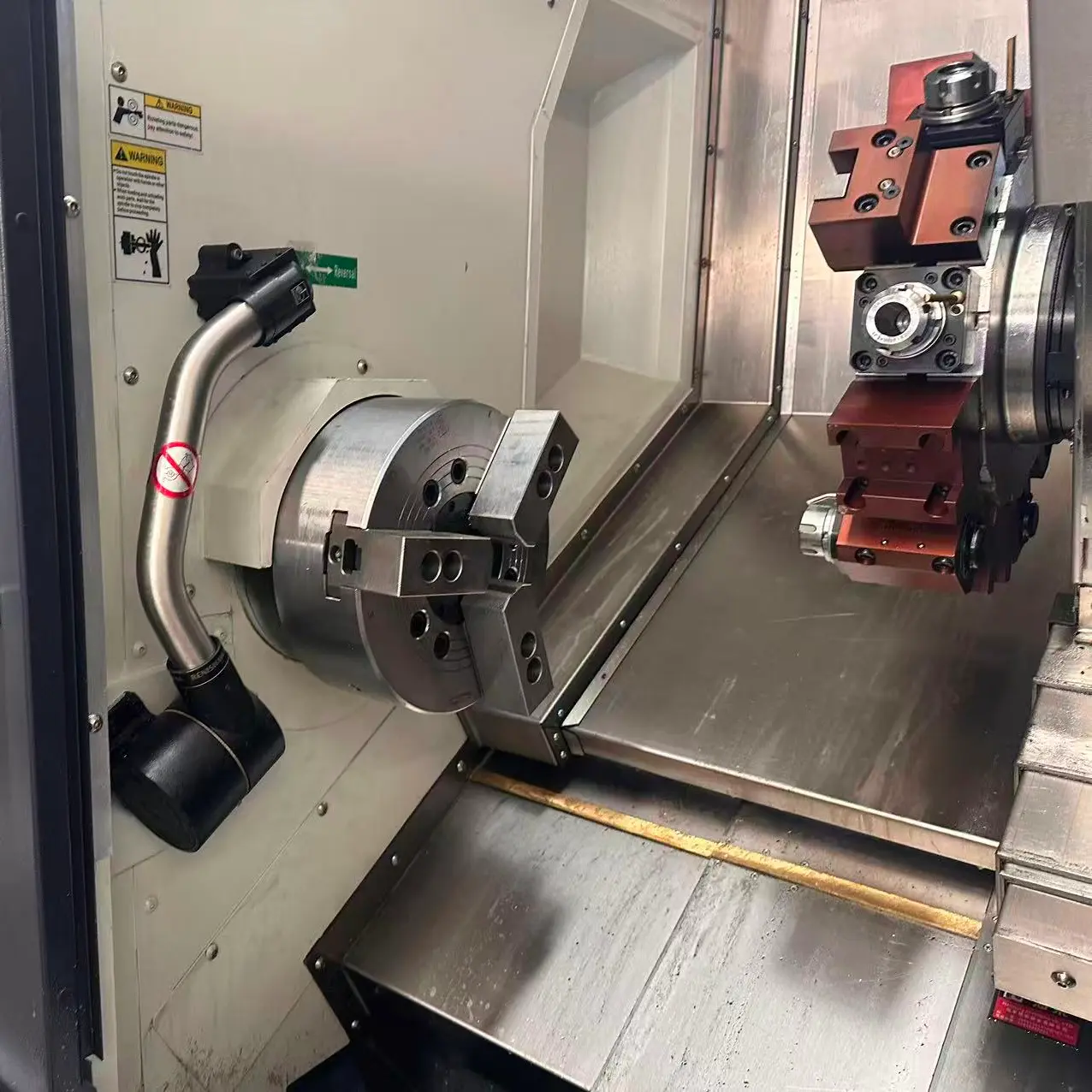
Slant Bed CNC Lathe Machine Price and What Drives It
| Lớp | Phạm vi hoạt động thông thường hoặc công suất | Ví dụ về điều khiển hoặc nguồn | Giá FOB tham khảo (USD) |
|---|---|---|---|
| Entry 2-axis | Max turning diameter 250–320 mm, length 500 mm | GSK 980TDi or KND K2000Ti, 5.5–7.5 kW spindle | 28,000–38,000 |
| Mid-range 2-axis | Max turning diameter 360–400 mm, length 750–1000 mm | Syntec 22TA or Mitsubishi M80, 11–15 kW spindle | 42,000–58,000 |
| Mid-range with C-axis | Max turning diameter 400–500 mm, length 1000–1500 mm | FANUC 0i-TF or Siemens 828D, 15–18.5 kW spindle | 65,000–85,000 |
| Heavy-duty slant bed | Max turning diameter 630–800 mm, length 2000–3000 mm | FANUC 0i-TF Plus or Siemens 840D sl, 22–30 kW spindle | 95,000–140,000 |
| Twin-spindle / twin-turret | Max turning diameter 400–500 mm, bar capacity 65–102 mm | FANUC 31i-B or Siemens 840D sl, dual 15 kW spindles | 180,000–260,000 |
Prices assume standard 380V 50Hz supply, wooden crate export packing, and FOB Tianjin or Shanghai. They exclude optional live tooling, Y-axis, or parts catcher systems.
What Actually Drives The Price
A slant bed CNC lathe is not a commodity. Two machines with identical swing and between-centres dimensions can differ by 40–60 percent in FOB price because the cost stack is uneven and several items are single-source. The control system brand and the spindle/servo package are normally the two largest line items on the BOM, followed by the casting and guideway class.
Typical cost structure for a mid-range slant bed (400 mm swing, 1000 mm length, FANUC 0i-TF, linear guides):
| Yếu tố chi phí | Tỷ trọng FOB | Ghi chú |
|---|---|---|
| Casting / bed and saddle | 12–16% | HT300 resin sand casting, stress relieved; HT250 saves 8–10% but needs thicker sections |
| Linear guideways and ball screws | 10–14% | HIWIN or PMI 35/45 mm roller blocks, C3 or C5 ground screws; box-way machines shift cost to scraping labour |
| Bộ trục chính | 14–18% | A2-6 or A2-8 nose, built-in motor or belt drive; ceramic bearings add 3–5% |
| Hệ thống điều khiển và bộ servo | 22–28% | FANUC or Siemens dominate; GSK or KND cuts this to 10–12% |
| Tool turret | 8–12% | 8-station or 12-station servo turret; VDI40 or BMT55 interfaces |
| Hydraulic / lubrication / coolant | 4–6% | Centralised lubrication, chip conveyor, coolant pump |
| Electrical panel and ancillaries | 5–7% | Transformers, contactors, encoder cables |
| Assembly labour and scraping | 6–9% | Hand-scraping on box ways; linear guide machines need less |
| Factory testing and QA | 2–3% | Laser interferometer, ball bar, geometric accuracy report |
| Export packing and inland freight | 3–5% | Wooden crate, moisture barrier, fumigation, truck to port |
| Margin and overhead | 10–15% | Varies by builder volume and export channel |
Sea freight, insurance, duty and VAT are destination variables. A 6500 kg slant bed in a 40-foot container adds roughly 2,500–4,500 USD for CIF Southeast Asia or Middle East; 5,500–8,500 USD to East Africa or South America. Destination duty ranges from 5% (ASEAN FTA with Form E) to 15–25% for markets without preferential treatment. VAT or GST is typically 10–20% on CIF plus duty.
Why The Cheapest Quote Is Cheaper
Trading offices in coastal cities often quote machines they do not build. The price gap against a factory-direct machine with documented traceability usually comes from three substitutions:
Lighter or lower-grade casting. A 400 mm swing machine should carry roughly 4,500–5,500 kg net weight with HT300 bed and saddle. HT250 castings at 3,800–4,200 kg save material and machining time but reduce damping capacity and thermal stability. The machine will chatter on interrupted cuts and hold size poorly across shift changes.
Unbranded or downgraded motion components. C7 rolled ball screws instead of C5 ground; generic linear blocks without preload adjustment; or box ways with minimal turkite/flake application and no hand scraping. Positioning accuracy drifts from ±0.005 mm to ±0.015 mm within 12 months.
Control and servo substitution. A “FANUC-compatible” or “FANUC-level” control is not FANUC. GSK 980TDi at 1,800 USD versus FANUC 0i-TF at 8,500–11,000 USD is a real choice for simple shaft work, but the servo loop gain, rigid tapping synchronisation, and parts program portability are different machines. Siemens 828D sits between them at 5,500–7,000 USD with good availability in Eastern Europe and Middle East markets.
Danh sách kiểm tra tiêu chuẩn nhà cung cấp
Machine shop owners evaluating a “best slant bed CNC lathe supplier” should verify the builder rather than the broker. Request documentation on the following:
Foundry or casting source. Own foundry with resin sand lines and annealing ovens is ideal; at minimum, a long-term contract foundry with HT300 certification and batch traceability. Ask for a mill certificate from the casting batch used on your machine.
Assembly floor and scraping records. Photos or video of the bed-saddle scraping process; blue-check contact pattern should exceed 12 points per 25 mm × 25 mm on box way machines. Linear guide machines need less scraping but still require precision grinding and alignment.
Metrology equipment and records. Laser interferometer (Renishaw XL-80 or equivalent) for positioning accuracy and repeatability; ball bar test for circular interpolation. Ask for the actual report with your machine serial number, not a generic template.
Factory acceptance test (FAT). Witness or remote-witness test cutting: test bar cylindricity, surface finish, and chip-to-chip time on representative parts. A 400 mm swing lathe should hold 0.01 mm cylindricity over 300 mm on a test bar.
Payment structure. 30% T/T advance, 70% against copy of B/L is standard for first orders. Demands for 50% advance or 100% before shipment without FAT access are red flags. Letter of credit adds 800–1,500 USD bank charges but protects both parties.
After-sales engineering capability. Stocked spare parts within your region; video or on-site support commitment with response time in the contract; not just a WeChat group. Ask for the service engineer’s CNC control certification (FANUC or Siemens training completion).
So sánh chi phí vận hành trong 5 năm
| Loại chi phí | Entry Class (GSK, HT250, generic guides) | Mid-Range (FANUC 0i-TF, HT300, HIWIN) |
|---|---|---|
| Annual power consumption (2-shift operation) | 18,000–22,000 kWh at 0.10 USD/kWh = 1,800–2,200 USD | 16,000–19,000 kWh at 0.10 USD/kWh = 1,600–1,900 USD |
| Insert and tooling cost (carbide, coated) | 3,500–4,500 USD/year | 3,200–4,000 USD/year (better surface finish reduces rework) |
| Ball screw / guide replacement (year 3–5) | 2,500–3,500 USD (earlier wear) | 4,000–5,500 USD (longer interval, higher quality parts) |
| Control or servo repair | 1,200–2,500 USD (limited local support) | 800–1,500 USD (dealer network, stocked drives) |
| Unplanned downtime (estimated hours/year) | 45–70 hours | 15–30 hours |
| Five-year total (excluding labour) | 42,000–55,000 USD | 38,000–48,000 USD |
The mid-range machine carries a higher acquisition cost but typically returns the gap through reduced downtime and lower energy draw from efficient servo systems. The entry-class machine is viable for low-utilisation job shops or markets with limited parts availability, provided the buyer budgets for earlier guideway maintenance and longer setup times.
Lead Time And Export Practicalities
Standard lead time from confirmed payment to FOB readiness is 45–65 days for a configured slant bed with FANUC or Siemens control. GSK or KND configurations ship in 30–40 days. Add 7–10 days for laser interferometer and ball bar documentation if witness testing is required.
Voltage and frequency. Chinese-built machines ship as 380V 50Hz three-phase. Buyers in 220V 60Hz territories (parts of North America, Philippines, South Korea) need a step-up transformer rated at 1.5× the machine kVA to handle inrush. Budget 1,200–2,800 USD for a 25–40 kVA transformer with enclosure.
Unloading and installation. A 5,500 kg slant bed requires a forklift with 6-tonne capacity or an overhead crane with 8-tonne safe working load for unloading from container flatbed. Foundation bolts and levelling pads are standard; anti-vibration mounts add 400–700 USD. Levelling to 0.02 mm/m over the bed length is the installer’s responsibility and takes 1–2 days with proper instruments.
Spare parts for first year. Budget 800–1,500 USD for a recommended spares kit: turret index fingers, proximity switches, coolant pump seal, spindle belt, and control battery. These ship in the same container or air freighted separately.
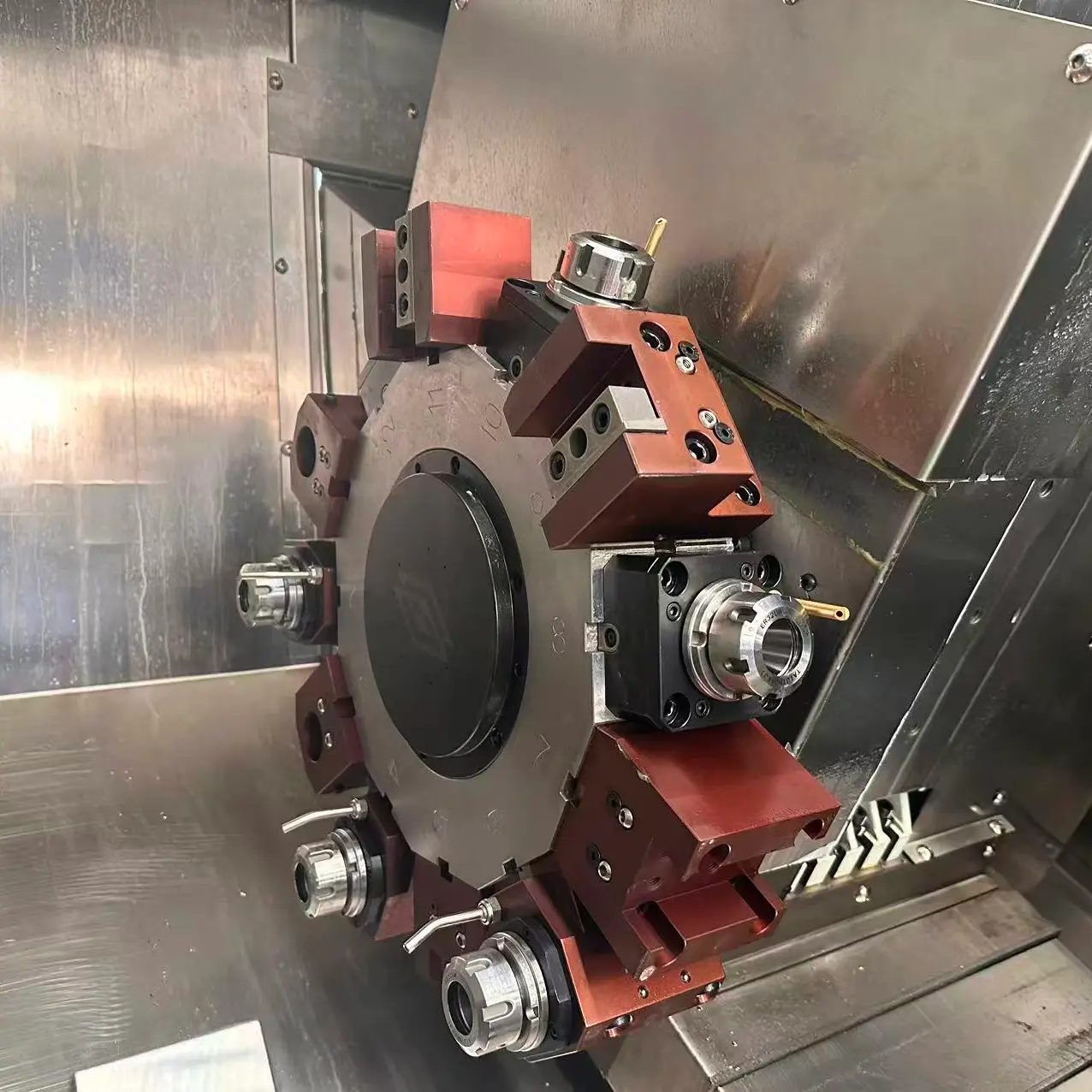
Industry Applications for Slant Bed CNC Lathe Machine
| Lĩnh vực | Các bộ phận tiêu biểu được sản xuất | Thông số kỹ thuật đề xuất | Tại sao chiếc máy này lại phù hợp |
|---|---|---|---|
| Phụ tùng ô tô và xe máy | Brake discs, wheel hubs, camshafts, connecting rods, fork tubes | 8″ hydraulic chuck, A2-6 spindle nose, 45 kW spindle (3500 rpm), X/Z travel 220/650 mm, positioning accuracy 0.008 mm, repeatability 0.004 mm | High-volume turning with C-axis live tooling for cross-drilling; rigid casting handles interrupted cuts on cast iron brake discs |
| Máy móc nông nghiệp | PTO shafts, gearbox housings, hydraulic cylinder rods, bearing seats | 10″ chuck, A2-8 spindle, 37 kW (2500 rpm), max turning diameter 500 mm, length 1000 mm, HT300 bed, 5500 kg machine weight | Heavy stock removal on forged blanks; slant bed geometry sheds chips from sandy castings common in agricultural supply chains |
| Phụ kiện thủy lực và khí nén | Cylinder bodies, valve spools, union nuts, banjo bolts, port connectors | 6″ collet-ready chuck, A2-5 nose, 22 kW (6000 rpm), C-axis, Y-axis (±50 mm), 12-station turret | Precision threading (BSP, NPT, metric) and angular port drilling in single setup; Y-axis corrects for tool pressure on small diameters |
| Khớp nối cho ngành dầu khí | Drill pipe tool joints, wellhead connectors, manifold blocks, stud bolts | 12″ chuck, A2-8, 55 kW (2000 rpm), 60° slant angle, 800 mm swing over bed, box ways on Z-axis, 8200 kg | Withstands 12-hour continuous runs on alloy steel; box way damping reduces chatter on deep boring of thick-walled couplings |
| Công nghệ khuôn mẫu | Core pins, ejector sleeves, gate inserts, circular cavity blocks | 8″ chuck, A2-6, 30 kW (4000 rpm), sub-spindle, bar feeder interface, 0.005 mm positioning accuracy, linear roller guides (HIWIN/PMI) | Sub-spindle enables complete machining of hardened pins up to 62 HRC after heat treat; linear guides maintain geometric stability for finish passes |
| Trung tâm Đào tạo Kỹ thuật | Curriculum workpieces: stepped shafts, tapered threads, grooved pulleys, test specimens | 6″ chuck, A2-5, 15 kW (3500 rpm), FANUC 0i-TF or GSK 980TDi, 1500 kg machine weight, 220V 60Hz option | Compact footprint (2.1 m × 1.4 m) fits classroom rows; control commonality with local industry; transparent guarding for demonstration |
Automotive And Motorcycle Parts
Automotive suppliers running brake disc lots of 500+ pieces per shift need thermal stability more than raw power. A 45 kW spindle at 3500 rpm with A2-6 nose and 8″ chuck matches cast iron disc diameters to 320 mm. The slant bed’s 45° or 60° angle directs cast iron dust away from the guideways, reducing scrape frequency. C-axis live tooling at 4000 rpm on turret stations eliminates second-operation drilling on hub bolt circles. Positioning accuracy of 0.008 mm keeps disc run-out within 0.015 mm TIR for ABS tone ring compatibility. Machine weight here runs 4200–4800 kg on a 2.8 m × 1.6 m footprint; rapid traverse of 20 m/min on X and 24 m/min on Z keeps cycle times competitive with Korean-built alternatives at 40% higher price points.
Máy móc nông nghiệp
Forged PTO shaft blanks from 1045 or 4140 arrive with 3–5 mm decarburized skin. The 10″ chuck and A2-8 spindle nose on a 500 mm swing machine with 37 kW at 2500 rpm can take 6 mm depth-of-cut passes at 0.4 mm/rev feed without stall. HT300 casting with resin sand moulding and stress relief annealing is the minimum grade; Meehanite-equivalent castings add 15% cost but reduce bed twist variation across seasonal temperature swings in unheated Middle Eastern or African workshops. Box ways on Z-axis outperform linear guides here because grit contamination from incoming castings is inevitable. A 5500 kg machine ships in a 40 HQ container with one other lathe or standalone; foundation bolts at 150 mm depth with M20 anchors.
Hydraulic And Pneumatic Fittings
Cylinder bodies in batches under 200 pieces demand changeover speed. The collet-ready 6″ chuck with A2-5 nose and 22 kW at 6000 rpm suits bar stock to 65 mm diameter. C-axis interpolation at 0.001° resolution machines helical ports and angular flats without fixturing. Y-axis travel of ±50 mm corrects tool deflection when boring small ID threads at L/D ratios above 4:1. Twelve-station turrets with driven tools at 4500 rpm handle M16×1.5 and 9/16-18 UNF threads in-cycle. GSK 980TDi or KND K2000TFi controls dominate this segment in Southeast Asian job shops; FANUC 0i-TF adds $3200–$4800 but simplifies operator recruitment in markets where FANUC training is standard.
Oil And Gas Couplings
Drill pipe tool joints in API spec 7-1 require 60° included thread angles with 0.03 mm pitch cumulative error across 150 mm engagement length. The 12″ chuck, A2-8 nose, and 55 kW at 2000 rpm on an 800 mm swing machine with 60° slant bed places the operator above the cutting zone for manual thread inspection. Box ways on Z-axis with Turcite-B coating and hand-scraped contact points of 8–10 points per 25 mm×25 mm maintain straightness over 10-year lifespans. Machine weight of 8200 kg demands a 5-tonne forklift or overhead crane for unloading; container loading requires flat-rack or breakbulk for machines above 7500 kg. Payment structures in this sector typically run 30% T/T advance, 70% against copy of B/L; letters of credit add 2.5–4% bank charges and 10–14 days to lead time.
Mould And Die Work
Core pins for plastic injection moulds finish at 62 HRC after rough turning in annealed state. Sub-spindle synchronization at ±0.5 rpm allows handoff turning without rechucking, holding 0.01 mm concentricity on 150 mm length pins. Linear roller guides (HIWIN HG series or PMI MSA series) with 0.005 mm positioning accuracy maintain geometric stability for 0.2 mm finish passes on hardened surfaces using CBN or ceramic inserts. Bar feeder interfaces for 3 m lengths reduce manual loading on pin lots of 50–100 pieces. Lead time for sub-spindle configurations runs 55–70 days versus 35–45 days for single-spindle machines; the sub-spindle adds 18–22% to base machine cost.
Trung tâm Đào tạo Kỹ thuật
Classroom layouts in technical schools from Nigeria to Peru constrain machine width to 1.5 m and length to 2.5 m. The 6″ chuck, A2-5 nose, and 15 kW at 3500 rpm on a 1500 kg machine with 2.1 m × 1.4 m footprint fits two machines per 20-foot container. Voltage flexibility matters: 380V 50Hz is Chinese standard, but 220V 60Hz regions (Philippines, parts of South America) need $800–$1200 motor reconnections or step-up transformers. FANUC 0i-TF controls align with employer expectations in Eastern European and North American markets; GSK 980TDi dominates where local service infrastructure is GSK-trained. Transparent polycarbonate guarding with interlocked doors satisfies CE machinery directive requirements for educational environments; documentation package includes electrical schematics in English, operation manual, and parameter backup USB.
Hướng dẫn từng bước về đặt hàng và nhập khẩu
Three mistakes leave a slant bed CNC lathe idle after delivery more often than mechanical failure. Each has a one-line fix.
Voltage or frequency mismatch. A 380V 50Hz machine on a 220V 60Hz shop floor fries the chiller, spindle drive and fan motors. Fix: Confirm supply voltage, frequency and phase with the builder before deposit; budget for a step-up/step-down transformer plus frequency converter if needed.
Working range too small for the actual part. A 500 mm max turning diameter looks generous until a 520 mm forged flange arrives. Fix: Model your largest existing and forecast part in CAD, add 15% clearance for chuck jaws and tool overhang, then match swing over bed, max turning diameter and Z-axis travel to that number.
No electrical schematic, parameter backup or local consumable source. One blown fuse or worn proximity switch stalls production for weeks. Fix: Demand native-language electrical and hydraulic schematics, a complete parameter backup on USB, and a written list of local equivalents for fuses, relays, solenoids and tool holder bolts.
Defining Workpiece Envelope and Tolerance
Start with the part, not the catalogue. A slant bed CNC lathe in the 8-inch to 12-inch chuck class typically offers 400 mm to 660 mm swing over bed, 220 mm to 400 mm max turning diameter, and Z-axis travel from 500 mm to 1500 mm. Match these to your actual mix:
| Tham số | Typical Range for Mid-Size Slant Bed | What to Verify |
|---|---|---|
| Xích đu treo trên giường | 400–660 mm | Largest diameter with chuck jaws fully extended |
| Max turning diameter | 220–400 mm | Part diameter plus tool clearance |
| Hành trình trục Z | 500–1500 mm | Longest shaft plus face driver or tailstock |
| Hành trình trục X | 200–300 mm | Depth of groove or largest radial cut |
| Lỗ trục chính | 65–105 mm | Bar capacity if running bar feed |
| Công suất trục chính | 7.5–22 kW | Continuous duty at your heaviest cut |
| Tốc độ trục chính | 3500–6000 rpm | Aluminum vs cast iron sweet spot |
| Độ chính xác định vị | ±0.005 mm | Needed for IT7 tolerance bands |
| Độ lặp lại | ±0,003 mm | Process capability for batch work |
State your worst-case part in the RFQ: material, max diameter, max length, tolerance class, surface finish Ra requirement, and annual volume. A builder with an assembly floor will ask about chip breaking on Inconel versus mild steel; a trading office will forward your email unchanged.
Choosing Control System and Service Path
The control dictates who can service the machine in five years.
| Kiểm soát | Common on Slant Bed Lathes | Các yếu tố cần xem xét về dịch vụ |
|---|---|---|
| FANUC 0i-TF / 0i-TF Plus | Premium tier, global parts network | Higher hardware cost; local FANUC technician likely available in major markets |
| Siemens 828D / 840D sl | European and training centre preference | Requires Siemens-certified engineer; software options add cost |
| Mitsubishi M80 | Strong in Southeast Asia | Good availability in ASEAN; verify local stock of servo amplifiers |
| GSK 980TDi / 988T | Chinese domestic standard, lowest cost | GSK has direct service in 30+ countries; elsewhere, rely on builder’s engineer |
| KND K2000TF / K1000TF | Cost-focused, improving trajectory | Check whether your builder stocks KND servo motors and drives |
| Syntec 22TA / 220TB | Taiwanese origin, flexible macro syntax | Popular in job shops; confirm firmware update path |
Ask the builder: “Who performed the last control swap or spindle drive replacement in my country, and when?” A real builder names the engineer and the date. A trading office deflects.
Confirming Electrical Supply and Transformer Need
Slant bed CNC lathes from Chinese builders ship wired for three-phase 380V 50Hz. North American shops often run 208V or 480V 60Hz. The mismatch affects:
- Spindle motor: 50Hz motor on 60Hz overspeeds 20% if voltage is not stepped proportionally
- Coolant pump: Impeller curves shift; flow drops or motor overheats
- Chiller unit: Refrigeration compressor locked to frequency
- Control transformer: Secondary voltages drift
Request the builder’s electrical schematic during quotation. Calculate transformer KVA: sum spindle motor (15 kW typical), servo axes (3 kW), coolant pump (0.75 kW), chip conveyor (0.5 kW), lighting and fan loads, then apply 1.25 safety factor. A 22 kVA three-phase transformer with taps for ±5% adjustment covers most mid-size machines. Budget $800–$2,500 depending on local electrical codes.
Floor Loading Foundation and Floor Space
A slant bed CNC lathe with 10-inch chuck and 1000 mm Z travel weighs 3,500 kg to 5,500 kg with chip conveyor and coolant tank. Floor loading at each foot: 8,000–12,000 kg/m² if the machine stands on four pad feet. Standard industrial concrete (200 mm thick, 25 MPa) handles this; mezzanine or upper floors require structural engineer sign-off.
Floor space required: machine footprint 3,500 mm × 2,000 mm, plus 1,000 mm operator access on front and left, 800 mm rear clearance for electrical cabinet ventilation, and chip bin pull-out space. Total: roughly 6,000 mm × 3,500 mm. Ceiling height: 3,200 mm minimum for overhead crane hook access.
Specify foundation bolts or anti-vibration pads. A machine on uneven concrete twists the bed over months; precision disappears before the first annual service.
Dấu chứng nhận tuân thủ để làm thủ tục hải quan
CE marking is standard for European destinations. For other markets, clarify who prepares the technical file:
- CE: Builder provides Declaration of Conformity, risk assessment, electrical safety per EN 60204-1, electromagnetic compatibility per EN 61000-6-2 and EN 61000-6-4. Verify the notified body number if required by your importer of record.
- EAC: Required for Russia, Kazakhstan, Belarus. Most Chinese builders use a third-party certifier in Shanghai or Beijing; add 3–4 weeks and $1,500–$3,000.
- SONCAP: Nigeria. Pre-shipment verification mandatory.
- SABER: Saudi Arabia. Product and shipment certificates of conformity.
- None specified: Customs may still demand a certificate of origin and commercial invoice with HS code 8458.11.
Request the conformity document list before deposit payment. A real builder has templates. A trading office copies boilerplate from the internet.
Comparing FOB Versus CIF
| Thuật ngữ | What You Pay | What Builder Pays | Risk Transfer | Best For |
|---|---|---|---|---|
| FOB Chinese port | Ocean freight, insurance, unloading, customs, inland delivery | Factory to port, export clearance, port handling | On ship’s rail at origin port | Buyers with freight forwarder relationships, container consolidation plans |
| CIF destination port | Customs, unloading, inland delivery | All of above plus ocean freight and marine insurance | On ship’s rail at destination port | First-time importers, single-machine shipments, buyers in ports with limited forwarder choice |
CIF adds 8–15% to FOB price for a single 40-foot container to Southeast Asia or Middle East, 18–25% to East Africa or South America Atlantic coast. Ask for the actual freight quote breakdown; some builders mark up CIF heavily.
Loại container và giới hạn trọng lượng máy móc
A slant bed CNC lathe with 12-inch chuck and full enclosure exceeds the 20-foot flat rack payload? No—most fit in a 40-foot high cube container (12.032 m × 2.352 m × 2.698 m internal). Weight limits:
- Container gross maximum: 30,480 kg (standard), 32,500 kg (high cube with reinforced floor)
- Typical machine net weight: 4,000–6,500 kg
- With crate, coolant, tooling box: 5,500–8,500 kg
- Remaining payload for accessories: 22,000–25,000 kg
Machines over 7,000 kg net weight or 2.4 m width (enclosed with chip conveyor) may require flat rack or open-top container. This doubles ocean freight and requires port crane at both ends. Confirm during quotation.
Deposit and Balance Payment Structure
Standard terms for first-time buyers:
- 30% deposit on signed proforma invoice and technical specification confirmation. Builder releases material and begins casting or bed machining.
- 60% before shipment after factory acceptance test (FAT) and submission of packing list, bill of lading draft, and conformity documents.
- 10% after successful installation, commissioning, and operator training at your facility, or 60 days after arrival if installation is buyer-managed.
Negotiate a 5% or 10% retention held in escrow if the builder has no in-country service engineer. For repeat buyers with established history, 20/70/10 is achievable.
Never pay 100% before FAT. A real builder finances production through deposit and progress payments. A trading office may demand full prepayment because they lack capital to float the factory.
Factory Acceptance Test Before Balance Payment
The FAT is your only chance to reject before the machine crosses an ocean. Attend in person or commission a third-party inspector (SGS, Bureau Veritas, local metrology institute).
Minimum FAT checklist:
- Geometric accuracy: Laser interferometer on X and Z axes, positioning accuracy and repeatability per ISO 230-2. Demand the printout with serial number, date, and technician signature. Typical target: positioning ±0.005 mm, repeatability ±0.003 mm on a 500 mm travel machine with linear roller guides.
- Ball bar test: Circular interpolation at 1,000 mm/min, 150 mm radius. Roundness error under 0.015 mm for a mid-tier machine.
- Spindle runout: Test bar 300 mm from chuck face, 0.005 mm TIR maximum.
- Tailstock alignment: Dead center to spindle centerline, 0.01 mm over 300 mm.
- Cutting test: Your material, your tooling, your programmed cycle. Measure 50 consecutive parts for Cpk.
- Electrical: All voltages at terminal block, emergency stop response time under 500 ms, door interlock function.
Refuse to release balance without signed FAT protocol. A real builder has a climate-controlled inspection room with granite surface plate and laser equipment. A trading office rents a hotel conference room for “inspection.”
Thiết bị dỡ hàng tại điểm đến
Container delivery to your door does not include unloading. Plan for:
- Forklift capacity: 2.5× machine gross weight. A 6,000 kg machine requires 15,000 kg rated forklift with long forks or fork extensions.
- Overhead crane: If machine ships on a rigid base or skid, crane capacity 1.5× gross weight with certified lifting slings.
- Ramps or dock height: Container floor is 1,200 mm above ground. Machine on castors or machine skate requires steel ramp rated for point load.
- Rigging: Builder provides lifting eye locations on the casting. Use these; do not sling around sheet metal enclosures.
Request lifting diagram and center of gravity marking before shipment. A real builder includes this in the packing manual.
Lắp đặt và Đào tạo nhân viên vận hành
Builder’s engineer or authorized agent should provide:
- Leveling: Precision level (0.02 mm/m) on machined reference surfaces; adjust anti-vibration pads or grout until bed twist is under 0.04 mm over full length.
- Anchor: Foundation bolts torqued to specification; wait 48 hours after grouting before final level check.
- Power connection: Verify transformer tap settings, phase rotation, earth continuity under 0.1 ohm.
- Alignment: Re-verify spindle-to-tailstock, turret-to-spindle center height, tool changer arm or gang tool alignment if equipped.
- Test cut: Repeat FAT cutting test with local coolant and local power.
- Training: 3–5 days, two operators minimum. Cover program transfer (USB, Ethernet, RS-232), tool offset and wear offset, work coordinate systems, alarm diagnosis, daily lubrication points, and chip conveyor clearing.
Demand training completion certificate with operator names and date. This becomes warranty evidence.
Gói phụ tùng và vật tư tiêu hao ban đầu
Order with the machine, not after a breakdown at month three.
| Danh mục | Các mặt hàng | Số lượng thông thường |
|---|---|---|
| Điện | Control fuses, servo motor encoder cables, proximity switches, contactor coils, relay bases | 2 each of common ratings |
| Pneumatic | Solenoid valve rebuild kits, air filter elements, regulator diaphragms | 1 set |
| Thủy lực | Filter elements (10 micron return, 25 micron pressure), pump shaft seal, pressure switch | 2 filters, 1 seal kit |
| Cơ khí | Turret index dogs, tool holder clamping bolts, chuck jaw soft blanks, tailstock quill seal | Per chuck size |
| Vật tư tiêu hao | Way lubricant (ISO VG 68), hydraulic oil (ISO VG 46), coolant concentrate, spindle belt | 20L lubricant, 200L coolant, 1 belt |
| Tài liệu hướng dẫn | Electrical schematic (paper and PDF), ladder logic, parameter backup, PLC program backup, operation manual, parts manual | 1 set each |
Confirm voltage ratings on all electrical spares match your transformed supply. A 220V coil contactor on a 380V system fails immediately.
Ordered Checklist for Import
- Define largest part diameter, length, weight, material, tolerance class, and annual volume; add 15% margin to all envelope dimensions.
- Select control system based on local service availability, not brochure features alone.
- Request builder’s electrical schematic; calculate transformer KVA and confirm frequency compatibility.
- Verify floor loading capacity and total floor space including operator access and chip clearance.
- Confirm required conformity marking for destination customs; request document list and timeline.
- Compare FOB and CIF quotes with actual freight breakdown; select container type based on machine gross weight and dimensions.
- Negotiate payment terms with FAT-linked balance release; never 100% prepayment.
- Attend or commission FAT with laser interferometer and ball bar records tied to machine serial number.
- Arrange unloading equipment: forklift or crane capacity, slings, ramps, lifting diagram.
- Schedule installation and training; demand signed completion protocol.
- Order initial spare parts and consumables package with machine; verify voltage ratings.
Các máy móc liên quan của RUNNEWTECH

Máy tiện CNC giường nghiêng
Factory direct slant bed cnc lathe with FANUC, Siemens, Mitsubishi, GSK or Syntec control options and 380V/50Hz or 220V/60Hz supply for export.

Máy tiện CNC
Trực tiếp từ nhà máy máy tiện CNC với các tùy chọn hệ thống điều khiển của FANUC, Siemens, Mitsubishi, GSK hoặc Syntec và nguồn điện 380V/50Hz hoặc 220V/60Hz dành cho xuất khẩu.
Frequently Asked Questions About Slant Bed CNC Lathe Machine
Minimum Order Quantity And Sample Policy
Q: What is your minimum order quantity for a slant bed CNC lathe, and can I order a single machine for evaluation?
One machine is the practical MOQ. RUNNEWTECH ships single units to end users regularly. For dealers seeking exclusive territory, a 3-5 unit opening order with annual volume commitments unlocks tiered pricing and localized spare parts stocking. Sample machines ship from existing production; no separate sample line exists.
Control Systems Interface Languages And Documentation
Q: Which CNC controls do you offer, and can the interface match my operators’ language?
FANUC 0i-TF Plus, Siemens 828D, Mitsubishi M80, GSK 980TDi, KND K2000TF, and Syntec 22TA are standard options. All include English. Russian, Spanish, Arabic, Turkish, and Vietnamese are factory-loaded on request. Technical manuals and electrical schematics ship in the same language. Fanuc and Siemens carry 15-20% control premium over GSK or KND.
Lead Time And Production Scheduling
Q: What is the lead time from deposit to factory readiness?
Standard slant bed lathes with A2-6 spindle, 8-inch hydraulic chuck, and GSK control: 25-30 days. FANUC or Siemens configurations add 10-15 days for control import and parameter adaptation. Peak season (March-June) extends this by 7-10 days. Critical-path item is casting aging; RUNNEWTECH holds 45-day minimum stress-relief stock on HT300 beds.
Payment Terms And Transaction Structure
Q: What are your payment terms, and how is the deposit structured?
30% T/T deposit to confirm production, 70% before shipment against copy of B/L. Irrevocable L/C at sight accepted for orders above $80,000 with 2.5% L/C surcharge. No OA terms for first orders. Deposit covers casting procurement and control system acquisition; cancellation after casting forfeits 15% of contract value.
Power Supply Adaptation And Electrical Preparation
Q: My shop runs 220V 60Hz or 415V 50Hz. Can you adapt the machine?
Standard build is 380V 50Hz three-phase. For 220V 60Hz (North America, parts of Southeast Asia) or 415V 50Hz (India, Africa), RUNNEWTECH fits a step-up/step-down transformer inside the electrical cabinet or ships an external unit. Specify at order; retrofit in field costs 40% more and voids warranty on electrical components. Transformer adds 80-120 kg to shipping weight.
Shipping Method Container Loading And Transit
Q: How do you ship, what container type, and what is door-to-door transit time?
Machines under 3500 kg ship 20-foot FCL; larger models or multiple units use 40-foot HQ. A CK6150-class slant bed (500 mm swing, 1500 mm between centers, 3200 kg net) fits one per 20-foot container with control cabinet and tooling crate lashed alongside. FOB Qingdao to Port Jebel Ali: 18-22 days; to Santos: 32-38 days; to Mombasa: 22-26 days. CIF available; DDP requires local agent coordination.
Warranty Spare Parts And After-Sales Engineering
Q: What warranty do you provide, and can your engineer reach my factory if the local dealer cannot solve the problem?
12 months from B/L date on mechanical and electrical components, 6 months on consumables. Spare parts kit ships with machine: limit switches, proximity sensors, fuses, encoder cable, hydraulic seals, and chuck jaw soft blanks. RUNNEWTECH maintains three regional service engineers for Southeast Asia, Middle East, and Africa; visa-ready deployment within 72 hours of video-diagnosed failure. Remote PLC and parameter access via Ethernet for FANUC and Siemens builds.
Factory Acceptance Test Accuracy Documentation And CE Compliance
Q: Do you provide a factory acceptance test, geometric accuracy report, and CE documentation for customs clearance?
Yes. Every machine runs a 48-hour FAT including: laser interferometer verification of positioning accuracy (±0.008 mm) and repeatability (±0.003 mm), ball bar circularity test, and spindle runout check. Geometric accuracy report per ISO 13041 or JIS B 6334 ships with the machine. CE Declaration of Conformity, EC Machinery Directive 2006/42/EC technical file, and harmonized standard compliance list provided for customs. Non-CE markets receive Certificate of Origin and China export license copy.
Thông báo quan trọng
Các thông số kỹ thuật, số liệu về độ chính xác và mức giá trong hướng dẫn này chỉ mang tính tham khảo và được cung cấp nhằm phục vụ công tác lập kế hoạch
chỉ dành cho mục đích này. Phạm vi hoạt động thực tế, dung sai có thể đạt được, tính sẵn sàng của hệ thống điều khiển, yêu cầu về điện áp nguồn và sự tuân thủ
Các thông số kỹ thuật khác nhau tùy theo mẫu máy và quốc gia nhập khẩu. Người mua phải tự xác nhận điện áp và tần số nguồn điện, tải trọng sàn và
nền móng, thiết bị dỡ hàng và các yêu cầu nhập khẩu trước khi đặt hàng. Tất cả các con số đều phải được xác nhận bằng văn bản trong
hóa đơn tạm tính cuối cùng do RUNNEWTECH phát hành.
Sourcing Slant Bed CNC Lathe Machine from RUNNEWTECH
A slant bed CNC lathe is a long-term capital decision. The gap between a machine that holds ±0.005 mm repeatability after five years and one that drifts in eighteen months is not visible in a brochure photograph. It is built into the casting grade, the scraping of the guideway mating surfaces, the preload on the ballscrew support bearings, and the documentation that proves each step was verified before the machine left the factory.
What RUNNEWTECH Builds In-House
Runlongjia Machinery, founded in 2010, operates its own casting supply chain and full assembly floors for slant bed CNC lathes. Machines are built on HT300 resin sand castings with stress relief treatment. Assembly includes hand-scraping of critical mating surfaces. Each slant bed CNC lathe undergoes run-in testing and factory acceptance testing with documented geometric accuracy reports. Laser interferometer and ball bar records are available for buyer review before packing.
Control and Power Adaptation
RUNNEWTECH slant bed CNC lathes are offered with FANUC, Siemens, Mitsubishi, GSK, KND, or Syntec controls. Electrical systems are adapted to the buyer’s supply voltage and frequency—380V 50Hz or 220V 60Hz with transformer as required. Spindle configurations include A2-5, A2-6, and A2-8 tapers with power from 7.5 kW to 15 kW and speeds to 4,000 rpm. Rapid traverse rates reach 24 m/min on X and Z axes. Positioning accuracy is held to 0.010 mm with repeatability of 0.005 mm on machines equipped with linear roller guides.
Export Packaging and Terms
Machines are packed in plywood cases with VCI rust protection. Loading into containers accounts for machine weight—typically 3,500 kg to 6,000 kg for slant bed models in the 300 mm to 500 mm swing range. Quotes are provided FOB or CIF. Foundation drawings, levelling specifications, and crane capacity requirements (minimum 5-ton lifting for mid-size machines) are supplied with the proforma invoice.
After-Sales Engineering Support
RUNNEWTECH provides installation guidance, operator training material, remote commissioning support, and spare parts inventory for critical components—spindle bearings, turret encoders, ballscrews, and control system modules. This is supported by application engineers, not a general sales desk.
Request a Specification Review
Send your workpiece material, maximum part diameter and length, required tolerance, annual volume, and destination port to receive a quotation within 24 hours via email or the contact form at runnewtech.com. Include any existing machine model you are replacing and the control system your operators prefer.
Get a Factory Direct Quote on Slant Bed Cnc Lathe Machine
RUNNEWTECH đã sản xuất máy móc gia công kim loại từ năm 2010,
với hơn 15 năm kinh nghiệm xuất khẩu. Các máy móc được cung cấp kèm theo hệ thống điều khiển theo sự lựa chọn của quý khách, phù hợp với nguồn điện của quý khách
điện áp và tần số, đã qua thử nghiệm chạy thử và thử nghiệm nghiệm thu tại nhà máy trước khi đóng gói. Vui lòng cung cấp cho chúng tôi thông tin về vật liệu phôi, kích thước tối đa của chi tiết,
Vui lòng cung cấp thông số dung sai và cảng đích, chúng tôi sẽ gửi báo giá trong vòng 24 giờ.

 English
  Indonesian
  Vietnamese
  Arabic
  Russian
  Spanish