
Hướng dẫn mua máy cắt laser CNC
The right wholesale Máy cắt laser CNC from China depends on your actual cut volume, material mix, and whether you are buying from a builder with a factory floor or from a trading office with a website. For a 3015 format single-platform machine with a 3 kW Raycus or MAX fiber source and Raytools BM110 head, expect FOB Qingdao in the range of USD 28,000–38,000; a 6 kW IPG source with Precitec Procutter and exchange-table 4020 format pushes to USD 55,000–72,000; 12 kW and above with full enclosure, dust collector, and automatic nozzle changer run USD 95,000–140,000. Lead time from deposit to ready-for-inspection is 25–35 days for standard configurations, 45–55 days for high-power or custom table sizes.
This page covers how to qualify the supplier behind those numbers. The rest of this section walks through physical factory verification, documented accuracy testing, payment structures that protect both parties, and after-sales engineering capability that determines whether your machine keeps cutting or sits waiting for a technician who never arrives.
Verify Physical Manufacturing Assets
A trading office can source components; only a builder controls quality at origin. Ask for video or visit to confirm:
- Casting source. The laser gantry base and side beams should be resin sand castings, HT250 or HT300 grade, stress relieved. A trading company will show you catalog photos. A builder shows you rough castings in the yard, machining centers boring the bearing seats, and scraping of mounting surfaces to 0.02 mm/m flatness
- Gantry machining. The crossbeam for a 3015 machine is roughly 4,200 mm long and 450 mm tall; it needs a floor-type boring mill or gantry machining center to maintain straightness. Ask for the machine tool model in their own shop
- Assembly floor. Look for jigs locating the linear guide mounting surfaces (HIWIN or PMI HGW series, 30 mm or 35 mm rail), ball screw preload fixtures, and gantry alignment stations. A 4020 machine with 6 kW source weighs 8,500–11,000 kg; you need overhead cranes rated 10-ton minimum to handle frames safely
Demand Documented Geometric Accuracy
Every builder claims ±0.03 mm positioning. Few produce the paper trail. Require these before final payment:
| Test | Tiêu chuẩn | Acceptable Result |
|---|---|---|
| Linear positioning accuracy | ISO 230-2 | ±0.05 mm over 1,000 mm travel |
| Độ lặp lại | ISO 230-2 | ±0.03 mm |
| Diagonal displacement error | ISO 230-4 | 0.08 mm over 3,000 mm × 1,500 mm diagonal |
| Cutting geometry | Actual sample | 1 mm stainless squareness ≤0.1 mm; 6 mm mild steel dross height ≤0.3 mm |
The builder should have a laser interferometer (Renishaw XL-80 or equivalent) and ball bar (QC20-W) on site. Ask for the last six months of test reports, not a single golden sample. Check dates and serial numbers match machines in production.
Factory Acceptance Test Structure
Structure payment to force compliance. Typical terms for a USD 50,000 machine:
- 30% T/T deposit on PO with signed technical specification
- 60% on FAT pass after you or your agent witness cutting tests on your actual material thickness
- 10% after installation and 72-hour continuous run at your facility
For first-time relationships, use an escrow or letter of credit. A trading office often demands 100% before shipping; a real builder accepts FAT-linked terms because they know their machine will pass.
After-Sales Engineering Capability
Laser downtime costs more than the machine. Verify:
- Spare parts stock. Fiber source modules, cutting head lenses and ceramics, proportional valves, and servo motors should be in domestic stock, not ordered on demand. Ask for warehouse video with your serial-number range parts
- Service response. Written commitment for technician dispatch within 48 hours to Southeast Asia or Middle East, 72 hours to Africa or South America. Remote diagnostics via NC Ethernet or OPC UA
- Training depth. Not button-pushing. Parameter adjustment for 1 kW vs 6 kW on 4 mm aluminum, nozzle centering procedure, capacitive height calibration, and weekly maintenance schedule
Red Flags That Signal a Trading Office
- Cannot name their casting supplier or show rough castings with factory markings
- No laser interferometer on premises; “we use third party” without contact
- FAT is “optional” or costs extra
- Payment terms are 100% T/T before BL release with no inspection window
- Quoted lead time is 7–10 days for a 6 kW machine (physically impossible for proper assembly and test)
Voltage Export and Site Preparation
Standard Chinese build is 380V 50Hz three-phase. For 220V 60Hz regions (North America, parts of South America), the builder must install a step-up transformer or re-specify servo drives and chiller. Confirm:
- Chiller voltage matches your supply (S&A or Hanli chillers have 220V/60Hz variants)
- Dust collector motor rating and phase
- Machine net weight and floor loading: 3015 single table ≈ 3,500 kg/m² concentrated; exchange-table 4020 ≈ 6,500 kg. Foundation thickness 200 mm minimum with rebar mesh
Container loading: a 3015 machine fits in one 40HQ; a 4020 with exchange table and dust collector needs 40HQ plus 20GP or flat rack. Unloading requires 8-ton forklift or 10-ton overhead crane capacity at your dock.
Các loại và cấu hình của máy cắt laser CNC
| Loại hoặc Lớp | Phạm vi làm việc điển hình | Tùy chọn điều khiển | Phù hợp nhất với | Ghi chú |
|---|---|---|---|---|
| Entry-Level Single-Table Fiber Laser | 1500 × 3000 mm (3015) | GSK, KND, Syntec | Small job shops, training centres, first-time buyers | 1.5–3 kW Raycus source, 0.08 mm positioning accuracy, ~6500 kg net weight |
| Dual-Exchange-Table Fiber Laser | 1500 × 3000 mm to 2000 × 4000 mm (3015/4020) | Syntec, Mitsubishi, FANUC 0i-F | High-volume sheet metal shops, automotive Tier 2 suppliers | 3–6 kW Raycus/MAX/IPG, 0.05 mm repeatability, 12–18 m/min rapid traverse, 9000–12000 kg |
| Large-Format Gantry Fiber Laser | 2000 × 6000 mm to 2500 × 8000 mm (6020+) | FANUC, Siemens 828D | Shipbuilding, construction equipment, agricultural machinery frames | 6–12 kW IPG or MAX, segmented bed design, 0.06 mm/m geometric accuracy, requires foundation bolts |
| Tube and Sheet Combo Laser | Tube: Ø20–220 mm × 6000 mm; Sheet: 1500 × 3000 mm | Syntec, FANUC 0i-TF | Nhà sản xuất đồ nội thất, thiết bị thể dục và kết cấu thép | Chuck-based tube rotation ±360°, 0.1 mm tube cut accuracy, slower sheet cycle than dedicated flatbed |
| Precision Small-Format Laser | 600 × 600 mm to 1300 × 900 mm | KND, GSK, Mitsubishi M80 | Electronics, medical device subcontractors, precision instrument makers | 0.5–1.5 kW MAX/JPT source, 0.02 mm positioning accuracy, granite base option, 1500–2500 kg |
| High-Power Thick-Plate Laser | 2000 × 4000 mm to 2500 × 6000 mm | Siemens 840D sl, FANUC 31i-B | Heavy fabrication, mining equipment, defence subcontractors | 12–30 kW IPG or nLIGHT, oxygen/nitrogen cutting to 50 mm mild steel, thermal distortion management critical |
Entry-Level Single-Table Fiber Laser
This class represents the lowest barrier to entry for shops transitioning from plasma or turret punch. Buyers are typically small job shops in Southeast Asia or Africa with 380V 50Hz supply, or North American garage shops needing 220V 60Hz step-up transformers. The 1.5–3 kW Raycus source cuts 3 mm stainless at 1.2–1.8 m/min and 6 mm mild steel at 0.6–0.9 m/min with nitrogen assist. GSK or KND controls keep hardware costs down but limit macro programming and advanced nesting integration. The single table means 30–50% idle time during sheet loading, so daily output rarely exceeds 1.5 tonnes of processed steel. These machines ship in 20 GP containers (net weight ~6500 kg fits within 21.5 tonne limit) and do not require pit foundations—four-point levelling on 200 mm concrete suffices. What they cannot do: economical processing of aluminium over 4 mm, reflective copper or brass without frequent nozzle changes, or unattended night shifts due to manual loading.
Dual-Exchange-Table Fiber Laser
This is the workhorse configuration that dominates export volumes from Chinese builders. The exchange pallet system—typically driven by servo chain or rack-and-pinion—reduces non-cutting time to 15–25 seconds, enabling true continuous production. Syntec control is standard at 3–6 kW power levels; stepping to FANUC 0i-F adds roughly $8000–12000 but provides better servo loop tuning for 12–18 m/min rapid traverse without following error alarms. Mitsubishi M80 offers a middle path with strong PLC ladder access for custom automation. The 4020 format (2000 × 4000 mm) demands 40 HC container loading or flat-rack for oversize; machine weight 9000–12000 kg requires 10-tonne forklift or gantry crane at destination port. Geometric accuracy depends heavily on builder scraping practice: HIWIN or PMI linear guides on properly stress-relieved HT250 beds achieve 0.05 mm repeatability, while poorly sourced castings show 0.15 mm drift across a double shift. These machines cannot process tube stock without add-on chuck systems that compromise table access, and 6 kW sources struggle with 12 mm aluminium at production speeds.
Large-Format Gantry Fiber Laser
Shipbuilders and agricultural machinery makers buy this class for single-piece processing of side frames, booms, and hull sections. The gantry architecture—cross beam spanning 2500–3200 mm—separates motion mass from the workpiece, reducing thermal coupling compared to cantilever designs. Siemens 828D with Sinamics drives is preferred for multi-axis interpolation across segmented beds; FANUC 31i-B appears in Japanese-influenced supply chains. IPG 6–12 kW sources dominate at this scale due to beam quality consistency (M² < 1.3) over 10,000-hour diode life. The 6020 bed requires field assembly: four to six bolted sections with laser interferometer alignment to achieve 0.06 mm/m straightness. Foundation specifications are non-negotiable—800 mm reinforced concrete with M24 anchor bolts, 12-tonne minimum crane capacity for gantry installation. Lead times extend to 75–90 days versus 30–45 days for 3015 formats. These machines cannot economically run small batches below 50 pieces; setup and programming time overwhelms cycle time savings on one-off parts.
Tube and Sheet Combo Laser
Fitness equipment manufacturers and architectural metalwork shops favour this configuration for mixed-format capability without capital duplication. The tube axis uses pneumatic or electric chucks with through-bore capacity to 220 mm, supported by adjustable roller V-stands for 6000 mm bar stock. Syntec’s tube-cutting macro package handles standard profiles (round, square, rectangle, channel) but struggles with variable-wall thickness transitions common in hydroformed automotive parts. Sheet cutting shares the same source and cutting head via manual or automatic shuttle change, though the smaller effective table and chuck interference reduce nesting efficiency by 15–20% versus dedicated flatbeds. Positioning accuracy on tube rotary axis is typically 0.1 mm due to chuck runout and bar straightness variation, acceptable for furniture-grade work but not hydraulic fitting interfaces. These machines cannot match dedicated tube laser speeds: a 3 kW combo achieves 0.8 m/min on 3 mm wall tube where a 3 kW dedicated rotary machine runs 1.4 m/min with flying cut optimisation.
Precision Small-Format Laser
Medical device subcontractors and electronics enclosure makers operate in this segment where part value justifies slower processing for tighter tolerances. Granite-base or epoxy-granite composite frames isolate 0.5–1.5 kW JPT or MAX MOPA sources from floor vibration, achieving 0.02 mm positioning with 0.01 mm repeatability. KND or GSK controls suffice at this scale; Mitsubishi M80 appears where factory automation integration (robot loading, vision alignment) is planned. The 1300 × 900 mm format fits standard 20 GP containers without disassembly, 1500–2500 kg net weight allows 3-tonne forklift unloading. Cutting speeds are modest: 0.3–0.6 m/min on 1 mm 304 stainless with nitrogen at 8 bar, prioritising edge oxidation control over throughput. These machines cannot process standard 1500 × 3000 mm sheet stock, cannot justify their capital cost in general fabrication, and lack the power reserve for mild steel over 4 mm.
High-Power Thick-Plate Laser
Mining equipment rebuilders and defence fabricators drive demand for 12–30 kW systems that displace plasma on 20–50 mm mild steel. The physics shift dramatically above 12 kW: nitrogen cutting of mild steel becomes uneconomical, oxygen-assisted burning dominates, and heat-affected zone width increases to 0.3–0.5 mm. Siemens 840D sl with adaptive piercing cycles manages this transition; FANUC 31i-B offers robust thermal compensation algorithms. nLIGHT sources with beam shaping (core-ring fibre architecture) improve 25 mm plate edge straightness versus standard Gaussian profiles. Machine weight exceeds 18000 kg, requiring 40 HC or breakbulk shipment, 25-tonne crane capacity, and 1200 mm foundation depth with vibration isolation pads. Daily consumables scale: oxygen flow 15–25 m³/hour, nozzle life 4–8 hours on dirty plate, ceramic ring replacement every 2–3 shifts. These machines cannot achieve the surface finish of waterjet on aluminium plate, cannot economically cut below 6 mm due to power density management challenges, and require dedicated operators with 6+ months training to avoid catastrophic collision on thick-plate piercing blowback.
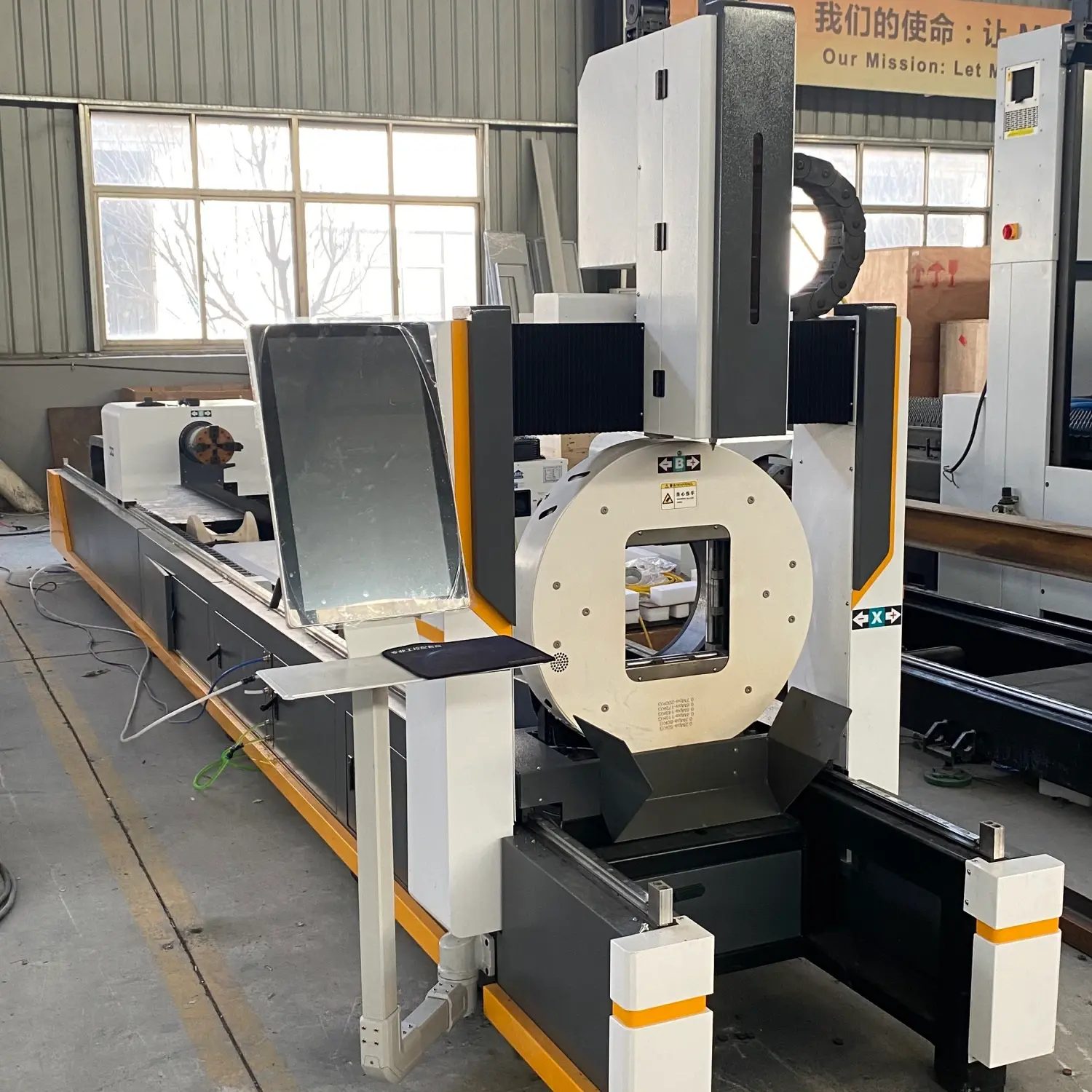
Thông số kỹ thuật và cách đọc chúng
| Tham số | Mức độ sơ cấp | Phân khúc tầm trung | Thông số kỹ thuật cao |
|---|---|---|---|
| Kích thước bàn cắt (mm) | 3015 (3000×1500) | 4020 (4000×2000) | 6020 (6000×2000) |
| Hành trình trục X/Y (mm) | 3000 / 1500 | 4000 / 2000 | 6000 / 2000 |
| Hành trình trục Z (mm) | 120 | 150 | 200 |
| Laser Source Power (kW) | 1.5 / 3.0 Raycus | 3.0 / 6.0 MAX | 6.0 / 12.0 / 20.0 IPG |
| Đầu cắt | Raytools BM110 | Raytools BM111 with capacitive height | Precitec LightCutter / ProCutter |
| Max Cutting Speed (m/min) | 60 | 80 | 120 |
| Tốc độ di chuyển nhanh theo trục X/Y (m/phút) | 80 | 100 | 140 |
| Độ chính xác định vị (mm) | ±0,05 | ±0,03 | ±0,02 |
| Độ lặp lại (mm) | ±0,03 | ±0,02 | ±0,01 |
| Hệ thống điều khiển | FSCUT 2000 / Cypcut | FSCUT 4000 / PA8000 | Beckhoff / Siemens 840D |
| Hướng dẫn tuyến tính | HIWIN 25 mm | HIWIN 30 mm / PMI 35 mm | THK / Rexroth roller |
| Gantry Structure | Welded steel, stress relieved | HT250 cast beam, scraped | HT300 Meehanite, hand scraped |
| Trọng lượng tịnh của máy (kg) | 3,500 | 6,500 | 12,000 |
| Floor Space (L×W×H mm) | 4,800 × 2,600 × 2,200 | 6,200 × 3,400 × 2,400 | 9,500 × 3,600 × 2,800 |
| Tổng công suất kết nối (kW) | 18 | 35 | 65 |
| Điện áp nguồn | 380V 3-phase 50Hz | 380V 3-phase 50Hz | 380V 3-phase 50Hz / 440V 60Hz |
| HS Code | 84561100 | 84561100 | 84561100 |
How to Read the Specification Sheet Line by Line
Working Range or Cutting Table Size
The table size determines what sheet you can lay down without repositioning. A 3015 table handles standard 1500×3000 mm mild steel sheet. A 4020 lets you nest two 2000×1000 mm parts side by side on a 4000 mm length. The 6020 is for full truck-body panels or agricultural equipment sides. The entry-level 3015 fits in a 20 GP container. The 6020 requires flat-rack or breakbulk shipping.
Z Axis Travel
120 mm on entry machines handles up to 6 mm mild steel with standard capacitive sensing. 150–200 mm on higher builds clears formed parts, tube cutting fixtures, or thick plate warpage. Check whether the Z travel number is mechanical limit or usable stroke under the cutting head and crash sensor.
Công suất nguồn laser và thương hiệu
Raycus dominates the 1.5–3 kW segment at roughly $3,500–$5,500 per kilowatt. MAX Photonics sits in the 3–6 kW range with better beam quality stability. IPG Photonics at 6 kW and above delivers the M² factor and modulation response needed for brass, copper, and high-speed aluminum cutting. The brand matters because source replacement at end-of-life (80,000–100,000 hours rated) is 30–40% of initial machine cost. Ask for the source serial number and factory calibration date in the packing list.
Đầu cắt
Raytools BM110 is a fixed-focus head for 1.5–3 kW. BM111 adds automatic nozzle change and pierce detection. Precitec ProCutter at 6 kW+ includes collision protection and adaptive focus for thick plate. A Precitec head adds $4,000–$8,000 to BOM but reduces nozzle crash replacement by 60% in production environments.
Max Cutting Speed versus Rapid Traverse
Cutting speed is the actual vector speed while the beam is on—60 m/min for 1 mm steel at 1.5 kW, 120 m/min for thin aluminum at 12 kW. Rapid traverse is positioning speed between cuts. The gap between the two numbers tells you about acceleration: a 100 m/min rapid with 1G acceleration reaches that speed only on 200 mm+ moves. Nesting density on small parts makes acceleration, not top speed, the bottleneck.
Độ chính xác và độ lặp lại trong định vị
±0.05 mm positioning with ±0.03 mm repeatability on entry machines is adequate for structural steel, tanks, and general fabrication. ±0.02 mm / ±0.01 mm on high-spec builds holds ±0.05 mm part tolerance over a 4000 mm beam if the thermal compensation and screw pitch error correction are active. Demand the laser interferometer report: Renishaw XL-80 or equivalent, measured at 20°C ±1°C, with compensation on and off.
Control System and Motion Architecture
FSCUT 2000/4000 from Friendess (Cypcut) runs on Windows embedded, uses Look Ahead for 500 blocks, and dominates the Chinese domestic market. Beckhoff TwinCAT on mid-to-high builds gives true NC code execution and EtherCAT servo bus cycle times under 1 ms. Siemens 840D sl is rare below $80,000 machine price but integrates with factory MES systems. The real difference is servo tuning: a FSCUT system with properly tuned Yaskawa or Panasonic servos outperforms a Beckhoff system with default gains.
Guideway Type and Gantry Construction
HIWIN 25 mm linear guides on 20 mm rail spacing is standard entry. PMI 35 mm or THK SRG on 30 mm spacing with 4-block carriages per axis is the high-spec norm. The hidden spec is scraping: a cast HT300 gantry beam hand-scraped to 0.02 mm/m over 4000 mm length costs 14 days of fitter time but eliminates the harmonic vibration that shows up as striation in 4 mm stainless cuts. Welded steel gantries stress-relieved and finish-machined are 30% cheaper but 15% heavier for equivalent stiffness.
Machine Weight and Foundation
3,500 kg for a 3015 entry machine sits on 150 mm factory concrete with no special isolation. 12,000 kg for a 6020 high-spec machine needs 200 mm reinforced concrete with 300×300 mm mesh at 150 mm depth, leveled to 0.5 mm/m. The foundation drawing should come with the technical proposal. Absence of foundation data is a flag for trading-house documentation.
Supplier Qualification: Builder versus Trading Office
Foundry or Documented Casting Source
A real builder shows you the rough casting, the resin sand process, or the purchase contract with a named foundry (typically Weichai Casting, Xuzhou, or similar in Shandong/Jiangsu). HT250 versus HT300 is not a marketing term; it is a GB/T 9439 tensile specification. Ask for the material certificate with batch heat number. Trading offices describe “high quality casting” without grade or source.
Assembly Floor and Scraping Records
Request dated photos of the assembly bay: granite surface plates, manual scraping tools, blue-check patterns on guideway mounting surfaces. A 4000 mm gantry takes 200–300 hours of scraping after finish machining. The builder should have 10+ assembly stations with overhead cranes rated to the machine weight. Trading offices show clean showrooms or nothing at all.
Laser Interferometer and Ball Bar Records
Geometric accuracy verification requires a Renishaw XL-80 laser interferometer for linear positioning and a QC20-W ball bar for circular interpolation. Ask for the unedited .xls or .pdf with machine serial number, date, technician signature, and environmental conditions. The report should show compensation values loaded into the control. A trading office forwards a generic template or a competitor’s document.
Factory Acceptance Test (FAT) Protocol
A legitimate FAT for laser cutting includes: (1) cut sample on customer material with specified thickness and grade, (2) dimensional report on 10+ features using CMM or height gauge, (3) edge roughness Ra measurement on cut face, (4) dross height and angle measurement, (5) 8-hour thermal drift test at 75% rated power. The protocol should be agreed before deposit payment. Trading offices offer “video inspection” or third-party photos.
Payment Structure as Signal
Builders with 15+ years export history typically ask 30% T/T deposit, 70% L/C at sight or T/T before shipment. Trading offices often demand 50% deposit and accept loose terms because they hold no inventory risk. A builder who refuses L/C or demands 100% advance without FAT option is undercapitalized or hiding subcontracted production.
After-Sales Engineering Capability
Verify: (1) dedicated laser application engineer count, not total staff, (2) regional service partner contracts with named companies in your country, (3) spare parts inventory location—Dubai, Rotterdam, or only factory stock, (4) remote diagnostic capability through control Ethernet or TeamViewer integration. Ask for the service response time in writing: 48 hours remote, 7 days on-site is achievable from established builders; 30 days or “best effort” is typical for traders.
Điều khoản thương mại và các vấn đề thực tiễn trong xuất khẩu
FOB (Giao hàng tại tàu)
Seller delivers machine to named Chinese port, cleared for export, loaded on vessel. Buyer pays ocean freight, insurance, and all destination charges. FOB Qingdao or Shanghai is standard. The seller’s cost ends at vessel rail; risk transfers at that point. FOB is preferable when you have freight forwarder relationships and want to control the ocean leg.
CIF (Giá cước, bảo hiểm và cước vận chuyển)
Seller adds ocean freight and minimum marine insurance to FOB price. The insurance is typically 110% of CIF value, Institute Cargo Clauses (C). CIF is simpler for first-time buyers but the seller chooses the carrier—often slower, consolidated cargo. CIF quotes vary 8–15% above FOB for Southeast Asia, 18–25% for East Africa, 22–30% for South America Atlantic coast.
CFR (Giá cước và cước vận chuyển)
Same as CIF but without insurance. Rare in machinery; use only if you arrange separate marine policy.
EXW (Giao hàng tại xưởng)
Machine stays at factory; buyer arranges all export clearance, trucking, loading. EXW saves the seller 3–5% in documentation and handling but requires your Chinese agent to manage VAT rebate, customs declaration, and port logistics. Only viable if you have presence in China.
Payment Instruments
T/T (Telegraphic Transfer): 30/70 or 30/60/10 split is normal. The 10% retention after installation is negotiable with builders who have confidence in their commissioning team.
L/C (Letter of Credit): At-sight L/C protects buyer if documents are discrepant. Usance L/C (60–90 days) costs 3–5% annualized in bank charges and is only accepted by builders with strong banking relationships. Confirmed L/C adds 1–2% but guarantees payment even if seller bank fails.
Mã HS và tài liệu kèm theo
84561100 covers “machine tools for working any material by removal of material, operated by laser.” This determines import duty in your country. CE marking for laser machines falls under Machinery Directive 2006/42/EC and EN ISO 11553-1 for laser safety. The Declaration of Conformity must list the notified body or the manufacturer’s self-certification route. The packing list must match actual container contents by line item: machine body, control cabinet, chiller, dust collector, tooling, and spare nozzles.
Yêu cầu về điện áp và máy biến áp
Chinese factory test is 380V ±10%, 50 Hz. For 220V 60 Hz regions (parts of Southeast Asia, North America residential), a step-up transformer 220V→380V at 1.25× rated kVA is required. For 440V 60 Hz (Gulf, some Caribbean), verify the servo drives and laser power supply accept 440V or specify transformer 440V→380V. The transformer adds $800–$2,500 and 150–400 kg shipping weight. Factory reconfiguration to 60 Hz servo parameters is sometimes possible; confirm before order.
Container Loading and Weight Limits
A 3015 entry machine at 3,500 kg plus chiller and accessories fits one 20 GP container (21,500 kg payload limit). A 4020 mid-range at 6,500 kg needs 40 HQ with 26,500 kg limit; gantry and table often ship knocked down to stay within axle load. 6020 machines at 12,000 kg require flat-rack or open-top containers, with lifting points certified to IMO CSS Code. Crane or forklift at destination must handle 1.25× machine weight for tilt during unloading: 15-ton capacity minimum for 12-ton machine.
Installation and Training
Foundation curing: 28 days minimum for reinforced concrete. Builder technician installs, levels, and performs geometric alignment over 3–5 days. Operator training: 5 days for basic nesting, parameter selection, and daily maintenance; 10 days for advanced troubleshooting and source replacement simulation. Training completion should be signed off against a checklist, not open-ended.
Phụ tùng và vật tư tiêu hao
Nozzle: $8–$25 each, consumption 20–50/month at high duty. Ceramic ring: $45–$120. Focus lens: $80–$200, 3–6 month life in clean environment. Protective lens: $15–$40, changed weekly in production. Chiller coolant: propylene glycol mix, 20 liters every 2 years. Ask for 2-year consumables price list at quotation stage; a 30% price hike after delivery is common from traders.
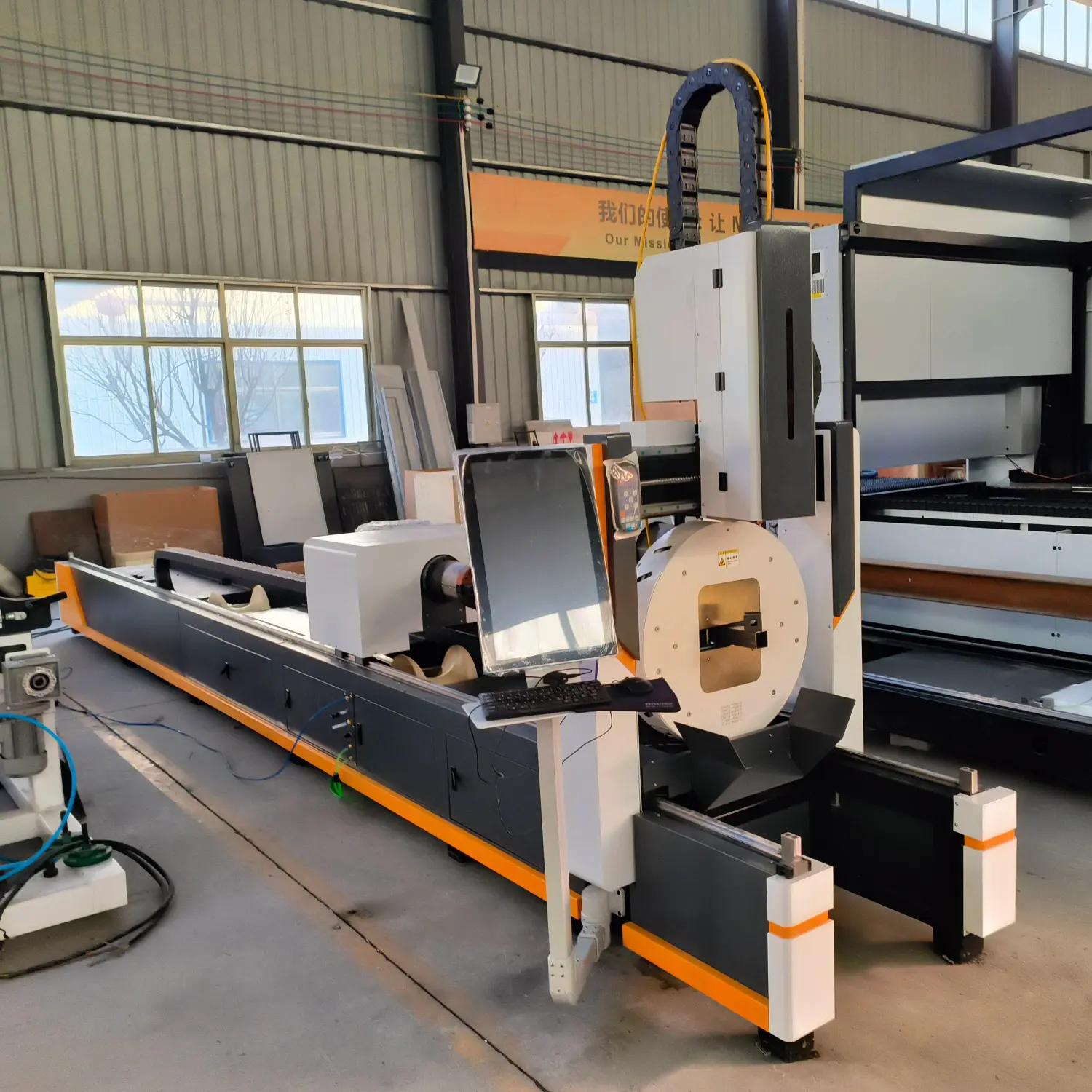
Giá máy cắt laser CNC và các yếu tố ảnh hưởng đến giá
| Lớp | Phạm vi hoạt động thông thường hoặc công suất | Ví dụ về điều khiển hoặc nguồn | Giá FOB tham khảo (USD) |
|---|---|---|---|
| Giường mở dành cho người mới bắt đầu | 1500×3000 mm, 1.5–3 kW fiber | GSK / KND control, Raycus source | 18,000–28,000 |
| Mid-range gantry | 1500×3000 mm, 3–6 kW fiber | Syntec / Mitsubishi, Raycus / MAX | 32,000–55,000 |
| Heavy gantry industrial | 2000×4000 mm, 6–12 kW fiber | Siemens 828D / FANUC 0i-F, IPG / MAX | 58,000–95,000 |
| Large format / multi-pallet | 2000×6000 mm, 12–20 kW fiber | FANUC 31i-B5 / Siemens 840D sl, IPG | 110,000–180,000 |
| Tube-sheet combo or specialty | 1500×3000 mm + tube chuck, 3–6 kW | Syntec / Mitsubishi, Raycus / MAX | 45,000–75,000 |
Real Cost Structure From Factory Floor to Your Door
A CNC fiber laser cutting machine shipped from China breaks into roughly twelve cost layers. The proportions below reflect RUNNEWTECH’s actual build data for a mid-range 3015 gantry machine with 6 kW MAX source and Syntec control.
Mechanical core (35–42% of FOB)
- Casting or welded frame: 8–12%. HT250 resin-sand castings for the gantry and bed run heavier and more stable than fabricated steel weldments. A 3015 machine bed casting typically weighs 4,500–6,500 kg. Fabricated frames cut this to 2,800–3,500 kg and cost 30–40% less, but damping and long-term geometry suffer.
- Linear guideways and ball screws: 6–9%. HIWIN or PMI 35 mm/45 mm linear roller guides on Y and X, 32 mm or 40 mm C5 or C7 ground ball screws. Genuine HIWIN blocks and rails carry laser-etched serial numbers; copies exist.
- Rack and pinion or direct drive: 2–4%. Helical rack with planetary reducer on larger gantries; direct-coupled servo on compact units.
- Z-axis lifter and cutting head: 4–6%. Raytools BM110 or BM111 auto-focusing head, or Precitec Procutter for 6 kW and above. The head unit alone is $2,800–$6,500 depending on sensor package.
Laser and control package (32–40% of FOB)
- Fiber laser source: 18–25%. This is the single largest line item. Raycus 3 kW runs roughly $4,500–$6,000; MAX 6 kW $8,500–$11,000; IPG 6 kW $14,000–$18,000; IPG 12 kW $26,000–$32,000. Source brand directly dictates cut quality consistency, especially on reflective metals and at power levels above 6 kW.
- CNC control and servo package: 14–18%. The second largest line item. GSK 983 with analog servos might add $3,500–$5,000. Syntec 60WA with absolute encoders: $7,500–$10,000. Siemens 828D with S120 drives and 1FK7 motors: $14,000–$19,000. FANUC 0i-F with αi series servos: $16,000–$22,000. The control determines interpolation smoothness, cornering performance, and whether your operator already knows the interface.
Assembly and finishing (8–12% of FOB)
- Assembly labour, scraping, and alignment: 4–6%. Hand scraping of guideway mounting surfaces on cast machines adds 2–3 days but improves contact area to 70%+ versus 40–50% on machined-only surfaces.
- Factory acceptance test and laser calibration: 1–2%. Laser interferometer check on X/Y positioning, ball bar test for circular interpolation. Documented geometric accuracy report should show positioning accuracy ≤0.05 mm and repeatability ≤0.03 mm on a 3015 machine.
- Paint, guarding, and coolant system: 2–3%.
Logistics and export (10–15% of FOB)
- Export packing: 1–2%. Vacuum-sealed membrane, plywood crate, desiccant. A 3015 machine ships in 3–4 crates totaling 8,500–12,000 kg.
- Inland freight to port: 1–2%.
- Sea freight (20′ or 40′ HQ container): 3–6%. A 3015 gantry fits one per 40′ HQ; a 4020 may need flat-rack or open-top.
- Marine insurance: 0.3–0.5%.
- Destination duty and VAT: varies by country; typically 5–15% of CIF value plus local VAT.
- Customs clearance and port handling: $800–$2,500 depending on port and broker.
Tại sao báo giá rẻ nhất lại rẻ hơn?
A quote 25–35% below the bands above normally achieves savings in predictable places:
- Lighter casting or fabricated frame. A 3,200 kg weldment frame versus a 5,800 kg HT250 casting saves $4,000–$6,000 but transmits more vibration at 15 m/min rapid traverse and 6 kW cutting loads. Positioning accuracy drifts faster under thermal load.
- Lower grade ball screw or unbranded linear guide. C7 rolled screws instead of C5 ground, or non-HIWIN rails without proper preload, saves $2,000–$3,500. Backlash increases to 0.05–0.10 mm; repeatability suffers on tight-nesting sheet work.
- Unbranded or recycled laser source. A source labeled “Made in China” without Raycus, MAX, IPG, or JPT traceability may be a refurbished module or lower-bar diode array. Output stability degrades after 6–12 months; warranty support is nonexistent.
- Analog servo or stepper on auxiliary axes. Saves $1,500–$2,500 versus digital bus servos. Corner cutting quality drops; acceleration limits software-compensated.
- No laser interferometer or ball bar documentation. Saves half a day and $400 in test equipment rental. You receive no objective evidence of geometric accuracy.
So sánh chi phí vận hành trong 5 năm
Assumptions: 3015 gantry, 6 kW source, two-shift operation, 220 cutting hours/month, electricity at $0.12/kWh, mild steel and aluminum mix, operator wage excluded.
| Mục chi phí | Entry-Level Build (3 kW Raycus, GSK, lighter frame) | Mid-Range Build (6 kW MAX, Syntec, HT250 casting) | Industrial Build (6 kW IPG, Siemens 828D, Meehanite bed) |
|---|---|---|---|
| Annual power consumption | 38,000 kWh | 52,000 kWh | 54,000 kWh |
| Annual power cost | $4,560 | $6,240 | $6,480 |
| Protective lens and ceramics (annual) | $1,800–$2,400 | $2,200–$2,800 | $2,000–$2,600 |
| Nozzle replacement (annual) | $600–$900 | $700–$1,000 | $600–$900 |
| Assist gas (O₂/N₂ annual) | $4,500–$6,000 | $5,500–$7,500 | $5,200–$7,000 |
| Source degradation / reconditioning at Year 3–4 | $3,500–$5,500 (Raycus module swap) | $4,500–$7,000 (MAX partial rebuild) | $6,000–$9,000 (IPG factory refurb, but slower degradation) |
| Unplanned downtime (estimated hours/year) | 45–70 hours | 25–40 hours | 15–25 hours |
| Downtime cost at $85/hour lost margin | $3,825–$5,950 | $2,125–$3,400 | $1,275–$2,125 |
| Five-year total operating cost | $74,000–$98,000 | $92,000–$120,000 | $95,000–$125,000 |
The entry-level build saves $14,000–$28,000 upfront on FOB but accumulates higher downtime and earlier source degradation. The industrial build costs more initially yet delivers lower variance in part quality and fewer emergency service calls. The mid-range build represents the crossover point where most job shops and fabrication shops find acceptable risk-adjusted returns.
Danh sách kiểm tra tiêu chuẩn nhà cung cấp
Use this to distinguish a machine builder from a trading office that outsources assembly to three subcontractors.
Physical factory verification
- Own foundry or documented long-term casting supplier with HT250/HT300 material certificates. Ask to see rough castings with factory markings.
- Assembly floor with overhead cranes rated for the machine bed weight. A 4020 gantry bed exceeds 8,000 kg; a 5-ton crane is insufficient.
- Scraping benches and hand tools for guideway fitting, not only CNC machining centers.
Measurement and documentation
- Laser interferometer (Renishaw or equivalent) with calibration certificate dated within 12 months.
- Ball bar test records for circular interpolation, showing roundness error ≤0.03 mm on 150 mm diameter at 2 m/min feed.
- Documented geometric accuracy report: straightness of X and Y, squareness of axes, parallelism of gantry to bed, all recorded with numerical values, not pass/fail stamps.
Payment structure and risk allocation
- 30% advance, 70% against copy of bill of lading is standard for first orders. A builder confident in delivery may accept 30/60 with retention of 10% until FAT video approval.
- Demands for 50% advance or 100% before production on a standard machine warrant caution.
After-sales engineering capability
- Stocked spare parts within your region or bonded warehouse, not only “we can ship from China in 7 days.”
- Video or on-site installation and training included in quote, with named engineer and estimated man-days.
- Remote diagnostics capability: Ethernet or 4G module for real-time alarm logging and parameter backup.
RUNNEWTECH machines are built at Runlongjia’s Jinan facility with in-house casting supply, Siemens and Syntec control integration, and MAX/IPG source partnerships. Factory acceptance tests include laser interferometer and ball bar records supplied with each machine. Lead time from confirmed payment to FOB Qingdao is typically 25–35 days for standard 3015 configurations and 40–50 days for 4020/6020 or custom tube-sheet combinations.
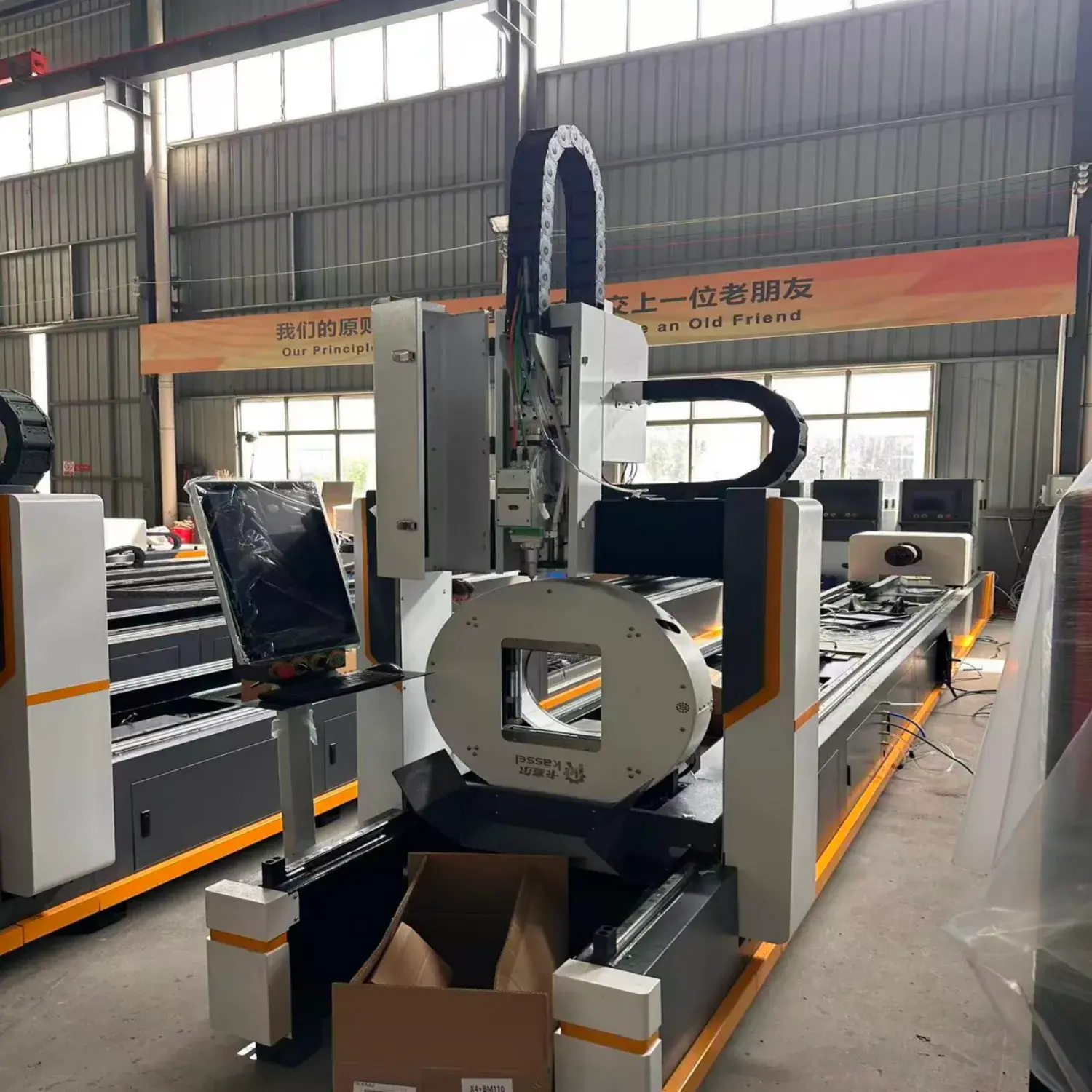
Các ứng dụng trong công nghiệp của máy cắt laser CNC
| Lĩnh vực | Các bộ phận tiêu biểu được sản xuất | Thông số kỹ thuật đề xuất | Tại sao chiếc máy này lại phù hợp |
|---|---|---|---|
| Phụ tùng ô tô và xe máy | Exhaust flanges, brackets, sprockets, frame tubes, battery trays | 3015 table, 3 kW Raycus or IPG source, ±0.03 mm positioning, 120 m/min rapid traverse, Raytools BM110 head | High repeatability for JIT supply chains; rapid traverse matches takt time requirements |
| Máy móc nông nghiệp | Plow shares, harrow discs, hitch plates, grain chute liners, hydraulic mounts | 4020 table, 6 kW MAX or IPG source, ±0.05 mm positioning, HT250 bed casting, 8000 kg machine weight | Thick mild steel and wear plate cutting; heavy bed dampens vibration from 6 mm+ plate |
| Phụ kiện thủy lực và khí nén | Valve bodies, manifold plates, cylinder caps, flange adapters, port blocks | 3015 table, 2 kW IPG source, ±0.02 mm repeatability, Precitec cutting head, 0.5 mm hole piercing capability | Tight tolerances on port geometry; Precitec capacitive height sensing tracks warped 20 mm plate |
| Khớp nối cho ngành dầu khí | Pipeline flanges, API ring gaskets, blowout preventer plates, wellhead adapters | 6020 table, 12 kW IPG source, ±0.08 mm positioning over full length, dual exchange pallets, 15000 kg machine weight | Large diameter flange cutting in single setup; dual pallets eliminate dead time on 30-minute nests |
| Chế tạo kim loại tấm và tủ | Electrical enclosures, server racks, switchgear panels, HVAC ducting, tool cabinets | 3015 table, 1.5 kW Raycus source, 100 m/min rapid traverse, GSK or Syntec control, automatic nesting software | Cost-sensitive sector; lower laser power handles 0.5–3 mm galvanized and stainless sheet |
| Thiết bị nhà bếp | Commercial hoods, prep tables, shelving, exhaust ducts, food-grade hoppers | 3015 table, 3 kW MAX source, stainless-optimized cutting parameters, oil-mist lubrication for guides | Reflective material processing; 3 kW bridges thin stainless without dross on cosmetic edges |
| Advertising and Signage | Channel letters, decorative screens, architectural panels, logo plates | 3015 table, 1 kW Raycus source, 0.1 mm repeatability, small-format nozzle for 0.3 mm brass, CCD alignment camera | Fine feature resolution; low capital outlay for job shops with mixed material workflows |
| Đóng tàu và thép kết cấu | Deck plates, bulkhead sections, stiffener profiles, porthole rings, ladder frames | 6020 table, 12 kW IPG source, ±0.1 mm over 6 m length, oxygen cutting for 25 mm mild steel, 20000 kg machine weight | Bevel-ready thick plate; machine mass eliminates thermal drift during 40-minute continuous cuts |
| Công nghệ khuôn mẫu | Ejector plates, backing plates, cavity inserts, guide bushing holes, vent slots | 3015 table, 6 kW IPG source, ±0.015 mm repeatability, linear motor drive option, 0.3 mm micro-joint cutting | Pre-hardened steel cutting to 45 HRC; linear motors eliminate ball screw thermal growth |
| Trung tâm Đào tạo Kỹ thuật | Curriculum plates, sample nests, certification test pieces, maintenance trainers | 3015 table, 1.5 kW Raycus source, FANUC or Siemens control, open parameter access, 4500 kg machine weight | Control familiarity for graduate placement; open architecture lets instructors demonstrate cause-effect |
Automotive And Motorcycle Parts
A tier-two supplier in Thailand running 24-hour shifts for Japanese OEMs uses a 3015-format machine with 3 kW IPG source and Raytools BM110 head to produce exhaust flanges from 4 mm 409 stainless. Positioning accuracy of ±0.03 mm ensures flange bolt patterns mate with cast manifold faces without secondary reaming. The 120 m/min rapid traverse lets the machine complete a 12-piece nest in under four minutes, matching the customer’s 120-second takt time when balanced across three identical machines. The buyer specified FANUC 0i-F Plus control because their operators already knew the macro programming syntax from milling centers, eliminating a two-week training gap that would have delayed PPAP approval.
Máy móc nông nghiệp
A harvester component manufacturer in Brazil cuts 8 mm AR400 wear plate for plow shares on a 4020 machine with 6 kW MAX source. The HT250 resin-sand bed casting at roughly 8000 kg machine weight damps the low-frequency vibration that produces striation marks on long straight edges. They initially considered a 3 kW machine at 30 percent lower capital cost but rejected it because cut speed on 8 mm plate drops from 1.2 m/min to 0.4 m/min, requiring a second shift and eroding the price advantage within eleven months. The 4020 table lets them nest two plow shares side-by-side from standard 2000 mm wide coil stock, improving material yield from 78 percent to 91 percent.
Hydraulic And Pneumatic Fittings
A valve manufacturer in Turkey produces manifold plates with 0.5 mm diameter pilot holes on a 3015 machine with 2 kW IPG source and Precitec ProCutter head. The Precitec’s capacitive height sensing tracks warped 20 mm thick plate to within ±0.1 mm, preventing nozzle crashes that destroyed three standard heads per quarter on their previous plasma setup. Positioning repeatability of ±0.02 mm means reamed port intersections stay within 0.05 mm true position tolerance after secondary machining. They pay a 15 percent premium for IPG over Raycus but recover it through 40 percent longer diode life in their high-reflectivity brass cutting program.
Oil And Gas Couplings
A flange fabricator in the UAE runs 30-inch API pipeline flanges on a 6020 dual-pallet machine with 12 kW IPG source. The 15000 kg machine weight and 6000 mm X-axis travel let them cut a complete 762 mm OD flange from 25 mm ASTM A105 in one setup, eliminating the concentricity errors that occurred when they transferred between two smaller machines. Dual exchange pallets reduce non-cutting time to 45 seconds per nest; on a 30-minute heavy plate cycle, this adds two extra parts per eight-hour shift. They specified 380V 50Hz supply with a step-down transformer for their 415V plant, plus a 25-tonne overhead crane for unloading from 40-foot open-top container.
Sheet Metal Fabrication And Cabinets
A 40-employee job shop in Mexico produces electrical enclosures for local OEMs on a 3015 machine with 1.5 kW Raycus source and Syntec control. The lower capital outlay—roughly 35 percent below equivalent IPG configurations—matches their price-sensitive market where enclosure contracts bid to 8 percent gross margin. Automatic nesting software with common-line cutting reduces 1.5 mm galvanized sheet consumption by 12 percent, worth approximately $8000 annually at their volume. They accept the shorter Raycus warranty period (two years versus three for IPG) because their 90 percent runtime is on mild steel, where source degradation is minimal.
Thiết bị nhà bếp
A commercial kitchen fabricator in Malaysia cuts 1.2 mm and 2 mm 304 stainless for prep tables and exhaust hoods on a 3015 machine with 3 kW MAX source. The 3 kW power level bridges the gap between entry-level 1.5 kW machines that dross on 2 mm at corners and 6 kW units whose capital cost cannot be recovered on 0.5–3 mm work. They specified oil-mist lubrication for HIWIN linear guides because steam and grease in their shop environment caused two premature guide failures in three years on a dry-lube predecessor. Cut edge roughness of Ra 6.3 µm on 2 mm stainless eliminates secondary deburring for visible surfaces.
Advertising And Signage
A signage shop in South Africa produces brass channel letters and decorative screens on a 3015 machine with 1 kW Raycus source and CCD camera alignment. The 0.1 mm repeatability lets them cut 0.3 mm brass for LED letter faces without distortion from thermal bulging. The CCD corrects for print-to-cut registration errors on laminated acrylic-steel composites, reducing setup scrap from 8 percent to under 2 percent. They run the machine on 220V 60Hz supply with a transformer and VFD, accepting the 5 percent speed derating because their mix is 70 percent non-ferrous where cutting speeds are already limited by reflectivity rather than power.
Shipbuilding And Structural Steel
A shipyard subcontractor in Vietnam cuts deck plates and bulkhead sections up to 25 mm on a 6020 machine with 12 kW IPG source and oxygen assist. The 20000 kg machine weight and 6000 mm × 2000 mm table handle 12 m × 3 m standard ship plate with repositioning. Oxygen cutting on 12–25 mm mild steel achieves nitrogen-comparable edge quality at one-third assist gas cost, though the buyer must maintain oxygen dew point below -40°C to prevent edge carbon embrittlement. They specified a 40-foot flat-rack container for export because the 6020 machine exceeds standard container internal dimensions, adding $4000 to freight versus a 3015 machine that fits in a 20-foot container.
Mould And Die Work
A die maker in Poland produces ejector plates and cavity inserts from 1.2379 tool steel at 48 HRC on a 3015 machine with 6 kW IPG source and optional linear motor drive. Linear motors eliminate ball screw thermal growth that caused 0.02 mm drift during 45-minute continuous cuts on their previous machine, directly causing two insert rejections per month at $1200 each. The 0.3 mm micro-joint cutting parameter leaves tabs that prevent part drop during skeleton cutting, then break clean with light hammer taps. They specified the linear motor option despite 25 percent higher machine cost because their customer requires continuous geometric accuracy verification with ball bar records every six months.
Trung tâm Đào tạo Kỹ thuật
A vocational institute in Kenya purchased a 3015 machine with 1.5 kW Raycus source and FANUC 0i-F control for their metal fabrication program. The 4500 kg machine weight allows forklift unloading without crane infrastructure, critical because their workshop has 3.5 m eaves height. Open parameter access lets instructors demonstrate how feed rate and focal position affect cut quality on mild steel, stainless, and aluminum test pieces. They selected FANUC control because 70 percent of local employers run FANUC-based machines, improving graduate placement rates. The institute negotiated a 20 percent academic discount against standard export pricing in exchange for case study cooperation and annual student visit rights.
Hướng dẫn từng bước về đặt hàng và nhập khẩu
Ba sai lầm thường khiến sản phẩm sau khi giao hàng Máy cắt laser CNC sitting idle are easy to prevent with one-line fixes checked before signing the purchase order.
Mistake 1: Supply voltage or frequency mismatch. Fix: Confirm your shop delivers 380V 50Hz three-phase or 220V 60Hz three-phase in writing, and specify whether the machine ships with a transformer or you source locally.
Mistake 2: Working envelope too small for actual parts after nesting allowances. Fix: Measure your largest sheet plus clamping margins and add 200 mm minimum on each axis before selecting table size.
Mistake 3: No electrical schematic, parameter backup, or local consumable source. Fix: Require hardcopy and digital schematic, parameter backup on USB, and a written consumable sourcing list with part numbers before final payment release.
Step-by-Step Ordering and Import Checklist
1. Define the Workpiece Envelope and Tolerance Requirement
Record the maximum sheet dimensions you will process: 1500 × 3000 mm (3015 table), 2000 × 4000 mm (4020 table), or 2000 × 6000 mm (6020 table). Add 150–200 mm per axis for shuttle table motion or edge clamping. For tolerance-critical work, specify positioning accuracy ≤ ±0.05 mm/m and repeatability ≤ ±0.03 mm; request the supplier’s laser interferometer report and ball bar circular interpolation test for the specific machine serial number, not a generic brochure figure. State material thickness range: mild steel to 6 mm at 1.5 kW, to 12 mm at 3 kW, to 25 mm at 6 kW, to 40 mm at 12 kW. Stainless and aluminum require roughly 1.5× the power for equivalent feed rates.
2. Choose the Control System and Serviceability
Common configurations: FANUC 0i-F Plus or Siemens 840D sl for shops with existing service contracts; Mitsubishi M800 for integrated laser-specific functions; GSK 983, KND K2000TF-L, or Syntec 60W-E for lower acquisition cost with regional parts availability. Verify who performs parameter-level service in your country—the builder, a distributor, or a third-party integrator. Ask for the service engineer’s location and typical response time. A control without local backup leaves you dependent on remote support for alarm decoding.
3. Confirm Voltage Frequency Phase and Transformer Need
Standard Chinese-built machines ship for 380V 50Hz three-phase. If your facility runs 220V 60Hz (common in North America, parts of Southeast Asia, and South America), you need a step-up transformer rated at minimum 1.5× the machine’s total electrical load: a 3 kW laser with 15 kW total auxiliary draw requires a 30 kVA transformer minimum. Specify whether the builder installs a built-in transformer or you procure locally. Include transformer weight (typically 400–800 kg for this class) in floor loading calculations.
4. Check Floor Loading Foundation and Floor Space
Machine net weight ranges: 6,000 kg for a 3015 single-table 3 kW machine; 12,000 kg for a 4020 pallet shuttle 6 kW machine; 18,000 kg for a 6020 high-power configuration. Floor loading at foundation points concentrates to 8–15 kN/m²; reinforced concrete minimum 200 mm thick, or steel-framed platform with I-beam support at 1,000 mm centers. Total floor space including operator walkways, material staging, and extraction ducting: 3015 needs 5.5 m × 8.5 m; 4020 needs 6.5 m × 11 m; 6020 needs 7.5 m × 14 m. Ceiling height minimum 4 m for crane clearance over shuttle tables.
5. Confirm Conformity Marking for Customs Clearance
Require CE marking documentation for EU destinations, GCC marking for Gulf states, or EAC for Russia/Kazakhstan/Belarus. The builder must provide: Declaration of Conformity, EN ISO 12100 risk assessment, EN 60204-1 electrical safety report, and laser safety classification per EN 60825-1. For non-regulated destinations, request a Certificate of Origin and commercial invoice with HS code 8456.11. Trading offices often hold photocopied CE files from unrelated machines; verify the certificate references your specific machine model and serial number prefix.
6. Compare FOB Versus CIF
| Thuật ngữ | What You Pay | What Supplier Pays | Risk Transfer | Best For |
|---|---|---|---|---|
| FOB Chinese port | Ocean freight, insurance, unloading, inland delivery | Factory to port, export clearance | On ship’s rail at origin | Experienced importers with freight forwarder relationships |
| CIF destination port | Customs duties, unloading, inland delivery, port charges | Factory to destination port, freight, insurance | On ship’s rail at origin (not destination) | First-time buyers or unstable freight markets |
CIF does not include destination unloading or customs clearance. Laser machines in 4020 or 6020 configuration exceed standard container internal dimensions and ship flat-rack or open-top; CIF quotes on these terms often exclude port crane rental at destination, which runs $800–2,500 depending on port.
7. Specify Container Type and Machine Weight Limits
3015 machines with dismantled tables fit 40-foot high-cube containers (internal width 2.35 m, height 2.69 m). Weight limit per container: 26,000 kg gross including packaging. Single-table machines under 6,000 kg net ship two units per 40HQ with proper blocking. 4020 and 6020 machines require flat-rack containers (no sidewalls) or breakbulk vessel; flat-rack payload 35,000–45,000 kg depending on length. Confirm the builder’s loading plan and lashing certificate; ocean surge can shift 12,000 kg machines if blocking is inadequate.
8. Negotiate Deposit and Balance Payment Terms
Standard structure: 30% deposit on order confirmation, 70% balance before shipment. For orders above $150,000, propose 30% deposit, 60% on readiness for factory acceptance test, 10% after successful installation and sign-off. Avoid 100% advance for untested suppliers. Payment instrument: wire transfer for deposits; letter of credit at sight for balance if trust is unestablished, though LC fees add $1,500–4,000. Escrow through Alibaba Trade Assurance or similar protects against non-shipment but does not cover specification disputes.
9. Conduct Factory Acceptance Test Before Balance Payment
Require attendance or third-party proxy at FAT. Minimum tests: laser power output verification at nominal and 80% duty cycle; geometric accuracy—straightness of X/Y axis ≤ 0.05 mm/m, perpendicularity of axes ≤ 0.05 mm/500 mm; positioning accuracy per ISO 230-2; repeatability; ball bar test for circular interpolation at 1,000 mm/min feed; cutting test on your actual material thickness with speed and edge quality sign-off. Demand the interferometer and ball bar reports with date, technician signature, and environmental conditions. Refuse shipment if geometric errors exceed 1.5× the quoted specification.
10. Verify Supplier Qualification: Builder Versus Trading Office
Request video walkthrough of: (a) casting source or foundry partnership documentation—HT250 bed castings minimum, HT300 for high-accuracy machines; (b) assembly floor with machines in build, not finished machines only; (c) scraping station for hand-fitting guides; (d) laser interferometer (Renishaw XL-80 or equivalent) and ball bar (QC20-W) in calibration certificate; (e) finished machine test area with material cutting, not just dry runs. Trading offices resist live video from production areas; builders schedule FAT slots regularly. Check payment beneficiary name matches the factory business license, not a Hong Kong or unrelated trading company.
11. Plan Unloading Equipment at Destination
Machine base units weigh 4,000–8,000 kg even for 3015 sizes. Unloading requires: forklift minimum 5-ton capacity with extended forks (2.5 m minimum), or overhead crane 10-ton capacity with spreader bar. Flat-rack deliveries need port crane coordination booked 72 hours ahead. Ground must support concentrated load; soft asphalt or gravel requires steel plates. Unpacking and positioning to foundation: allow one full day with rigging crew of four.
12. Arrange Installation and Operator Training
Builder or distributor responsibility should include: mechanical leveling to 0.05 mm/m using precision level; laser alignment and beam path verification; control parameter load; cutting test and speed optimization for your material; 40 hours minimum operator training on nesting software, parameter adjustment, nozzle change, and daily maintenance. Training completion must be signed by both parties. Specify whether engineer travel, lodging, and daily rate are included in quoted price or additional; typical all-inclusive package runs $3,500–6,500 per engineer depending on destination.
13. Define Initial Spare Parts and Consumables Package
Require inclusion or priced option for: ceramic ring/nozzle holder set (2 units); nozzles diameter 1.0 mm, 1.5 mm, 2.0 mm (10 each); focus lens and collimator lens (2 each); protective windows (20 units); lubrication oil specified grade (20 liters); belts and limit switches for axis drives (1 each); complete electrical schematic hardcopy and parameter backup USB. For laser source: Raycus or MAX sources have wider global distribution; IPG requires authorized service channels. Confirm consumable part numbers cross-reference to local availability or 72-hour builder dispatch. Without this package, a single damaged protective window can idle the machine for two weeks.
Summary Verification Before Signature
| Mặt hàng | Your Record | Confirmed with Supplier |
|---|---|---|
| Table size and axis travel | ||
| Laser source brand and power | ||
| Control system and local service | ||
| Voltage / frequency / transformer | ||
| Foundation load and floor space | ||
| Customs conformity marking | ||
| Shipping terms and container type | ||
| Payment schedule and FAT attendance | ||
| Unloading equipment booked | ||
| Training hours and engineer costs | ||
| Spare parts package contents |
Keep one signed copy with your freight forwarder and one with the supplier’s project manager named and contactable.
Các máy móc liên quan của RUNNEWTECH

Máy cắt laser CNC
Máy cắt laser CNC xuất xưởng trực tiếp từ nhà máy, có các tùy chọn hệ thống điều khiển FANUC, Siemens, Mitsubishi, GSK hoặc Syntec và nguồn điện 380V/50Hz hoặc 220V/60Hz, dành cho xuất khẩu.
Các câu hỏi thường gặp về máy cắt laser CNC
Minimum Order Quantity And Price Structure
Q: What is the minimum order quantity and what drives the wholesale price?
One unit is the practical MOQ for container loading. Price drivers are: laser source brand and power—Raycus 1.5 kW costs roughly 30-40% less than IPG 3 kW of the same nominal output; cutting table format—3015 mm × 1525 mm versus 4020 mm × 2000 mm or 6020 mm × 2000 mm; and gantry construction—welded steel frame with stress relief versus cast iron bed. Control system choice between FSCUT, Syntec, or Beckhoff also shifts cost.
Control System And Interface Language
Q: What control systems are available and can the interface run in my local language?
Standard is Cypcut or FSCUT for fiber laser, with Beckhoff or Syntec as alternatives for higher automation. Interface supports English, Spanish, Russian, Arabic, and Vietnamese; other languages require 5-7 working days for translation verification. The nesting software license is perpetual, not subscription-based. Remote diagnostics port is standard on all configurations.
Lead Time And Production Transparency
Q: What is the actual lead time from deposit to readiness for shipment?
Standard configuration with Raycus 3 kW and 3015 table: 25-30 working days. IPG source or 6 kW and above: 35-40 working days. Critical path is laser source import clearance and gantry grinding. Buyers receive photos of casting receipt, rough machining, finish scraping, and laser interferometer run at 5 stages. Final assembly overlap with electrical fit-out saves 5-7 days versus sequential build.
Payment Terms And Financial Structure
Q: What payment structure protects both parties?
Standard terms: 30% T/T deposit to confirm order, 70% before release for shipment after factory acceptance test video and photos. Letter of credit accepted for orders above USD 80,000; buyer bears confirming bank charges. No D/P or open account for first transactions. Deposit locks laser source price for 60 days against market fluctuation.
Power Supply And Frequency Adaptation
Q: My facility runs 220V 60Hz or 380V 50Hz—what is required?
Machine native supply is 380V 3-phase 50Hz. For 220V 60Hz regions including parts of North America and Philippines: step-up transformer to 380V is mandatory, rated at 1.5× machine installed power to handle inrush. Transformer cost USD 800-1,500 depending on laser power. 60Hz motor derating is not required for servo drives; spindle cooling pump may need Hz-matched replacement at USD 120.
Shipping Method And Transit Logistics
Câu hỏi: Máy được vận chuyển như thế nào và thời gian vận chuyển là bao lâu?
3015 machines ship in 40HQ container, one unit per container, net weight 3,500-4,200 kg depending on cast bed thickness. 4020 and 6020 require flat-rack or open-top container due to gantry height. FOB Qingdao or Shanghai. Transit: Southeast Asia 12-18 days, Middle East 20-28 days, Africa 35-45 days, South America West Coast 30-40 days, East Coast 40-50 days. CIF available; buyer handles destination clearance and unloading crane minimum 5-ton capacity.
Warranty Spare Parts And After-Sales Engineering
Q: What warranty coverage is standard and how are spare parts supplied?
Laser source: Raycus 2 years, IPG 3 years. Machine mechanical and electrical: 12 months from arrival. Spare parts kit included: protective lens 10 pieces, nozzle 5 pieces, ceramic ring 2 pieces, focus lens 1 piece, O-ring set, limit switches 2 pieces. Critical spares ship by air within 72 hours; routine consumables 7-10 days by express. Remote diagnostics via TeamViewer or factory VPN; on-site engineer dispatch USD 180/day plus visa and airfare.
Factory Acceptance Test And Accuracy Documentation
Q: Is a factory acceptance test performed and what accuracy records are provided?
Yes. FAT includes: laser interferometer measurement of positioning accuracy ±0.05 mm and repeatability ±0.03 mm over full 3015 mm travel; ball bar test for circular interpolation; and actual cutting sample on buyer’s material thickness. Delivered documents: geometric accuracy report, interferometer graph with serial number, ball bar plot, and CE Declaration of Conformity. Buyer or third-party inspector may witness; 2 days notice required.
Installation Training And Operator Handover
Q: What does installation and operator training include?
Machine arrives 90% assembled; gantry and table are single unit. Buyer handles unloading with 5-ton forklift or crane, positioning on 150 mm reinforced concrete with M16 anchor bolts, and primary power connection. Factory engineer then completes: final levelling with 0.02 mm/m precision level, laser alignment, parameter upload for 3 material types, and 3-day operator training covering nesting, nozzle change, lens cleaning, and alarm diagnosis. Training certificate issued with operator name and machine serial number.
Achievable Tolerance On Buyer Material
Q: What cutting tolerance can I expect on my actual material?
On mild steel to 6 mm: ±0.05 mm positional, ±0.03 mm repeatability, cut edge perpendicularity within 0.1 mm over 10 mm thickness. Stainless steel 3 mm: ±0.04 mm with nitrogen assist. Aluminum 2 mm: ±0.06 mm due to reflectivity; requires parameter adjustment. Tolerance degrades 20-30% on material with mill scale, rust, or thickness variation beyond ±5%. Sample cut on buyer-supplied sheet is standard FAT requirement.
Consumables Cost And Running Economics
Q: What are the annual consumables costs for a 3 kW fiber laser?
Protective lens: USD 8-12 each, replacement every 80-120 cutting hours depending on air quality. Nozzle brass: USD 6-10 each, life 200-400 hours on clean steel. Ceramic ring: USD 45-60, 6-12 month life. Focus lens: USD 120-180, 12-18 months with proper handling. Total annual consumables at 2,000 hours single shift: USD 2,800-4,200 excluding assist gas. Oxygen for mild steel: USD 0.80-1.20 per hour; nitrogen for stainless: USD 2.50-4.00 per hour at 99.995% purity.
Tài liệu CE và thủ tục thông quan
Q: Can the factory supply CE documentation for customs clearance in my country?
CE Declaration of Conformity, machinery directive 2006/42/EC technical file summary, and laser safety EN 60825-1 report are standard export documents. For markets requiring in-country type approval—Saudi Arabia SASO, Nigeria SONCAP, Egypt GOEIC—factory provides test report basis; buyer handles local certification through their clearing agent. No CE mark is applied to machine frame; documentation packet carries CE reference for EU-destined shipments.
Thông báo quan trọng
Các thông số kỹ thuật, số liệu về độ chính xác và mức giá trong hướng dẫn này chỉ mang tính tham khảo và được cung cấp nhằm phục vụ công tác lập kế hoạch
chỉ dành cho mục đích này. Phạm vi hoạt động thực tế, dung sai có thể đạt được, tính sẵn sàng của hệ thống điều khiển, yêu cầu về điện áp nguồn và sự tuân thủ
Các thông số kỹ thuật khác nhau tùy theo mẫu máy và quốc gia nhập khẩu. Người mua phải tự xác nhận điện áp và tần số nguồn điện, tải trọng sàn và
nền móng, thiết bị dỡ hàng và các yêu cầu nhập khẩu trước khi đặt hàng. Tất cả các con số đều phải được xác nhận bằng văn bản trong
hóa đơn tạm tính cuối cùng do RUNNEWTECH phát hành.
Mua máy cắt laser CNC từ RUNNEWTECH
Why Runlongjia Machinery Builds Differently Than Trading Offices
A trading office can show you a polished brochure. A machine builder can show you the casting supplier, the assembly floor, and the inspection record for the specific machine that will carry your serial number. Runlongjia Machinery, operating under the RUNNEWTECH export brand, maintains direct control over the manufacturing chain that determines whether your laser cutting machine holds ±0.05 mm on a 6 mm stainless part after three years of production.
The company sources castings from long-term foundry partnerships with specified material grades—typically HT250 or HT300 for bed frames on smaller machines, with Meehanite-grade castings used on heavy-duty platforms for 4020 and 6020 table formats. Assembly teams scrape matching surfaces rather than relying solely on machining tolerances, a practice that trading offices cannot verify because they never handle the metal. Every CNC fiber laser cutting machine undergoes run-in testing before packing, followed by geometric accuracy verification with documented results.
Documentation That Separates Builders From Brokers
Request these specific records before any deposit:
- Laser interferometer and ball bar test reports for positioning accuracy and repeatability. RUNNEWTECH machines typically achieve positioning accuracy of ±0.03 mm and repeatability of ±0.02 mm on standard configurations; higher precision is available with selected control and drive combinations.
- Factory acceptance test (FAT) video showing actual cutting on your material thickness and type, with dimensional report.
- Geometric accuracy report referencing ISO 230-2 or equivalent standards, not internal checklists.
- CE technical file documentation for European destinations, or applicable conformity evidence for your market.
Trading offices often forward manufacturer-provided PDFs they cannot explain. A builder’s application engineer can walk you through why the Y-axis straightness reading matters for your nested part layout.
Payment Structure and Risk Distribution
RUNNEWTECH quotes on FOB Qingdao or CIF basis with standard terms: 30 percent deposit on order confirmation, balance against copy of bill of lading. This structure aligns payment milestones with verifiable production progress. Machines are packed in plywood cases with VCI rust protection; container loading accounts for machine weight distribution, with typical units ranging from 3,500 kg for a 3015 single-table 3 kW configuration to 12,000 kg for a 6020 pallet-changing 12 kW system. Transformer requirements for 220V 60Hz regions are specified in the quotation, not discovered at installation.
After-Sales Engineering Capability
Remote commissioning support, operator training materials in English or Spanish, and spare parts inventory for Raycus, MAX, and IPG laser sources, Raytools and Precitec cutting heads, and HIWIN or PMI linear guide systems are maintained at the factory. This matters because a trading office’s “after-sales support” typically consists of forwarding your complaint to the actual manufacturer.
Send your workpiece material, maximum part size, required tolerance, and destination port to receive a quotation within 24 hours via email or the contact form at runnewtech.com.
Nhận báo giá trực tiếp từ nhà máy cho máy cắt laser CNC
RUNNEWTECH đã sản xuất máy móc gia công kim loại từ năm 2010,
với hơn 15 năm kinh nghiệm xuất khẩu. Các máy móc được cung cấp kèm theo hệ thống điều khiển theo sự lựa chọn của quý khách, phù hợp với nguồn điện của quý khách
điện áp và tần số, đã qua thử nghiệm chạy thử và thử nghiệm nghiệm thu tại nhà máy trước khi đóng gói. Vui lòng cung cấp cho chúng tôi thông tin về vật liệu phôi, kích thước tối đa của chi tiết,
Vui lòng cung cấp thông số dung sai và cảng đích, chúng tôi sẽ gửi báo giá trong vòng 24 giờ.

 English
  Indonesian
  Vietnamese
  Arabic
  Russian
  Spanish