
Hướng dẫn mua máy tiện CNC
CNC lathe types break down by bed orientation, spindle configuration, and axis count. Flat bed machines carry the tool post above a horizontal bed; slant bed machines tilt the bed 30°–45° and mount the turret behind the spindle centerline, letting chips fall away by gravity. The rest of this page maps every production-relevant sub-type, lists the spindle tapers, chuck sizes, and typical travels that separate them, and notes which part families each handles best.
Máy tiện CNC bàn phẳng
Configuration: Horizontal bed, typically HT250 or HT300 casting, guideways as hardened box ways or linear roller guides (HIWIN/PMI). Spindle nose A2-5, A2-6, or A2-8; chuck 200–400 mm; max turning diameter 500–1000 mm; max turning length 750–3000 mm. X travel 250–400 mm, Z travel 750–3000 mm. Rapid traverse 6–12 m/min. Spindle power 7.5–22 kW, speed 2000–3500 rpm. Positioning accuracy ±0.01 mm, repeatability ±0.005 mm. Weight 2500–8000 kg.
Best for: Heavy shaft work, large flanges, repair of long industrial rollers. Box way versions absorb interrupted cuts better than linear guides.
Trade-off: Chip evacuation requires conveyor or manual clearing; operator visibility of the cut zone is lower than slant bed designs. Floor space runs 3.5 m × 1.5 m and up.
Máy tiện CNC giường nghiêng
Configuration: Bed angled 30°–45°; turret sits behind spindle centerline. Casting HT300, stress relieved. Linear roller guides dominate this class for speed. Spindle nose A2-5 or A2-6 standard; chuck 160–315 mm; max turning diameter 360–560 mm; max length 500–1500 mm. X travel 200–300 mm, Z travel 500–1500 mm. Rapid traverse 20–30 m/min. Spindle power 5.5–15 kW, speed 4000–6000 rpm. Positioning accuracy ±0.008 mm, repeatability ±0.004 mm. Weight 2000–4500 kg.
Best for: High-volume shaft, pin, and hydraulic fitting production where cycle time dominates cost.
Trade-off: Less rigid than flat beds for heavy roughing; max workpiece diameter drops as bed angle steepens.
Horizontal Turning Center with Y-Axis and Live Tooling
Configuration: Slant or flat bed base with full C-axis spindle, Y-axis travel ±50 mm off centerline, and turret stations accepting ER32/ER40 driven tools. Same spindle specs as slant bed class, plus 3–5 kW live tool motors, 4000–6000 rpm rotary tool speed.
Best for: Milled flats, cross-drilled holes, and polygonal features completed in one fixturing—valve bodies, pump housings, agricultural hydraulic blocks.
Trade-off: Machine cost rises 40–60 % over two-axis lathes; programming complexity increases; live tool maintenance adds to annual spare parts spend.
Vertical CNC Lathe / VTL
Configuration: Table rotates in horizontal plane; ram or cross-rail carries tooling vertically. Table diameter 1000–5000 mm; max turning height 800–2000 mm; max weight capacity 2000–20000 kg. Spindle power 22–75 kW, speed 100–800 rpm. Positioning accuracy ±0.015 mm. Weight 12000–80000 kg.
Best for: Large brake drums, flywheels, turbine casings, wind power rings—parts too wide or heavy for horizontal chucking.
Trade-off: Requires pit or elevated platform; chip management demands overhead crane and flood coolant; floor space 4 m × 4 m minimum.
Máy tiện CNC kiểu Thụy Sĩ
Configuration: Sliding headstock feeds bar through guide bushing; tool stations arranged around the work zone in radial and axial planes. Bar capacity 3–32 mm; spindle speed 8000–12000 rpm; typically FANUC or Mitsubishi control. No chuck—collet and guide bushing system.
Best for: Medical screws, connector pins, watch components: long, slender parts with L/D ratio over 4:1.
Trade-off: Bar stock only; remnant waste 100–150 mm per bar; guide bushing wear is a consumable cost; not suited to cast or forged blanks.
Multi-Spindle CNC Lathe
Configuration: 4–8 spindles in drum or linear transfer, each with independent tool stations. Spindle power 3.7–7.5 kW each; speeds 4000–8000 rpm. Part cycle times measured in seconds, not minutes.
Best for: Automotive fittings, fasteners, small hydraulic bodies at volumes above 50000 pieces annually.
Trade-off: Setup time 4–8 hours; tooling cost 3–5× single-spindle; justified only by dedicated part families running months without changeover.
Twin-Spindle Twin-Turret CNC Lathe
Configuration: Two spindles nose-to-nose or opposed; two turrets work simultaneously on first and second operations. Chuck 200–250 mm each; spindle power 11–18.5 kW; rapid traverse 24–36 m/min.
Best for: Medium-volume shafts and hubs needing both ends machined—output approaches multi-spindle rates without the same changeover penalty.
Trade-off: Higher capital cost than single-spindle; requires balanced cycle times between operations to realize simultaneous cutting gains.
Control System and Voltage Notes by Type
| Machine Class | Common Controls | Typical Supply Voltage | Transformer Needed |
|---|---|---|---|
| Flat bed, slant bed | FANUC 0i-TF, Siemens 828D, GSK 980TDi, KND K2000Ti | 380V 3-phase 50Hz | 220V 60Hz markets: step-up transformer 30–60 kVA |
| Turning center with live tooling | FANUC 0i-TF Plus, Mitsubishi M80, Syntec 22TA | 380V 3-phase 50Hz | Same; live tool motor adds 5–10 kVA |
| VTL | Siemens 840D sl, FANUC 31i-B | 380V–440V 50/60Hz | Often built-in; confirm with supplier |
| Swiss-type | FANUC 32i-B, Citizen proprietary, Tsug proprietary | 200V 3-phase in Japan origin; 380V with transformer | Standard export unit includes transformer |
Selection Logic by Part Family
| Your Part | Start With | Why |
|---|---|---|
| Shaft 50 mm × 300 mm, 5000 pcs/month | Slant bed, 2-axis | Speed, chip control, lowest cost per part |
| Same shaft with cross-hole and flat | Slant bed with C-axis, Y-axis, live tooling | One fixturing, tolerance stack-up control |
| Flange 800 mm × 200 mm thick, 50 pcs/batch | Flat bed, 400 mm chuck, box ways | Rigidity for interrupted cut; repair work flexibility |
| Brake drum 400 mm × 250 mm, 20000 pcs/year | VTL or flat bed with 500 mm chuck | VTL for dedicated line; flat bed if mixed work |
| Medical bone screw 6 mm × 40 mm | Swiss-type, 20 mm bar capacity | Guide bushing supports full length; surface finish Ra 0.4 achievable |
| Hydraulic manifold block, cast | Horizontal turning center, Y-axis, live tooling | Milling and drilling in lathe; VMC alternative if prismatic dominates |
Quick Reference: What Each Type Costs in Floor Space and Weight
| Type | Floor Space (m) | Net Weight (kg) | 20-ft Container Loading |
|---|---|---|---|
| Slant bed 200 mm chuck | 2.5 × 1.5 | 2200–2800 | 2 units, partial third |
| Flat bed 500 mm swing × 1500 mm | 4.0 × 1.8 | 4500–5500 | 1 unit; second requires 40-ft |
| Turning center with Y-axis | 3.0 × 1.8 | 3500–5000 | 1 unit |
| VTL 1600 mm table | 5.0 × 4.0 | 15000–25000 | Break bulk or flat rack; not container |
| Swiss-type 20 mm | 2.0 × 1.2 | 1800–2500 | 2 units; bar feeder separate |
Cách thức hoạt động của máy tiện CNC
Workpiece loading and chucking. The operator or gantry loader places a bar stock, casting, or forging into the work-holding system. A 3-jaw hydraulic chuck with A2-5, A2-6, or A2-8 spindle nose interface clamps the part; chuck sizes run 6 inch to 15 inch (150 mm to 380 mm). Through-hole diameter determines maximum bar capacity, typically 45 mm to 105 mm on flat-bed lathes and 52 mm to 135 mm on slant-bed turning centers. The tailstock, if used, extends with a quill stroke of 100 mm to 150 mm and centers the part with a Morse taper MT4 or MT5 center. A cheap machine loses accuracy here first: cast-iron spindle housings made from HT250 instead of HT300 deflect under clamping load, and non-hardened chuck jaws repeat within 0.05 mm rather than 0.01 mm.
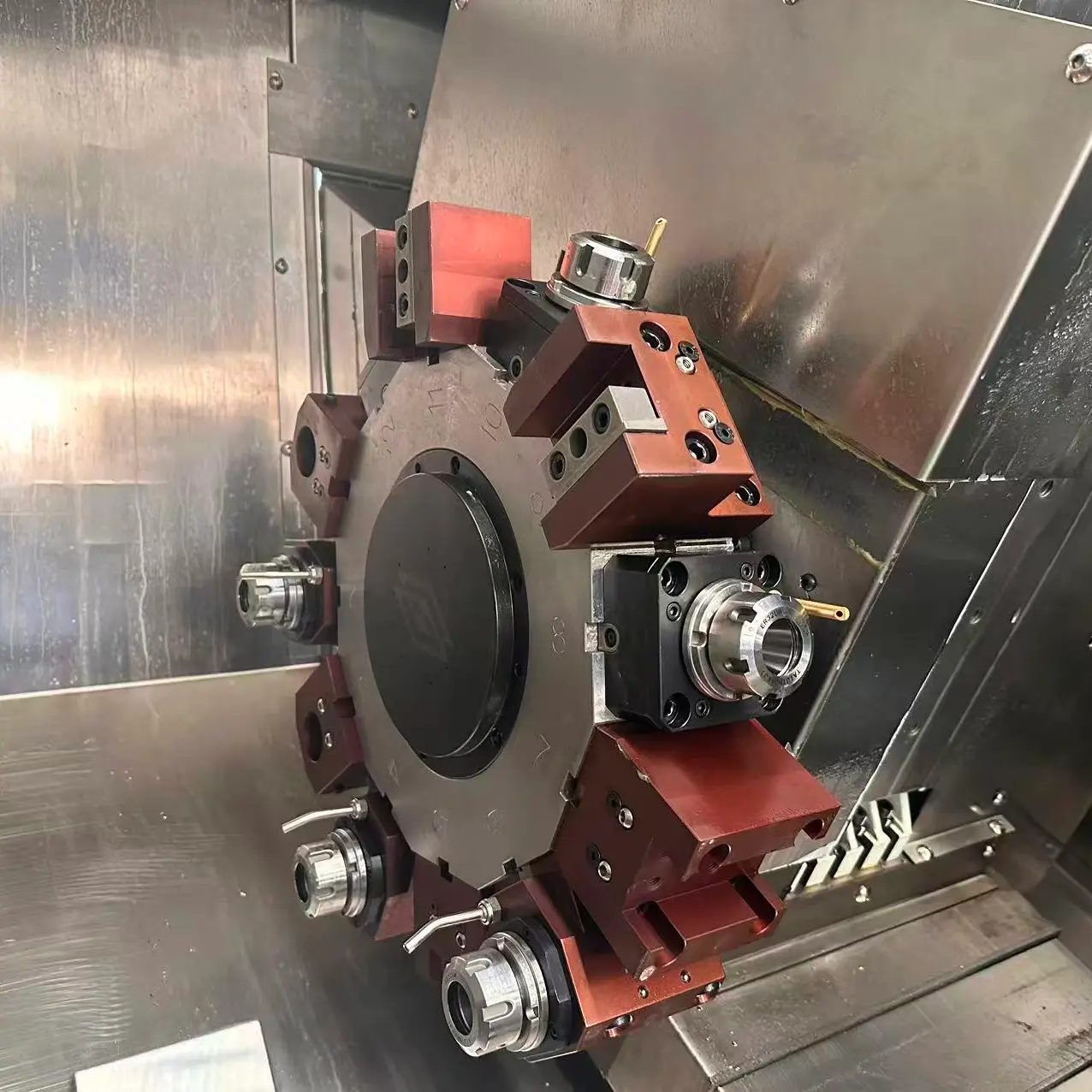
Tool presentation and turret indexing. The servo-driven turret or gang-tool slide positions cutting tools. Turret styles include 8-station electric on entry flat-bed lathes, 12-station servo on slant-bed machines, and VDI or BMT turrets on turning centers. Index time ranges 0.3 s to 1.2 s station-to-station. Tool holders lock with a 40 mm or 50 mm VDI shank or bolt-on BMT55/BMT65 interface. Live tooling on Y-axis and C-axis machines spins drills and end mills at 3,000 rpm to 6,000 rpm through the turret face. A cheap machine suffers here: turret repeatability of ±0.02 mm versus ±0.005 mm on hardened curvic-coupling indexers, and slower 0.8 s index times that add 15% to 25% cycle time on multi-tool jobs.
CNC control interpretation and motion generation. The control—FANUC 0i-TF, Siemens 828D, Mitsubishi M80, GSK 980TDi, KND K2000TF, or Syntec 21TA—reads the G-code program or post-processed CAM output. The interpolator calculates simultaneous X and Z axis trajectories (and Y, C, or B on multi-axis machines) at the block processing rate: 0.001 mm command resolution on modern systems. The servo bus transmits position commands to X-axis and Z-axis amplifiers every 2 ms to 4 ms. Rapid traverse reaches 20 m/min to 30 m/min on linear guideway machines, 12 m/min to 16 m/min on box-way flat beds. Cutting feed is interpolated at 0.01 mm/rev to 2.0 mm/rev. A cheap machine loses speed here: 16-bit encoders versus 22-bit absolute encoders on FANUC αi series, and slower PLC scan times that add 50 ms to 100 ms dwell between rapid and cut transitions.
Closed-loop feedback and real-time correction. Linear scales or rotary encoders on the servo motor report actual position. A 22-bit encoder resolves 4,194,304 pulses per revolution; on a 5 mm ball-screw pitch this yields 0.0012 mm theoretical resolution. The servo loop compares commanded versus actual position every 2 ms; following error is held within 0.003 mm to 0.005 mm during cutting. Thermal expansion of the 300 mm to 500 mm Z-axis ball screw is compensated through pitch-error mapping stored in the control—typically 30 to 50 compensation points per axis measured by laser interferometer during factory alignment. A cheap machine loses accuracy here: semi-closed loop (motor encoder only, no linear scale) misses 0.02 mm to 0.05 mm of thermal and backlash drift over a 4-hour shift; no pitch-error map leaves 0.01 mm cumulative screw error uncorrected.
Chip formation and process monitoring. The main spindle rotates at 50 rpm to 3,500 rpm on flat-bed lathes, or 50 rpm to 6,000 rpm on slant-bed turning centers with 7.5 kW to 22 kW spindle motors. Constant surface speed (CSS) mode in G96 automatically adjusts rpm as diameter changes. Tool load monitoring through spindle motor current draw triggers feed-hold at 120% nominal load. A cheap machine lacks this: basic GSK or older KND controls may not offer real-time load display, forcing the operator to set conservative feeds that extend cycle time 10% to 20%.
Part unloading and bar feed continuation. The chuck opens, the part ejector or sub-spindle transfers the finished component, and the bar feeder advances new stock. Bar feeders on production lathes push 3 m to 4 m bars through the spindle bore at 0.5 m/s to 1.0 m/s. Remnant length is 150 mm to 300 mm. On flat-bed lathes without bar feed, the operator reloads manually. A cheap machine loses uptime here: pneumatic bar feeders with single-tube design jam on 0.05 mm out-of-round stock; hydraulic chucks without stroke confirmation switches crash into the turret if the bar slips.
Where Budget Machines Sacrifice Accuracy or Speed
| Process Step | Premium Specification | Typical Budget Compromise | Consequence |
|---|---|---|---|
| Spindle rigidity | HT300 casting, A2-6 nose, 15 kW motor | HT250 casting, A2-5 nose, 7.5 kW motor | 0.03 mm to 0.08 mm deflection at full depth-of-cut; chatter on interrupted cuts |
| Axis feedback | 22-bit absolute encoder + linear scale | 18-bit incremental motor encoder only | 0.02 mm to 0.05 mm positional drift; no thermal compensation |
| Turret indexing | Hardened curvic coupling, 0.3 s index, ±0.003 mm repeatability | Pin-and-hole locator, 0.8 s index, ±0.015 mm repeatability | Tool-to-tool variation stacks into 0.05 mm diameter tolerance band |
| Control processing | FANUC/Siemens with 0.001 mm resolution, 2 ms servo update | GSK/KND with 0.005 mm resolution, 4 ms update | Visible faceting on arcs; slower acceleration curves limit productivity |
Control System and Component Mapping
| Machine Tier | Common Control | Servo/Encoder | Loại đường dẫn | Typical Positioning Accuracy | Typical Repeatability |
|---|---|---|---|---|---|
| Entry flat bed | GSK 980TDi, KND K2000TF | GSK/KND servo, motor encoder | Hardened box way, scraped | ±0,015 mm | ±0,008 mm |
| Mid slant bed | Syntec 21TA, Mitsubishi M80 | Mitsubishi αi/βi, optional linear scale | Hệ thống dẫn hướng con lăn tuyến tính (HIWIN/PMI) | ±0,010 mm | ±0.005 mm |
| Production turning center | FANUC 0i-TF Plus, Siemens 828D | FANUC αi series, 22-bit absolute, linear scale standard | Linear roller guide, hardened and ground | ±0.005 mm | ±0,003 mm |
Workpiece Holding and Spindle Interface Detail
Flat-bed CNC lathes favor manual 3-jaw chucks and tailstock work for one-off and repair jobs. Slant-bed turning centers use hydraulic chucks with foot-pedal operation and programmable clamp pressure (8 bar to 25 bar) to prevent thin-wall distortion. Through-spindle coolant at 20 bar to 70 bar clears chips in deep-hole drilling; budget machines often omit this, requiring peck cycles that triple drilling time. Sub-spindle configurations on twin-turret machines permit complete back-side machining without re-chucking—critical for 0.01 mm concentricity on shaft work—but add 40% to machine cost and require Y-axis travel of ±40 mm to ±80 mm for off-center features.

Các loại và cấu hình của máy tiện CNC
| Loại hoặc Lớp | Phạm vi làm việc điển hình | Tùy chọn điều khiển | Phù hợp nhất với | Ghi chú |
|---|---|---|---|---|
| Máy tiện CNC bàn phẳng | Swing over bed 400–800 mm; between centers 750–3000 mm | GSK 980TDi, KND K1000Ti, FANUC 0i-TF, Siemens 828D | Shafts, long bars, repair work, oil-field couplings | Manual tailstock and steady rest friendly; chip evacuation inferior to slant bed |
| Máy tiện CNC giường nghiêng | Swing over bed 360–660 mm; max turning length 500–1500 mm | FANUC 0i-TF Plus, Mitsubishi M80, Syntec 22TA, Siemens 828D | Medium-batch automotive, hydraulic fittings, general precision turning | 30–45° bed angle; linear guides or box ways; turret with 8–12 stations standard |
| Máy tiện CNC đứng | Max turning diameter 1000–2500 mm; max height 800–1600 mm | FANUC 0i-TF, Siemens 828D, GSK 980MDi | Brake discs, pump housings, large flanges, aerospace rings | Gravity-assisted chip fall; sub-spindle and C-axis rare below 1600 mm diameter |
| Máy tiện CNC kiểu Thụy Sĩ | Max bar diameter 12–38 mm; Z-axis travel 200–350 mm | FANUC 32i-B, Mitsubishi M70V, Syntec 21TA | Medical bone screws, connector pins, watch parts | Sliding headstock; guide bushing required; gang tooling plus rotary tools standard |
| Twin-Spindle / Multi-Axis Turning Center | Main/sub spindle A2-5 to A2-8; B-axis milling spindle optional | FANUC 31i-B5, Siemens 840D sl, Mitsubishi M800 | Complex prismatic shafts, gear blanks, five-face machining in one fixturing | Y-axis ±40–100 mm; live tooling 4000–12000 rpm; 80–120 tool magazine on mill-turn variants |
| Heavy Duty CNC Lathe | Swing over bed 1000–2000 mm; between centers 4000–12000 mm | Siemens 840D sl, FANUC 35i-B | Ship propeller hubs, turbine shafts, large roll cylinders | HT300 or Meehanite casting; 55–110 kW main spindle; floor-mounted steady rests; foundation bolts mandatory |
Máy tiện CNC bàn phẳng
Flat bed CNC lathes preserve the horizontal bed layout of conventional engine lathes with the saddle and cross-slide riding on hardened box ways or, in newer designs, on linear roller guides. Typical specifications include a 400–660 mm swing over bed, 750–1500 mm between centers, spindle nose A2-6 or A2-8, and a 7.5–15 kW main motor driving to 2500 rpm. Positioning accuracy runs 0.015 mm and repeatability 0.008 mm on GSK or KND controls; FANUC and Siemens variants tighten this to 0.010 mm / 0.005 mm. Machine weight sits between 2800 kg and 5500 kg. Buyers are job shops doing shaft repair, oil-field coupling rework, and agricultural implement manufacturing. The flat bed excels at manual intervention—adding a steady rest, tailstock drilling, or between-center grinding attachments is straightforward. What it cannot do is evacuate chips efficiently at high cutting speeds; the horizontal surface traps swarf, and coolant pooling is chronic. Slant bed machines outperform it on cycle time and automation integration.
Máy tiện CNC giường nghiêng
Slant bed CNC lathes angle the bed at 30°, 45°, or 60° to the horizontal, directing chips by gravity into a conveyor while lowering the operator loading height. Working ranges center on 360–660 mm swing and 500–1500 mm maximum turning length. Spindle power ranges 7.5–22 kW with speeds to 4000–6000 rpm on A2-5, A2-6, or A2-8 nose. Rapid traverse reaches 20–36 m/min on X and Z axes with HIWIN or PMI linear guides; box-way variants trade speed for rigidity at interrupted cuts. Positioning accuracy is typically 0.010 mm with 0.005 mm repeatability. FANUC 0i-TF Plus, Mitsubishi M80, and Syntec 22TA dominate export configurations. Machine weight spans 3500 kg for a 360 mm swing machine to 8500 kg at 660 mm swing. Automotive tier-two suppliers, hydraulic fitting producers, and general job shops buy these in volume. The slant bed cannot economically handle very long shafts—tailstock alignment over 1500 mm grows troublesome—and large-diameter face work is awkward because the carriage interferes with the chuck face on short, wide parts.
Máy tiện CNC đứng
Vertical CNC lathes orient the spindle axis vertically with the worktable facing upward, using the machine base as a natural chip pan. Typical machines handle 1000–2500 mm maximum turning diameter and 800–1600 mm height, with table speeds 100–500 rpm and main power 30–75 kW. Controls are FANUC 0i-TF or Siemens 828D on standard models; Siemens 840D sl on machines with live tooling and C-axis. Positioning accuracy is 0.015 mm on diameter due to the large rotary table bearing; repeatability holds at 0.008 mm. Weight runs 12000–45000 kg. Brake disc manufacturers, pump casing foundries, and aerospace ring producers are the core buyers. The vertical configuration eliminates gravitational deflection on thin-walled rings and lets heavy castings load directly from overhead cranes. It cannot turn long shafts—there is no between-center capability—and the footprint per unit of swept diameter is larger than a horizontal lathe of equivalent capacity. Sub-spindle and second-op automation are rare below the 1600 mm class.
Máy tiện CNC kiểu Thụy Sĩ
Swiss-type CNC lathes feed bar stock through a guide bushing with the headstock sliding in Z, keeping the cutting zone close to the guide bushing support point for minimal deflection on slender parts. Bar capacity defines the machine: 12, 16, 20, 25, or 32 mm are standard, with 38 mm as the upper commercial limit. Z-axis travel matches bar advance at 200–350 mm; X-axis travel is typically 120–200 mm per spindle. Main spindle speeds reach 10000–15000 rpm with 3.7–11 kW motors. Gang tooling is standard; rotary tools mill flats and drill cross-holes at 6000–12000 rpm. Controls are FANUC 32i-B, Mitsubishi M70V, or Syntec 21TA. Positioning accuracy is 0.003 mm with 0.002 mm repeatability. Machine weight is compact at 2500–4500 kg. Medical device contract manufacturers, automotive connector specialists, and precision component shops buy these. The Swiss-type cannot use cast or forged blanks—bar stock only—and the guide bushing bore must match bar diameter within 0.05 mm, requiring inventory of multiple bushing sets. Chucker conversion kits exist but sacrifice the rigidity advantage.
Twin-Spindle Multi-Axis Turning Center
Twin-spindle turning centers add a sub-spindle opposed to the main, plus Y-axis off-center milling and live tooling, to complete prismatic features without secondary operations. Main and sub spindles run A2-5 to A2-8 with 11–30 kW and speeds to 5000 rpm; live tooling spindles hold ER25 or ER32 collets at 4000–12000 rpm. Y-axis travel is ±40 mm on smaller machines, ±100 mm on mill-turn variants with B-axis milling heads. X/Z rapid traverse reaches 36–60 m/min with linear roller guides. Tool magazines expand to 80–120 stations with automatic tool changers on mill-turn configurations. FANUC 31i-B5, Siemens 840D sl, and Mitsubishi M800 handle the synchronized spindle transfers and five-axis interpolation. Positioning accuracy is 0.008 mm; repeatability 0.004 mm. Machine weight runs 8000–18000 kg. Automotive camshaft and gear blank producers, aerospace hydraulic manifold manufacturers, and high-mix low-volume job shops invest here. The machine cannot justify its capital cost on pure turning—milling content must exceed 30 percent of operation time—and programming complexity demands CAM software and skilled operators. Single-spindle slant beds outperform it on simple shafts at one-third the price.
Heavy Duty CNC Lathe
Heavy duty CNC lathes scale the flat bed architecture to swing diameters of 1000–2000 mm and between-center lengths of 4000–12000 mm, with bed widths of 800–1400 mm. HT300 or Meehanite castings are stress-relieved twice; machine weight runs 25000–85000 kg. Main spindle power is 55–110 kW at 800–1500 rpm with A2-11 or larger nose; torque, not speed, is the design priority. Controls are Siemens 840D sl or FANUC 35i-B for the servo load management. Positioning accuracy relaxes to 0.020 mm given thermal growth in the bed; repeatability holds 0.010 mm with linear scales. Floor-mounted steady rests, follow rests, and custom gap beds for face-plate work are common. Shipyards, turbine rebuilders, steel mill roll shops, and heavy equipment manufacturers buy these. The machine cannot achieve the surface finishes or tolerance bands of smaller lathes—thermal mass and bearing size work against micron-level stability—and foundation requirements are severe: reinforced concrete inertia blocks 300–500 mm thick with anchor bolt patterns specified by the builder. Crane or gantry capacity for installation matches the machine weight plus 20 percent rigging margin.
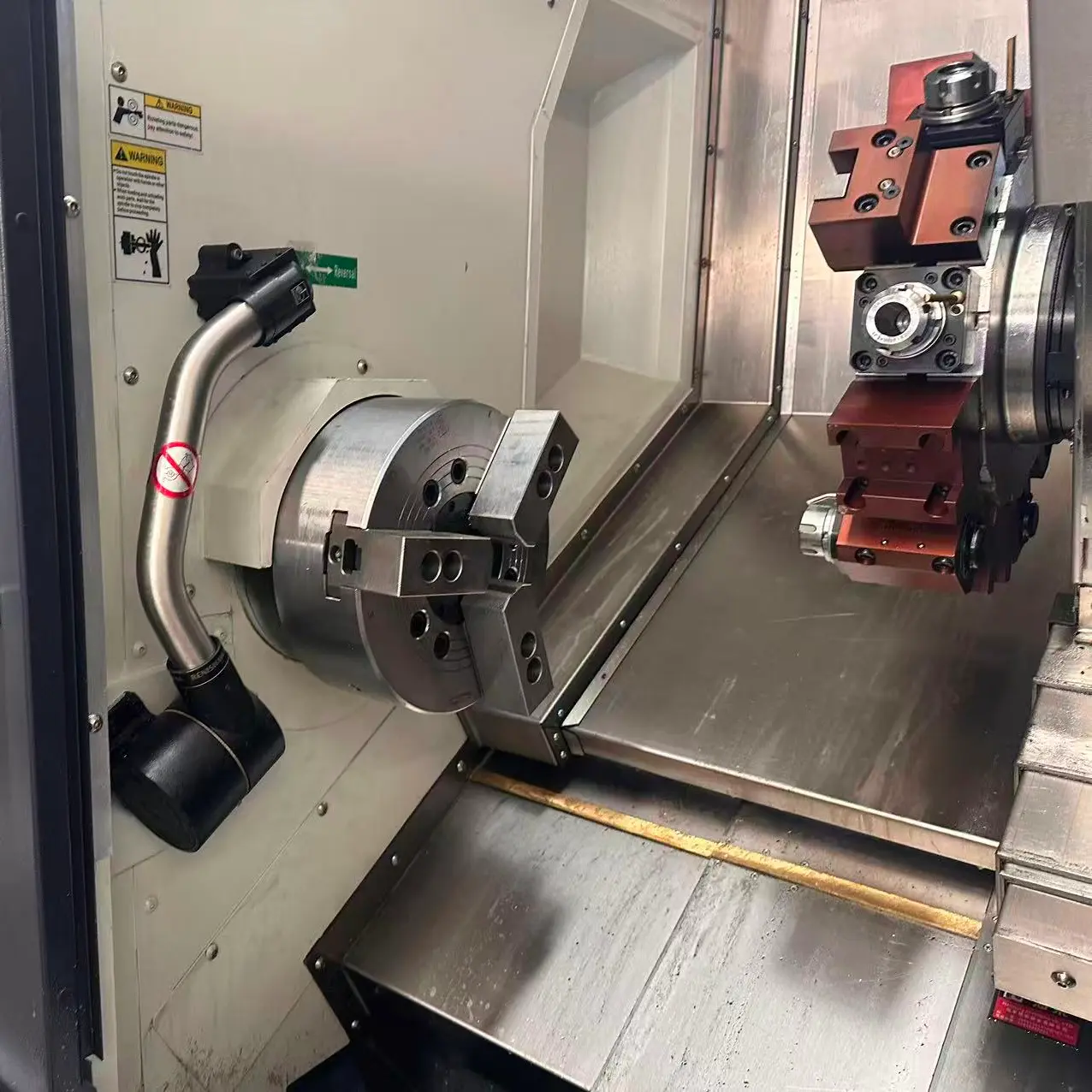
Các bộ phận chính của máy tiện CNC
| Hội đồng | Chức năng | Phiên bản cơ bản tiêu biểu | Phiên bản nâng cấp tiêu biểu | Điều gì sẽ hỏng trước tiên? |
|---|---|---|---|---|
| Đúc giường hoặc khung giường | Structural foundation that absorbs cutting forces and maintains geometric alignment between spindle and turret | HT250 gray cast iron, stress relieved but not always aged, roughly 2500 kg on a 360 mm swing machine | HT300 or Meehanite casting, fully stress relieved and artificially aged 12+ months, 3200–4500 kg on 500 mm swing machine | Thermal distortion from uneven coolant return; foundation settling if floor loading is ignored |
| Đường dẫn | Precise bearing surface for axis motion; determines damping and load capacity | Hardened box way (HRC 52–55), hand-scraped, 0.03 mm positioning accuracy, 15 m/min rapid | Linear roller guide (HIWIN/PMI HG or CG series), 0.008 mm positioning accuracy, 30–36 m/min rapid, lower friction but less vibration damping | Box ways: scoring from contaminated lubrication; linear guides: carriage delamination from impact or overload |
| Vít bi và bộ truyền động | Convert rotary servo motion to linear axis movement with minimal backlash | C7 grade ball screw, 0.05 mm backlash, fixed-free support, 5000 mm/min cutting feed | C3 or C5 grade, 0.01 mm backlash, fixed-fixed support with pretension, 10000 mm/min, often with linear scale feedback | Ball nut wear from chip ingress; support bearing fatigue from rapid reversals at high feed |
| Trục chính | Primary rotary axis that holds workpiece and transmits cutting power | A2-5 nose, 4000 rpm, 7.5 kW, grease-lubricated angular contact bearings | A2-6 or A2-8 nose, 6000 rpm, 15–22 kW, oil-air or oil-mist lubrication, ceramic hybrid bearings for thermal stability | Front bearing pair from contamination or thermal preload mismatch; belt drive belts on entry machines |
| Hệ thống điều khiển và bộ điều khiển servo | Motion planning, G-code execution, servo loop closure | GSK 980TDi or KND K2000Ti, 0.001 mm command resolution, analog servo drive, 3–4 axes | FANUC 0i-TF Plus or Siemens 828D, 0.0001 mm resolution, serial servo bus, 5-axis capability with live tooling, 200+ block lookahead | Power supply capacitors in entry-level systems; encoder cable fatigue in all systems |
| Turret | Indexable tool storage and rapid tool change | 8-station electric turret, 1.2 s index time, VDI30 or VDI40 tool holders, no live tooling | 12-station servo turret, 0.4 s index, VDI40 or BMT55 with live tooling (ER25 collet, 5000 rpm driven tool), hydraulic clamping | Index mechanism wear from crash; tool disc flexure on heavy milling cuts |
| Chuck và trục đuôi | Work holding and long-part support | 3-jaw hydraulic chuck 200 mm, 35 mm through-hole, manual tailstock with MT4 quill | 250 mm power chuck with 52 mm bore, programmable tailstock with 100 mm quill stroke, hydraulic clamp/release | Chuck jaw serration wear; tailstock quill bearing brinelling from repeated dead-center loading |
| Hệ thống chip và chất làm mát | Remove swarf and manage thermal stability | External flood coolant, 200 L/min pump, hinged chip pan, manual cleanout | Through-spindle coolant (70 bar), 500 L/min, scraper conveyor + chip auger, coolant chiller maintaining 24 ±1°C | Pump seal from abrasive particles; conveyor chain stretch from stringy swarf |
| Vỏ bảo vệ và cơ cấu khóa an toàn | Contain chips/coolant, protect operator, manage noise | Partial splash guard, single-door interlock, 78 dB(A) | Full steel enclosure with telescopic covers, dual-channel safety PLC, 72 dB(A), CE-certified light curtain option | Door seal degradation; interlock switch contamination from coolant mist |
Assemblies That Govern Long Term Accuracy
Bed Casting and Thermal Mass
A 500 mm swing CNC lathe with HT300 casting weighing 3800 kg carries roughly 40% more thermal inertia than its HT250 counterpart. This matters because spindle bearing heat and coolant return temperature swings distort the bed over a shift. Machines with artificially aged castings and integrated coolant temperature control hold size on interrupted cuts where lighter beds grow 0.02–0.04 mm between morning and afternoon sessions. The trade-off is floor loading: 4500 kg plus coolant requires 200 mm reinforced concrete, not standard 150 mm industrial slab.
Guideway Geometry Retention
Box ways recover from minor crashes; linear guides do not. However, the accuracy half-life of a hand-scraped box way depends entirely on lubrication discipline—oil film thickness below 0.005 mm invites adhesive wear. Linear roller guides in the same duty cycle show predictable degradation: preload drops 15–20% over 15,000 hours, measurable as increased following error during profiling. Rebuilding box ways is feasible in most markets; replacing linear guide carriages requires OEM part availability. For Southeast Asian and African buyers where service infrastructure is sparse, this shapes total cost more than purchase price.
Spindle Bearing System
The front bearing pair determines both radial runout and thermal drift. A 6000 rpm A2-6 spindle with ceramic hybrid bearings generates 30–40% less heat than steel-alloy equivalents at equal preload, holding 0.003 mm TIR stability after thermal equilibrium. Grease-lubricated entry spindles require repack at 6,000–8,000 hours; oil-air systems run 15,000+ hours but need compressed air filtration to ISO 8573-1 Class 1.2.1. The failure mode to watch is not catastrophic seizure but gradual preload loss: part diameter grows 0.010 mm across a batch before operators notice the trend.
Thông số kỹ thuật và cách đọc chúng
| Tham số | Mức độ sơ cấp | Phân khúc tầm trung | Thông số kỹ thuật cao |
|---|---|---|---|
| Max turning diameter | 360 mm | 500 mm | 800 mm |
| Chiều dài quay tối đa | 500 mm | 1.000 mm | 3.000 mm |
| Kích thước mũi khoan | 6″ (160 mm) hydraulic | 8″ (210 mm) hydraulic | 12″ (305 mm) hydraulic |
| Mũi trục | A2-5 | A2-6 | A2-8 |
| Tốc độ trục chính | 3.500 vòng/phút | 4000 rpm | 2.500 vòng/phút |
| Công suất trục chính | 7,5 kW | 11 kW / 15 kW dual | 22 kW |
| Độ côn trục chính | — | — | — |
| Hành trình trục X | 180 mm | 250 mm | 420 mm |
| Hành trình trục Z | 550 mm | 1.050 mm | 3050 mm |
| Di chuyển nhanh (X/Z) | 20/24 m/phút | 24/30 m/phút | 16/20 m/min |
| Loại đường dẫn | Rãnh dẫn hướng hộp được tôi cứng | Hệ thống dẫn hướng con lăn tuyến tính (HIWIN/PMI) | Rãnh dẫn hướng hộp được tôi cứng |
| Độ chính xác định vị | ±0,015 mm | ±0,010 mm | ±0,008 mm |
| Độ lặp lại | ±0,006 mm | ±0,004 mm | ±0,003 mm |
| Trạm tháp pháo | 8-position electric | 12-position servo | 12-position servo + Y-axis |
| Thời gian thay dao | 0,3 giây/trạm | 0,2 giây/trạm | 0.15 sec/station |
| Hệ thống điều khiển | GSK 980TDi / KND K2000Ti | FANUC 0i-TF / Siemens 828D | FANUC 0i-TF Plus / Siemens 840D sl |
| Trọng lượng tịnh của máy | 2.200 kg | 4.500 kg | 12500 kg |
| Floor space (L×W×H) | 2400×1500×1700 mm | 3600×2000×1900 mm | 7200×2500×2200 mm |
| Điện áp nguồn | 380V 3-phase 50Hz | 380V 3-phase 50Hz | 380V 3-phase 50Hz |
| Tổng công suất tải kết nối | 15 kVA | 25 kVA | 45 kVA |
How to Read Each Line of the Specification Sheet
Working Range or Travels (X/Z axes)
These numbers define the envelope inside which the tool can move. X-axis travel controls how far from the spindle centerline you can cut—roughly half your max turning diameter minus clearance. Z-axis travel is your maximum part length plus chuck and tool clearance. A 500 mm Z-travel machine cannot handle a 500 mm shaft; subtract 80–150 mm for jaw protrusion and tool overhang.
Max Turning Diameter and Length
The diameter is the largest disc or flange you can swing over the bed ways without collision. The length is the longest shaft between centers or in chuck-only work. These are marketing numbers—actual usable dimensions shrink by 10–15% once you mount fixtures, boring bars, or tailstocks.
Spindle Speed and Power
Speed in rpm multiplied by torque determines your material removal rate. Small parts in aluminum need 4000+ rpm; large steel shafts in oil and gas need high torque at 800–1500 rpm. Power ratings are continuous duty—peak ratings may be 20% higher for short bursts. A 15 kW spindle on a mid-range machine is typically dual-wound: 11 kW at standard speed, 15 kW at base speed for heavy roughing.
Spindle Taper or Chuck Size
CNC lathes use A2-nose camlock spindles (A2-5, A2-6, A2-8) rather than milling tapers like BT40. The number correlates with chuck diameter: A2-5 for 6–8″ chucks, A2-6 for 8–10″, A2-8 for 12″ and above. Larger noses mean larger through-bores for bar feeding and stiffer mounting for big chucks.
Loại đường dẫn
Hardened box ways ( scraped Turcite-B lined cast iron) damp vibration and handle interrupted cuts in cast iron or forged blanks. They wear slowly but limit rapid traverse to 16–20 m/min. Linear roller guides (HIWIN, PMI, Schneeberger) enable 30+ m/min rapids and finer finishes but transmit more vibration and require clean coolant. Heavy-duty machines above 6 tonnes typically return to box ways for rigidity.
Rapid Traverse and Feed Rate
Rapids are positioning moves with no cutting—higher numbers reduce non-cutting time. Feed rates during cutting are typically 1/10th to 1/100th of rapid. Entry-level machines at 20 m/min rapids lose productivity on short-cycle parts; high-end machines at 30 m/min with 0.2 second turret indexing can justify the premium only above 2000 hours annual spindle time.
Độ chính xác và độ lặp lại trong định vị
Positioning accuracy (±0.010 mm) measures how close the tool reaches the commanded dimension. Repeatability (±0.004 mm) measures whether it hits the same spot twice. Repeatability matters more for production—if your process is stable, you offset for accuracy once and hold repeatability for thousands of parts. Laser calibration and ballbar testing verify these; ask for the actual report, not the brochure claim.
Tool Magazine Capacity and Change Time
Turret lathes use disk or drum turrets with 8–12 stations. “Change time” here means index time to the next station—0.2 seconds is standard for servo turrets. True tool magazines with arm changers appear on mill-turn centers, not pure lathes. Each station holds one tool; if you need drills, OD turners, grooving tools, and boring bars for one part, 8 stations fill fast.
Hệ thống điều khiển
FANUC 0i-TF dominates global job shops for reliability and technician familiarity. Siemens 828D offers better conversational programming and five-axis capability if you expand to mill-turn. GSK 980TDi and KND K2000Ti cut 40–50% from control cost but reduce resale value and local service depth. Mitsubishi M80 is common in Southeast Asian markets with Japanese supply chains. Syntec suits Taiwanese-built machines with good English support.
Supply Voltage and Total Connected Load
380V 50Hz is Chinese and European standard. North American buyers at 220V 60Hz or 480V 60Hz need step-up/step-down transformers. Connected load includes spindle, coolant, hydraulic, and chip conveyor—size your workshop supply 25% above this number.
Machine Net Weight and Floor Space
Weight correlates with rigidity and vibration damping. A 2200 kg entry machine needs no special foundation; a 12500 kg machine needs 150–200 mm reinforced concrete with anchor bolts and leveling pads. Floor space must include operator access, chip conveyor extension, and tool cart circulation—add 1 meter clearance on all sides to the stated dimensions.
Trade Terms and Export Documentation
FOB (Giao hàng tại tàu)
Seller delivers the machine to the port of departure and loads it onto the vessel. Buyer pays ocean freight, insurance, and all unloading costs. Risk transfers when the machine crosses the ship’s rail. RUNNEWTECH quotes FOB Qingdao or Shanghai as standard.
CIF (Giá cước, bảo hiểm và cước vận chuyển)
Seller arranges and pays for ocean freight and marine insurance to the named destination port. Buyer handles unloading, customs clearance, and inland transport. Insurance coverage is typically 110% of invoice value; verify whether it covers total loss only or partial damage.
CFR (Giá cước và cước vận chuyển)
Same as CIF but without insurance arranged by seller. Buyer must procure their own marine policy. Rare in machinery trade but appears when buyers have existing annual coverage.
EXW (Giao hàng tại xưởng)
Buyer collects from the factory and handles all export clearance, loading, and transport. Lowest quoted price but highest buyer burden. Only practical if you have a freight forwarder in China and export experience.
Điều khoản thanh toán
T/T (Telegraphic Transfer) is standard: 30% deposit with order, 70% before shipment. L/C (Letter of Credit) at sight adds 0.3–0.8% bank charges but protects both parties on first transactions. RUNNEWTECH accepts both; L/C is mandatory for some Middle Eastern and African markets per central bank regulations.
HS Code
CNC lathes fall under 8458.11 (horizontal lathes, numerically controlled) or 8458.91 (other lathes, numerically controlled). Correct classification determines import duty rates—typically 5–15% in developing markets, 0–3% in markets with China FTA agreements.
CE Marking and Documentation
CE declaration of conformity covers machinery directive 2006/42/EC, EMC directive 2014/30/EU, and low voltage directive 2014/35/EU. The dossier includes risk assessment, electrical schematics, hydraulic diagrams, and operation manual in English. CE is mandatory for EU entry; other markets accept it as quality shorthand but may require additional local certification.
Packing List and Certificate of Origin
Packing list details gross weight, net weight, dimensions, and contents of each crate—typically one crate for the machine body, one for chip conveyor and accessories, one for tools and manuals. Certificate of origin (FORM A, CO, or FTA certificate) determines preferential duty rates. Request the specific format your customs authority recognizes before shipment.
Container Loading Considerations
Entry-level machines at 2200 kg fit in 20′ GP containers (max payload 21 tonnes). Mid-range machines at 4500 kg need 40′ GP or high cube. Large machines exceeding 2500 mm width require flat-rack OOG (out of gauge) shipment with lifting lugs and lashing plans. Machine weight limits road transport in some African and Southeast Asian markets—verify bridge formulas and axle limits for your final destination.
Các ứng dụng trong công nghiệp của máy tiện CNC
| Lĩnh vực | Các bộ phận tiêu biểu được sản xuất | Thông số kỹ thuật đề xuất | Tại sao chiếc máy này lại phù hợp |
|---|---|---|---|
| Phụ tùng ô tô và xe máy | Brake discs, camshafts, piston pins, wheel hubs, drive shafts, gear blanks | Flat bed CNC lathe, 500 mm max turning diameter, 1500 mm max turning length, A2-8 spindle nose, 45 kW spindle power, 2000 rpm, positioning accuracy 0.015 mm, repeatability 0.008 mm, FANUC 0i-TF control | High torque at low speed for interrupted cuts on cast iron brake discs; flat bed design allows easy chucking of irregular forgings and accommodates steady rests for long camshafts |
| Máy móc nông nghiệp | Tractor axle shafts, hydraulic cylinder rods, bearing housings, pulley hubs, gearbox shafts | Flat bed CNC lathe, 630 mm swing over bed, 3000 mm between centers, A2-11 spindle, 55 kW, 1500 rpm, hardened box ways, GSK 980TDb or Siemens 828D control | Hardened box ways absorb vibration from heavy interrupted cuts on sand-cast workpieces; long bed configuration handles shaft lengths common in tractor drivetrains |
| Phụ kiện thủy lực và khí nén | Cylinder bodies, piston rods, valve spools, port connectors, hose adapters | Slant bed CNC lathe with live tooling, 8″ hydraulic chuck, A2-6 spindle, 22 kW, 4000 rpm, C-axis, positioning accuracy 0.010 mm, repeatability 0.005 mm, Syntec 22TA control | Slant bed chip evacuation prevents bird-nesting on deep bore operations; live tooling and C-axis machine cross-holes and flats without secondary setups |
| Khớp nối cho ngành dầu khí | Drill pipe couplings, casing connectors, wellhead components, valve bodies | Flat bed CNC lathe, 800 mm swing, 4000 mm bed, A2-15 spindle, 75 kW, 800 rpm, constant surface speed control, FANUC 31i-B control | Extreme torque and large spindle bore accommodate heavy wall pipe; rigid construction handles Inconel and stainless steel threading with carbide inserts |
| Công nghệ khuôn mẫu | Core pins, ejector sleeves, gate inserts, sprue bushings, cavity blanks | Slant bed CNC lathe with sub-spindle and Y-axis, 6″ chuck, A2-5 spindle, 15 kW, 6000 rpm, 0.008 mm positioning accuracy, Mitsubishi M80 control | Sub-spindle completes back-side operations in one clamping; Y-axis off-center milling machines flat gates and angular features that would otherwise require a machining center |
| Trung tâm Đào tạo Kỹ thuật | Curriculum parts: shafts, pulleys, threaded connectors, simple gears, test specimens | Flat bed CNC lathe, 360 mm swing, 750 mm length, A2-6 spindle, 11 kW, 2500 rpm, GSK 980TDb or KND K2000Ti control, 2200 kg net weight | Open architecture controls teach G-code fundamentals; smaller footprint fits classroom layouts; lower spindle speed reduces risk during student operation |
Automotive And Motorcycle Parts
Automotive production demands volume and repeatability. A flat bed CNC lathe with A2-8 spindle nose and 45 kW motor delivers the torque needed for roughing cast iron brake discs at 2000 rpm, while 0.015 mm positioning accuracy holds finish tolerances on bearing journals. The flat bed configuration accepts quick-change jaw systems and steady rests for long camshafts up to 1500 mm. For motorcycle forks and wheel hubs, the same machine handles aluminum at higher speeds with coolant-through tooling. FANUC 0i-TF controls dominate this sector for their reliability in unattended shifts, though Siemens 828D offers advantages in multi-axis turning centers where milling integration matters.
Máy móc nông nghiệp
Agricultural components are heavier, rougher cast, and less uniform than automotive work. A 630 mm swing flat bed lathe with hardened box ways—not linear guides—absorbs the vibration from machining sand-cast bearing housings with skin hardness variations. The 3000 mm between-centers specification handles tractor axle shafts that would overhang dangerously on shorter machines. Spindle power of 55 kW at 1500 rpm provides ample torque for interrupted cuts on welded fabrication components. GSK 980TDb controls reduce capital outlay for shops serving seasonal demand, while Siemens 828D suits higher-volume producers running multiple shifts during harvest equipment build cycles.
Hydraulic And Pneumatic Fittings
Hydraulic cylinder bodies require deep, straight bores and precisely machined ports. A slant bed CNC lathe with 8″ chuck and 22 kW spindle at 4000 rpm keeps chips falling away from finished surfaces during long drilling cycles. The 45-degree slant bed geometry prevents chip accumulation in blind holes—a common cause of tool breakage when machining steel cylinder bodies. C-axis and live tooling machine cross-holes and BSP/UNF ports without transferring to a machining center, holding concentricity within 0.010 mm positioning accuracy. Syntec 22TA controls offer cost-effective live tooling integration for mid-volume hydraulic shops, while FANUC systems dominate in OEM production environments.
Oil And Gas Couplings
Drill pipe couplings in API specification require threading heavy-wall steel and exotic alloys at low speed with high torque. An 800 mm swing flat bed lathe with A2-15 spindle nose and 75 kW motor running 800 rpm provides the power density needed for Inconel 718 threading. Constant surface speed control maintains optimal cutting conditions across varying diameters on tapered connections. The 4000 mm bed length accommodates pipe preparation and coupling machining in single setups. FANUC 31i-B controls include canned cycles for API thread forms, reducing programming complexity for shops entering this regulated market. Machine weight exceeds 12,000 kg, requiring foundation design with rebar reinforcement and epoxy-grouted leveling pads.
Mould And Die Work
Mould components demand geometric complexity in small packages. A slant bed lathe with sub-spindle and Y-axis machines core pins and ejector sleeves complete in one clamping—critical when 0.005 mm concentricity between OD and internal water channels determines mould cooling performance. The A2-5 spindle at 6000 rpm with 15 kW provides speed for pre-hardened steel finishing, while Y-axis travel of ±50 mm machines flat gates and angular parting lines without secondary operations. Mitsubishi M80 controls integrate well with CAD/CAM systems used in mould shops. Positioning accuracy of 0.008 mm matches the tolerances typical of H13 and P20 tool steel components.
Trung tâm Đào tạo Kỹ thuật
Teaching CNC turning requires machines robust enough for student mistakes yet accessible enough for curriculum progression. A 360 mm swing flat bed lathe at 2200 kg net weight fits standard classroom floor loading without structural reinforcement. The A2-6 spindle with 11 kW and 2500 rpm ceiling reduces consequences of incorrect speed selection by inexperienced operators. GSK 980TDb and KND K2000Ti controls expose students to ISO G-code programming without proprietary interface layers that obscure fundamental concepts. These machines typically ship 380V 50Hz with transformer options for 220V 60Hz regions, and their 750 mm maximum length handles standard curriculum projects from shafts to threaded connectors without excessive capacity that encourages misuse.
Các máy móc liên quan của RUNNEWTECH

Máy tiện CNC
Trực tiếp từ nhà máy máy tiện CNC với các tùy chọn hệ thống điều khiển của FANUC, Siemens, Mitsubishi, GSK hoặc Syntec và nguồn điện 380V/50Hz hoặc 220V/60Hz dành cho xuất khẩu.
Các câu hỏi thường gặp về máy tiện CNC
Câu hỏi: Số lượng đặt hàng tối thiểu cho một máy tiện CNC là bao nhiêu?
Single-unit orders are standard for lathes under 1500 mm swing. Container consolidation discounts apply at three units for slant-bed models or two units for large flat-bed machines over 3000 kg net weight. OEM badging requires 10-unit annual commitments.
Q: Which control systems are available and what interface languages are supported?
FANUC 0i-TF Plus, Siemens 828D, Mitsubishi M80, GSK 980TDi, KND K2000TF, and Syntec 22TB are stocked. Fanuc and Siemens carry 15 percent price premiums over GSK. All support English; Spanish, Russian, and Arabic require 3-day software loads. USB and Ethernet program transfer are standard.
Câu hỏi: Thời gian xử lý đơn hàng từ khi đặt hàng đến khi giao hàng thường là bao lâu?
Standard slant-bed lathes with A2-5 or A2-6 spindles ship in 25–30 days. Flat-bed machines with 750 mm swing or custom between-centre distances run 45–55 days. FANUC and Siemens controls add 7–10 days due to import lead time from Japan or Germany.
Câu hỏi: Các điều khoản thanh toán tiêu chuẩn cho các đơn hàng xuất khẩu là gì?
30 percent TT deposit, 70 percent balance against copy of bill of lading. Irrevocable LC at sight accepted above 50,000 USD value. No OA terms for first transactions. Currency: USD or EUR. Bank charges are buyer’s responsibility on both ends.
Q: Can the machine be adapted to our local supply voltage and frequency?
Standard build is 380V 50Hz 3-phase. For 220V 60Hz regions including North America and parts of Southeast Asia, a step-up transformer is required: minimum 25 kVA for machines under 11 kW spindle power, 40 kVA for 15–22 kW spindles. Transformers are FOB-priced separately; specify at order.
Q: What shipping method, container type, and transit time apply?
Machines under 3500 kg ship in 20-foot containers; larger flat-bed lathes require flat-rack or 40-foot open-top. FOB Qingdao standard; CIF to main port adds 8–12 percent. Transit: 18–25 days to Southeast Asia, 30–35 days to Middle East, 40–50 days to East Africa, 25–30 days to South America west coast.
Q: What warranty coverage and spare parts support are provided?
12 months from arrival at port for mechanical and electrical components. FANUC and Siemens control warranties are passed through from the OEM. Spare parts kit included: turret seals, proximity switches, fuses, and drive belts. Critical spares ship within 72 hours from Qingdao stock; non-stock items carry 15–20 day lead time.
Q: Is a factory acceptance test and accuracy report provided?
Yes. Every machine undergoes ball-bar testing and laser interferometer verification before shipment. Positioning accuracy and repeatability are recorded: typically 0.015/0.008 mm for linear roller guide machines, 0.020/0.010 mm for hardened box way models. Test reports, CE conformity declaration, and material certificates for HT250 or HT300 castings are included in document pouch.
Q: Does the price include installation and operator training?
No. Basic installation supervision is 180 USD per day plus visa, flight, and local accommodation; typical requirement is 5–7 days. Operator training covers G-code, tool offset, and maintenance over 3 days at buyer’s facility. Remote video support is free for 90 days post-installation.
Q: What tolerance can be held on my specific material?
On 45# carbon steel and 304 stainless, slant-bed lathes with linear guides hold IT6–IT7 with 0.8 Ra surface finish under stable conditions. Repeatability of 0.008 mm does not guarantee part tolerance; thermal variation, tooling, and workholding contribute. Aluminium and brass allow 15–20 percent higher cutting speeds but demand sharper edge geometry.
Q: What are the annual consumables costs?
Inserts: 800–1500 USD/year for moderate production. Hydraulic oil change: 60 litres every 2000 hours. Turret index mechanism grease: 4 cartridges annually. Coolant concentrate: 200 litres/year at standard concentration. These figures assume 16-hour daily operation; job shops running 8 hours see roughly half.
Câu hỏi: Quý công ty có thể cung cấp hồ sơ chứng nhận CE để làm thủ tục thông quan không?
Yes. CE conformity assessment covers electrical safety per EN 60204-1, noise per EN 61800-5-1, and electromagnetic compatibility. Declaration of conformity and technical construction file are provided. Note: CE marking is for EU customs; non-EU destinations may require additional certificates such as EAC for Russia or SONCAP for Nigeria, which must be specified separately.
Thông báo quan trọng
Các thông số kỹ thuật, số liệu về độ chính xác và mức giá trong hướng dẫn này chỉ mang tính tham khảo và được cung cấp nhằm phục vụ công tác lập kế hoạch
chỉ dành cho mục đích này. Phạm vi hoạt động thực tế, dung sai có thể đạt được, tính sẵn sàng của hệ thống điều khiển, yêu cầu về điện áp nguồn và sự tuân thủ
Các thông số kỹ thuật khác nhau tùy theo mẫu máy và quốc gia nhập khẩu. Người mua phải tự xác nhận điện áp và tần số nguồn điện, tải trọng sàn và
nền móng, thiết bị dỡ hàng và các yêu cầu nhập khẩu trước khi đặt hàng. Tất cả các con số đều phải được xác nhận bằng văn bản trong
hóa đơn tạm tính cuối cùng do RUNNEWTECH phát hành.
Mua máy tiện CNC từ RUNNEWTECH
Once you have matched your part family to the correct CNC lathe type, the next decision is sourcing a machine that actually ships with the configuration you specified. Runlongjia Machinery, operating its export brand RUNNEWTECH since 2010, has built and shipped flat bed and slant bed CNC lathes for over 15 years across Southeast Asia, the Middle East, Africa, South America, Eastern Europe and North America.
What RUNNEWTECH Builds and Ships
The CNC lathe range covers swing over bed from 400 mm to 800 mm, max turning length from 750 mm to 3000 mm, and spindle bores from 52 mm to 105 mm. Control options include FANUC 0i-TF, Siemens 828D, GSK 980TDi and KND K2000TF. Spindle power ranges 7.5 kW to 22 kW, with A2-5, A2-6 or A2-8 nose configurations and hydraulic or manual chucks from 6 inch to 12 inch. Guideways are offered as hardened box ways (HT300 casting, suitable for heavy interrupted cuts) or linear roller guides (HIWIN/PMI, for faster 24 m/min rapid traverse and tighter positioning accuracy to ±0.005 mm repeatability).
Every machine is run-in for a minimum 8 hours, factory acceptance tested against the buyer’s sample program, then packed in plywood cases with VCI rust protection. Voltage and frequency are adapted to your local supply—380V 50Hz or 220V 60Hz—with transformer supplied where needed. Documentation includes CE conformity, foundation layout drawings, and lifting diagrams specifying crane or forklift capacity for unloading.
Support After Delivery
Installation guidance is provided via remote video commissioning and written operator training material. Spare parts—turret index fingers, chuck jaws, tool holders, proximity switches—are stocked for common configurations and shipped within 72 hours.
Send your workpiece material, maximum part diameter and length, required tolerance class, and destination port to receive a quotation within 24 hours through the contact form at runnewtech.com or directly via email.
Nhận báo giá trực tiếp từ nhà máy cho máy tiện CNC
RUNNEWTECH đã sản xuất máy móc gia công kim loại từ năm 2010,
với hơn 15 năm kinh nghiệm xuất khẩu. Các máy móc được cung cấp kèm theo hệ thống điều khiển theo sự lựa chọn của quý khách, phù hợp với nguồn điện của quý khách
điện áp và tần số, đã qua thử nghiệm chạy thử và thử nghiệm nghiệm thu tại nhà máy trước khi đóng gói. Vui lòng cung cấp cho chúng tôi thông tin về vật liệu phôi, kích thước tối đa của chi tiết,
Vui lòng cung cấp thông số dung sai và cảng đích, chúng tôi sẽ gửi báo giá trong vòng 24 giờ.

 English
  Indonesian
  Vietnamese
  Arabic
  Russian
  Spanish