
Hướng dẫn mua máy cắt laser CNC
A Máy cắt laser CNC is an automated machine tool that uses a focused, high-power laser beam to melt, burn, or vaporize metal sheet and plate, then uses pressurized gas to eject the molten material and create a cut edge. A computer numerical control system guides the cutting head along two axes—typically X and Y—over a stationary workpiece fixed to a cutting table.
The problem this machine solves is speed and repeatability in profile cutting. A manual oxy-fuel or plasma setup requires layout, tracing, and hand guidance; kerf variation runs 1–3 mm, and a skilled operator might manage 1–2 metres per minute on thin mild steel. A 3 kW fiber laser on a 3015 table (3000 mm × 1500 mm) cuts 3 mm stainless steel at 8–12 m/min with a kerf of 0.1–0.3 mm, with repeatability of ±0.03 mm. The CNC program stores nesting patterns, so once the first part is proven, the hundredth is identical.
How It Differs from Manual and Plasma Methods
Manual plasma cuts conductive metals with an arc and compressed air, but the torch height varies, bevel angle drifts, and dross requires grinding. Oxy-fuel limits you to carbon steel and needs preheat cycles. A fiber laser source—Raycus, MAX, or IPG at 1 kW to 12 kW—cuts mild steel, stainless, aluminum, brass, and copper with a single setup. The cutting head, typically Raytools or Precitec, maintains float height via capacitive sensing at 0.5–1.0 mm above the sheet. Linear guides from HIWIN or PMI drive the gantry at rapid traverse rates of 80–120 m/min; positioning accuracy is ±0.05 mm with repeatability of ±0.03 mm on machines built to CE standards.
What First-Time Buyers Must Understand
Three factors determine whether a machine fits your work: laser source power, table size, and bed construction. A 1 kW source handles sheet up to 6 mm mild steel; 3 kW reaches 12–16 mm; 6 kW and above cuts 20–25 mm. Table sizes run 3015, 4020, or 6020; match this to your standard sheet stock to reduce remnant waste. The bed frame uses welded steel plate or cast construction, often 4000–8000 kg net weight for a 3015 machine, requiring a factory floor rated for the load and a forklift or crane with 5-tonne capacity for container unloading. Controls are typically CypCut or FSCUT for fiber lasers, with EtherCAT servo drives; FANUC or Siemens integration appears on high-end gantry systems.
The remainder of this page covers source types, assist gas selection, nesting software, and the foundation and electrical requirements for installation.
How a CNC Laser Cutting Machine Works
A Máy cắt laser CNC is an automated fabrication system that uses a focused beam of coherent light to melt, burn or vaporize material along a programmed path. It replaces manual layout, marking and cutting with a process that positions the beam relative to a stationary or moving sheet with sub-millimetre accuracy.
What Problem It Solves
Manual cutting with oxy-fuel torches, shears or band saws requires template making, edge cleanup and constant operator attention. A CNC laser eliminates layout time, reduces kerf width to 0.1–0.3 mm on thin steel, and cuts complex contours without tool changes. For a job shop producing 50–500 parts per batch, the payoff is not speed alone but the elimination of setup time between different geometries.
The Process Flow
- Sheet loading and clamping. A raw sheet—typically 1.25 m × 2.5 m, 1.5 m × 3 m, 2 m × 4 m or 2 m × 6 m—rests on a support table with integrated pneumatic clamps or a vacuum zone. On pallet-exchange systems, one table loads while the other cuts. The sheet sits approximately 0.5–2 mm above slat supports to prevent beam reflection damage.
- CNC controller parses the nest. The control—commonly FANUC, Siemens 828D, Mitsubishi M800, or in cost-sensitive markets GSK, KND or Syntec—reads the G-code or native CAM output. The nest defines part geometry, lead-in/lead-out paths, cutting sequence and tab placement. The controller calculates velocity profiles, acceleration limits and corner rounding to maintain contour accuracy.
- Laser source generates the beam. A fiber laser source—Raycus, MAX or IPG are common brands—pumps diode light into a doped fiber, producing a beam at 1,070 nm wavelength. Power ratings run 1 kW to 12 kW or higher. The beam exits the source through a fiber optic cable, typically 10–20 m long, to the cutting head.
- Beam delivery and focusing. The cutting head, often a Raytools BM110 or Precitec LightCutter, contains collimating optics, a focusing lens with 125–200 mm focal length, and a protective window. The lens concentrates the beam to a spot 0.1–0.2 mm in diameter with power density exceeding 10^6 W/cm². Assist gas—oxygen for mild steel, nitrogen for stainless and aluminium, compressed air for thinner gauges—coaxially jets through a 0.8–2.5 mm nozzle at 8–25 bar.
- Capacitive height sensing maintains standoff. A capacitive sensor in the cutting head measures distance to the sheet surface in real time, typically maintaining 0.5–1.5 mm standoff. The Z-axis servo—driven by a ball screw on entry machines, linear motor on high-end systems—adjusts at 50–200 Hz to follow warped or uneven material. Without this closed-loop feedback, the beam defocuses and cut quality degrades immediately.
- X-Y motion executes the program. Gantry or flying-optic systems move the cutting head over the sheet. Entry-level machines achieve positioning accuracy of ±0.05 mm and repeatability of ±0.03 mm; precision systems reach ±0.03 mm / ±0.02 mm. Rapid traverse rates range from 60 m/min on small machines to 140 m/min or higher on large-format gantries. Linear guides—HIWIN or PMI on many Chinese-built systems—carry the load; hardened box ways appear only on heavy-duty plasma-laser hybrid builds, not pure fiber lasers.
- Part unloading and skeleton removal. Cut parts drop through a chute to a parts bin, or remain tabbed to the skeleton for manual removal. On automated lines, a sorting robot or conveyor separates finished pieces. The skeleton is lifted by crane or forklift for scrap processing.
Where Cheap Machines Lose Accuracy or Speed
Open-loop or low-resolution Z-axis control. Budget machines substitute mechanical limit switches or low-frequency contact probes for true capacitive height sensing. At 6 kW and above, thermal distortion of the sheet during cutting exceeds the correction bandwidth. The result is focal length drift, edge striation and dross adhesion that requires secondary grinding.
Gantry construction and guide spacing. A 3015 format (3 m × 1.5 m) machine needs a portal beam with sufficient torsional stiffness to prevent nod under acceleration. Machines under 4,000 kg net weight often use single-sided rack-and-pinion drives or undersized linear guides (HIWIN 25 mm rail instead of 35 mm or 45 mm). The positioning accuracy may still test at ±0.05 mm in static conditions, but dynamic following error during direction reversal at 1G acceleration can exceed 0.15 mm on corners.
Laser source and optics quality. A 3 kW Raycus source costs significantly less than a 3 kW IPG. The trade-off is beam parameter product (BPP): Raycus units typically run 2.0–3.5 mm·mrad, IPG single-mode units below 2.0 mm·mrad. Higher BPP means a larger focused spot and lower power density. At 6 mm mild steel, the difference is negligible. At 20 mm, the premium source cuts 15–25 percent faster with cleaner edges. Cheap machines also use non-OEM protective windows and lenses; thermal lensing from poor coatings causes beam wander that no amount of CNC compensation can fix.
What First-Time Buyers Must Verify
Request the manufacturer’s acceleration specification, not just rapid traverse. A machine rated at 120 m/min rapid but 0.5G acceleration spends most of its cutting time below 30 m/min on complex nests. Ask for the capacitive height sensor brand and sampling frequency. Confirm whether the controller supports real-time power modulation linked to feed rate—essential for small holes and tight radii. Finally, verify the laser source warranty terms separately from the machine warranty; they often differ, with source manufacturers offering 24–36 months on the resonator but only 12 months on the delivery fiber.

Cnc Laser Cutting Machine assembled and run-in tested before shipment
Các loại và cấu hình của máy cắt laser CNC
A CNC laser cutting machine is an automated machine tool that directs a focused high-power laser beam through a CNC-controlled cutting head to melt, burn, or vaporize material along programmed paths. It replaces manual layout, marking, and cutting with a process that needs no physical contact, no tooling changes for different part shapes, and no post-cut deburring on many materials.
The “CNC” element matters because it separates these machines from handheld laser cutters or manually guided tracing units. A CNC laser cutter reads G-code or proprietary CAM output, drives servo motors on X, Y, and optionally Z and rotary axes, and modulates laser power, assist gas pressure, and cutting speed in real time. The operator loads sheet stock, calls the program, and monitors; the machine handles positioning accuracy to ±0.03 mm and repeatability to ±0.02 mm on well-built systems.
Entry-Level Open Bed Fiber Laser
| Loại hoặc Lớp | Phạm vi làm việc điển hình | Tùy chọn điều khiển | Phù hợp nhất với | Ghi chú |
|---|---|---|---|---|
| Entry-Level Open Bed Fiber Laser | 1500 × 3000 mm (3015) | GSK, KND, Syntec | Small job shops, sign makers, prototype shops | Single pallet, no enclosure; operator exposed to laser class 4 radiation without added guarding |
These machines typically run 1 kW to 3 kW Raycus or MAX fiber laser sources with Raytools BT210 or BT240 cutting heads. Rapid traverse reaches 80–100 m/min on HIWIN or PMI linear guides. Weight sits around 2500–3500 kg. Buyers are often first-time laser users moving from plasma or shears. The open design keeps cost down but requires the buyer to add external extraction and safety enclosure; without this, the machine cannot meet CE or most local safety codes. Cut quality on thin mild steel and stainless is acceptable, but the lack of pallet changer kills throughput on anything above ten-sheet production runs.
Dual-Pallet Enclosed Fiber Laser
| Loại hoặc Lớp | Phạm vi làm việc điển hình | Tùy chọn điều khiển | Phù hợp nhất với | Ghi chú |
|---|---|---|---|---|
| Dual-Pallet Enclosed Fiber Laser | 1500 × 3000 mm (3015) or 2000 × 4000 mm (4020) | Syntec, Siemens, Mitsubishi | Mid-size fabrication shops, automotive Tier 2 suppliers, agricultural equipment makers | Enclosed class 1 laser safe; automatic pallet exchange cuts idle time |
Power class ranges 3 kW to 6 kW, with IPG, MAX, or nLIGHT sources becoming common at the upper end. Precitec or Raytools auto-focusing cutting heads handle 0.5–25 mm mild steel depending on power and assist gas. Machine weight runs 8000–12000 kg. The dual-pallet design lets the operator unload finished parts and reload while the machine cuts the next sheet—critical for shops billing hourly that cannot afford gantry idle time. Positioning accuracy typically ±0.05 mm, repeatability ±0.03 mm. These machines cannot economically cut copper or brass without oxygen assist and parameter tuning; reflective metal cutting remains a limitation without higher-end piercing routines and burst-mode power control.
Large-Format Gantry Fiber Laser
| Loại hoặc Lớp | Phạm vi làm việc điển hình | Tùy chọn điều khiển | Phù hợp nhất với | Ghi chú |
|---|---|---|---|---|
| Large-Format Gantry Fiber Laser | 2000 × 6000 mm (6020) up to 2500 × 8000 mm | Siemens 840D, FANUC 0i-F, Mitsubishi M800 | Shipbuilding, heavy equipment, wind tower component fabrication | Split gantry or fixed beam design; massive foundation requirements |
Working with 6 kW to 12 kW sources, these machines handle 20–40 mm mild steel and 10–15 mm stainless in production. Gantry rapid traverse drops to 60–80 m/min versus smaller machines due to moving mass, but the cutting envelope matters more than speed. Weight exceeds 15000 kg; floor loading and foundation specs become part of the purchase decision. Some builders use hardened box ways on the longitudinal axis for damping versus linear guides on the cross axis. The buyer normally needs a 10-tonne crane for unloading and a concrete foundation isolated from forklift traffic. These machines cannot do precision small-part work cost-effectively; the beam footprint at focal distance limits detail on features under 8–10 mm, and the large bed makes nitrogen consumption prohibitive for thin-sheet batch jobs.
Tube and Profile Fiber Laser
| Loại hoặc Lớp | Phạm vi làm việc điển hình | Tùy chọn điều khiển | Phù hợp nhất với | Ghi chú |
|---|---|---|---|---|
| Tube and Profile Fiber Laser | Round tube Ø20–220 mm, square 20×20–150×150 mm, length 6000–9000 mm | Syntec, Siemens, FANUC | Furniture, fitness equipment, automotive exhaust, structural steel | Chuck-based or roller support; rotary axis interpolation for angled cuts |
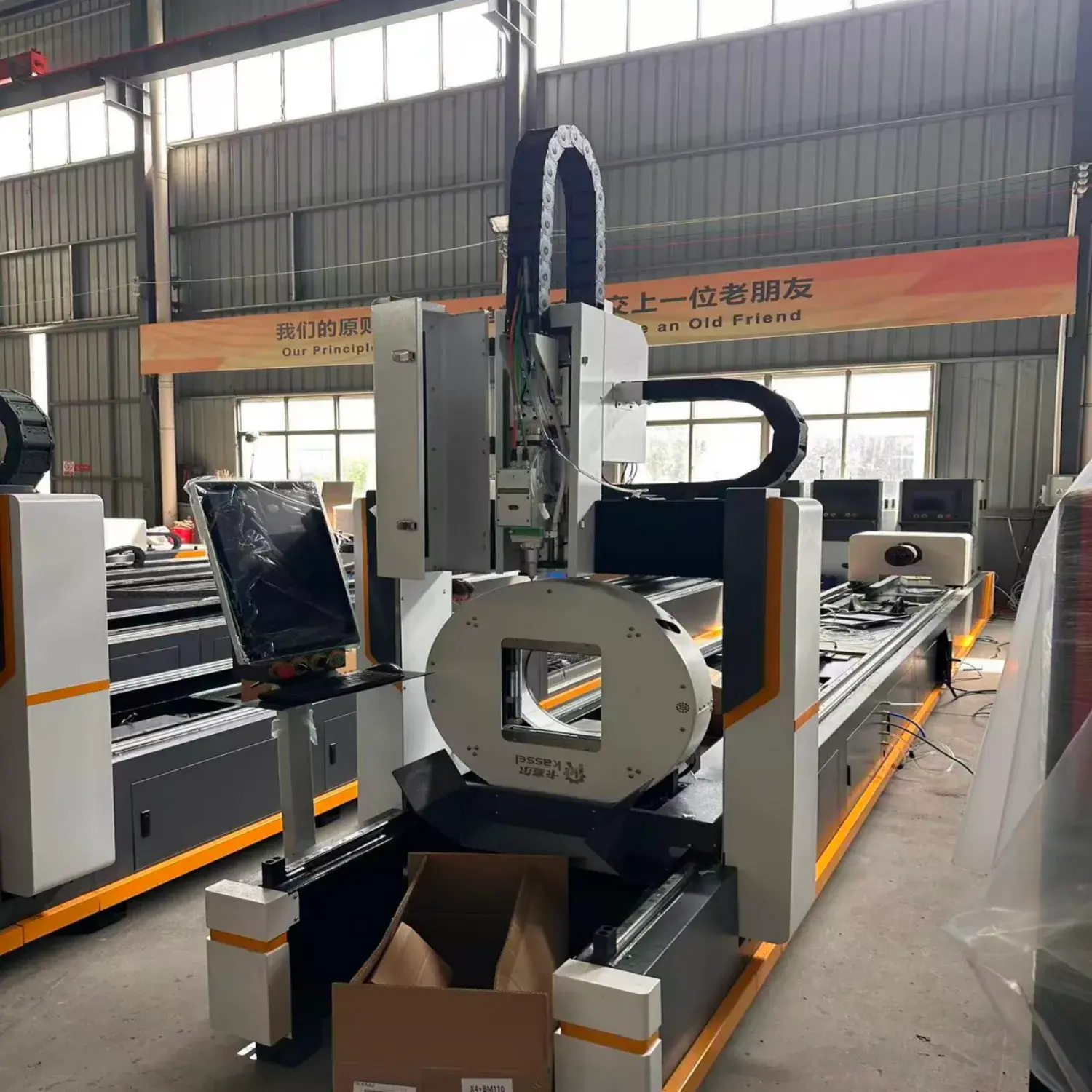
Chuck systems use self-centering pneumatic or hydraulic chucks with through-bore passage for long tube. Laser power typically 1.5 kW to 4 kW; tube wall capacity ranges 0.5–12 mm depending on power and material. Positioning on the rotary axis reaches ±0.05 mm, but tube straightness and residual stress become larger error sources than machine geometry. The control must handle Y, Z, and rotary (B or C axis) interpolation for saddle cuts, miters, and fishmouths. Buyers are normally shops already doing tube fabrication with band saws or cold saws, looking to eliminate layout and secondary machining. These machines cannot process open-channel profiles (angle, channel) without fixturing that defeats the automation; they also struggle with heavy-wall structural tube over 12 mm without 6 kW+ and slow feed rates that torch productivity.
3D Five-Axis Laser Cutting System
| Loại hoặc Lớp | Phạm vi làm việc điển hình | Tùy chọn điều khiển | Phù hợp nhất với | Ghi chú |
|---|---|---|---|---|
| 3D Five-Axis Laser Cutting System | X/Y/Z 2000–4000 mm, A/B ±120° to ±150° | Siemens 840D sl, FANUC 31i-B5, Mitsubishi M800 | Hot-stamped automotive body parts, hydroformed exhaust components, aerospace brackets | Trunnion or articulated head; collision avoidance software essential |
These systems add rotary tilting axes to the cutting head, allowing the beam to approach curved or angled surfaces normal to the local surface. Typical installations use 2 kW to 6 kW fiber sources with Precitec three-dimensional cutting heads incorporating capacitive height sensing and crash protection. Linear positioning holds ±0.05 mm, but contouring accuracy on complex 3D paths depends heavily on CAM postprocessor quality and kinematic calibration. Machine weight 10000–20000 kg. Buyers are Tier 1 automotive suppliers and aerospace subcontractors with existing 3D CAD/CAM workflows. The machine cannot replace press tooling for high-volume simple blanks; cycle time and capital cost make sense only where part complexity justifies eliminating hard tooling, or where annual volumes fall below 50000–100000 pieces.
Precision Small-Format Laser
| Loại hoặc Lớp | Phạm vi làm việc điển hình | Tùy chọn điều khiển | Phù hợp nhất với | Ghi chú |
|---|---|---|---|---|
| Precision Small-Format Laser | 600 × 600 mm to 1300 × 900 mm | Syntec, proprietary Galvo-scanner controllers | Electronics shields, medical instruments, jewelry, watch components | Granite base or epoxy-granite composite; often uses fixed beam with XY stage or galvo scan |
Working ranges under 1 m² with positioning accuracy to ±0.01 mm and repeatability ±0.005 mm. Laser power 500 W to 2 kW; the emphasis is on beam quality (M² < 1.2) and stability, not raw power. Some systems use linear motor drives rather than ballscrews for zero backlash. Weight 1500–3000 kg despite small footprint, due to granite or composite base mass for thermal and vibrational stability. Buyers are medical device manufacturers, precision electronics fabricators, and research labs. The machine cannot handle standard 1500 × 3000 mm sheet stock; material must be pre-cut or purchased in narrow coil, and throughput per square meter of floor space is poor for heavy fabrication workloads.

Main Components of a CNC Laser Cutting Machine
A CNC laser cutting machine is an automated metal fabrication tool that directs a high-power laser beam through a computer numerical control system to cut flat sheet metal and plate into precise two-dimensional shapes. Unlike manual cutting with oxy-fuel torches, plasma cutters, or mechanical shears, the CNC laser eliminates operator-dependent variation, holds ±0.05 mm to ±0.1 mm contour accuracy depending on machine class, and runs unattended once the nest is programmed.
The machine solves three core problems for fabrication shops: cutting complex contours without hard tooling or dies, producing repeatable parts across long runs without thermal distortion from operator technique, and nesting parts tightly to maximize material yield. A first-time buyer needs to understand that “laser cutting machine” describes a system of integrated subsystems, not a single component. The cutting quality depends as much on the capacitive height sensor and assist gas delivery as on the raw laser power.
Major Assemblies and Their Functions
| Hội đồng | Chức năng | Phiên bản cơ bản tiêu biểu | Phiên bản nâng cấp tiêu biểu | Điều gì sẽ hỏng trước tiên? |
|---|---|---|---|---|
| Machine Bed and Frame | Rigid foundation that supports the gantry and worktable; determines dynamic stiffness and vibration damping during high-speed cutting | Welded steel tube frame, 2500–3500 kg for 3015 format, no stress relief | HT300 cast iron or welded frame with stress relief and CNC machined mounting surfaces, 4500–7000 kg | Welded joints in tube frames crack under cyclic gantry loading; cast frames rarely fail structurally but mounting surfaces can wear if not hardened |
| Gantry and Y-Axis Beam | Moves the cutting head across the width of the table; must maintain perpendicularity to X travel and resist bending from acceleration | Single-wall steel plate beam, 6–8 mm wall thickness, bolted construction | Box-section cast aluminum or steel beam, ribbed internal structure, machined as one piece, 200–300 kg mass | Bearing rails loosen from bolted joints; beam deflection under acceleration causes corner rounding on parts |
| X/Y Linear Motion System | Converts rotary servo motion to precise linear positioning of the cutting head | HIWIN or PMI HG-series 25 mm linear guides on X and Y, 1610 or 2010 ball screws, 0.5–1.0 m/min rapid traverse | HIWIN RG-series 35 mm roller guides or Schneeberger, 2525 or 3232 double-nut ball screws with preload, 1.5–2.5 m/min rapid traverse | Ball screw nut wear from dust ingress; guide rail scoring from metal particle contamination; both show as backlash first |
| Drive Motors and Servo Package | Powers and controls axis motion with closed-loop feedback | GSK or KND 1.0–1.5 kW servo motors, 17-bit encoders, 0.05 mm positioning accuracy | FANUC αi or Siemens 1FK7 2.0–3.0 kW servos, 22-bit absolute encoders, 0.02 mm positioning, 0.01 mm repeatability | Encoder cable fatigue from gantry flexing; motor bearing contamination in unsealed designs |
| Laser Source and Chiller | Generates the cutting beam; fiber lasers use diode-pumped rare-earth doped fiber | Raycus 1.5 kW or 2.0 kW single-module, air-cooled or small chiller, 25% electro-optical efficiency | IPG or MAX Photonics 3.0–6.0 kW, modular with redundancy, closed-loop chiller with deionized water, 35–40% efficiency | Diode bar degradation in pump source (typically 30,000–40,000 hours for entry level, 60,000+ for premium); chiller pump failure causes immediate source shutdown |
| Cutting Head and Capacitive Height Sensor | Focuses the beam and maintains constant standoff above the material surface | Raytools BM110 or WSX KC13, fixed focus lens 100–150 mm focal length, mechanical collision protection | Precitec LightCutter or Raytools BM114S, motorized focus adjustment 200 mm range, capacitive height following at 1000 Hz, magnetic breakaway | Ceramic nozzle damage from piercing splashback; capacitive sensor drift from oil film on plate; focus lens contamination from poor gas filtration |
| Assist Gas Delivery System | Provides cutting gas (oxygen, nitrogen, or compressed air) to the kerf to eject molten metal and control oxidation | Single-gas manifold, 10–15 bar shop air with basic filtration, manual pressure regulation | Dual-gas automatic switching, 25 bar high-purity nitrogen with oxygen monitoring, proportional valve control from cutting parameters | Solenoid valve sticking from moisture; pressure regulator diaphragm rupture; gas purity sensors drift |
| Control System and Nesting Software | Executes G-code, manages laser parameters, and optimizes part layout | GSK 980TC3 or Syntec 60WA with basic nesting, USB program transfer, no material library | FANUC 31i-B5 or Siemens 840D sl with Lantek or SigmaNEST integration, automatic nozzle change, real-time power modulation, Ethernet to MES | Flash memory corruption from electrical noise; USB port wear; software obsolescence on older Windows-based controllers |
| Dust and Fume Extraction | Captures vaporized metal and particulate from the cutting zone | Single-stage bag filter, 3000–5000 m³/h airflow, manual cleaning | Cartridge filter with automatic pulse-jet cleaning, 8000–12000 m³/h, spark arrestor and fire suppression interlock | Filter blinding from fine particulate; fan bearing seizure from abrasive dust; ducting corrosion from condensate |
| Vỏ bảo vệ và cơ cấu khóa an toàn | Contains the laser radiation, contains assist gas, and protects operators from moving machinery | Partial enclosure with acrylic windows, basic door switches, Class 1 laser safety rating | Full steel enclosure with laser-safe glass viewing windows, pressure-sealed for nitrogen cutting atmosphere, CE-compliant dual-channel safety PLC, fume containment verified to EN ISO 15012 | Door switch contact welding; window coating degradation from reflected beam exposure; seal gasket hardening from ozone |
Assemblies That Most Affect Long Term Accuracy
Three assemblies above determine whether a machine holds its factory accuracy specification at year five or drifts to unacceptable variation.
The Linear Motion System and Its Environment
Ball screw preload relaxation and guide rail wear are the dominant mechanical degradation modes. A 3015 machine with 2500 mm X travel and HIWIN HG25 guides running 8 hours daily in a shop without positive-pressure enclosure will show 0.03–0.05 mm backlash in the ball screw nut within 8,000–10,000 hours. Preloaded double-nut assemblies in upgraded versions extend this to 20,000+ hours but add cost and friction. The critical maintenance variable is not the component grade alone but contamination control: machines with bellows covers over the Y-axis rail and positive air purge on the X-axis rack-and-pinion (where fitted) degrade at one-third the rate of exposed systems. Buyers should verify that the manufacturer specifies IP54 minimum for the axis motor enclosures and supplies replacement wiper seals in the spare parts kit.
The Gantry Beam Structural Integrity
Gantry deflection under acceleration directly translates to corner rounding and dimensional error on parts. A 200 kg box-section aluminum beam with 300 mm depth shows approximately 0.02 mm deflection at 1.5 m/min² acceleration with a 15 kg cutting head payload. The same load on a single-wall steel beam of 150 mm depth deflects 0.08–0.12 mm. Over years of operation, bolted joint relaxation in fabricated beams increases this deflection unpredictably. Cast or monolithic welded beams with machined integral rail mounting surfaces maintain alignment because there are no bolted interfaces to loosen. The practical test is not the static specification sheet but dynamic behavior: machines that cannot hold 0.05 mm on a 10 mm square corner at 80% rated rapid traverse will degrade faster as joints settle.
The Cutting Head and Height Control Loop
The capacitive height sensor and focus position together determine effective power density at the cut front. A 0.5 mm standoff error changes the beam waist position by approximately 0.1 mm relative to the plate surface, which for 3 mm mild steel can shift the cut from clean nitrogen to oxidized edge requiring secondary processing. Capacitive sensors drift from oil films, scale from vaporized deposits, and suffer mechanical damage from plate warpage collisions. The motorized focus adjustment in upgraded heads compensates for material thickness changes without manual shim changes, but adds a motor and lead screw that themselves wear. The assembly that fails first is almost always the ceramic nozzle orifice: 1.0 mm nozzles in oxygen cutting last 20–40 hours, 1.5 mm nozzles in nitrogen cutting 80–120 hours. Shops running mixed production should verify that nozzle change time is under 30 seconds and that the control stores focus and height parameters per material thickness to minimize setup error after maintenance.
Thông số kỹ thuật và cách đọc chúng
| Tham số | Mức độ sơ cấp | Phân khúc tầm trung | Thông số kỹ thuật cao |
|---|---|---|---|
| Kích thước bàn cắt (mm) | 3015 (3000×1500) | 4020 (4000×2000) | 6020 (6000×2000) |
| Hành trình trục X/Y (mm) | 3000 / 1500 | 4000 / 2000 | 6000 / 2000 |
| Hành trình trục Z (mm) | 150 | 200 | 250 |
| Laser Source Power (kW) | 1.5 (Raycus/MAX) | 3.0 (Raycus/MAX) | 6.0–12.0 (IPG/MAX) |
| Laser Source Brand | Raycus or MAX Photonics | Raycus or MAX Photonics | IPG Photonics or MAX |
| Đầu cắt | Raytools BM110 | Raytools BM111 with capacitive height sensor | Precitec Procutter or Raytools BS06K |
| Độ chính xác định vị (mm) | ±0,05 | ±0,03 | ±0,02 |
| Độ lặp lại (mm) | ±0,03 | ±0,02 | ±0.015 |
| Tốc độ di chuyển nhanh theo trục X/Y (m/phút) | 80 / 80 | 100 / 100 | 120 / 120 |
| Tốc độ cắt tối đa (m/phút) | 30 | 60 | 80 (material dependent) |
| Linear Guideway Brand | HIWIN or PMI | HIWIN or PMI | THK or Rexroth |
| Hệ thống điều khiển | Cypcut or FSCUT2000 | Cypcut or FSCUT3000 | Beckhoff or PA8000 with Cypcut Pro |
| Supply Voltage / Frequency | 380V 3-phase 50Hz | 380V 3-phase 50Hz | 380V 3-phase 50Hz (220V 60Hz optional) |
| Total Connected Load (kVA) | 18 | 35 | 55–80 |
| Trọng lượng tịnh của máy (kg) | 3,500 | 8,500 | 14,000 |
| Diện tích sàn Dài × Rộng × Cao (mm) | 4,800×2,500×2,000 | 9,500×3,500×2,200 | 13,000×3,800×2,500 |
| Maximum Sheet Thickness—Mild Steel (mm) | 8 | 16 | 25 |
| Maximum Sheet Thickness—Stainless Steel (mm) | 4 | 8 | 16 |
| Maximum Sheet Thickness—Aluminum (mm) | 3 | 6 | 12 |
What This Machine Actually Is
A CNC laser cutting machine is a gantry-style or cantilever machine tool that directs a high-power fiber laser beam through a cutting head onto sheet metal, vaporizing or melting material along a programmed path. A CNC controller coordinates motion between the laser source, cutting head height, and XY (and sometimes rotary) axes to produce flat parts from metal sheets or plates.
The problem it solves: producing complex contours, holes, and slots in sheet metal faster than punching or shearing, without hard tooling. A single machine can switch from 2 mm electrical enclosures to 10 mm structural brackets by changing parameters, not dies.
Compared to manual oxy-fuel or plasma cutting, the CNC laser eliminates layout marking, hand guiding, and heat-affected zone inconsistency. Compared to turret punch presses, it requires no punch-and-die inventory and handles irregular shapes without nibbling. The trade-off is capital cost and the need for assist gas (typically nitrogen or oxygen) at pressures from 10 to 25 bar depending on material and thickness.
Reading the Specification Sheet Line by Line
Phạm vi làm việc và kích thước bàn cắt
The table size—3015, 4020, 6020—describes the maximum sheet dimensions the machine accepts. A 3015 table handles standard 3 m × 1.5 m sheets common in Asia and Europe. A 4020 accommodates the 4 m × 2 m sheets increasingly standard in North American and Middle Eastern markets. The 6020 variant targets heavy fabrication and long structural components. First-time buyers often overestimate needs: a 3015 machine cuts two 1.5 m × 1.5 m parts from a 3 m sheet with efficient nesting, while a 4020 with the same laser power costs 40–60 percent more and consumes more floor space and gas.
Z Axis Travel
Z axis movement controls focus position and pierce height. Entry machines at 150 mm handle sheet up to 25 mm with adequate clearance. Higher Z travel (200–250 mm) allows thicker plate, bevel cutting attachments, or automated nozzle changers. For pure thin-sheet work under 6 mm, excessive Z travel adds cost without benefit.
Công suất nguồn laser và thương hiệu
Fiber laser source power directly determines cutting speed and maximum thickness. The three dominant brands in Chinese-built machines are:
- Raycus: Chinese-made, 1.5–6 kW common, lower cost per watt, acceptable beam quality for general fabrication. MTBF around 50,000 hours.
- MAX Photonics: Chinese-made, competitive with Raycus in the 1.5–12 kW range, often selected for higher brightness models.
- IPG Photonics: German/US origin, premium pricing, superior beam quality and stability, especially above 6 kW. Preferred for reflective metals (brass, copper, high-grade aluminum) and tight tolerance work.
A 1.5 kW source cuts 4 mm mild steel at roughly 1.2 m/min. A 3 kW source cuts the same at 3.5 m/min. A 6 kW source reaches 8 m/min and handles 16 mm mild steel. Above 6 kW, beam delivery and cutting head cooling become critical; budget machines with undersized chillers or basic heads fail to realize rated performance.
Đầu cắt
The cutting head focuses the beam and delivers assist gas through a coaxial nozzle. Raytools BM110/BM111 heads dominate the 1.5–6 kW range. Precitec Procutter heads offer better sealed optics and crash protection, justifying their 30–50 percent premium for unattended operation or high-power applications. Capacitive height sensing maintains 0.1 mm standoff distance automatically; without it, pierce spatter destroys lenses on thick plate.
Độ chính xác và độ lặp lại trong định vị
Positioning accuracy (±0.05 mm to ±0.02 mm) measures how close the actual position matches commanded position across the full table. Repeatability (±0.03 mm to ±0.015 mm) measures consistency returning to the same point. For sheet metal parts with ±0.5 mm tolerances, 0.05 mm accuracy suffices. For precision electronics chassis or mating flange holes, 0.03 mm or better prevents fit-up issues.
Rapid Traverse and Cutting Speed
Rapid traverse (80–120 m/min) moves the head between cuts without firing the laser. Higher values reduce non-cutting time on nested parts with many starts. Cutting speed varies enormously by material, thickness, power, and gas: 1 mm stainless steel at 3 kW with nitrogen assist cuts at 25–35 m/min; 10 mm mild steel at the same power with oxygen cuts at 0.8–1.2 m/min. Published “maximum cutting speed” figures usually reference thin mild steel in ideal conditions.
Linear Guideway Type
HIWIN or PMI linear roller guides are standard on entry and mid-range machines, offering low friction and 20 m/s² acceleration capability. Some heavy-plate builders use hardened box ways on one axis for damping, but this is rare in fiber laser gantries. Guide protection from spatter and dust determines longevity more than brand—look for telescopic covers and positive-pressure bellows.
Hệ thống điều khiển
Cypcut (by Shanghai Friendess) and FSCUT (by Shanghai Baichu) dominate Chinese fiber laser controls. They integrate laser power modulation, gas pressure, height sensing, and nesting software. For complex 5-axis tube cutting or full factory automation, Beckhoff or PA8000 platforms appear. FANUC and Siemens are uncommon in pure laser cutting but appear in hybrid punch-laser or laser-milling machines. The control’s nesting software efficiency directly affects material yield; Cypcut Pro with automatic common-line cutting reduces scrap 5–15 percent over basic versions.
Supply Voltage and Connected Load
Standard Chinese export machines run 380V three-phase 50Hz. For 220V 60Hz regions (North America, parts of Japan, Taiwan), specify a transformer or order a machine with 220V 60Hz motors and control. A 3 kW laser with chiller, dust collector, and servo drives draws 25–35 kVA continuous. A 6 kW system needs 50 kVA minimum service. Voltage stability matters: ±10 percent fluctuation causes resonator instability and poor edge quality.
Machine Net Weight and Floor Space
Weight correlates with frame rigidity and vibration damping. A 3,500 kg entry machine uses welded steel tube construction. An 8,500 kg mid-range machine adds cast iron or granite composite elements. A 14,000 kg high-specification machine uses thick-walled steel with sand fill or polymer concrete for harmonic damping. Heavier machines maintain consistent beam focus during high-acceleration direction changes, critical for small hole quality and sharp corners.
Understanding Export Trade Terms
FOB (Giao hàng tại tàu)
The seller delivers the machine to the port of departure, clears export customs, and loads it onto the vessel. The buyer pays ocean freight, insurance, and all costs from arrival port onward. FOB suits buyers with established freight forwarders and import experience.
CIF (Giá cước, bảo hiểm và cước vận chuyển)
The seller arranges and pays for ocean freight to the destination port and marine insurance to that point. The buyer handles unloading, import clearance, and inland transport. CIF offers price predictability but gives the seller incentive to minimize freight cost, sometimes resulting in slower or less reliable carriers.
CFR (Giá cước và cước vận chuyển)
Identical to CIF except the buyer arranges marine insurance. Common when the buyer’s lender or corporate policy mandates specific insurance terms.
EXW (Giao hàng tại xưởng)
The buyer collects the machine from the factory. The seller’s obligation is minimal: make the machine available, packed for export. The buyer handles all export clearance, domestic transport in China, and international shipping. EXW saves the seller administrative effort; for the buyer, it requires a Chinese customs broker and significant logistics coordination.
Điều khoản thanh toán
- T/T (Telegraphic Transfer): Wire transfer. Standard structure: 30 percent deposit to start production, 70 percent before shipment against copy of bill of lading. Some sellers accept 30/60/10 (30 percent deposit, 60 percent before shipment, 10 percent after installation).
- L/C (Letter of Credit): Bank-guaranteed payment on presentation of compliant documents. Adds 0.3–1.5 percent bank fees and strict documentation requirements. Preferred by buyers in markets with currency controls or limited seller trust. Sellers dislike L/C for small orders due to amendment costs and discrepancy risks.
HS Code
Fiber laser cutting machines typically classify under HS 8456.11 (machine tools for working any material by removal of material, operated by laser) or 8456.90 depending on customs interpretation. Correct classification determines duty rate; verify with your customs broker before ordering.
CE Marking
CE indicates conformity with EU machinery directive 2006/42/EC, electromagnetic compatibility, and low voltage directives. For laser machines, this includes interlocked enclosures, beam dump verification, and emergency stop circuits. CE documentation must accompany the machine; without it, EU customs detention and port storage fees apply. CE is not automatically valid in non-EU markets, though many Middle Eastern and African buyers accept it as proxy for safety standard compliance.
Packing List and Certificate of Origin
The packing list details each crate’s contents, net and gross weights, and dimensions for customs valuation and unloading planning. A typical 3015 machine ships in 4–6 crates: main gantry (largest, often 4 m × 2.2 m × 2 m, 2,500 kg), control cabinet, chiller, dust collector, and accessories. The certificate of origin (Form A, CO, or regional FTA certificate) determines preferential tariff treatment. Chinese-origin machines may face anti-dumping duties in specific markets; verify with your trade attorney.
Unloading and Installation Practicalities
A 3,500 kg entry machine unloads with a 5-ton forklift. An 8,500 kg mid-range machine needs a 10-ton forklift or 16-ton crane with spreader bar. A 14,000 kg high-specification machine requires a 25-ton crane and reinforced floor loading (consult structural engineer for mezzanine or upper-floor installations). Foundation requirements: level to 0.5 mm/m, vibration-isolated from punch presses or forging hammers, ambient temperature 5–35°C with <80 percent humidity non-condensing. Chiller and dust collector need separate space with service access. Allow 3–5 days for mechanical installation, 2–3 days for laser alignment and cutting parameter development, plus operator training on actual production parts.
Các ứng dụng trong công nghiệp của máy cắt laser CNC
A CNC laser cutting machine is a computer-numerical-controlled fabrication system that directs a high-power density laser beam through optics and a cutting head to melt, burn, or vaporize material along programmed paths. It replaces manual layout, marking, and oxy-fuel or plasma cutting with automated precision, eliminating tooling per part and reducing setup from hours to minutes.
How It Differs from Manual Methods
Manual cutting requires templates, shears, punches, or hand torches. Each part needs individual layout time, and repeatability depends on operator skill. A CNC laser cutter loads a DXF or NC file, nests parts automatically, and produces the first accurate piece within seconds of starting. Positioning accuracy of ±0.03 mm and repeatability of ±0.02 mm are routine on modern gantries—tolerances difficult to hold consistently by hand. The trade-off: capital cost, floor space, and the need for stable power and compressed air or nitrogen supply.
What First-Time Buyers Must Understand
Before shortlisting, clarify three variables: material type and thickness range, required edge quality and tolerance, and production volume. These determine laser source power, bed size, and automation level. A 1 kW fiber laser cuts 6 mm mild steel at roughly 1.2 m/min; 6 kW cuts 20 mm at 0.6 m/min with oxygen assist. Aluminum and copper demand higher peak power and specific cutting parameters. Bed sizes of 3000 mm × 1500 mm (3015), 4000 mm × 2000 mm (4020), or 6000 mm × 2000 mm (6020) must exceed your largest blank with room for clamping. Controls from FANUC, Siemens, or Syntec manage motion; laser sources from Raycus, MAX, or IPG define beam quality and maintenance intervals. Cutting heads by Raytools or Precitec handle focal adjustment and capacitive height sensing.
Application Sectors and Machine Fit
| Lĩnh vực | Các bộ phận tiêu biểu được sản xuất | Thông số kỹ thuật đề xuất | Tại sao chiếc máy này lại phù hợp |
|---|---|---|---|
| Phụ tùng ô tô và xe máy | Exhaust brackets, mounting plates, frame gussets, sprockets, decorative trim | 3–6 kW fiber laser, 3015 or 4020 table, ±0.03 mm positioning, Syntec or FANUC control, rapid traverse 80–120 m/min | High mix, medium volume; tight tolerances for assembly; clean edges reduce secondary deburring |
| Máy móc nông nghiệp | Plow shares, hitch plates, guards, chassis components, grain handling panels | 4–6 kW, 4020 table for large blanks, HT300 gantry base, 120 m/min rapid, oxygen cutting for thick mild steel | Abrasion-resistant steels up to 16 mm; long parts from large sheets minimize weldment count |
| Phụ kiện thủy lực và khí nén | Valve bodies, manifold plates, cylinder mounts, flange adapters, bracketry | 2–3 kW, 3015 table, ±0.02 mm repeatability, nitrogen assist for stainless, Precitec cutting head | Burr-free edges on 304/316 stainless; hole quality affects sealing surfaces; batch sizes 50–500 |
| Khớp nối cho ngành dầu khí | Pipeline flanges, connector plates, gasket retainers, structural supports | 6 kW+, 6020 table for pipe and plate, IPG or MAX source, dual pallet or tube cutting option | Thick plate to 25 mm; remote site parts from certified material; traceability via nested part marking |
| Chế tạo kim loại tấm và tủ | Enclosure panels, doors, brackets, cable trays, chassis, server racks | 1.5–3 kW, 3015 table, Syntec or GSK control, HIWIN linear guides, 80 m/min rapid | Nesting efficiency drives material yield; thin gauge to 3 mm dominates; quick turnaround for custom orders |
| Thiết bị nhà bếp | Sinks, range hoods, worktops, appliance housings, shelving, trolleys | 2–4 kW, 3015 or 4020, nitrogen for stainless cosmetic faces, automatic nozzle changer | Mirror-finish stainless demands minimal heat-affected zone; complex curves and cutouts for plumbing and vents |
| Advertising and Signage | Lettering, logos, decorative screens, architectural panels, display stands | 1–2 kW, 3015 table, lower cost Raycus source, Syntec control, 60 m/min rapid sufficient | Thin brass, aluminum composite, acrylic (with fiber-CO2 hybrid); artistic geometry; prototype-to-production in hours |
| Đóng tàu và thép kết cấu | Bulkhead panels, deck sections, stiffener profiles, hatch covers, pipe supports | 6–12 kW, 6020 table, hardened box-way gantry for shock loads, oxygen cutting, 100 m/min rapid | Thick plate to 30 mm; large format reduces joints; heavy gantry mass 8000–15000 kg absorbs reaction forces |
| Công nghệ khuôn mẫu | Ejection plates, backing plates, wear plates, insert pockets, vent slots | 3–6 kW, 3015 table, ±0.02 mm repeatability, chiller-stabilized IPG source, fine nozzle | Hardened steels to 50 HRC with parameter control; wire-start holes; contour accuracy affects die fit |
| Trung tâm Đào tạo Kỹ thuật | Curriculum samples, student projects, maintenance trainers, demonstration panels | 1–2 kW, 3015 table, GSK or KND control for cost transparency, full safety enclosure, manual jog and simulation mode | Safe operation training; visible beam path with red-pointer alignment; covers sheet metal and thin plate fundamentals |
Phụ tùng ô tô và xe máy
A Tier-2 supplier in Thailand producing 400 exhaust bracket variants monthly runs a 4 kW fiber laser with 4020 table and Syntec 21MA control. Rapid traverse at 100 m/min reduces non-cutting time between nested parts. The machine replaces three turret punch presses and eliminates per-tool setup. Tolerance on mounting holes is ±0.05 mm; laser positioning of ±0.03 mm leaves margin for thermal drift. Nitrogen assist on 409 stainless prevents oxidation that would interfere with welding downstream. Cycle time per bracket drops from 4.5 minutes punching to 1.2 minutes laser cutting, with no tool wear.
Máy móc nông nghiệp
A combine harvester manufacturer in Brazil sources 6 mm and 12 mm AR400 wear plates. Their 6 kW system with 4020 bed and oxygen cutting produces plow shares 1800 mm long in single pieces. The HT300 cast gantry at roughly 12000 kg limits vibration at 1G acceleration. Positioning accuracy holds slot patterns for bolt-on replacement within ±0.08 mm over the length. Manual plasma previously required 3 mm grind stock; laser cuts to near-net with 0.2 mm edge squareness, reducing weld prep by 70 percent. The trade-off: oxygen assist costs versus nitrogen, and 16 mm plate needs reduced speed to 0.4 m/min to avoid dross.
Phụ kiện thủy lực và khí nén
A valve manufacturer in Turkey machines 304 stainless manifold plates from 50 mm × 200 mm blanks on a 2 kW system with Precitec ProCutter head. Nitrogen at 16 bar produces matte edges with Ra 6.3 µm, acceptable for O-ring grooves without milling. Repeatability of ±0.02 mm ensures port spacing matches CNC machining center fixturing. Batch size is 200 pieces; laser cutting time is 8 minutes versus 45 minutes milling from solid. The limitation: 50 mm thickness exceeds fiber laser practical range; the supplier blanks to 15 mm and finishes on mill.
Khớp nối cho ngành dầu khí
A pipeline fabricator in the UAE cuts 20 mm API 5L plate on a 6 kW IPG system with 6020 table and dual shuttle pallets. One pallet loads while the other cuts, giving roughly 85 percent spindle-on efficiency. Oxygen assist achieves 0.8 m/min at 20 mm with 0.5 mm perpendicularity error. The machine marks heat numbers with 0.3 mm depth via parameter shift, replacing manual stamping. Foundation requirements: 200 mm reinforced concrete with M12 chemical anchors; gantry mass of 15000 kg needs 10-tonne crane for installation. Transformer step-down from 440V 60Hz site supply to 380V 50Hz was required.
Chế tạo kim loại tấm và tủ
A job shop in Mexico serving telecom and medical OEMs runs a 3 kW Raycus-source machine with Syntec control and 3015 table. HIWIN HGW45CA linear guides on the gantry achieve 120 m/min rapid with 1.2G acceleration. Nesting software improves sheet yield from 72 percent on shear-and-punch to 89 percent on laser. Typical parts: 1.5 mm steel chassis with M4 PEM nut holes, 2 mm aluminum panels with vent patterns. Positioning accuracy of ±0.03 mm holds hole-to-edge at ±0.1 mm after springback. The shop added automatic nozzle changer after six months; downtime for 1.5 mm to 4 mm transitions dropped from 8 minutes to 45 seconds.
Thiết bị nhà bếp
A sink manufacturer in India produces 304 stainless bowls from 1.2 mm coils on a 2 kW system with nitrogen assist and automatic sheet loader. The critical specification: heat-affected zone under 0.5 mm to prevent discoloration visible on exposed edges. Cutting speed at 8 m/min on 1 mm material with 12 bar nitrogen achieves this. The Raytools BM110 head with capacitive height sensing tracks coil crown to ±0.1 mm. Post-cut, edges need only edge rounding; no weld cleanup. The machine replaced a 200-tonne hydraulic press with blanking dies, eliminating $40000 annual die maintenance and allowing same-day design changes.
Advertising and Signage
A display fabricator in Poland cuts 3 mm aluminum composite and 1.5 mm brass on a 1.5 kW entry-level system with GSK 983M control. Rapid traverse of 60 m/min is sufficient for artistic geometry with high pen-up percentage. Syntec or GSK controls in this segment offer conversational programming for operators without CAD background. The machine runs 6 hours daily; IPG source would extend maintenance interval from 30000 to 100000 hours but was not justified at this utilization. Limitation: reflective brass requires lead-in techniques to prevent back-reflection damage to the cutting head.
Đóng tàu và thép kết cấu
A Korean yard subcontractor cuts 25 mm DH36 ship plate on an 8 kW system with 6020 bed and hardened box-way construction. Linear guides would deflect under the 15000 kg gantry and cutting reaction forces at 1.5G. Positioning of ±0.05 mm over 6 m is acceptable for welded assemblies; the constraint is edge preparation quality for robotic welding. Oxygen cutting at 0.35 m/min produces square edges to 20 mm; beyond that, bevel plasma takes over. The laser handles complex penetrations and lightening holes that plasma cannot hold to tolerance. Foundation: isolated pad 300 mm thick with vibration isolation; 15-tonne crane for table sections.
Công nghệ khuôn mẫu
A toolroom in Portugal rough-cuts ejection plates from 1.2379 tool steel at 30 HRC on a 4 kW system, leaving 0.3 mm stock for grinding. Fine nozzle 1.0 mm diameter and reduced speed to 0.5 m/min on 20 mm plate hold taper under 0.05 degrees. The IPG YLS-4000 with chiller maintains ±1 percent power stability for consistent kerf width. Wire-start holes for EDM are drilled at 0.8 mm diameter with spiral path. The application is secondary to wire EDM and milling; laser adds speed on 2D geometry and large pockets where end mill time would be prohibitive.
Trung tâm Đào tạo Kỹ thuật
A vocational institute in Kenya acquired a 1 kW system with full enclosure, light curtain, and GSK 980TDi control familiar from their CNC lathes. The machine demonstrates piercing, contouring, tabbing, and nesting on 2 mm mild steel and 1 mm aluminum. Red-pointer alignment and simulation mode let students verify programs before beam-on. Specifications: 3015 table, 60 m/min rapid, ±0.05 mm positioning—adequate for curriculum, not production. Maintenance training includes quarterly lens inspection, nozzle centering, and capacitive calibration. The enclosed design meets CE guard-opening interlock requirements for educational settings.
Các máy móc liên quan của RUNNEWTECH
Máy cắt laser CNC
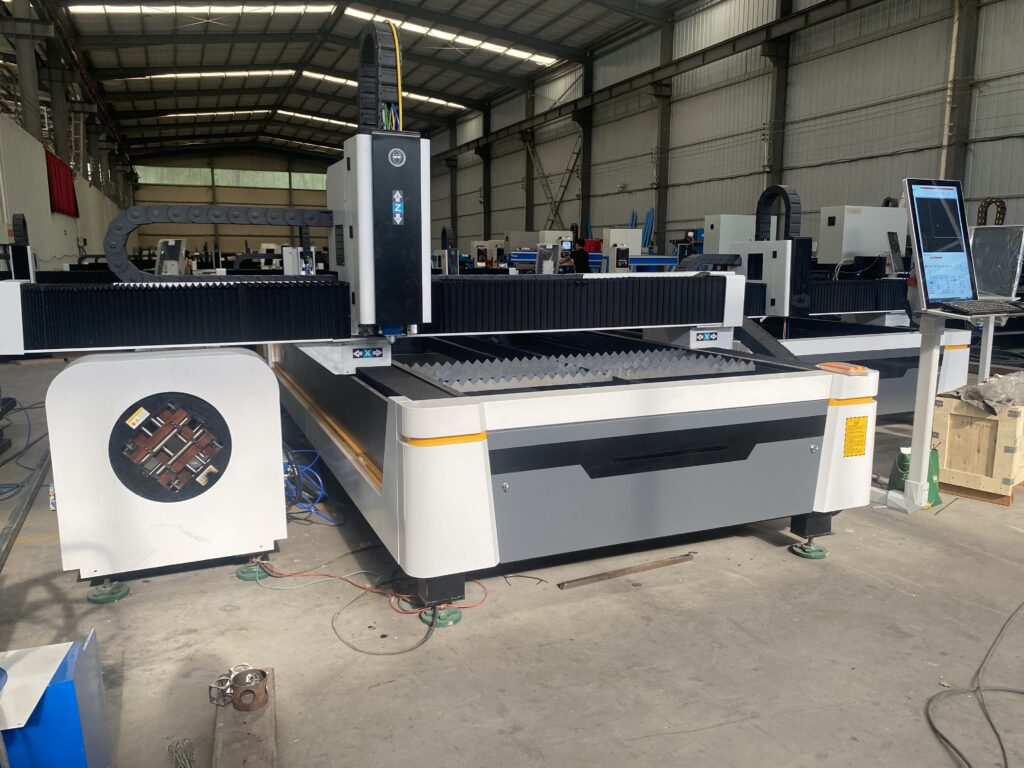
Máy cắt laser CNC xuất xưởng trực tiếp từ nhà máy, có các tùy chọn hệ thống điều khiển FANUC, Siemens, Mitsubishi, GSK hoặc Syntec và nguồn điện 380V/50Hz hoặc 220V/60Hz, dành cho xuất khẩu.
Các câu hỏi thường gặp về máy cắt laser CNC
A CNC laser cutting machine is an automated thermal cutting system that directs a focused high-power laser beam through a nozzle to melt, burn, or vaporize material along a programmed path. A computer numerical control system drives servo motors on the X, Y, and optionally Z axes, replacing manual torch guidance with motion control repeatability measured in ±0.03 mm to ±0.05 mm positioning accuracy depending on machine class.
The problem it solves is throughput and consistency in profile cutting of flat sheet metal. A manual oxy-fuel or plasma operator cannot hold 0.1 mm repeatability across hundreds of parts, cannot switch from 1 mm to 10 mm mild steel without stopping to reset parameters, and cannot nest parts algorithmically to minimize scrap. A CNC laser does all three unattended after program verification.
What distinguishes the CNC laser from manual methods is not merely automation but the combination of non-contact cutting, narrow kerf width (typically 0.1 mm to 0.3 mm), and high traverse speeds. A mid-range 3 kW fiber laser on a 3015 table (3000 mm × 1500 mm) cuts 3 mm mild steel at roughly 15–25 m/min with nitrogen assist, while rapid traverse reaches 80–140 m/min on linear rail gantries. The same operator running manual plasma on a tracing table manages 1–3 m/min with dross and bevel to grind off.
First-time buyers must understand three constraints before shortlisting. First, material scope: fiber lasers excel at ferrous and non-ferrous metals under 25 mm; CO₂ lasers remain necessary for some plastics and wood, but fiber dominates metal fabrication and requires no mirror alignment or gas lasing medium. Second, assist gas logistics: oxygen for thick mild steel cutting (better finish, slower speed), nitrogen for stainless and aluminum (oxide-free edge, faster on thin gauge), and compressed air as economy option (acceptable on thin mild steel, higher dross). Third, infrastructure: a 6 kW fiber laser with chiller, dust collector, and gas manifold draws 30–50 kW electrical, weighs 8000–12000 kg, and needs 1.5 m clearance on all sides for maintenance access.
What Is A Laser Cutting Machine And How Does It Work
A CNC laser cutting machine uses a focused laser beam to melt or vaporize metal sheet, with a computer controlling motion along X and Y axes. Assist gas blows molten material through the kerf. The result is a programmed, repeatable profile cut without mechanical tooling contact.
Common Buyer Questions
Q: What is your minimum order quantity?
One machine is standard for export. For container loading efficiency, two 3015-format machines fit in a 40-foot HQ container; a 4020 or 6020 table requires flat-rack or open-top due to length. No MOQ penalty applies to single-unit orders.
Q: What control systems are available and in what languages?
FANUC, Siemens, Mitsubishi, Syntec, and GSK are offered depending on laser source pairing. FANUC and Siemens dominate 4 kW and above systems for their servo synchronization. Interface supports English, Spanish, Russian, and Arabic; others on request. Parameter manuals ship in the selected language.
Q: What is the lead time from deposit to ready-for-shipment?
Standard configuration: 25–35 days. Custom voltage, extended tables, or IPG/Raycus source swaps add 10–15 days. Peak season (March–May, September–November) extends by one to two weeks.
Q: What are your payment terms?
30 percent T/T deposit, 70 percent L/C at sight or T/T before shipment. Orders above USD 150,000 may negotiate 20/80 split. No D/P or D/A terms for first-time transactions.
Q: Can you adapt supply voltage and frequency?
380V 50Hz three-phase is standard. 220V 60Hz (North America, parts of Southeast Asia) or 415V 50Hz (India, Middle East) require a step-up/step-down transformer and frequency converter, typically USD 800–2500 depending on laser power. We confirm motor and chiller compatibility before build.
Q: How do you ship and what is transit time?
40-foot HQ container for 3015 machines; flat-rack or breakbulk for 4020/6020. Port-to-port: 18–25 days to Southeast Asia, 25–35 days to Middle East and Africa, 30–45 days to South America, 35–50 days to Eastern Europe. CIF or FOB Qingdao/Tianjin.
Q: What warranty and spare parts coverage do you provide?
Twelve months from B/L date on mechanical and electrical components; laser source warranty follows Raycus (24 months), MAX (24 months), or IPG (36 months) terms. Spare parts kit includes nozzles, protective lenses, ceramic rings, and focus lenses; consumables ship DHL within 72 hours of order confirmation.
Q: Is a factory acceptance test and accuracy report provided?
Yes. FAT includes geometric accuracy (linear positioning ±0.03 mm, repeatability ±0.02 mm on 3015 format), squareness, and cutting test on buyer’s material thickness. Report includes laser power meter verification, ball-bar data if specified, and signed protocol before release for shipment.
Q: What installation and training is included?
Two technician-days at buyer’s site included under CIF terms; buyer provides interpreter, crane, and local accommodation. Scope: leveling, alignment, gas and electrical hookup verification, cutting parameter development, and operator training on nesting software. Additional days at USD 350 per technician per day.
Q: What tolerance can you hold on my material?
Positioning accuracy ±0.03 mm to ±0.05 mm and repeatability ±0.02 mm to ±0.03 mm are machine specifications. Achieved part tolerance depends on material thickness, assist gas purity, and focal position calibration. On 3 mm mild steel with nitrogen, ±0.05 mm to ±0.1 mm is typical; 10 mm mild steel with oxygen, ±0.1 mm to ±0.15 mm.
Q: What are consumables costs per hour?
Protective window: USD 2–4 per piece, 2–8 hours depending on piercing density. Nozzle: USD 8–25, 20–80 hours. Ceramic ring: USD 40–80, 400–800 hours. Focus lens: USD 150–400, 2000+ hours with proper gas filtration. Assist gas dominates: nitrogen at 15–25 bar for stainless runs USD 8–15 per hour at industrial cylinder rates; bulk liquid drops this 60 percent.
Câu hỏi: Quý công ty có thể cung cấp hồ sơ chứng nhận CE để làm thủ tục thông quan không?
CE conformity declaration, machinery directive 2006/42/EC technical file summary, and laser safety EN 60825-1 documentation are provided. We do not hold notified body certificates for laser products; the declaration is manufacturer-issued based on internal testing and component supplier certifications. Verify acceptance with your customs broker before ordering.
Thông báo quan trọng
Các thông số kỹ thuật, số liệu về độ chính xác và mức giá trong hướng dẫn này chỉ mang tính tham khảo và được cung cấp nhằm phục vụ công tác lập kế hoạch
chỉ dành cho mục đích này. Phạm vi hoạt động thực tế, dung sai có thể đạt được, tính sẵn sàng của hệ thống điều khiển, yêu cầu về điện áp nguồn và sự tuân thủ
Các thông số kỹ thuật khác nhau tùy theo mẫu máy và quốc gia nhập khẩu. Người mua phải tự xác nhận điện áp và tần số nguồn điện, tải trọng sàn và
nền móng, thiết bị dỡ hàng và các yêu cầu nhập khẩu trước khi đặt hàng. Tất cả các con số đều phải được xác nhận bằng văn bản trong
hóa đơn tạm tính cuối cùng do RUNNEWTECH phát hành.
Mua máy cắt laser CNC từ RUNNEWTECH
A CNC laser cutting machine is a computer-controlled thermal cutting system that uses a focused high-power laser beam to melt, burn or vaporize material along a programmed path. Unlike manual oxy-fuel or plasma cutting, the machine executes vector paths from CAD/CAM files with no physical tool contact, no cutting force on the workpiece, and positioning repeatability typically held to ±0.03 mm to ±0.05 mm depending on machine class and material thickness.
What Problem It Solves
Sheet metal and plate fabrication shops face three persistent constraints: tooling cost for short runs, geometric complexity that punching or shearing cannot achieve, and throughput limits when operators must mark, clamp and guide every cut manually. A CNC laser cutter removes these bottlenecks by cutting intricate contours, small holes down to roughly 0.5× material thickness, and nested parts directly from nested DXF or DWG files. A single operator can run one machine while it processes unattended, provided the material loading and part removal are automated or batched.
How It Differs from Manual Cutting
Manual oxy-acetylene or handheld plasma relies on operator skill, steady travel speed, and straightedges or templates for repeatability. Kerf width varies with torch angle and standoff; heat-affected zone control is inconsistent. A CNC laser machine instead holds the cutting head on a gantry or flying optics system, maintains constant focal position through capacitive height sensing, and delivers assist gas (typically nitrogen, oxygen or compressed air) through a coaxial nozzle at controlled pressure. The result is kerf width held to 0.1 mm–0.3 mm on mild steel, minimal dross on nitrogen cuts, and part-to-part consistency across thousands of pieces.
Core Subsystems a First-Time Buyer Must Understand
Laser source. Fiber laser sources from Raycus, MAX or IPG dominate the current market. A 1.5 kW source cuts mild steel up to 12 mm and stainless to 6 mm at production speeds. A 3 kW source extends mild steel capacity to 20 mm and aluminum to 12 mm. A 6 kW or 12 kW source enters thick plate territory above 25 mm but requires proportionally more robust machine structure and chiller capacity. Source brand affects beam quality, wall-plug efficiency (IPG typically 35–40%), and warranty terms.
Motion system and machine structure. Entry-level machines use rack-and-pinion drives on HIWIN or PMI linear guides with rapid traverse of 80–120 m/min. Heavy-duty machines for 6 kW+ sources use helical rack drives on wider-span gantries, rapid traverse to 140–170 m/min, and machine weights of 8,000 kg to 14,000 kg to dampen acceleration forces. Positioning accuracy is typically ±0.05 mm with repeatability ±0.03 mm on standard machines; high-precision versions claim ±0.03 mm / ±0.02 mm.
Cutting head and optics. Auto-focusing heads from Raytools or Precitec adjust focal length for material thickness changes. Collimating and focusing lenses, typically protected by disposable windows, determine spot size and depth of field. A 125 mm or 150 mm focal length suits general sheet metal; 200 mm or longer suits thicker plate.
Control system. Common choices include FAGOR, Syntec, or Beckhoff-based CNC with dedicated laser process software. The controller manages laser power ramping, pierce routines, gas pressure, and real-time height following.
Table and automation. Standard sizes are 3015 (3,000 mm × 1,500 mm), 4020 (4,000 mm × 2,000 mm), and 6020 (6,000 mm × 2,000 mm). Exchange pallet systems allow loading while cutting; tower storage and automatic loading extend to fully automated cells.
What This Means for Sourcing
A buyer shortlisting machines must match laser power to actual material mix, not theoretical maximums. A shop cutting mostly 2–6 mm mild steel and stainless does not need 6 kW; 1.5–3 kW with nitrogen cutting delivers cleaner edges at lower operating cost. Conversely, a shop entering thick structural plate or aluminum extrusion cutting must verify that the machine structure, chiller capacity, and gas supply can sustain high-power continuous operation without thermal drift.
Voltage and frequency compatibility matter for export purchases. RUNNEWTECH machines are configured for the buyer’s supply—380V 50Hz, 220V 60Hz, or other—and factory run-in tested before packing in plywood cases with VCI rust protection. Foundation requirements, crane capacity for unloading, and installation sequencing should be confirmed against machine net weight and floor space before delivery.
Requesting a Configuration
Send your workpiece material and thickness range, maximum part dimensions, required tolerance class, and destination port to receive a machine specification and quotation within 24 hours via email or the runnewtech.com contact form.
Nhận báo giá trực tiếp từ nhà máy cho máy cắt laser CNC
RUNNEWTECH đã sản xuất máy móc gia công kim loại từ năm 2010,
với hơn 15 năm kinh nghiệm xuất khẩu. Các máy móc được cung cấp kèm theo hệ thống điều khiển theo sự lựa chọn của quý khách, phù hợp với nguồn điện của quý khách
điện áp và tần số, đã qua thử nghiệm chạy thử và thử nghiệm nghiệm thu tại nhà máy trước khi đóng gói. Vui lòng cung cấp cho chúng tôi thông tin về vật liệu phôi, kích thước tối đa của chi tiết,
Vui lòng cung cấp thông số dung sai và cảng đích, chúng tôi sẽ gửi báo giá trong vòng 24 giờ.

 English
  Indonesian
  Vietnamese
  Arabic
  Russian
  Spanish