
Руководство для покупателей станков для лазерной резки с ЧПУ
A Станок для лазерной резки с ЧПУ generates a high-density beam from a fiber laser source—typically 1 kW to 12 kW from brands like Raycus, MAX, or IPG—and focuses it through a cutting head with a collimating lens and focusing lens onto the workpiece surface. The focused spot, roughly 0.1 mm to 0.3 mm in diameter, melts or vaporizes the metal; a coaxial or side-assist gas jet (oxygen for mild steel up to 25 mm, nitrogen for stainless and aluminum up to 30 mm, or compressed air for thinner stock) ejects the molten material to create a kerf. The CNC control system—FANUC, Siemens, Syntec, or GSK—coordinates servo motors driving the gantry on HIWIN or PMI linear guides so the cutting head traverses at rapid speeds up to 140 m/min with positioning accuracy of ±0.05 mm and repeatability of ±0.03 mm, following the programmed toolpath while adjusting Z-axis height via capacitive sensing to maintain constant focal standoff.
This page walks through the complete sequence an operator observes: loading raw sheet onto a 3015 (3000 mm × 1500 mm), 4020, or 6020 exchange pallet table; nesting the part geometry; selecting cutting parameters by material and thickness; executing the pierce-and-cut cycle; and unloading finished parts with skeleton removal. We explain where physics and control logic intersect with purchase decisions—laser source wavelength and beam quality, cutting head optics and nozzle design, gantry dynamics, thermal lensing compensation, and assist gas pressure control—so buyers understand what specifications actually determine cut edge quality, dross formation, and cycle time on their actual parts.
The Laser Generation and Delivery Path
The process begins at the laser source cabinet. A fiber laser diode pumps energy into a doped fiber gain medium, producing a 1070 nm wavelength beam with a beam parameter product (BPP) of 1.0 to 4.0 mm·mrad depending on source power and module design. This near-infrared wavelength absorbs efficiently into ferrous and non-ferrous metals, unlike CO₂ lasers at 10.6 μm. The beam travels through a fiber optic cable with a minimum bend radius of 150 mm to 200 mm, entering the cutting head mounted on the Y-axis carriage. Inside the head, collimating optics set the beam divergence, and a focusing lens with focal lengths of 125 mm, 150 mm, or 200 mm concentrates energy to power densities exceeding 10⁶ W/cm². The nozzle bore diameter—1.0 mm to 3.0 mm—matches material thickness and gas type. A Raytools BM110 or Precitec LightCutter head includes ceramic ring insulation, crash protection, and automatic nozzle centering. The control system modulates laser power in real time: ramping down during corners to prevent overheating, ramping up for lead-in pierces, and pulsing for small hole diameters below 1:1 thickness-to-diameter ratio.
Gantry Motion and Positioning Control
The machine bed carries a cast iron or welded steel frame weighing 8000 kg to 15000 kg depending on table size, with granite or steel base plates for thermal stability. X-axis travel spans 3000 mm to 6000 mm, Y-axis 1500 mm to 2000 mm, and Z-axis 150 mm to 300 mm for focal adjustment. Linear motors or servo motors with rack-and-pinion or ball screw drives achieve cutting speeds of 0.5 m/min to 30 m/min in mild steel 10 mm thick, versus 60 m/min to 80 m/min in 1 mm sheet. Acceleration rates of 1.0 G to 2.5 G reduce non-cutting time between nested parts. The CNC interpolates X, Y, and Z with lookahead algorithms processing 1000 to 2000 blocks ahead, smoothing velocity profiles to eliminate vibration marks on cut edges. Encoders with 0.001 mm resolution close the position loop; some systems use glass scales for thermal drift compensation over long table spans.
The Operator Sequence From Load to Unload
The operator clamps sheet stock onto the front pallet while the machine cuts on the rear pallet of an exchange table system, reducing idle time to 10 to 15 seconds per cycle. Nesting software nests parts with common-line cutting, bridge cutting, or micro-joints for skeleton stability. The operator sets cutting parameters: laser power in watts, cutting speed in mm/min, focal position relative to sheet surface, assist gas pressure in bar (typically 8 to 25 bar for nitrogen cutting of stainless steel), and nozzle standoff at 0.5 mm to 1.5 mm. The machine executes a pierce—either standard, pulse, or high-speed pierce for thick plate—then transitions to cutting speed along the programmed vector path. Capacitive height sensing maintains Z position despite sheet warp up to ±10 mm. After cutting, the operator sorts parts, removes micro-joints with a hammer or deburring station, and scrapes skeleton remnants for recycling.
Physics That Drive Specification Choices
Beam quality, measured by M² factor approaching 1.0 for single-mode fibers, determines minimum kerf width and achievable edge squareness. Higher-power multi-mode sources (6 kW to 12 kW) enable faster cutting of 20 mm to 40 mm mild steel but produce slightly wider kerfs and more taper in thin material. Thermal lensing in the focusing optic shifts focal position during long cuts; active compensation adjusts Z-axis in real time. Assist gas purity matters: nitrogen at 99.999% prevents oxidation on stainless edges for cosmetic welds; oxygen at 99.95% exothermically reacts with carbon steel, increasing cutting speed in 6 mm to 12 mm plate by 30% to 40% versus nitrogen but leaving oxide layers requiring secondary cleaning. These interactions explain why a 3 kW machine with excellent beam quality outcuts a 6 kW unit with poor mode stability on reflective materials like 3 mm aluminum or copper.
Как работает лазерный станок с ЧПУ
A CNC fiber laser cutting machine produces parts by moving a focused laser beam across a stationary metal sheet in a programmed path. The beam melts or vaporizes material at the cut line, while assist gas blows molten metal through the kerf. A CNC control coordinates this motion in real time, adjusting power, speed, and height to match the material and geometry.
The Process Sequence
1. Sheet Loading and Clamping
The operator loads a raw sheet onto the cutting table, typically a carbon steel or stainless blank up to 3015 mm × 1530 mm on a standard half-sheet machine, or 4020 mm × 2000 mm and 6020 mm × 2000 mm on larger formats. Pneumatic clamps or a vacuum frame secure the sheet at the edges. The table does not move during cutting; the gantry carries all motion axes.
2. Program Transfer and Nesting
The operator calls a part program from the CNC memory or imports a DXF/DWG nest from CAD/CAM software. The control—commonly Syntec, GSK, or a dedicated laser CNC from Beckhoff or PA—calculates cutting sequence, lead-in geometry, and pierce points. Nesting software optimizes sheet utilization and minimizes head travel between cuts.
3. Pierce and Cut Cycle
The cutting head moves to the first pierce position. The capacitive height sensor, integrated in the Raytools or Precitec head, detects sheet surface distance and maintains standoff at 0.5–1.2 mm depending on material and nozzle. The laser source—Raycus, MAX, or IPG at 1 kW to 12 kW—delivers beam through fiber cable to the cutting head, where collimating and focusing optics concentrate energy to 0.1–0.3 mm spot size.
For mild steel up to 6 mm, oxygen assist achieves cutting speeds of 600–800 mm/min at 3 kW. For stainless or aluminum, nitrogen assist prevents oxidation; speed drops roughly 30% for equivalent thickness. The CNC modulates laser power in real time: full power for piercing, reduced power on corners and small radii to prevent overheating.
4. Axis Motion and Feedback
The gantry moves in X and Y across the sheet, with rapid traverse typically 80–140 m/min on linear roller guideways from HIWIN or PMI. A rack-and-pinion or direct-drive linear motor system achieves positioning accuracy of ±0.05 mm and repeatability of ±0.03 mm on mid-range machines. Encoders on each motor shaft provide closed-loop feedback to the servo drives; the CNC interpolates X, Y, and Z axes at 1 ms cycle time or faster.
The Z-axis adjusts head height continuously. Capacitive sensing resolution reaches 0.01 mm; if the sheet warps from thermal input or residual stress, the head tracks surface variation without contact. This prevents nozzle crash and maintains cut quality.
5. Part Separation and Unloading
Completed parts drop through slats into a collection bin, or remain tabbed in the skeleton for manual removal. Some systems include automatic sorting or part removal robots. The operator removes the skeleton, inspects first-off parts for dross and edge squareness, and loads the next sheet.
Where Budget Machines Diverge
Gantry Construction and Guideway Selection
Entry-level machines use 20 mm or 25 mm HIWIN linear guides on welded steel frames without stress relief. Positioning accuracy degrades to ±0.08 mm or worse after thermal cycling. Machines built on HT250 or HT300 cast bases with hand-scraped box ways or preloaded linear roller guides maintain geometry over years of operation. A 3000 mm × 1500 mm machine with cast construction weighs 4500–6500 kg; lighter welded designs at 2500 kg transmit vibration into the cut.
Laser Source and Beam Quality
Raycus and MAX sources dominate the 1–3 kW range at lower cost. IPG sources command 40–60% premium for superior beam parameter product (BPP) and stability. The practical difference: an IPG 3 kW cuts 4 mm stainless at 900 mm/min with clean edges; a Raycus 3 kW may require 700 mm/min and produce slight dross at equivalent settings. For 6 mm and above, or reflective metals like brass and copper, IPG’s anti-back-reflection technology prevents source damage that destroys lower-cost resonators.
Height Sensing and Control Loop Speed
Basic machines sample Z height at 500 Hz with slower servo response. On corrugated or uneven remnant sheets, the head lags surface changes, producing taper or nozzle contact. Industrial systems with 1000–2000 Hz sampling and linear motor Z-axis maintain constant standoff across warped material. The difference between 0.05 mm and 0.02 mm height variation translates directly to kerf width consistency and perpendicularity of cut edges.
Control System and Acceleration Profiles
Syntec or GSK laser controls handle standard geometries adequately. FANUC or Siemens 840D sl systems provide advanced features: adaptive feed control based on real-time capacitive feedback, automatic nozzle cleaning cycles, and sophisticated corner deceleration that maintains edge quality without operator intervention. Rapid traverse of 140 m/min versus 80 m/min matters less than the achievable acceleration—1.5 G versus 0.8 G determines actual part-to-part cycle time in nested arrays with frequent direction changes.

Типы и конфигурации станков для лазерной резки с ЧПУ
A Станок для лазерной резки с ЧПУ works by generating a high-power laser beam in a resonator, delivering it through a fiber optic cable to a cutting head mounted on a gantry, and focusing that beam onto a metal sheet with assist gas to melt and eject material along a programmed path. The operator loads a sheet onto the bed, clamps it with vacuum or pneumatic fixtures, loads a CAD/CAM nest into the control, and presses cycle start. The CNC interpolates X and Y axes to follow the contour while the Z axis maintains precise focal distance above the plate, adjusting for warping via capacitive height sensing.
Types and Size Classes
| Тип или класс | Типичный рабочий диапазон | Параметры управления | Наиболее подходит для | Примечания |
|---|---|---|---|---|
| Single-platform open bed | 1500 × 3000 mm (1530) or 2000 × 4000 mm (2040) | GSK, KND, Syntec 21MA; optional Cypcut or FSCUT | Job shops, HVAC ducting, elevator panels, agricultural machinery guards | Lowest cost entry; manual sheet loading; no automatic unloading; cycle time includes loading and unloading |
| Exchange-pallet dual platform | 1500 × 3000 mm to 2000 × 6000 mm | Syntec 21MA, FSCUT 2000/3000/4000, Beckhoff; paired with Cypcut or Lantek nesting | Automotive stamping support, appliance panels, medium-volume contract cutting | Pallet exchange in 10–15 seconds; second sheet loads while first cuts; requires 380V 50Hz or 220V 60Hz with transformer; floor space roughly 25% larger than single platform |
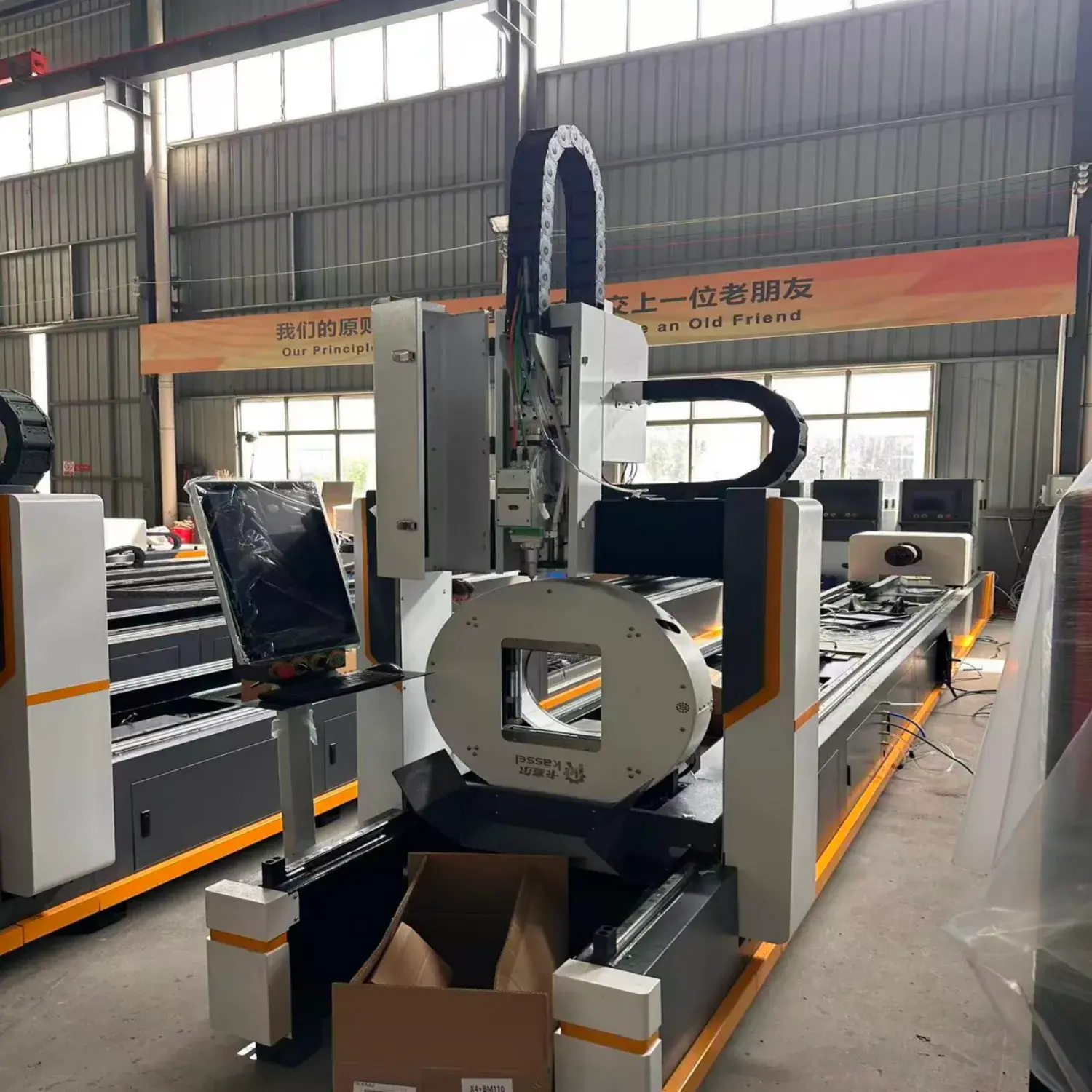
| Tube and pipe cutting (LT series) | Round tube 20–220 mm OD, square 20×20 to 150×150 mm, length 6000 mm | FSCUT with tube-specific nesting, Siemens 808D on higher-end builds | Furniture frames, exhaust systems, structural steel, handrail fabrication | Chuck-based rotation as B-axis; cannot cut flat sheets without major retrofit; mandrel support needed for thin-wall tube over 4 m |
| High-power thick plate gantry | 2000 × 4000 mm to 2500 × 8000 mm; Z travel 150–300 mm | Beckhoff, Siemens 840D sl; FSCUT 8000 for ultra-high power | Shipbuilding, construction equipment, mining machinery plate up to 25 mm stainless or 40 mm mild steel | 12 kW to 30 kW IPG or nLIGHT source; gantry mass 8000–15000 kg; requires water chiller 30 kW cooling capacity; oxygen cutting below 6 mm becomes inefficient |
| Compact desktop / training unit | 600 × 400 mm to 1300 × 900 mm | Modified Ruida or small Syntec; simplified nesting software | Technical schools, R&D labs, jewelry prototypes, architectural model shops | 500 W to 1500 W Raycus or MAX source; air-cooled; positioning accuracy ±0.05 mm; not CE certified on all variants; cannot cut steel over 3 mm |
| Coil-fed flying optics (laser blanking) | Strip width 800–1600 mm, coil thickness 0.5–3.0 mm | Custom Siemens or Beckhoff with tension control and loop pit integration | Automotive press blanking, high-volume appliance stampings, motor laminations | Decoiler and straightener upstream; no discrete sheets; cut while coil feeds continuously; requires precise speed matching between coil feed and laser traverse; investment 3–4× standard sheet-fed machine |
Single-platform open bed. These dominate the Southeast Asian and African import market because they ship in a single 40-foot container and need no pit or civil work beyond a level concrete floor rated for 3000–5000 kg concentrated load. A 1530 machine with 3 kW Raycus source, HIWIN 25 mm linear guides on X and Y, and rack-and-pinion drives with helical teeth achieves positioning accuracy ±0.03 mm and repeatability ±0.02 mm. Rapid traverse runs at 80–120 m/min depending on servo motor size (typically 1 kW Yaskawa or Panasonic on each axis). The buyer normally operates from a small job shop cutting 1–6 mm mild steel and 1–3 mm stainless for local agricultural equipment repair or building fabrication. What it cannot do: run unattended overnight because the operator must remove cut parts and reload sheets manually; thick aluminum over 8 mm reflects too much energy at 3 kW and risks head damage without higher power and anti-back reflection optics.
Exchange-pallet dual platform. The second pallet sits below or beside the cutting zone on a scissor or fork mechanism. While the laser cuts on pallet A, the operator sorts parts and loads a new sheet on pallet B. Exchange time 10–15 seconds at 1.5G acceleration. A 4020 machine with 6 kW source weighs 7500–9000 kg and demands a 16-ton forklift or 10-ton overhead crane for unloading from flat rack or open-top container. Controls commonly pair Syntec or FSCUT motion with Cypcut nesting; the Beckhoff option adds EtherCAT servo bus and better real-time height sensing for plasma-scribed plate. Buyers include Tier-2 automotive suppliers and appliance OEMs in Turkey, Mexico, and Vietnam running two shifts. What it cannot do: justify its capital cost below roughly 20 cutting hours per week; the pallet mechanism adds failure modes and consumes maintenance time that single-platform operators avoid.
Tube and pipe cutting. The machine replaces the flat bed with a pair of pneumatic chucks—front driving, rear supporting—on a heavy welded base. The B-axis rotates tube while the cutting head executes X, Y, and Z interpolation in the plane of the cut face. Bevel cutting to 45° requires a tilting head (A-axis) and pushes price up 40–60%. A typical 220 mm round capacity machine with 3 kW source uses Yaskawa servos and harmonic drive for chuck rotation, achieving ±0.05 mm repeatability on 6 m tube length. Buyers are exhaust fabricators, stadium seat manufacturers, and greenhouse builders. What it cannot do: process flat sheet without a separate module; tube ovality over 1% of diameter causes focal drift that capacitive sensing cannot fully compensate; thin-wall square tube below 1.2 mm wall distorts under chuck pressure.
High-power thick plate gantry. The physics change above 6 kW: nitrogen becomes economical for stainless cutting up to 12 mm, replacing slower oxygen processes and eliminating oxide edge. At 12 kW and above, mild steel cuts at 1.5× linear speed at 6 mm compared to 6 kW, but the relationship is not linear—thermal losses and plasma blow-out limit gains above 20 mm. The gantry beam uses HT300 casting or welded steel box construction with internal ribbing; linear guides scale to HIWIN 35 mm or 45 mm; drives use helical rack with dual-motor gantry synchronization to limit skew. A 12 kW 4020 machine with IPG YLS-12000 and Precitec Procutter head runs 380V 50Hz three-phase at 60–80 A full load; 220V 60Hz markets need a step-up transformer or dual-voltage chiller and source configuration. Buyers are shipyards in Turkey, mining equipment rebuilders in Chile, and wind tower fabricators in Brazil. What it cannot do: compete with plasma on 40 mm mild steel for speed or capital cost; the beam quality and mode stability of the source become critical—Raycus 12 kW multimode delivers acceptable results but IPG single-mode shows cleaner edges on 8–12 mm stainless.
Compact desktop / training unit. These use sealed CO2 or fiber sources down to 500 W, air-cooled chillers, and aluminum extrusion frames rather than cast beds. Positioning accuracy degrades to ±0.05 mm with open-loop stepper drives; upgrading to closed-loop stepper or small servo adds 15–20% cost. The 1300 × 900 mm format fits through a standard door and runs on 220V single-phase, making it attractive to technical schools in Nigeria, Kenya, and Indonesia where three-phase infrastructure is unreliable. What it cannot do: cut steel commercially—speed at 1 mm is roughly 3–5 m/min versus 15–25 m/min on an industrial 3 kW machine; the small bed precludes standard 1220 × 2440 mm sheet stock, forcing remnant-based material flow; no automatic height sensing on most units, so warped sheet crashes the nozzle.
Coil-fed flying optics. The laser head traverses across a moving strip while the coil feeds continuously at matched speed. Loop pits or dancer rollers maintain tension. This eliminates shearing and stacking entirely, cutting automotive blanking die costs from the process. Controls integrate coil line PLCs with laser CNC via Profibus or EtherCAT; the nesting software must generate cuts that never trap a slug in the strip. A typical 1250 mm width line with 6 kW source and 0.5–2.0 mm coil runs at 30–60 m/min combined feed/cut speed. Buyers are Tier-1 automotive stampers and high-volume motor manufacturers in China, India, and Eastern Europe. What it cannot do: handle lot sizes below roughly 5000 pieces—die changeover becomes cheaper below that threshold; the coil must be clean and dry; surface scale or oil contamination destabilizes the height sensor and contaminates optics; strip width changes require 30–60 minute mechanical adjustment of guides and straightener rollers.

Основные компоненты станка для лазерной резки с ЧПУ
A CNC laser cutting machine produces parts by directing a focused high-power laser beam onto sheet metal, melting or vaporizing material along a programmed path while assist gas blows the molten metal out of the kerf. The operator loads a sheet onto the cutting bed, clamps or holds it with vacuum, runs a nested CNC program, and retrieves finished parts from the skeleton. Everything between those two points is handled by coordinated motion control, beam delivery, and process gas systems.
Основные органы и их функции
| Сборка | Функция | Типичная версия начального уровня | Типичная обновлённая версия | Что выходит из строя первым |
|---|---|---|---|---|
| Станина и каркас станка | Supports all axes and maintains flatness under thermal and cutting loads | Welded steel tube frame, 3000 kg on 3015 size | HT250 or HT300 resin sand casting, stress relieved, 4500–6500 kg | Welded frames warp under thermal cycling; cast beds crack at bolt points if not stress relieved |
| Gantry and Y-Axis Drive | Carries the cutting head across the sheet width | Single-sided rack and pinion, HIWIN or PMI HG series 25 mm linear guides, rapid traverse 60 m/min | Dual-motor dual-drive gantry with 35 mm or 45 mm linear roller guides, rapid traverse 100–140 m/min | Rack wears on entry-level machines; guide block contamination on both types |
| X-Axis Beam and Z-Axis Head | X moves the head along gantry length; Z maintains standoff | Aluminium beam, 500 W servo, 150 mm Z stroke | Cast iron or steel beam, 1 kW servo, 200–300 mm Z stroke with collision protection | Z-axis ball screw or belt stretch; capacitive sensor cable fatigue |
| Лазерный источник и охладитель | Generates the cutting beam; chiller maintains diode and fiber stability | Raycus 1.5 kW or 3 kW, air-cooled or small chiller | IPG 6 kW or 12 kW with 6 kW chiller unit, closed-loop temperature control | Chiller pump or flow sensor; source degradation from back-reflection on reflective metals |
| Cutting Head and Optics | Focuses the beam and delivers assist gas to the kerf | Raytools BM110, fixed focus 125 mm or 150 mm focal length, manual nozzle change | Precitec Procutter or LightCutter, auto-focus, zoom collimation, motorized nozzle changer | Protective window contamination from spatter; ceramic ring fracture on collision |
| Control System and Servo Package | Interprets G-code, coordinates axes, modulates laser power and gas | GSK or KND with 0.05 mm positioning accuracy, 0.03 mm repeatability, pulse command servos | FANUC 0i-F or Siemens 828D with 0.03 mm positioning, 0.02 mm repeatability, absolute encoders | Encoder battery failure; I/O module damage from plasma noise if poorly shielded |
| Система подачи газа Assist | Provides cutting gas (O₂, N₂, compressed air) at controlled pressure | Single-line O₂/N₂ manual switch, 10 bar max, mechanical regulator | Multi-gas automatic manifold, 25 bar high-pressure N₂ for stainless, proportional valve with mass flow control | Solenoid valve seat erosion from moisture; pressure sensor drift |
| Удаление пыли и дыма | Removes vaporized metal and particulate from cutting zone | 1500 m³/h side-draft or downdraft with bag filter | 4000 m³/h segmented downdraft with automatic damper zones, cartridge filter with reverse pulse | Filter blinding on mild steel; spark detection system false trips |
| Корпус и блокировки безопасности | Contains laser radiation, contains high-pressure gas leaks, protects operator | Partial enclosure with CE-compliant laser safety glass, mechanical door switches | Full enclosure with light curtain, fume containment, automatic fire suppression in cutting head zone | Door switch contact corrosion; safety relay coil failure |
Assemblies That Most Affect Long-Term Accuracy
Gantry and Y-Axis Drive
Dual-motor dual-drive gantry systems eliminate the racking errors that single-sided drives accumulate as rack wears asymmetrically. A 3015 machine (3000 mm × 1500 mm cutting area) with 100 m/min rapids and 1.5G acceleration demands 0.01 mm pitch error compensation or diagonal geometry errors exceed 0.1 mm over the full stroke. Linear roller guides on 35 mm rails with C5 or C3 ground ball screws maintain positioning accuracy of 0.03 mm over 5000 hours; 25 mm guides with C7 rolled screws drift to 0.08 mm in the same period. The trade-off is cost and weight: a dual-drive cast gantry adds 800–1200 kg to machine mass and requires 20–30% more servo power.
Лазерный источник и охладитель
Beam quality (M² value) degrades with source age and thermal instability. A Raycus 3 kW unit specifies M² < 1.5 when new; after 20,000 resonator hours this can drift to 2.0 if chiller temperature fluctuates beyond ±2°C. IPG sources hold tighter tolerances but the 6 kW chiller represents a separate failure point—pump cavitation from glycol degradation or flow restriction from algae growth causes power drops the operator misdiagnoses as optics problems. For buyers in 50 Hz regions running 60 Hz specified chillers, transformer sizing must include chiller inrush current, typically 3× running current for 2–3 seconds.
Control System and Servo Package
Absolute encoder systems (FANUC αi series, Siemens 1FK7 with EnDat 2.1) eliminate homing drift after power cycles. Incremental encoders on entry-level systems lose position reference during emergency stops or power loss, introducing restart errors of 0.05–0.2 mm depending on axis speed at interruption. The servo loop bandwidth determines corner accuracy: a 1 kHz loop following a 10 mm radius corner at 30 m/min maintains 0.03 mm path fidelity; 400 Hz loops round the same corner to 0.1 mm. Higher bandwidth demands rigid mechanical transmission—belt drives on Z-axis fail here, which is why upgraded machines use ball screws or linear motors for Z.
Технические характеристики и как их понимать
| Параметр | Начальный уровень | Средний ценовой диапазон | Высокие технические характеристики |
|---|---|---|---|
| Working Range (X × Y × Z) | 3000 × 1500 × 150 mm | 4000 × 2000 × 200 mm | 6000 × 2000 × 250 mm |
| Мощность лазерного источника | Raycus мощностью 1,5 кВт | 3 kW MAX | 6 кВт IPG |
| Бренд лазерных источников | Рэйкус | MAX Photonics | IPG Photonics |
| Режущая головка | Raytools BM110 | Raytools BM111 | Precitec Procutter 2.0 |
| Max Cutting Speed (Carbon Steel) | 25 m/min at 1 mm | 35 m/min at 1 mm | 45 m/min at 1 mm |
| Max Cutting Thickness (Mild Steel) | 8 mm | 12 mm | 20 mm |
| Max Cutting Thickness (Stainless Steel) | 4 mm | 8 mm | 12 mm |
| Max Cutting Thickness (Aluminum) | 3 mm | 6 mm | 10 mm |
| Точность позиционирования | ±0.05 mm | ±0.03 mm | ±0.02 mm |
| Повторяемость | ±0.03 mm | ±0.02 mm | ±0.01 mm |
| Rapid Traverse (X/Y) | 80 m/min | 120 m/min | 150 m/min |
| Ускорение | 1.0 G | 1.5 G | 2.0 G |
| Система управления | Cypcut / FSCUT2000 | Cypcut / FSCUT3000 | Beckhoff / Siemens 840D |
| Servo Drive | Yaskawa Σ-7 | Yaskawa Σ-7 | Mitsubishi MELSERVO-J5 |
| Linear Guide | HIWIN HG Series 25 mm | HIWIN HG Series 30 mm | THK SHS 35 mm |
| Rack and Pinion | Taiwan YYC C5 | Taiwan YYC C5 / C3 | Germany Atlanta Alpha |
| Machine Bed | Welded steel tube, annealed | HT250 cast iron frame, stress relieved | HT300 Meehanite, full annealing |
| Table Load Capacity | 800 kg | 1200 kg | 2000 kg |
| Exhaust System | 1 × 7.5 kW blower | 2 × 7.5 kW blowers | 4 × 7.5 kW blowers with pre-filter |
| Chiller | S&A CW-5200 (1.5 kW) | S&A CW-6200 (3 kW) | Teyu CW-6300 (6 kW dual circuit) |
| Напряжение питания | 380V 3-phase 50 Hz | 380V 3-phase 50 Hz | 380V 3-phase 50 Hz / 480V 60 Hz optional |
| Total Connected Load | 22 kVA | 38 kVA | 65 kVA |
| Machine Net Weight | 3500 kg | 6500 kg | 12 000 кг |
| Floor Space (L × W × H) | 4800 × 2600 × 1800 mm | 6200 × 3200 × 2200 mm | 8500 × 3500 × 2500 mm |
| Dust Collector | Optional | Included | Included with automatic filter cleaning |
How the Machine Actually Works From Stock to Finished Part
A fiber laser cutting machine is a Cartesian gantry system that melts and blows away metal with a focused beam of infrared light. The sequence an operator sees on the floor runs as follows.
The raw sheet arrives on the pallet and loads onto the exchange table or fixed cutting bed. On single-table machines common in entry-level builds, the operator cranes the sheet directly onto slat supports. On mid-range and high-specification builds, a hydraulic or electric shuttle system exchanges the cutting table with a second table outside the cutting zone, giving approximately 15–30 seconds of parallel loading time.
The CNC reads the nested DXF or NC code. The control—Cypcut on most Chinese exports, Beckhoff on European-targeted builds, Siemens 840D on heavy industrial systems—breaks the geometry into G-code motions and assigns laser parameters per layer. The operator sets focal position, nozzle standoff (typically 0.5–1.5 mm above the sheet), assist gas pressure, and cutting speed via the parameter library.
The laser source generates 1070 nm wavelength light in the fiber oscillator. Raycus, MAX, and IPG sources differ in beam quality (M² value), wall-plug efficiency, and diode lifetime. A 1.5 kW Raycus unit runs at approximately 30% electrical efficiency with a rated diode life of 50,000 hours. A 6 kW IPG runs nearer 40% efficiency with 100,000-hour diode rating and better beam parameter product (BPP under 2.0 mm·mrad versus 3.5 for entry sources). This matters because lower BPP means tighter focus spot and cleaner edge quality at equal power.
The beam travels through a flexible fiber cable to the cutting head. Inside the head, collimating optics expand the beam, then focusing optics concentrate it to a spot diameter of 0.1–0.3 mm. The head carries a capacitive height sensor that maintains nozzle-to-sheet distance within ±0.05 mm even over warped material. The Raytools BM110 on entry builds uses single-lens focusing; the Precitec Procutter 2.0 on high builds uses zoom optics with automatic focal adjustment from −10 mm to +10 mm relative to the nozzle tip, enabling piercing on thick plate without manual shim changes.
Assist gas—oxygen for mild steel to accelerate exothermic reaction, nitrogen for stainless and aluminum to prevent oxidation—blows coaxially through the nozzle at 10–25 bar depending on material and thickness. The gas jet ejects molten metal from the kerf. Kerf width runs 0.15–0.3 mm on thin sheet, widening to 0.5–1.0 mm on 20 mm mild steel with oxygen assist.
The gantry moves in X and Y. The Z axis rides on the crossbeam and adjusts only for focal height, not for profiling. Entry-level machines drive X and Y with rack-and-pinion on HIWIN HG25 linear guides, achieving 80 m/min rapid and 1.0 G acceleration. Mid-range machines upgrade to HG30 guides and YYC C3-grade racks, pushing 120 m/min and 1.5 G. High-specification builds use THK SHS35 guides with Atlanta Alpha planetary rack drives or direct linear motors, reaching 150 m/min and 2.0 G. Acceleration matters more than top speed for thin-sheet cutting; higher G allows the machine to maintain cutting speed through tight radii and small holes without thermal overburn.
The cut completes. Parts drop through slats into a collection bin on single-table machines, or remain on the shuttle table for parts removal while cutting continues on the second table. The operator sorts parts, removes micro-tabs if skeleton-breaking was used, and sends to downstream bending or welding.
Чтение технического паспорта строка за строкой
Working Range or Cutting Table Size
The 3015 designation means 3000 mm × 1500 mm. The 4020 means 4000 mm × 2000 mm. The 6020 means 6000 mm × 2000 mm. These numbers define the maximum sheet size the machine accepts, not the reachable cutting area, which is typically 50–100 mm less per axis due to guarding and limit switches. A 3015 machine handles standard 1220 × 2440 mm or 1250 × 2500 mm sheets with margin. A 4020 handles 1500 × 3000 mm or 1525 × 3050 mm Euro sheet. A 6020 handles 2000 × 6000 mm plate for shipbuilding or heavy equipment. Buy one size up from your common sheet stock; nesting efficiency drops sharply when you must rotate or split sheets.
Мощность лазерного источника и марка
Power determines maximum cutting speed and thickness, but the relationship is not linear. Doubling power from 3 kW to 6 kW does not double speed on 1 mm mild steel because the machine hits kinematic limits first. It does, however, extend maximum thickness from 12 mm to 20 mm on mild steel and improve edge squareness on 6–10 mm stainless. Raycus dominates entry-level Chinese exports at roughly 15–20% lower cost than MAX or IPG. The trade-off is beam quality stability over diode aging and slightly higher maintenance frequency. MAX occupies the middle ground with good support networks in Southeast Asia and South America. IPG remains the reference for aerospace and precision work but carries 40–60% price premium. Source replacement cost runs 30–50% of initial machine price, so brand availability in your region matters for long-term cost.
Cutting Head Specification
Raytools BM110 and BM111 heads use ceramic bodies and standard focusing lenses. Precitec Procutter uses crash-protected magnetic coupling and integrated zoom optics. The magnetic breakaway prevents head damage on collision with tipped parts or slag buildup, saving approximately 2–4 hours of replacement time per incident. Zoom optics eliminate manual lens changes when switching between thin-sheet high-speed and thick-plate piercing modes.
Точность и повторяемость позиционирования
Positioning accuracy ±0.05 mm means the machine places the beam within 0.05 mm of the commanded coordinate under no-load conditions. Repeatability ±0.03 mm means returning to the same point within 0.03 mm over multiple cycles. For sheet metal work, repeatability matters more than absolute accuracy because parts are cut from single sheets without re-referencing. ±0.05 mm positioning is adequate for general fabrication. ±0.02 mm repeatability becomes necessary for parts that mate with CNC machined components or for fine-feature tabs and slots.
Rapid Traverse and Acceleration
Rapid traverse is the maximum non-cutting speed between features. On thin material, the machine never reaches this speed while cutting because the laser must maintain controlled feed. On thick material, rapids dominate non-productive time. Acceleration, expressed in m/s² or G (1 G = 9.81 m/s²), determines how quickly the machine reaches cutting speed after a corner or pierce point. Entry-level 1.0 G machines show visible lag on 1 mm radii in 2 mm sheet, producing slight overburn. Mid-range 1.5 G and high-spec 2.0 G machines hold speed through tighter geometry.
Тип направляющей
All fiber laser cutting machines use linear roller guides, not box ways. The choice is between standard ball-guided rails (HIWIN HG, PMI MSB) and roller-guided rails (THK SHS, NSK RA). Ball guides run quieter and cost less but have lower load capacity and stiffness. Roller guides handle the higher acceleration and inertial loads of large gantry systems above 6000 kg moving mass. For 3015 entry machines, HG25 ball guides are sufficient. For 6020 machines with 12000 kg mass and 2.0 G acceleration, SHS35 roller guides or equivalent are necessary to maintain 20,000 km rated life.
Система управления
Cypcut and its hardware variants FSCUT2000/3000/4000 control approximately 80% of Chinese fiber laser exports. The system integrates laser source communication, height sensing, gas control, and motion in one package. It is cost-effective and well-supported for 2D cutting. Beckhoff TwinCAT and Siemens 840D appear on high-specification machines requiring multi-axis coordination for tube cutting, 3D bevel cutting, or integration into automated lines. The control choice affects spare parts availability and technician training requirements in your region.
Machine Bed and Casting
Entry-level beds use welded structural steel tube, stress-relieved and milled. This is adequate for 1.5–3 kW systems where thermal input and vibration are moderate. HT250 cast iron beds appear at 3 kW and above; the damping capacity of cast iron reduces vibration during high-speed direction changes. HT300 Meehanite castings with full annealing and natural aging appear on 6 kW+ systems where thermal distortion over years of operation must be controlled. A 6020 HT300 bed typically weighs 8000–9000 kg versus 3500 kg for a welded 3015 bed. The extra mass reduces relative motion between beam delivery and workpiece during acceleration transients.
Supply Voltage and Total Connected Load
Standard Chinese export specification is 380V 3-phase 50 Hz. North American buyers need 480V 60 Hz or 208V 60 Hz with transformer. The transformer must be sized at 1.25× the total connected load to handle inrush current from chiller compressors and blower motors. A mid-range 38 kVA machine needs 50 kVA transformer minimum. Voltage stability requirement is typically ±10%; beyond this, servo drives fault and laser source power fluctuates. Total connected load includes laser source, chiller, dust collection, servo drives, and auxiliary systems. Do not size electrical supply on laser source power alone; the 3 kW MAX source in a mid-range machine draws 8–10 kW electrical, but total connected load is 38 kVA due to power factor and auxiliary loads.
Вес оборудования без упаковки и занимаемая площадь
Net weight indicates structural mass and shipping cost. A 3015 entry machine at 3500 kg ships in one 40-foot HC container with other equipment. A 6020 high-spec machine at 12000 kg requires dedicated flat-rack or open-top container, or disassembly of gantry from bed for standard container loading. Floor space must include 1000 mm minimum service access on all sides, 1500 mm at electrical cabinet, and material handling zones. A 4020 machine with 6200 × 3200 mm footprint needs approximately 10 m × 8 m total shop space with loading crane access.
Условия торговли и практические аспекты экспорта
FOB (сдача на борт)
The seller delivers goods onto the vessel at named port of shipment. Risk transfers when goods pass ship’s rail. For a 3500 kg 3015 machine, FOB Shanghai means you pay ocean freight, marine insurance, and destination charges. For a 12000 kg 6020 machine, FOB may require you to arrange heavy-lift vessel or flat-rack container. Confirm with seller whether FOB includes terminal handling charges; Chinese ports often bill these separately.
CIF (стоимость, страхование, фрахт)
Seller pays freight and insurance to named destination port. Insurance coverage is typically 110% of CIF value under Institute Cargo Clauses (A), (B), or (C). Clause (A) covers all risks; (C) covers only major casualties. For laser sources worth 30–50% of machine value, specify Clause (A) or add specific coverage for shock and moisture damage. CIF does not include destination unloading, customs clearance, or inland transport.
CFR (стоимость и фрахт)
Identical to CIF except seller does not procure insurance. You bear risk during transit and must arrange coverage. CFR is uncommon for machinery but appears when buyers have existing marine policies.
EXW (Ex Works)
Seller makes goods available at factory. You arrange all transport, export clearance, and insurance. EXW saves seller markup on logistics but requires you to manage Chinese export documentation, customs declaration, and container loading supervision. For first-time importers, EXW on a 12000 kg machine is risky; loading damage during container stuffing is your responsibility.
Аккредитив (L/C)
Bank guarantees payment against presentation of compliant documents. Common terms: 30% T/T advance, 70% L/C at sight. L/C adds 0.1–0.3% cost and 5–10 days document processing. Specify exact documents required: commercial invoice, packing list, full set original bill of lading, certificate of origin, and CE conformity declaration if applicable. Discrepancies in L/C documents cause payment delays; inspect draft documents before shipment.
T/T (телеграфный перевод)
Direct bank transfer. Typical structure: 30% deposit on order confirmation, 70% before shipment against copy of bill of lading, or 100% against copy of B/L for repeat buyers. T/T is faster and cheaper than L/C but offers less security for buyer. For first orders, negotiate 30/70 with 70% payable after successful pre-shipment inspection video or third-party survey.
Код HS
Fiber laser cutting machines fall under HS 8456.11 (machine tools for working any material by removal of material, operated by laser). Some customs authorities classify under 8456.12 (operated by plasma arc) if combined laser-plasma. Correct classification affects duty rate, which ranges 0–8% depending on trade agreement. Certificate of origin under ASEAN-China FTA, RCEP, or bilateral agreement may reduce or eliminate duty. Verify with your customs broker before shipment.
Маркировка CE
CE marking indicates conformity with EU Machinery Directive 2006/42/EC, EMC Directive 2014/30/EU, and Low Voltage Directive 2014/35/EU. For laser machines, EN ISO 11553-1 (safety of machinery—laser processing machines) and EN 60825-1 (laser product safety) apply. CE documentation includes EC declaration of conformity, technical file, and risk assessment. Non-EU buyers sometimes request CE as proxy for safety standard compliance; confirm which directives and standards are cited, as CE for export-only machines may be self-declared without notified body involvement.
Упаковочный лист и сертификат происхождения
The packing list details each crate, dimensions, weight, and contents. For a 3015 machine: crate 1 (gantry and bed, 3200 × 2200 × 1800 mm, 2800 kg), crate 2 (electrical cabinet and chiller, 1200 × 1000 × 1600 mm, 450 kg), crate 3 (accessories and tools, 800 × 600 × 600 mm, 250 kg). The certificate of origin, issued by China Council for the Promotion of International Trade (CCPIT) or customs authority, establishes eligibility for preferential tariff treatment.
Foundation and Installation
Vibration isolation matters less for laser cutting than for punch presses, but bed leveling affects cutting accuracy. Specification typically requires flatness within 0.1 mm/m over machine footprint. Entry 3015 machines install on standard industrial concrete 150 mm thick at 200 kg/cm² compressive strength. High-specification 6020 machines require 200 mm minimum with embedded leveling pads or isolated foundation pads to prevent transmitted vibration from adjacent operations. Foundation bolts or chemical anchors secure the bed; allow 7–14 days concrete curing before machine placement.
Unloading and Handling
A 3015 machine at 3500 kg unloads with 5-ton forklift or 3-ton crane with spreader bar. A 6020 machine at 12000 kg requires 10-ton forklift with extended forks or 10-ton overhead crane. Container unloading of flat-rack or open-top shipments needs mobile harbor crane or shore crane at port; arrange before vessel arrival to avoid demurrage.
Installation and Training
Standard RUNNEWTECH provision includes 3–5 days installation and operator training by technician. Allow additional 2–3 days for machines with tube cutting attachment or automatic nozzle changer. Training covers: control operation, parameter adjustment for material types, daily maintenance (lens cleaning, nozzle inspection, chiller fluid check), and fault diagnosis. Request written training completion certificate for operator qualification records.
Запасные части и расходные материалы
Consumables: focusing lenses (50–200 hour life depending on contamination), ceramic nozzles (20–80 hours), protective windows (8–40 hours), and assist gas. Stock one year of nozzles and protective windows; lead time from China is 2–4 weeks. Critical spares: spare laser source (if production continuity requires), servo motor and drive, rack and pinion set, and capacitive height sensor. The chiller is a single point of failure; keep spare pump and temperature sensor. Laser source warranty is typically 2 years or 20,000 hours; machine mechanical warranty 1–2 years. Extended warranty on source to 3 years adds 8–12% cost but may be worthwhile for single-machine operations without backup capacity.
Промышленные области применения лазерного станка с ЧПУ
A CNC fiber laser cutting machine works by focusing a high-power laser beam through a cutting head onto a metal sheet, melting or vaporizing the material while a pressurized assist gas blows the molten metal through the kerf. The CNC controller coordinates servo-driven gantry motion in X and Y axes, with a Z-axis maintaining precise focal distance above the sheet. The operator loads a DXF or NC program, nests parts on the virtual sheet, sets cutting parameters by material and thickness, then runs the cycle: pallet exchange or sheet loading, edge detection, pierce and cut sequence, part unloading, and scrap skeleton removal.
Real World Application Sectors
| Сектор | Типичные изготавливаемые детали | Рекомендуемые технические характеристики | Почему эта машина подходит |
|---|---|---|---|
| Запчасти для автомобилей и мотоциклов | Фланцы выхлопной системы, кронштейны, ушки рамы, держатели звездочек, поддоны для аккумуляторов | 3015 or 4020 table, 1.5–3 kW Raycus or IPG source, ±0.05 mm positioning accuracy, 120 m/min rapid traverse | High-volume nested cutting of 1–6 mm mild steel and 1–3 mm stainless; clean edges reduce downstream deburring for JIT assembly lines |
| Сельскохозяйственная техника | Plow shanks, hitch plates, guard brackets, combine sieve frames, hydraulic mount plates | 4020 or 6020 table, 3–6 kW IPG or MAX source, 15–25 mm mild steel capacity, pneumatic or electric pallet changer | Large parts from 4–12 mm wear plate demand long open tables; pallet changers keep cutters running during 8–12 hour seasonal production pushes |
| Гидравлические и пневматические фитинги | Valve bodies, manifold plates, cylinder end caps, port flanges, adapter rings | 3015 table, 2–4 kW source, ±0.03 mm repeatability, Raytools or Precitec autofocus head with capacitive height sensing | Tight tolerance on port patterns and bolt circles; autofocus maintains cut quality across 3–10 mm carbon steel and 316 stainless variations |
| Муфты для нефтегазовой отрасли | Flange rings, pipe saddles, gasket retainers, blowout preventer plates, wellhead adapters | 6020 table, 6–12 kW IPG source, 25 mm mild steel / 16 mm stainless capacity, oxygen and nitrogen gas switching | Thick-wall pipe transition pieces and pressure-rated flanges require deep penetration with oxygen cutting; large table handles 6 m pipe sections |
| Изготовление изделий из листового металла и шкафов | Electrical enclosures, server racks, HVAC ducting, switchgear panels, tool cabinets | 3015 table, 1.5–3 kW source, 80 m/min rapid traverse, GSK or Syntec controller, integrated shuttle table | High mix / low volume job shops need fast programming turnaround; shuttle tables cut non-productive loading time to under 30 seconds |
| Кухонное оборудование | Commercial sink bowls, range hoods, shelving brackets, prep table tops, exhaust collars | 3015 table, 2–3 kW source, nitrogen cutting for 1.5–4 mm 304 stainless, slat conveyor or ball transfer unloading | Cosmetic finish requirements on exposed stainless surfaces; nitrogen assist eliminates oxidation discoloration, reducing post-cut grain finishing |
Запчасти для автомобилей и мотоциклов
A Tier 2 supplier in Thailand runs two 4020 tables with 3 kW IPG sources and Syntec controllers to produce motorcycle frame brackets and exhaust flanges. The shop nests 40–60 parts per 4 m × 2 m sheet of 2.5 mm mild steel, running at 8 m/min cutting speed with oxygen assist. Positioning accuracy of ±0.05 mm keeps hole-to-edge dimensions within drawing tolerance without secondary machining. Rapid traverse at 120 m/min reduces non-cut travel between nested parts to under 2 seconds. The operator loads sheets via forklift onto a pneumatic pallet changer; finished skeletons drop to a scrap conveyor. Cycle time per sheet averages 14 minutes, supporting a 2,000-piece daily output for a Honda parts subcontractor.
Сельскохозяйственная техника
A combine harvester parts maker in Hebei Province operates a 6020 machine with 6 kW MAX laser source for 6–10 mm Q345 wear plate. The extended table accepts full 6 m × 2 m sheets of plow shank material. Cutting 8 mm plate at 2.2 m/min with oxygen yields square edges that withstand welding distortion better than plasma-cut equivalents. Machine weight of 12,000 kg and HT300 cast gantry base maintain stability at these loads. The shop runs 16-hour shifts during spring planting season; the electric pallet changer swaps sheets in 45 seconds while the operator removes cut parts from the offload side. Without pallet automation, the gantry sits idle for 4–5 minutes per load cycle, eroding seasonal capacity by roughly 15 percent.
Гидравлические и пневматические фитинги
A Zhongshan valve manufacturer uses a 3015 table with 3 kW Raycus source and Raytools BM110 autofocus head to cut manifold plates from 10 mm 6061-T6 aluminum and 8 mm 316 stainless. The capacitive height sensor tracks sheet warp within ±0.5 mm, adjusting Z-axis in real time to maintain 0.2 mm focal standoff. This prevents edge rollover on precision port patterns where ±0.05 mm repeatability governs downstream CNC machining center alignment. The shop switched from waterjet to fiber laser for aluminum manifolds; cutting speed improved from 0.3 m/min to 4 m/min, though heat-affected zone width increased from 0.1 mm to 0.4 mm. For hydraulic systems rated above 35 MPa, post-cut stress relief remains mandatory.
Муфты для нефтегазовой отрасли
A Dongying fabricator serving Sinopec subcontractors runs 6 kW and 12 kW IPG machines on 6020 tables for wellhead flange rings to 25 mm thickness. Oxygen cutting at 0.6 m/min in 25 mm A105 carbon steel produces kerf widths of 0.3–0.4 mm with minimal dross on the underside. The 12 kW source extends productive thickness range to 30 mm mild steel, though edge quality degrades above 25 mm; plasma or oxyfuel handles thicker sections more economically. The shop maintains nitrogen and oxygen bulk tanks with automatic gas selection by material program. CE-certified guarding and fume extraction meet offshore supplier audit requirements. Foundation specifications call for 200 mm reinforced concrete with M16 anchor bolts at 500 mm spacing for the 15,000 kg machine mass.
Изготовление изделий из листового металла и шкафов
A job shop in Mexico City runs three 3015 machines with 1.5 kW Raycus sources and GSK 980TB controllers for electrical enclosure production. The Syntec-compatible nesting software imports customer DXF files, applies common-line cutting to reduce scrap from 18 percent to 12 percent, and outputs G-code in under 90 seconds. Shuttle tables allow one operator to manage two machines; loading time drops to 25 seconds versus 3 minutes for manual sheet placement. The shop cuts 1.2 mm galvanized steel at 12 m/min with nitrogen for zinc-coated edge quality, eliminating post-cut phosphating touch-ups. Positioning accuracy of ±0.05 mm ensures that punched mounting holes align with laser-cut door openings in final assembly.
Кухонное оборудование
A stainless fabricator in Foshan produces 800 commercial sink units monthly on a 3015 table with 2 kW IPG source, nitrogen cutting 1.5–3 mm 304 stainless at 6–10 m/min. The critical requirement is cosmetic edge finish on visible sink rims and backsplash returns; nitrogen assist at 15–20 bar produces straw-colored edges that pass 240-grit scratch tests without additional finishing. The machine runs HIWIN linear guides on the gantry with 0.02 mm repeatability, maintaining consistent focal position across 3 m travel. Slat conveyors below the cutting zone collect small dropouts and direct coolant residue to a filtration sump. The shop compared CO2 laser to fiber for this work; fiber’s 1.07 µm wavelength cuts stainless 40 percent faster with 30 percent lower power consumption, though initial capital cost runs 15–20 percent higher for equivalent wattage.
Соответствующее оборудование RUNNEWTECH
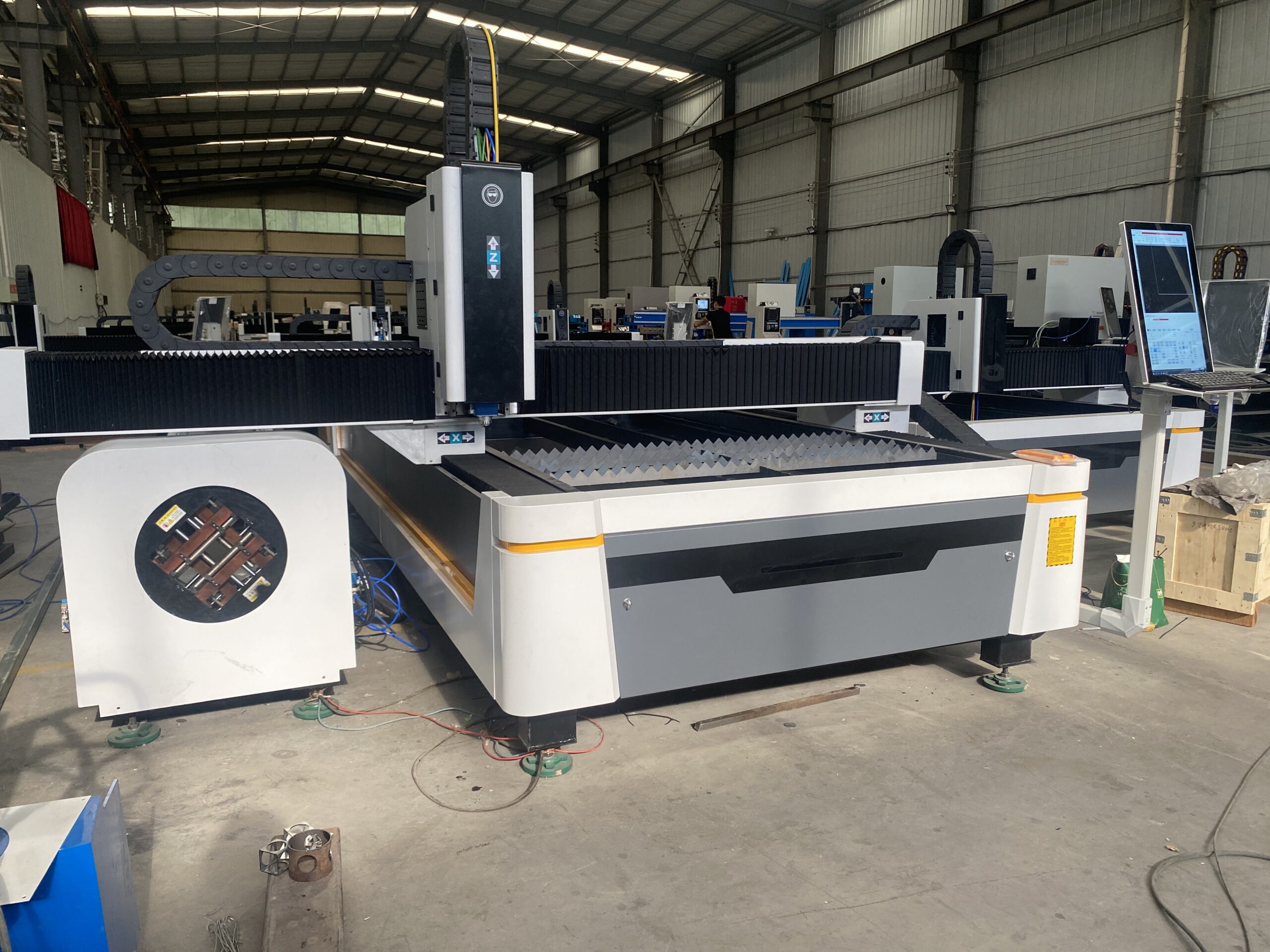
Станок для лазерной резки с ЧПУ
Станок для лазерной резки с ЧПУ, поставляемый напрямую с завода, с возможностью выбора системы управления FANUC, Siemens, Mitsubishi, GSK или Syntec и питанием 380 В/50 Гц или 220 В/60 Гц для экспорта.
Часто задаваемые вопросы о станке для лазерной резки с ЧПУ
Q: What is the minimum order quantity for a CNC laser cutting machine?
Single-unit orders are standard for machines up to 6 kW. Orders of two or more units—common for training centres or dealer stock—qualify for consolidated container loading and reduced per-unit freight. No MOQ applies to standard 3015 or 4020 table sizes. Custom 6020 or multi-pallet configurations typically require three units minimum to justify jig and fixture production.
Вопрос: Какие системы управления доступны и на каких языках?
CypCut, FSCUT, or Syntec laser-dedicated controllers ship as standard. FANUC and Siemens are available on industrial automation orders where the buyer already stocks those part numbers. Interface languages include English, Spanish, Russian, Arabic, and Turkish; others by firmware load prior to shipment. The nesting and CAM layer runs on Windows-based industrial PCs with USB and Ethernet part transfer.
Q: What is the typical lead time from deposit to shipment?
Standard-configuration machines with Raycus 3 kW or 6 kW sources: 25–35 days after confirmed 30% deposit. IPG or MAX source substitution adds 10–14 days. Custom table sizes, rotary axis integration, or CypCut Pro vision systems extend to 50–60 days. Peak season (November–January) adds one week. Factory confirmation photos and video are provided before final balance and booking.
Q: What are the payment terms?
30% T/T deposit to confirm production, 70% T/T before shipment against copy of B/L. Irrevocable L/C at sight is accepted for orders above USD 80,000 with confirmed bank charges to buyer. No D/P or consignment terms. Currency is USD unless otherwise agreed. Deposit locks material and laser source allocation; exchange rate risk after 30 days is buyer’s.
Вопрос: Может ли оборудование работать при напряжении и частоте, характерных для нашей местной электросети?
Standard build is 380V three-phase 50Hz. For 220V 60Hz regions (North America, parts of Southeast Asia, South America), a step-up transformer to 380V is required—specify at order so terminal blocks and motor data plates match. Transformer capacity: 1.5× the machine’s total connected load (typically 25–40 kVA for a 3–6 kW system). Chiller and dust collector must be on the same phase plan.
Вопрос: Как осуществляется доставка оборудования и сколько времени занимает транспортировка?
Machines up to 4020 table size ship in 40-foot high-cube containers; 6020 or tandem configurations require flat-rack or breakbulk. Net weight ranges from 3,500 kg (3015, 3 kW) to 8,500 kg (6020, 12 kW). FOB Qingdao or CIF to named port. Transit time: 18–25 days to Southeast Asian ports; 30–40 days to Middle East and East Africa; 35–45 days to South America; 25–35 days to Eastern Europe via rail option.
Q: What warranty and spare parts support is provided?
Two-year warranty on laser source (Raycus/MAX: 24 months or 20,000 hours; IPG: 36 months by source terms), one year on motion components and control system. Spare parts kit included: one nozzle set, protective lenses (10 pcs), ceramic ring, focus lens, and O-rings. Critical spares—laser source modules, servo motors, ball screws—held in regional warehouses for Middle East and Southeast Asian distributors. Air freight spares typically 5–7 days.
Q: Is factory acceptance testing and an accuracy report provided?
Yes. FAT includes cutting test on buyer-supplied material or standard SUS304/Q235A samples. Report documents: positioning accuracy ±0.05 mm/m, repeatability ±0.03 mm, cutting surface roughness Ra 12.5–25 μm depending on thickness and assist gas. Video recording of full test cycle is included. Third-party SGS or Bureau Veritas witness at buyer’s cost and 5-day advance notice.
Q: What about installation and operator training?
Two options: supervised install by buyer’s electrician with RUNNEWTECH engineer remote guidance (included); or flying engineer dispatch (USD 180–220/day plus visa, airfare, local accommodation). On-site training covers nesting software, parameter tables by material, nozzle and lens change, daily maintenance, and fault code diagnosis. Typical duration: 3–5 days for experienced operators; 7 days for new teams. Training certificate provided.
Q: What tolerance can we expect on our actual material?
On mild steel to 6 mm: ±0.05 mm contour accuracy, ±0.08 mm on 10–12 mm with oxygen assist. Stainless to 4 mm with nitrogen: ±0.04 mm. Aluminium to 3 mm: ±0.06 mm due to reflectivity; anti-spatter coating and parameter optimisation required. Tolerance degrades with dirty material, incorrect focal length, or worn nozzle. Kerf width: 0.1–0.3 mm depending on power and speed.
Q: What are the running consumables costs?
Protective lens: USD 8–15 each, 50–80 hours in clean environment, 20–30 hours in heavy dust. Nozzle: USD 12–25, 200–400 hours. Ceramic ring: USD 60–120, 800–1,200 hours. Focus lens: USD 150–400, 2,000–4,000 hours if protected. Assist gas: nitrogen at 99.999% purity for stainless/aluminium, oxygen for mild steel; consumption 0.5–2.5 m³/hour depending on thickness and pressure. Annual consumables budget for single-shift operation: USD 3,500–6,000 at 3 kW; USD 5,500–9,000 at 6 kW.
Вопрос: Можете ли вы предоставить документацию CE для таможенного оформления?
CE conformity declaration, machinery directive 2006/42/EC technical file, and EN ISO 11553 laser safety assessment are provided for EU-bound machines. For non-EU destinations requiring CE for import preference or tender compliance, documentation is available by order specification. EMC and LVD test reports are held at factory; copies certified true are included in shipping documents. Original certificates travel with machine; electronic copies sent 72 hours before arrival for pre-clearance where permitted.
Важное уведомление
Технические характеристики, показатели точности и ценовые диапазоны, приведенные в данном руководстве, носят ориентировочный характер и приведены для целей планирования
только в этих целях. Фактический рабочий диапазон, достижимый допуск, доступность системы управления, требования к напряжению питания и соответствие
Маркировка зависит от модели и страны назначения. Покупатели должны самостоятельно уточнить напряжение и частоту в своей электросети, нагрузку на пол и
фундамент, разгрузочное оборудование и требования к импорту перед размещением заказа. Все цифры подлежат письменному подтверждению в
окончательный проформа-счёт, выставленный компанией RUNNEWTECH.
Покупка станка для лазерной резки с ЧПУ у компании RUNNEWTECH
Sourcing from RUNNEWTECH
Runlongjia Machinery was founded in 2010 and has more than 15 years of manufacturing and export experience. The product range covers conventional lathes, milling machines, flat bed and slant bed CNC lathes, CNC machining centers, CNC fiber laser cutting machines, plasma cutting machines and portable laser welding machines.
RUNNEWTECH machines are supplied with a choice of control system including FANUC, Siemens, Mitsubishi, GSK, KND and Syntec. Each machine is adapted to the buyer’s supply voltage and frequency—380V 50Hz or 220V 60Hz with transformer where required. Machines are run-in and factory acceptance tested before packing, then packed in plywood cases with rust protection. Pricing is quoted FOB or CIF. Support includes installation guidance, operator training material, remote commissioning and spare parts.
For a CNC fiber laser cutting machine, typical RUNNEWTECH configurations include Raycus, MAX or IPG laser sources from 1 kW to 12 kW, Raytools or Precitec cutting heads, and cutting table sizes 3015 (3000 mm × 1500 mm), 4020 (4000 mm × 2000 mm) or 6020 (6000 mm × 2000 mm). Positioning accuracy is ±0.05 mm with repeatability of ±0.03 mm. Rapid traverse reaches 120 m/min on X and Y axes. Machine net weight ranges from 3500 kg for a 3015 single-platform machine to 12000 kg for a 6020 pallet changer configuration.
Send your workpiece material, maximum part size, required tolerance and destination port to receive a quotation within 24 hours via email or the website contact form at runnewtech.com.
Получите предложение напрямую от производителя на станок для лазерной резки с ЧПУ
Компания RUNNEWTECH занимается производством металлообрабатывающего оборудования с 2010 года,
с более чем 15-летним опытом работы в сфере экспорта. Оборудование поставляется с системой управления по вашему выбору, адаптированной к вашим требованиям
напряжение и частота; перед упаковкой изделия проходят обкатку и заводские приемочные испытания. Сообщите нам материал заготовки, максимальные размеры детали,
Укажите требуемый допуск и порт назначения, и мы предоставим вам коммерческое предложение в течение 24 часов.

 English
  Indonesian
  Vietnamese
  Arabic
  Russian
  Spanish