
Vertical CNC Machining Center Buyer Guide
The best vertical machining center supplier in China is the one that can prove they build the machine, not just broker it. That proof shows up in hard data: a geometric accuracy report from a laser interferometer and ball bar test, with positioning accuracy of 0.008 mm and repeatability of 0.005 mm documented before the machine leaves the factory floor.
A real builder controls casting quality from the start. Look for HT300 resin sand castings, stress relieved, not HT250 from an anonymous foundry. The assembly floor should have hand-scraped guideway surfaces—hardened box ways for heavy cuts on steel, linear roller guides (HIWIN or PMI) for speed in aluminum. Ask for spindle taper inspection records: BT40 at 12,000 rpm and 7.5 kW for general work, BT50 at 6,000 rpm and 15 kW for mold and die. Rapid traverse should hit 36 m/min or better on X/Y, 24 m/min on Z. Machine weight matters—an 850-class VMC (X/Y/Z travels 850/500/550 mm) should scale at 5,500 kg minimum; anything lighter signals thin walls and vibration.
Payment structure reveals builder versus trader. Real manufacturers take 30% T/T deposit, 70% before shipment, and offer factory acceptance test (FAT) with your part program. Traders push 100% upfront or vague “LC at sight” with no FAT access. After-sales engineering capability means spare parts stocked locally, not “we’ll check with the factory,” and a technician who can re-level the machine and re-compensate ball screw pitch error on site.
What This Page Verifies
The rest of this section walks through each qualification checkpoint: foundry and casting traceability, assembly floor evidence, metrology documentation, FAT protocol, payment risk structure, and after-sales engineering response time. Use it as a checklist before you sign.
Types and Configurations of Vertical CNC Machining Center
| Jenis atau Kelas | Rentang Kerja Umum | Opsi Pengaturan | Paling Cocok Untuk | Catatan |
|---|---|---|---|---|
| Compact 3-Axis VMC | X/Y/Z: 500/400/450 mm | GSK 25i, KND 2000MF, Syntec 60WA | Job shops, training centres, prototype work | 24,000 rpm max spindle, BT30 or BT40 taper, linear guides, under 3,500 kg |
| Mid-Size Linear Guide VMC | X/Y/Z: 1000/600/600 mm | FANUC 0i-MF Plus, Mitsubishi M80, Siemens 828D | General machining, automotive parts, mould bases | BT40 11–15 kW spindle, rapid traverse 36–48 m/min, positioning 0.008/0.005 mm |
| Heavy-Duty Box Way VMC | X/Y/Z: 1300/700/700 mm | FANUC 0i-MF Plus, Siemens 828D | Roughing, alloy steel, interrupted cuts | BT50 18.5–22 kW spindle, 6,000–8,000 rpm, 6,500–9,000 kg machine weight |
| 5-Axis Trunnion VMC | X/Y/Z: 600/450/450 mm + A/C axes | FANUC 31i-B5, Siemens 840D sl, Heidenhain TNC 640 | Aerospace impellers, medical implants, complex moulds | A2-5 or HSK-A63 spindle, requires thermal compensation, 30–50 % price premium over 3-axis |
| Double-Column Bridge VMC | X/Y/Z: 2000/1600/800 mm | FANUC 31i-B, Mitsubishi M800 | Large dies, wind turbine components, structural parts | BT50 or ISO50, 26–37 kW, positioning 0.015 mm, foundation bolts mandatory |
| High-Speed Tapping Centre | X/Y/Z: 500/400/300 mm | FANUC 0i-MF, Mitsubishi M80 | Mass production of small aluminium parts, 3C electronics | 20,000–30,000 rpm, BT30, 2.2–5.5 kW, chip-to-chip 1.2–1.8 s, not for steel roughing |
Compact 3-Axis VMC
This class sits at the entry point for buyers who need CNC capability without the footprint or power infrastructure of larger machines. Typical table sizes run 600 × 400 mm to 700 × 420 mm, with Z-axis travel rarely exceeding 450 mm. Spindles top out at 24,000 rpm on ceramic hybrid bearings, but 12,000–15,000 rpm with 5.5–7.5 kW is more common at the price point. Controls from GSK, KND, or Syntec keep acquisition cost under $25,000 FOB China for a standard configuration. The trade-off is rigidity: these machines use C-type castings in the 2,500–3,500 kg range with linear guides on all axes, which excels in aluminium and plastics but chatters in steel above 40 HRC. Technical schools and first-time CNC buyers dominate this segment. It cannot handle heavy interrupted cuts or large mould cavities.
Mid-Size Linear Guide VMC
This is the volume segment that most job shops and automotive tier-2 suppliers actually buy. Travels of 1000/600/600 mm or 1100/650/600 mm accommodate workpieces up to roughly 500 kg on a 1300 × 600 mm table. BT40 taper with 11–15 kW direct-drive spindles at 12,000 rpm balances finishing and moderate roughing. Rapid traverse rates of 36–48 m/min and positioning accuracy of 0.008 mm with repeatability of 0.005 mm are achievable with HIWIN or PMI linear guides on properly scraped mounting surfaces. FANUC 0i-MF Plus and Mitsubishi M80 dominate export orders; Siemens 828D appears when the buyer already runs Siemens-based shop-floor programming. Machine weight runs 4,500–6,000 kg depending on casting grade—HT250 is standard, HT300 adds roughly 8–10 % to cost but improves damping. These machines struggle with heavy alloy steel roughing at low speeds; the linear guide system prefers consistent feed rates over high-torque interrupted cuts.
Heavy-Duty Box Way VMC
When a shop machines 4140 pre-hard, cast iron weldments, or forged blanks, the guideway choice becomes decisive. This class retains hardened box ways—typically Turcite-B or equivalent low-friction coating on scraped surfaces—on X and Y axes, sometimes with a linear Z axis for speed. The extra contact area and damping capacity support BT50 spindles at 18.5–22 kW and 6,000–8,000 rpm, with torque curves peaking below 2,000 rpm where roughing happens. Machine weight climbs to 6,500–9,000 kg for a 1300/700/700 mm machine, and floor loading exceeds 8,000 kg/m². FANUC 0i-MF Plus or Siemens 828D are standard; the control must handle rigid tapping and look-ahead for high-volume chip evacuation. Foundries, die shops, and agricultural equipment makers buy these. The penalty is speed: rapid traverse drops to 24–30 m/min, and acceleration/deceleration cycles add cycle time on positioning moves. It is the wrong choice for thin-wall aluminium parts or high-mix low-volume work where spindle time dominates.
5-Axis Trunnion VMC
Adding A and C rotary axes through a trunnion table or direct-drive tilt-rotary unit transforms a VMC into a contouring machine. Typical working envelopes remain compact—600/450/450 mm or less—because the rotary assembly consumes Z-axis clearance and the casting must accommodate swing interference. Spindles shift to A2-5 or HSK-A63 for tool retention security at compound angles, with thermal compensation becoming mandatory rather than optional. FANUC 31i-B5 and Siemens 840D sl are the realistic control choices; Syntec and GSK 25i offer 5-axis packages but lag in TCP (tool centre point) dynamic correction. Aerospace subcontractors and medical device shops pay the 30–50 % premium. The limitation is accessibility: the trunnion blocks one side of the workpiece, and large overhangs at extreme angles amplify chatter. It cannot replace a dedicated 5-axis horizontal for prismatic parts requiring machining on five faces in one clamping.
Double-Column Bridge VMC
For workpieces measured in metres rather than millimetres, the C-frame design fails structurally. Double-column bridge machines with moving tables or moving gantry configurations span 2000/1600/800 mm to 4000/2500/1200 mm, with spindle-to-table distances exceeding 1,000 mm. BT50 or ISO50 spindles at 26–37 kW run at 4,000–6,000 rpm for heavy roughing; some configurations add a secondary high-speed spindle for finishing. Positioning accuracy relaxes to 0.015 mm due to thermal expansion across the span, and repeatability holds at 0.010 mm with Heidenhain or Renishaw linear scales. Foundation design becomes critical: these machines ship in sections for container loading, require epoxy-grouted levelling pads, and need crane capacity of 10–20 tonnes for assembly. Wind energy, injection mould bases, and construction equipment manufacturers are the buyers. The machine is unsuitable for small-batch precision work; the inertia of the bridge and table makes it inefficient for parts under 500 mm in any dimension.
High-Speed Tapping Centre
Originally developed for 3C electronics manufacturing in Taiwan and Japan, this class has migrated into general job shops for aluminium-intensive production. The defining specification is chip-to-chip time: 1.2–1.8 seconds for tool change, feed rates of 60 m/min on X and Y, and spindle acceleration to 24,000 rpm in under 1.5 seconds. BT30 taper with 2.2–5.5 kW and minimal nose-to-table distance (often 150–200 mm) keeps cycle times minimal. FANUC 0i-MF and Mitsubishi M80 dominate; the control prioritises small program buffer execution and fast I/O response over multi-block look-ahead. Machine weight stays under 2,500 kg, and 380V 50Hz power draw is 15–20 kVA total. Mass producers of smartphone frames, LED housings, and automotive sensor brackets buy these by the line. The limitation is absolute: BT30 torque capacity and spindle bearing preload make steel, stainless, and any material over 35 HRC destructive to both tool and spindle life. It is a single-purpose machine, not a general VMC with a fast spindle.

Spesifikasi dan Cara Membacanya
| Parameter | Tingkat Pemula | Kelas Menengah | Spesifikasi Tinggi |
|---|---|---|---|
| Perpindahan X/Y/Z (mm) | 600/400/450 | 1000/600/600 | 1300/700/700 |
| Worktable Size (mm) | 400×800 | 600×1200 | 700×1400 |
| Taper Poros | BT40 | BT40 | BT50 |
| Max Spindle Speed (rpm) | 8,000 | 12,000 | 15,000 |
| Daya Spindel (kW) | 5.5 / 7.5 | 7.5 / 11 | 15 / 18.5 |
| Kecepatan Pergerakan Cepat X/Y/Z (m/menit) | 24/24/20 | 36/36/24 | 48/48/36 |
| Kecepatan Pemotongan (m/menit) | 10 | 15 | 20 |
| Akurasi Penentuan Posisi (mm) | ±0,010 | ±0,008 | ±0,005 |
| Repeatabilitas (mm) | ±0,006 | ±0,005 | ±0,003 |
| Jenis Jalur Pandu | Hardened Box Way | Linear Roller (HIWIN/PMI) | Linear Roller (HIWIN/PMI) |
| Kapasitas Majalah Tool | 16 (Armless) | 24 (Arm Type) | 30 (Arm Type) |
| Tool Change Time (sec) | 8 | 2.5 | 1.8 |
| Sistem Pengendalian | GSK 980MDC | FANUC 0i-MF Plus | Siemens 828D / FANUC 31i-B |
| Berat Bersih Mesin (kg) | 3,200 | 5,800 | 8,500 |
| Luas Lantai P×L×T (mm) | 2,100×1,800×2,400 | 3,200×2,500×2,700 | 3,800×2,900×2,900 |
| Total Beban Terhubung (kVA) | 15 | 25 | 35 |
| Tegangan Masukan | 380V 50Hz 3-Phase | 380V 50Hz 3-Phase | 380V 50Hz 3-Phase |
Cara Membaca Lembar Spesifikasi Baris demi Baris
Jangkauan Kerja atau Jarak Tempuh
X, Y and Z travels define the rectangular envelope the spindle nose can reach. On a 1000/600/600 mm mid-range machine, the table moves in X while the saddle and spindle head move in Y and Z. Add 50–80 mm clearance at each end for fixture overhang and tool length. If your largest part is 850 mm long, you need at least 1000 mm X travel. The 1300 mm X on the high-spec build suits automotive die bases and long aluminum extrusion machining.
Worktable Size and Load
The 600×1200 mm mid-range table carries roughly 800 kg distributed load. Entry-level 400×800 mm tables top out near 400 kg. High-spec 700×1400 mm tables handle 1,500 kg. T-slot spacing (typically 5×18 mm or 5×22 mm) determines clamping flexibility. Measure your heaviest fixture before you buy.
Kecepatan dan Daya Spindel
5.5 kW at 8,000 rpm handles mild steel and cast iron with 12–20 mm tools. 11 kW at 12,000 rpm machines stainless and titanium with smaller cutters at higher feed rates. 18.5 kW at 15,000 rpm with BT50 taper is built for heavy hogging in mold steel and high-speed aluminum roughing. Power drops at continuous duty; check the 30-minute rating, not the peak.
Taper Poros
BT40 (MAS 403, 7:24 taper, 40 mm gauge) accepts tools to 20 mm shank diameter and 80 mm projection. BT50 (50 mm gauge) doubles clamping force and torque transmission for 32 mm end mills and face mills over 100 mm diameter. CAT40 and CAT50 are dimensionally similar but use inch drawbar threads; confirm tool holder inventory before specifying taper.
Jenis Jalur Pandu
Hardened box ways (entry level) use Turcite-B or Rulon sliding surfaces, hand-scraped to 8–12 contact points per 25×25 mm. They damp vibration in interrupted cuts but cap rapid traverse at 20–24 m/min. Linear roller guides (HIWIN HG series or PMI MSA series) on mid and high-spec machines roll at 36–48 m/min with 0.003 mm stick-slip, but transmit more vibration to the casting. For die/mold finishing, box ways still win; for production aluminum, linear guides dominate.
Kecepatan Pergerakan dan Kecepatan Pengumpanan
Rapid traverse is positioning speed, not cutting speed. A 36 m/min mid-range machine moves 600 mm in one second. Actual metal removal depends on feed rate, typically 10–20 m/min. The gap between rapid and cutting feed narrows on high-speed machines because acceleration to 48 m/min demands 0.5G+ servo torque that only linear motors or direct-drive ballscrews deliver.
Akurasi dan Konsistensi Penentuan Posisi
±0.010 mm positioning means the controller commands 500.000 mm and the table stops between 499.990 and 500.010 mm. ±0.006 repeatability means ten returns to the same commanded point scatter within a 0.006 mm diameter circle. Repeatability matters more than positioning for production; you compensate positioning with work offsets. Laser interferometer verification per ISO 230-2 at 20°C ±1°C is the only valid proof. Ask for the actual printout with polynomial compensation values recorded.
Tool Magazine and Change Time
Armless (umbrella) magazines hold 16–20 tools and swap in 6–10 seconds by Z-axis retract and spindle orientation. Arm-type magazines with random-address memory hold 24–30 tools and swap in 1.8–2.5 seconds while the spindle returns to cut. For cell automation with 50+ tools, consider chain magazines or standalone tool servers.
Sistem Pengendalian
GSK 980MDC (entry) costs roughly one-third of FANUC, supports rigid tapping and look-ahead of 40 blocks, but lacks 5-axis RTCP and high-speed smoothing. FANUC 0i-MF Plus (mid) dominates job shops for reliability and parts availability; 600 m/min high-speed machining package is optional. Siemens 828D (high) offers ShopMill conversational programming and better 5-axis kinematics; FANUC 31i-B suits high-end mold and aerospace with 1,000 block look-ahead and nanometer interpolation.
Tegangan Masukan dan Beban yang Terhubung
380V 50Hz 3-phase is standard PRC export. North American 220V 60Hz or 480V 60Hz requires a 30–50 kVA transformer or vector motor drive. Specify voltage tolerance ±10% and frequency ±5% in the contract. Total connected load includes spindle motor, servo axes, coolant pump, chip conveyor and tool changer; size your workshop breaker at 1.25× connected load.
Machine Weight and Floor Space
3,200 kg entry-level machines fit in a 20-foot container (max 21,500 kg payload). 8,500 kg high-spec machines need flat-rack or 40-foot HQ with partial disassembly of column and table. Foundation mass should equal machine weight; a 5,800 kg VMC needs 6,000 kg concrete pad 200 mm thick with M16 or M20 anchor bolts on 500 mm centers.
Price Drivers and What They Cost
Casting Source and Grade
A machine built on HT250 gray iron castings from a commodity foundry costs 8–12% less than HT300 resin-sand castings with stress relief. HT300 has 30% higher tensile strength and better damping; the price gap pays back in geometric stability over 5–7 years. Machines claiming “Meehanite” process without actual Meehanite Association licensing are using the term generically; ask for foundry certificates.
Control System Premium
FANUC 0i-MF Plus adds $4,500–$6,000 over GSK 980MDC on a mid-range VMC. Siemens 828D with advanced surface adds $5,500–$7,500. The premium includes 24-month control warranty versus 12 months for domestic systems.
Linear Guide vs Box Way
Linear roller guide upgrade on a 1000 mm travel machine adds $1,800–$2,500. The faster rapid traverse reduces non-cut time by 15–20% in high-volume production; for prototype work with frequent setup changes, the payback is marginal.
Direct-Drive Spindle vs Belt-Drive
Direct-drive 12,000 rpm spindle with ceramic bearings adds $3,000–$4,500 over belt-drive 8,000 rpm. Belt spindles tolerate crashes better and cost $400 to rebuild; direct-drive cartridge replacement runs $2,500–$4,000.
Chip Management and Coolant
Through-spindle coolant (20 bar) adds $2,200; 70 bar high-pressure for drill-intensive work adds $4,500. Chip conveyor with coolant filtration adds $1,500–$2,800. These are frequently omitted in base quotes and added later.
Lead Time and Production Reality
Standard configuration VMCs from Chinese builders with in-house assembly carry 25–35 days lead time for single units. High-spec builds with imported spindle cartridges or FANUC/Siemens controls extend to 45–55 days because controls ship from Japan or Germany to the builder before integration. Custom table sizes, 4th-axis preparation or automation interface add 10–15 days.
Trading offices quoting 7–10 days “ready stock” are typically redirecting existing inventory from another builder or broker; verify serial number prefix matches the claimed factory. Real builders with own foundry or long-term casting contracts cannot deliver from zero in under three weeks.
Supplier Qualification: Builder vs Trading Office
Foundry or Casting Documentation
Ask for the casting supplier name, grade certificate (HT250/HT300) and stress-relief cycle record. A builder with own foundry or 10+ year sole-source contract controls porosity and wall thickness consistency. Trading offices rarely hold this documentation; they rely on the actual builder’s paperwork.
Assembly Floor and Scraping Records
Request dated photos of the specific machine’s bed, saddle and column contact faces showing scraping marks and blue-check patterns. A 1000 mm travel machine should show 10–14 contact points per 25×25 mm on box ways, verified with Prussian blue and a master straightedge. Builders maintain this record; traders cannot produce it without forwarding the builder’s files.
Laser Interferometer and Ball Bar Records
ISO 230-2 positioning verification requires a laser interferometer (Renishaw XL-80 or equivalent) along each axis at five points with bidirectional measurement. Ball bar (Renishaw QC20-W) checks circular interpolation and servo match. Valid reports show serial number, date, technician signature and environmental conditions. Records older than 30 days from shipping date may reflect a different machine or compensated state.
Factory Acceptance Test (FAT)
A proper FAT machines an aluminum test piece (typically 100×100×50 mm) with contouring, tapping and surface finish verification. The buyer or third-party inspector witnesses real-time; video FAT is acceptable only with live screen capture of program execution and dimensional report. Trading offices cannot conduct FAT; they arrange builder participation and mark up the coordination.
Payment Structure Red Flags
Legitimate builders accept 30% T/T advance, 70% L/C at sight or before shipment. Trading offices often demand 50% advance and offer no L/C option because their margin cannot cover letter of credit fees. Exporters with own export license (not a trading company’s license) provide customs declaration documents in the builder’s name.
After-Sales Engineering Capability
Confirm whether the supplier employs application engineers who can recompile PLC ladders, adjust servo parameters and diagnose alarm history. A builder maintains source code for their machine’s PMC; a trader forwards emails to the builder with 24–48 hour delay. Ask for specific examples of remote diagnosis performed in the buyer’s country or region.
Trade Terms Buyers Actually Encounter
EXW (Ex Works)
Buyer collects from factory door. You arrange inland China transport, export customs, ocean freight and destination clearance. Only accept EXW if you have a China-based logistics agent. Machine is typically on a factory skid, not export crate; crating adds $400–$800.
FOB (Free On Board)
Seller delivers to port of loading (Tianjin, Shanghai, Ningbo) and loads on vessel. Buyer pays ocean freight, insurance and destination charges. Standard for single VMC shipments in 20-foot containers. Confirm whether THC (terminal handling charges) are included; disputes at $200–$400 are common.
CFR (Biaya dan Angkutan)
Seller pays ocean freight to destination port. Risk transfers at loading port; buyer insures the voyage. Useful for buyers with existing marine insurance. Freight collect vs prepaid affects document release timing.
CIF (Biaya, Asuransi, dan Angkutan)
Seller arranges freight and minimum marine insurance (typically 110% of invoice value, Institute Cargo Clauses C). For VMCs worth $45,000–$85,000, upgrade to ICC A coverage for an additional 0.15–0.25% premium; collision and jettison protection matters for heavy machinery.
Payment Instruments
T/T (telegraphic transfer) in two stages is standard. Irrevocable L/C at sight protects the buyer against document discrepancies but adds $600–$1,200 bank fees and 5–10 days document checking delay. Some builders accept L/C for 70% balance only after established relationship; first orders may require 100% T/T or 50/50 split.
HS Code and Documentation
HS 8457.10.00 covers machining centers in most tariff schedules. CE Declaration of Conformity (for EU-bound machines) must reference EN ISO 12100, EN 60204-1 and EN ISO 13849-1 for safety-related control systems. The builder’s CE certificate number should be verifiable through a notified body database; self-certified CE marks from traders are common and legally insufficient for customs clearance in regulated markets.
Daftar Kemasan dan Sertifikat Asal
Packing list declares net weight, gross weight, dimensions and crate contents by crate number. Certificate of Origin (Form A for GSP countries, COO-China for others) determines tariff preference. A builder’s export department issues these directly; a trader’s COO may show their company name rather than the builder’s, complicating warranty claims.
Container Loading and Site Preparation
A 5,800 kg mid-range VMC in export crate measures approximately 3,400×2,600×2,800 mm and weighs 6,500 kg gross. One machine fits a 20-foot container (internal 5,900×2,350×2,390 mm) with the crate diagonal; two machines require 40-foot HQ with one unit inverted on the other or side-by-side with reduced protection. Maximum payload for 20-foot standard is 21,500 kg; a single VMC leaves 14,000 kg unused capacity, so buyers sometimes combine with a lathe or surface grinder from the same builder.
Unloading requires a forklift with 3,500 kg capacity at 2,500 mm load center for entry-level machines, or 6,000 kg forklift for high-spec units. No forklift on site means hiring a mobile crane with 10-tonne capacity and 6-meter boom; budget $300–$800 depending on region.
Foundation bolts require 200 mm minimum embedment in concrete with 25 MPa compressive strength. Allow 7-day cure before grouting. Machine sits on three-point or five-point leveling pads; final level to 0.02 mm/m using precision spirit level or electronic level. Thermal gradients from nearby furnaces or direct sunlight exceed positioning accuracy specifications; maintain 20°C ±2°C for precision work.
Installation and Training
Builder-supplied installation includes geometric alignment (squareness of spindle to table, parallelism of Z-axis to column ways), ballscrew pre-load verification and laser compensation upload. Allow 3–5 days for entry-level, 5–7 days for high-spec with 4th axis or pallet changer. Operator training covers program edit, tool offset, work coordinate setting and basic alarm recovery; 2–3 days for experienced machinists, 5 days for novices. Training at builder’s facility in China is cheaper but loses context of your actual fixtures and coolant system.
Spare parts stocking: ballscrew support bearings, spindle encoder, drawbar spring set, way wipers and coolant pump seals. A $1,200–$2,000 spare parts kit covers first-year consumption. FANUC or Siemens control boards are proprietary and must ship from authorized channels; domestic GSK/KND boards are cheaper but regionally supported.
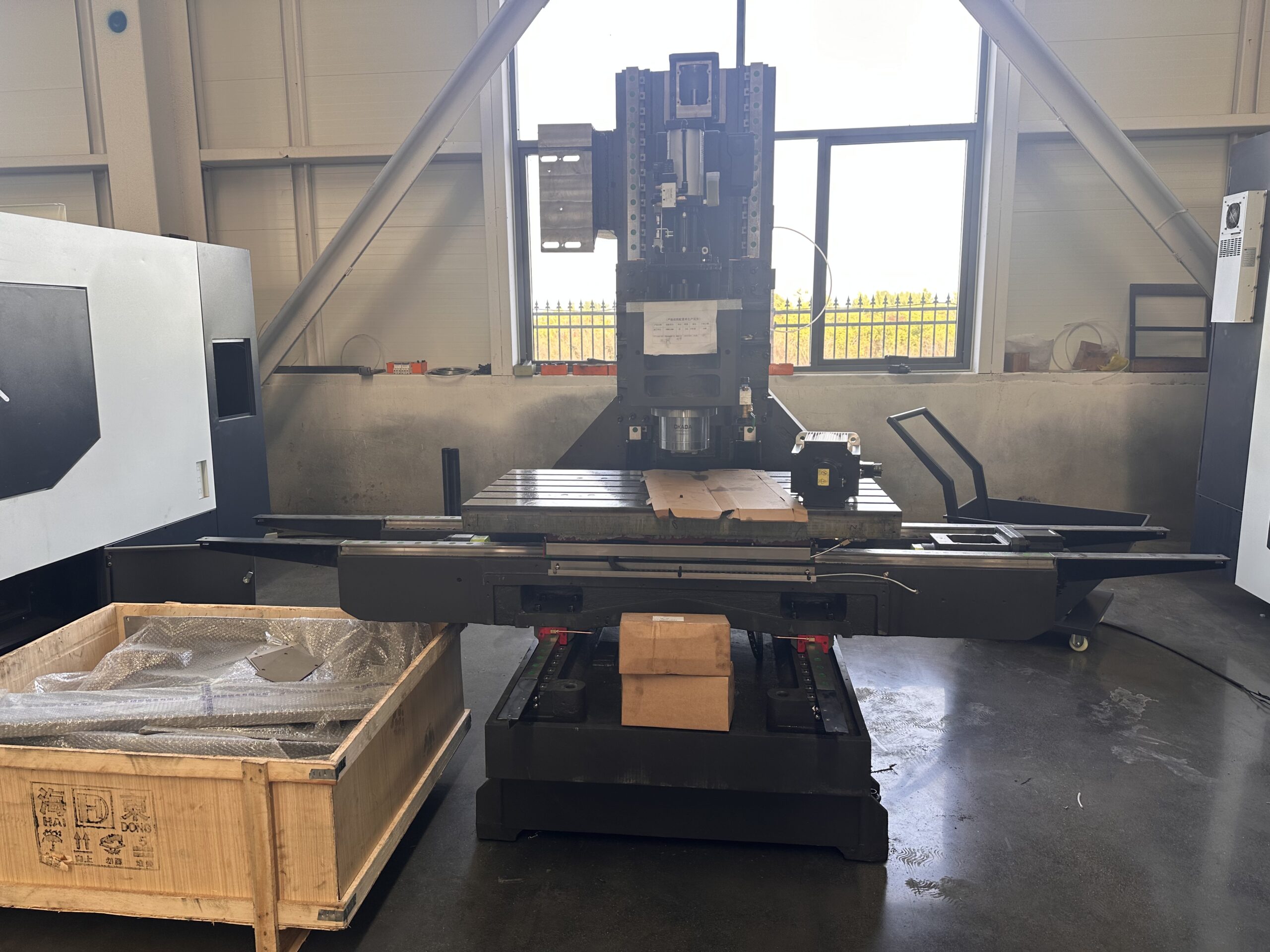
Vertical CNC Machining Center Price and What Drives It
| Kelas | Rentang Kerja atau Daya Tipikal | Contoh Kontrol atau Sumber | Harga FOB Perkiraan dalam USD |
|---|---|---|---|
| Light-duty job shop VMC | X/Y/Z 600/400/450 mm, BT30, 7.5 kW | GSK 980MDi or KND K2000Ti | $28,000 – $38,000 |
| Standard vertical machining center | X/Y/Z 1000/600/630 mm, BT40, 11 kW | Syntec 22MA or Mitsubishi M80 | $42,000 – $58,000 |
| Heavy-duty box way VMC | X/Y/Z 1300/700/700 mm, BT50, 15 kW | FANUC 0i-MF Plus atau Siemens 828D | $68,000 – $95,000 |
| High-speed linear guide VMC | X/Y/Z 1200/700/650 mm, BT40, 18 kW | FANUC 0i-MF Plus with 24K rpm | $75,000 – $110,000 |
| Large double-column VMC | X/Y/Z 2100/800/800 mm, BT50, 22 kW | Siemens 828D or FANUC 31i-B | $140,000 – $220,000 |
How To Tell A Real Builder From A Trading Office
A trading company quotes fast because they hold no inventory and subcontract every machine. A builder owns the risk of the casting, the scrape marks on the ways, and the test report that travels with the machine. Verify five points before paying a deposit.
Casting provenance. Ask for the foundry name and the casting grade on the machine bed. HT250 is acceptable for 600 mm Y-travel machines under 4,000 kg. HT300 or Meehanite-grade equivalent is required for BT50 spindles, heavy cuts, or machines above 6,000 kg net weight. A trading office will deflect or send a generic mill certificate. A builder shows photos of the resin sand molds, the annealing oven cycle, and the rough casting date stamp.
Assembly floor evidence. Request a video showing the spindle cartridge pressed into the headstock, not just finished machines in a warehouse. Look for hand-scraped contact faces on the column-to-bed joint and the headstock-to-column joint. Scraping creates visible hash marks 25–40 mm long at roughly 8–12 points per 25×25 mm. Grinding alone leaves continuous swirl marks and lower oil retention.
Metrology records. A factory acceptance test (FAT) for a VMC should include a laser interferometer report for positioning accuracy and repeatability on all axes, plus a ball bar test for circular interpolation. Typical targets for a new BT40 machine: positioning accuracy ±0.008 mm, repeatability ±0.005 mm, ball bar circularity ≤0.015 mm. The report should carry the instrument serial number, environmental conditions, and technician signature. Trading offices often present a template or a report from a different machine serial.
Payment structure as signal. Real builders with monthly output above 30–50 units typically ask 30% T/T deposit, 70% against copy of B/L, or negotiate 30/60/10 with letter of credit for orders above $150,000. A demand for 50% or 100% upfront, or payment only to a personal account, correlates with higher risk. Escrow through Alibaba Trade Assurance offers no protection against specification substitution if the contract lacks explicit component brands.
After-sales engineering depth. Ask which countries their technicians have obtained visas for and how many spindle cartridge replacements they have supervised remotely. A builder keeps photos of failed bearings, root-cause reports, and a shelf of servo drives, encoder cables, and ball screw support units in the factory spare parts room.
Real Cost Structure Of A China-Sourced VMC
The following breakdown applies to a standard BT40, 1000×600×630 mm machine at roughly $50,000 FOB Shanghai. Percentages shift with specification but the hierarchy holds.
| Unsur Biaya | Pangsa FOB | What The Money Buys |
|---|---|---|
| Cetakan / rangka | 12–16% | Bed, column, saddle, headstock; HT300 with stress relief |
| Linear guideways and ball screws | 10–14% | HIWIN or PMI 35 mm or 45 mm roller blocks; C5 or C3 grade screws |
| Rakitan spindel | 14–18% | BT40 cartridge, 11–15 kW, 8,000–12,000 rpm; belt or direct drive |
| Sistem kendali dan paket servo | 18–25% | FANUC, Siemens, Mitsubishi, or Syntec with matching motors and drives |
| Automatic tool changer | 6–10% | 24-arm umbrella or 24/32-chain magazine, BT40 |
| Assembly labour and scraping | 6–8% | 80–120 hours per machine for a 1000 mm class unit |
| Paint, guarding, chip conveyor, coolant | 4–6% | Sheet metal enclosures, auger or hinge conveyor, tank |
| Kemasan ekspor | 2–3% | Vacuum-sealed VCI film, plywood crate, desiccant, bracing |
| Pengangkutan darat ke pelabuhan | 1–2% | Flatbed truck from factory to Shanghai or Shenzhen terminal |
| Factory overhead and margin | 12–18% | Management, sales, engineering, warranty reserve |
The control system brand and the spindle assembly are usually the two single biggest line items that move the price. A FANUC 0i-MF Plus with αi series servos adds $8,000–$14,000 over a domestic GSK or KND package on a 1000 mm machine. A 15,000 rpm direct-drive spindle with ceramic bearings adds $4,000–$7,000 over a standard 8,000 rpm belt-drive unit.
Sea freight, insurance, destination duty and VAT, and clearance charges sit outside the FOB price. For a single VMC in a 40-foot container to Southeast Asia: sea freight $1,800–$3,500; insurance 0.3% of CIF; import duty 0–15% depending on HS code 8457.10 and local tariff; VAT 5–20%; customs clearance and THC $400–$900. A second machine in the same container splits the ocean and terminal costs, often the decisive factor for dealers ordering pairs.
Why The Cheapest Quote Is Cheaper
Three substitutions drive low quotes without changing the brochure photograph.
Lighter casting. A bed casting at 2,800 kg instead of 3,800 kg for the same 1000×600 mm envelope saves foundry cost and machining time. The machine vibrates in heavy milling, loses accuracy within 18 months, and cannot be repaired by adjusting gibs. Net weight on the specification sheet is the fastest check: ask for it and compare across quotes.
Lower grade ball screw or unbranded linear guide. C7 grade ball screws cost 40% less than C5 and are not marked visibly. Positioning accuracy degrades from ±0.008 mm to ±0.020 mm within two years of 4,000 rpm rapid traverse. HIWIN and PMI blocks carry laser-etched serial numbers; generic copies do not.
Unbranded or relabeled spindle. A cartridge built in a small workshop with angular contact bearings of unknown preload will run 8,000 rpm but fail thermally at 10,000 rpm. The replacement cost—$3,500–$6,000 plus three days downtime—eliminates the initial savings.
Perbandingan Biaya Operasional Selama Lima Tahun
Assumption: standard BT40 VMC, 2,000 hours per year, 65% spindle load factor, electricity at $0.10/kWh, operator at $12/hour loaded cost.
| Cost Category | Budget Configuration ($38,000 FOB) | Standard Configuration ($52,000 FOB) | Premium Configuration ($78,000 FOB) |
|---|---|---|---|
| Konsumsi daya tahunan | 18,500 kWh ($1,850) | 16,200 kWh ($1,620) | 14,800 kWh ($1,480) |
| Tooling and consumables | $4,200 | $3,800 | $3,400 |
| Expected annual downtime (unplanned) | 85 hours | 45 jam | 22 hours |
| Downtime cost at $12/hour + lost margin | $3,400 | $1,800 | $880 |
| Spindle major service or replacement | Year 3, $4,500 | Year 4–5, $3,200 | Year 5+, $2,800 |
| Control system failure / board swap | Year 2, $2,800 | Minimal | Minimal |
| 5-year total operating cost | $58,250 | $42,100 | $34,280 |
The budget machine costs 53% more to run over five years than the premium configuration, and the gap widens if downtime includes penalty clauses with end customers. The standard configuration at roughly $52,000 FOB with Syntec or Mitsubishi control and HIWIN linear guides represents the inflection point where purchase price and operating cost balance for most job shops running aluminum and mild steel.
Lead Time And Export Practicalities
Standard VMCs from RUNLONGJIA carry 35–45 days production from confirmed deposit and approved electrical schematic. Machines with FANUC or Siemens controls extend to 50–60 days due to import servo lead time from Japan or Germany. Double-column or 1500 mm Y-travel machines run 60–75 days.
Voltage and frequency must be specified on the purchase order. Factory default is 380V 50Hz three-phase. For 220V 60Hz regions (parts of North America, Philippines, South Korea), a step-up transformer rated at 1.5× the spindle nameplate kVA is required; budget $800–$2,200 depending on local electrical code. The transformer sits outside the machine warranty.
Container loading: one 1000 mm-class VMC fits a 40-foot high-cube with the chip conveyor and tool box lashed alongside. Two machines fit if the coolant tanks and conveyors ship separately for field assembly. Gross weight per machine with packing reaches 5,500–6,800 kg; verify your unloading crane or forklift capacity at destination. Foundation requires M16 or M20 chemical anchors into 200 mm minimum reinforced concrete, leveled to 0.05 mm/m over the full footprint.
Installation and training by factory technician: typically 5–7 days including geometric alignment check, spindle runout verification, and basic G-code operation. Spare parts to hold locally: spindle belt, tool changer arm spring, proximity switches for ATC count, and one set of axis servo motor encoder cables. These four items resolve 70% of first-year service calls without waiting for air freight from China.
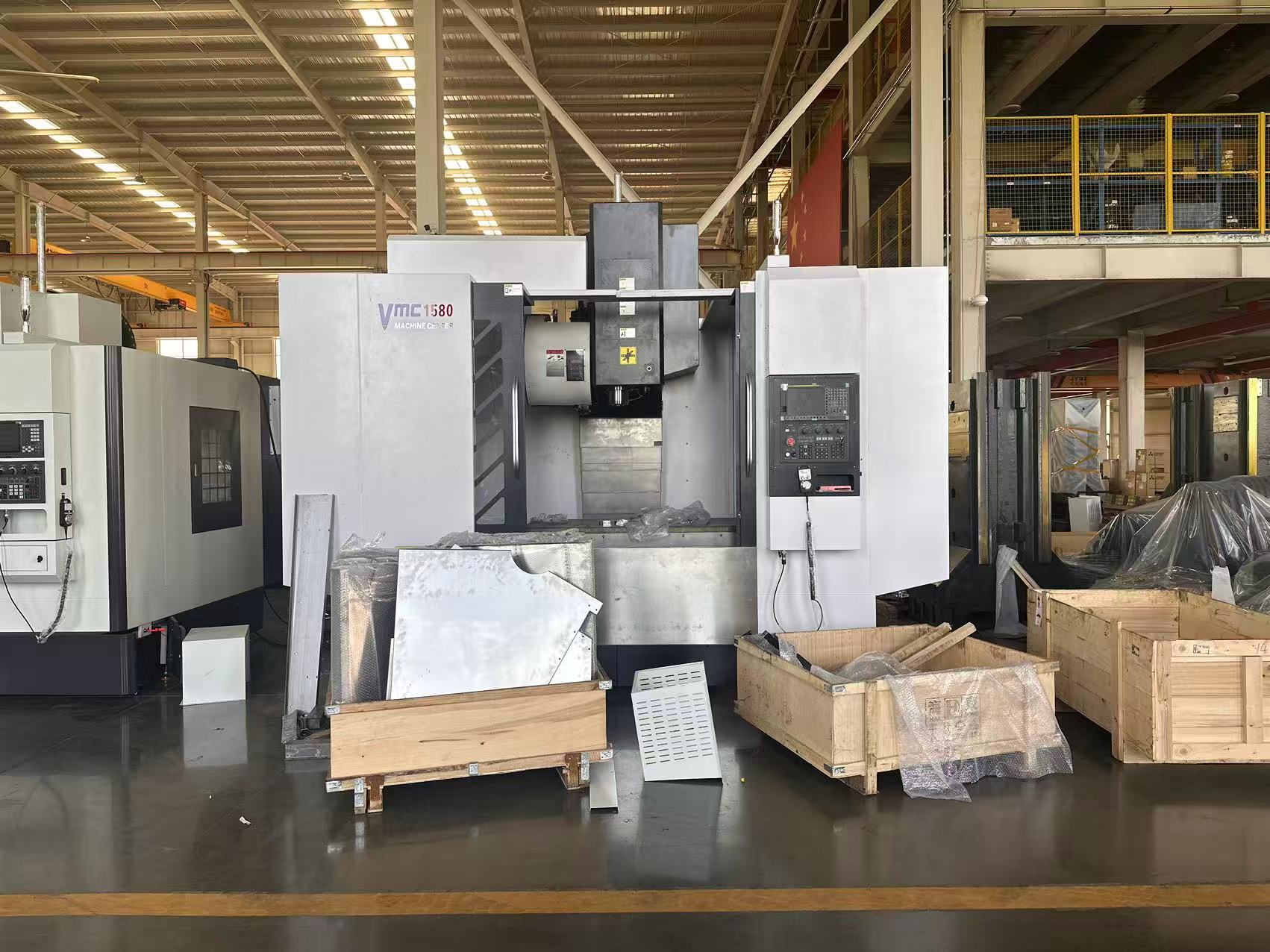
Industry Applications for Vertical CNC Machining Center
| Sektor | Komponen yang Umum Diproduksi | Spesifikasi yang Direkomendasikan | Mengapa Mesin Ini Cocok |
|---|---|---|---|
| Suku Cadang Mobil dan Sepeda Motor | Cylinder heads, transmission cases, brake caliper mounts, camshaft housings, wheel hubs | 1000/600/630 mm X/Y/Z travel, BT40 taper, 8000-12000 rpm direct-drive spindle, 11-15 kW spindle power, 0.008/0.005 mm positioning/repeatability, FANUC 0i-MF or Mitsubishi M80, linear roller guideways, 3200-4500 kg machine weight | High-volume mixed production demands rapid tool changes and consistent bore geometry; linear guides deliver 36-48 m/min rapid traverse for shorter cycle times on aluminium and cast iron |
| Mesin Pertanian | Gearbox housings, hydraulic lift arms, PTO shaft flanges, planter disc hubs, combine concave frames | 1200/700/700 mm travel, BT50 taper, 6000-8000 rpm geared spindle, 18.5-22 kW spindle power, hardened box way construction on Z-axis, GSK 218MC or KND K2000MF, HT300 casting | Cast iron weldments and thick steel plate require higher torque at lower rpm; box ways absorb interrupted cuts better than linear guides; heavier machines resist vibration during roughing |
| Sambungan Hidraulik dan Pneumatik | Manifold blocks, valve bodies, cylinder end caps, quick-connect couplings, port adapters | 600/400/450 mm travel, BT40 taper, 10000-15000 rpm spindle, 7.5-11 kW power, 0.006/0.004 mm positioning/repeatability, Syntec 22MA or Siemens 828D, 0.001 mm scale feedback on X/Y/Z | Small precision parts need tight tolerance on intersecting drilled and tapped holes; high-speed spindle with through-spindle coolant maintains accuracy on deep hole patterns in aluminium and ductile iron |
| Pekerjaan Cetakan dan Matris | Injection mould cavities, blow mould inserts, stamping die shoes, forging die impressions, extrusion dies | 1300/800/700 mm travel, BT50 taper, 6000 rpm rigid tapping spindle, 22-30 kW spindle power, hardened box ways on all axes, FANUC 31i-B5 or Siemens 840D sl, 0.005/0.003 mm repeatability, 5500-7500 kg machine weight | Heavy cuts in pre-hardened steel (HRC 48-52) demand thermal stability and rigidity; scraped box ways with Turcite-B or Moglice coating maintain geometry under sustained loads; heavier castings reduce thermal drift during long cycle times |
| Pusat Pelatihan Teknis | Curriculum demonstration parts, student projects, skill competition workpieces, certification test pieces | 800/500/500 mm travel, BT40 taper, 8000 rpm spindle, 5.5-7.5 kW power, GSK 980MDc or KND K1000MF, 0.01/0.008 mm positioning/repeatability, 2200-2800 kg machine weight, 220V/60Hz or 380V/50Hz convertible | Lower capital cost and simpler control architecture reduce training barriers; sufficient capability to teach G-code, tool offsets, work coordinate systems, and basic CAM post-processing without industrial-tier complexity |
| Sheet Metal Fabrication and Cabinets | Mounting brackets, enclosure frames, hinge blocks, latching mechanisms, cable management channels | 1000/600/600 mm travel, BT40 taper, 10000 rpm spindle, 11 kW power, linear guideways, Syntec or Mitsubishi M80, 0.008/0.005 mm accuracy, 4th-axis rotary table capability | Bridge work between laser-cut blanks and finished weldments; machining tapped holes, counterbores, and precision locating features on formed sheet steel and aluminium extrusion; 4th axis enables multi-face processing without refixturing |
Suku Cadang Mobil dan Sepeda Motor
A job shop in Thailand running second-tier supply for Japanese motorcycle brands replaced two ageing bridge mills with VMCs configured at 1000/600/630 mm travel, BT40 taper, and 12000 rpm direct-drive spindles. The 11 kW spindle power proved sufficient for aluminium cylinder head prototyping, while 48 m/min rapid traverse on HIWIN linear guides cut non-cutting time by roughly 30 percent compared to their previous box-way machines. Positioning accuracy of 0.008 mm and repeatability of 0.005 mm held bore-to-bore spacing within 0.015 mm on multi-cavity transmission cases, eliminating hand-finishing. The trade-off: linear guides require more diligent chip management and way-cover maintenance in high-volume aluminium environments where fine chips migrate easily.
Mesin Pertanian
A Brazilian dealer sold three machines to a soybean equipment manufacturer specifying 1200/700/700 mm travel, BT50 taper, and 22 kW geared spindles running at 6000 rpm. The Z-axis runs on hardened box ways to handle 20 mm depth-of-cut roughing in cast iron gearbox housings. Machine weight sits at 5800 kg on an HT300 casting base. The customer initially requested FANUC for familiarity, but accepted GSK 218MC after factory-run test cuts on their actual parts demonstrated comparable contouring performance at roughly 60 percent of the control premium. Lead time from casting to factory acceptance test was 45 days; payment structure was 30 percent T/T advance, 70 percent against FAT photos and geometric report.
Sambungan Hidraulik dan Pneumatik
A Turkish manufacturer of stainless steel manifold blocks for mobile hydraulic equipment runs a 600/400/450 mm travel VMC with 15000 rpm spindle and 0.001 mm linear scale feedback on all axes. The Syntec 22MA control handles high-speed tapping at 6000 rpm and rigid peck drilling cycles for M5 through M16 ports intersecting at 90 degrees. Through-spindle coolant at 70 bar prevents chip packing in 12:1 depth-to-diameter holes. The compact work envelope matches their part size; larger machines would waste floor space and reduce thermal stability. Annual consumables cost runs approximately 8 percent of machine acquisition price, dominated by BT40 tool holders and ER32 collet sets.
Pengerjaan Cetakan dan Die
A Portuguese toolroom specialising in injection moulds for automotive interior components purchased a 1300/800/700 mm machine with 30 kW spindle and Siemens 840D sl control. The scraped box ways on all axes, coated with Turcite-B, maintain 0.005 mm repeatability after eighteen months of continuous hard-steel machining. The 7500 kg machine weight and Meehanite-grade casting bed resist thermal distortion during 12-hour unattended roughing cycles. Laser interferometer records from the builder showed cumulative pitch error under 0.012 mm across 1000 mm X-axis travel; ball bar testing produced circularity results of 0.008 mm at 150 mm radius. Factory acceptance included a machined test piece in 718H steel verifying surface finish Ra 0.4 µm and contour accuracy 0.015 mm. This specification commands roughly 40 percent premium over entry-level BT40 configurations; the buyer accepted the cost to avoid secondary jig grinding on complex cavity geometries.
Pusat Pelatihan Teknis
A vocational college in Kenya selected an 800/500/500 mm VMC with GSK 980MDc control, 7.5 kW spindle, and convertible 220V/60Hz or 380V/50Hz electrical input. The 2500 kg machine ships in a single 40-foot container with three other training machines, keeping per-unit freight under 8 percent of EXW price. The simpler control architecture teaches fundamental G-code programming without the abstraction layers of FANUC or Siemens; students learn tool length offsets, work coordinate systems, and subprogram calls directly. Positioning accuracy of 0.01 mm is sufficient for certification test pieces; the machine will not hold tight mould tolerances, but that is not the training objective. Spare parts availability from GSK’s Nairobi service partner was verified before purchase, with committed 10-day delivery on servo motors and drives.
Sheet Metal Fabrication And Cabinets
A Malaysian enclosure manufacturer integrates VMC work between their 3 kW fiber laser cutting and powder coating lines. They machine precision mounting holes, PEM nut locations, and hinge pockets on formed 2-6 mm mild steel and 3-5 mm 5052 aluminium. Machine specification is 1000/600/600 mm travel, BT40 taper, 10000 rpm, with Syntec control and optional 4th-axis rotary table. The rotary table enables machining of four faces on rectangular tube frames without refixturing, holding perpendicularity within 0.02 mm. Rapid traverse at 36 m/min keeps cycle times competitive with dedicated punching operations on lot sizes below 200 pieces. The 4th-axis package adds approximately 15 percent to base machine price and requires 400 mm additional clearance on the operator side; the buyer confirmed crane capacity and floor space before ordering.
Langkah demi Langkah dalam Memesan dan Mengimpor
Three mistakes regularly leave a delivered vertical machining center sitting idle while parts pile up. Each has a one-line fix.
Ketidakcocokan tegangan atau frekuensi. The machine arrives with a 380V 50Hz main contactor label and the shop floor is 220V 60Hz or 415V 50Hz with a different phase sequence. The fix: confirm supply voltage, frequency, phase count and tolerance in writing before the electrical cabinet is wired, and specify whether the builder supplies a matching transformer or you source it locally.
Rentang kerja terlalu kecil untuk komponen yang sebenarnya. A 600 mm Y-axis travel machine is ordered for a 550 mm wide fixture base that needs clearance on both sides for tool change and chip evacuation. The fix: model the largest part, plus fixture, plus tool stick-out, plus 100 mm minimum clearance per side, and compare against the machine’s X/Y/Z travels before signing the specification.
No electrical schematic, parameter backup or local consumable source. A blown servo drive at month three becomes a three-week downtime because the control parameters are locked and the local dealer has no replacement fuses or tool gripper fingers in stock. The fix: require a complete electrical schematic in English, a USB parameter backup, a written consumable cross-reference list, and a local spare parts commitment in the contract.
Define Workpiece Envelope and Tolerance First
Start with the largest part you expect to run in the next three years, not the largest part on today’s order list. For a vertical machining center, the critical numbers are:
| Parameter | Rentang Tipikal | What to Verify |
|---|---|---|
| X/Y/Z travel | 600/400/450 mm to 1600/800/700 mm | Part length + fixture + clearance |
| Table size | 400×800 mm to 700×1600 mm | Clamping area versus fixture footprint |
| Max table load | 300 kg to 2000 kg | Part mass plus fixture, with 30% margin |
| Spindle nose to table | 150–650 mm | Part height + tool length + gauge line |
| Max spindle speed | 8000–15000 rpm standard, 20000–24000 rpm optional | Tool diameter and material |
| Tenaga spindel | 7.5 kW–15 kW continuous, 18.5 kW–30 kW peak | Roughing versus finishing duty cycle |
| Taper spindel | BT40 or BT50 | Tool inventory and rigidity requirement |
| Akurasi penentuan posisi | ±0.005 mm to ±0.010 mm full travel | Part tolerance divided by process capability index |
| Repeatabilitas | ±0.003 mm to ±0.005 mm | Critical bore or surface match requirements |
If your parts include cast iron automotive brackets with ±0.05 mm tolerances, a 600×400×450 mm travel machine with BT40 taper, 10000 rpm, 7.5 kW spindle and hardened box ways is sufficient. If you are cutting hardened steel injection mold cores to ±0.01 mm, you need 1200 mm X travel, BT50, 8000 rpm with higher torque, linear roller guideways for 24–36 m/min rapid traverse, and a chiller-cooled spindle.
State the tolerance requirement in the purchase specification. A builder who cannot quote positioning accuracy and repeatability per ISO 230-2 with laser interferometer records is not a machine builder.
Choose Control System and Service Path
The CNC control determines who can repair it, how fast parts arrive, and what your operators already know.
| Kontrol | Common in Markets | Service Consideration |
|---|---|---|
| FANUC 0i-MF Plus | Global | Widest third-party service network; higher hardware cost; parameter access sometimes restricted |
| Siemens 828D / 840D sl | Europe, Middle East, Southeast Asia | Good integration with digital twin; requires Siemens-certified technician for drive replacement |
| Mitsubishi M80 | Southeast Asia, Japan-centric shops | Strong in mold and die applications; smaller service footprint in Africa and South America |
| GSK 980MDi / 25i | Domestic China, price-sensitive export | Lowest controller cost; verify English manual completeness and overseas parts stock |
| KND K2000MF / K2100MF | Southeast Asia, Eastern Europe | Mid-range cost; check whether local distributor carries servo motors and drives |
| Syntec 22MA / 220MA | Taiwan-origin machines, job shops | Flexible PLC access; confirm firmware update path and backup procedure |
Ask three questions: Who services this control within 500 km of your shop? What is the typical parts lead time for a servo motor or spindle drive? Does the builder provide a parameter backup on USB and a printed electrical schematic with wire numbers matching the cabinet?
A real builder will tell you which control they have shipped to your country, in what quantity, and who the local service contact is. A trading office will redirect you to the control manufacturer.
Confirm Electrical Supply and Transformer Need
Document your incoming supply exactly:
- Voltage: 380V ±10%, 400V, 415V, 440V, or 220V
- Frequency: 50 Hz or 60 Hz
- Phases: three-phase
- Neutral: grounded or floating
- Available capacity: kVA rating at the machine location, not just the building main
Standard Chinese-built vertical machining centers ship with 380V 50Hz three-phase main contactors and transformers. If your supply is 220V 60Hz (common in North America residential-industrial areas), 440V 60Hz (parts of South America), or 415V 50Hz (UK, Australia, India), specify the required transformer and motor winding configuration before production. A 30 kVA transformer for a mid-size VMC weighs approximately 180 kg and requires its own floor space and ventilation. The builder can supply it mounted in the machine base or as a separate cabinet; separate is easier to replace but needs cable routing.
Phase sequence matters for spindle rotation direction. Include a phase sequence indicator in the specification if your local supply is known to vary.
Check Floor Loading Foundation and Space
Machine weight and dynamic loading determine foundation requirements:
| Machine Class | Approximate Net Weight | Floor Loading | Foundation |
|---|---|---|---|
| Small VMC, 600×400 mm travel | 3500–4500 kg | 8–12 kN/m² | Reinforced concrete pad, 150 mm minimum, level to 0.05 mm/m |
| Medium VMC, 1000×600 mm travel | 6000–9000 kg | 15–20 kN/m² | Isolated pad 200 mm, or steel spring isolators if near heavy presses |
| Large VMC, 1600×800 mm travel | 12000–18000 kg | 25–35 kN/m² | Engineered foundation with rebar mesh, vibration isolation from adjacent machines |
Floor space must include: machine footprint plus chip conveyor extension (typically 800–1200 mm rear), operator access front and sides (minimum 1000 mm per side for tool loading and maintenance), and electrical cabinet swing clearance. A 1000×600 mm travel VMC with chip conveyor and coolant tank requires roughly 4.5 m × 3.5 m of clear floor space.
Ceiling height: minimum 3.2 m for standard machines, 3.8 m if overhead crane access is needed for spindle cartridge replacement.
Confirm Conformity Marking for Customs
For export to the European Union, CE marking is required for customs clearance. The builder must provide: Declaration of Conformity, technical construction file summary, and EC Machinery Directive compliance documentation. For EAEU countries (Russia, Belarus, Kazakhstan, Armenia, Kyrgyzstan), EAC marking applies. For Southeast Asia, individual country requirements vary: Thailand requires TISI for some electrical components; Vietnam requires import inspection; Indonesia requires SNI for local assembly content if applicable.
Request the specific marking and documentation in the purchase order. A real builder has export compliance records and can specify which directive applies. A trading office will ask you what you need after the machine is already packed.
Compare FOB versus CIF
| Term | What You Pay | What Builder Pays | Risk Transfer | Best For |
|---|---|---|---|---|
| FOB Chinese port | Ocean freight, insurance, unloading, customs, inland delivery | Factory to port, export clearance, loading | On ship’s rail at origin port | Buyers with freight forwarder relationships, container consolidation experience |
| CIF destination port | Customs clearance, inland delivery, unloading equipment | Factory to destination port, freight, marine insurance | On ship’s rail at destination port | First-time importers, single-machine orders, buyers without freight contacts |
For a single vertical machining center, CIF to your nearest main port reduces coordination. For multiple machines or mixed container loads, FOB gives you control over consolidation and carrier selection.
Container Type and Weight Limits
| Ukuran Mesin | Container | Packing Method | Gross Weight Limit |
|---|---|---|---|
| Small VMC, ≤4500 kg | 20′ GP | Skid-mounted, shrink-wrapped, steel frame | 21.5 tonnes container capacity, 18 tonnes road limit in many countries |
| Medium VMC, ≤8500 kg | 40′ GP or 40′ HQ | Skid with lifting lugs, moisture barrier, desiccant | 26.5 tonnes container capacity |
| Large VMC, >10000 kg | 40′ FR (flat rack) or breakbulk | Open deck, tarped, lifting points certified | Per-shipment engineering; may require special transport permit |
Verify road weight limits from destination port to your facility. A 40′ container with 9-tonne machine plus packing plus container tare can exceed 18-tonne axle limits in some Southeast Asian and African road networks. If so, arrange flatbed truck or dismount the machine from container at port and transport separately.
Lifting points: confirm number, location, and rated capacity. Standard is four lifting lugs on the machine base, rated for full machine weight with 4:1 safety factor.
Deposit and Balance Payment Structure
Standard terms for machinery from China: 30% deposit upon order confirmation and technical specification sign-off, 70% balance before shipment after factory acceptance test. For first-time relationships or custom specifications, negotiate: 30% deposit, 60% after FAT and before shipment, 10% within 30 days of successful installation and run-off.
Payment method: irrevocable letter of credit for first orders over USD 50,000; T/T telegraphic transfer for smaller or repeat orders. Avoid 100% advance payment. A builder with assembly floor and foundry relationship will accept standard machinery terms. A trading office often demands higher deposit or faster balance payment because they are financing the purchase from the actual builder.
Factory Acceptance Test Before Balance Payment
The FAT is your only chance to verify the machine before it is crated and shipped. Minimum FAT content:
- Geometric accuracy: Straightness, perpendicularity, parallelism per ISO 10791 or equivalent, measured with laser interferometer and electronic levels. Request the raw data printout, not just a pass/fail certificate.
- Positioning accuracy and repeatability: Laser interferometer measurement per ISO 230-2, full travel of each axis, with compensation values recorded.
- Ball bar test: 150 mm or 300 mm ball bar, circular interpolation in XY, XZ, YZ planes, feed rate 1000 mm/min, roundness and reversal spike recorded.
- Spindle runout: Test bar, 300 mm from spindle nose, radial and axial runout measured.
- Spindle thermal drift: Warm-up cycle, temperature rise measured at spindle nose over 4 hours if high-speed spindle.
- Cutting test: Material specified (typically cast iron or mild steel), tool specified, cutting parameters recorded, surface finish and dimensional result measured.
- Function test: All M codes, tool changer full magazine cycle, chip conveyor, coolant through-spindle if equipped, enclosure interlocks.
Attend the FAT in person or send a third-party inspector. Video conference is not sufficient for geometric verification. The builder should provide English-language test reports with serial number, date, technician signature, and instrument calibration dates.
Unloading Equipment at Destination
| Machine Weight | Minimum Equipment | Alternative |
|---|---|---|
| ≤3000 kg | Forklift, 3.5 tonne capacity, forks minimum 1200 mm | Manual pallet jack and inclined ramp (slow, higher drop risk) |
| 3000–8000 kg | Forklift 5 tonne, or overhead crane 5 tonne with certified lifting beam | Mobile gantry with chain hoist, engineered lift plan |
| >8000 kg | Overhead crane or mobile hydraulic gantry, lift plan by certified rigger | Disassemble at port, transport in sub-assemblies |
Check container door height versus machine height. A 40′ HQ container has 2.69 m internal height. A large VMC on its skid may require tilting or partial disassembly to clear the door. Request door opening dimensions and machine packed height from the builder before shipping.
Foundation bolts: builder should supply J-bolts or expansion anchors, foundation layout drawing with anchor locations, and grouting specification.
Installation and Operator Training
Installation sequence: uncrate, position on foundation, level with precision level (0.02 mm/m) on machined pads, anchor, connect utilities, run electrical phase check, power on, refill lubrication and coolant, run spindle warm-up, verify geometric accuracy after 48 hours of thermal stabilization.
Training minimum content: control operation and edit mode, tool length and diameter measurement and entry, work coordinate setup, program transfer via USB or network, daily maintenance (lubrication levels, chip removal, air filter), alarm diagnosis and safe shutdown, tool changer recovery procedure.
Training duration: 3–5 days for experienced machinists on a familiar control; 7–10 days for new operators or unfamiliar control. Specify number of trainees (typically 2–3), language, and whether training is at builder’s factory (before shipment) or at your site (after installation). Site training is more relevant to your parts but costs travel and lodging.
Initial Spare Parts and Consumables Package
Require a written spare parts list with: part number, description, quantity recommended for first year, unit price, and local availability status. Minimum package for first-year operation:
- Spindle tool gripper fingers or tool clamp assembly: 2 sets
- ATC arm drive belt or cam follower: 1 set
- Coolant pump mechanical seal: 1
- Lubrication pump cartridge or metering unit: 2
- Axis servo motor encoder battery: 2 (if applicable)
- Control system backup battery: 2
- Fuses and contactors: 1 each of each rating in electrical cabinet
- Waycover wipers and felt: 2 sets
- Air filter elements: 6
Consumables: specify whether first fill of way lube (ISO VG68) and hydraulic oil (ISO VG46) is included. Confirm grease specification for linear guides if lifetime-lubricated, or interval and type if not.
A real builder stocks these parts against your serial number and can ship within 72 hours. Ask for the parts manager’s contact and warehouse location. A trading office will not have a parts warehouse.
Final Verification Checklist
- Workpiece envelope: largest part + fixture + clearance fits within X/Y/Z travels with 20% margin on at least one axis for future growth.
- Tolerance requirement: stated in purchase order, with ISO 230-2 positioning accuracy and repeatability values specified and FAT verification method agreed.
- Control system: brand and model specified, local service contact confirmed, parameter backup and schematic included.
- Electrical supply: voltage, frequency, phase, neutral configuration documented; transformer requirement resolved and quoted.
- Foundation: floor loading calculated, pad dimensions and reinforcement specified, leveling tolerance stated.
- Conformity marking: CE, EAC, or other required marking confirmed, with documentation commitment in contract.
- Shipping terms: FOB or CIF selected, container type and gross weight verified against road limits to final destination.
- Payment: deposit percentage, FAT trigger, balance trigger, and retention if any, in written agreement.
- Factory acceptance: geometric, positioning, ball bar, spindle, and cutting test content specified; attendance or third-party inspection arranged.
- Unloading: equipment capacity confirmed, container door clearance checked, lifting points and foundation bolt layout received.
- Installation: builder or agent responsibility defined, leveling and anchoring specification received, thermal stabilization period stated.
- Training: duration, location, number of trainees, language, and content agreed in writing.
- Spare parts: first-year package quoted with part numbers, prices, and delivery commitment; consumable cross-reference provided.
Related RUNLONGJIA Machines

Pusat Pemesinan CNC
Langsung dari pabrik cnc machining center dengan pilihan sistem kendali FANUC, Siemens, Mitsubishi, GSK, atau Syntec, serta tegangan suplai 380 V/50 Hz atau 220 V/60 Hz untuk ekspor.
Frequently Asked Questions About Vertical CNC Machining Center
How To Verify A Real Machine Builder
Q: What is your minimum order quantity and do you keep vertical machining centers in stock?
MOQ is one unit. We do not stock finished machines; every VMC is assembled to order because control systems, spindle packages and voltage specifications vary. A typical 850 mm X-travel machine with BT40 taper and 24-tool arm magazine ships 35-40 days after deposit. Larger 1370 mm or BT50 configurations need 50-55 days. Rush orders with FANUC 0i-MF Plus controllers can sometimes be compressed by two weeks if servo motors and drives are in local inventory.
Q: Which CNC control systems do you offer and is the operator interface available in my language?
Standard options are FANUC 0i-MF Plus, Siemens 828D, Mitsubishi M80, GSK 25i and Syntec 22MA. FANUC and Siemens represent 80 percent of export orders for their global service footprint. GSK and Syntec reduce controller cost by 30-40 percent but narrow local repair options outside China. Interface languages include English, Spanish, Russian and Turkish loaded at factory; others by request. Parameter manuals and ladder diagrams ship on USB with the machine.
Q: What is the lead time from deposit to ready-for-shipment and what drives delays?
Lead time is 35-55 days depending on configuration. Delays arise from three sources: imported control components held in Shanghai customs, spindle taper or RPM changes requiring different bearing sets, and buyer-specified options like through-spindle coolant or rotary tables that need sub-supplier coordination. We confirm a fixed shipping week within 72 hours of deposit receipt and update weekly by email. Peak season (September-December) adds 7-10 days.
Q: What are your payment terms and how is the transaction structured to protect both parties?
Standard terms are 30 percent deposit by T/T to confirm order, 70 percent balance against copy of bill of lading. For orders above USD 150,000 we accept 30/40/30: deposit, progress payment after casting and rough machining photos, balance before shipment. Letter of credit at sight is available with 3 percent surcharge for banking fees. We do not offer open account terms to first-time buyers. Escrow through Alibaba Trade Assurance is accepted for orders under USD 50,000.
Q: Can you adapt supply voltage and frequency for our local electrical standard?
Standard build is 380V 50Hz three-phase. For 220V 60Hz regions (North America, parts of South America and Philippines) we install a step-up transformer inside the electrical cabinet or supply an external 45-75 kVA isolation transformer rated for CNC duty. Transformer adds 5-7 days lead time and USD 800-2,200 depending on machine size. We require buyer confirmation of phase-to-phase voltage tolerance (±10 percent) and whether local supply is delta or wye configuration to size protection correctly.
Q: What shipping method, container type and transit time apply to a vertical machining center?
Machines ship FOB Shanghai or Tianjin in 40-foot high-cube containers. A VMC850 (X/Y/Z 850/500/540 mm, net weight 5,200 kg) fits one unit per container with control cabinet detached and bolted to pallet. Larger VMC1370 machines (7,800 kg) require flat-rack or open-top containers with crane loading at port. Transit times: Southeast Asia 12-18 days, Middle East 25-35 days, Africa (Tanzania/Mombasa) 30-40 days, South America east coast 35-45 days, Eastern Europe via rail 18-22 days to Warsaw/Malaszewicze.
Q: What warranty do you provide, how do you handle spare parts and what is typical consumables cost?
Warranty is 12 months from arrival at buyer’s port, covering all components except consumables. Critical spares—spindle bearings, servo motors, ball screws, tool changer cams—ship by air freight within 72 hours of failure confirmation. Annual consumables budget for a VMC running two shifts: way oil (ISO VG68) 180 liters at USD 4/liter, coolant concentrate 400 liters at USD 6/liter, tool holder retention knobs (BT40) 12-15 pieces at USD 8 each, and spindle drawbar spring set every 3-4 years at USD 320. We stock these in our export warehouse for same-week dispatch.
Q: Do you provide factory acceptance test, geometric accuracy report and CE documentation for customs clearance?
Yes. Every machine undergoes FAT before shipment: laser interferometer check on X/Y/Z positioning accuracy (typically ±0.008 mm, repeatability ±0.005 mm), ball bar test for circular interpolation, and 48-hour continuous run with thermal compensation mapped. We provide printed geometric accuracy report (ISO 10791 standards), laser data files on USB, and CE conformity documentation including Declaration of Conformity, electrical schematics with EN 60204-1 compliance, and machine risk assessment. These are essential for customs in EU member states, Turkey, and Middle Eastern free zones requiring third-party inspection.
Q: What installation and operator training is included and what must the buyer prepare?
We send one application engineer for 7-10 working days: 2 days for unloading, leveling and geometric verification; 3-4 days for installation, spindle run-in and parameter optimization; 2-3 days for operator training on programming, tool presetting and maintenance routines. Buyer prepares: forklift or crane rated 1.5× machine weight (minimum 10-ton capacity for VMC1370), 100 mm reinforced concrete foundation with M16 anchor bolts, prepared electrical supply with local disconnect, and one bilingual technician to assist. Training materials include printed operation manual, maintenance checklist and sample programs in Fanuc or Siemens format.
Q: What tolerance can your vertical machining center hold on our actual material and geometry?
Positioning accuracy of ±0.008 mm and repeatability of ±0.005 mm are verified under ISO 230-2 conditions with no load. On actual parts, achievable tolerance depends on part rigidity, tooling and fixturing. In aluminum with proper rough/finish strategy: ±0.015 mm on 100 mm dimension, ±0.025 mm on 300 mm. In 45# steel or 304 stainless: add 30-50 percent due to cutting forces and thermal drift. For mold work requiring ±0.005 mm, we recommend machines with 0.001 mm scale feedback and chiller-cooled spindle, which we offer as option on VMC650 and VMC850 configurations.
Q: How do I know you are the actual machine builder and not a trading office?
Verify four things before deposit: visit or video-call the assembly floor to see castings being scraped and box ways being hand-fitted—our 500 mm swing lathe bed weighs 3,200 kg in HT300 Meehanite equivalent and shows scraping patterns from 10-point contact check. Request dated laser interferometer and ball bar records with machine serial numbers matching your order. Ask for photos of your specific casting batch with heat number. Confirm payment to RUNLONGJIA’s corporate account, not a personal or unrelated trading company account. We maintain 12,000 m² factory in Tengzhou, Shandong with in-house casting partnership, not own foundry, which is standard for our machine size class.
Pemberitahuan Penting
Spesifikasi, angka akurasi, dan kisaran harga dalam panduan ini bersifat indikatif dan disediakan untuk keperluan perencanaan
hanya untuk tujuan tersebut. Jangkauan kerja aktual, toleransi yang dapat dicapai, ketersediaan sistem kendali, persyaratan tegangan suplai, dan kesesuaian
Penandaan bervariasi tergantung model dan negara tujuan. Pembeli harus memastikan sendiri tegangan dan frekuensi listrik, kapasitas beban lantai, serta
pondasi, peralatan bongkar muat, dan persyaratan impor sebelum melakukan pemesanan. Semua angka masih tunduk pada konfirmasi tertulis dalam
the final proforma invoice issued by RUNLONGJIA.
Sourcing Vertical CNC Machining Center from RUNLONGJIA
What RUNLONGJIA Verifies Before Container Loading
Every vertical machining center ships only after documented factory acceptance testing. For the VMC-850 platform—a 1020 × 550 × 600 mm X/Y/Z travel machine with BT40 taper, 24-tool arm-type changer and 8000 rpm belt-driven spindle—we record laser interferometer positioning accuracy of 0.010 mm and repeatability of 0.006 mm on each axis. Ball bar circular interpolation tests follow ISO 230-4. The geometric accuracy report includes squareness of spindle to table, parallelism of Y to X within 0.015 mm over full travel, and spindle runout at 0.005 mm. These records travel with the machine in a sealed document pouch.
Supply Voltage and Site Preparation
Standard configuration runs on 380V 50Hz three-phase. For buyers in 220V 60Hz territories—common across Southeast Asia and parts of the Americas—we fit a step-up transformer sized to spindle demand, typically 15–22 kVA for a 7.5 kW spindle unit. Foundation requirements are 300 mm reinforced concrete with M16 anchor bolts on 800 mm centers. Unloading demands a 5-tonne forklift or overhead crane; net machine weight is 4800 kg for the VMC-850, 6200 kg for the VMC-1060 with 1300 × 600 × 650 mm travels. Floor space including chip conveyor and coolant tank is 3.2 m × 2.8 m.
Sistem Pengendalian dan Ketertelusuran Komponen
RUNLONGJIA builds to order with FANUC 0i-MF Plus, Siemens 828D, Mitsubishi M80, GSK 25i, KND or Syntec controls. Linear roller guides are HIWIN or PMI; hardened box way construction remains available on heavy-duty VMC-1270 and VMC-1580 models for interrupted cuts in cast iron. Ball screws are ground C3 or C5 grade with pretension. Each machine carries a metal build plate with serial number, casting date and assembly technician signature.
Payment Structure and After-Sales Engineering
Terms are typically 30 percent T/T deposit, 70 percent before shipment. No hidden tooling charges; workholding and cutting tools remain buyer-supplied. After-sales support includes remote commissioning via Ethernet or RS-232, video-based operator training materials in English and Spanish, and a two-year spare parts availability commitment for controllers, servo motors and spindle bearings. Critical spares—drawbar springs, proximity switches, coolant pumps—ship from RUNLONGJIA’s warehouse within 72 hours.
Request Your 24-Hour Quotation
Send your workpiece material, maximum part dimensions, required tolerance band and destination port to RUNLONGJIA. A matched vertical machining center specification with confirmed FOB or CIF pricing returns within one business day.
Get a Factory Direct Quote on Vertical Cnc Machining Center
RUNLONGJIA has been building metalworking machinery since 2010,
dengan pengalaman ekspor lebih dari 15 tahun. Mesin-mesin tersebut dilengkapi dengan sistem kendali sesuai pilihan Anda, yang disesuaikan dengan kebutuhan Anda
tegangan dan frekuensi, telah melalui uji pemanasan awal dan uji penerimaan pabrik sebelum dikemas. Beritahukan kepada kami bahan benda kerja Anda, ukuran maksimum komponen,
Tolong sampaikan toleransi yang dibutuhkan serta pelabuhan tujuan, dan kami akan mengirimkan penawaran harga dalam waktu 24 jam.

 English
 Indonesian
 Vietnamese
 Arabic
 Russian
 Spanish