
Panduan Pembelian Mesin Bubut CNC
A Mesin bubut CNC consists of seven major assemblies that determine part quality, uptime, and total cost of ownership: the bed casting, guideway system, spindle and drive, CNC control, turret or tool post, chip management, and coolant delivery. Each assembly has a specification range where performance gains justify the price increase, and a threshold below which the machine becomes a maintenance liability.
This page walks through each assembly in sequence. For every component, we cover its function in the machining cycle, the practical difference between economy and industrial-grade builds, and the failure mode that typically appears first in the field. The numbers referenced below reflect common configurations in RUNNEWTECH’s flat bed and slant bed CNC lathe ranges: 500 mm to 800 mm swing over bed, 750 mm to 3000 mm between centers, spindle bores from 52 mm to 105 mm, and bar capacities up to 65 mm.
Bed Casting and Foundation Rigidity
The bed casting anchors every other assembly and absorbs cutting forces without deflection. It carries the headstock, tailstock, carriage, and guideways in fixed geometric relationship.
What it does. Cast iron beds damp vibration from interrupted cuts and heavy turning. Mass and section thickness matter more than footprint. A 500 mm swing machine with 1500 mm bed length typically weighs 2,800 kg to 4,200 kg depending on casting grade and whether the bed is flat or slant configuration.
What cheap looks like. HT150 or ungraded gray iron, sand cast without stress relief, sometimes with ribbing omitted from the tailstock end. These beds warp within 6–12 months of operation, especially in climates with wide temperature swings. Repeatability degrades before the operator notices visible deflection.
What fails first. Twist along the bed’s longitudinal axis. The headstock-to-tailstock alignment drifts, producing taper in shaft work. Re-scraping the bed costs more than the original price difference to a proper casting. RUNNEWTECH uses HT250 or HT300 resin sand castings, stress relieved, with wall thicknesses starting at 22 mm on smaller machines and 35 mm on 800 mm swing models.
Guideway System
Guideways constrain the carriage and cross-slide to linear motion under load. The choice between hardened box ways and linear roller guides is the most consequential specification after spindle power.
What it does. Box ways (hardened to HRC 52–58, typically Turcite-B or similar low-friction lining on the mating surface) handle high cutting forces and intermittent loads with long wear life. Linear roller guides (HIWIN, PMI, or equivalent) enable rapid traverse to 20–30 m/min and reduce stick-slip in contouring operations.
What cheap looks like. Unhardened cast iron ways, or linear guides below 25 mm rail width on a machine over 500 mm swing. Unhardened ways score within months; undersized rails develop brinelling under roughing cuts.
What fails first. On box ways, the low-friction strip wears through locally, creating high spots that gall. On linear guides, the recirculating balls or rollers pit under shock loading from facing cuts. Replacement rail sets cost $800–$2,500 depending on size and brand, plus alignment labor.
Trade-off. Box ways tolerate abuse and require less frequent adjustment but limit rapid traverse to 8–12 m/min. Linear guides demand cleaner coolant and more attentive way covers but enable higher productivity in repetitive short-cycle work. For mixed job shops, RUNNEWTECH typically recommends box ways on flat bed lathes above 750 mm swing and linear guides on slant bed CNC lathes under 500 mm swing.
Spindle and Drive Assembly
The spindle transmits motor power to the workpiece through chuck or collet, determines maximum part diameter, and sets the harmonic frequency of the machining system.
What it does. Spindle nose specifications (A2-5, A2-6, A2-8, A2-11) define chuck mounting compatibility. A2-5 handles chucks to 250 mm; A2-6 to 315 mm; A2-8 to 400 mm. Spindle bore determines maximum bar feed diameter: 52 mm bore passes 45 mm bar; 65 mm bore passes 60 mm; 80 mm bore passes 75 mm; 105 mm bore passes 100 mm. Spindle power ranges from 7.5 kW on light-duty machines to 22 kW or 30 kW on heavy-duty flat bed lathes. Base speed typically 500–800 rpm with constant power extension to 2,500–3,500 rpm; high-speed variants reach 4,000–6,000 rpm on slant bed machines.
What cheap looks like. Taper roller bearings without preload adjustment, or angular contact bearings in paired arrangement below DB or DF configuration. Belt drives with multi-groove V-belts instead of poly-V or direct-coupled servo drives. These spindles exhibit chatter at 40–60% of rated power and bearing temperatures above 65°C within the first year.
What fails first. Front bearing preload loss. The chuck runout increases from 0.010 mm to 0.050 mm or worse. Rebuilding requires spindle removal, bearing replacement ($400–$1,200 for a matched set), and regrinding the taper seat if damage has propagated.
CNC Control and Servo Drive
The control interpolates axis motion, executes part programs, and provides the operator interface. On a lathe, the critical performance metric is thread-cutting synchronization between spindle encoder and Z-axis servo.
What it does. FANUC 0i-TF Plus, Siemens 828D, Mitsubishi M80, GSK 980TDi, KND K2000Ti, and Syntec 22TA are common configurations. Entry-level lathes run GSK or KND with analog servo interfaces; mid-range machines use GSK or Syntec with serial bus communication to digital drives; high-specification or automation-ready machines use FANUC or Siemens with absolute encoders eliminating homing cycles.
What cheap looks like. Stepper-driven open-loop positioning on any axis. Pulse multiplication that advertises 0.001 mm resolution while delivering 0.05 mm following error under load. Controls without rigid tapping or thread repair cycles.
What fails first. Encoder feedback degradation on the Z-axis, producing thread pitch variation. On budget controls, the servo drive fails from heat or dust ingress because the electrical cabinet lacks positive-pressure sealing. Replacement control boards for proprietary systems cost $1,500–$4,000 and require parameter reload from backup; generic systems often have shorter part availability.
Turret and Tool Holding
The turret indexes cutting tools under program control and maintains tool center height repeatability.
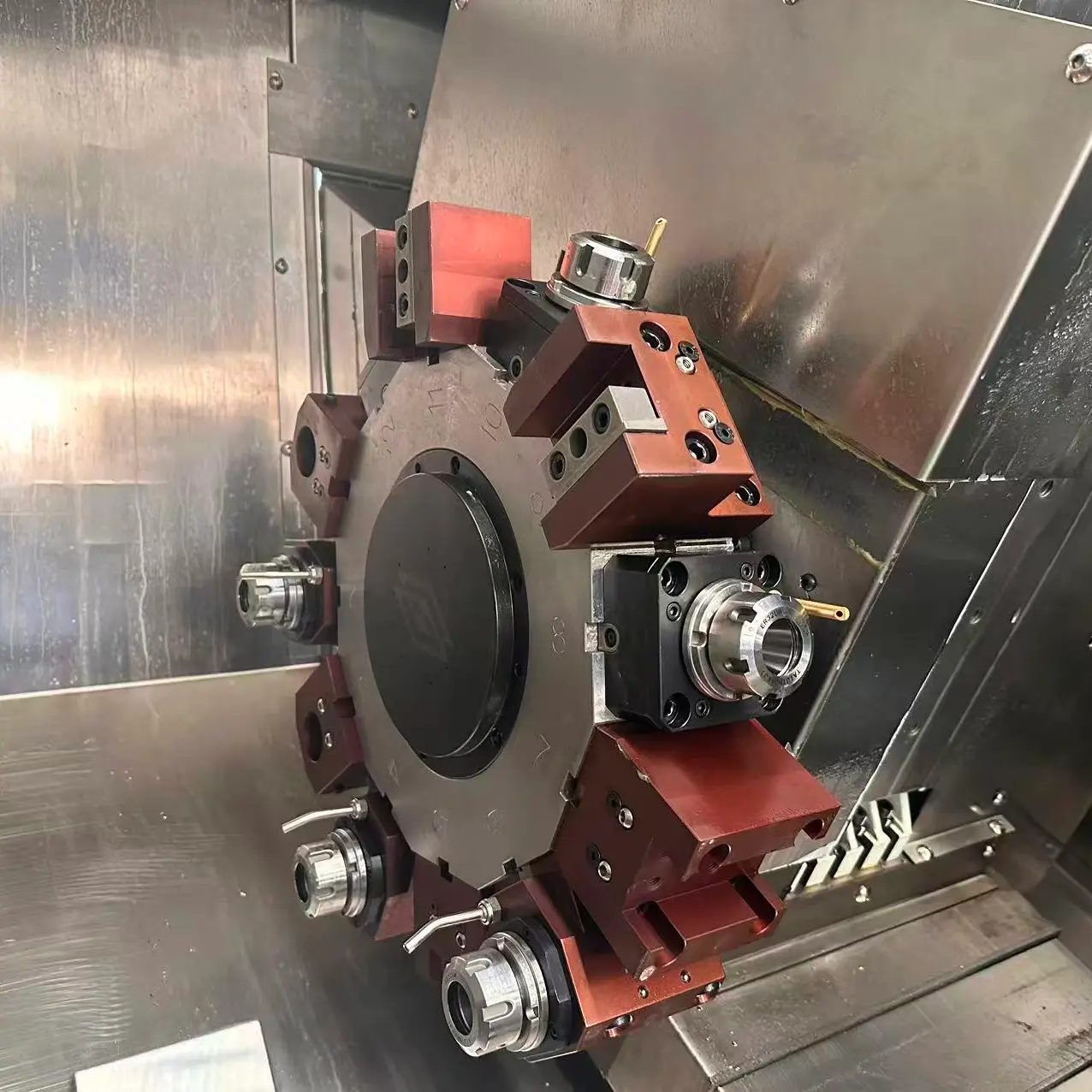
What it does. Electric or hydraulic indexers with Hirth couplings (typically 120-tooth or 144-tooth) achieve ±2 arc-second indexing repeatability. Tool stations number 8, 10, or 12 on standard machines; VDI or BMT tooling systems allow driven tools for milling and drilling operations on turning centers. Tool shank size 20 mm × 20 mm or 25 mm × 25 mm on smaller machines; 32 mm × 32 mm on heavy-duty models.
What cheap looks like. Worm gear indexers without Hirth coupling, relying on a single pin for location. Tool stations machined from aluminum rather than alloy steel. These turrets accumulate backlash within months and cannot maintain tool height within 0.05 mm after 500 indexing cycles.
What fails first. The coupling wear causes tool-to-tool positioning error. A finish pass with a worn insert at the wrong height leaves a witness mark or steps in the diameter. On driven-tool turrets, the live tool spindle bearings fail from coolant contamination because the seal design omits labyrinth protection.
Chip and Coolant Management
Chip handling and coolant delivery are often specified last and regretted first.
What it does. Flood coolant at 6–12 bar pressure through flexible hose or fixed nozzles; high-pressure systems to 70 bar for deep-hole drilling or insert cooling. Chip conveyors (hinged belt or screw type) remove continuous and broken chips from the cutting zone. On slant bed lathes, gravity assists chip flow to the conveyor; flat bed machines require chip pans with steeper angles or coolant flushing.
What cheap looks like. No chip conveyor, manual shovel-out. Coolant pump at 2 bar with no filtration, recirculating chips into the coolant stream. These machines lose 15–30 minutes per shift to chip removal and experience premature pump seal failure.
What fails first. The coolant pump impeller erodes from abrasive particles. Without a bag filter or hydrocyclone, the turret coolant nozzles clog. On machines with inadequate slope or chip pan volume, packed chips harden in the machine base and corrode unpainted surfaces. A 50-micron bag filter and 20-minute chip conveyor cycle time are minimum practical specifications for steel machining.
Integration and Failure Interaction
No assembly fails in isolation. A warped bed loads the guideways unevenly, accelerating wear. A degraded spindle bearing induces vibration that hammers the turret coupling. Inadequate coolant flow permits thermal growth that the control cannot compensate.
The inspection protocol for a used or new machine should verify: bed twist with precision level or laser alignment (0.02 mm/m maximum); spindle runout at nose and bore (0.010 mm maximum); rapid traverse following error (0.015 mm maximum per axis); turret repeatability across all stations (0.010 mm maximum radial); and coolant pressure at tool tip with all nozzles open. These five measurements reveal more about machine life than specification sheet comparisons.
How a CNC Lathe Machine Works
Workpiece clamping and spindle orientation. The operator loads a raw bar or casting into a chuck—typically hydraulic 3-jaw on a 200 mm to 400 mm swing lathe, or collet for bar work. The spindle nose, standardized at A2-5, A2-6, or A2-8, registers the chuck concentrically. Clamping pressure, usually 20–60 bar from a hydraulic power pack, must grip securely against cutting forces that peak during roughing. On a 15 kW spindle at 2000 rpm, a 100 mm diameter cast iron workpiece generates substantial centrifugal and tangential load.
Program call and tool preset. The operator selects the part program from the CNC control—FANUC 0i-TF, Siemens 828D, or GSK 980TDb on most Chinese-built machines. Tool offsets, entered either by manual touch-off or through a tool presetter, compensate for insert wear and holder variation. A turret lathe carries 8–12 stations; a turning center with driven tools adds Y-axis capability and live tooling at 4000–6000 rpm.
Axis interpolation and cutting motion. The control parses G-code into simultaneous X and Z axis movement. For a straight turn at 0.2 mm/rev feed, the X-axis cross-slide advances the insert radially while the Z-axis carriage tracks longitudinally. Ballscrews with 32 mm or 40 mm diameter and 5 mm or 10 mm pitch convert rotary servo motion to linear travel. Rapid traverse reaches 20–30 m/min on linear guideway machines, 12–18 m/min on box-way designs.
Feedback correction and thermal compensation. Rotary encoders on the servo motors—17-bit or 23-bit absolute on FANUC and Siemens systems—report actual position every 0.5 ms. The control compares commanded versus actual position; deviation triggers torque adjustment within milliseconds. For C-axis contouring on a turning center, the spindle motor operates in servo mode with 0.001° indexing resolution. Some systems apply thermal growth models based on spindle bearing temperature sensors.
Chip formation and process fluid delivery. The insert engages, generating continuous or segmented chips depending on material and geometry. Coolant pumps deliver 6–12 bar pressure through nozzles aimed at the cutting edge; through-spindle coolant requires rotary unions rated for 70 bar on higher-spec machines. Chip conveyors—hinged belt or scraper type—evacuate swarf to a collection bin.
Part unload and cycle reset. After final pass and cutoff, the control executes M-code for part catch or sub-spindle transfer on twin-turret machines. Bar feeders extend unmanned operation. The operator or gantry robot removes the finished component; the chuck opens for the next cycle.
Where Budget Machines Lose Accuracy or Speed
Servo loop stiffness and encoder resolution. Entry-level lathes using GSK or KND controls with incremental encoders and 5 μm positioning accuracy cannot hold the 0.01 mm tolerance that a FANUC or Siemens system with 0.001 mm repeatability achieves consistently. The cheaper loop lacks lookahead processing; at feed rates above 10 m/min, corner rounding and following error become visible on test pieces.
Pembangunan jalur rel dan sistem peredaman. Machines built with linear guides on lightweight beds—HT250 casting without stress relief, net weight under 2500 kg for a 500 mm swing—exhibit chatter during interrupted cuts. Hardened box ways on HT300 or Meehanite castings, properly scraped and with Turcite-B or Rulon lining, absorb vibration but sacrifice 30–40% rapid traverse speed. A buyer choosing linear guides for speed on a light bed gains cycle time but loses tool life and surface finish in heavy roughing.
Spindle bearing preload and thermal management. Budget spindles using 7014 angular contact bearings with fixed preload heat 15–20°C above ambient within two hours of operation. This thermal growth shifts the nose 0.03–0.05 mm axially, directly affecting facing flatness and length dimensions. Higher-spec spindles with ceramic hybrid bearings and oil-air lubrication maintain temperature within 8°C, with growth under 0.01 mm. The cost difference is substantial—roughly 15–20% of machine value—but the cheaper spindle requires warm-up routines and mid-shift dimensional checks that erase any initial savings in a production environment.

Jenis dan Konfigurasi Mesin Bubut CNC
| Jenis atau Kelas | Rentang Kerja Umum | Opsi Pengaturan | Paling Cocok Untuk | Catatan |
|---|---|---|---|---|
| Compact Flat Bed CNC Lathe | Max turning diameter 400–500 mm, length 750–1000 mm, chuck 6–8 inch | GSK 980TDi, KND K1Ti, Siemens 808D ADVANCED | Job shops, training centres, small automotive repair, prototype work | 2-axis only; no C-axis or live tooling; HT250 bed; linear guides or box ways depending on price |
| Mid-Range Slant Bed Turning Center | Max turning diameter 400–520 mm, length 650–1000 mm, chuck 8–10 inch | FANUC 0i-TF Plus, Mitsubishi M80, Syntec 22TA | Production job shops, hydraulic fittings, shaft work, general subcontracting | Often with 8-station turret or VDI30; rapid traverse 20–30 m/min; positioning accuracy ±0.005 mm |
| Heavy-Duty Flat Bed CNC Lathe | Swing over bed 630–800 mm, length 1500–3000 mm, chuck 12–15 inch | FANUC 0i-TF, Siemens 828D, GSK 980TDi | Oil and gas, mining, shipbuilding, large shaft and pipe threading | HT300 or Meehanite casting; hardened box ways; spindle bore 80–105 mm; weight 4500–8500 kg |
| Twin-Turret Twin-Spindle Turning Center | Main chuck 8–10 inch, sub-spindle 6–8 inch, bar capacity 51–65 mm | FANUC 31i-B, Siemens 840D sl, Mitsubishi M800 | High-volume automotive, medical, precision components | Complete front/back machining in one clamping; 12-station turrets standard; 0.003 mm repeatability |
| Mesin Bubut CNC Tipe Swiss | Bar capacity 20–32 mm, max part length 200–400 mm | FANUC 32i-B, Citizen proprietary, Star SR series | Watch parts, connectors, medical implants, long slender components | Sliding headstock with guide bushing; 5–7 axes; cannot handle castings or forgings; bar feeder mandatory |
| Mesin Bubut CNC Vertikal (VTL) | Table diameter 1000–2500 mm, max turning height 800–1600 mm, table load 3000–12000 kg | FANUC 0i-MF, Siemens 828D, GSK 25i | Railway wheels, brake discs, large flanges, wind turbine rings | Low centre of gravity for heavy chucks; ram type or turret type; floor space 4.5 × 5.5 m minimum |
Compact Flat Bed CNC Lathe
This is the entry point for shops buying their first CNC lathe or replacing manual engine lathes. Typical specifications include a 6-inch or 8-inch hydraulic chuck, 7.5 kW spindle running to 2500 rpm, X/Z travels of 220 mm/750 mm, and a machine weight of 1800–2200 kg. The control is usually a GSK 980TDi or KND K1Ti; FANUC is available at a 25–35 percent premium. Buyers are small job shops, agricultural repair stations, and technical colleges. What fails first: the turret indexing mechanism on budget machines with curvic couplings instead of Hirth couplings, and the ball screws on machines using domestic C7 grade rather than HIWIN or PMI ground C5. These machines cannot perform Y-axis milling or polygon turning; they are strictly two-axis turning with limited threading and grooving capability.
Mid-Range Slant Bed Turning Center
The slant bed design at 30° or 45° improves chip flow and operator access, and this class dominates general subcontracting work. A typical machine carries an 8-inch chuck, 11–15 kW spindle to 4000 rpm, rapid traverse of 24 m/min, and positioning accuracy of ±0.005 mm with repeatability of 0.003 mm. Controls are FANUC 0i-TF Plus or Mitsubishi M80 for export markets; Syntec 22TA is common for Southeast Asia and Middle East buyers seeking lower initial cost. The turret is usually an 8- or 12-station electric servo unit, sometimes with VDI30 tool holders. Buyers are independent job shops producing hydraulic fittings, pump shafts, and general turned components. What fails first: the turret clamp sensor and the linear guide blocks if coolant concentration drops below 5 percent. These machines handle 90 percent of turning work but struggle with heavy interrupted cuts on forgings; the slant bed and linear guides favour speed over rigidity compared to a flat bed box way machine.
Heavy-Duty Flat Bed CNC Lathe
Built for mass and torque, this class uses HT300 or Meehanite castings in the 4500–8500 kg range, with hardened box ways scraped to 8–12 points per 25 × 25 mm. Typical specifications: swing over bed 630–800 mm, distance between centres 1500–3000 mm, spindle bore 80–105 mm for pipe threading, and spindle power 15–22 kW at 1500 rpm. Controls are FANUC 0i-TF or Siemens 828D; GSK is acceptable for markets where local service exists. Buyers are oilfield service companies, mining equipment rebuilders, and shipyards. What fails first: the main spindle bearings after improper chuck mounting or unbalanced heavy workpieces; the apron and half-nut assembly on machines where the builder skimps on induction hardening of the bed ways. These machines excel at low-speed heavy cuts but cannot match the rapid traverse (typically 6–10 m/min) or tool change speed of a slant bed turning center.
Twin-Turret Twin-Spindle Turning Center
This is the productivity solution for volumes above 500 pieces per shift. The main spindle carries an 8-inch or 10-inch chuck; the sub-spindle, aligned on the Z-axis, receives the part for back-end machining without reclamping. Typical bar capacity is 51 mm or 65 mm; both turrets offer 12 stations with live tooling and C-axis for milling operations. Spindle power is 15 kW main, 11 kW sub; positioning repeatability is 0.003 mm. Controls are FANUC 31i-B or Siemens 840D sl; anything less cannot synchronise the spindles for part transfer. Buyers are Tier 2 automotive suppliers, medical device contract manufacturers, and precision component specialists. What fails first: the part catcher and transfer mechanism; the live tooling drive gears if coolant pressure drops below 70 bar through-tool. These machines cannot justify themselves below 2000 hours annual running time; the capital cost is 3–4 times a single-turret slant bed machine.
Mesin Bubut CNC Tipe Swiss
Despite the name, most Swiss-type machines are now built in Japan, Korea, and increasingly China. The defining feature is a sliding headstock that feeds bar stock through a guide bushing, supporting the material within millimetres of the cutting point. Bar capacity ranges from 12 mm to 38 mm; the most common industrial sizes are 20 mm and 32 mm. Spindle power is modest at 3.7–7.5 kW, but speeds reach 12 000 rpm for small tools. Controls are FANUC 32i-B or proprietary systems from Citizen and Star; Chinese alternatives using Syntec are emerging at 40 percent lower cost. Buyers are medical implant manufacturers, connector specialists, and watch component suppliers. What fails first: the guide bushing, worn by abrasive brass or stainless steel bar surfaces; the collet and pusher mechanism if bar straightness exceeds 0.3 mm/m. These machines cannot process sawn blanks or castings; they require coil-fed or straightened bar, and the guide bushing must match bar diameter within 0.05 mm.
Mesin Bubut CNC Vertikal
The VTL inverts the conventional arrangement: the workpiece sits on a horizontal table, and the cutting tool moves vertically on a ram or turret. Table diameters start at 1000 mm for brake discs and extend to 2500 mm or more for wind turbine rings. Typical specifications: table load 5000 kg, max turning height 1000 mm, ram travel 1200 mm, spindle power 30–55 kW at 250 rpm. Controls are FANUC 0i-MF or Siemens 828D; the GSK 25i is found in domestic Chinese applications. Buyers are railway wheel manufacturers, power generation equipment suppliers, and heavy fabrication shops. What fails first: the table cross-roller bearings, overloaded by uneven clamping; the ram guideway on machines using glued Turcite instead of scraped cast iron inserts. These machines handle diameters impossible on horizontal lathes but cannot efficiently produce long shafts; the height-to-diameter ratio is fundamentally limited by the column structure.
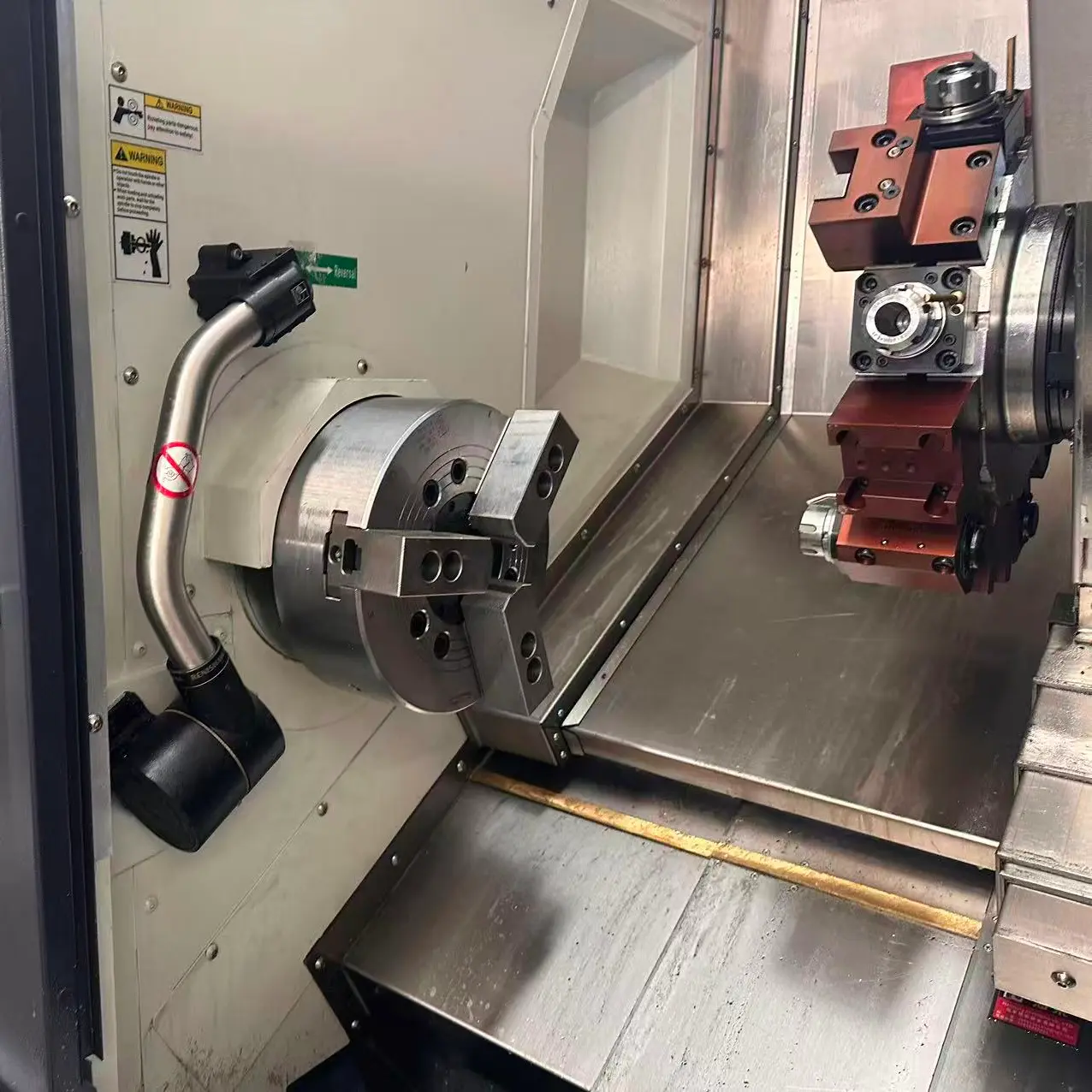
Main Components of a CNC Lathe Machine
| Perakitan | Fungsi | Versi Tingkat Pemula yang Umum | Versi Peningkatan Standar | Apa yang Gagal Terlebih Dahulu |
|---|---|---|---|---|
| Pengecoran Rangka Tempat Tidur | Absorbs cutting forces, maintains geometric alignment between spindle and tool | HT250 gray iron, ~2,800 kg on 500 mm swing machine, minimal ribbing | HT300 or Meehanite casting, 3,500–4,200 kg, full box-section ribs with internal bracing, twice stress-relieved | Thermal distortion from uneven mass distribution; crack propagation at thin-wall sections near guideway mounting |
| Rel Panduan | Define axis motion precision and load capacity | Hardened box ways (HRC 45–50), 180–220 mm width, hand-scraped contact points, 8 m/min rapid | Linear roller guides (HIWIN/PMI HGW or RG series), 25–35 mm rail, preload adjustable, 20–30 m/min rapid | Box ways: adhesive wear and stick-slip at low feeds; linear guides: ball track fatigue and cage migration in contaminated coolant |
| Sekrup Bola dan Sistem Penggerak | Convert rotary servo motion to linear axis movement | C7 grade ground screw, 32 mm diameter, 5 mm pitch, fixed-simple support, 0.050 mm positioning accuracy | C5 or C3 grade, 40 mm diameter, 10 mm pitch, fixed-fixed thermal pretension, 0.010 mm positioning, 0.005 mm repeatability | Entry: backlash from nut wear, support bearing fatigue; upgraded: thermal growth mismatch between screw and cast iron bed |
| Poros | Primary rotary motion, torque transmission to workpiece | A2-5 nose, 5.5 kW continuous, 4,000 rpm max, dual-row cylindrical roller + angular contact bearing | A2-6 or A2-8 nose, 11–15 kW, 6,000 rpm, ceramic hybrid bearings, oil-air mist lubrication, 0.005 mm runout | Bearing preload loss from contamination ingress; A2-5 tapers on heavy cuts: nose deflection and chatter marks |
| Sistem Kontrol dan Paket Servo | Motion planning, G-code execution, closed-loop axis control | GSK 980TDi or KND K1000Ti, 0.1 μm command resolution, analog servo interface | FANUC 0i-TF Plus or Siemens 828D, 1 nm resolution, EtherCAT or FANUC FSSB digital bus, 166 MHz CNC processor | Entry: servo lag during threading (spindle-encoder sync drift); upgraded: flash memory corruption from electrical noise, battery-backed parameter loss |
| Tool Turret | Indexable tool storage and rapid tool change | 8-station electric turret, 1.8 kW indexing motor, 2.5 sec station-to-station, curvic coupling | 12-station servo turret (VDI 40 or BMT 55), 0.6 sec index, hydraulic clamping 35 bar, 80 mm tool disc diameter | Curvic tooth wear causing 0.03–0.08 mm repeatability loss; electric motor encoder failure; tool pot galling in dusty environments |
| Chuck and Tailstock | Workholding (chuck) and axial support (tailstock) | 3-jaw hydraulic chuck 200 mm, 55 mm through-hole, MT4 tailstock, manual quill advance | 250 mm 3+2 jaw chuck, 65 mm bore, MT5 tailstock with programmable quill, 80 mm stroke, 20 kN thrust | Chuck: jaw serration wear, hydraulic cylinder seal weep; tailstock: quill bearing brinelling from dead-center overload, misalignment from casting shift |
| Sistem Chip dan Pendingin | Thermal management and debris evacuation | 25 L/min coolant pump, single outlet, gravity chip tray, manual cleanout | 60 L/min multi-stage pump, programmable nozzle ring, hinged conveyor with 30° incline, 200 L sump with filter bag | Pump cavitation from tramp oil; conveyor chain pin wear; filter media blinding on cast iron fines |
| Penutup dan Pengunci Keamanan | Operator protection and coolant containment | Single-piece sheet steel, 1.5 mm, basic door switch, no internal lighting | 2 mm steel with bonded polymer liner, full-width sliding door with safety relay category 3, LED array 500 lux, CE guarding | Door switch contact welding from coolant vapor; seal compression set causing coolant puddling on floor |
Komponen yang Paling Mempengaruhi Akurasi Jangka Panjang
Three assemblies above determine whether a CNC lathe holds tolerance at 5,000 hours versus 15,000 hours: the bed casting, the guideways, and the ball screw drive system.
Bed Casting and Thermal Mass
A lathe bed does not merely support components; it is the dimensional reference frame against which all cuts are measured. HT250 castings with minimal ribbing and single stress relief cycle cost less but retain internal casting stresses that release asymmetrically during the first 2,000–3,000 operating hours. The result is a slow twist or sag between headstock and tailstock positions, typically 0.02–0.05 mm over 1,000 mm length. HT300 or Meehanite castings with full box-section geometry and double stress relief (rough machine, relieve, finish machine, relieve) stabilize to roughly 0.005 mm/m thermal growth. The trade-off is mass: a properly ribbed 500 mm swing slant-bed frame runs 3,800–4,500 kg versus 2,600 kg for the light version. Container loading limits (typically 22–26 tonnes in a 40′ HQ) become relevant when shipping multiple machines. The failure mode to anticipate is not sudden collapse but gradual geometric drift that consumescutter compensation values and produces tapered shafts on long parts.
Guideway Type and Maintenance Burden
The choice between box ways and linear guides commits a shop to different accuracy maintenance regimes. Hardened box ways (HRC 45–50, 200 mm contact width) tolerate interrupted cuts and heavy stock removal because the large contact area distributes shock loads. Their weakness is low-speed stick-slip below 0.05 mm/rev feed, and the hand-scraped contact points require re-scraping after 8,000–12,000 hours as the oil film breaks down. Linear roller guides eliminate stick-slip and permit 24–30 m/min rapids on 500 mm Z-axis machines, but the 25–35 mm ball tracks concentrate load. Contaminated coolant with cast iron fines or aluminum chip infiltration causes pitting fatigue; guide block replacement at 6,000–10,000 hours is typical in unfiltered environments. Preload class matters: Z0 or ZA preload suits general turning, while ZB or ZC preload (higher) extends accuracy life but increases rolling friction and servo load. A practical check: request the guide rail manufacturer (HIWIN, PMI, THK) and preload designation in the quotation, not merely “Taiwan linear guide.”
Ball Screw Drive and Thermal Behavior
Ball screw grade (C7 versus C5 versus C3) specifies cumulative pitch error over 300 mm: 0.050 mm, 0.018 mm, and 0.008 mm respectively. For long-term accuracy, however, the support configuration and thermal management matter equally. Fixed-simple bearing support (entry level) allows screw sag beyond 800 mm length and creates periodic pitch error from gravity-induced bow. Fixed-fixed support with pretension (typically 50–100 μm elongation) compensates for thermal expansion but requires matched angular contact bearing pairs and precise assembly. The critical failure is thermal growth mismatch: a 40 mm diameter screw at 30°C above ambient expands 0.011 mm per 100 mm. If the cast iron bed expands at roughly half that rate, the screw effectively lengthens relative to the bed, altering X-axis tool position. Upgraded machines address this with hollow screw oil cooling or glass-scale linear feedback that closes the loop at the table, bypassing screw thermal error. Without these measures, even C3 screws produce tapered diameters on long shafts during warm-up cycles.
Spesifikasi dan Cara Membacanya
| Parameter | Tingkat Pemula | Kelas Menengah | Spesifikasi Tinggi |
|---|---|---|---|
| Max Turning Diameter | 360 mm | 500 mm | 800 mm |
| Max Turning Length | 500 mm | 1.000 mm | 1.500 mm |
| Chuck Size | 6 inci (160 mm) | 8 inch (200 mm) | 12 inci (315 mm) |
| Taper Poros | A2-5 | A2-6 | A2-8 |
| Spindle Speed | 3.500 putaran per menit | 4000 rpm | 2.500 putaran per menit |
| Spindle Power | 7,5 kW | 11 kW | 18.5 kW |
| Jenis Jalur Pandu | Rel kotak yang diperkeras | Pemandu rol linier (HIWIN/PMI) | Pemandu rol linier (HIWIN/PMI) |
| X/Z Travel | 180/500 mm | 250/1050 mm | 420/1600 mm |
| Rapid Traverse X/Z | 12/16 m/min | 20/24 m per menit | 24/30 m/menit |
| Akurasi Penentuan Posisi | ±0,015 mm | ±0,010 mm | ±0,008 mm |
| Repeatabilitas | ±0,008 mm | ±0,005 mm | ±0,003 mm |
| Tool Stations | 4-station VDI30 | 8-station VDI40 turret | 12-station servo turret |
| Sistem Pengendalian | GSK 980TDb | FANUC 0i-TF / KND 2000Ti | FANUC 0i-TF Plus / Siemens 828D |
| Tegangan Masukan | 380V 50Hz | 380V 50Hz / 220V 60Hz optional | 380V 50Hz / 220V 60Hz optional |
| Berat Bersih Mesin | 2.200 kg | 4.500 kg | 8500 kg |
| Luas Lantai (P × L × T) | 2200×1400×1700 mm | 3200×1800×1900 mm | 4800×2200×2100 mm |
Bed Casting and Foundation
The bed carries every other assembly and determines whether the machine holds tolerance after five years of chip loads and thermal cycles. Entry-level beds use HT250 gray cast iron with minimal ribbing; you will see flex during heavy interrupted cuts and the ways will show wear patterns within 2000 operating hours. Mid-range and high-specification machines use HT300 or Meehanite castings, stress-relieved in two stages, with box-section ribs and internal sand cores that add mass without creating trapped pockets. A 500 mm swing machine in HT300 with proper ribbing weighs roughly 3200 kg bare; if the brochure claims 2500 kg for the same swing, the casting is thin or the material grade is lower.
The bed sits on three-point leveling pads. Foundation requirements vary by weight: machines under 3000 kg can run on 150 mm reinforced industrial concrete; machines above 6000 kg need 200 mm minimum with rebar mesh and isolation from vibration sources such as stamping presses or overhead crane rails.
Guideways and Motion Accuracy
Hardened box ways survive heavy interrupted cuts and abrasive dust better than linear guides. The trade-off is friction: rapid traverse on box ways rarely exceeds 12 m/min, and stick-slip during micro-feeds can reach 0.003 mm. Linear roller guides from HIWIN or PMI allow 24–30 m/min rapids and positioning accuracy to ±0.008 mm, but the rolling elements dent under impact loads and the lubrication seals fail in chip-heavy environments.
What fails first on linear guides: the wiper seals. Once coolant and fine chips breach the seal, the raceways pit within months. Box ways fail by progressive wear; you can scrape and recondition them two or three times over a machine life.
Rakitan Poros
The spindle nose taper (A2-5, A2-6, A2-8) determines chuck size and workpiece capacity. A2-5 accepts 6–8 inch chucks and handles bar stock to 52 mm diameter. A2-6 takes 8–10 inch chucks, bar stock to 65 mm. A2-8 accepts 12 inch chucks and 105 mm bar. The taper itself is a short-taper camlock standard; cheaper spindles run true to 0.015 mm TIR, better assemblies to 0.005 mm.
Spindle bearings are typically double-row cylindrical roller plus angular contact ball bearings in back-to-back arrangement. The angular contact pair sets preload; cheaper machines use fixed-position preload with standard tolerance bearings, while high-specification spindles use spring-preloaded or hydraulic-preloaded systems that compensate for thermal expansion. A 7.5 kW spindle at 3500 rpm suits aluminum and small steel parts; 11 kW at 4000 rpm covers most alloy steel and stainless work; 18.5 kW at 2500 rpm delivers the torque for large-diameter roughing in cast iron or forged blanks.
What fails first: the front bearing seal, then the bearing itself if coolant ingress occurs. Belt-drive spindles need belt replacement every 3000–4000 hours. Direct-drive spindles eliminate belts but require more expensive bearing sets and generate more heat.
Drive Motors and Ballscrews
X and Z axis servo motors couple to C5 or C3 grade ballscrews through bellows or telescopic covers. Entry machines use 0.75–1.0 kW servos with C5 screws; mid-range uses 1.5–2.0 kW with C3 screws and double-nut preload; high-specification uses 2.5–3.0 kW with C3 screws and optical linear scales for closed-loop positioning. Ballscrew diameter matters: 32 mm screws on a 1000 mm Z axis will whip above 3000 rpm equivalent; 40 mm screws handle the span without critical speed issues.
What fails first: the ballscrew nut if chips enter through damaged covers, or the support bearings if lubrication intervals are missed.
Sistem Pengendalian
GSK 980TDb dominates entry-level Chinese CNC lathes. It handles two-axis simultaneous interpolation, standard G-code, and USB program input. The limitation is macro programming and rigid tapping synchronization—functional but not smooth compared to FANUC or Siemens.
FANUC 0i-TF and KND 2000Ti occupy the mid-range. FANUC offers the deepest technician familiarity globally, rigid tapping, and servo learning control that reduces corner rounding. KND matches most features at lower cost but has narrower third-party support for post-processors and simulation software.
Siemens 828D and FANUC 0i-TF Plus serve high-specification machines. Siemens excels in five-axis turning-milling combinations and has open architecture for shop-floor data collection. FANUC 0i-TF Plus adds AI servo tuning and thermal compensation algorithms.
The control dictates spare parts strategy. FANUC and Siemens maintain distribution networks in most countries; GSK and KND require ordering from China with 2–4 week lead times for boards and drives.
Tool Changer and Turret
Entry-level machines use 4-station manual or electric tool posts with VDI30 shanks. Each tool index takes 2–3 seconds, and tool-to-tool time is not a meaningful metric because the operator often intervenes.
Mid-range machines use 8-station servo turrets with VDI40 or BMT55 shanks, random-access indexing in 0.3–0.6 seconds, and live tooling capability for cross drilling and milling. The turret disc rides on a curved coupler and locates via Hirth coupling teeth; cheaper turrets use single-disc couplers that wear and develop 0.02 mm repeatability loss.
High-specification machines use 12-station servo turrets with BMT65 shanks, higher clamping force, and internal coolant passages rated to 70 bar for through-tool delivery. What fails first: the Hirth coupling teeth if crash forces exceed design limits, or the turret encoder battery that maintains absolute position reference.
Chip and Coolant Systems
Chip conveyors are optional on entry machines and standard above mid-range. Auger-style conveyors handle stringy steel and aluminum; hinged-belt conveyors manage cast iron chips and heavier volumes. Coolant tank capacity ranges from 60 liters on small machines to 250 liters on large slant-bed lathes with through-spindle coolant.
What fails first: the coolant pump seal, typically within 18 months in hard-water environments, or the conveyor motor if chips jam and the operator repeatedly resets overloads without clearing the blockage.
Membaca Lembar Spesifikasi Baris demi Baris
Jangkauan Kerja atau Jarak Tempuh — X travel is the cross-slide movement toward and away from centerline; Z travel is the carriage movement along the bed axis. Check that Z travel exceeds your longest workpiece by at least 100 mm for chuck clearance and tool overhang.
Max Turning Diameter and Length — These are nominal. Actual capacity reduces with tool size, tool holder interference, and tailstock or steady rest in place. A 500 mm max diameter may become 420 mm usable with a 25 mm insert holder.
Kecepatan dan Daya Spindel — Higher rpm suits small diameters and aluminum; lower rpm with higher torque suits large diameters and tough materials. Constant surface speed (CSS) control requires the control system to calculate rpm from programmed surface speed and measured diameter—standard on FANUC and Siemens, present but sometimes limited on GSK.
Spindle Taper or Chuck Size — A2-6 is the practical minimum for general job shop work. Verify that your existing chucks and fixtures match the spindle nose, or budget for new mounting hardware.
Jenis Jalur Pandu — Hardened box way for heavy roughing in dirty environments; linear roller guide for speed, precision, and finish work in controlled conditions.
Kecepatan Pergerakan dan Kecepatan Pengumpanan — Rapids matter for non-cutting positioning time; feed rates for actual material removal. The ratio of rapid to cutting feed indicates machine responsiveness. Entry machines may rapid at 12 m/min but struggle to maintain smooth feed below 0.05 mm/rev.
Akurasi dan Konsistensi Penentuan Posisi — Positioning accuracy is where the machine goes on command; repeatability is whether it returns to the same place after a full cycle. Repeatability matters more for batch production. ±0.010 mm positioning with ±0.005 mm repeatability is acceptable for most automotive and agricultural parts; ±0.005 mm / ±0.003 mm is needed for hydraulic fittings and bearing seats.
Kapasitas dan Waktu Pergantian di Majalah Tool — On lathes, this means turret stations. Live tooling adds complexity; verify that the turret builder (Sauter, Duplomatic, Baruffaldi, or domestic Chinese) supports the live tool speeds and torques you need.
Sistem Pengendalian — Match to your operator experience and your CAM software post-processor library.
Supply Voltage and Total Connected Load — A 7.5 kW spindle with 2 kW axis servos and 2 kW auxiliary loads draws roughly 18–20 kVA continuous. Check that your shop transformer and main breaker have headroom above this figure.
Berat Kotor Mesin dan Luas Lantai — Heavier machines damp vibration and hold accuracy. Compare weight per unit of swing: a 360 mm swing machine at 2200 kg (6.1 kg/mm) versus a 500 mm machine at 4500 kg (9.0 kg/mm) shows where the builder invested in mass.
Ketentuan dan Dokumen Perdagangan Ekspor
EXW (Ex Works) — You collect the machine from the factory. You arrange export packing, inland transport to port, customs clearance, ocean freight, marine insurance, and destination clearance. Lowest quoted price, highest coordination burden. Suitable only if you have established freight forwarders in China.
FOB (Free On Board) — The supplier delivers to port, clears export customs, and loads onto the vessel. You pay ocean freight, insurance, and all destination costs. Most common for machinery purchases from China. Verify the port: Qingdao, Shanghai, or Tianjin for northern factories; Shenzhen or Guangzhou for southern.
CFR (Biaya dan Angkutan) — Supplier pays to your destination port. You arrange insurance and unloading. Risk transfers at loading port, so you bear the loss if the vessel sinks even though you have not paid for freight directly.
CIF (Biaya, Asuransi, dan Angkutan) — Supplier pays freight and basic marine insurance to destination port. The insurance is typically minimal coverage; arrange additional cargo insurance for full replacement value.
Ketentuan Pembayaran — T/T (telegraphic transfer) in two stages is standard: 30% deposit to start production, 70% before shipment against copy of bill of lading. L/C (letter of credit) at sight adds bank fees (0.15–0.3% of value) but gives documentary security. Some suppliers accept L/C only above $100,000 or for repeat customers.
Kode HS — CNC lathes fall under 8458.11 (horizontal lathes numerically controlled) or 8458.91 (other lathes numerically controlled). Correct classification determines duty rate and import license requirements in your country.
Tanda CE — Indicates conformity with EU machinery directive 2006/42/EC. The supplier must provide EC declaration of conformity, technical file summary, and sometimes notified body certificate for the electrical components. CE is not a quality guarantee; it is a regulatory compliance marker. Some non-EU buyers request CE as a proxy for safety design review.
Daftar Barang yang Dibawa — Must itemize: machine net and gross weight, overall dimensions, crate or container number, list of loose accessories (chuck, tool holders, manual, coolant tank, chip conveyor if separate). Cross-check against actual container contents on arrival; shortages are easier to claim within the free time period at port.
Sertifikat Asal — Issued by China Council for the Promotion of International Trade (CCPIT) or local customs. Required for preferential tariff treatment under bilateral trade agreements (ASEAN-China, China-Pakistan, etc.). Verify whether your country has an active agreement before requesting this document.
Transformer and Voltage — Chinese-built machines ship wired for 380V 50Hz three-phase. For 220V 60Hz regions (North America, parts of Japan, Taiwan), the supplier can install a step-up transformer or reconfigure motor connections if the motor nameplate supports dual voltage. A 15 kVA transformer for a mid-range lathe weighs 80–120 kg and costs $800–1500; specify whether this is included or excluded.
Container Loading — Small lathes (under 2500 kg, under 2.2 m height) fit in 20-foot containers. Mid-range machines need 40-foot containers; machines above 6000 kg or 2.5 m height may require flat-rack containers or break-bulk shipment. A 40-foot container holds one large lathe or two small lathes if crated separately. Loading by overhead crane at factory; unloading at destination requires crane or forklift capacity matching machine gross weight (typically net weight plus 300–500 kg for crate and packing).
Installation and Training — RUNNEWTECH provides installation supervision and operator training as optional services. Budget 7–10 days for a single machine including leveling, geometric alignment, spindle runout check, and basic G-code operation training. Two technicians travel; buyer provides local accommodation and interpreter if needed. Alternatively, a local machine tool service contractor can perform installation against supplier documentation and remote video support.
Aplikasi Industri untuk Mesin Bubut CNC
| Sektor | Komponen yang Umum Diproduksi | Spesifikasi yang Direkomendasikan | Mengapa Mesin Ini Cocok |
|---|---|---|---|
| Suku Cadang Mobil dan Sepeda Motor | Brake discs, camshafts, wheel hubs, piston rods, drive shafts | Flat bed CNC lathe, 750 mm max turning diameter, 1500 mm max turning length, A2-8 spindle nose, 11 kW spindle motor, 2500 rpm, FANUC 0i-TF, ±0.008 mm positioning accuracy | High torque at low speed for cast iron and forged steel; flat bed accommodates long shaft work common in driveline components |
| Mesin Pertanian | Hydraulic cylinder rods, gear blanks, bearing housings, pulley hubs | Slant bed CNC lathe, 500 mm max turning diameter, 750 mm max turning length, A2-6 spindle, 7.5 kW spindle, 3500 rpm, GSK 980TDi, linear roller guideways, 0.015 mm repeatability | Slant bed geometry sheds chips from abrasive castings; 45-degree bed angle improves rigidity for interrupted cuts on rough forgings |
| Sambungan Hidraulik dan Pneumatik | Cylinder bodies, valve spools, connector threads, piston glands | Slant bed CNC lathe with live tooling, 360 mm max turning diameter, 500 mm max turning length, A2-5 spindle, 5.5 kW, 4000 rpm, Syntec 21TA, C-axis, 8-station turret | Live tooling and C-axis eliminate second-op milling for cross-drilled ports; tight tolerances on thread forms demand ±0.005 mm repeatability |
| Sambungan untuk Industri Minyak dan Gas | Drill collar subs, tubing couplings, valve bodies, flanged connectors | Flat bed CNC lathe, 1000 mm swing over bed, 3000 mm between centers, A2-11 spindle, 22 kW, 1500 rpm, Siemens 828D, hardened box ways, HT300 casting, 8500 kg machine weight | Massive workpieces in alloy steel require torque over speed; box ways dampen vibration during heavy roughing; long bed supports pipe threading operations |
| Pekerjaan Cetakan dan Matris | Core pins, ejector sleeves, gate inserts, round cavities | Slant bed CNC lathe with sub-spindle, 400 mm max turning diameter, 650 mm max turning length, A2-6 main / A2-5 sub, 11 kW / 5.5 kW, 6000 rpm, FANUC 0i-TF Plus, 0.003 mm repeatability | Sub-spindle enables complete machining in one setup for concentricity on multi-diameter cores; high spindle speed and thermal stability for pre-hardened steel finishing |
| Pusat Pelatihan Teknis | Curriculum shafts, stepped cylinders, threaded test pieces, tolerance inspection samples | Flat bed CNC lathe, 400 mm max turning diameter, 1000 mm max turning length, A2-6 spindle, 5.5 kW, 2000 rpm, GSK 980TDi or KND K1000Ti, handwheel, RS232 and USB, 2800 kg net weight | Open-architecture controls match regional industrial standards; lower spindle speed reduces risk for novice operators; sufficient travel to demonstrate facing, turning, threading, and taper cuts without machine size overwhelming classroom floor space |
Suku Cadang Mobil dan Sepeda Motor
Automotive production demands volume and traceability. A brake disc run of 500 pieces per shift requires spindle duty cycles that budget machines cannot sustain. The A2-8 nose with 11 kW continuous rating delivers 800 Nm at 130 rpm for roughing cast iron, then spins to 2500 rpm for the finish face. Wheel hubs with 120 mm through-bore need chuck capacity that matches the spindle bore; mismatch here forces secondary operations. FANUC 0i-TF with servo spindle orientation enables rigid tapping for wheel bolt holes without floating tap holders. Positioning accuracy of ±0.008 mm keeps bearing seat runout within OEM tolerance stacks. What fails first on underspecified machines: spindle bearings from thermal cycling between heavy roughing and finishing, and linear guides contaminated by cast iron dust when seal ratings fall below IP54.
Mesin Pertanian
Agricultural components originate from sand castings with 3 mm to 5 mm stock allowance and surface hardening to 45 HRC in spots. The interrupted cut loads the machine structure heavily. Slant bed CNC lathes at 45 degrees place the cutting force vector into the bed casting rather than deflecting the carriage. Linear roller guideways on Z-axis with 30 mm roller diameter and preload class Z1 maintain rigidity while allowing 20 m/min rapid traverse for fast return after each cut. The 7.5 kW spindle at 3500 rpm is adequate because agricultural parts rarely need fine surface finish below Ra 1.6; they need dimensional stability across 8-hour runs in unconditioned workshops. GSK 980TDi controls with Chinese-language support reduce training friction in domestic markets. What fails first: turret index mechanism from swarf accumulation in slant bed machines without adequate chip conveyor slope; and X-axis ball screws when cast scale embeds in the nut.
Sambungan Hidraulik dan Pneumatik
Hydraulic fittings live or die on thread form accuracy and port-to-body concentricity. A valve spool with 25 mm diameter and 150 mm length requires turning the OD, then cross-drilling three 8 mm ports at 90-degree intervals. Live tooling on a slant bed machine with C-axis positioning at 0.001 degree eliminates transfer to a machining center. The Syntec 21TA control handles polar interpolation for contouring on the spool end. Eight-station turret with VDI 40 tool holders provides sufficient stations for OD roughing, OD finishing, grooving, threading, and three live-tool drills. Repeatability of ±0.005 mm ensures the spool seals against the sleeve without leakage at 350 bar. What fails first: live tool spindle bearings from coolant ingress when rotary unions use generic seals instead of mechanical face seals; and C-axis brake wear from frequent indexing during porting cycles.
Sambungan untuk Industri Minyak dan Gas
Oil field couplings in API 5CT grades P110 or Q125 exceed 50 kg finished weight and 300 mm diameter. The flat bed configuration with 1000 mm swing and 3000 mm between centers supports these workpieces on steady rests. A2-11 spindle with 22 kW and 1500 rpm maximum prioritizes torque: 1400 Nm at 150 rpm for roughing 200 mm diameter bores in normalized steel. Siemens 828D with ShopTurn conversational programming helps operators manage complex thread forms without full G-code knowledge. Hardened box ways on X and Z, scraped to 8 contact points per 25 mm square, outlast linear guides by years in this duty. Machine weight of 8500 kg absorbs vibration that would chatter on 4000 kg machines. What fails first: tailstock quill bearings from side loads during steady rest adjustment; and main spindle thrust bearings if drawbar force drops below 35 kN on large chucks.
Pengerjaan Cetakan dan Die
Mould cores in H13 pre-hardened to 48 HRC require finish turning to 0.01 mm tolerance before grinding. The sub-spindle configuration grabs the finished OD and completes the back end, maintaining total runout under 0.005 mm between diameters. Main spindle at 6000 rpm with 11 kW and ceramic hybrid bearings runs cooler than steel bearings at these speeds. The 0.003 mm repeatability specification demands thermal stability: HT300 casting with ribbed structure, coolant jacket around the spindle housing, and linear scale feedback on X and Z to close the loop on ball screw thermal growth. FANUC 0i-TF Plus with AI contour control I predicts acceleration points to reduce following error on small radii. What fails first: sub-spindle collet alignment from crash damage during hand-off; and thermal drift in the turret if coolant flow to the tool tip is interrupted during long finishing passes.
Pusat Pelatihan Teknis
Training machines see operators who crash, forget clamping, and override feeds without understanding consequences. The 5.5 kW spindle at 2000 rpm maximum limits damage potential while still demonstrating all standard operations. GSK 980TDi or KND K1000Ti controls with full G-code capability prepare students for industrial FANUC or Siemens environments through similar programming structures. USB and RS232 ports accept curriculum files from instructor PCs; Ethernet enables remote monitoring of multiple stations. Handwheel with 0.001 mm increment teaches manual axis control before automatic execution. At 2800 kg and 3200 mm × 1500 mm floor space, two machines fit a standard 8 m × 6 m classroom with workbenches between. What fails first: chuck jaws from repeated clamping on unchamfered student workpieces; and door interlock switches from forced entry while spindle runs; and control parameter corruption from USB drives carrying malware between student laptops.
Mesin RUNNEWTECH yang Terkait

Mesin Bubut CNC
Langsung dari pabrik mesin bubut CNC dengan pilihan sistem kendali FANUC, Siemens, Mitsubishi, GSK, atau Syntec, serta tegangan suplai 380 V/50 Hz atau 220 V/60 Hz untuk ekspor.
Pertanyaan yang Sering Diajukan Mengenai Mesin Bubut CNC
Bed Casting and Guideways
Q: What casting grade and guideway type do you use, and why does it matter for part accuracy?
RUNNEWTECH flat-bed CNC lathes use HT300 resin-sand castings, stress-relieved before machining. HT300 offers better damping than HT250, which matters for surface finish at higher depths of cut. Slant-bed models sit on Meehanite-class castings with similar thermal stability. Hardened box ways (HRC 52–55) on economy models carry heavier interrupted cuts but cap rapid traverse at 6–8 m/min. Linear roller guideways (HIWIN or PMI) on higher configurations reach 20–24 m/min rapid traverse with 0.003 mm positioning accuracy, though they demand cleaner coolant. The failure point on cheap box-way machines is guideway scoring from contaminated oil; on linear guides, it is seal degradation letting chips into the carriage.
Spindle and Drive Assembly
Q: What spindle taper, chuck size, and power rating should I match to my workpiece range?
A2-5 spindles suit 6-inch chucks and parts under 250 mm diameter, running to 4,000 rpm with 7.5 kW motor. A2-6 with 8-inch chuck handles 500 mm swing at 3,500 rpm, typically 11 kW. A2-8 with 10-inch or 12-inch chuck reaches 800 mm swing, 2,000 rpm, 15–18.5 kW. Cheap spindles use angular-contact bearings in DB arrangement without ceramic hybrids; they fail first at the rear bearing from thermal preload loss. Belt-drive spindles cost less than direct-drive but vibrate above 3,000 rpm. Direct-drive with built-in motor adds 15–20% to price, eliminates belts, and holds ±0.005 mm runout cold to hot.
Control System and Interface
Q: Which CNC controls do you offer, and can the interface run in my local language?
FANUC 0i-TF Plus, Siemens 828D, Mitsubishi M80, GSK 980TDi, KND K2000TF, and Syntec 22TA are standard options. FANUC and Siemens carry 25–40% control premium over GSK or KND. GSK and KND support English, Spanish, Russian, and Chinese; FANUC and Siemens add Turkish, Arabic, and Portuguese via licensed language packs. Cheap controls fail first at the I/O board from voltage spikes; isolated 24V power supplies extend life. All controls except entry-level GSK offer USB and Ethernet program transfer. Macro B and canned cycles for threading are standard on FANUC, optional on some GSK variants.
Tool Turret and Tooling Interface
Q: What turret configuration do I need for my part mix, and where does wear show first?
Economy machines ship with 4-station electric tool posts or 6-station bolt-on turrets. Production machines use servo-driven VDI30 or VDI40 turrets with 8 or 12 stations, indexing in 0.3–0.4 seconds. Cheap turrets fail at the curvic coupling from repeated clamping under cutting load; you will see 0.02 mm repeatability drift before mechanical failure. VDI40 handles 25 mm boring bars; VDI30 tops out at 20 mm. Live tooling on C-axis models adds Y-axis capability but needs a 1:1 timing belt or direct-drive servo—belts stretch and cause chatter in cross-drilling. Tool life monitoring is standard on FANUC and Siemens, absent on GSK base models.
Chip and Coolant Systems
Q: How does chip handling scale with machine size, and what coolant pressure do I actually get?
Flat-bed lathes use single or dual augers discharging to a chip cart; slant-bed designs gravity-feed chips to a conveyor. Machines under 2,500 kg ship with 60 L/min coolant pump at 2.5 bar. Heavy-duty models over 4,000 kg offer 120 L/min at 7 bar with through-spindle coolant option. Cheap systems fail at the pump seal from chip infiltration; a cyclone filter or magnetic separator adds cost but pays for itself in pump life. Tank capacity runs 120 L on 360 mm swing machines, 240 L on 500 mm swing. Without adequate flow, you will see built-up edge on stainless and dimensional growth in aluminum from thermal drift.
Drive Train and Feedback
Q: What servo motor and feedback resolution do I need for tight threading and profiling?
X and Z axes use FANUC βi or αi series servos, or equivalent Siemens 1FK7 motors. Economy GSK systems run 17-bit encoders (131,072 pulses/rev); FANUC and Siemens offer 20-bit or 22-bit (4,194,304 pulses/rev) as standard. For metric threading to ISO 6H, 17-bit is adequate. For aerospace profiles or multi-start threads, 20-bit reduces following error. Ball screws are C5 or C3 grade, preloaded, with 32 mm or 40 mm diameter depending on machine weight. Cheap machines skip thermal compensation; a 20°C shop temperature swing shifts a 500 mm Z-axis part by 0.011 mm on steel. Linear scale feedback on Z-axis closes that loop but adds $3,000–$5,000.
Minimum Order and Lead Time
Q: What is your minimum order quantity, and how long from deposit to ready shipment?
MOQ is one machine for standard configurations. Custom spindle bore, extended bed, or special control require 3-unit minimum. Standard flat-bed CNC lathe lead time is 25–30 days. Slant-bed with linear guides and FANUC control runs 35–40 days. C-axis and live tooling add 10–15 days for assembly and testing. Peak season (October–December) extends by 10 days. Payment terms are 30% T/T deposit, 70% before shipment; L/C at sight accepted above $50,000 order value.
Voltage Adaptation and Factory Testing
Q: Can you adapt voltage to 220V 60Hz or 440V, and do you provide factory acceptance testing with accuracy data?
Standard supply is 380V 50Hz three-phase. For 220V 60Hz regions (North America, parts of Southeast Asia), we fit a 1:2 step-up transformer inside the electrical cabinet or supply external dry-type transformer rated at machine kVA plus 20% margin. 440V 60Hz needs motor reconnection or inverter duty motors—specify at order. Every machine undergoes factory acceptance test: positioning accuracy and repeatability per laser interferometer (0.005/0.003 mm or better, depending on configuration), spindle runout, and 8-hour thermal cycle. Report includes ball-bar plot and roundness test on test piece. CE documentation—Declaration of Conformity, technical file, risk assessment—is provided for customs clearance; we do not claim CE marks we have not verified through notified body assessment for the specific machine variant.
Shipping and Installation
Q: What container type, transit time, and installation support do you include?
Machines under 3,000 kg ship in 20GP container; heavier or multiple units need 40HQ or flat-rack. Flat-bed lathe 360 × 750 mm weighs roughly 2,200 kg; 500 × 1,500 mm slant-bed reaches 4,500 kg. Transit to Southeast Asia: 12–18 days; Middle East: 20–25 days; East Africa: 30–35 days; South America East Coast: 35–45 days. Unloading requires forklift at 1.5× machine weight capacity, or overhead crane with 3-ton minimum. Installation includes one technician for 5–7 days: levelling with precision level (0.02 mm/m), geometric alignment, spindle runout check, and 3-day operator training on G-code, tool offsets, and maintenance. Spare parts kit includes turret solenoid, limit switches, fuses, and coolant pump seal—typically $400–$600 value. Warranty is 12 months from B/L date; extended to 24 months if RUNNEWTECH technician performs installation.
Pemberitahuan Penting
Spesifikasi, angka akurasi, dan kisaran harga dalam panduan ini bersifat indikatif dan disediakan untuk keperluan perencanaan
hanya untuk tujuan tersebut. Jangkauan kerja aktual, toleransi yang dapat dicapai, ketersediaan sistem kendali, persyaratan tegangan suplai, dan kesesuaian
Penandaan bervariasi tergantung model dan negara tujuan. Pembeli harus memastikan sendiri tegangan dan frekuensi listrik, kapasitas beban lantai, serta
pondasi, peralatan bongkar muat, dan persyaratan impor sebelum melakukan pemesanan. Semua angka masih tunduk pada konfirmasi tertulis dalam
faktur proforma terakhir yang diterbitkan oleh RUNNEWTECH.
Pemasokan Mesin Bubut CNC dari RUNNEWTECH
What RUNNEWTECH Builds and Ships
Runlongjia Machinery has manufactured and exported metalworking equipment since 2010. The CNC lathe line covers flat bed models with 500 mm to 800 mm maximum turning diameter and 750 mm to 3000 mm maximum turning length, plus slant bed models with 36° or 45° bed angles and 350 mm to 660 mm swing over bed. Spindle configurations range from A2-5 to A2-11 with 5.5 kW to 22 kW spindle motors and maximum speeds from 2,000 rpm to 3,500 rpm depending on chuck size and bearing specification.
Control systems are not locked to a single vendor. FANUC 0i-TF Plus, Siemens 828D, Mitsubishi M80, GSK 980TDi, KND K2000TF and Syntec 22 series are all available, selected against the buyer’s existing shop practice and operator familiarity. Supply voltage and frequency are adapted at the factory—380V 50Hz, 220V 60Hz, or 415V 50Hz with transformer where required—so the machine runs on arrival without electrical rework.
Factory Preparation and Export Packaging
Every machine is run-in for a minimum cycle count and factory acceptance tested against the buyer’s sample program or RUNNEWTECH’s standard test piece. Positioning accuracy is verified to 0.020 mm or better; repeatability to 0.008 mm. Guideways are inspected for straightness after thermal stabilization. Only then is the machine packed in plywood cases with VCI film and desiccant, braced for container loading. Net weights run from 2,800 kg for a CK6136 slant bed to 12,000 kg for a CK6180 flat bed with 3,000 mm bed length. A 20-foot container handles machines up to 6,500 kg; heavier units require 40-foot flat rack or breakbulk.
Documentation and After-Sales Support
CE technical file, operation manual, electrical schematics, and spare parts list ship with the machine. RUNNEWTECH provides installation guidance by video link, operator training material in English or local language, and remote commissioning support via internet-connected control systems. Spare parts—drive belts, proximity switches, solenoid valves, chuck jaws, and turret tool holders—are stocked at the factory for 10-day air freight or 30-day sea freight dispatch.
Request a Quotation
Send your workpiece material, maximum part diameter and length, required tolerance class, annual volume, and destination port to RUNNEWTECH. A machine specification and FOB or CIF quotation returns within 24 hours. Contact through runnewtech.com or direct email.
Dapatkan Penawaran Harga Langsung dari Pabrik untuk Mesin Bubut CNC
RUNNEWTECH telah memproduksi mesin pengolahan logam sejak tahun 2010,
dengan pengalaman ekspor lebih dari 15 tahun. Mesin-mesin tersebut dilengkapi dengan sistem kendali sesuai pilihan Anda, yang disesuaikan dengan kebutuhan Anda
tegangan dan frekuensi, telah melalui uji pemanasan awal dan uji penerimaan pabrik sebelum dikemas. Beritahukan kepada kami bahan benda kerja Anda, ukuran maksimum komponen,
Tolong sampaikan toleransi yang dibutuhkan serta pelabuhan tujuan, dan kami akan mengirimkan penawaran harga dalam waktu 24 jam.

 English
  Indonesian
  Vietnamese
  Arabic
  Russian
  Spanish