
CNC Lathe Machine Buyer Guide
Entry-class CNC lathes typically turn 200–400 mm over the bed with 500 mm between centers, run 2,500–3,500 rpm on a 5.5–7.5 kW spindle, and position within ±0.015 mm. Mid-range flat-bed machines handle 500 mm swing and 750–1,000 mm length with 11–15 kW spindles reaching 4,000 rpm, ±0.010 mm positioning, and linear roller guideways. High-performance slant-bed lathes with A2-6 or A2-8 spindles, 15–22 kW, 6,000 rpm, and ±0.005 mm repeatability cover 650 mm swing and 1,500–3,000 mm length with rapid traverse to 24 m/min.
This page breaks down every line of a CNC lathe specification sheet into plain language. The parameter table below compares entry, mid, and high classes across the numbers that actually determine cycle time, part accuracy, and floor space. The following sections explain spindle tapers, chuck sizing, control system trade-offs, guideway types, and the electrical and logistical data buyers need for installation planning.
Entry / Mid / High Parameter Comparison
| Parameter | Entry Class | Mid Class | High Class |
|---|---|---|---|
| Max turning diameter over bed (mm) | 200–400 | 400–500 | 500–650 |
| Max turning length (mm) | 500 | 750–1,000 | 1,500–3,000 |
| Spindle nose taper | A2-5 | A2-6 | A2-6 / A2-8 |
| Chuck size (mm) | 160–200 | 200–250 | 250–315 |
| Spindle power (kW) | 5.5–7.5 | 11–15 | 15–22 |
| Max spindle speed (rpm) | 2,500–3,500 | 3,500–4,000 | 4,000–6,000 |
| Rapid traverse X/Z (m/min) | 12–16 | 16–20 | 20–24 |
| Positioning accuracy (mm) | ±0.015 | ±0.010 | ±0.005 |
| Repeatability (mm) | ±0.008 | ±0.005 | ±0.003 |
| Guideway type | Hardened box way | Box way or linear | Linear roller (HIWIN/PMI) |
| Control system | GSK, KND | GSK, KND, Syntec | FANUC, Siemens, Mitsubishi |
| Machine net weight (kg) | 1,500–2,500 | 3,000–4,500 | 5,000–8,000 |
| Floor space L×W (mm) | 2,200×1,200 | 3,000×1,500 | 4,500×2,000 |
Decoding the Specification Sheet Line by Line
Swing and bed length define your hard limit. “Max turning diameter over bed” is the largest part the machine can swing without hitting the bed; “over carriage” or “over cross slide” is smaller because the tool post occupies space. Always check both numbers against your largest flange or shaft diameter.
Spindle nose and chuck determine workholding flexibility. A2-5 suits collets and 160 mm chucks for bar work. A2-6 carries 200–250 mm chucks for disc and shaft jobs. A2-8 with 315 mm chuck handles heavy irregular castings. Larger tapers accept larger chucks but reduce max rpm due to centrifugal force limits on jaw mass.
Spindle power and speed set your material removal ceiling. 7.5 kW at 3,000 rpm drives 50 mm stainless steel adequately. 22 kW at 6,000 rpm enables ceramic insert speeds on cast iron or aggressive aluminum profiling. Continuous duty rating matters more than peak; check the 30-minute S1 rating, not the S6 intermittent figure.
Rapid traverse affects non-cutting time. Entry machines at 12 m/min add seconds per tool change. High-class machines at 24 m/min cut that by half on long shafts. The difference is most visible in job-shop batch work with frequent indexing.
Positioning accuracy versus repeatability are distinct. Positioning accuracy (±0.010 mm) is how close the commanded position lands to the true dimension. Repeatability (±0.005 mm) is how consistently it returns to that same spot. Repeatability governs batch consistency; accuracy governs absolute conformance to print.
Guideway type is a rigidity-versus-speed tradeoff. Hardened box ways (HT250 or HT300 casting, hand-scraped, Turcite-B coated) damp vibration and carry heavy interrupted cuts. Linear roller guides (HIWIN or PMI) enable higher rapid traverse and lower friction but transmit more vibration to the cut. For continuous heavy turning, box ways last longer; for mixed batch work with frequent positioning, linear guides win on cycle time.
Control system shapes operator transition and spare parts access. FANUC 0i-TF and Siemens 828D dominate high-class exports for their global service networks and proven reliability in unattended shifts. GSK 980TDi and KND K2000TF cover mid-range machines at lower hardware cost with adequate threading and macro capability. Syntec systems suit custom applications with good Ethernet integration. Match the control to your existing shop standard to avoid retraining.
Machine weight and foundation indicate required floor preparation. Entry machines at 2,000 kg run on standard industrial concrete 150 mm thick. High-class machines at 7,000 kg need 200 mm reinforced concrete with leveling pads and anchor bolts. Vibration isolation pads are advisable for machines above 4,000 kg with linear guideways.
Electrical and export data complete the sheet. Standard supply is 380V 3-phase 50Hz; 220V 60Hz regions need a step-up transformer sized to 1.5× spindle power to handle inrush. CE documentation covers the machinery directive, low voltage directive, and electromagnetic compatibility. For container loading, confirm machine width against container door aperture (2,260 mm for 40-foot HC) and weight against destination port crane capacity.
Types and Configurations of CNC Lathe Machine
| Type or Class | Typical Working Range | Control Options | Best Suited For | Notes |
|---|---|---|---|---|
| Benchtop / Compact CNC Lathe | Max turning diameter 160–250 mm, max length 250–400 mm, chuck 4–6 inch | GSK 980TB3i, KND K1Ti, Siemens 808D | Technical schools, prototype labs, small medical/dental parts | Spindle power 2.2–5.5 kW at 3000–6000 rpm; positioning accuracy ±0.015 mm; machine weight 400–900 kg; cannot handle interrupted cuts or heavy stock removal |
| Flat Bed CNC Lathe (Entry–Mid) | Max turning diameter 400–660 mm over bed, max length 750–3000 mm, chuck 8–12 inch (A2-6 or A2-8 spindle nose) | GSK 980TC3, KND K1000TF, FANUC 0i-TF, Siemens 828D | General job shops, agricultural and construction equipment parts, shaft work | Spindle power 7.5–15 kW at 1600–2500 rpm; X/Z rapid traverse 6–10 m/min; hardened box ways or linear roller guides (HIWIN/PMI); HT250 casting 2500–5500 kg; positioning accuracy ±0.02 mm, repeatability ±0.008 mm; cannot match slant-bed rigidity for high-speed turning |
| Slant Bed CNC Lathe (Mid–High) | Max turning diameter 360–580 mm over bed, max length 500–2000 mm, chuck 6–10 inch (A2-5 or A2-6) | FANUC 0i-TF Plus, Siemens 828D/840D sl, Mitsubishi M80, Syntec 22TA | Automotive components, hydraulic fittings, batch production with bar feeder | Spindle power 11–22 kW at 3500–4500 rpm; X/Z rapid traverse 18–30 m/min; linear roller guides on 30–45° slant bed; HT300 or Meehanite casting 3500–8000 kg; positioning accuracy ±0.008 mm, repeatability ±0.003 mm; chip evacuation superior to flat bed; cannot economically justify single-piece or very large diameter work |
| Heavy Duty Flat Bed CNC Lathe | Max turning diameter 800–1600 mm over bed, max length 3000–8000 mm, chuck 15–32 inch (A2-11 or A2-15) | FANUC 31i-B, Siemens 840D sl, GSK 980TDi | Oil and gas, power generation, shipbuilding, large bearing races | Spindle power 22–55 kW at 800–1500 rpm; hardened box ways with Turcite-B or PTFE coating; casting 12000–45000 kg; positioning accuracy ±0.025 mm; requires substantial foundation and 40–80 metric ton crane for installation; cannot achieve the surface finish or tight tolerances of smaller slant-bed machines on small parts |
| CNC Turning Center with Live Tooling / Y-Axis | Max turning diameter 200–500 mm, max length 300–1500 mm, chuck 6–8 inch, driven tools VDI30/VDI40 or BMT55/BMT65 | FANUC 0i-TF Plus, Siemens 828D, Mitsubishi M80 | Complex aerospace, medical implant, fluid power components requiring milling, drilling, off-center holes | Spindle power 11–18.5 kW turning, 3.7–7.5 kW per live tool station; Y-axis travel ±30 to ±60 mm; C-axis positioning ±0.01°; rapid traverse 20–36 m/min; machine weight 4500–12000 kg; cannot match dedicated machining center rigidity for heavy milling operations |
| Swiss-Type CNC Lathe (Sliding Headstock) | Bar capacity 12–38 mm diameter, part length typically 3× diameter ratio, sometimes to 250 mm | FANUC 32i-B, Siemens 840D sl, Mitsubishi M80, Citizen or Star proprietary controls | High-volume medical, watchmaking, connector, automotive fuel injection components | Main spindle 3.7–7.5 kW at 10000–15000 rpm, sub-spindle 2.2–5.5 kW; 5–8 axes standard; positioning accuracy ±0.003 mm; gang tooling and modular tool posts; machine weight 1800–4000 kg; requires ground and straightened bar stock; cannot handle castings, forgings, or chucked work from raw blanks |
Benchtop and Compact CNC Lathes
These machines occupy the floor space of a large office desk—roughly 1.2 m × 0.8 m—and run on 220V single-phase or 380V three-phase supply. Technical training centers and prototype shops buy them because the GSK or KND control interfaces mirror those on full-size machines, letting students or engineers prove programs before committing production floor time. The 2.2–5.5 kW spindle and 6-inch chuck limit work to aluminum, brass, and small steel shafts. Interrupted cuts on 1045 steel or any significant depth-of-cut application will stall the spindle or produce chatter marks. Positioning accuracy of ±0.015 mm is acceptable for non-critical dimensions but falls short of automotive or hydraulic tolerance bands.
Flat Bed CNC Lathes Entry to Mid Range
This is the configuration most buyers picture when they hear “CNC lathe.” The horizontal bed with parallel ways carries the carriage, and the headstock sits at one end with the tailstock or steady rest at the other. Runlongjia Machinery builds these in the 360 mm to 660 mm swing range with GSK 980TC3 or FANUC 0i-TF controls, hardened box ways for heavy cuts, or optional linear roller guides for faster traverse. The 7.5–15 kW spindle at 1600–2500 rpm suits shaft work, pipe threads, and repair of agricultural equipment components. Job shops in Southeast Asia and Eastern Europe favor this class for its versatility: one machine can turn a 50 mm hydraulic piston rod in the morning and a 500 mm flanged drum in the afternoon. What it sacrifices is thermal stability and chip control—the flat bed geometry traps chips against the ways, and the saddle mass limits rapid traverse to 6–10 m/min compared to 24–30 m/min on slant-bed designs. Positioning accuracy of ±0.02 mm with ±0.008 mm repeatability meets ISO tolerance IT7–IT8 but struggles with IT6 or better without compensation cycles.
Slant Bed CNC Lathes Mid to High Range
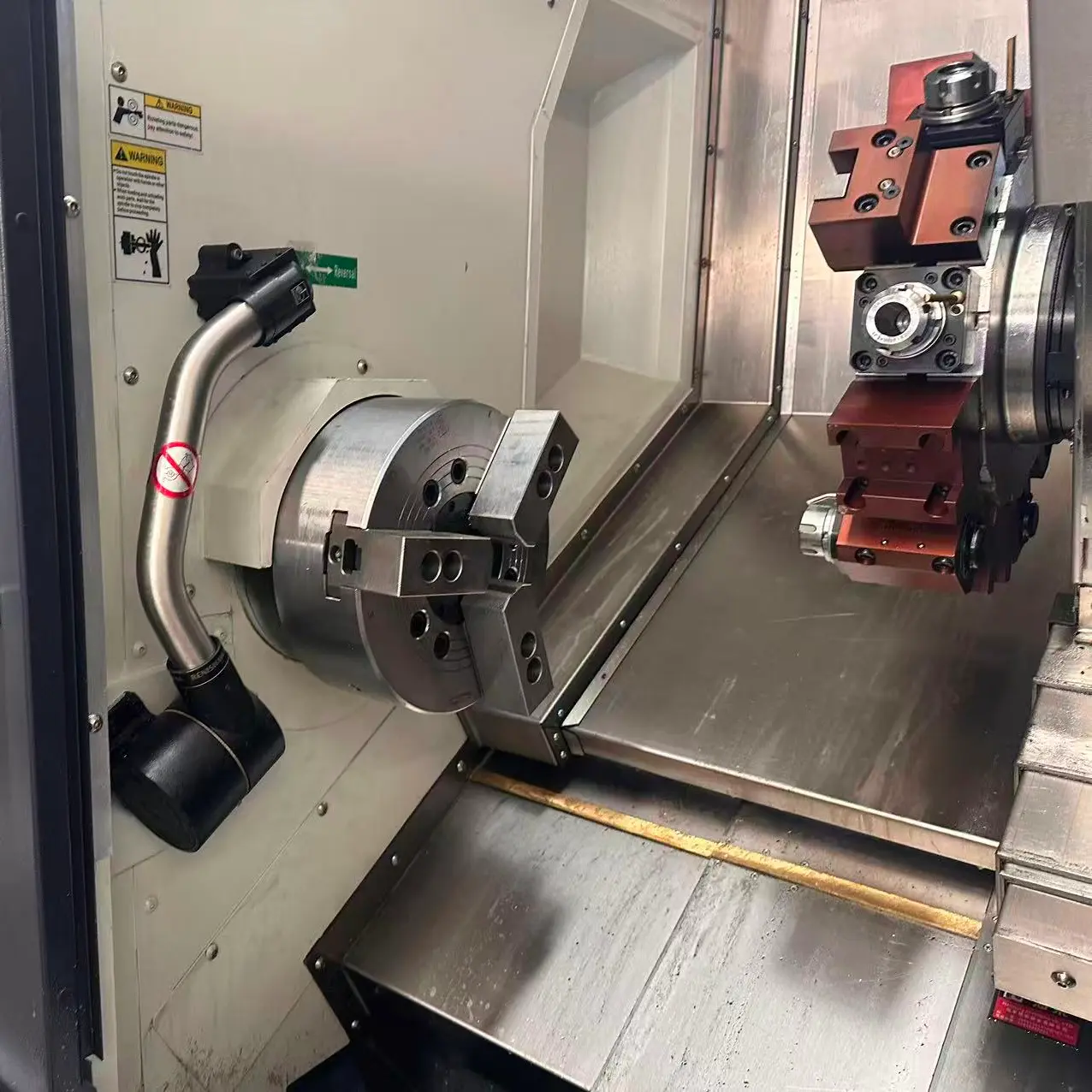
The 30° to 45° slanted bed forces chips downward into a conveyor, keeps the operator at ergonomic height, and positions the X-axis ball screw near the cutting force line for improved rigidity. Runlongjia’s slant-bed line uses HT300 castings stress-relieved and finish-machined on CNC boring mills, with linear roller guides (HIWIN or PMI) rated for 0.003 mm repeatability. FANUC 0i-TF Plus and Siemens 828D dominate this segment because buyers expect macro B programming, tool life management, and Ethernet connectivity for factory integration. The 11–22 kW spindle with A2-6 nose and 8-inch hydraulic chuck runs 3500–4500 rpm for alloy steel finishing and drops to 500 rpm for heavy roughing with ceramic inserts. Automotive tier-two suppliers and hydraulic fitting manufacturers buy these with bar feeders and parts catchers for unattended shifts. The limitation is economic: a slant-bed machine with comparable swing costs 30–50 percent more than a flat-bed equivalent, and the rigidity advantage disappears on single-piece work where spindle time dominates cycle time.
Heavy Duty Flat Bed CNC Lathes
When the workpiece exceeds 800 mm diameter or weighs more than two tons, the machine structure becomes the specification. These lathes use Meehanite or HT300 castings in the 12000–45000 kg range, with hardened and scraped box ways, 55 kW DC or AC spindles, and 15-inch or larger spindle bores for oil-field pipe. The FANUC 31i-B or Siemens 840D sl controls are standard not for sophistication but for reliability in environments where a day of downtime costs more than the control upgrade. Foundation requirements specify 300–500 mm reinforced concrete with anchor bolts on 500 mm centers; installation needs a 40–80 metric ton crane and precision leveling to 0.02 mm/m. Shipyards in Turkey, valve manufacturers in India, and wind turbine hub producers in Brazil operate this class. It cannot economically produce a 50 mm diameter shaft to tight tolerance—the mass and spindle inertia make small-part finishing inefficient, and the control resolution relative to machine scale limits micro-level precision.
CNC Turning Centers with Live Tooling and Y-Axis
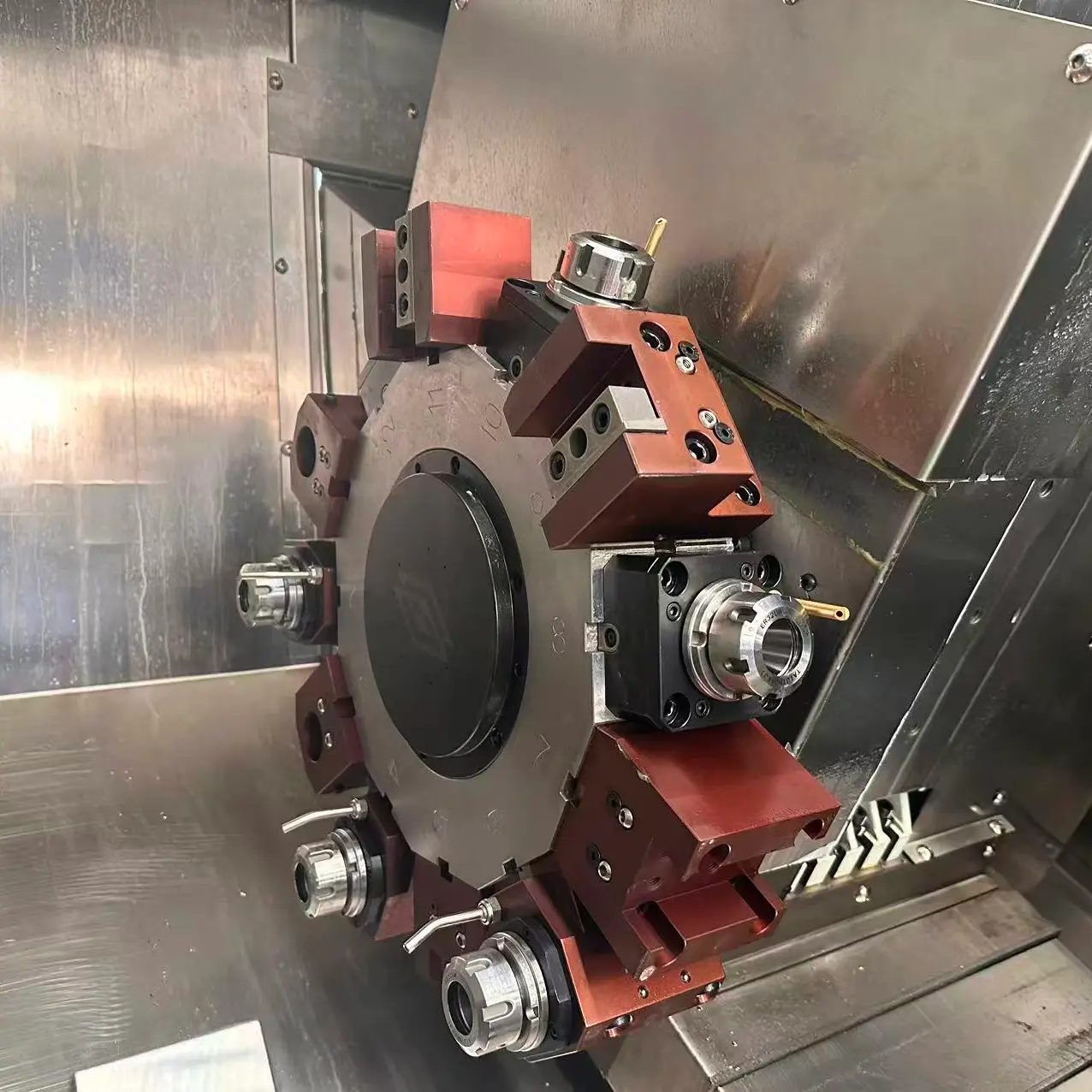
The addition of rotary-driven tools and Y-axis perpendicular travel converts a lathe into a turn-mill center. VDI or BMT turret interfaces hold driven tools at 4000–8000 rpm for cross-drilling, axial milling, and polygon turning. Aerospace fastener manufacturers and medical implant producers buy these to complete parts in one fixturing: a titanium femoral stem gets turned, grooved, cross-drilled for pins, and polished without operator intervention. The Y-axis travel of ±30 to ±60 mm enables off-center milling and eccentric turning. Runlongjia configures these with 0.001° resolution C-axis and hydraulic disc brakes for indexed drilling. The trade-off is rigidity: a live-tool turret adds 200–400 kg of rotating mass, and the Y-axis slide stack reduces stiffness compared to a pure turning turret. Heavy milling loads—slotting steel with a 20 mm end mill—deflect the turret and produce taper. These machines excel at prismatic features on rotational parts but cannot replace a vertical machining center for plate work or box-shaped housings.
Swiss-Type CNC Lathes
Despite the name, the majority of Swiss-type machines sold globally are manufactured in China, Japan, or Taiwan. The sliding headstock feeds bar stock through a guide bushing, supporting the material within millimeters of the cut to eliminate deflection on long, slender parts. The 12–38 mm bar capacity and 10000–15000 rpm main spindle suit medical bone screws, watch shafts, and electronic connectors with length-to-diameter ratios exceeding 10:1. Five to eight axes—main spindle, sub-spindle, X1/X2, Z1/Z2, Y, and C—allow simultaneous front and back working. Positioning accuracy of ±0.003 mm and surface finishes to Ra 0.4 µm are achievable with ground bar stock. The critical limitation is material form: castings, forgings, and saw-cut blanks cannot pass through the guide bushing. Shops must invest in bar straighteners and precision saws, and scrap rates rise with bar diameter variation above 0.05 mm. The machine also demands dedicated tooling—ER16 or ER20 collets, modular tool holders, and often brand-specific interfaces—that locks the buyer into a consumable ecosystem.

Specifications and How to Read Them
| Parameter | Entry Level | Mid Range | High Specification |
|---|---|---|---|
| Max turning diameter over bed | 360 mm | 500 mm | 800 mm |
| Max turning length | 750 mm | 1500 mm | 3000 mm |
| Chuck size | 6″ (160 mm) hydraulic | 8″ (210 mm) hydraulic | 12″ (300 mm) hydraulic |
| Spindle nose | A2-5 | A2-6 | A2-8 |
| Spindle bore | 52 mm | 66 mm | 87 mm |
| Spindle speed max | 3500 rpm | 3000 rpm | 2000 rpm |
| Spindle power (continuous/rated) | 7.5/11 kW | 11/15 kW | 18.5/22 kW |
| Tailstock quill diameter/travel | 75 mm/100 mm | 100 mm/150 mm | 160 mm/200 mm |
| X-axis travel | 180 mm | 260 mm | 420 mm |
| Z-axis travel | 750 mm | 1500 mm | 3000 mm |
| Rapid traverse X/Z | 20/24 m/min | 24/30 m/min | 20/24 m/min |
| Positioning accuracy X/Z | ±0.016/±0.020 mm | ±0.012/±0.016 mm | ±0.010/±0.012 mm |
| Repeatability X/Z | ±0.006/±0.008 mm | ±0.005/±0.006 mm | ±0.004/±0.005 mm |
| Guideway type | Hardened box way, 400 mm width | Linear roller guide (HIWIN/PMI) on 45 mm rails | Hardened box way, 600 mm width, Turcite-B coated |
| Turret stations | 8-station electric | 12-station servo | 12-station servo + optional sub-spindle |
| Tool shank size | 25 × 25 mm | 32 × 32 mm | 32 × 32 mm |
| Control system | GSK 980TC3 or KND K1000Ti | FANUC 0i-TF Plus or Siemens 828D | FANUC 31i-B or Siemens 840D sl |
| Machine net weight | 2800 kg | 5500 kg | 14500 kg |
| Floor space (L × W × H) | 2400 × 1500 × 1700 mm | 3800 × 1850 × 1950 mm | 7200 × 2200 × 2100 mm |
| Supply voltage | 380V 3-phase 50Hz | 380V 3-phase 50Hz | 380V 3-phase 50Hz |
| Total connected load | 18 kVA | 28 kVA | 55 kVA |
How to Read Each Line of a CNC Lathe Specification Sheet
Working Range or Travels
The working range defines what physical size of part the machine can handle. “Max turning diameter over bed” is the largest disc or flange you can swing without collision—measured at the bed ways, not at the carriage. “Max turning diameter over saddle” is smaller, typically 100–150 mm less, because the tool carriage sits in the path. Z-axis travel equals max turning length only if the chuck face and tailstock center align perfectly; practical usable length is 50–80 mm shorter. Entry-level machines with 750 mm Z-travel suit hydraulic fittings and small shafts. Mid-range 1500 mm covers most automotive drive shafts. High-specification 3000 mm requires bed extension sections and often a steady rest for intermediate support.
Spindle Speed and Power
Spindle speed and power trade off directly. The entry-level 3500 rpm with 7.5 kW continuous power suits aluminum and small-diameter steel with carbide inserts. The high-specification 2000 rpm with 18.5 kW continuous delivers torque for heavy interrupted cuts in cast iron and large-diameter alloy steel. Check whether the kilowatt rating is continuous duty (S1) or 30-minute rating (S6)—Japanese and European builders typically quote S1, some Chinese builders quote S6 which reads 20–30% higher for the same motor. Spindle bore diameter matters for bar feeding: 52 mm passes 2-inch stock, 87 mm passes 3.5-inch stock.
Spindle Taper and Chuck Size
A2-5, A2-6, A2-8 are short taper nose standards (DIN 55021). The number indicates the nominal flange diameter in inches—A2-5 is 5-inch, A2-8 is 8-inch. Larger tapers carry more torque and run truer at load. Chuck size in inches (6″, 8″, 12″) is the jaw diameter capacity; hydraulic chucks clamp consistently at 2–4 bar oil pressure and repeat within 0.02 mm jaw runout when maintained. Manual chucks cost less but slow production and depend on operator consistency.
Guideway Type
Hardened box ways (cast iron with induction-hardened steel strips, 55–60 HRC) absorb vibration in interrupted cuts and heavy turning. They wear gradually and can be rescraped. Linear roller guides (HIWIN HG series or PMI MSA series, 45 mm rail common at mid-range) enable the 24–30 m/min rapid traverse that reduces non-cutting time by 40% versus box-way machines. Trade-off: linear guides have lower damping; they excel in finishing and medium-duty work, suffer in heavy roughing without adequate chip management. Turcite-B or Rulon coating on box ways reduces stick-slip at low feed rates below 0.05 mm/rev.
Rapid Traverse and Feed Rate
Rapid traverse is the fastest non-cutting axis movement, quoted in meters per minute. Feed rate is the cutting movement, typically 0.001–500 mm/min programmable. Entry-level machines at 20 m/min rapid spend more time between cuts; high-specification machines with linear guides hit 30 m/min but rarely sustain that in actual part programs due to acceleration limits. Check acceleration spec separately—1.0 G on linear guides versus 0.3 G on box ways changes cycle time more than top speed alone.
Positioning Accuracy and Repeatability
Positioning accuracy (±0.016 mm entry level) measures how close commanded position matches actual after compensation. Repeatability (±0.006 mm entry level) measures dispersion across 30 cycles to the same point—this determines bore consistency and thread fit. Repeatability matters more than accuracy for production; accuracy can be ball-screw compensated, repeatability reflects mechanical stability. FANUC and Siemens controls include pitch error and backlash compensation tables. Laser interferometer verification costs $800–1200 as factory option; request the actual printout, not the brochure claim.
Tool Magazine and Turret Specifications
CNC lathes use indexing turrets, not magazines. “8-station electric” means a Geneva mechanism with 0.8-second index time, no tool pre-selection. “12-station servo” uses a servomotor for 0.3-second index and can index to any station in either direction. Live tooling (driven tools) adds milling and drilling capability; check whether live tools are standard or require a sub-spindle configuration. Tool shank 25 × 25 mm versus 32 × 32 mm determines insert size and depth of cut capacity.
Control System
GSK 980TC3 (Chinese domestic, English/Russian/Spanish interface) controls entry-level machines at one-third the FANUC cost. KND K1000Ti offers similar functionality with better threading algorithms. FANUC 0i-TF Plus dominates mid-range exports for its reliability in dusty environments and global service network. Siemens 828D matches FANUC on interpolation but requires different programming syntax (ISO dialect versus Siemens native). FANUC 31i-B and Siemens 840D sl on high-specification machines support 5-axis interpolation, high-speed machining (HSC), and integrated safety PLC. Mitsubishi M80 competes in Southeast Asian markets with strong tapping and rigid tapping cycles.
Supply Voltage and Connected Load
380V 50Hz 3-phase is Chinese and European standard. North American buyers at 220V 60Hz or 460V 60Hz require a step-up/step-down transformer sized at 1.25× connected load minimum. A mid-range 28 kVA machine needs 35 kVA transformer. Voltage stability must stay within ±10%; rural factories in Southeast Asia and Africa often see ±20% swings that trigger servo alarms. Specify voltage monitoring relay as factory-fit option.
Machine Net Weight and Floor Space
Net weight indicates casting mass and rigidity. A 500 mm swing machine below 2500 kg uses thin-wall castings (HT250 grade) that damp vibration poorly. HT300 or Meehanite castings at 3200+ kg for equivalent swing run quieter and hold tolerance longer. Floor space includes chip conveyor and operator access; add 800 mm minimum on all sides for maintenance. Container loading: a 20-foot container holds entry-level machines (2.4 m length) two units if nested; mid-range machines at 3.8 m length ship one per 40-foot high-cube; high-specification machines at 7.2 m require flat-rack or break-bulk ocean freight.
Export Trade Terms and Documentation
FOB CIF CFR EXW
EXW (Ex Works) means buyer collects from factory, arranges all export clearance and ocean freight. FOB (Free On Board) adds seller loading onto vessel at named Chinese port—Qingdao, Shanghai, Ningbo, Shenzhen. CFR (Cost and Freight) includes ocean freight to destination port; CIF (Cost Insurance Freight) adds marine insurance. For CNC lathes, CIF is common to first-time buyers; repeat buyers often prefer FOB to control freight and insurance selection. DDP (Delivered Duty Paid) is rare for machinery due to complex import duty structures.
Payment Terms
T/T (Telegraphic Transfer) 30% advance, 70% against copy of bill of lading is standard for Chinese machinery exports under $100,000. L/C (Letter of Credit) at sight adds $800–1500 bank charges and 5–10 days documentation delay but protects both parties for larger orders. Some builders accept 10% T/T advance, 90% L/C at sight as compromise. Never agree to 100% advance without verified factory audit or escrow arrangement.
HS Code and CE Marking
HS code 8458.11.00 covers horizontal CNC lathes for customs classification and duty calculation. CE marking requires compliance with Machinery Directive 2006/42/EC, EMC Directive 2014/30/EU, and Low Voltage Directive 2014/35/EU. Request CE conformity declaration and technical construction file summary; some Chinese factories self-certify without notified body involvement. For EU import, customs may request test reports for electrical safety (EN 60204-1) and noise emission. CE marking is not required for Southeast Asian, Middle Eastern, or African markets but signals build quality.
Packing List and Certificate of Origin
Packing list must itemize: machine net/gross weight, dimensions, number of crates, control cabinet separate or integrated, accessories (chuck, tool holders, manual, spare fuses). Certificate of Origin (Form A for GSP countries, or ordinary CO from CCPIT) affects import duty rates—ASEAN-China FTA reduces duty to 0–5% with correct Form E. Wooden crates require ISPM-15 heat treatment stamp; some Australian and New Zealand ports reject untreated wood. Request packing photos before vessel loading to confirm lifting eye placement and重心 (center of gravity) marking for safe unloading.
Foundation and Unloading
Machine weight determines unloading equipment. Entry-level 2800 kg needs 3-ton forklift or 2-ton crane with spreader bar. Mid-range 5500 kg needs 5-ton forklift with extended forks or 3-ton overhead crane; check factory floor load rating—standard industrial concrete 200 mm thick handles 3 ton/m², but 5500 kg on four 300 × 300 mm leveling pads concentrates to 15 ton/m². High-specification 14500 kg requires 10-ton crane and reinforced foundation pad 400 mm deep with anchor bolts grouted after leveling. Vibration isolation pads (Rubber Design or similar, 20 mm thickness) reduce transmitted vibration to floor by 60% but increase machine height; verify door clearance.
CNC Lathe Machine Price and What Drives It
| Class | Typical Working Range or Power | Control or Source Example | Indicative FOB USD |
|---|---|---|---|
| Entry flat bed CNC lathe | 500 mm max turning diameter, 750 mm bed length | GSK 980TDi or KND K1000Ti | 18,000 – 28,000 |
| Entry slant bed CNC lathe | 260 mm max turning diameter, 500 mm length | GSK 980TDi or Syntec 22TA | 22,000 – 35,000 |
| Mid-range flat bed CNC lathe | 630 mm swing, 1500 mm bed, A2-8 spindle | FANUC 0i-TF or Siemens 828D | 35,000 – 55,000 |
| Mid-range slant bed CNC lathe | 360 mm swing, 750 mm length, 12-station turret | FANUC 0i-TF Plus or Mitsubishi M80 | 45,000 – 75,000 |
| High-precision slant bed with Y-axis | 400 mm swing, 1000 mm length, 4 kW driven tools | FANUC 0i-TF Plus with αi servo | 75,000 – 120,000 |
| Heavy-duty flat bed CNC lathe | 1000 mm swing, 3000 mm length, 22 kW main spindle | Siemens 828D or FANUC 0i-TF | 85,000 – 140,000 |
These bands assume standard configuration without optional bar feeders, parts catchers, or live tooling. Add 15–25% for CE-certified builds with full interlocking and European safety guarding.
How to Read a CNC Lathe Specification Sheet
A specification sheet lists dozens of parameters. These are the lines that actually move price and performance.
Max turning diameter over bed (mm) — The largest workpiece the machine can swing without collision. A 500 mm machine costs roughly 30% less than a 630 mm machine from the same builder because the casting mass, spindle bearing size, and bed width all scale up.
Max turning length (mm) — Distance between chuck face and tailstock center or sub-spindle. Length drives bed casting length and ball screw span. Machines over 1500 mm need thicker beds to resist sag; over 3000 mm often use two-piece beds with scraped joints.
Spindle nose (A2-5, A2-6, A2-8, A2-11) — The mounting flange standard. A2-5 suits collets and 6-inch chucks for bar work. A2-6 handles 8-inch chucks and is the sweet spot for general job shops. A2-8 and A2-11 carry 10-inch to 15-inch chucks, need larger spindle bearings, and add 20–35% to spindle cost.
Spindle bore (mm) — The hole through the spindle. 65 mm bore fits 2.5-inch bar. 87 mm fits 3.5-inch. 105 mm and above need larger spindle tubes and stronger front bearings; each step up adds roughly 8–12% to spindle assembly cost.
Spindle speed (rpm) — Entry machines run 2500–3500 rpm with 7.5–11 kW motors. Mid-range machines reach 4000–5000 rpm with 15 kW. High-speed precision lathes for small parts hit 6000–8000 rpm with built-in motors. Higher speed needs better balance grades, ceramic bearings, and more sophisticated thermal compensation.
Spindle power (kW) — Continuous duty rating at base speed. 11 kW handles most shaft and flange work. 18.5–22 kW is needed for heavy roughing in stainless steel or large cast iron castings. Power correlates directly with motor cost and drive amplifier size.
Chuck size (inch) — 6-inch, 8-inch, 10-inch, 12-inch hydraulic chucks. The chuck itself is a consumable, but the hydraulic actuator, drawtube, and spindle bearing preload must match. A 10-inch chuck on an A2-8 nose requires a stiffer spindle and larger hydraulic unit than an 8-inch on A2-6.
X/Z axis travel (mm) — X is cross-slide (diameter direction), Z is carriage (length direction). Travel must exceed your longest part by at least 50 mm for tool clearance. Longer travel needs longer ball screws and wider guideways.
Rapid traverse (m/min) — Entry machines move 12–16 m/min. Mid-range reaches 20–24 m/min. High-speed machines with linear roller guides hit 30–36 m/min. Faster rapids need larger servo motors, higher voltage bus drives, and better damping to avoid overshoot.
Positioning accuracy / repeatability (mm) — Standard claims are ±0.008 mm positioning and ±0.003 mm repeatability for entry machines. Mid-range with laser-compensated ball screws and thermal monitoring achieves ±0.005 mm / ±0.002 mm. High-precision machines with glass scales reach ±0.003 mm / ±0.001 mm. The difference is ball screw grade (C5 vs C3), compensation cycles, and whether the builder maps thermal drift.
Guideway type — Hardened and scraped box ways (HT250 or HT300 cast iron, Turcite-B or Rulon lining) absorb vibration and carry heavy interrupted cuts. Linear roller guides (HIWIN, PMI, THK) allow faster rapids and tighter positioning but have lower damping and require more protection from chips and coolant. Box way machines weigh 15–25% more for the same envelope.
Turret stations / tool size — 8-station turrets suit low-mix production. 12-station is standard. Driven tool stations (live tooling) add a motor and encoder per station, multiplying turret cost by 2.5–4×. VDI 40 or BMT 55 tool interfaces cost more than VDI 30 but handle larger tools.
Control system — The CNC unit, servo drives, and motors as a package. This is typically the single largest cost line after the casting itself. See breakdown below.
Real Cost Structure of a CNC Lathe from China
The following applies to a mid-range slant bed CNC lathe with 360 mm swing, 750 mm length, FANUC 0i-TF control, sold FOB Qingdao at approximately USD 55,000. Percentages shift by class but the pattern holds.
| Cost Element | Typical Share of FOB | Notes |
|---|---|---|
| Casting / frame | 12–18% | HT300 resin sand casting, stress relieved. A 360 mm swing slant bed weighs 4200–5500 kg bare. Heavier castings use more iron and longer annealing cycles. |
| Guideways and ball screws | 8–12% | HIWIN or PMI linear guides, C5 or C3 ground ball screws. Box way machines shift share to scraping labor. |
| Spindle assembly | 10–15% | A2-6 nose, 4000 rpm, 15 kW motor, ceramic hybrid bearings. Built-in spindles cost 40–60% more. |
| Control system and servo package | 22–30% | FANUC, Siemens, or Mitsubishi with matched αi or i servo motors and drives. This is the largest single line item. |
| Tool turret | 6–10% | 12-station servo index, hydraulic clamp. Driven tool turrets add 15–25 percentage points. |
| Hydraulic and lubrication systems | 4–6% | Hydraulic power unit for chuck and turret, centralized lube pump, coolant system. |
| Electrical panel and wiring | 5–7% | Contactors, breakers, transformers, cable harnesses. |
| Assembly labor and testing | 8–12% | Scraping, fitting, laser alignment, 24–72 hour test run, ball bar testing. |
| Factory margin | 10–15% | Varies by builder and order volume. |
| Export packing | 2–3% | Vacuum-sealed VCI film, plywood case, desiccant, steel banding. |
| Inland freight to port | 1–2% | Qingdao, Shanghai, or Tianjin. |
Sea freight, insurance, duty, VAT, and clearance sit below the FOB line but belong in landed cost. For a 5.5-ton machine in a 20-foot container:
- Sea freight to Southeast Asia: USD 800–1,500
- Sea freight to Europe or US West Coast: USD 2,500–4,500
- Marine insurance: 0.15–0.3% of CIF value
- Import duty (varies by HS code 8458.11 and trade terms): 0–8% in ASEAN under RCEP, 2.7% into US, 0–4.5% into EU
- VAT at destination: 10–20% depending on country, often recoverable for registered businesses
- Customs clearance and port handling: USD 400–900
Why the Control System and Spindle Source Dominate Price
The control system brand is normally the single biggest variable. A FANUC 0i-TF package with αi series 4-kW servo motors on X and Z, spindle motor, and drives costs the builder roughly 2.8–3.5× what a GSK 980TDi with domestic servos costs. Siemens 828D with S120 drives sits midway. The buyer gains: proven post-processor compatibility, global service network, faster fault diagnosis, and higher resale value. The trade-off: FANUC and Siemens carry annual software licensing and stricter spare parts channel control, so long-term ownership costs run higher even if the upfront gap is amortized.
The spindle is the second critical line. A branded spindle assembly (Weiss, Kenturn, or in-house built with SKF/FAG bearings) with A2-6 nose, 15 kW, 4000 rpm, and ceramic hybrid bearings costs 1.8–2.2× an unbranded unit with standard steel bearings. The branded spindle runs cooler at high speed, maintains preload longer, and delivers rated L10 bearing life of 10,000–15,000 hours versus 4,000–6,000 hours for budget units.
Why the Cheapest Quote Is Cheaper
A quote 20–30% below the mid-market band typically reflects one or more of these:
- Lighter casting: HT250 instead of HT300, or thinner wall sections, reducing machine weight by 800–1200 kg. Rigidity suffers in heavy cuts; chatter appears at lower depths of cut.
- Lower-grade ball screws: C7 rolled screws instead of C5 ground, or no preloading. Positioning accuracy drifts faster; backlash grows within 2–3 years.
- Unbranded or “white label” spindle: No named bearing brand, no published L10 life. Thermal runaway risk at sustained high speed; bearing replacement at 3,000–4,000 hours instead of 10,000+.
- Domestic control with limited English support: Functional for standard turning, but macro programming, custom cycles, and remote diagnostics may be poorly documented.
- Omitted features: No hydraulic tailstock, no parts catcher, no bar feeder interface, no CE guarding. These are addable later at higher cost than factory fit.
Five-Year Running Cost Comparison
Assumptions: mid-range slant bed, two-shift operation (4,000 hours/year), electricity at USD 0.10/kWh, operator cost excluded.
| Cost Element | Entry Class (GSK, domestic spindle) | Mid Class (FANUC, branded spindle) | High Class (Siemens 828D, built-in spindle) |
|---|---|---|---|
| Annual power consumption | 28,000 kWh (11 kW avg load, 70% duty) | 32,000 kWh (15 kW avg, 75% duty) | 36,000 kWh (18 kW avg, 80% duty, plus driven tools) |
| 5-year electricity | USD 14,000 | USD 16,000 | USD 18,000 |
| Chuck jaws (sets, 5-year) | USD 1,200 (standard steel, 3 sets) | USD 1,800 (hard jaws, soft jaws, 4 sets) | USD 2,400 (specialized jaws, 5 sets) |
| Insert and tooling (annual) | USD 3,500 | USD 4,200 | USD 5,500 (driven tool inserts add 30%) |
| Coolant and maintenance fluids | USD 2,500 | USD 3,000 | USD 3,500 |
| Bearing replacement (spindle) | USD 3,500 at year 3–4 (unplanned) | USD 4,800 at year 5 (planned) | USD 6,500 at year 5–6 (planned) |
| Control system faults / service calls | USD 2,800 (limited remote support, 2–3 days downtime) | USD 1,200 (remote diagnostics, 1 day) | USD 800 (predictive monitoring, <1 day) |
| 5-year running cost total | USD 24,000 | USD 30,000 | USD 36,700 |
| Expected downtime (hours, 5-year) | 120–180 | 60–90 | 30–50 |
The entry machine saves roughly USD 6,000 over five years in running costs but costs USD 15,000–25,000 less upfront. For a job shop with low utilization or simple shaft work, the math may favor entry. For a production shop running 3,500+ hours/year with tight delivery penalties, the mid-range or high-class machine returns the premium through uptime and part consistency.
Voltage and frequency matter for total cost. Chinese-built CNC lathes ship standard at 380V 3-phase 50Hz. Buyers in 220V 60Hz regions (Philippines, parts of Latin America, US rural shops) need a step-up transformer or specify a 220V 60Hz motor winding at order. A 30 kVA transformer adds USD 1,200–2,000 and 3–5% power loss. Specify before build; retrofitting motors and drives is impractical.
Industry Applications for CNC Lathe Machine
| Sector | Typical Parts Produced | Recommended Specification | Why This Machine Fits |
|---|---|---|---|
| Automotive and Motorcycle Parts | Brake discs, camshafts, wheel hubs, connecting rods, transmission shafts | Flat bed CNC lathe, 500 mm max turning diameter, 1000–1500 mm max turning length, A2-8 spindle nose, 11–15 kW spindle power, 2500 rpm, FANUC 0i-TF or Siemens 828D, ±0.015 mm positioning accuracy, HT300 casting, 4500 kg net weight | High-volume production of rotational symmetry parts demands rigid spindle and programmable tailstock for shaft work; A2-8 nose accepts large chucks for disc brakes |
| Agricultural Machinery | Tractor axle housings, hydraulic cylinder rods, gear blanks, pulley hubs, PTO shafts | Flat bed CNC lathe, 615 mm swing over bed, 1500–3000 mm between centers, 75 mm spindle bore, 15–18.5 kW spindle, GSK 980TDb or KND K2000Ti, hardened box ways, 5 m/min rapid traverse | Long bed machines handle extended shafts; large spindle bore passes drawn bar stock for hydraulic rods; box ways withstand interrupted cuts in cast iron |
| Hydraulic and Pneumatic Fittings | Cylinder caps, piston rods, valve bodies, adapter fittings, hose couplings | Slant bed CNC lathe, 360 mm max turning diameter, 12-station turret, A2-6 spindle nose, 7.5–11 kW spindle, 4000 rpm, C-axis and driven tools optional, ±0.01 mm repeatability | Slant bed design improves chip evacuation for continuous small-part production; live tooling enables cross-drilling of ports in single setup |
| Oil and Gas Couplings | Drill collars, tubing couplings, casing connectors, valve bonnets, flanges | Flat bed CNC lathe, 800 mm swing, 2000 mm turning length, 130 mm spindle bore, 22 kW spindle, 1000 rpm, Siemens 828D, A2-11 spindle nose, 8000 kg machine weight | Heavy roughing on alloy steel requires low-speed torque and massive casting; large bore accommodates upset pipe ends; wide swing handles coupling diameters |
| Mould and Die Work | Core pins, ejector sleeves, gate inserts, round cavities, punch blanks | Slant bed CNC lathe with C-axis and Y-axis, 300 mm max turning diameter, 8-station turret with driven tools, 7.5 kW spindle, 6000 rpm, FANUC 0i-TF Plus, linear roller guides, ±0.008 mm positioning accuracy | C-axis milling of flats and keyways eliminates secondary operations; sub-spindle or bar feeder compatibility suits long ejector pin production |
| Technical Training Centres | Curriculum shafts, stepped cylinders, threaded connectors, gear blanks, basic CNC projects | Flat bed CNC lathe, 360 mm swing, 750 mm turning length, A2-5 spindle, 5.5 kW spindle, 2500 rpm, GSK 980TDb or Syntec 21TA, 2200 kg machine weight, 380V/50Hz or 220V/60Hz with transformer | Simpler control systems reduce learning curve; compact footprint fits classroom layout; proven mechanical design tolerates student errors without costly repairs |
Automotive And Motorcycle Parts
Automotive production lines run brake discs at 2–3 minute cycle times per face. A flat bed CNC lathe with 500 mm swing and A2-8 spindle nose mounts a 380 mm three-jaw hydraulic chuck gripping the disc by the hub bore. The 11 kW spindle delivers 800 Nm at 500 rpm for cast iron roughing, then shifts to 2500 rpm for finish facing to Ra 1.6 µm. Programmable tailstock with MT5 center supports camshaft finishing between centers over 1200 mm length. FANUC 0i-TF controls handle macro programming for family-of-parts tooling offsets. The 4500 kg HT300 casting absorbs vibration during interrupted cuts on slotted brake discs. For motorcycle wheel hubs, the same machine class with 360 mm swing and A2-6 nose runs at higher spindle speeds with smaller chuck, maintaining ±0.015 mm concentricity for bearing seat machining.
Agricultural Machinery
Tractor axle housings in QT500-7 nodular cast iron require 615 mm swing over bed and 2000 mm between centers. The 75 mm spindle bore passes 65 mm drawn bar stock for hydraulic cylinder rod production, eliminating pre-cut blanks. Hardened box ways on X and Z axes withstand the impact loading of cast skin interruptions at 2 mm depth of cut. A 15 kW spindle at 800 rpm generates sufficient torque for 10 mm/rev feed rates in roughing. GSK 980TDb controls with Chinese-language interface suit operators in domestic markets, while KND systems offer broader aftermarket support in Southeast Asia. The 5 m/min rapid traverse positions the 12-station turret quickly between roughing and finishing stations, though this is slower than linear guide machines—acceptable given the priority on rigidity over speed in agricultural work.
Hydraulic And Pneumatic Fittings
Slant bed CNC lathes dominate this sector because 45-degree bed angle directs brass and aluminum chips into the conveyor, preventing bird-nesting around the chuck. A 360 mm max turning diameter machine with A2-6 nose and 6-inch chuck handles valve bodies up to 80 mm diameter. The 12-station turret indexes in 0.3 seconds; live tooling at 4000 rpm drills M22 cross-holes in cylinder caps without transfer to machining center. C-axis positioning to 0.001 degree enables hexagonal flats on fittings via driven end mills. Repeatability of ±0.01 mm holds BSP thread pitch diameter consistency across 500-piece shifts. For pneumatic push-to-connect fittings in PA12, the same machine runs at 6000 rpm with balanced chucks to minimize ovality on thin-wall sleeves.
Oil And Gas Couplings
API 5CT tubing couplings in 4130 alloy steel demand heavy-duty flat bed machines with 800 mm swing and A2-11 spindle nose accepting 500 mm four-jaw chucks. The 22 kW spindle delivers 2100 Nm at 200 rpm for rough turning coupling OD from 180 mm forged blanks. Siemens 828D controls manage threading macros for 8-round and buttress profiles with automatic tool tip compensation. The 130 mm spindle bore permits pipe end upsetting before machining, a common workflow in coupling manufacture. Machine weight of 8000 kg minimum resists deflection during 5 mm depth roughing cuts. Foundation requirements specify 200 mm reinforced concrete with M16 anchor bolts; crane capacity for installation must exceed 10 tons given pallet and packaging weight.
Mould And Die Work
Core pins for injection molds require diameter tolerances of ±0.005 mm over 200 mm length, achievable on slant bed lathes with C-axis and Y-axis. The C-axis locks spindle for milling operations: a 6 mm end mill machines the flat on a 12 mm core pin at 3000 rpm driven tool speed. Y-axis travel of ±25 mm off centerline enables eccentric features. Linear roller guides (HIWIN or PMI) support the 0.5 µm interpolation needed for fine finishing. Sub-spindle or bar feeder integration allows unattended production of 50-piece ejector pin lots from 3 meter H13 bar stock. The 7.5 kW spindle at 6000 rpm provides adequate power for pre-hardened 48 HRC material using ceramic inserts, though dedicated grinding follows for final surface finish.
Technical Training Centres
Teaching environments prioritize mechanical reliability over specification extremes. A 360 mm swing flat bed lathe with 5.5 kW spindle and GSK 980TDb control teaches fundamental G-code programming, threading, and taper turning without the complexity of live tooling or sub-spindles. The A2-5 nose with 8-inch chuck handles student projects from simple shafts to threaded connectors. Dual voltage capability (380V/50Hz or 220V/60Hz) accommodates international training lab standards; a 15 kVA transformer suffices for 220V regions. At 2200 kg, two technicians and a 3-ton forklift manage installation without rigging services. Syntec 21TA alternatives offer conversational programming for students transitioning from manual lathes. Spare part availability for GSK and Syntec systems exceeds 10 years through domestic Chinese supply chains, reducing institutional procurement risk.
Ordering and Importing Step by Step
Three mistakes that most often leave a delivered CNC lathe sitting idle, and their fixes:
Voltage or frequency mismatch. The machine arrives with a 380 V 50 Hz nameplate; your shop runs 220 V 60 Hz or 415 V 50 Hz with unstable local voltage. The fix: confirm exact supply at your meter, specify required input voltage and frequency in the purchase order, and order the factory-fitted transformer or servo-stabilizer with the machine rather than sourcing it locally in a rush.
Working range too small for the actual part. The specification sheet showed a 500 mm max turning diameter, but your flanged shaft with fixture needs 520 mm clearance, or your 1,500 mm shaft exceeds the 1,000 mm between-centres capacity. The fix: model your largest existing and planned part in CAD, add 15 % to every dimension for fixture and tailstock clearance, then compare against the machine’s actual swing over bed and max turning length—not the marketing brochure’s “economic cutting length.”
No documentation, backup or consumable source. The control parameter backup is missing, the electrical schematic is in Chinese only, and the only turret tool holder supplier is 8,000 km away. The fix: require English electrical and hydraulic schematics, a USB stick with factory parameter backup, and a written list of local or regional sources for tool holders, inserts, and control spare boards before you sign the acceptance certificate.
Parameter Comparison Across Entry Mid and High Classes
| Parameter | Entry Class | Mid Class | High Class |
|---|---|---|---|
| Typical model size | 250 mm × 500 mm swing | 360–400 mm × 750–1,000 mm swing | 500–800 mm × 1,500–3,000 mm swing |
| Max turning diameter over bed | 250–320 mm | 400–520 mm | 650–1,000 mm |
| Max turning length | 500–750 mm | 750–1,500 mm | 1,500–4,000 mm |
| Spindle nose | A2-5 | A2-6 or A2-8 | A2-8 or A2-11 |
| Chuck size | 6″ (160 mm) hydraulic | 8–10″ (200–250 mm) hydraulic | 12–15″ (315–380 mm) hydraulic |
| Spindle power | 5.5–7.5 kW | 11–15 kW | 18.5–45 kW |
| Spindle speed | 2,500–3,500 rpm | 2,000–3,000 rpm | 1,500–2,500 rpm |
| Rapid traverse X/Z | 12–16 m/min | 16–24 m/min | 20–30 m/min |
| Positioning accuracy | ±0.015 mm | ±0.010 mm | ±0.005 mm |
| Repeatability | ±0.008 mm | ±0.005 mm | ±0.003 mm |
| Guideway type | Hardened box way or linear guide | Linear roller guide (HIWIN/PMI) or box way | Hardened and ground box way or large linear roller guide |
| Bed casting grade | HT250 | HT300 | HT300 or Meehanite equivalent |
| Control systems offered | GSK 980TDb, KND K1Ti, Syntec 22TA | FANUC 0i-TF, Siemens 828D, Mitsubishi M80 | FANUC 0i-TF Plus, Siemens 840D sl, FANUC 31i-B |
| Turret stations | 4–6 station electric | 8–12 station servo turret | 12 station servo turret with driven tools |
| Machine net weight | 1,800–2,500 kg | 3,000–4,500 kg | 6,000–15,000 kg |
| Floor space (L × W) | 2,200 × 1,400 mm | 3,000 × 1,600 mm | 4,500 × 2,000 mm and larger |
| Typical supply requirement | 380 V 50 Hz 3-phase | 380 V 50 Hz 3-phase | 380 V 50 Hz 3-phase |
How to Read Each Line of a CNC Lathe Specification Sheet
Swing over bed vs swing over carriage. Swing over bed is the maximum diameter the machine can theoretically turn with no tool interference—measured from bed ways to spindle centreline, doubled. Swing over carriage is smaller; it is the practical limit once the tool turret and its holders are in place. For a 360 mm swing over bed machine, expect 200–220 mm swing over carriage. Always design your fixture and tool setup to the smaller number.
Max turning length. This is the distance the tool can travel along the Z-axis from the chuck face to the tailstock centreline, not the physical bed length. On a 1,000 mm turning length machine, a 950 mm shaft leaves only 50 mm for facing cuts and tool clearance. Add 50–100 mm buffer for every job.
Spindle nose and chuck size. A2-6 is the standard for 8–10″ chucks on mid-size machines. A2-8 handles 12″ and larger. The chuck bolt pattern must match the spindle nose; adapters exist but reduce rigidity and runout tolerance. Specify hydraulic chuck with through-hole matching your bar feeder plans.
Spindle power and torque curve. A 15 kW spindle sounds ample, but check the continuous rating and the rpm at which peak torque occurs. For heavy interrupted cuts on cast iron, you need high torque at low rpm (500–1,000 rpm). For aluminium with small tools, high rpm with adequate power matters more. Ask for the torque curve chart, not just the nameplate kW.
Rapid traverse vs cutting feed. Rapid traverse (16–24 m/min on mid-class machines) moves the tool to position without cutting. Cutting feed is far slower and controlled by the servo system. Do not confuse the two when estimating cycle time.
Positioning accuracy and repeatability. Positioning accuracy (±0.010 mm on a mid-class machine) is how close the tool reaches the commanded position in one move. Repeatability (±0.005 mm) is how consistently it returns to that position after many cycles. Repeatability matters more for batch production. Both figures require laser interferometer measurement per ISO 230-2; ask for the test report with ambient temperature recorded.
Guideway selection trade-off. Hardened box ways ( scraped or ground, on HT300 beds) damp vibration and carry heavy interrupted cuts. They wear gradually and can be rescraped. Linear roller guides (HIWIN or PMI) allow faster rapids and tighter positioning but have lower vibration damping and are harder to repair once worn. For general job-shop work with mixed materials, box ways offer more forgiveness. For high-volume light alloy parts, linear guides win on speed.
Control system and service footprint. FANUC 0i-TF dominates global aftermarket support; spare boards and parameters are understood by technicians in most industrial regions. Siemens 828D offers strong conversational programming and integrated safety. GSK, KND, and Syntec reduce machine cost by 15–25 % but require you to establish a local service relationship or train in-house staff. Before selecting, map the distance to your nearest authorised service centre or competent independent technician.
Step-by-Step Ordering and Import Checklist
1. Define the workpiece envelope and tolerance
- [ ] List your largest current part: diameter __ mm, length _ mm, weight ___ kg
- [ ] List your largest planned part within 3 years: diameter __ mm, length ____ mm
- [ ] Add 15 % diameter clearance for chuck jaws and fixture overhang
- [ ] Add 100 mm length clearance for facing and tailstock gap
- [ ] Note tightest tolerance required: ______ mm (e.g., ±0.01 mm for shaft bearing seats)
- [ ] Match to machine positioning accuracy and repeatability; require 1:3 to 1:5 ratio (machine capability to part tolerance)
- [ ] Specify C-axis and driven tools if milling or drilling on face/OD is needed
2. Choose control system and confirm service support
- [ ] Select control: FANUC / Siemens / Mitsubishi / GSK / KND / Syntec / other: ______
- [ ] Confirm local or regional service technician availability within ______ hours travel
- [ ] Request English-language operator and maintenance manuals (paper and PDF)
- [ ] Require electrical schematic in English with wire numbers matching terminal strips
- [ ] Request factory parameter backup on USB stick and instructions for restoration
3. Confirm electrical supply and transformer needs
- [ ] Measure actual shop voltage at main panel: __ V, _ Hz, ___ phase
- [ ] Machine nameplate requirement: __ V, _ Hz, ___ phase
- [ ] If voltage differs: specify step-up or step-down transformer, ______ kVA rating, factory-mounted or separate cabinet
- [ ] If frequency differs (50 Hz machine on 60 Hz supply): confirm motor derating or VFD compatibility with supplier
- [ ] If supply is unstable (±10 % or worse): specify servo-voltage stabilizer, ______ kVA
- [ ] Record maximum circuit breaker rating available: ______ A
4. Check floor loading foundation and floor space
- [ ] Machine net weight: __ kg; shipping weight: ____ kg
- [ ] Floor load: ______ kg/m² (machine weight ÷ footprint); compare to your floor rating
- [ ] Foundation requirement: isolated pad / vibration damping pad / none: ______
- [ ] Floor space required: __ mm (L) × ____ mm (W)
- [ ] Add 1,000 mm minimum clearance on operator side and rear for service access
- [ ] Confirm ceiling height for crane clearance or overhead lifting: ______ mm
- [ ] Check doorway width for machine entry: ______ mm (disassemble chip conveyor and coolant tank if needed)
5. Confirm conformity marking for customs clearance
- [ ] Destination country required marking: CE / EAC / SASO / other: ______
- [ ] Request conformity declaration and technical file in English
- [ ] Confirm marking is affixed to machine nameplate, not shipping documents only
- [ ] For CE: check that electrical components carry individual CE marks (contactors, drives, motors)
- [ ] Verify harmonised standards referenced on declaration: EN 60204-1 for electrical safety, EN ISO 23125 for machine tools
6. Compare FOB versus CIF and confirm container type
- [ ] FOB port: __; CIF port: ____; compare total landed cost
- [ ] Machine shipping dimensions: __ mm (L) × _ mm (W) × ___ mm (H)
- [ ] Machine shipping weight: ______ kg
- [ ] Container type: 20′ GP / 40′ GP / 40′ HC / flat rack / open top: ______
- [ ] 20′ GP limit: approximately 21,500 kg payload, 28 CBM; confirm machine + crate fits within weight and cube
- [ ] For machines over 3,500 kg or over-width: budget for flat rack or breakbulk; obtain ocean freight quote separately
- [ ] Confirm lifting lugs or forklift pockets on crate; note centre of gravity marking
7. Agree deposit and balance payment terms
- [ ] Deposit percentage: ______ %; typical range 30 % for new customers, 20 % for established relationship
- [ ] Balance payment: against copy of BL / against fax/telex release / after FAT but before shipment: ______
- [ ] Payment method: T/T (wire) / letter of credit / other: ______
- [ ] Currency: USD / EUR / CNY: ______
- [ ] Penalty clause for late delivery: __ % per week, capped at ____ %
8. Conduct factory acceptance test before balance payment
- [ ] FAT date: __; your attendance: in person / video / third-party inspector: ____
- [ ] Test pieces: specify material (e.g., 1045 steel, 6061 aluminium), diameter __ mm, length ____ mm
- [ ] Required measurements: roundness, cylindricity, surface finish Ra, dimensional accuracy over 10 parts
- [ ] Run thermal compensation test: warm-up cycle, then re-measure after 2 hours
- [ ] Verify all axes return to reference point reliably; check lubrication system cycling
- [ ] Record serial numbers of critical components: spindle motor, servo motors, drives, control unit
- [ ] Photograph machine nameplate, electrical cabinet layout, and terminal strip numbering
- [ ] Obtain signed FAT protocol with measurement data attached
9. Arrange unloading equipment at destination
- [ ] Unloading method: forklift / crane / roll-off truck / gantry: ______
- [ ] Forklift capacity required: ______ tonnes (minimum 1.5 × machine weight for stability)
- [ ] Fork length: __ mm; fork spread: _ mm; mast height clearance: ___ mm
- [ ] Crane capacity at required radius: ______ tonnes
- [ ] Sling type and rating: ______; soft slings for painted surfaces
- [ ] Unloading surface: concrete rated for __ kg/m²; level within ____ mm/m
- [ ] Weather protection if open-air unloading: tarpaulin or warehouse roof
10. Plan installation and operator training
- [ ] Installation: supplier technician / local dealer / in-house: ______
- [ ] Technician travel days required: __; daily rate: _; accommodation responsibility: ___
- [ ] Foundation grouting and levelling: precision level to 0.02 mm/m over full bed length
- [ ] Anchor bolt torque specification: __ Nm; grouting compound type: ____
- [ ] Operator training: ______ days; topics: programming, setup, tool offset, maintenance routines
- [ ] Maintenance training: ______ days; topics: lubrication schedule, belt tension, way wipers, coolant system
- [ ] Training language: __; interpreter needed: yes / no: ____
11. Specify initial spare parts and consumables package
- [ ] Turret tool holders: __ pcs, type ____ (VDI or bolt-on), matching your tooling inventory
- [ ] Chuck jaws: __ sets, soft / hard, for chuck size ____
- [ ] Way wipers and bellows: ______ sets
- [ ] Coolant pump seal and impeller: ______ sets
- [ ] Control battery: ______ pcs (lithium backup for parameter memory)
- [ ] Fuse and contactor set for electrical cabinet: ______ sets
- [ ] Drive belts: ______ pcs
- [ ] Hydraulic oil: __ litres, grade _; way lube: litres, grade ___
- [ ] Spare parts value as percentage of machine price: typically 2–4 % for initial package
Final Verification Before Signing
- [ ] Re-read the purchase order: does the specification table match the quotation exactly, or did “or equivalent” creep in?
- [ ] Confirm warranty period: __ months; coverage: parts only / parts and labour / control system separate: ____
- [ ] Confirm warranty start date: Bill of Lading date / installation completion / acceptance certificate signed: ______
- [ ] File all communications, signed PO, proforma invoice, and technical annexes in one folder for customs and warranty claims.
Related RUNNEWTECH Machines

CNC Lathe Machine
Factory direct cnc lathe machine with FANUC, Siemens, Mitsubishi, GSK or Syntec control options and 380V/50Hz or 220V/60Hz supply for export.
Frequently Asked Questions About CNC Lathe Machine
Entry Mid And High Class Parameter Overview
| Parameter | Entry Class | Mid Class | High Class |
|---|---|---|---|
| Max turning diameter | 360 mm | 500 mm | 800 mm |
| Max turning length | 750 mm | 1500 mm | 3000 mm |
| Spindle bore | 52 mm | 65 mm | 105 mm |
| Chuck size | 8″ hydraulic | 10″ hydraulic | 12″ hydraulic |
| Spindle speed | 2500 rpm | 3500 rpm | 2000 rpm |
| Spindle power | 7.5 kW | 11 kW | 22 kW |
| X/Z travel | 200/600 mm | 250/1100 mm | 400/2900 mm |
| Rapid traverse | 15 m/min | 20 m/min | 12 m/min |
| Positioning accuracy | ±0.015 mm | ±0.010 mm | ±0.008 mm |
| Repeatability | ±0.006 mm | ±0.004 mm | ±0.003 mm |
| Guideway | Hardened box way | Linear roller guide (HIWIN/PMI) | Hardened box way + linear |
| Control system | GSK 980TDi / KND K1000Ti | FANUC 0i-TF / Siemens 828D | FANUC 0i-TF Plus / Siemens 840D sl |
| Machine net weight | 2200 kg | 4500 kg | 12000 kg |
| Floor space (L×W) | 2400×1400 mm | 3400×1800 mm | 6200×2200 mm |
Q: What is the minimum order quantity for a CNC lathe machine?
Single-unit orders are accepted for standard models. Container consolidation becomes cost-effective at two to three machines for slant-bed units or four to five for compact flat-bed models. Custom configurations—spindle bore enlargement, turret station count, or control system upgrades—require MOQ discussion starting at one unit but with longer lead times.
Q: Which control systems are available and what interface languages are supported?
GSK 980TDi and KND K1000Ti are standard on entry machines; FANUC 0i-TF and Siemens 828D on mid-range; FANUC 0i-TF Plus or Siemens 840D sl on high-end. Syntec and Mitsubishi are available on request. Interface languages include English, Spanish, Russian, Arabic, and Chinese. Parameter backup via USB or Ethernet is standard across all systems.
Q: What is the typical lead time from order confirmation to readiness for shipment?
Standard configurations ship in 25–35 days. FANUC or Siemens control systems add 10–15 days due to import lead time for the CNC unit. Custom spindle bore, A2-6 or A2-8 nose instead of A2-5, or special turret configurations extend to 50–60 days. Peak season (March–May, September–November) adds one week.
Q: What payment terms are standard for export orders?
30% T/T deposit with order, 70% T/T before shipment against copy of B/L. Letter of Credit at sight is accepted for orders above USD 80,000 with bank charges borne by buyer. For repeat customers with established history, documents against payment (D/P) is negotiable. Currency: USD or EUR.
Q: Can the machine run on our local supply voltage and frequency?
Standard build is 380V 50Hz three-phase. For 220V 60Hz regions (North America, parts of South America, Philippines), a step-up transformer 220V-to-380V is required, sized at 1.5× the machine’s total electrical load. For a 15 kW spindle machine with 8 kW auxiliary, a 50 kVA transformer is adequate. Transformer is buyer-supplied; wiring diagram and phase sequence requirements are provided.
Q: What shipping method container type and transit time apply?
Flat-bed CNC lathes up to 360 mm swing and 1500 mm length fit in 20′ FCL. Larger machines—500 mm swing with 3000 mm bed or slant-bed models—require 40′ FCL or flat-rack OOG for width. Machine weight per unit ranges 2200 kg to 12000 kg; container payload limits are checked per destination port. Typical transit: 18–25 days to Southeast Asia, 30–40 days to Middle East, 35–45 days to Africa and South America, 40–50 days to Eastern Europe, 25–30 days to North America west coast.
Q: What warranty coverage and spare parts availability are provided?
Twelve months from Bill of Lading date covering manufacturing defects. Spindle bearings, ball screws, and servo motors carry the same term. Spare parts stocked at factory for 10 years minimum. Critical wear items—turret index pins, hydraulic seals, coolant pump impellers—ship within 72 hours by courier. A recommended spare parts list with part numbers and weights is provided with proforma invoice.
Q: Is a factory acceptance test and accuracy report provided?
Yes. Every machine undergoes ball-bar test and laser interferometer measurement for positioning accuracy and repeatability before shipment. Test report includes actual measured values for X and Z axes, spindle runout at nose and taper, and turret indexing accuracy. Buyer or third-party inspector may witness FAT at factory; travel and accommodation are buyer’s cost.
Q: What installation and operator training is included?
Installation supervision and operator training are included for one technician for up to 7 working days. Scope covers leveling, geometric alignment check, utility connection verification, and hands-on programming for the supplied control system. Buyer provides local interpreter if needed, crane or forklift for unloading (minimum 5-ton capacity for mid-size machines), and accommodation. Additional technician or extended stay is chargeable.
Q: What tolerance can be achieved on our actual material?
Positioning accuracy ±0.010 mm and repeatability ±0.004 mm on mid-class machines translates to workpiece tolerance IT7–IT8 under stable conditions. Actual achieved tolerance depends on material consistency, tooling condition, and program optimization. For 4140 steel at 28–32 HRC with coated inserts, 0.02 mm diameter consistency is routine. Cast iron or stainless steel with varying hardness may require adjusted speeds and depth of cut.
Q: What are the ongoing consumables costs?
Inserts: USD 8–25 per edge depending on geometry and coating. Hydraulic oil: 46# anti-wear, 60-liter fill, change interval 2000 hours at USD 120 per fill. Coolant: water-soluble synthetic, 80-liter sump, USD 60 per concentration fill. Way lubrication: ISO VG68, 15-liter reservoir. Annual consumables budget for moderate production: USD 1800–3500 depending on material mix and running hours.
Q: Can CE documentation be supplied for customs clearance?
CE Declaration of Conformity, machinery directive 2006/42/EC compliance documentation, and electrical safety test report are provided for machines configured to EU standards. For non-EU destinations where CE facilitates import (Middle East, parts of Africa, Southeast Asia), same documentation is available on request at no charge. Verify with your customs broker whether CE or ISO 9001 factory certificate is preferred for your HS code 8458.11.
Important Notice
Specifications, accuracy figures and price ranges in this guide are indicative and are provided for planning
purposes only. Actual working range, achievable tolerance, control system availability, supply voltage requirements and conformity
marking differ by model and by destination country. Buyers must confirm their own mains voltage and frequency, floor loading and
foundation, unloading equipment and import requirements before placing an order. All figures are subject to written confirmation in
the final proforma invoice issued by RUNNEWTECH.
Sourcing CNC Lathe Machine from RUNNEWTECH
How to Match a Spec Sheet to Your Real Job
A specification sheet is only useful if you can map it to the parts you actually cut. Start with your largest workpiece diameter and length, then add 20% for future capacity. Check that your heaviest part does not exceed the chuck and tailstock load limits. Verify that the materials you run—aluminum, mild steel, stainless, cast iron—fit within the spindle power and torque curves, not just the maximum rpm.
Control system choice matters more than most buyers expect. FANUC 0i-TF or Siemens 828D handle complex contouring and multi-axis cycles; GSK 980TDi or KND K2000Ti cover standard turning at lower cost but with fewer canned cycles and slower PLC response. If your operators already know one brand, switching costs time.
Positioning accuracy of ±0.005 mm and repeatability of ±0.003 mm suit most automotive and general engineering work. Job shops cutting hydraulic fittings or bearing races should demand ±0.003 mm / ±0.002 mm and verify with a ball-bar test, not just the factory certificate.
Why RUNNEWTECH
Runlongjia Machinery, operating under the export brand RUNNEWTECH (runnewtech.com), has manufactured and exported metalworking machinery since 2010. The CNC lathe range spans flat bed and slant bed designs, with control options including FANUC, Siemens, Mitsubishi, GSK, KND and Syntec. Machines are adapted to your supply voltage and frequency—380V 50Hz or 220V 60Hz with transformer where needed—run-in and factory acceptance tested before packing, then shipped in plywood cases with rust protection under FOB or CIF terms. Installation guidance, operator training material, remote commissioning support and spare parts are included.
Send your workpiece material, maximum part size, required tolerance and destination port to receive a quotation within 24 hours via email or the website contact form.
Get a Factory Direct Quote on Cnc Lathe Machine
RUNNEWTECH has been building metalworking machinery since 2010,
with more than 15 years of export experience. Machines are supplied with your choice of control system, adapted to your supply
voltage and frequency, run-in and factory acceptance tested before packing. Send us your workpiece material, maximum part size,
required tolerance and destination port and we will return a quotation within 24 hours.

 English
  Indonesian
  Vietnamese
  Arabic
  Russian
  Spanish